Beer Institute Releases Results Of New Beer Drinkers Poll

beer-institute
According to the Beer Institute (BI), recent economic analysis has revealed “that brewing and importing accounted for $223.8 billion in the economic output of the United States — with employees earning nearly $71.2 billion wages and benefits, and generating more than $44 billion taxes. In 2010, the last year tax statistics were available, 45 percent of what every beer drinker paid for a beer went to taxes of some kind, which “makes taxes the most expensive ingredient in your beer,” Joe McClain, president of the BI, stated.

The Beer Institute has just released a national poll of 1,000 likely voters, which found strong opposition to increasing taxes on beer. Nine out of 10 voters in the poll agreed that “raising taxes on beer will mean working class consumers will have to pay more.”

The poll also found that self-identified “beer drinkers” are a larger proportion of the electorate than self-identified supporters of either the Tea Party of Occupy Wall Street movement, and were evenly split between Republican and Democratic parties.

Beer drinkers are also more political than the average likely voter:

  • 68 percent of regular beer drinkers say they discuss what’s going on in the presidential campaign with friends or co-workers.
  • 66 percent of regular beer drinkers say they are going to be watching the presidential debates, meaning they are more likely to watch presidential debates than watch the World Series or an NFL game.
  • 25 percent say they will likely donate or contribute money to a political party, cause, or candidate running for public office.
  • 14 percent (or one out of seven) beer drinkers say they will likely volunteer for a political party, cause, or on the campaign for a candidate running this year.

Why Is This News? Beer Beats Wine!

beer-vs-wine
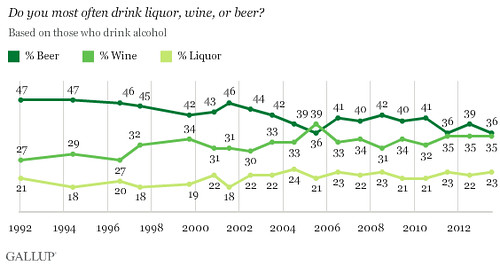
I never quite understand why this is even considered news at all? The L.A. Times is reporting that “Beer beats out wine as Americans’ booze of choice.” Their source for this so-called news is a new Gallup Poll entitled Majority in U.S. Drink Alcohol, Averaging Four Drinks a Week. But that’s not exactly news insofar as it’s been that way since the dawn of time, or thereabouts. The gallup poll is just a survey, of course, and prone to people’s prejudices and perceptions. So when they report that “Beer edges out wine by 39% to 35% as drinkers’ beverage of choice,” it’s hard not to laugh, and even harder to take it seriously. This is what people tell pollsters, and it’s pretty divorced from reality.

If you want a truer, more accurate picture of peoples’ tastes, look at what they buy. The World Health Organization, at their website, gives the following data, collected in 2005 (though it rarely changes by much):

Alcohol Consumption By Type:

  • Beer: 53%
  • Wine: 16%
  • Spirits: 31%

And the Ginley USDC 2010 reports that for 2009, the volume of alcohol sold in the U.S. — 3.3 billion cases — is divided as follows, giving beer an 85 share:

Alcohol Sales By Volume:

  • Beer: 85%
  • Wine: 6%
  • Spirits: 9%

And by retail dollars — a total $1.89 billion — beer still has a commanding lead:

Alcohol Sales By Dollars:

  • Beer: 52%
  • Wine: 14%
  • Spirits: 34%

It doesn’t really matter what people tell the voice on the other end of the phone when Gallup calls asking for peoples’ preferences, this is what they really drink. And while it does fluctuate over time, it’s been roughly like this as long as anybody can remember. Trying to turn it into something newsworthy takes a certain amount of opportunistic forgetfulness, ignorance and a willingness to ignore history.

And while somewhat petty, this also struck me in a way I couldn’t ignore, like someone slapped me. The author of the L.A. Times piece, Tiffany Hsu, refers to men as floozies, when she reports. “Men tend to be the biggest floozies, downing 6.2 drinks a week on average compared with 2.2 drinks for women.” Now I assume she owns a dictionary, and I was pretty sure what the definition of a floozy was. So after checking at least six dictionaries to confirm my suspicions — like it or not — a floozy is always described as a woman. It’s an old, archaic word you rarely hear these days, but it doesn’t mean someone who drinks too much, as she appears to believe.

There’s also other findings in the Gallup Poll results, part of their annual Consumption Habits poll, and some are interesting, if not altogether showing anything particularly novel or new. But toward the end of Gallup’s press release, they make this obnoxious statement in the conclusion, which they title “The Bottom Line.”

With drinking comes overdrinking, and despite possible reluctance by some respondents to admit problems, one in five drinkers — representing 14% of all U.S. adults — say they sometimes drink too much.

Okay, first of all, WTF! “With drinking comes overdrinking?” No it doesn’t. It’s hardly a fait accompli. Even by their own numbers, that’s twisted logic. 86% of the people polled say they don’t drink too much so one clearly does not follow from the other, now does it? And how about this for twisting; “one in five” is 20%, not even close to 14%. You can’t even say that’s rounding, it’s simply inflating the numbers. So much for even the illusion of accuracy.

And just the idea that one alcoholic beverage has “beat” the other is annoying, too. I may prefer beer, but as a cross-drinker — like most people, frankly — I don’t feel that they’re competing in an us vs. them kind of way. It seems only news outlets hungry for headlines pit the two against one another. The first sentence of the article is “Score one for beer.” What was the contest?

There are plenty of positive stories from the world of beer that mainstream media could be covering. As Garrett Oliver recently wrote in Food & Wine magazine, one of the Crimes Against Beer is its continuing lack of media coverage. Oliver writes. “The public is yearning for more knowledge about beer, and nobody’s giving it to them. Even though craft beer is more popular than wine in the US, every major newspaper has a wine column, and almost nobody has a beer column. What’s wrong with this picture?”

What’s wrong, indeed.

UPDATE: An interesting side discussion came out of my linking Garrett Oliver’s piece, Crimes Against Beer, in which he casually mentions that “craft beer is more popular than wine in the US.” I confess that when I first read that, I thought it couldn’t be correct, but since it wasn’t relevant to the broader point I was trying to make in this post, I didn’t dwell on it. Alan, from A Good Beer Blog, however, did, and used it as a launching point for his own post, Is All That Made Up Stuff A Problem With The Dialogue?. He also did a little digging this morning to get at the actual numbers, and between the two of us, here’s what we found. Alan looked at statistics gathered by the Brewers Association and the Wine Institute. He found that in 2011, there were 347 million cases of wine and 11,468,152 barrels of craft beer sold in the U.S. From that he concluded that craft beer volume is roughly one-third of wine. Being lazier than Alan, I looked at retail dollars from the same sources and saw that there was an “estimated $8.7 billion” in craft beer sales and $32.5 billion in U.S. wine sales. That works out to craft beer selling about 26.8% — just over one-quarter — of wine sales. So no matter how you slice it, craft beer sales are nowhere near that of wine sold in America. That number could be slightly higher, as my one quibble with this is that the Brewers Association definition of what it means to be a craft beer is fine for their purposes (which is membership-based) but is not practical in the real world where what makes a beer crafty is, to my mind at least, how it’s made and how it tastes. I do, for example, consider Blue Moon a craft beer. And that would change the numbers to some degree, but I suspect not enough to alter the fact that wine still outsells craft beer, at least for now.

Thirty Percent Of Americans Drink Once A Week

harris-poll
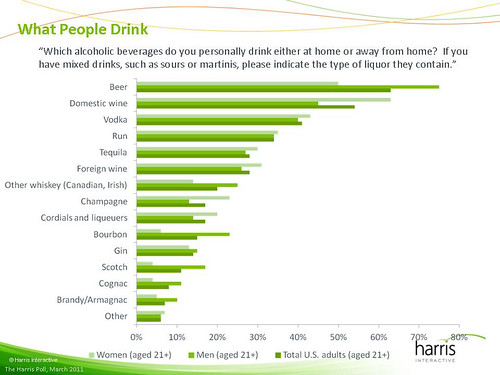
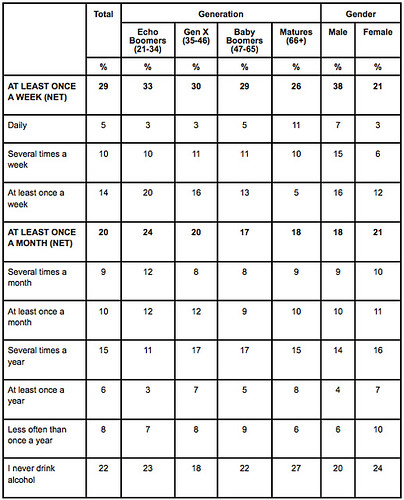
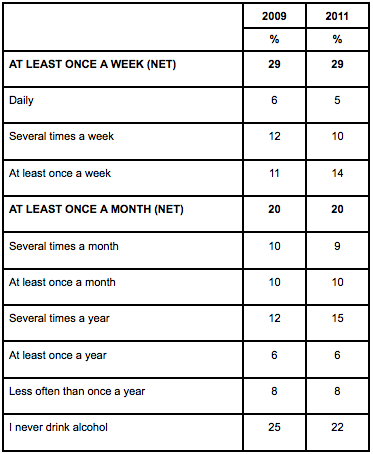
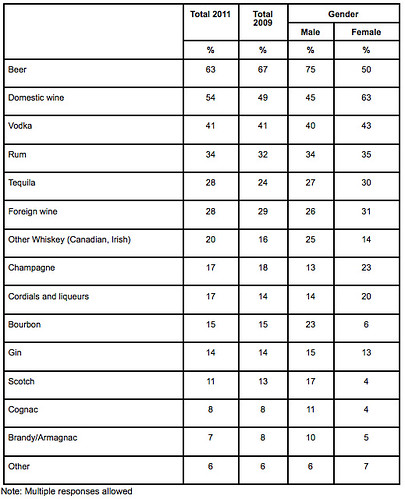
A Harris Poll conducted in March of this year concluded that Three in Ten Americans Drink Alcohol at Least Once a Week. The poll, conducted by Harris Interactive, surveyed 2,379 adults between March 7 and 14, 2011. Not surprisingly, beer continues to be the most popular alcoholic beverage, followed by American wine and vodka. And men still drink beer more than women “75% vs. 50%.”

Harris-What_People_Drink-2011

Here are some other findings from the poll:

Question 1: “How often do you drink alcohol, including beer or wine?”

Harris-2001-1

Question 2: “How often do you drink alcohol, including beer or wine?”

Harris-2001-2

Question 3: “Which alcoholic beverages do you personally drink either at home or away from home? If you have mixed drinks, such as sours or martinis, please indicate the type of liquor they contain.”

Harris-2001-3

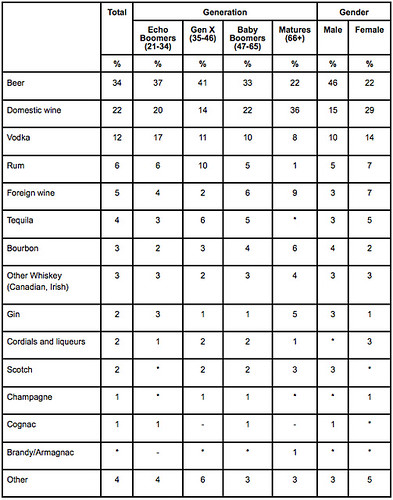
Question 4: “Although you may drink several types of alcoholic beverages, which one type would you say you drink most often?”

Harris-2001-4

Naturally, I have a couple of quibbles:

  1. Why did they separate out domestic and foreign wine, but not domestic and foreign beer?
  2. “It’s probably not surprising that men and women have different drinking preferences.” Maybe, but isn’t this something of a self-perpetuating prophecy? I know plenty of women who love beer and find wine too sweet. I also know women who claim to find beer too bitter but drink their weight in coffee. I can’t help but wonder if we keep reinforcing this by asking the question, and people respond with the answer they think is the case, which ends up making it real when maybe it’s not.
  3. “According to many doctors and medical studies, a glass of wine is good for one’s health. And even beyond wine, a drink, as long as it’s in moderation, is something that people shouldn’t be afraid of having.” Goddammit, why does this one persist, that “wine” is good for you but the rest are not? By omission, the statement implies that beer and other alcohol is not “good for one’s health” or at a minimum not “as” good which infuriates me. And adding the qualifying statement that “beyond wine” it’s okay to drink the other alcoholic drinks “as long as it’s in moderation” likewise implies that it’s healthful to drink as much wine as you like. How can they be so detail-oriented about the statistics involved in polling, and so ignorant in their statements of analysis? Sheesh.

Latest Gallup Poll Reveals Drinking At 25-Year High With Beer #1

gallup-poll
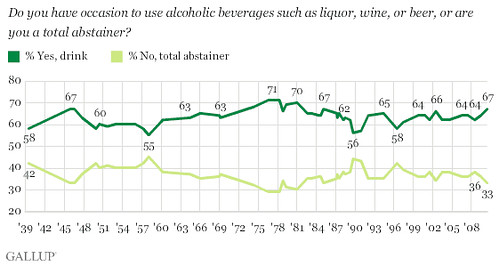
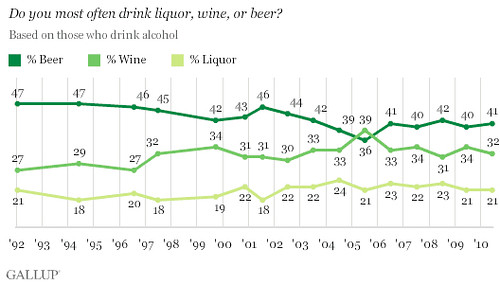
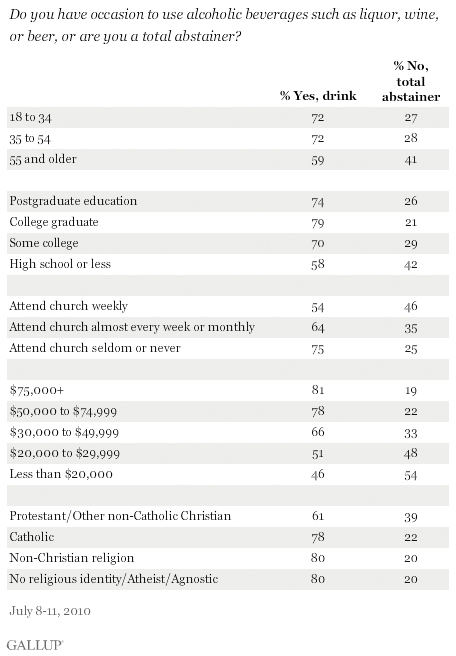
The annual Gallup Poll into American drinking habits was recently released. According to this year’s results, 67% of adults imbibe, a 1% increase from last year, and the highest percentage in 25 years. Also, the percentage of American abstaining hitting what looks to be the second-lowest number, 33%. Only around 1978-81 looks to have had fewer abstainers, which is great news since studies have shown that moderate drinkers tend to live longer than abstainers.

Gallup-2010-1

As has been the case in all but one suspect year, beer is the most consumer alcoholic beverage. I suspect, because even in the year people “reported” drinking more wine — 2005 — beer still outsold wine 4 to 1.

Gallup-2010-3

There’s some other interesting data about the demographics of current alcohol consumers. For instance, not surprisingly, there are more older abstainers. People with more education also drink more, and those with the least education comprise the majority of abstainers. Protestant Christians, followed by Catholics, have the largest number of abstainers.

Gallup-2010-2

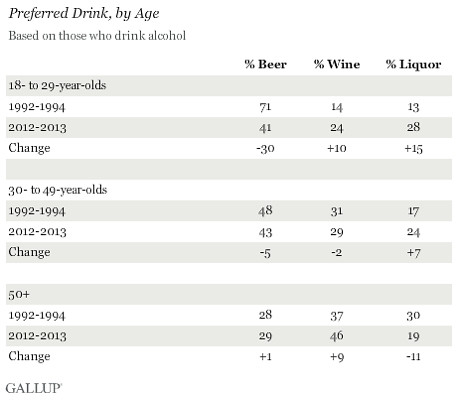
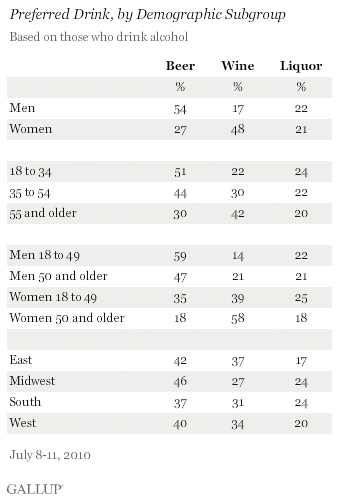
And finally, by age and gender, men drink more beer, as do older people, regardless of gender. Somewhat surprisingly, the area of the country with the highest percentage of beer drinkers is the Midwest, followed by the East coast, the West coast with the South having the least.

Gallup-2010-4

Zymurgy Poll Picks Best Beers In America

aha
Zymurgy magazine, which is published by the American Homebrewers Association for its members, today released the results of their latest poll, asking their readers to “readers to send us a list of their 20 favorite beers. The only rule [was] that the beer [had] to be commercially available somewhere in the United States. A record number of votes were cast this year, with 1,192 different beers from 450 breweries represented in the poll.” So while the name of the poll is 2010 Zymurgy Best Beers In America, the list does include a few imported beers that are sold in the U.S.

For the second year in a row, Russian River’s Pliny the Elder took the top spot.

rr-pliny

2010 Zymurgy Best Beers In America Poll

  1. Russian River Pliny the Elder
  2. Bell’s Two Hearted Ale
  3. Stone Arrogant Bastard
  4. Dogfish Head 90 Minute IPA
  5. Sierra Nevada Pale Ale
  6. Stone IPA
  7. Tie for 7th
    • Bear Republic Racer 5
    • Guinness
    • Sierra Nevada Bigfoot Barleywine
    • Sierra Nevada Celebration
  8. Stone Ruination
  9. Tie for 12th
    • North Coast Old Rasputin
    • Sierra Nevada Torpedo
    • Rahr Winter Warmer
    • Rahr Ugly Pug
    • Rahr Iron Thistle
  10. Tie for 17th
    • Oskar Blues Ten Fidy
    • New Glarus Belgian Red
    • Dogfish Head 60 Minute IPA
    • Duvel
  11. Tie for 21st
    • Lagunitas IPA
    • Samuel Adams Boston Lager
    • Rahr Storm Cloud
    • Saison Dupont
  12. Tie for 25th
    • Founders Kentucky Breakfast Stout
    • Rahr Bucking Bock
    • Ommegang Three Philosophers

That’s the top 25, but the top 50 can bee seen at Zymurgy’s press release.

They also picked the top 25 favorite breweries, of which Rahr & Sons Brewing Co. of Fort Worth, Texas was number one and they “tabulated which breweries had the most brands in the voting. That honor went to Boston Beer Co. with 22 of its Samuel Adams brews getting votes. Dogfish Head was close behind with 20 brands.” You can also see the full list of Beer Portfolios and Favorite Breweries at the American Homebrewers Association website.

Portland Food Writer Goes Negative

thumbs-down
This is just disappointing. A writer at the Portland Mercury, Patrick Alan Coleman, missed the point of the Beer City USA poll by Charlie Papazian and the Brewers Association and instead took things negative with this missive.

Normally I wouldn’t be concerned about something from the Examiner. But Asheville, NC? We’ve got to take them down. We’ve got more “beer city” in the backwash at the bottom of our pint glasses than can be found in all of their pubs and breweries.

Dude, you should be ashamed of yourself. This is supposed to be fun. It’s supposed to be about civic pride, beer pride, beer community pride and building up support for your hometown. It’s not supposed to be about tearing down the other communities. It’s not about insulting other communities. I’m going to go out on a limb and guess you’ve never even been to Asheville or probably any other beer towns, either, because you come off like a provincial bigot. You’re not helping your community. Both towns have a lot to offer, beer-wise. It goes without saying that I’m a huge fan of Portland and have many, many friends in the Rose City. And I hope they all do the right thing and denounce you for being so antithetical to what makes the broader craft beer community so great: the sense of community that’s bigger than any one town.

Beer City USA Poll 2010

all-america-city
Charlie Papazian is doing another poll this year during American Craft Beer Week to determine BeerCity USA. Last year’s winner was a tie between Portland, Oregon and Asheville, North Carolina. So far, after just one day, Asheville is out in front with Portland a close second. Everybody else, including the San Francisco Bay Area, is woefully behind. We are all the tortoise to Portland/Asheville’s hare. The poll closes just before midnight on May 23.

Let’s go Bay Area people, get out there and vote. Let’s see if we can win this year. Let’s declare the San Francisco Bay Area to be Beer City USA!

beer-city

Beer City USA

all-america-city
A few weeks ago, Charlie Papazian, at his Beer Examiner blog, launched a poll in conjunction with the upcoming American Craft Beer Week to have people vote for their choice for Beer City USA. The results are now in:

beer-cities

The Top 10 Vote-Getters

  1. TIE: Portland, OR / Asheville, NC
  2. Philadelphia, PA
  3. San Diego, CA
  4. St. Louis. MO
  5. San Francisco/Oakland – Bay Area, CA
  6. Seattle, WA
  7. Denver, CO
  8. Portland, ME
  9. Milwaukee, WI
  10. Fort Collins, CO

It probably goes without saying that the results are hardly scientific, but that doesn’t render them meaningless. They do, I’d suggest, indicate which local communities care deeply about their local beer culture and also have a very well-developed online presence that is able to motivate that community to action. To further clarify, I mean both conditions have to exist, both pride and performance for a particular community to be high in the rankings.

The results were, I’m sorry to say, tainted somewhat by some early ballet-stuffing that somehow got around the one vote protocol in the polling software. I guess I shouldn’t be surprised that quite a bit of it came from the Bay Area, after all this is Silicon Valley. But I was shocked all the same, and not a little embarrassed that some bad apples in my region thought cheating was the way to win, not that we were the only ones. I commend Charlie for putting a stop to that early on and decisively. I suspect that some votes that were legitimate probably didn’t get through or were discarded, but that’s what happens when you try to game the system. But I still can’t shake those lingering feelings that cast a shadow on the efficacy of the results, despite the good intentions of all the parties involved.

Still, despite that, it was a fun idea and very interesting to see which communities stepped up with swelling pride for their own local beer scenes. Congratulations to all the winners, but I’d say we’re all winners to have so many great beer destinations around the country. That wasn’t true as recently as two decades ago, maybe less. We’ve come a long way, baby.

But maybe we shouldn’t stop there. Remember all the “All-American Cities” that the National Civic League has been declaring since the 1950s? Actually 1949 was the first year the award was given to ten American communities and they’ve continued to do so each year since. “The award is the oldest community recognition program in the nation and recognizes communities whose citizens work together to identify and tackle community-wide challenges and achieve uncommon results. Since the program’s inception in 1949, more than 4,000 communities have competed and over 500 have been named All-America Cities.” Winning cities get to put up the sign below at the entrance to their community.

all-america-city

So here’s what I’m thinking. It’s a pie-in-the-sky idea, but what the hell. Nothing ventured, nothing gained. How cool would it be if there was an organization like a “National Beer Community League” that each year accepted nominations from communities who believed they were worthy of the title “Beer City USA”? There would have to be some criteria like breweries, brewpub and defined “good beer bars” per capita, the number of local festivals, beer dinners and other events, and things like that. Then maybe five communities each year get the “Beer City USA” award and are allowed to put a sign like this up.

beer-city