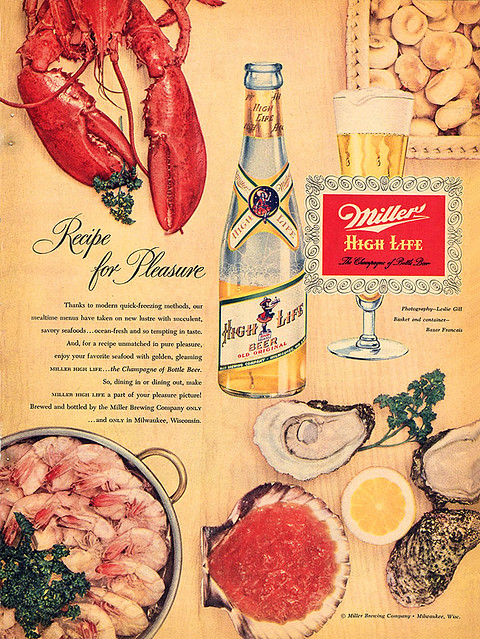
Tuesday’s ad is for Miller High Life, from 1953. With the tagline “Recipe for Pleasure,” they’re pushing the radical notion that seafood and beer might well be enjoyed together. Who knew?

Tuesday’s ad is for Miller High Life, from 1953. With the tagline “Recipe for Pleasure,” they’re pushing the radical notion that seafood and beer might well be enjoyed together. Who knew?

Today is the birthday of William Bradford, who was born March 19, 1590 and was aboard the Mayflower on its journey to found Plymouth Colony in today what is part of Massachusetts. Although not initially a leader, he became governor of the colony, a post he held for thirty years, and is generally credited with creating the first Thanksgiving.
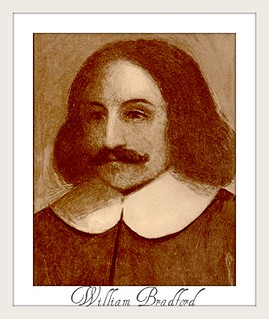
Bradford kept a journal covering the years 1620 to 1647, which was later published in a variety of forms, including in Of Plymouth Plantation and Mourt’s Relation: A Journal of the Pilgrims at Plymouth. Within the world of beer, Bradford is best known for his diary entry suggesting that the colonists dropped anchor in Plymouth Bay because they’d run out of beer, though he put it quite a bit more elegantly; “we could not now take time for further search or consideration, our victuals being much spent, especially our beer.”
In context, of course, the meaning is changed somewhat:
That night we returned againe a ship board with resolution the next morning to settle on some of those places. So in the morning, after we had called on God for direction, we came to this resolution, to go presently ashore again, and to take a better view of two places which we thought most fitting for us; for we could not now take time for further search or consideration, our victuals being much spent, especially our Beere, and it being now the 19. [new style 29th] of December. After our landing and viewing of the place, so well as we could, we came to a conclusion, by most voyces, to set on the maine Land, on the first place, on an high ground where there is a great deale of Land cleared, and hath beene planted with Corne three or four yeares agoe, and there is a very sweet brooke runnes under the hill side, and many delicate springs of as good water as can be drunke, and where we may harbour our Shallops and Boates exceeding well, and in this brooke much good fish in their season: on the further side of the river also much Corne ground cleared: in one field is a great hill, on which wee poynt to make a platiforme, and plant our Ordnance, which will command all round about; from thence we may see into the Bay, and farre into the Sea, and we may see thence Cape Cod.
Author and beer historian Bob Skilnik has pointed out that the myth of beer being the sole catalyst for the Pilgrims has been well documented, though still it persists. (BTW, anyone heard from Bob lately?) I’ve written about this before (but the link to the newspaper article is down) and also Don Russell wrote one of his columns about it, Don’t believe the Pilgrims’ beer myth, a few years ago, saying “it’s absurd to believe the Pilgrims anchored simply because they had run out of beer. Aside from making them sound like drunken frat boys on a transatlantic beer cruise, historical documents indicate they had other priorities. ‘In actuality, there was plenty of beer still on board for crew members who had to make the return passage to England,’ said Skilnik, author of “Beer & Food: An American History.'” As Skilnik discovered.
Expeditionary crews sent from the anchored ship had been checking the lay of the land for weeks, looking for a suitable place to build homes. Yes, food and supplies had run low. But more importantly, Skilnik noted, the cold was brutal, passengers were dying and the ship’s crew wanted to return to Europe. Meanwhile, there was fowl and fresh water waiting on shore. It wasn’t the shortage of beer that finally prompted the Pilgrims to give up the ship, Skilnik said. It was plain common sense.
The fault, Skilnik contends, begins with a full page ad in the Washington Post from January 8, 1908 taken out by Anheuser-Busch for Budweiser. This was just as the forces for prohibition were intensifying their efforts, and the breweries were finally starting to recognize the threat. Damage control was initiated, but most historians see it it now as “too little, too late,” and this ad was most likely a part of that effort to show beer in a better light. The fake newspaper page contains stories about beer through history, including the pilgrim’s tale.
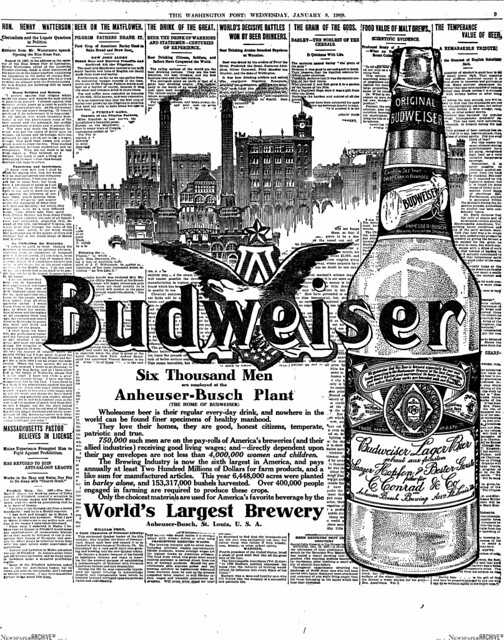
The pilgrims appear in the story in the second column from the left, at the top.
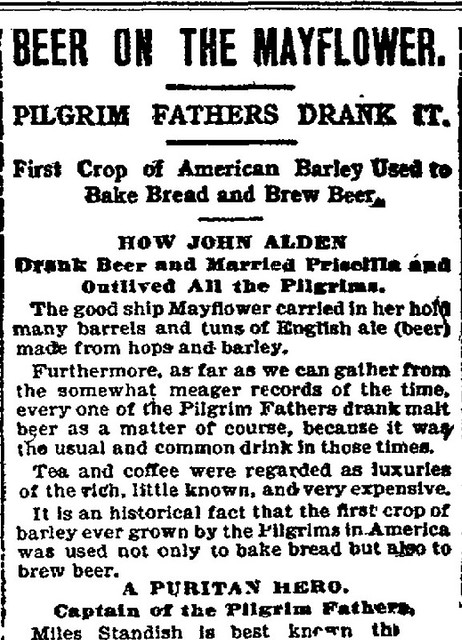
That was the beginning. Before, and after Prohibition, advertising continued to make the connection, in fact tried to make it even stronger. As Russell continues, “After Prohibition, the message grew even slicker, with an annual Thanksgiving publicity campaign from the U.S. Brewers Association. Each Thanksgiving throughout the 1930s and ’40s, newspaper readers were treated to features with headlines like, ‘Beer, Not Turkey, Lured Pilgrims to Plymouth Rock.'”
Bradford may have written it, but hundreds of years later, it’s not quite the smoking gun we’ve been let to believe.
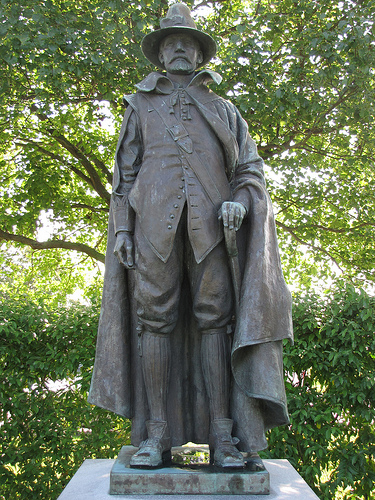
Statue of William Bradford in Plymouth Rock State Park, Massachusetts.
But Bradford’s journals also contain additional references to beer. Here’s a few more Bradford quotes with beer in them.
November 15:
In the morning so soon as we could see the trace, we proceeded on our journey, and had the track until we had compassed the head of a long creek, and there they took into another wood, and we after them, supposing to find some of their dwellings, but we marched through boughs and bushes, and under hills and valleys, which tore our very armor in pieces, and yet could meet with none of them, nor their houses, nor find any fresh water, which we greatly desired, and stood in need of, for we brought neither beer nor water with us, and our victuals was only biscuit and Holland cheese, and a little bottle of aquavitae, so as we were sore athirst.
Mid-November:
Again, we had yet some beer, butter, flesh, and other such victuals left, which would quickly be all gone, and then we should have nothing to comfort us in the great labor and toil we were like to undergo at the first. It was also conceived, whilst we had competent victuals, that the ship would stay with us, but when that grew low, they would be gone and let us shift as we could.
Christmas Day:
Monday, the 25th day, we went on shore, some to fell drink water aboard, but at night the master caused us to have some beer, and so on board we had divers times now and then some beer, but on shore none at all.

Today’s infographic comes from the homebrewing book Beer Craft: A Simple Guide to Making Great Beer, by William Bostwick and Jessi Rymill. Dwell magazine did a profile of the book, including this page with their Field Guide to Hops.
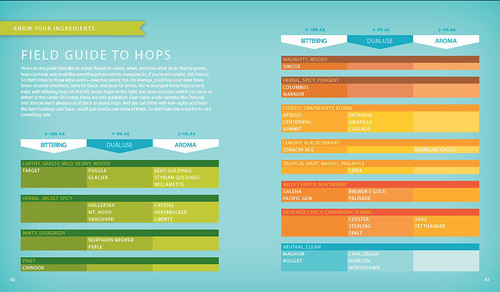
Click here to see the field guide full size.

The American Homebrewers Association announced this morning that the governor of Mississippi, Phil Bryant, signed into law a bill effectively legalizing homebrewing within the state. Congratulations to all of beer lovers and homebrewers in Mississippi that worked so hard for so long to make this happen, and especially the hoproots organization Raise Your Pints. Forty-nine down, one to go. Now that Mississippi finally allows homebrewing, only Alabama does not permit its citizens to brew beer at home. Check out the full story at the AHA’s press release.
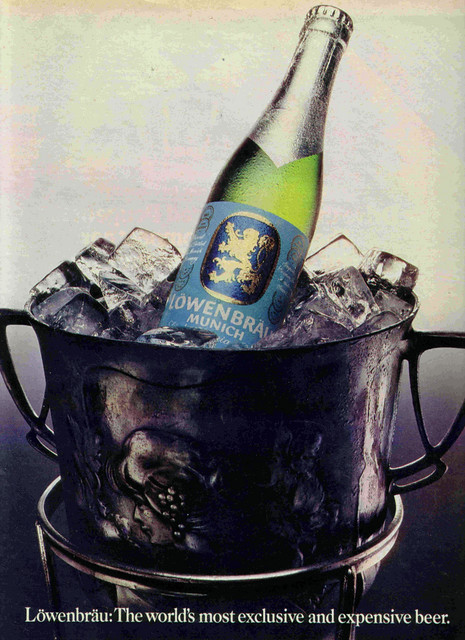
Monday’s ad is for Lowenbrau, which is 1976 was billed as “The world’s most exclusive and expensive beer.” Given the recent debate over the packages and prices of beer, it’s pretty funny to see so pedestrian a beer as this in a Champagne ice bucket with gold foil covering the neck and crown. If that was truly the most expensive beer in 1976, then it really says something about how awful the beer scene must have been at that time. And for that matter, is it really wise to declare that you’re the “most expensive” anything?

Today’s infographic is a timely one, and was released just this morning. The Brewers Association today released the preliminary numbers for beer sales last year. Not surprisingly, the 2012 numbers look great, and continue the trend in recent years of forward momentum for craft beer. The big news is simple. “In a year when the total U.S. beer market grew by one percent, craft brewers saw a 15 percent rise in volume and a 17 percent increase in dollar growth.”
But here’s a bit more, from the press release:
With production at 13,235,917 barrels in 2012, craft brewers reached 6.5 percent volume of the total U.S. beer market, up from 5.7 percent the previous year. Additionally, craft dollar share of the total U.S. beer market reached 10.2 percent in 2012, as retail dollar value from craft brewers was estimated at $10.2 billion, up from $8.7 billion in 2011.
Also, the number of breweries continues to rise at an amazing pace. The surprising thing to notice is that the growth is almost entirely in production breweries, which increased 44%!
In 2012, there was an 18 percent increase in the number of U.S. operating breweries, with the total count reaching 2,403. The count includes 409 new brewery openings and only 43 closings. Small breweries created an estimated 4,857 more jobs during the year, employing 108,440 workers, compared to 103,583 the year prior.
And here’s all of that good news, distilled into a colorful infographic.


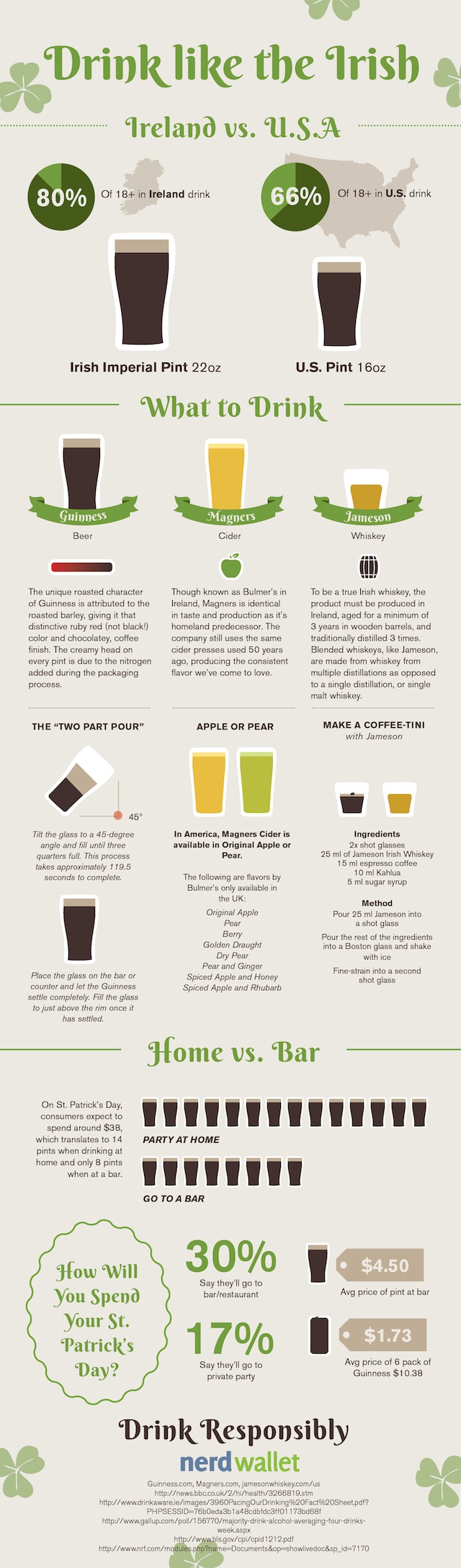
Today’s infographic is from NerdWallet, and is part of a story on St. Patrick’s Day trends in how people are celebrating this year. In Study: Consumers Can Save $2.6 Billion By Avoiding Pubs and Sticking to House Parties This St. Patrick’s Day. I’m not sure if I’m convinced, although I’ve avoided going out for St. Patrick’s Day for years. Still, some interesting bits of information.

Today’s infographic is a funny one, and comes from the Huntsville Beer Week, which took place in Alabama last October. The local paper created a fun poster for the event, entitled Funky Brewers, which anthropomorphized various styles of beer, giving them unique personalities that corresponded to the character of their flavors. It was created by the staff of the Huntsville Times and illustrated by Bethany Bickley, and the whole process is explained in Brewing up something special for the weekly entertainment tab in Huntsville, Ala. at the website of the American Copy Editors Society. To fully appreciate the humor, not all of which works, you really need to see it full size.

Click here to see the poster full size.
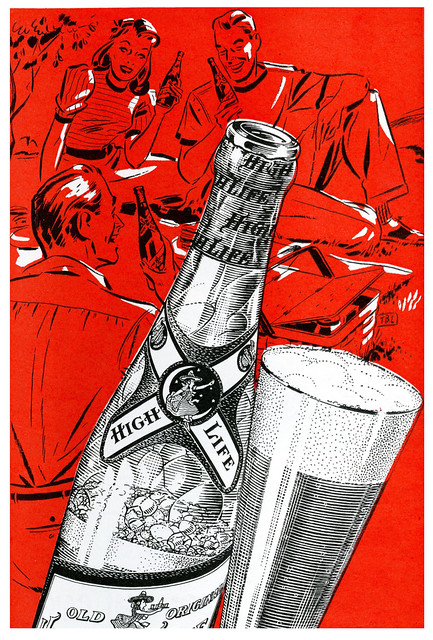
Friday’s ad is for Miller High Life, from 1941. It’s a two-color ad, using mostly red, but it really makes the beer bottle and glass pop. It looks this might only be part of the ad, it feels like something must be missing, and the proportions don’t look quite right, either, providing more evidence that this is only a piece of the original ad.

While I’m firmly in the “beer came before bread” camp in the anthropological debate about what sparked civilization, evidence has been mounting for that view since it was first proposed over a half-century ago. In a new opinion piece in the New York Times by Jeffrey P. Kahn, the CEO of WorkPsych Associates, entitled How Beer Gave Us Civilization, he lays out the case for why “we needed beer” and runs through an overview of early civilization’s introduction of alcohol and why it was so necessary to our development. He also brings into the debate a recent study from the Journal of Archaeological Method and Theory, What Was Brewing in the Natufian? An Archaeological Assessment of Brewing Technology in the Epipaleolithic, which adds new support for what I call the “beer first” theory.
He unfortunately ends with the long-discredited Benjamin Franklin beer quote, but apart from that gaffe, it’s a good read. Just stop short of the final two paragraphs, and it’s even better. He should have just finished with this sage observation. “Beer’s place in the development of civilization deserves at least a raising of the glass.” Hear, hear.
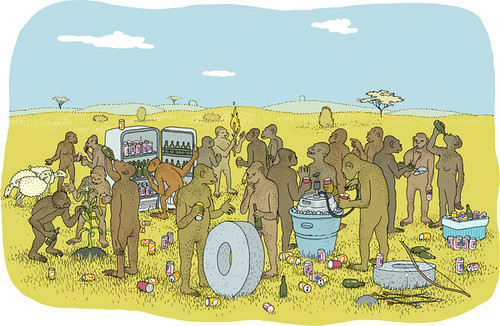
Illustration by Anders Nilsson.