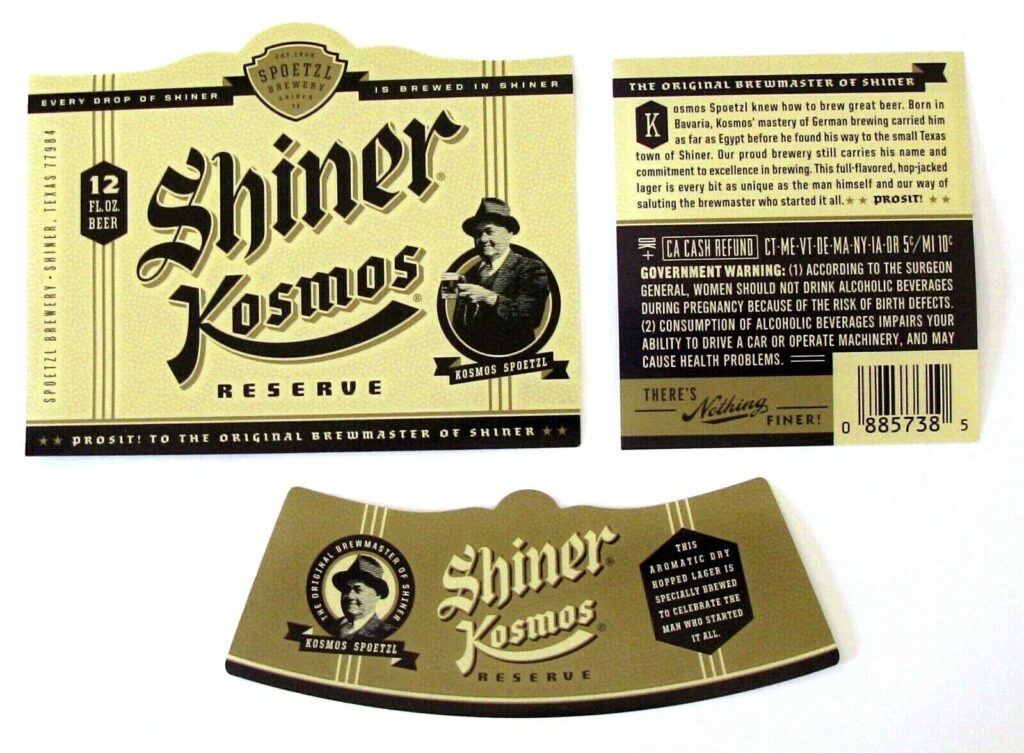
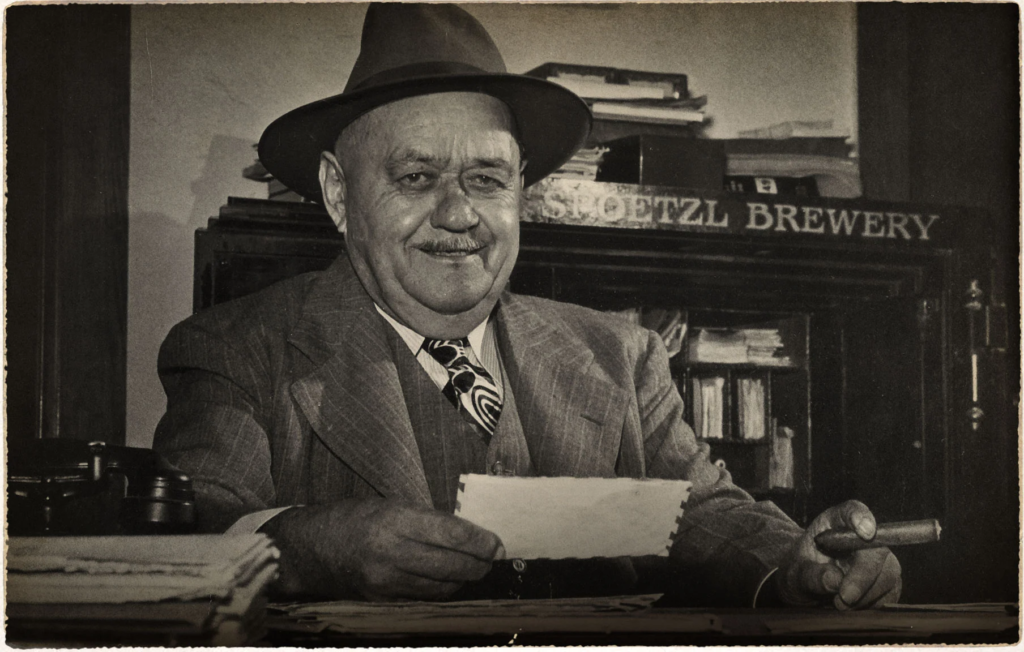
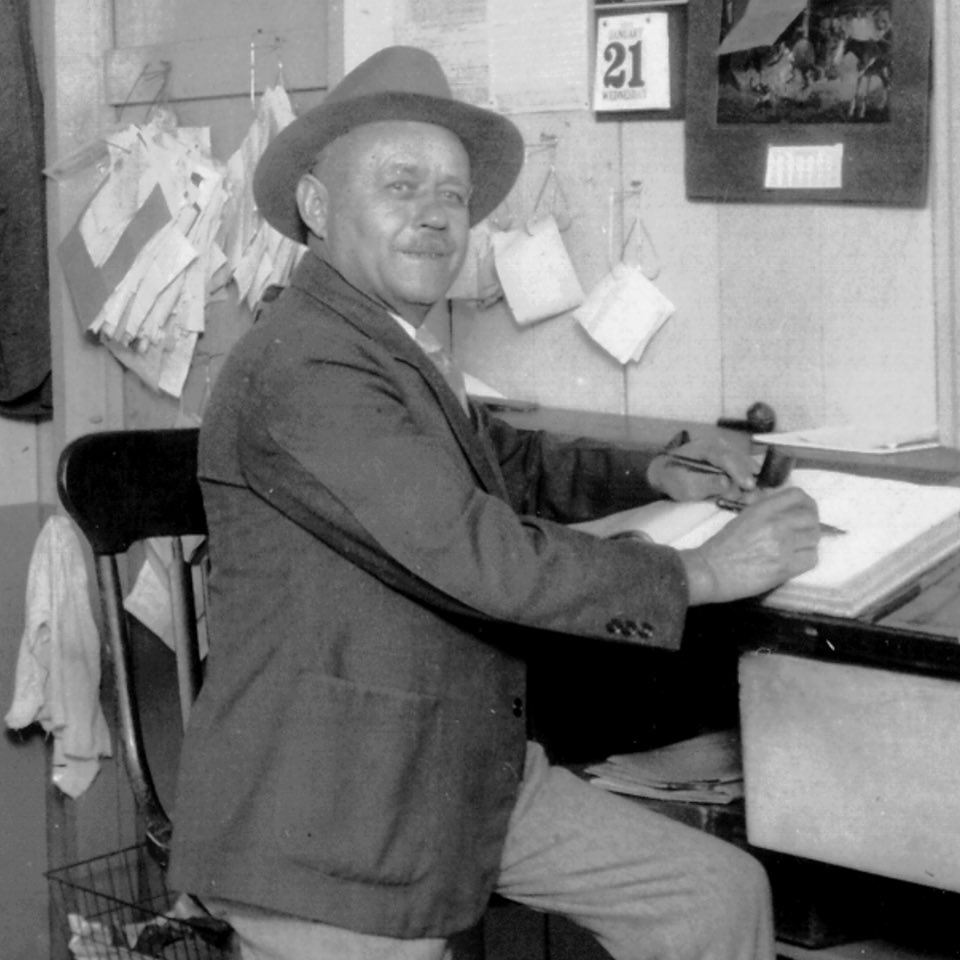
Today is the birthday of Kosmos Spoetzl (March 3, 1873-June 17, 1950). He was born in Bavaria, Germany and was trained a brewer. When the Texas-based Shiner Brewing Association was searching for a new brewmaster. Wikipedia takes up the story: “They found one in Bavarian-born Kosmos Spoetzl, a onetime soldier who had trained as a brewmaster in his native Germany. Part of the package that lured Spoetzl to Shiner was potential ownership of the brewery. In 1914, he co-leased it with Oswald Petzold with an option to buy in 1915, which he did, giving the brewery his own name, but continuing to call the product Shiner Beer. Spoetzl had attended brewmaster’s school and apprenticed for three years in Germany, worked for eight years at the Pyramids Brewery in Cairo, Egypt, and then worked in Canada. He had moved to San Antonio in search of a better climate for his health, bringing with him a family recipe for a Bavarian beer made from malted barley and hops.” He Served as the brewmaster until his death in 1950.

This is his obituary from the Shiner Gazette, June 22, 1950:

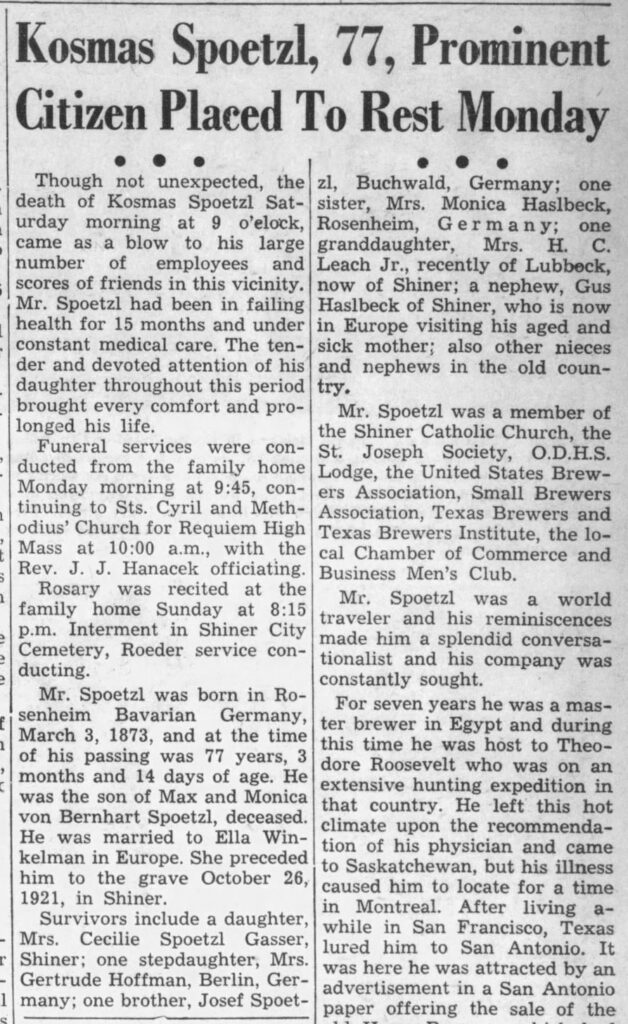

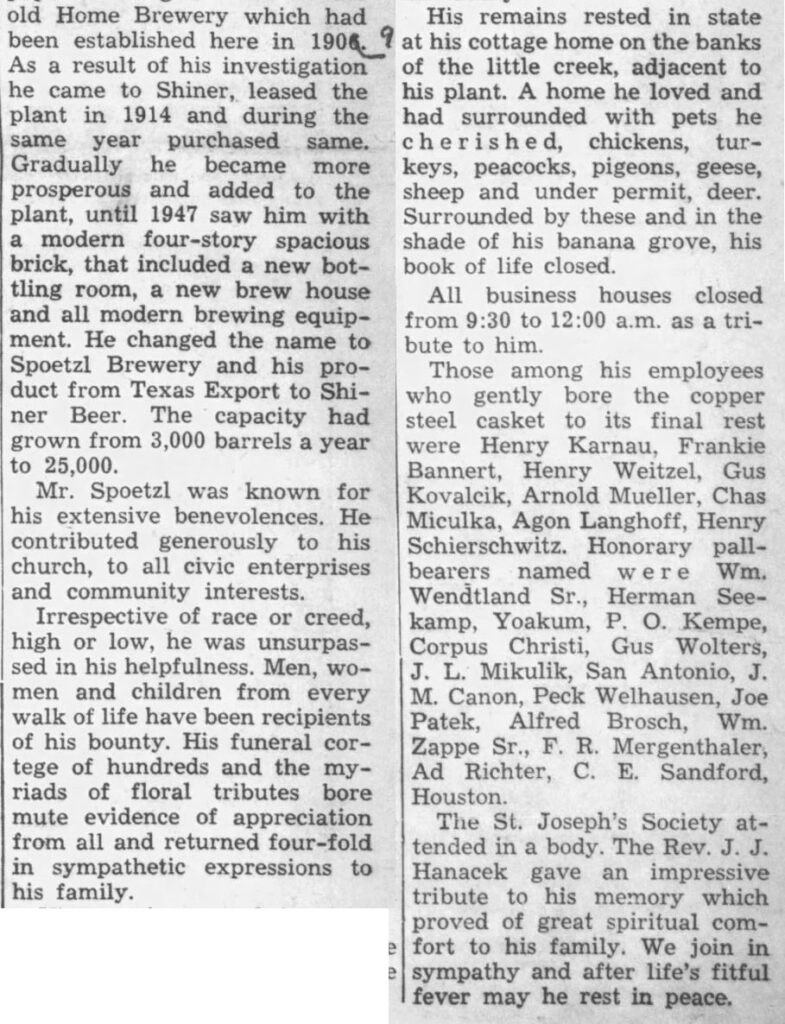

And this account is from the Texas State Historical Society, by Diana J. Kleiner from 1995:
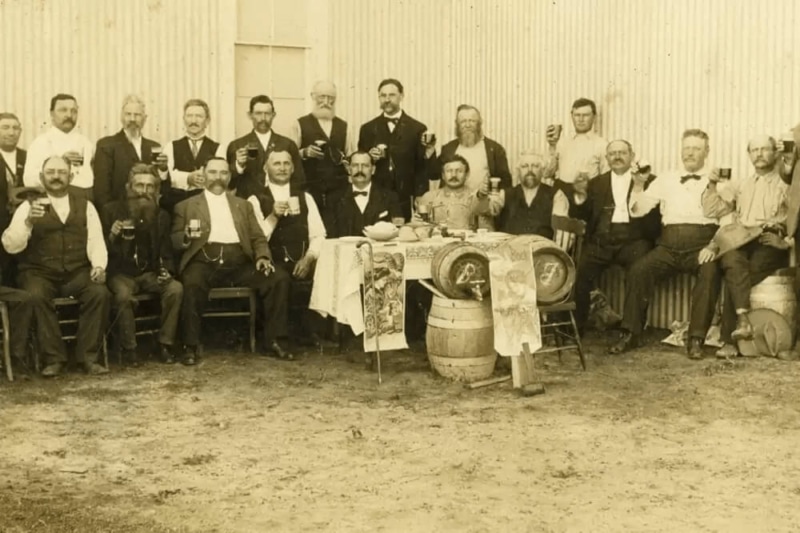
The Spoetzl Brewery, also known as the Shiner Brewing Association, headquartered in Shiner, Texas, produces beer characterized by its carmelized quality. Private label brews produced by Spoetzl include Texas Tap, Gilley’s, and Rio Grande, while its original product, Texas Export, later became Shiner Texas Special Beer, or Shiner Beer. In 1986, before the rise of new microbreweries, the firm was the state’s last independently owned commercial brewing establishment. The original tin brewery was founded in the center of an Austrian, German, and Czech farming community near the railroad tracks on the banks of Boggy Creek. A group of Shiner businessmen interested in appealing to new Bohemian settlers established the original stock company, known as the Shiner Brewing Association in 1909, with Herman Weiss of Galveston as first brewmaster. The local product replaced beer formerly shipped in by rail from San Antonio and Houston. The first keg beer spoiled because of improper fermentation and refrigeration, however, and the founders offered the plant for lease in 1914.
Kosmos Spoetzl, a German immigrant brewmaster, learned of the Shiner operation and coleased the facility with Oswald Petzold with an option to buy in 1915. Spoetzl had attended brewmaster’s school and apprenticed for three years in Germany and worked for eight years at the Pyramid Brewery in Cairo, Egypt, before moving to San Antonio in search of a better climate for his health. He came, carrying the recipe for a Bavarian beer made by his family from pure malt and hops. Within a year Spoetzl bought the brewery, which he renamed the “Home Brewery,” and began to produce beer in wooden kegs and bottles. After 1916 the beer was packaged in glass returnable bottles; aluminum kegs were first used in 1947, nonreturnable bottles came in 1958, party kegs in 1964, and cans in 1970. When Prohibition was declared in 1918, Spoetzl produced near beer, ice, and, according to some sources, regular beer as well. During this period, he sustained the brewery by doing construction work in Florida with crews and trucks brought from Texas. After his wife’s death in 1921, Spoetzl considered returning to Bavaria but was convinced by his daughter to retain the business. “Miss Celie,” as Cecilie was called, served as business manager of the firm, and her daughter Rose joined the firm in 1964. August Haslbeck, who served as brewmaster, was the son of a noted Bavarian maltmaster and Spoetzl’s nephew. He later returned to Germany to complete an apprenticeship and receive a brewmaster’s degree. With repeal of Prohibition in 1933, the business resumed, with the introduction of “Texas Export,” a new product later known as “Texas Special” beer. Sales were made within a 100-mile radius. Over the next decade the company added a new bottling room and brew house, and in 1947 Spoetzl constructed the white brick Alamo-style plant still in use today. Across from the brewery, Spoetzl kept a menagerie of peacocks, deer, and other animals. Spoetzl is remembered for driving through the countryside, offering farmers cold beer, soda, or silver coins, and marketing his beer with the help of a hobo band, which continued to represent the company after his death. At his death in 1950 Spoetzl was succeeded by his daughter Cecilie, who became the only female brewery owner in the nation.

And this is half of the story, “The Two Men who Rescued Shiner Beer” at Texas Standard:
In 1909, in the little town of Shiner, Texas, a group of German and Czech farmers decided they missed the beer of the old country. They pooled their money, built a ramshackle brewery, and called it the Shiner Brewing Association.
But they weren’t brewers. They were farmers. The beer was bad – so bad, locals joked it tasted more like medicine than malt. By 1914, the brewery was on its last legs, or last barrels.
That’s when a Bavarian brewmaster named Kosmos Spoetzl appeared. He’d been trained in Germany, worked in Egypt, and landed in San Antonio. He leased the struggling brewery with an option to buy. And buy it he did, with his own savings and no small measure of faith.
Spoetzl brought with him an old-world recipe for a dark lager. He brewed it carefully, stubbornly. And soon, the townsfolk said Shiner beer finally tasted like beer.
Through Prohibition he kept the brewery alive making so-called “near beer”and ice, and even construction materials. By the time he died in 1950, Shiner beer had become the pride of a little Texas town.
But it never got much bigger than that. For decades, Shiner was still a tiny brewery in a town of two thousand souls, barely scraping by, undercapitalized for sure, but ably managed by Spoetzl’s daughter, Ms. Celie.
She held on. She kept it going against all odds. Hers was the only female-owned brewery in America. She even lived in a house on the brewery site to devote all her time to it. She kept it alive, but she couldn’t get it healthy.
Locals were loyal to the brand. Still, Shiner’s market was mighty small. Even after Ms. Celie stepped down in 1966 and Shiner went through a succession of different owners; it never, during the ’70s and ’80s, managed to garner more than one percent of the Texas beer market.