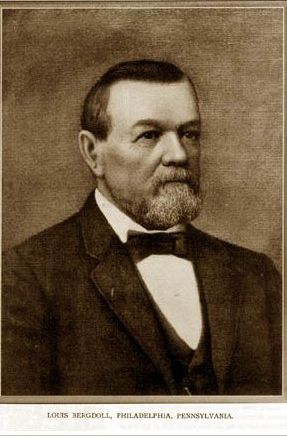
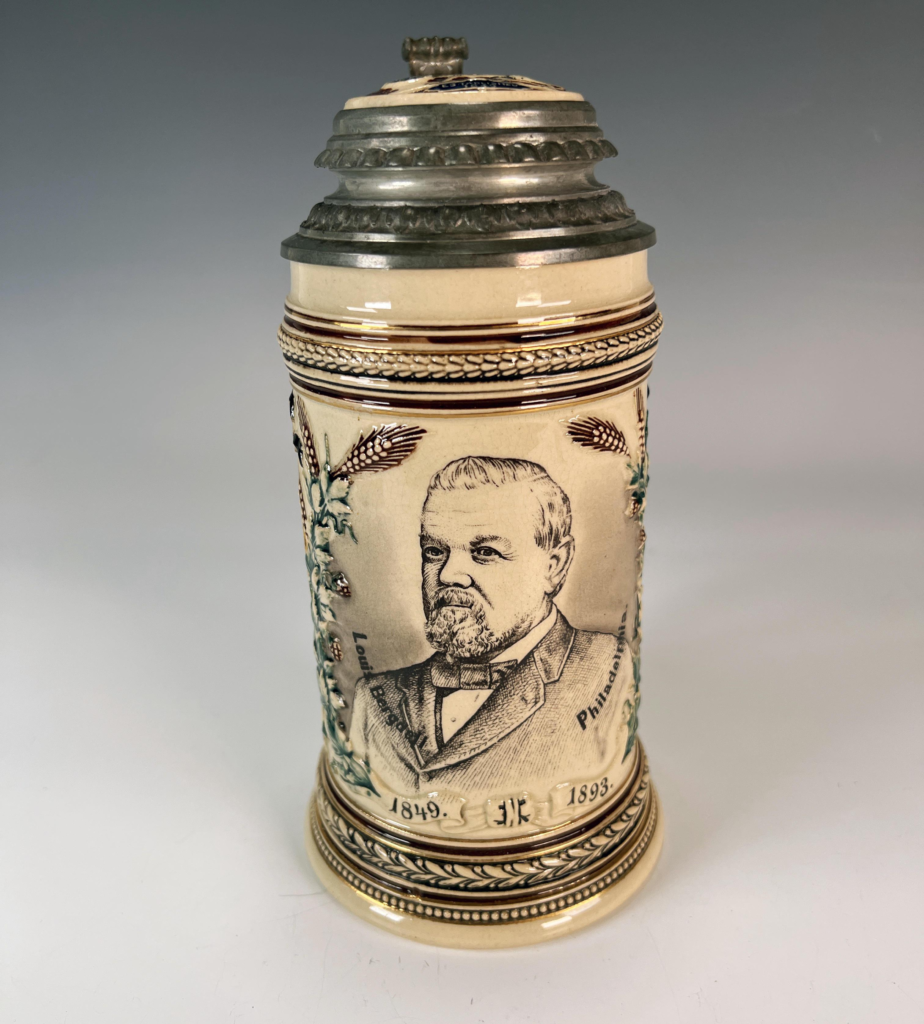
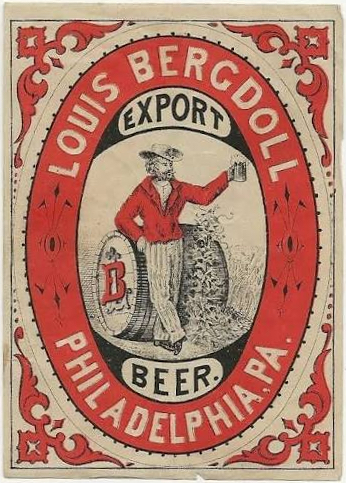
Today is the birthday of Louis Bergdoll Sr. (July 21, 1825-August 18, 1894). He was born in Sinsheim, Rhein-Neckar-Kreis, Baden-Württemberg, Germany. He trained there as a brewer, and emigrated to the U.S. when he was 21, in 1846, arriving in New York City. He settled in Philadelphia, and in 1849 founded the Bergdoll & Schema Brewery, with a partner, Peter Schema. That partnership apperas to have lasted two years, and then a new partner, Johann Carl “Charles” Psotta, came on board for the next twenty-five years. After 1876 it appears to be owned by Bergdoll alone, known as the Louis Bergdoll Brewery, and also trading under the name “City Brewery,” and possibly until it was closed by prohibition in 1920.
Louis Bergdoll Sr. was born on July 21, 1825, in Sinsheim near Heidelberg in Baden, Germany, the son of Johann Georg Bergdoll and Catharina Schneider. He learned the brewing trade in his native Germany during a period when Bavarian-style lager beer production was spreading throughout the German states and transforming the brewing industry. Seeking greater opportunity in America, he immigrated to the United States in 1846, arriving at Castle Garden in New York aboard the ship Doris on June 27 of that year before eventually settling in Philadelphia among the city’s rapidly growing German immigrant community.
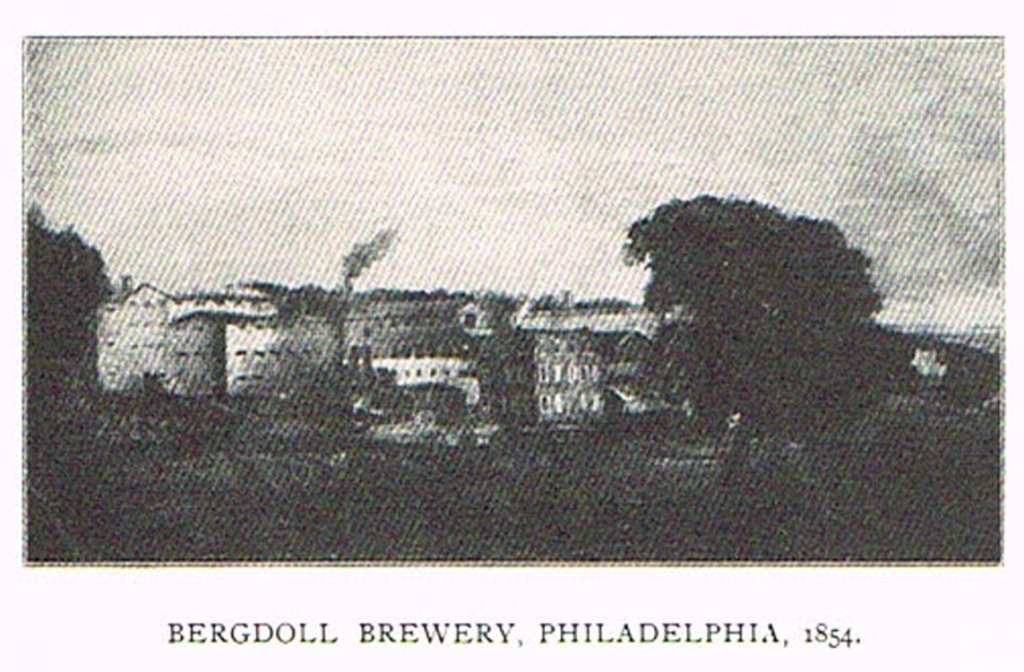
Only a few years after his arrival, Bergdoll entered the Philadelphia brewing industry. In 1849 he established a brewery at 508 Vine Street in partnership with Peter Schemm under the name Bergdoll & Schemm. The venture proved successful, and after Schemm withdrew from the business, Bergdoll partnered with Charles Psotta, reorganizing the company as Bergdoll & Psotta. During the mid-nineteenth century Philadelphia emerged as one of the leading brewing centers in the United States, largely through the influence of German immigrants who introduced lager beer and German brewing methods to the city. Bergdoll became one of the important figures in that transformation.
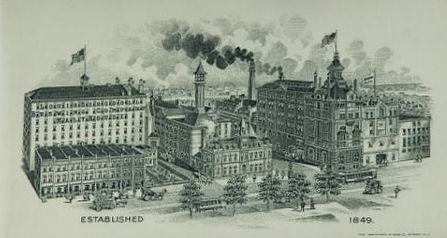
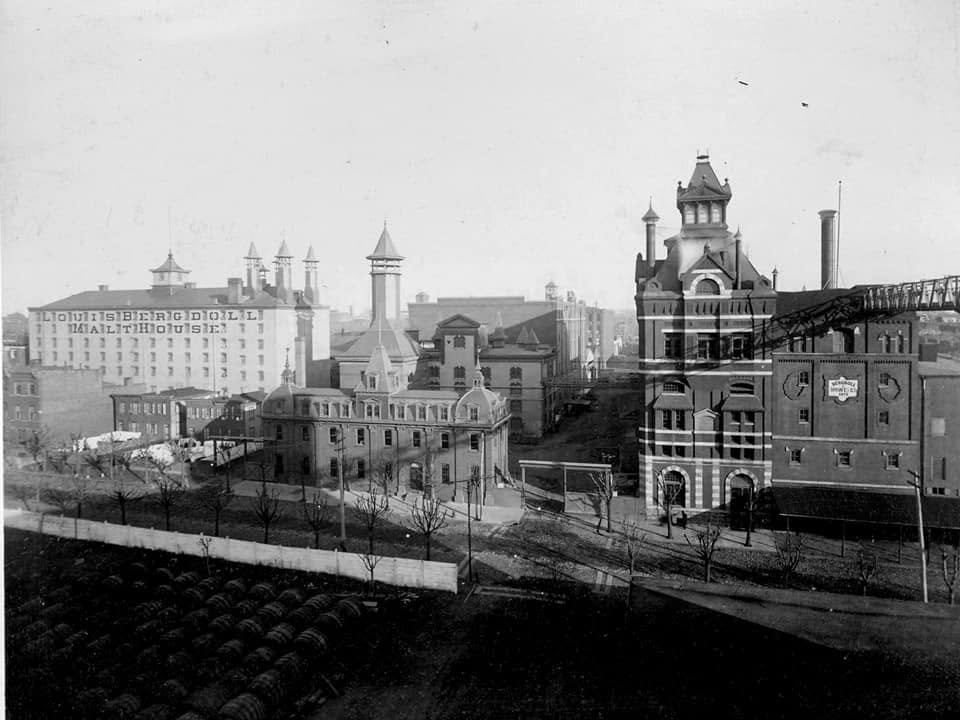
In 1856 the firm relocated to a far larger site near Fairmount Park between North 28th and 29th Streets in what later became known as Brewerytown. The new complex became known as the City Park Brewery. The location was chosen for its proximity to excellent water sources and expanding transportation networks, both essential to large-scale lager beer production. Over the following decades the brewery expanded into one of Philadelphia’s major brewing operations, with extensive brew houses, malt houses, storage buildings, stables, and bottling facilities occupying a substantial portion of the neighborhood.
As Philadelphia’s taste increasingly turned toward lager beer during the nineteenth century, the Bergdoll brewery gained a strong regional reputation. The brewery became one of the industrial foundations of Brewerytown, the section of Philadelphia that grew into one of America’s great brewing districts. The success of the enterprise brought Bergdoll considerable wealth and established the Bergdoll family among Philadelphia’s prominent German-American business families.
In 1881 the business incorporated as the Louis Bergdoll Brewing Company, with Bergdoll serving as president while members of his family assumed important positions within the operation. By this period the brewery ranked among the city’s best-known lager beer producers. The Bergdoll name became closely associated with Philadelphia brewing for generations, and the family’s influence continued well into the twentieth century.
Outside the brewing industry, Bergdoll invested heavily in Philadelphia real estate, particularly in the Fairmount section of the city near his brewery operations. He developed numerous residential properties and became a substantial property owner. The prosperity generated through the brewing business allowed the family to construct several notable residences associated with the Bergdoll name, including the impressive Louis Bergdoll House and the later Bergdoll Mansion, both of which survive as important reminders of Philadelphia’s brewing era and German-American industrial wealth.
Bergdoll was also active in charitable and civic causes within Philadelphia’s German-American community. He supported the German Hospital, later known as Lankenau Hospital, the Little Sisters of the Poor, and Salem Reformed German Church. His philanthropy reflected both his prosperity and his continuing ties to the city’s German immigrant institutions.
He married Elizabeth Wolf, and together they raised a family whose descendants remained prominent in Philadelphia society and business circles. Several of his children and extended family members later became involved in the family brewing enterprise and associated business interests.
Louis Bergdoll Sr. died at his home in Philadelphia’s Fairmount section on August 10, 1894, at the age of sixty-nine. He was buried at West Laurel Hill Cemetery in Bala Cynwyd, Pennsylvania. Portions of the former City Park Brewery complex still stand in Philadelphia today as enduring reminders of the city’s once vast brewing industry and of the German immigrant entrepreneurs who helped build it.
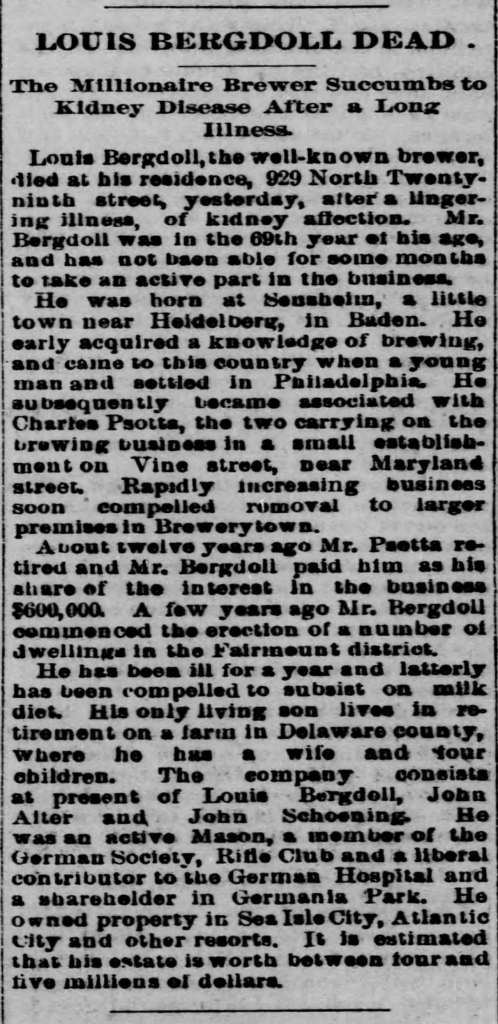
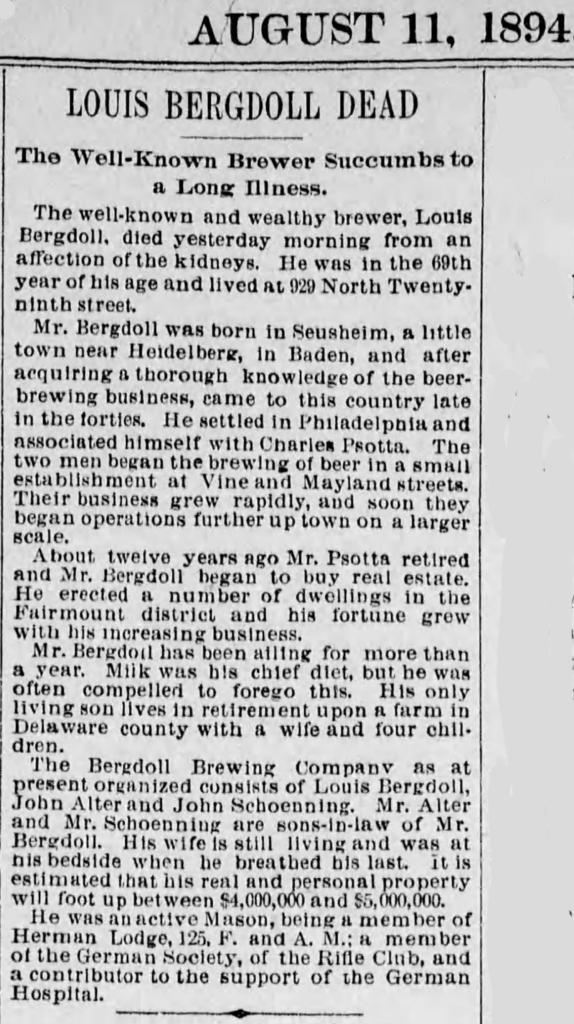
Here’s an obituary of Bergdoll from the Philadelphia Inquirer: