Brookston Beer Bulletin

Jay R. Brooks on Beer

  • Home
  • About
  • Editorial
  • Birthdays
  • Art & Beer

Socialize

  • Dribbble
  • Email
  • Facebook
  • Flickr
  • GitHub
  • Instagram
  • LinkedIn
  • Pinterest
  • RSS
  • Twitter
  • YouTube

Powered by Genesis

Beer in Art #3: Ford Madox Brown’s Work

November 23, 2008 By Jay Brooks

Today’s masterpiece of art — and beer — is in one of my favorite styles of art: Pre-Raphaelite. The Pre-Raphaelite Brotherhood was a group of English painters “who aimed to revive the style and spirit of the Italian artists before the time of Raphael.” According to the Encyclopedia Britannica, they were a “group of young British painters who banded together in 1848 in reaction against what they conceived to be the unimaginative and artificial historical painting of the Royal Academy and who purportedly sought to express a new moral seriousness and sincerity in their works.”

While today’s artist, Ford Madox Brown, was not formally a member of the Brotherhood, he was friends with several of the other artists and tended to paint in a style strikingly similar, so much so that his is often considered alongside of the Pre-Raphaelites.

The painting is titled “Work,” and is one of his most famous works, as it attempts to depict all of Victorian English society.
 

Click on the image above for a larger view. There’s an interesting interactive display at the Manchester City Galleries — which is where the original painting hangs — that discusses the symbolism of the sailor drinking a beer in the center of the painting.

This beer represents attitudes towards drinking alcohol.

Beer was often drunk by navvies during the day to quench their thirst. While some people campaigned against drinking alcohol, it was often considered to be safer to drink beer than drink dirty water and risk death.

You can then click on six different character within the painting to hear their thoughts about drinking beer.

Brown himself wrote about the drinking sailor. “‘Here are Presented……the strong fully developed navvy who does his work and loves his beer; the selfish old bachelor navvy, stout of limb, and perhaps a trifle tough in those regions where compassion is said to reside; the navvy of strong animal nature, who, but that he was, when young, taught to work at useful work, might even now be working at the useless crank.”

From Wikipedia:

Brown’s most important painting was Work (1852–1865), which he showed at a special exhibition. It attempted to depict the totality of the mid-Victorian social experience in a single image, depicting ‘navvies’ digging up a road, Heath Street in Hampstead, London, and disrupting the old social hierarchies as they did so. The image erupts into proliferating details from the dynamic centre of the action, as the workers tear a hole in the road – and, symbolically, in the social fabric. Each character represents a particular social class and role in the modern urban environment. Brown wrote a catalogue to accompany the special exhibition of Work. This publication included an extensive explanation of Work that nevertheless leaves many questions unanswered.

For more about Ford Madox Brown, the ArtCyclopedia has some good links and the Art Archive has a good biography.
 

Filed Under: Art & Beer

Porcelain Beer Cans

November 21, 2008 By Jay Brooks

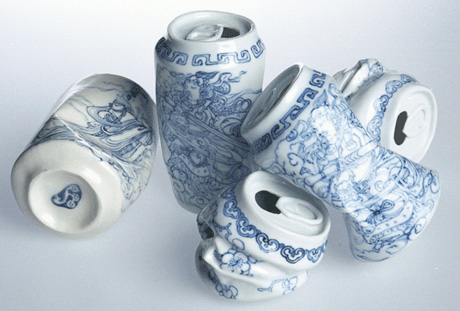
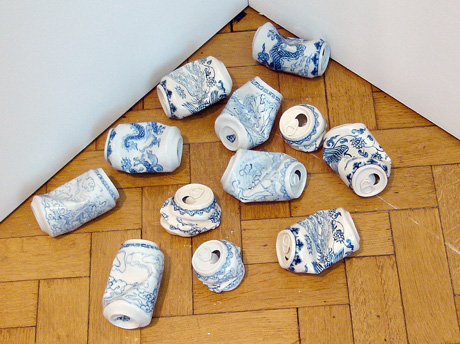
Another interesting find while searching for images. There’s a contemporary Chinese artist, Lei Xue, who’s making art out of handmade bone china. He’s taking ordinary objects and creating porcelain versions of them. Lately, he’s been making beer cans that are hand-painted and resemble Ming Dynasty vases.

porcelain-cans

The title of this piece is “Teetrinken.” It’s amazing how he’s captured the crumpled, flattened look of them.

porcelain-cans2

These porcelain beer cans littered in the corner were for an exhibition in Germany. I imagine they’re heavier than they look.


Filed Under: Art & Beer Tagged With: Cans

Beer in Art #2: Jasper Johns’ Painted Bronze

November 16, 2008 By Jay Brooks

art-beer
Our second installment of “Beer in Art” is another favorite of mine, and one I’ve seen the original of at a Jasper Johns exhibition at Berkeley I saw in the late 980s with an artist friend of mine. It’s official title is “Painted Bronze,” though most people refer to by what it represents, Ballantine Ale cans. Johns actually cast two beer cans in bronze and then painted them to look precisely like ordinary beer cans. The work stems from 1960, and gave the same treatment to other ordinary objects, such a Savarin coffee can filled with used paint brushes.

One analysis of the work, from US History Companion:

Johns’s views were undoubtedly influenced by the iconoclasm of the earlier dada movement and particularly by his idol, Marcel Duchamp, whom he sought out in 1960. After their initial meeting, Johns made a gesture worthy of Duchamp when he cast two beer cans in bronze and then painted them to look precisely like ordinary beer cans. This triple entendre clearly indicated how deeply Johns was engaged in the criticism of orthodox aesthetics, particularly the aesthetics of gestural painting, which he often parodied.

In an interview from 1974, Johns explains a little bit about the point of Painted Bronze.

Painted Bronze, two cans of Ballantine Ale cast in bronze, was one in a series of sculptures that came to define Johns’ theories of reality; like the pop art that followed it, his experiments with context sought to reconstitute “ordinary” objects in such a way as to highlight the power of the perceptual over the physical world. In 1964 he explained, as fulsomely as he ever would, what it was he was trying to do: “I am concerned with a thing’s not being what it was, with its becoming something other than what it is, with any moment in which one identifies a thing precisely and with the slipping away of that moment.”

Although there’s nothing about this work, Wikipedia has a good overview of Jasper johns, as does Answers.com. Also, the overview at Area of Design includes a few of his representative works throughout his career.

Filed Under: Art & Beer Tagged With: Cans

Molecular Beer

November 11, 2008 By Jay Brooks

I stumbled upon this interesting piece of digital art by a Maury Schallock. I suppose technically it’s not art, but a computer generated molecular model of a beer molecule. But it is beautiful, and reminded me of a very colorful galaxy.


Filed Under: Art & Beer

Beer in Art #1: Edouard Manet’s Bar at the Folies-Bergere

November 9, 2008 By Jay Brooks

Unless you’ve traveled with me, you probably didn’t know that one of my other geeky hobbies is art. I love going to art museums, especially obscure local ones, whenever I travel. And while I naturally check out what breweries there are wherever I go, I also consult Art Across America, a great reference book of art museums that tells you where they are, their hours and other basic information. So I’ve been thinking lately that I should share that passion and highlight the countless times when beer and art intersect. So once a week, I’ll bring you another work of art that has something to do with beer, alternating between old classics and modern interpretations. If you know of a piece of art featuring beer, please drop me a line or comment here and I’ll work it into the queue for future artistic posts.

We’ll start today with an undisputed masterpiece. Started in 1882, A Bar at the Folies-Bergère, by the French painter Édouard Manet, is a favorite of mine, not least of which because it features prominently bottles of Bass Ale in the painting with their distinctive red triangles.

Click on the image above for a larger view. From Wikipedia:

A Bar at the Folies-Bergère, painted and exhibited at the Paris Salon in 1882, was the last major work by French painter Édouard Manet. It depicts a scene in the Folies Bergère nightclub in Paris.

The painting is filled with contemporaneous details specific to the Folies-Bergère. The distant pair of green feet in the upper left-hand corner belong to a trapeze artist, who is performing above the restaurant’s patrons.

The beer which is depicted would have catered not to the tastes of Parisians, but to those of English tourists, suggesting a British clientèle. Manet has signed his name on the label of the bottle at the bottom left, combining the centuries-old practice of self-promotion in art with something more modern, bordering on the product placement concept of the late twentieth century.

But for all its specificity to time and place, it is worth noting that, should the background of this painting indeed be a reflection in a mirror on the wall behind the bar as suggested by some critics, the woman in the reflection would appear directly behind the image of the woman facing forward. Neither are the bottles reflected accurately or in like quantity for it to be a reflection. These details were criticized in the French press when the painting was shown. The assumption is faulty when one considers that the postures of the two women, however, are quite different and the presence of the man to whom the second woman speaks marks the depth of the subject area. Indeed many critics view the faults in the reflection to be fundamental to the painting as they show a double reality and meaning to the work.

The increased use of the new technology of photography began to free artists such as Manet to do more than merely imitate life. At any rate, Manet was confident enough to take liberties with literal transcription for the sake of composition.

For this great painting, the Getty has some good info, too. If you want to learn more about the artist, the Art Archive or the ArtCyclopedia are both good places to start.


Filed Under: Art & Beer

Drinking Art

November 8, 2008 By Jay Brooks

Here’s as quirky a piece of modern art a I’ve ever encountered. It’s by German artist Hannes Broecker, whose recent installation was exhibited in Dresden, Germany. The work is called “Drink Away The Art,” and is a series of flat, glass containers hanging on the wall filled with various colored cocktails, wine and beer. Drinking glasses were a part of the work, and gallery visitors were invited to each drain some of the drinks from off the hanging containers into a glass via a pressure-sensitive tap at the bottom of each one.

Drink Away The Art, a series of nine glass containers of alcoholic beverages.

Here you can see the taps protruding down at the right-hand corner of each container. Throughout each evening at the gallery, the levels of the liquids became lower and lower at varying intervals, creating new patterns every few minutes.

You placed your glass below the framed artwork, and drained some of whatever was in that particular container into it.


Filed Under: Art & Beer

Beer Bottle Cap Art

November 6, 2008 By Jay Brooks

sierra-nevada-crown
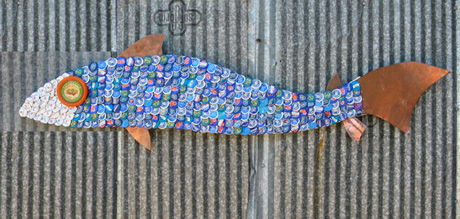
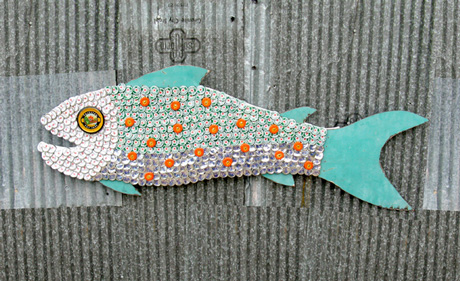
Ever wonder what to do with all those bottle caps amassed from opening your beer bottles? Well artist John T. Unger has figured out at least one thing to do with them: make beautiful fish art. Talk about taking trash and turning int o treasure. He takes varying used beer bottle crowns and uses them like tiles to make mosaics. Below is just a sample of his work, which can be purchased online, though they are a bit spendy (about $450 per fish). But they are very cool looking.

capart-1
This fish is made from a mixed palette of blue bottle caps with a white face of Becks caps.

capart-2
This fish is made from Bud Light, Heineken and Becks bottle caps.

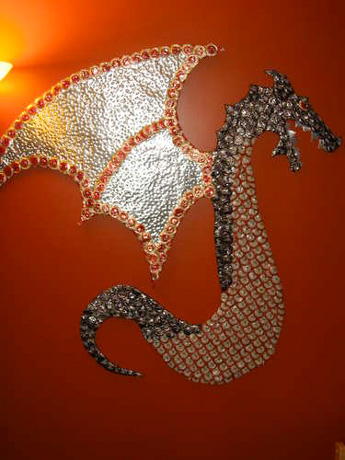
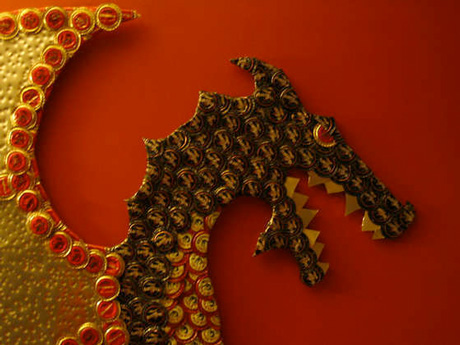
And inspired by Unger’s work with beer bottle crowns, the craft website Instructables has posted step-by-step DIY instructions to make a dragon wall-hanging using 540 beer bottle caps (170 Michelob Amber Bock, 206 Killians, 68 Budweiser Select, 96 Budweiser).

capart-3
540 crowns is 90 six-packs or 22.5 cases of beer.

capart-4
And here’s a close-up of the dragon.

Filed Under: Art & Beer Tagged With: Crowns, DIY

« Previous Page

Find Something

Northern California Breweries

Please consider purchasing my latest book, California Breweries North, available from Amazon, or ask for it at your local bookstore.

Recent Comments

  • Bob Paolino on Beer Birthday: Grant Johnston
  • Gambrinus on Historic Beer Birthday: A.J. Houghton
  • Ernie Dewing on Historic Beer Birthday: Charles William Bergner 
  • Steve 'Pudgy' De Rose on Historic Beer Birthday: Jacob Schmidt
  • Jay Brooks on Beer Birthday: Bill Owens

Recent Posts

  • Beer In Ads #5308: Wissembourg Heute Bock! August 1, 2026
  • Historic Beer Birthday: Henry Hess August 1, 2026
  • Historic Beer Birthday: Frederick Gettelman Jr. August 1, 2026
  • Beer In Ads #5307: Heute Bock Double Goats July 31, 2026
  • Historic Beer Birthday: Rita Daigle July 31, 2026

BBB Archives

Feedback

Head Quarter
This site is hosted and maintained by H25Q.dev. Any questions or comments for the webmaster can be directed here.