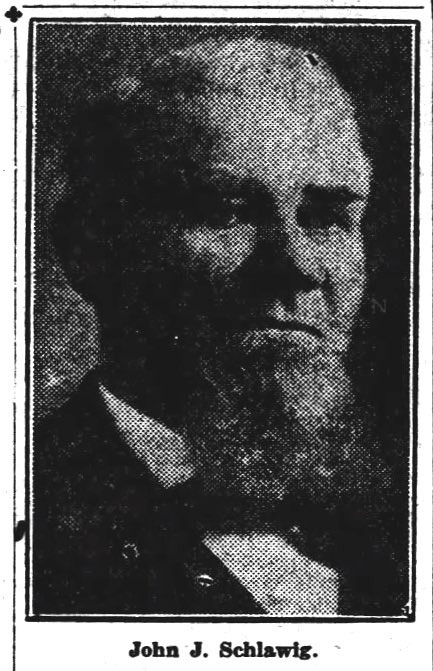
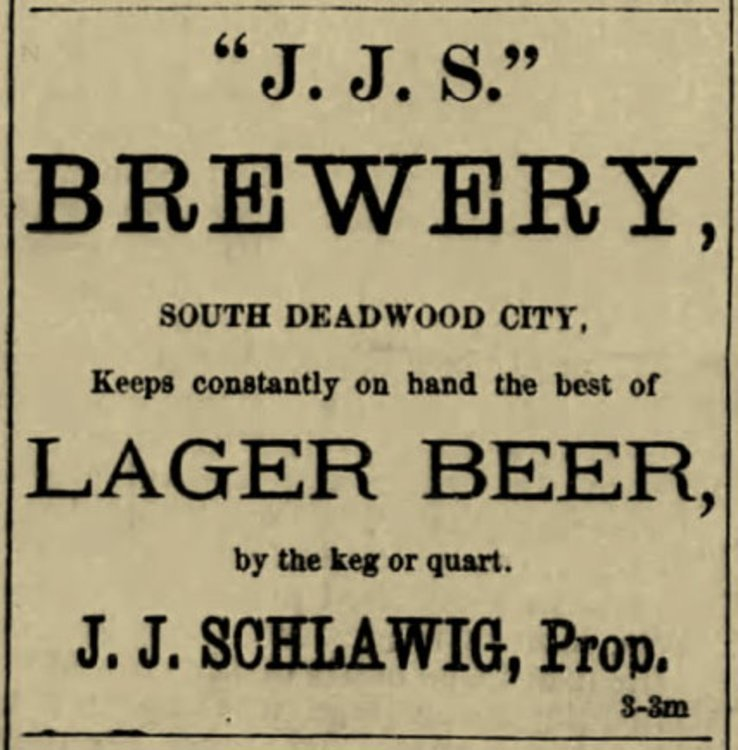
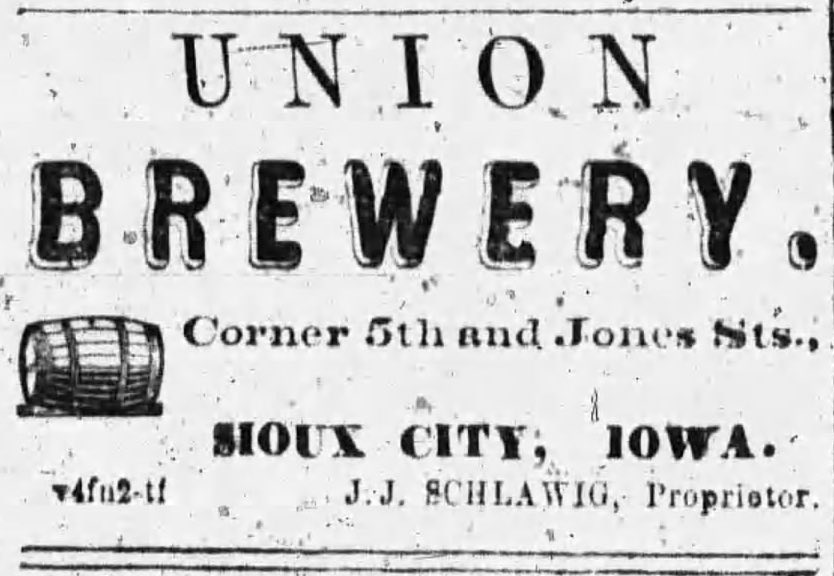
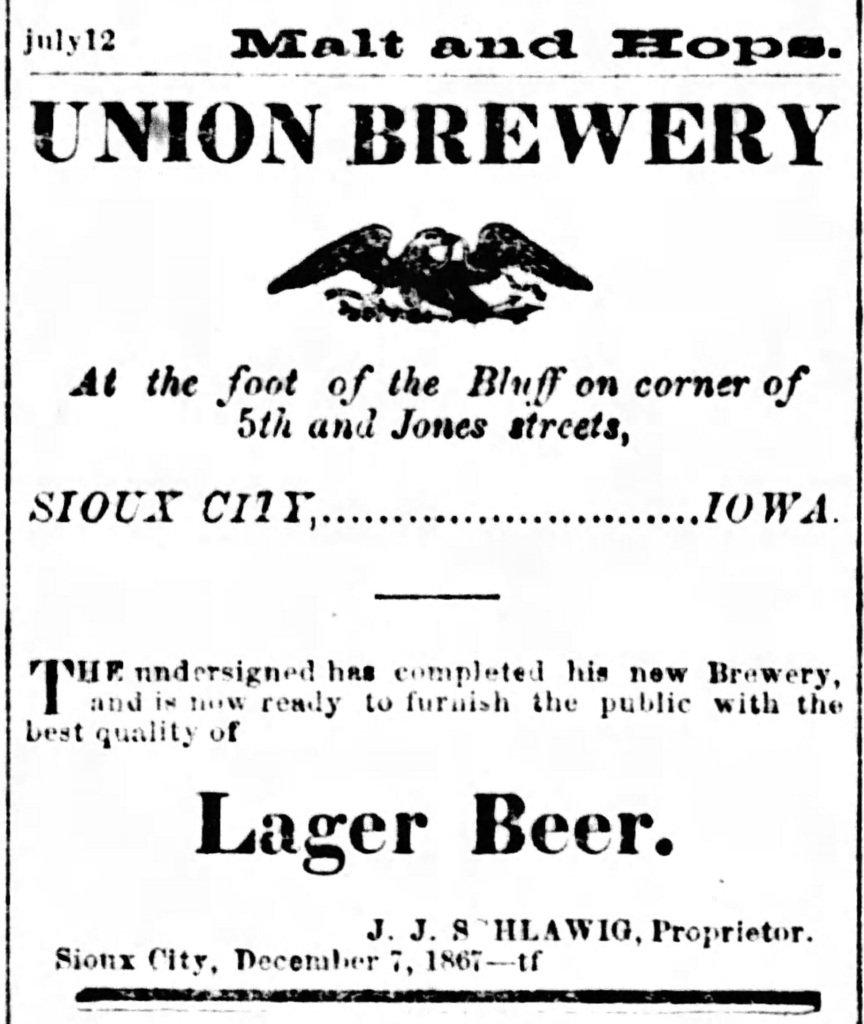
Today is the birthday of John Jacob Schlawig (February 27, 1831-October 11, 1919). He was born in Thusis, Graubünden, Switzerland but was a pioneer of Sioux City, Iowa, believed to be its longest resident at the time of his death in 1919. He married Ursula Haag on 20 September 1853, in Thusis, Graubünden, Switzerland and the couple moved to Iowa in 1857, settling in Sioux City. In 1867, he opened a brewery, the John Schlawig Union Brewery, which was only open until 1876. That same year, gold an silver were discovered in the Dakota Territories, and leaving his family in Iowa, became a miner off and on there for a number years. He also took his brewing equipment and established the J.J. Schlawig Brewery (a.k.a. as J.J.S. Brewery) in Deadwood, South Dakota, though it only lasted one year, closing in 1877.
Here’s a biography of Schlawig from The Sioux City Tribune from October 11, 1919:
J. J. Schlawig Dies, Aged 88 Years; Had Lived in Sioux City Since 1857. Pioneer Believed to Hold Record For Longest Residence Here. Taken By Death Before New Home Was Completed. Family Homestead Recently Sold.
John J. Schlawig, who is believed to have lived longer in Sioux City and to have witnessed more of its growth than any other man, died at 9 a.m. today at the home of his daughter, Mrs. C. A. Patch, 2324 Douglas street, from the infirmities of old age. Mr. Schlawig was born in Thusis, Switzerland. There he married Miss Ursula Haag, 67 years ago. His wife died here one month before the celebration of their golden wedding. He is survived by three daughters, one son, two grandsons and one granddaughter. Dr. J. J. Schlawig, a son, died here 17 years ago. The other son is Dr. William M. Schlawig, of Monument, Col., who has been in the city for the last week. The daughters are Miss Anna Schlawig, who has made the home for her father since the death of the mother; Mrs. R. E. Conniff, and Mrs. Patch at whose home he died. John B. and Arthur C. Patch and Miss Anna Marie Conniff are the grandchildren. He came to Sioux City 62 years ago. He was a wagon and carriage maker and manufactured the first wagon and the first carriage ever made in the city. In 1861 Mr. Schlawig enlisted in Company I of the Seventh Iowa cavalry, a civil war unit of which only two or three men survive. He served as bugler of the regiment and as bodyguard of General Sully. He participated in the White Stone battle.
This is from a “History of Woodbury and Plymouth Counties,” published in 1890:
John Jacob Schlawig, Sioux City. In the picturesque city of Thuses, Canton of Graubunden, Switzerland, February 27, 1831, there was born to one of the oldest families in that historic country an only son, the subject of this sketch, John Jacob Schlawig. His ancestry was prominently identified with the political history of Switzerland, and took an active part in the defense of their land against the invasion of other powers; and a grandfather fell in the gallant defense made against the French army in the battle of Richenan. His early education was acquired among his native hills, where he learned to love the freedom of his Fatherland, and despise the serfdom and oppression of neighboring monarchies. At the age of eighteen he removed to Chur, where he learned the trade of a carriage-maker. There he met and wedded, September 20, 1853, Miss Ursula Haag, the daughter of an old citizen of that city. For some years thereafter he followed his trade, but all the while longing for the greater possibilities offered in America to industry and integrity. In 1857 the dream of his youth was realized when he embarked for this country, taking with him his young wife and two children. On reaching America he pushed westward, believing that that region promised better opportunities to willing hearts and ready hands. He first stopped in Dubuque for a few months, then crossed the state overland by team to Sioux City. On this trip the second daughter, a child of two years, sickened and died, which well nigh discouraged him and his young wife, but they journeyed on, reaching Sioux City, then a frontier village, September 19, 1857. He immediately set to work to procure for himself and family a home. He erected a crude shop and worked at his trade, making and repairing wagons, and built the first wagon made in Sioux City. At the outbreak of the Civil war he offered himself as a volunteer in the defense of his adopted country, and served from 1861 to 1864 in the Seventh Iowa cavalry, Company I. He was with Gen. Sully in his famous expedition against the hostile Sioux, and took part in the battle of White Stone Hill and other engagements. At the close of hostilities he received his honorable discharge, and re-engaged in the wagonmaker’s trade in this city.
In 1875 he was one of the pioneers of the Black Hills, S. D., country, where he prospected extensively, and located several silver mines at Galena, which he afterward consolidated into the Washington Gold and Silver Mining company, of which company he is the principal owner and president. He also owns the Sula mine, at Lead City, S. D. His mining property is well located, and among the best and richest mines in that wonderfully productive mineral region. In the summer of 1890 he platted what is known as Sunny Side addition to Lead City, and a large part of which he still owns. His family consists of two sons and three daughters. The oldest son, John J., is a rising young physician, while the younger, William, is now in college, preparing himself for the practice of dentistry. Two daughters, Anna and Marie, are still at home, the other, Christina, is the wife of Dr. R. E. Conniff, of this city. Mr. Schlawig has always had abundant faith in the future of Sioux City, and has seen it grow from a frontier village to a city of nearly 40,000. He, with other old settlers, endured many of the privations of the early history of Sioux City. His industry and abiding faith in the future of the city have been rewarded by material prosperity, and we find him in his old age surrounded by the comforts of life, and with a competence that jjlaces him above want and secures for him that ease that his industry deserves. Mr. Schlawig is still a man in robust health, of a jovial, kindly disposition that makes and keeps friends, and is respected and esteemed by all that know him.
And this account is from Tavern Trove’s page for Schlawig:
John Jacob Schlawig was born in Thusis, Graubünden, Switzerland where he was trained as a wagon maker. In 1855 he emigrated to America with his wife Ursula (née Haag) and their two daughters. They reached their intended destination of Dubuque, Iowa that summer, but after only a few months they relocated to Sioux City.
In 1855 Sioux City was a hamlet situated on the banks of Perry Creek, far from the noise and nuisance of the lawless frontier town of Dubuque. The Schlawigs made Sioux City their home and John opened a wagon shop on Water Street. He participated in the local guard that defended the area from Sioux warriors who considered the land the property of the Sioux.
In 1861 John Jacob answered the patriotic call of his adopted country and enlisted in the Union Army. The U.S. generals sent him not south but west, to continue the battle with the Native Americans. After his service he returned to Sioux City and opened a brewery next to his home on 6th and Nebraska Street.
For a nearly a decade Schlawig was content in his brewery on the creek. He had three daughters and two sons at home. He took on Joseph Rechner as a foreman and they opened up The William Tell Beer Hall. By all accounts business was good.
Then in 1875 Iowa’s ever-changing Temperance laws caused business strife. The city sued Schlawig for breaking liquor and gambling ordinances. Then his former foreman and another employee sued him for back wages. All three verdicts came down against the brewer and like that, the tidy brewing empire Schlawig built was finished. Schlawig mortgaged the brewery property in February and offered it for sale in November.
In 1876 news came from the west that gold and silver was there for the taking in the Dakota Territory. Schlawig decided to check it out. At age 45 Schlawig filed a miners claim on Bear Butte and rushed back to Iowa in order to pack up his brewery equipment and relocate to the town of Deadwood. He arrived in April of 1876, and, while he retained his residence in Sioux City, over the next decade he spent less and less time there, and more time in the boom town nearly 500 miles away.
By July of 1876 Schlawig was mining by day and brewing at night and both enterprises were earning money. But within the year he will have abandoned the brewery in favor of his silver mine. In February of 1877, when he returned to Iowa he talked only of silver. In June of that year the Sioux City Journal reportedthat Schlawig’s brewery in Deadwood was sitting idle.
Up in the hills Schlawig had hit a vein of silver so rich that soon his brewery debts would soon be a small matter. The Washington Lode, as it was called, was one of the most valuable veins of silver in the Black Hills, and Schlawig had claim to a good bit of it. It ended up making him a very wealthy man.
With the help of Schlawig’s money Sioux City prospered and his old house on 6th and Nebraska Street grew old with him. By 1919 it was considered an eyesore in the business district, and also very valuable property. In April of 1919, 88 year old Schlawig was finally persuaded to move out of the home he built in the 1860s. By that October, he was dead.
John Jacob Schlawig died on October 11th 1919 at age 88 years.
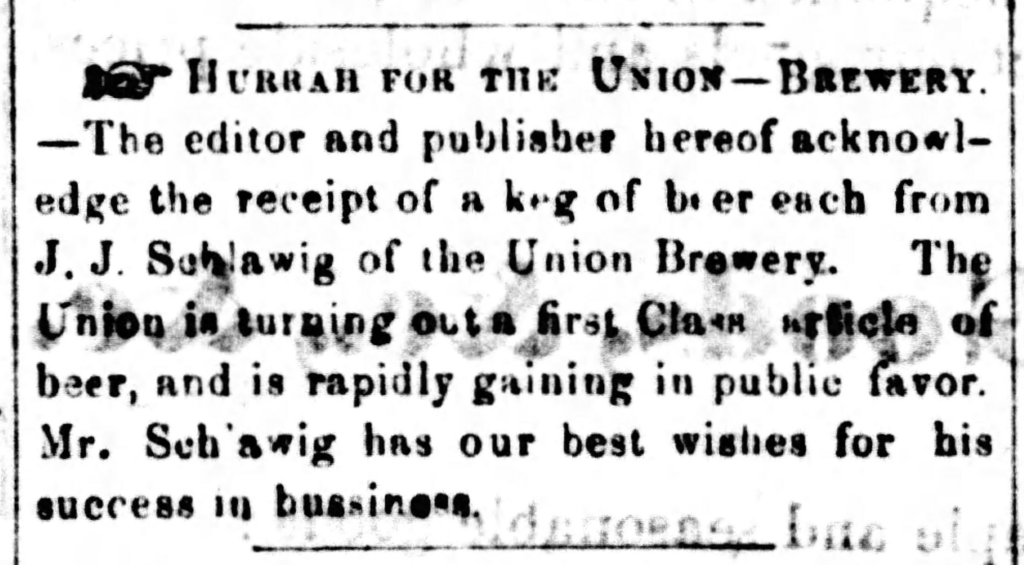
And this was published shortly after the brewery opened: