Brookston Beer Bulletin

Jay R. Brooks on Beer

  • Home
  • About
  • Editorial
  • Birthdays
  • Art & Beer

Socialize

  • Dribbble
  • Email
  • Facebook
  • Flickr
  • GitHub
  • Instagram
  • LinkedIn
  • Pinterest
  • RSS
  • Twitter
  • YouTube

Powered by Genesis

Former BJCP Treasurer Sentenced

December 29, 2008 By Jay Brooks

If you’ve spent anytime around BJCP judges or hardcore homebrewing types, you’ve probably heard the conversation inevitably turn to the name Bill Slack. Slack used to be the treasurer of the judge-certifying organization, but was shown the door after it was discovered that he’d helped himself to at least $31,000 of the group’s money (and more likely closer to $64,000). The case has been winding through the courts for some time now, and just before Christmas, the BJCP got an early present, as Slack was finally sentenced, essentially ending the proceedings.

Slack plead guilty in September. He could have received as much as 20 years in prison, though federal guidelines suggested 10-26 months. Instead, Slack received a more rare “intermittent” sentence in which he’ll spend one week each month for a year behind bars. Following that he’ll be on probation for five years, and will have to pay the BJCP back $43,139 in restitution.

I never met the Nashua, New Hampshire man, but according to the story in the Nashua Telegraph, he sounds like he may have been something of a nut job. In 1998, he was arrested on an unrelated charge, when he “point[ed] a shotgun at a teenage Telegraph carrier who was trying to collect money for his delivery route.” You’ve got to watch out for those newspaper delivery boys or they’ll rob you blind. And stealing is better left to the professionals.

 

Filed Under: Uncategorized Tagged With: Uncategorized

Beer in Art #8: Pieter Claesz’ Still Lifes With Beer

December 28, 2008 By Jay Brooks

Today’s works of art, like last week, also date from the 17th Century and are a trio of still lifes depicting several ordinary objects from daily life, including beer. They’re also by a relatively obscure artist, Pieter Claesz. He was a Dutch still life painter who painted most of his life in Haarlem, though he was born in Westphalia in what today is part of Germany.

The title of the first of today’s painting is Still Life with Overturned Jug, Glass of Beer, and Food, an oil on canvas painted in 1635. In his time, Claesz was considered one of the premiere painters of still life. A few years ago, when the National Gallery in Washington, D.C., did a retrospective of Claesz’ works, they described his contributions like this:

Pieter Claesz, who lived and worked in Haarlem between 1621 and 1660, was one of the most important Dutch still-life painters of the 17th century. Claesz pioneered the development of monochrome table-top still lifes (the so-called monochrome banketjes), quietly restrained works imbued with an extraordinary sense of naturalism. … Claesz reveled in capturing the effects of light and the different textures of objects through his varied handling of paint. He also included objects infused with symbolic implications, indicating that the viewer should reflect upon worldly transience and spiritual truths.

Several years later, in 1649, he painted Still Life With Drinking Vessels, which today is in London’s National Gallery.

The wineglass at the left is a ‘roemer’, and in the centre is an octagonal ‘pas-glas’, containing beer. The porcelain bowl is an example of Chinese export ware which can be dated to the Wanli period (1573 – 1619). The metal objects were most likely made of silver and pewter. Although the arrangement evokes an impression of simplicity and modesty, a contemporary viewer would have immediately recognised the costliness of the different objects.

The final painting, Still Life With Herring, was painted in 1636, and hangs in the Museum Boijmans Van Beuningen, in Rotterdam. There’s little information about the painting itself, other than “The stylistic phases and fluctuations in aesthetics through which the Dutch landscape passed had their direct counterpart in still-life. The silvery tone which dominates in this Still-life by Claesz, muting the colours and subtly adjusting the objects to each other, directly relates to the tonal direction landscape took after 1630.” It appears, however, that the glass on the table may be filled with beer.

There is a little more information about Pieter Claesz at Wikipedia, and also some more of his works at the Web Gallery of Art and ArtCyclopedia.


Filed Under: Art & Beer

Dave Barry on Beer At Christmas

December 25, 2008 By Jay Brooks

While searching for Christmas quotations, I happened upon this gem by Dave Barry. Although it wasn’t quite right for my Christmas post, I thought it was still funny enough to share.

In the old days, it was not called the Holiday Season; the Christians called it “Christmas” and went to church; the Jews called it “Hanukkah” and went to synagogue; the atheists went to parties and drank. People passing each other on the street would say “Merry Christmas!” or “Happy Hanukkah!” or (to the atheists) “Look out for the wall!”

            — Dave Barry, “Christmas Shopping: A Survivor’s Guide”


Filed Under: Uncategorized Tagged With: Holidays

Amber, Gold & Black

December 24, 2008 By Jay Brooks

Over at Real Beer’s Holiday Blog again, I posted a last minute gift idea that I thought I’d pimp here too, because I’m so impressed with it. British beer writer and historian Martyn Cornell published an e-book entitled Amber, Gold & Black: The Story of Britain’s Great Beers. It’s only available as a pdf so you can buy it online right now at the Corner Pub and have it in plenty of time for Christmas.


And not only is it easy to buy online, but it’s one of best books on beer styles ever written, the result of years of painstaking research that shatters many of the myths surrounding the origins of famous beer styles like Porters and India Pale Ales.

Chapters cover sixteen different beer styles and go into great detail about each one of them. Did I mention it’s also a pleasure to read? And it’s filled with photographs, graphics, beer labels and old brewery advertisements. No matter how much you think you know about beer, you’ll learn a great deal from Cornell’s efforts. And did I mention it’s a mere fiver? At just five pounds, it may well be the bargain of the year, too. Seriously, you should buy this book. One for yourself and at least one as a gift. It’s that good.

Here’s more information from the publisher:

Amber, Gold and Black, The Story of Britain’s Great Beers, by the award-winning beer writer Martyn Cornell, is the most comprehensive history of British beer styles of all kinds ever written, the true stories behind Porter, Bitter, Mild, Stout, IPA, Brown Ale, Burton Ale, Old Ale, Barley Wine, and all the other beers produced in Britain.

This ebook is a celebration of the depths of British beer, a look at the roots of the styles we enjoy today, as well as those ales and beers we have lost, and a study into how the liquids that fill our beer glasses, amber gold and black, developed over the years.

Astonishingly, this is the first book devoted solely to looking at the unique history of the different styles of beer produced in Britain.

If you read about beer online a lot, you may already know Cornell’s work, though perhaps not his name. Martyn Cornell also writes online as The Zythophile, easily one of the most informative and interesting beer blogs on the planet.


Filed Under: Uncategorized Tagged With: Uncategorized

‘Twas The Brewer’s Night Before Christmas

December 24, 2008 By Jay Brooks

christmas
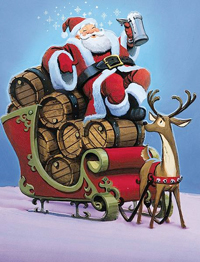
It’s Christmas Eve again and time once more for the brewer’s parody of The Night Before Christmas, or A Visit From St. Nicholas. Enjoy! Happy Christmas.

santa-kegs

‘Twas The Brewer’s Night Before Christmas

‘Twas the night before Christmas, and all through the house,
Every creature was thirsty, including the mouse…
The steins were empty, and the bottles were too
The beer had been drunk with no time to brew.

My family was nestled all snug in their beds
While visions of Christmas Ale foamed in their heads.
Mama in her kerchief lamented the drought,
She craved a pilsner and I, a stout.
                              santa-head
When out on the lawn, there arose such a clatter,
I sprang from my chair to see what was the matter.
Away to the kitchen, I flew like a flash,
Opening the door with a loud bang and crash!

I threw on the switch and the lights, all aglow,
Gave a luster of mid-day to the brew-pot below.
When, what to my wondering eyes should appear
But Gambrinus himself, the patron of beer.
                              santa
With a look in his eye, so lively and quick,
He said, “You want beer? Well, here, take your pick.”
More rapid than eagles, his recipes came
As he whistled and shouted and called them by name.

“Now, Pilsener! Now, Porter! Now, Stout and Now Maerzen!
On, Bitter! On, Lager! On, Bock and On Weizen!”
“To the top of the bottles, the short and the tall,
Now brew away, brew away, and fill them all!”
                              christmas-beer
As dried hops before a wild hurricane fly,
And then, without warning, settle down with a sigh,
So towards the brew-pot, the ingredients flew,
Malt extract, roasted barley and crystal malt, too.

And then in a twinkling, I heard it quite plain,
The cracking open of each barley grain.
As I drew in my head and was turning around,
Into the kitchen, he came with a bound.
                              santa-claus
He was dressed like a knight, from his head to his toes,
With an old family crest adorning his clothes.
A bundle of hops, he had flung on his back,
And the brewing began when he opened his pack.

His hops were so fragrant! His barley, how sweet!
The adjuncts included Munich malt and some wheat.
The malted barley was mashed in the tun,
Then boiled with hops in the brew-pot ’till done.
                              santa
Excitement had me gnashing my teeth,
As the sweet smell encircled my head like a wreath.
Beer yeast was pitched, both lager and ale,
The wort quickly fermented, not once did it fail.

It was then krausened, or with sugar primed,
And just being bottled when midnight had chimed.
A wink of his eye and a twist of his head,
Soon gave me to know, I’d be shortly in bed.
                              santa-head2
He spoke not a word but kept on with his work,
And capped all the bottles, then turned with a jerk.
And laying a finger alongside his nose,
He belched (quite a burp!) before he arose.

Clean-up was easy, with only a whistle,
And away the mess flew, like the down on a thistle.
And I heard him exclaim, ‘ere he left me the beer,
“Merry Christmas to all and a HOPPY New Year!”

                              santa-sleigh

 
Thanks to Steve Altimari from Valley Brewing, who sent me this parody of Clement C. Moore’s “A Visit from Saint Nicholas,” first published in 1823. The original version is on Wikipedia along with much more information about the poem.

In addition to this one, there are also numerous other parodies of the famous poem. I especially got a chuckle out of the lawyer’s version. For a truly staggering collection of these check out the Canonical List of ‘Twas the Night Before Christmas Variations, with 849 different versions of The Night Before Christmas.


Filed Under: Just For Fun Tagged With: Holidays, Humor

Joe Sixpack’s 50 World’s Best Christmas Beers

December 23, 2008 By Jay Brooks

Yesterday, over at Real Beer’s Holiday Blog, with Don Russell’s permission I posted his choices for the World’s 50 Best Christmas Beers, taken from his new book, Christmas Beer. It’s a fun list, with some fine beers on it. Just over half the beers on the list are from abroad. Most I agree with; only a couple I would not have put on the list and there are only a few I think are missing. I figured he wouldn’t mind if I posted them here as well. What do you think of the list? What would you have done differently in compiling such a list?


World’s 50 Best Christmas Beers, as Selected by Don Russell a.k.a. Joe Sixpack

  1. Mad Elf Ale; Troegs Brewing, Pennsylvania
  2. Avec les Bons Voeux; La Brasserie Dupont, Belgium
  3. Samichlaus Bier; Schloss Eggenberg, Austria
  4. Stille Nacht; Brouwerij De Dolle Brouwers, Belgium
  5. Our Special Ale; Anchor Brewing, California
  6. Celebration Ale; Sierra Nevada Brewing, California
  7. Samuel Smith’s Winter Welcome Ale; The Old Brewery at Tadcaster, England
  8. Winter Solstice; Anderson Valley Brewing, California
  9. Old Jubilation; Avery Brewing, Colorado
  10. Ringnes Julebokk; Ringnes Bryggeri, Norway
  11. Delirium Noel; Brouwerij Huyghe, Belgium
  12. Baladin Noel; Birrificio Le Baladin, Italy
  13. Gouden Carolus Noel; Brouwerij Het Anker, Belgium
  14. La Binchoise Reserve Speciale; Brasserie La Binchoise, Belgium
  15. Corsendonk Christmas Ale; Brouwerij Corsedonk, Belgium
  16. Mahr’s Christmas Bock; Brauerei Mahr, Germany
  17. Affligem Noel; Brouwerij Affligem, Belgium
  18. Hibernation Ale; Great Divide Brewing, Colorado
  19. Santa’s Private Reserve Ale; Rogue Ales Brewery, Oregon
  20. Smuttynose Winter Ale; Smuttynose Brewing, New Hampshire
  21. Alpha Klaus; Three Floyds Brewing, Indiana
  22. Winter-Traum; Klosterbrauerei Weltenburg, Germany
  23. Scaldis Noel; Brasserie Dubuisson Freres, Belgium
  24. Winter White Ale; Bell’s Brewery, Michigan
  25. 2° Below Ale; New Belgium Brewing, Colorado
  26. La Dragonne; BFM Brasserie des Franches-Montagnes, Switzerland
  27. Ebenezer Ale; BridgePort Brewing, Oregon
  28. La Choulette de Noel; Brasserie la Choulette, France
  29. St. Nikolaus Bock Bier; Pennsylvania Brewing, Pennsylvania
  30. St. Feuillien Cuvee de Noel; Brasserie St. Feuillien, Belgium
  31. Jenlain Noel; Brasserie Duyck, France
  32. Hitachino Nest Commemorative Ale; Kiuchi Brewery, Japan
  33. Doggie Claws; Hair of the Dog Brewing, Oregon
  34. St. Bernardus Christmas Ale; Brouwerij St. Bernardus, Belgium
  35. Heavy Seas Winter Storm; Clipper City Brewery, Maryland
  36. Goose Island Christmas Ale; Goose Island Beer, Illinois
  37. Petrus Winterbeer; Brouwerij Bavik, Belgium
  38. Longfellow Winter Ale; Shipyard Brewing, Maine
  39. Kerst Pater; Brouwerij Van den Bossche, Belgium
  40. Samuel Adams Old Fezziwig; Boston Beer, Massachusetts
  41. Alaskan Winter Ale; Alaskan Brewing, Alaska
  42. Geary’s Winter Ale; D.L. Geary Brewing, Maine
  43. Snow Goose Winter Ale; Wild Goose Brewery, Maryland
  44. Pere Noel; Brouwerij De Ranke, Belgium
  45. Old Man Winter Ale; Southern Tier Brewing, New York
  46. ‘t Smisje Kerst; Brouwerij De Regenboog, Belgium
  47. Young’s Winter Warmer; Wells & Young’s Brewing, England
  48. Snow Cap; Pyramid Breweries, Washington
  49. Nutcracker Ale; Boulevard Brewing, Missouri
  50. Monchshof Weihnachtsbier; Kulmbacher Brauerei, Germany

 
Though I’m not sure where, I would have included Lagunitas’ Brown Shugga, perhaps craft beer’s happiest accident, He’Brew’s Jewbelation, Marin’s Hoppy Holidaze, and Port Brewing’s Santa’s Little Helper. As for what I’d displace to make room for these, well that’s obviously trickier. Though I must confess that I’m not a fan of Anderson Valley’s Winter Solstice. I find the vanilla flavors waaaay to overpowering so that would be the first to go.


Excerpted from Don Russell’s wonderful new book, Christmas Beer, the season’s most ideal stocking stuffer. Pick up a copy for every beer lover on your shopping list at Amazon or buy one directly from the author.
 

Filed Under: Uncategorized Tagged With: Holidays

Blue Is the Most Drinkable Color

December 23, 2008 By Jay Brooks

Blue is the most drinkable color. That will be $100,000 for services rendered, thank you very much. Ah, such is the life of a marketeer. Given that life-sustaining water, which accounts for about 60% of our bodies, 70% of our brains and 90% of our lungs, is literally the stuff we’re made of, it’s quite remarkable that you’d need an expert to tell you that anything that associates consumers with water will perceived quite positively, especially if you’re selling a beverage that’s made mostly of water.

But last week, Anheuser-Busch unveiled plans to upgrade their packaging on Bud Light to give it a shot in the arm. I wasn’t going to write about this one. I really wasn’t. All of the big beer companies do this from time to time. They revamp their packaging, releasing press releases that all but tout it as the second coming. It’s frustrating, and doubly so because it usually works. I know good packaging is a must in our consumerist world, and that you must continually tweak it to keep it “fresh” otherwise people stop looking if it’s always the same. But I can’t help by being continually dumbfounded at how absolutely predictable and easily manipulated we all are. Look, shiny object … must touch … must buy. Sheesh, how pathetic. We all pride ourselves on our individuality but at the end of the day we’re more alike than we care to admit, myself included. And boy do marketers have our number. Pick up any recent book on the science of marketing and you’ll be astounded at the level of detail by which marketers can accurately predict our behavior. (For two good places to start, try Paco Underhill’s Why We Buy: The Science of Shopping or Douglas Rushkoff’s Coercion: Why We Listen To What “They” Say.) So, as I said, I was going to leave this latest one go, as I’ve beaten this dead horse time and time again.

What changed my mind was a surprisingly hilarious column in the St. Louis Post-Dispatch by Kevin Horrigan entitled New! Improved! Drinkable!. Given that it was written in St. Louis, it’s delightfully snarky, but perhaps now that the new regime is in perhaps it’s finally possible to criticize the local 100-lb. gorilla and get away with it in a way not possible a month ago. Jeremiah McWilliams, the Post-Dispatch’s usual man on the job when it comes to beer wrote about it earlier, but just related the facts with little commentary or asides.

And naturally, the AP towed the party line as well, with Emily Fredrix’s article passing along such wisdom as these choice nuggets:

The change comes as analysts say more people are buying beer instead of higher-priced wine and spirits.

“As the choices continue to grow for consumers, you also have to tell them what is it about this brand in the bottle,” Keith Levy, vice president of marketing, said recently.

The plastic label on Bud Light’s new bottles is 27 percent larger than the current label and touts “drinkability.” The cans, which are nearly all blue, feature the word “refreshment.”

Levy said the shift to blue came after extensive research showed the color helped drive home the message of refreshment.

And that’s where Horrigan picks up the story, taking the idea of “drinkability” (a 17th century word A-B recently appropriated as its own, it wold be interesting to see how fast the lawsuits fly if someone else tried to use the word now) and his article shows how ridiculous A-B’s marketing department’s use of the word really is. Here’s a sample of what he writes:

Literature fanbase, are you tired of reading ordinary newspaper columns? Why not try our new column, with superior readability?

Ordinary columns go down harsh. Our new column goes down smooth, with no bitter aftertaste. That’s what we call readability, a concept pioneered by our German wordmeisters.

They came to this country with but one thing on their minds: producing a newspaper column that would have superior readability. What’s that mean? Simply put, it means we don’t string words together like the Germans do, like schicklegruberhofmeistergesselschaft (literally, the “guy with the razor who grubs in the barn company”). No, we use short words. English words. Easily digestible words.

Readable words.

As cannily effective as that is, it was this next line that really got me back in the game, writing about this nonsense. After spending millions promoting the concept of “drinkability,” the next phase is to change the color of Bud Light’s packaging: the labels, the cans, the six-pack carriers and the mother cartons, all redone with a “fresh” new color scheme favoring blue. Why blue, you may rightly ask? Here’s how Horrigan puts it. “Because expensive marketing studies indicate that the color blue suggests ‘refreshment.'”

If you’re drinking something, now would be the perfect time to involuntarily spray/spit it out in surprise and horror. Really, people will associate the color of water, which is refreshing, with refreshment? How many advanced degrees, consumer focus groups and surveys and polls with appropriate statistical number crunching do you think led them to make so bold a proclamation as “the color blue suggests refreshment?”

What’s more amazing, is that armed with that insight, they’ve made the decision to make the packaging blue, wth the fir belief that this change will therefore make it sell better, too. If that were really so, wouldn’t every package of any sort of drinkable liquid for sale, alcoholic or not, be blue by now to tap into our subconscious desires for something refreshingly blue? Pepsi is blue. Foster’s is blue. Why aren’t they the number one brands in their categories. Coca-Cola seems to be doing reasonably well with their red packaging. Doesn’t red suggest heat. Why would anyone looking for refreshment choose Coke?

I hope you already know the answers to those questions. Marketing is all about manipulation. It’s the practical application of propaganda for business purposes pioneered during World War I by our government to “persuade” us that going to war was not only a good idea, but necessary for our own safety. Ever since, it’s been the same story before every war our politicians have dragged us into. Hitler was so impressed by how effective our World War I government propaganda was that it inspired him to create an entire department devoted to propaganda headed by Joseph Goebbels after he came to power and created Nazi Germany. It was called The Ministry for Public Enlightenment and Propaganda. Isn’t it comforting to know that advertising and marketing has such an impressive heritage and lineage? Modern day P.R. (a phrase coined specifically to avoid the negative connotations that propaganda took on during World War II) and marketing is a direct result of what was learned in the early part of the last century about how to manipulate people in such a way that they would not only do what you wanted, but think it was their idea. If you think that’s no longer going on or that we’re all too smart to fall for such tactics then you’re really not paying attention to the realities of the world. If anything, it has gotten much more sophisticated. Marketing really can make you see white but think its black.

But let’s return to the concept of “drinkability,” a term A-B has toyed with for a number of years before deciding to make it the cornerstone of their latest marketing assault. It’s sure sounds like something you’d want in a drink. But does is have any intrinsic meaning? None whatsoever. It merely means “suitable for drinking,” which fairly defines any liquid that won’t kill you or make you sick if you drink it. It’s hardly some magic idea that any particular drink will have more suitability than another. It’s subterfuge, a gimmick, a deception. But what’s perhaps most chilling about propaganda, is that despite all the science and literature that’s available about it, along with the research and science that forms its basis, it continues to work so effectively. If anything, it works better now than it did a century ago because it is understood today so much more fully and it is generally implemented in such as way that most people have no idea it’s even happening or that they are being manipulated.

Have another look at how the concept of “drinkability” is being sold, as quoted in the AP article:

“Bud Light’s new look will reflect the key attributes of the brand we are touting in all our marketing – drinkability and refreshment,” said Keith Levy, vice president of Marketing, Anheuser-Busch. “Drinkability offers a unique way to express a range of product benefits through a single term. It’s that just right taste – not too heavy or light – that sets Bud Light apart from other light beers.”

Not to put too fine a point on it, but really, nothing sets one light beer apart from any other light beer. That’s what makes them light beers, in a sense. If it weren’t for marketing and advertising, they almost would be interchangeable commodities. I have judged “American-style Light Lagers” at the Great American Beer Festival, and there are precious little differences in the taste of the these beers as made by the large breweries. I’ve been training my palette almost continually for nearly twenty years and it was one of the hardest categories I’ve ever judged, simply because of how alike they were. And it discussing them with my fellow judges, I was not alone in this. It was the general consensus. You end up searching more intensely for any defects, no matter how slight, just as a way to distinguish them from one another. There are slight variations in taste that can be perceived, but they are so superficial that they’re almost meaningless.

That’s where marketing comes in. Millions are spent to convince us that one light beer is different from another. And everybody falls for it, brand loyalty is created and money is made. But blue is also the color of sadness, a cold and lonely blue. That’s how this makes me feel. Blue. Sigh.
 

Filed Under: Uncategorized Tagged With: Cans

Beer in Art #7: Gabriel Metsu’s The Old Drinker

December 21, 2008 By Jay Brooks

Today’s work of art is dates from the 17th Century and depicts an elderly gentlemen enjoying his vices, both beer and tobacco. It’s by a relatively obscure artist, Gabriël Metsu. He was a Dutch painter who lived most of his life in Leiden, and his father was also a painter.

The title of today’s painting is The Old Drinker, which is at the Rijksmuseum in Amsterdam. The museum describes the painting like this:

On this minuscule panel, measuring just 22 x 19.5 cm, Gabriël Metsu painted with minute detail this everyday scene of an old man with his Gouda pipe. Gouda pipes are white and have a long, slender stem and a small bowl. They were mass produced from around 1617 in the Gouda area, where white pipe clay (terra alba) was readily available. Copper moulds were used to model the clay, which was subsequently fired in the kilns of local potters. Pipes manufactured in other cities usually had shorter stems, but long stems were popular because they cooled the smoke better. However, they were difficult to produce, and the pipe-makers of Gouda were the only manufacturers with the necessary expertise. and his pewter jar leaning on against a beer barrel. The old drinker looks rather the worse for wear; he sags rather than sits on the chair as he peers through his watery eyes, his chin unshaven, his collar open and his cap askew. Metsu presents the man with a direct honesty and realism that is not in fact harsh; the smile and the friendly eyes of the old drinker lend a certain sympathetic quality.

In more general terms they later discuss the symbolism in the painting.

In the seventeenth century, there was a belief that smoking and drinking in excess accelerated the aging process. Paintings of ‘old drinkers’ are often a reference to this idea. This work is perhaps a warning to avoid excessive indulgence in alcohol and tobacco.

There is a little more information about Gabriel Metsu at Wikipedia, and also some more of his works at the Web Gallery of Art and his official website.


Filed Under: Art & Beer

Santa Labels

December 20, 2008 By Jay Brooks

I’ve written recently about further efforts by neo-prohibitionist groups to take Santa Claus away from his heritage and out of the hands of adults entirely. As the patron saint of brewers, this effort is naturally misguided, but then so is virtually everything that these chuckleheads undertake. I came across this website from Japan today that collects a number of holiday beer labels from around the world, many of which feature Santa Claus prominently, and several of which I’d not seen before. This nicely illustrates how little issue the rest of the civilized world has with Santa Claus being associated with beer. Below is a sample of the labels.


This one’s from the Ukraine.
 

And this one’s from Poland.
 

The X-mas Gueuze is from Belgium.
 

And this last one’s also Polish.

Check out the rest of them.


Filed Under: Uncategorized Tagged With: Holidays

Bullies 2, Beer 0

December 19, 2008 By Jay Brooks

bully
It’s very sad to me, but the truth is despite all the rhetoric we heap on our kids about bullying never working, it really is an accepted practice in adult society. It’s no wonder kids turn to bullying when they see it modeled for them in countless ways throughout society. To look at me today, you’d never know I was a skinny runt of a kid until I bulked up in junior high school, first growing what was then called “husky” and then stretching taller to lose some of the — ahem — husk. And that meant that I did have several early encounters with bullies to the point where I have essentially a zero tolerance policy for bullying. Few things work me into a lather quite like a bully. And while it would be nice to believe that those same schoolyard thugs grow to realize the error of their ways, the sad fact is that many incorporate such philosophies into their adult life. Violence, fear and threats are all around us from the macro view of governments flexing their collective muscles and going to war down to the microcosm of individuals throwing their weight around in small ways; cutting people off in traffic, ignoring people in retail lines and stepping to the front, and generally throwing their weight around knowing that they can get away with it because most people don’t like confrontation. You also see it publicly in politics, sports, college hazing, the military, the workplace and even online where a lack of face-to-face cues often allows people to write things they would never say to another human being in person.

But where I’m noticing it more and more lately is in the neo-prohibitionist community’s aggressive bullying of society and their targets, the alcohol companies themselves. It sure feels like they look at the rest of us as less than human, to be pushed around, threatened and cajoled, using fear to make us tow their line, as if we were all children who didn’t know any better. Their world seems to allow for only one opinion and woe be to anyone with a contrary one. I personally have been threatened by one of these groups with legal action.

Here’s how Wikipedia defines a bully:

Bullying is the act of intentionally causing harm to others, through verbal harassment, physical assault, or other more subtle methods of coercion such as manipulation. … Bullying is usually done to coerce others by fear or threat.

That’s certainly the tactics used recently by several neo-prohibitionist groups to stop people from raising money for pediatric cancer and also to stop MillerCoors from selling their Alcopop Sparks. And unfortunately for decent society, their bullying tactics are working. They claim to want to protect kids, of course, but what kind of message does bullying send to them? “By any means necessary” is obviously their motto but I can’t help but think that has a cost to society that they’re overlooking (or simply don’t care about).

The Marin Institute, the CSPI and Join Together is crowing about MillerCoors’ decision to stop making Sparks. They’ve also settled disputes with thirteen states attorney and the City of San Francisco. Back in September, Sparks came under fire once more when the horribly misnamed CSPI filed suit. (They’re not remotely interested in the public interest, just a narrow sliver of it that agrees with their agenda.) I wrote at the time that it was a slippery slope for the beer industry not to support MillerCoors and I continue to believe that.

Then there was the Running of the Santas, a charity event in 25 cities to raise money for kids with cancer, which both the CSPI and Join Together objected to because people dressed up in Santa Claus suits, ran two blocks and — gasp — drank alcohol. They were very concerned that kids might see Santa drunk, but apparently not concerned that money was being raised to find a cure for pediatric cancer. Priorities, I guess. But what sort of person thinks it’s more important to stop kids from the mere potential of seeing drunken Santas than to find a cure for the cancer these same kids may soon die from? Anheuser-Busch had already bowed to their bullying and withdrew their support. Now MillerCoors has reportedly done likewise, according to Join Together.

I certainly understand these decisions by MillerCoors, at least from a business perspective. They’re in business to make money. Period. They’re not in business to tackle complex social issues of morality or take on the self-righteous factions of our world. I get that.

Still, there’s a part of me that wishes they’d man up and take on the bully, because that’s the only way to stop one. Bullies count on the fear and the threats that are their stock in trade. It’s that very corporate rule that business is all that matters — legally all that really can matter — that these bullies are using as a wedge to further their agenda. They know that the alcohol companies cannot be perceived as being in favor of underage drinking or people overindulging, and so they paint a false portrait of just that, suggesting the very opposite of what is in the company’s best interests to win over public sympathy. It’s the worst kind of propaganda. Bullying is not exclusively a childhood problem, but one that lingers throughout our lives, it’s only how we deal with a bully that defines us. And that’s perhaps what is scariest of all, that bullying continues to work time and time again. And it will keep on working until we stand up to the neo-prohibitionists.

I’ll leave you with a couple of great quotes that neatly express why I feel propaganda is so pernicious and why we must stand up to the bullies who use it.

“Propaganda is to a democracy what the bludgeon is to a totalitarian state.”
          —Noam Chomsky, Media Control: The Spectacular Achievements of Propaganda, 1997


“When any government, or any church for that matter, undertakes to say to its subjects, ‘This you may not read, this you must not see, this you are forbidden to know,’ the end result is tyranny and oppression, no matter how holy the motives. Mighty little force is needed to control a man whose mind has been hoodwinked; contrariwise, no amount of force can control a free man, a man whose mind is free. No, not the rack, not fission bombs, not anything—you can’t conquer a free man; the most you can do is kill him.”
          —Robert A. Heinlein, If This Goes On, 1940

Filed Under: Uncategorized Tagged With: Uncategorized

« Previous Page
Next Page »

Find Something

Northern California Breweries

Please consider purchasing my latest book, California Breweries North, available from Amazon, or ask for it at your local bookstore.

Recent Comments

  • Bob Paolino on Beer Birthday: Grant Johnston
  • Gambrinus on Historic Beer Birthday: A.J. Houghton
  • Ernie Dewing on Historic Beer Birthday: Charles William Bergner 
  • Steve 'Pudgy' De Rose on Historic Beer Birthday: Jacob Schmidt
  • Jay Brooks on Beer Birthday: Bill Owens

Recent Posts

  • Beer In Ads #5217: The King Of All Beers April 11, 2026
  • Historic Beer Birthday: Gambrinus April 11, 2026
  • Beer In Ads #5216: The Finest Bock, As Usual April 11, 2026
  • Historic Beer Birthday: Anton Heeb April 11, 2026
  • Beer In Ads #5215: Another Load Of “Milwaukee’s Choicest” April 10, 2026

BBB Archives

Feedback

Head Quarter
This site is hosted and maintained by H25Q.dev. Any questions or comments for the webmaster can be directed here.