Brookston Beer Bulletin

Jay R. Brooks on Beer

  • Home
  • About
  • Editorial
  • Birthdays
  • Art & Beer

Socialize

  • Dribbble
  • Email
  • Facebook
  • Flickr
  • GitHub
  • Instagram
  • LinkedIn
  • Pinterest
  • RSS
  • Twitter
  • YouTube

Powered by Genesis

Fanning the Flames of Phony Fears

September 11, 2006 By Jay Brooks

The mainstream media, well El Paso, Texas anyway, is once again fanning the flames of fear with distorted statistics. They’re using the same misguided survey by the Wine and Spirits Wholesalers of America (WSWA) which others have already shown to be faulty at best and purposely distorted at worst, including Free the Grapes and myself, not once, but twice.

I’m sure this isn’t the only community newspaper trying to fan the flames of another prohibition, but they’ve used some clever tactics in their piece, whether inadvertently or not, that bear examining.

First let’s look at the title that Diana Washington Valdez of the El Paso Times uses for her story: “Youths use Web to buy beer, liquor.” Notice how wine is absent from the title? She does mention wine at the end of the first paragraph, but for the many people who only skim the headlines it reinforces the carefully managed stereotype of wine as angelic and beer and spirits as demonic. I don’t necessarily think this sort of thing is done consciously, but it shows how ingrained those perceptions really are. If you want to catch peoples’ attentions with a headline, pick on liquor and beer, wine won’t generate the same level of fear.

The article trotted out these recent gems:

Millions of underage youths are buying alcoholic beverages over the Internet or know someone who does, according to a survey commissioned by the Wine and Spirits Wholesalers of America in Washington, D.C.

The association also found that 20 states are easing up on the sales of alcohol from Web sites — without adopting corresponding measures to prevent youths from using such sites.

“This is a dangerous situation,” said Stan Hastings, association chairman. “For the first time, we have hard evidence that millions of kids are buying alcohol online and that the Internet is fast becoming a high-tech, low-risk way for kids to get beer, wine and liquor delivered to their home with no ID check.”

The survey is unique because news about the alarming trend comes from an organization that represents the alcohol industry.

This “millions of underage youths” is simply poppycock. The figure is just plain wrong. See my earlier post to take a closer look at how they arrived at this figure, but suffice it to say it’s not using anything resembling a scientific method.

What I find more interesting is that last sentence that while acknowledging that the study was done by an organization which, in their words, “represents the alcohol industry,” the author accepts that at face value. Not only doesn’t she question whether there’s any ulterior motive, but she even suggests that because the WSWA dd the survey that the results are more “alarming.” This is a person, mind you — I think they call them re-port-ers — whose job it is to find out and report the truth. Apparently never once did it occur to ask “why” the WSWA might have even sponsored such a survey. Now why is one of the five Ws in journalism, so I don’t think I’m off base here to expect her to ask that question.

Of course, if she had looked into the WSWA’s agenda, she would have discovered she had no story. Because the WSWA has just as much interest in scaring parents as the El Paso Times does. They don’t want internet sales of alcohol for one very simple reason: it will cut into their monopoly on alcohol sales. The WSWA represents the interests of wholesalers whose business depends on their maintaining exclusive territories to sell their wine and spirits. If someone else can sell alcohol in the same place they do, it will mean they’ll have to compete on price and they’ll no longer have a monopoly. So is it very surprising that a study they commissioned would find that sales they’re not making money on constitutes a problem? And, of course, the surest way to find support for yourself is to align yourself with protecting children. It’s always about the kids, never about the money.

Then the article turns to local concerns:

Another research finding is that little enforcement exists in this area, something that ought to concern parents.

Lt. Mark Decatur, an enforcement official in El Paso for the Texas Alcoholic and Beverage Commission, said the TABC conducted an operation two years ago aimed at identifying Web sites that made it easy for teenagers to buy alcohol.

“We found that a lot of people sold to kids over the Net,” he said. “The investigation used the children of TABC employees (as decoys) that used their parents’ credit card to place orders. Since then, we have taken steps in Texas to make changes in the law to address this.”

Of course, placing orders is not the same as the kids actually receiving any alcohol. They claim to have taken “steps” to address this problem, but unless I’m missing something, it’s been illegal to sell alcohol to underage kids for quite some time now, and delivering alcohol to any destination requires an adult signature. So if busy delivery persons don’t get the required signature, how is that the fault of the internet? And why should it inspire any fear whatsoever? It’s certainly not causing many arrests. As Texas liquor control spokesperson, Carolyn Beck, notes, “the commission does not have any enforcement actions on record for the past two years related to online alcohol sales to minors.” That’s because there are bigger problems, such as “[o]ne in five retailers are willing to sell to minors when they are looking right at them.” That’s obviously not something the WSWA cares much about, since they still reap the rewards of those underage sales.

The author concludes that “[f]or determined youths, none of these checks are impossible to get around.” Which begs the question if trying to stop internet alcohol sales doesn’t work, then why try to restrict such sales entirely since that keeps adults from obtaining goods which are legal for them. If what she says is true — and I suspect it is — what is the point of her article?

I grew up well before the internet age, and I had little trouble getting beer as a teenager. I’m not an alcoholic today. I work; I pay my taxes. By all accounts, I’m a responsible member of society. So what harm did underage drinking cause me? I rebelled a little bit, tried something forbidden at a time when I was struggling to find my identity. I was fumbling toward becoming an adult even before I really knew what that meant. So what? Let’s not forget our esteemed president went so far as to drive drunk and still grew up to be president. So perhaps this isn’t the big problem so many imagine it to be?

Perhaps when my kids hit their teens, they will likewise rebel a little bit. I hope not, and I’ll do my best to keep them safe, but there is a certain inevitability to it happening in one form or another. In the end there are a lot more things keeping me up at night besides whether they can buy beer over the internet. That so many people seem to care so deeply about this relatively insignificant problem, especially while there are so many other more pressing problems in the world today, says more about us than I care to think about.

Filed Under: Editorial, News Tagged With: Mainstream Coverage, Prohibitionists, Southern States

Injecting Opinions, Injecting Beer

September 6, 2006 By Jay Brooks

no-bottles
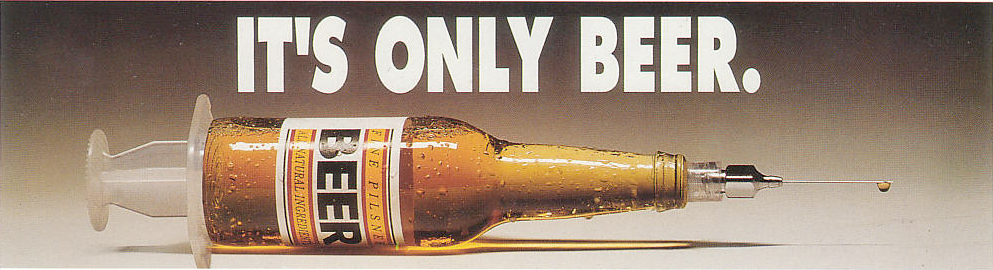
An understandably concerned brewer I know of noticed the image below while searching on the State of Indiana Alcohol & Tobacco website. Apparently it’s on a free flyer that also lists five “facts” about alcohol, but not about beer. I didn’t see the flyer on the website, but the image is taken from a neo-prohibitionist group called Facing Alcohol Concerns Through Education or FACE.

its-only-beer

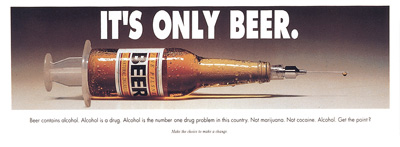
The caption is a little difficult to read, so here it is: “Beer contains alcohol. Alcohol is a drug. Alcohol is the number one drug in this country. Not marijuana. Not cocaine. Alcohol. Get the point? Make the choice to make a change.”

Of course, even without the text, the message is abundantly clear. Beer is the equivalent of a drug that you inject directly into your veins, like heroin. Sure, that seems reasonable. But it clearly shows the inability of fanatics to recognize the difference. Or perhaps they do know but purposely choose to be so extremely deceitful, dishonest and manipulative.

This image is in poster form, and you can actually buy one for $7.00 on FACE’s website, along with many, many other offensively ridiculous propaganda pieces. You can buy their many items as posters, magnets, billboards, bookmarks and even air fresheners. The amount of merchandise for sale to spread fear is truly staggering. That they present these items as tools to help you in the fight against alcohol underscores the extent to which alcohol is under attack once more in this country.

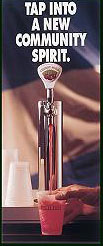
tap-into Here’s another one attacking beer festivals. Apparently they send a bad message to kids.

Every year, thousands of towns across the country gear up for their annual festivals. Too often these events focus on alcohol. This year, show kids the real meaning of community spirit. And let the good times roll! Make the choice to make a change. Tap into a new community spirit.

Now I go to a lot of beer festivals, probably many more than the average person. And whenever possible, I take my kids along with me because I like having my family around me. Perhaps that makes me strange, who knows? There are a growing number of festivals that because of liability issues and governmental controls are unable to even permit children to attend beer festivals. So soon I won’t be able to spend as much time with my family because neo-prohibitionists are making my parenting decisions for me. Few things anger me as much as being told what’s best for my children. If these people don’t want their kids exposed to alcohol and want to keep them as ignorant as possible about the world, they have an obvious choice. Here’s my simple advice to them. “Don’t go or don’t take your kids. But please, don’t tell me I can’t travel with my family. Don’t decide for me what is ‘dangerous’ for my children. That’s my decision, not yours.”

Frankly, a community spirit that seeks to control and restrict the actions of others is no community. It’s a dictatorship, a neo-fascist police state. Neo-prohibitionists have decided how the world should look and they’re doing everything in their growing power to make it look that way, public opinion be damned. The idea that “annual festivals,” which celebrate all manner of local culture, should not include alcohol — which is still legal the last time I checked — is antithetical to a community’s spirit is spurious at best and downright maliciously evil at worst.

But let’s return to Indiana. As our concerned brewer rightly asks, what is a state governmental agency doing spreading such obvious propaganda? Since when is it the job of our government to push the agenda of a few citizens and not represent the entirety of the population? To me that’s the biggest danger we’re facing right now. It seems like state agencies are being overrun by people who are either neo-prohibitionists themselves or are sympathetic to their ridiculous cause of making all alcohol illegal again. If I were a brewer from Indiana I would ask my state representative and/or senator why the tax dollars from my business and my own personal taxes along with the revenue and jobs I was creating for the state economy were being used to fund propaganda that depicts my livelihood as being comparable to heroin? But check first to see if he accepted any bribes … er, I mean campaign contributions from any neo-prohibitionist organizations. That will help you to judge the honesty of his answer.

its-only-beer-lg

Filed Under: Editorial Tagged With: Law, Midwest

Homelessness, Malt Liquor and Social Policy

August 31, 2006 By Jay Brooks

Well they’ve gone ahead and done it, legislated away malt liquor for several neighborhoods in Seattle, Washington, effective November 1. The state liquor board yesterday banned “29 drink brands” including, of course, malt liquor. Now I’m not a fan of malt liquor (except perhaps for Dogfish Head’s wacky craft malt liquor, but even that I wouldn’t drink under very many circumstances) but the idea that restricting the sale of certain inexpensive, but high alcohol drinks will in any way cure homelessness is ludicrous.

Apparently, the same or similar items were previously banned in the Pioneer Square area of Seattle. The new ban radiates out from Pioneer Square adding the neighborhoods of Belltown, Lower Queen Anne, Capitol Hill, the Central Area, the University District and the International District. This essentially widens the ban area considerably and adds a new ban area adjacent to the University of Washington. But that simply suggests that the previous ban didn’t work and what many residents fear actually happened before, customers for these cheap, high-alcohol drinks — who are primarily, let’s face it, homeless or low-income — simply bought them elsewhere. So now the areas where they took there business will see a ban, as well. It doesn’t take a genius to figure out what will happen next. Attendance at AA meetings will not sharply increase and homelessness will not disappear. Oh, it might be quieter in specific places where drunk homeless people would congregate and buy their vice of choice, but they won’t stop drinking. Heroin is illegal yet thousands and thousands manage to find it.

This will certainly make it easier for authorities to round up and further persecute the homeless. And it may keep them out of “your back yard,” a place nobody seems to want uncomfortable truths to stray into, but without treating the root causes of homelessness, alcoholism and other societal miseries nothing whatsoever will change. Naturally, city officials claim this is “only one step in an overall initiative to curtail homelessness.” When mayoral aide Jordan Royer says “[p]eople think we’re just pushing drunks around,” it shows he knows that’s exactly what he is doing. He goes on to say that the “city will monitor the effect of the new rules to ensure that they don’t simply displace the problems around fortified beer and wines favored by chronic inebriates.” Uh-huh, that’s believable.

The three-member Liquor Control Board defended its actions with such lofty principles as the ban was “needed for the greater good” and “[t]his was a community effort.” Board member Roger Hoen then had this priceless gem. “The fact is it’s a democracy and (the board) kind of went by votes and the majority of the testimony, the majority of the evidence and the majority of the information that came before the board was to support going forward with it.” I’m sure that’s true, but how many homeless people were allowed to speak, I wonder. Without addresses, they rarely vote so I don’t imagine their point of view was much sought after. But if they had, I imagine the more coherent and sane among them would have asked for shelter and perhaps a job. I don’t believe they chose homelessness or alcoholism as a lifestyle. And while this measure may do wonders for the residents who don’t like looking out of their windows and seeing the great unwashed littering “their” streets, it will do absolutely nothing to combat the issue of the homeless themselves, despite the local government’s hollow assurances.

Board member Roger Hoen “acknowledged some businesses would lose money because of the rules. But, in life, there’s a number of restrictions and inconveniences that we have to live with.” Actually, Roger, you won’t be inconvenienced one little bit so by “we,” you actually mean “they.” You should say what you mean or at least know what you’re saying. I think the “restrictions and inconveniences” you speak of will be borne, as usual, by the people with the least voice in our society, the invisible people without homes or a say in their lives.

But that’s depressing. Luckily, Merritt Long, chairman of the board, ends things on an “upbeat note.” “Besides,” he says, “customers can still choose from more than 4,000 other beer products allowed in Washington” Good point, Merritt, albeit cluelessly condescending, I’m sure we’ll see the homeless choosing a nice bottle of Westmalle Triple or a local barleywine. Way to show your compassion.

Filed Under: Editorial, News Tagged With: Business, Law, Washington

America’s Drunkest Cities! America’s Dumbest Survey?

August 25, 2006 By Jay Brooks

Forbes.com, the online part of the conservative financial organization, announced recently their list of the nation’s “drunkest cities.” Here’s the full list:

  1. Milwaukee
  2. Minneapolis-St. Paul
  3. Columbus, Ohio
  4. Boston
  5. Austin, Texas
  6. Chicago
  7. Cleveland
  8. Pittsburgh
  9. Tie:
    • Philadelphia
    • Providence, R.I.
  10. St. Louis
  11. San Antonio
  12. Seattle
  13. Las Vegas
  14. Denver/Boulder
  15. Tie:
    • Cincinnati
    • Kansas City
  16. Houston
  17. Portland, Oregon
  18. Tie:
    • San Francisco-Oakland
    • Washington-Baltimore
  19. Phoenix
  20. Los Angeles
  21. Tie:
    • New Orleans
    • Tampa
  22. Norfolk
  23. Dallas-Fort Worth
  24. Tie:
    • Atlanta
    • Detroit
  25. Indianapolis
  26. Orlando
  27. New York
  28. Miami
  29. Charlotte, N.C.
  30. Nashville

Setting aside the inanity of such a list, how — one might reasonably wonder — did they come up with such a list and keep a straight face?

Well here’s what they have to say:

Each city was ranked in five areas:

  1. state laws
  2. drinkers
  3. heavy drinkers
  4. binge drinkers
  5. alcoholism

Each metro was assigned a score in each category, based on quantitative data. All five categories were then totaled into a final score, which was sorted into our final rankings. For a fuller explanation, read the methodology used.

But here they are in nutshell, with some of my own commentary.

1. State Laws:

Cities were ranked on a scale of 1 to 8, with states deemed to have the least restrictive laws getting a higher score. They considered such intangibles as whether MADD liked that state’s alcohol laws, whether there was a law banning open containers and if kegs had to be tagged with identifying tags. Well, how scientific. How any of those vague standards can be said to make one state more “drunk” than another is simply ludicrous. The idea that a more permissive society in and of itself causes alcohol abuse or even leads to it is specious at best. Just because open containers are allowed, for example, does not mean citizens will necessarily abuse alcohol. That such a flimsy set of criterion was used and is being reported seriously is astounding.

2. Drinkers:

Cities were ranked from highest to lowest and given a score based on the number of each town’s residents who admitted to having one drink in the last month. One drink! Have we really gone so far down the neo-prohibitionist path that one drink in 30 days is equal to being an alcohol abuser? The idea that the more people who have one drink each month, the more abuse is occurring in a geographic area is so fallacious that it’s downright insulting. They use the seemingly non-judgmental term to describe this as a larger “percentage of [the town’s] population are alcohol consumers.” Well so what? last time I checked alcohol was still legal in this country and I can hardly see how a drink a month rises to the level where any reasonable person would be concerned.

3. Heavy Drinkers:

Scored similar to #2, but this time it was based on “the number of adult men who reported having had more than two drinks per day, and adult women having had more than one drink per day.” Apparently that’s what constitutes a “heavy drinker.” It doesn’t appear to make a difference what type of drink it is which apparently means there’s no difference between three pints of beer and three pints of whiskey per day. Yeah, that seems reasonable. So a beer with lunch and two with dinner and you’re a heavy drinker!

4. Binge Drinkers:

Scored like the previous two, the Forbes survey defined “binge drinking” as five or more drinks on one occasion. Is that ever? Within a year? What? To say that if you’ve ever had five beers at one party makes you a binge drinker is beyond ridiculous. It’s more than a little misleading to suggest that drinking one beer short of a six-pack one time makes you anything bad at all. Take the Super Bowl as an example. With pregame, long commercial breaks, an overblown half-time show and post game analysis it weighs in easily at least as long as five hours. So if you had one beer every hour during that one occasion you were a binge drinker according to Forbes and the CDC. Sure you are. What utter rubbish.

5. Alcoholism:

As laughably contemptible as the first four criteria were, this one takes the cake. Scoring was done “based on the number of Alcoholics Anonymous meetings held in the area, as a proportion of the number of residents over the legal drinking age.” Okay, personally I don’t agree with the idea of AA. To me, people are simply trading one addiction for a more socially acceptable one. But it obviously does work for some people and at least those who go to AA are trying to help themselves. So to measure a town’s relative drunkenness by the number of people trying to help themselves is not only wildly off the mark, it’s highly insulting to those attending the meetings. Is there a calculation or formula that explains how many people are alcoholics but not seeking help through AA. Are there no other methods, perhaps even private ones or clinics, besides AA?

The ways in which these results were calculated is so completely outside the realm of reality that it’s amazing an organization so supposedly respectable would have anything to do with it. I haven’t even scratched the surface on the ways in which these results are misleading and just plain wrong. They’re just too obvious and there are too many ways in which to show how embarrassingly disgraceful this list is.

A report on the survey by television station KPTV Channel 12 in Oregon added the following:

Forbes pointed out some surprising results. Some stereotypically “partying” cities didn’t rank high on the list. Las Vegas came in at only No. 14; New Orleans, home to Bourbon Street and Mardi Gras, only ranked in 24th place. And a town known for spring-break revelers, Miami, was only No. 33 on a list of 35 cities.

Well, perhaps it was the way in which the rankings were created in the first place. Given the amount of alcohol that flows in Las Vegas, couldn’t that fact alone be a clue that the results are erroneous? Saying people drink more in Providence, Rhode Island or Columbus, Ohio than in Vegas isn’t just “surprising,” it’s downright fiction. It could only come out that way if you design the survey to have little or no basis in reality.

So given how obviously absurd this all is, you have to wonder why an outfit like Forbes would put its name on something like this and publish it at all. It’s not exactly obvious what they’re up to. But if you look closely at the other items in Forbes’ “The Business of Nightlife,” of which America’s Drunkest Cities is just one part, there’s a link to an article entitled Cutting Alcohol’s Cost. This article is about the costs that people drinking — not even necessarily on the job — brings to businesses in increased health care and lower productivity. I should have guessed it would return, as things tend to do, to money. And their assertions that people who abuse alcohol do cause those problems may even be correct, but they completely ignore any factors that might cause their workers to drink, as if people generally make conscious choices to become alcoholics. And while there may be a few who are genetically predisposed to drink too much, I’m willing to bet that the stress of their jobs made as many or more drink too much as any other factor.

A study by the George Washington University Medical Center examined the incidence of “problem drinkers” (whatever that means) by different industries broadly defined and found that in the general population for every thousand people, an average of 91 are problem drinkers. The industries with higher than average problem drinking included:

  1. Construction and Mining 135
  2. Wholesale 115
  3. Retail 114
  4. Leisure and Hospitality 109
  5. Repair and Business Services 106
  6. Agriculture 106
  7. Transportation and Utilities 96

At the bottom of the list was professionals with only 54 in every 1,000. But notice the jobs most associated with drinking are also the ones with the highest stress, the lowest wages and/or the lowest respect. Professionals have unquestionably the highest income among the list and so it’s not terribly surprising that the have fewer problems with drinking. But Forbes knows its readers and so is more interested in how to get more productivity out of low-level employees by getting them to stop drinking than addressing the root causes of that drinking. They could just as reasonably suggested that to avoid drinking problems employers should pay them better, treat them with more respect and not put so much pressure on them that severe stress is produced. But sympathy for labor has rarely been considered by big business.

Curiously, but perhaps not surprisingly, big business was generally very supportive of the first temperance movements that agitated for prohibition in the late 1800s and into the early part of the last century. The industrial revolution had recently changed the business landscape and with workers using so many more machines, business owners looked for ways to keep their employees sober. Of course, making the machines safer, having shorter work hours or better working conditions overall might also have been beneficial to the workers, but it would have cost the business owners profits. Better they try to change the workers habits both on the job and more intrusively off the job. So many businesses gave money to support temperance groups and helped usher in a climate where prohibition was possible, all in the name of commerce. Breweries saw it all coming, of course, and tried to counteract the temperance movement with moderation PR campaigns and ads that focused on the tradition and heritage of beer. But it was too little, too late, and Prohibition decimated the industry and probably led to the Great Depression.

Then as now, business didn’t care about why their workers drank. That might focus attention on their own actions and it does nothing for the bottom line. Labor unions were created because so many were treated so unfairly for so long. If it weren’t for labor unions, we’d all still be working six or even seven days a week, far more than 8 hours a day and have far less safe working environments. All of these and more happened because workers fought to improve their lives and business fought these innovations every step of the way.

From the Forbes article:

Each year, alcohol abuse costs the United States an estimated $185 billion, according to the National Institute on Alcohol Abuse and Alcoholism. But only $26 billion, 14% of the total, comes from direct medical costs or treating alcoholics. Almost half, a whopping $88 billion, comes from lost productivity — a combination of all those hangovers that keep us out of work on Monday mornings, as well as other alcohol-related diseases. People who drink too much and too often are at greater risk for diabetes and several kinds of cancer, according to some studies.

“Alcohol is a worthless drug that affects every single cell in your body,” says Harris Stratyner, director of addiction recovery services at Mount Sinai Medical Center. Even hair transplants can fail because of the damage, he says.

“A worthless drug”? I know millions of people who might take issue with that statement. Anything and everything has the capacity to be abused. You could overdose on aspirin. That doesn’t make it a worthless drug, does it? People drink for many different reasons, of course, but certainly its popularity comes at least partly from the temporary positive effects alcohol has on the body. It allows one to relax, feel a little bit less stress for a period of time, give a feeling of euphoria. That some people might crave that feeling more often than others is directly proportional to how they feel about the rest of their lives. If you have a crappy job, a bad love life, etc. you might reasonably seek ways to feel better, and that might include alcohol. To ignore this, and other reasons why people might drink too much, in addressing alcohol’s impact on society is to overlook one of the most important aspects of the problem.

This series of stories by Forbes, and especially this last one addressing the relationship between worker productivity and alcohol, is startlingly reminiscent of big businesses’ support for prohibition groups over a century ago. And like the Anti-Saloon League, American Temperance Society and the Prohibition Party (among many others) the neo-prohibitionist groups of today are gaining power, especially political power. If business is truly once again supporting neo-prohibitionist causes to increase worker productivity, then we may be in for some dark days ahead. Today’s politics, of course, is very closely aligned with business interests so it doesn’t seem too far a leap to suggest that the conditions are once again repeating themselves in such a way that the possibility of another prohibition doesn’t seem as far-fetched as might have even a decade ago. That news alone might drive me to have another drink.

Filed Under: Editorial, News Tagged With: Mainstream Coverage, National

Your Beer Personality

August 20, 2006 By Jay Brooks

I enjoy personality quizzes, actually quizzes of almost any kind, so I’m not necessarily predisposed to find fault with them. But this one is another story. There’s a website called Blogthings that has literally almost 300 quizzes for people to use on their blogs, presuambly to spice them up with something fun. Most are five questions with several choices each. Their tagline is Cool Things to Put In Your Blog.

A friend sent me this one, it’s “What’s Your Beer Personality?” Five questions, six possible answers to each one, and it purports to tell you your beer personality by determining what beer you are based on your answers. There are 7,775 different possible ways to answer the five questions but as far as I can tell from playing around with the quiz, there are only six different personalities possible: Bud Light, Guinness, Heineken, Olde English and Sam Adams.

I realize this things are just for fun, they’re not meant to be taken too seriously. But it seems to me they should bear at least some passing resemblence to reality. Whoever put this quiz together apparently knows nothing about beer and thinks there are only six personality types. I certainly wasn’t expecting a Westmalle Tripel personality or Rodenbach Grand Cru but not even a Sierra Nevada Pale Ale? And the beers don’t really seem to fit the personalities, but they do say a lot about stereotypes many people have about beer and what certain brands mean or have come to mean through marketing and advertising.
 

Here are the 6 beer personalities:

You’re not fussy when it comes to beer. If someone hands it to you, you’ll drink it. In fact, you don’t understand beer snobbery at all. It all tastes the same once you’re drunk! You’re an enthusiastic drinker, and you can often be found at your neighborhood bar. You’re pretty good at holding your liquor too – you’ve had lots of experience.

Okay, this one’s near the mark. If you’ll drink this beer, you will drink anything and not notice the difference. It all tastes the same, even if you’re not drunk.

You don’t drink for the love of beer. You drink to get drunk. You prefer a very light, very smooth beer. A beer that’s hardly a beer at all. And while you make not like the taste of beer, you like the feeling of being drunk. You drink early and often. Sometimes with friends. Sometimes alone. All the party needs is you!

How could you, at least not if this is your choice. “Hardly a beer at all.” Hilarious. Corona was the answer to the question “what is your least favorite beer?” when posed to Michael Jackson when he was a guest on the Conan O’Brien Show in April of this year.

You know beer well, and you’ll only drink the best beers in the world. Watered down beers disgust you, as do the people who drink them. When you drink, you tend to become a bit of a know it all – especially about subjects you don’t know well. But your friends tolerate your drunken ways, because you introduce them to the best beers around.

This was the one I got when I answered the questions seriously, and it’s pretty sad that in the mind of the quiz, this is one the best beers the world has to offer. Which of the at least eleven different recipes of Guinness brewed worldwide are they talking about? Hopefully not that abomination that Diageo foisted on America, the widget bottle, which tried to undo decades of progress by marketing it to be consumed directly from the bottle. It’s also funny that they claim Guinness drinkers don’t like their beer watered down, since Guinness is a low alcohol beer and not heavy at all.

You appreciate a good beer, but you’re not a snob about it. You like your beer mild and easy to drink, so you can concentrate on being drunk. Overall, you’re a friendly drunk who’s likely to buy a whole round for your friends… many times. Sometimes you can be a bit boring when you drink. You may be prone to go on about topics no one cares about.

This is a bit surprising, since all of Heineken’s advertising is aimed at creating a perception of sophistication and premium quality, despite the fact of its legendary skunkiness. This, along with Corona, is one of the world’s worst beers. That it’s so popular is a testament to the advertising industry. That it is a personality is truly frightening.

Drinking is more than a hobby for you. It’s your favorite drug. When you drink, you want to get wasted. As quickly and cheaply as possible. Looking back on your best times drinking… well, you don’t remember them at all. You may be a few brain cells short, but you still can chug a 40!

This one’s just too easy. I guess there must really be people like this. Malt liquor does sell, after all.

You’re fairly easy to please when it comes to beer – as long as it’s not too cheap. You tend to change favorite beers frequently, and you’re the type most likely to take a “beers of the world” tour. When you get drunk, you’re fearless. You lose all your inhibitions. You’re just as likely to party with a group of strangers as you are to wake up in a very foreign place.

This one doesn’t even make much sense to me. It’s not like Sam Adams beer is expensive. And frankly, why is a “‘beers of the world’ tour” a bad thing? Or changing your choice of beer? As the only beer personality in the canon approaching craft beer, I can’t understand why it’s not the pinnacle.

Alright, I know this whole thing is pretty silly, but it was a quiet Sunday. Don’t take my word for it. Take the quiz for yourself. See what your beer personality is.

Filed Under: Editorial, Just For Fun

Chugging Contests to Promote Brewfest

August 20, 2006 By Jay Brooks

A few weeks ago I opined that the upcoming movie Brewfest was going to do nothing good for the good beer movement, and might even cause further harm to beer’s already beleaguered image. I even argued that position on a recent interview on the Brewing Network. Even though I’ve not seen the movie, everything I have seen has filled me with a growing sense of dread.

Along comes today’s Patriot-News of Harrisburg, Pennsylvania, the capitol city’s newspaper, with a story about how the co-creators and stars of Brewfest are promoting the film. It seems director Jay Chandrasekhar and “his co-writer/co-star/co-producer Paul Soter, 34, have been touring the country challenging locals to beer-chugging contests.” So to all of you who’ve defended this movie, I ask you. Is that really a good way to promote good beer? Is that good for beer’s image? I can just image how the MADD mothers will use this to their advantage.

“No team has beaten them yet.” The pair of filmmakers told the paper. Well, congratulations. You must be very proud. It’s good to have goals, and such lofty ones at that. That’s exactly what the beer industry needs, high-profile people in the media spotlight with the goal of chugging more beer than anybody else. It may sell newspapers and even the movie, but it does nothing to give beer any respect and in fact even undermines it more that the damage done year after year by the advertising created by the big breweries.

The Patriot-News describes the movie thusly:

The movie “Beerfest,” opening Friday, is most definitely an R-rated comedy that proudly features gratuitous nudity and all sorts of rude behavior, mostly involving imbibing lots of alcohol.

In and out of the movie, chugging beer is a bad idea.

Filed Under: Editorial, News Tagged With: National, Promotions

Beer Only Fit for Guzzling

August 18, 2006 By Jay Brooks

I realize that the Ventura County Reporter isn’t exactly mainstream media, but they’re in print and people believe what they read in print, so they’re fair game as far as I’m concerned, especially when they wear their ignorance on their sleeve. A regular column in the alternative weekly, called Body Politics, is written by Robert Ferguson, who apparently is a diet guru, at least according his byline, which reads:

Robert Ferguson is recognized as the weight loss “guru” and wellness expert, co-author of Fat That Doesn’t Come Back, speaker and has Diet Free Life offices in Southern California. E-mail him at robert@dietfreelife.com, or visit his Web site at www.dietfreelife.com.

Apparently in his column each week he answers questions sent in by readers. This week’s is particularly troubling. The question is innocuous enough, here it is:

You often talk about the benefits of drinking wine, but what about beer?

— Cia W., Thousand Oaks

Okay, Bobby, you got my attention, please tell me. What are the benefits of drinking beer? He brings up only one of the numerous studies showing health benefit for moderate beer drinking, this about “men who drank 11-24 pints” having a 66% reduced chance of getting a heart attack over teetotalers who drank none at all. All well and good, but he also says that the scientists conducting the study were “shocked” by the findings. Hardly. It’s not like the health benefits of beer is a new phenomenon. People have known beer is good for them for millennia and there were centuries when it was preferable to water, health-wise. But it shows his true disdain for beer while at the same time trying to appear unbiased.

Ignoring the many other and different ways beer provides health benefits, he then suggests that “[j]ust because there is a hint [my emphasis] of health associated with beer doesn’t mean it’s to your benefit to rush out and purchase a case of your favorite flavor.” Setting aside that beer doesn’t really come in “flavors,” but styles, just because he apparently knows only about a single study doesn’t mean there’s only a hint of benefits. A simple Google search of “health benefits of beer” would have revealed to him over 9 million hits! Even if only a tiny fraction were legitimate scientific studies, that would still be many more than one. Just in the last few years, there have been many new major findings on the health benefits of beer. But why use facts, when as a “guru” you can pretend to know what you’re talking about.

But Bobby’s not done insulting beer yet, as he ends with this bit of wisdom:

The challenge with beer is that it’s not usually sipped, but guzzled. And guzzling positions you to consume more than if you were to sip it.

Now here was a perfect opportunity to educate Cia and his readers that there are thousands of great beers designed to be sipped rather than knocked back. But instead Bobo, who appears to know precious little about beer, chose instead to recommend the following:

If you want weight loss however, choose a five-ounce glass of wine instead.

Dammit this is the sort of thing that if I were a cartoon would make smoke shoot out of my ears. Why does wine always get trotted out as this saintly stuff, perfect for a diet? Ferguson cautioned earlier in the article that beer had “alcohol and calories,” making it bad for dieting, apparently. But so does wine. And ounce for ounce wine has more calories than beer does. There’s 100 calories in five ounces of wine, while a similar amount of beer contains (depending on the amount of protein) between 50-75 calories which is — say it with me — less. Why couldn’t he have suggested that Cia share a nice bottle of Cuvee de Tomme (Ventura is in Southern California, after all) with some friends, having only five ounces herself in a nice tulip glass? She was asking about beer, after all, not wine. But talk of alcohol and health always seems to work its way back to grapes, despite the mounting evidence of beer’s positive benefits in a myriad of areas. This perception of wine as angelically good and beer as demonically bad is one tough nut to crack. People seem very, very attached to this misconception. We could debate the reasons for this and where the culpability lies, but that’s for another day. The fact is our cause it not helped by so-called experts like this guy who in his zeal to sell diet books, magazines and his online weight loss program, ignores the facts and plays on old stereotypes to misinform the public.
 

Robert Ferguson, the “Diet Guru.” “Remember kids, don’t guzzle that beer, you’ll get fat.“

Filed Under: Editorial, News Tagged With: California, Health & Beer, Mainstream Coverage, Southern California

The Pour’s the Thing

August 17, 2006 By Jay Brooks

No one in his right mind would argue that it’s better to drink beer directly from the bottle or can, yet thousands — perhaps millions — of people do that every single day. So getting people to first pour their beer into some type of vessel, preferrably a glass one, is job one. The advantages should be obvious. The head produced when you pour beer into a glass releases carbon dixoide (CO2) and makes the beer much less gassy. That’s why bottle drinkers burp and … well, you know. Also, the CO2 gets in the way of whatever flavor is in the beer because it overpowers it, so it’s absoluetly essential that you let the beer breathe. Usually that one big exhale when you pour it is enough, but what’s the best way to pour your beer into the glass?

On this point, many people differ, often bitterly. Today’s Sun-Sentinnel (which covers south Florida) has an article entitled “Beer foam foments flavor,” which explores this idea of a right way to pour a beer in surprising detail.

Boston Beer’s Jim Koch weighs in first, saying “A nice collar of foam around a glass of beer not only is aesthetically pleasing but serves a real function.”

He continues in the article:

“As the CO2 [carbon dioxide] rises in the glass, the beer will capture some of the hop aroma, and the foam releases this aroma,” Koch says. The more protein in the beer, the more sizable and durable the head.

The practice was so widespread, Koch says, that the ritual of pouring a glass with a good collar of foam practically disappeared, unless one happened on a knowledgeable bartender.

Pour the beer down the middle of a slightly tilted glass, straightening the glass gradually. If it is a bottle-conditioned beer, you can leave a half-inch of liquid in the bottle to keep the yeast sediment from clouding your beer.

Next up, Grady Hull, assistant brewmaster at New Belgium Brewing, who “agrees that the foam affects the flavor.” His take:

“Some aromas are released by the foam, and others are held in to be released as the beer is consumed,” Hull says. “It’s also an indication of the content of the beer. Beers made with cheap adjuncts like rice and corn are typically low in foam because they are low in protein.”

Lastly, Sam Calagione, of Dogfish Head Brewing, adds that “a good inch (two fingers) of froth on a glass of craft beer” is ideal.

CAMRA, unfortunately, while having done much else that is good, has been whining for years that a large head is cheating consumers out of their full pint of beer. They’ve been stubbornly demanding taller and taller glasses so that the liquid comes up to a pint line and the foam extends beyond it but still is in the glass. But the foam, of course, consists of a percentage of liquid which slides back into the glass as the bubbles dissipate. This argument for larger glasses always struck me as pedantic. A pint is 16 oz., not 20 oz., as is the British Imperial Pint. If pub owners want to end this argument, all they need do is stop selling pints and instead offer a glass of beer (which then could be of any size) for a set price. That the word “pint” is the trouble strikes me as fairly ridiculous. But I think this had led many to believe that a good-sized head is not desireable, and that is not the case at all.

Here in the states, the American-style lagers manufactured by the big breweries are all very highly carbonated, most likely to mask the lack of flavor underneath. One thing you can say about the big guys is they’re not stupid. These beers from the bottle have to be poured down the side of the glass, otherwise you’ll have foam everywhere. Notice you rarely, if ever, see their products in a glass in print or television ads. Letting an American-style lager breathe will reveal more of it’s actual flavor and that’s not necessarily something they want to do. So I was particularly puzzled to discover that the Beertender Guide to Serving Packaged Beer actually suggests the following:

Don’t pour the beer by the “down-the-side” method. This minimizes the foam, and the beer looks flat and will taste gassy. CO2 is retained in the beer and swallowed, so your customers fill up faster — and they may not have room for snacks or a meal.

The Beertender Guide is maintained by Anheuser-Busch for their wholesalers. It’s shared content that any of them can use on their individual websites and/or to train their employees. Their advice on pouring is also quite interesting.

For the smoothest taste, pour beer to produce a nice head or collar of foam.

  • Place the neck of the bottle or lip of the can over the edge of a clean glass or cup.
  • Quickly raise the bottom of the bottle or can to a high angle, causing the beer to agitate into the glass.
  • Lower the bottom of the bottle or can to reduce the flow until the foam rises to the rim.

This flies in the face of some conventional wisdom, especially the 45° angle theory, which is quite prevalant among most craft brewers. Beer Advocate, for example, in their advice on How To Pour Beer, advocates this method and even has a little online video of founder Todd Alström pouring a glass of Mendocino’s Eye of the Hawk to show this technique. Go watch it. Go on, I’ll wait. Like most of the advice in Beer Advocate’s Beer 101 pages, there’s a lot of good information there but this I think illustrates why the 45° angle is partially flawed. He’s using an imperial pint glass, of course, which is for 20 oz. of liquid and the bottle is 12 oz. which is fine. I, too, like and often use imperial pint glasses depending on the beer style. But notice at the end of the video, where his fingers come to rest at the edge of the foam, that the head produced looks to be maybe one finger thick. But the ideal head is at least around 1-1½ in., which is about two fingers on most of us. Now personally, I like a good thick head, more on the order of 1½ to 2 inches. That’s how important I think it is to blow off the gasses in the beer and get to the remaining flavor. And the 45° angle method just doesn’t get it done. It’s not bad per se, but in many cases it’s simply ineffective for getting a thick, pillowy head going. I prefer the following:

  1. Hold your bottle or can above a glass held straight up and pour it directly into the middle of the bottom of the glass, with an even, smooth pour rate
  2. This will get the foam going early and big, but watch it carefully
  3. If the foam becomes too volatile, then tilt the glass to roughly a 45° angle or less, as appropriate (this takes some practice)
  4. As you reach the point where roughly two-third of the bottle’s contents are in the glass, begin bringing the glass back to an upright position to empty the remaining contents

This is a dynamic process that much be watched constantly and continually adjusted for to get the head just right. Maybe it requires more concentration but it’s well worth it in my opinion, because of how important the results are.

Now I realize I’ve ignored certain exceptions, like bottle-conditioned beers, and certain styles with their own peculiarities, such as stouts or hefeweizens, but for the majority of beers, I think my method works quite well. This is especially true if your goal is to produce a generous head, and I think that’s crucially important to getting the full enjoyment out of your bottle of beer.

UPDATE: SeattleBeerGuy sent me the following tidy little article entitled Pouring the Perfect Pint from Pacific Brew News, which is a similar method to mine, but also includes a bit more detail.

Filed Under: Editorial Tagged With: Mainstream Coverage, Tasting

Blast From the Past: Genny Cream Ale

August 10, 2006 By Jay Brooks

Cans of Genesee Cream Ale were de rigueur when I was growing up in Eastern Pennsylvania in the late 1970s. The simple green can design is emblazoned in my memory of that more simple time. It was certainly one of the favorite beers of my youth — at least in my memory — probably because cream ales are such a light, undemanding style. They fell out of fashion for a number of years, but lately several craft brewers are resurrecting the style as their lightest offering. It’s a much better alternative than making a low-calorie beer or American-style lager. High Falls Brewing, who has owned the brand for many years now, abandoned the all-green design sometime in the 1980s and when I carried it at BevMo in the mid-1990s all that was available were bottles with a paper label. Which is a shame. The beer itself I recall wasn’t great but was certainly serviceable and a decent session choice. It was that plain green can that had us all enraptured, though in retrospect I have no idea why.

High Falls is now trying to tap into that nostalgia I feel for the brand with a new retro-styled website at www.geneseecreamale.com. It’s a nice site but I don’t think they went back far enough because they’re still showing that damned paper label and a bottle on the main page. It does suffer the problem I have with virtually all big brewery sites — Flash. They’re so over the top with using flash technology instead of HTML that I hate navigating them. Maybe I’m in the minority here because I started hand-coding HTML back in the mid 90s, but I find it very annoying.
 

Sure, it’s a nice piece of breweriana, made to look older than it is, but where’s the can?

Frankly, this is how I will always remember Genesee Cream Ale. If they really want to tap into nostalgia, they need to bring back this can.

Filed Under: Editorial, News Tagged With: Eastern States, Press Release, Websites

There Goes Traveling with Beer Samples

August 10, 2006 By Jay Brooks

I know I should be thinking of the potential victims saved and the fact that terrorism is on most people’s minds every day, but I confess that when I heard the news this morning, my first thought was how it affected me. If you haven’t looked at the news yet this morning, British police foiled a terrorist plot to blow up more airplanes, apparently ones to New York, Washington and California targeting American carriers United Airlines, Continental Airlines and American Airlines. The method uncovered this time was to use “liquid explosives disguised as beverages.” So if this goes the way things did the last time with the shoe bomb, we can kiss taking beer samples home from trips goodbye.

I realize this doesn’t impact very many people, but I usually carry 6-9 bottles of beer home with me from almost any trip. Sometimes it’s samples I’ve been given to try and other times I just pick up beers I can’t get where I live. So far, I’ve been lucky. I’ve only been hassled in the City if Brotherly Love — Philadelphia. The security guard I got didn’t know you could travel with beer and started giving me a hard time until a supervisor stepped in and asked me one simple question. “Are they open?” “No,” I replied. “Then please go ahead.” As I walked along, relieved, I could hear the supervisor explaining something to the newbie, presumably that I was well within my rights and a bottle of beer posed no security threat. Well I can all but guarantee that will be changing soon. The airlines will rush to impose a new prohibition to include beverages of all kinds: beer, wine, soda and probably even bottled water. I’m sure they’ll cry security, but you know they make a lot of money selling drinks on the planes now. Imagine if they suddenly have a monopoly?

My friend Stephen Beaumont recently told me he never travels with samples anymore. He finds it’s just too much of a hassle in a post 911 world. I can only imagine what a hassle it’s going to become now. My big problem with all of this — apart of course from the personal inconvenience — is that the increased security they keep heaping on us isn’t really producing the right result. It’s not making us any safer, it’s just giving us the illusion that we’re safer. And for most people, I don’t think it’s even doing that. How is it escaping so many people’s attention that turning America into a police state one new security measure at a time is not making us safer but instead is making us less and less a free society?

I wonder if there’s a train I can take to GABF this year?

Filed Under: Editorial, News

« Previous Page
Next Page »

Find Something

Northern California Breweries

Please consider purchasing my latest book, California Breweries North, available from Amazon, or ask for it at your local bookstore.

Recent Comments

  • Bob Paolino on Beer Birthday: Grant Johnston
  • Gambrinus on Historic Beer Birthday: A.J. Houghton
  • Ernie Dewing on Historic Beer Birthday: Charles William Bergner 
  • Steve 'Pudgy' De Rose on Historic Beer Birthday: Jacob Schmidt
  • Jay Brooks on Beer Birthday: Bill Owens

Recent Posts

  • Beer In Ads #5245: Wiedemann’s Brewing Bock Beer May 8, 2026
  • Beer Birthday: Dave Alexander May 8, 2026
  • Historic Beer Birthday: Emil Christian Hansen May 8, 2026
  • Beer In Ads #5244: Southern Brewing Bock Beer May 7, 2026
  • Historic Beer Birthday: Anton Dreher May 7, 2026

BBB Archives

Feedback

Head Quarter
This site is hosted and maintained by H25Q.dev. Any questions or comments for the webmaster can be directed here.