
New Zealand has picked up the challenge and today will be hosting their own Beer Drinker of the Year contest which will take place at the Cock & Bull in Te Rapa, Hamilton. Only announced less than three weeks ago by Bruce Holloway, beer and sports writer for the Waikato Times, the contest plans to widen the field for next year’s contest.
Diane Catanzaro Named Beer Drinker of the Year
On Saturday, Diane Catanzaro became the 11th recipient of the coveted title “Beer Drinker of the Year,” and only the second woman to win the award. Catanzaro is a college professor in Norfolk, Virginia, a homebrewer and a BJCP-certified beer judge.
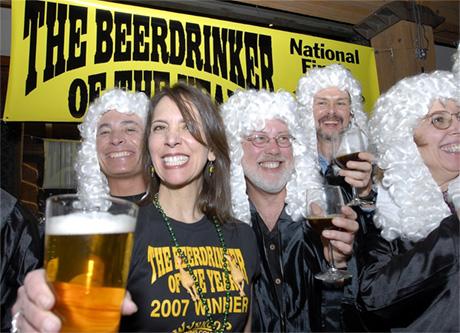
Diane Catanzaro moments after winning. Behind her are judges Tom Ciccateri (2005 winner), Tom Dalldorf (Celebrator Beer News), Gary Steinel (2003 winner) and Carolyn Smagalski (aka The Beer Fox, Bellaonline.com). (Photo by Duane Howell)
From the Press Release:
A professor of industrial/organizational psychology at Christopher Newport University (in Newport News, VA), Catanzaro is the second woman to win the competition. (Cornelia Corey of Clemmons, NC won the title in 2001.) Her home beer bar is The Biergarden in Portsmouth, Virginia.
“This is a dream come true for me,” Catanzaro said after winning the title. “I can use the title to carry the flag for Beer Nation and spread the news about craft beer. And it gives me an opportunity to promote a better understanding of beer to women in America.”
“Beer is not just some fizzy yellow drink,” she said. “It has a rich history, an incredible array of styles and flavors, and it’s part of a healthy life style. And it’s not just for the boys.”
Catanzaro, a finalist in last year’s Beerdrinker contest, beat out finalists Logan Perkins (of Denver, Colorado) and Phil Farrell (Cumming, GA). Her impressive beer drinking experiences, humor and beer ambassadorship helped her land the crown.
“I’ve never seen three more deserving finalists,” said Tom Dalldorf, editor and publisher of Celebrator Beer News and one of the seven judges for the finals. ”But Diane was very engaging, and her personality and very beery background helped her win the title. She speaks well for the beer community.”
The finalists weathered two hours of difficult questions from the judges. The queries stretched from questions about beer chemistry, styles and history, to the finalists’ abilities to sing old beer-advertising jingles and recall esoteric beer trivia.
During the competition’s Beer Whispering segment, Catanzaro impressed judges with a cross-continental conversation with a blend of the Duchess de Bourgogne and Oskar Blues Brewery’s Old Chub Scottish-Style Ale.
For her closing statement, she sang a reworked version of the bygone blues song “Beer Drinking Woman” that referenced Tommee Arthur, Flying Dog Brewery’s Horn Dog barley wine, and female craft brewing legend Carol Stoudt.
Catanzaro’s 2006 beer experiences included tasting beer at numerous breweries, bars and festivals in the US and Belgium, and leading 16 college students on a tour of Belgian breweries and bars.
On the heels of her Beerdrinker victory, she leaves this week for Belgium with another group of students. The group will explore the art and history of Belgium, and its beer culture. While in Belgium, Catanzaro will attend the Zythos Beer Festival and the famed “open brew day” at Cantillon Brewery in Brussels.
On her beer resume, she outlined her philosophy about beer drinking: “People who say they don’t like beer just haven’t met the right beer! I’ll be happy to arrange an introduction… I can be a positive role model for more women to discover the joy of beer and break stereotypes.”

Beer Drinker of the Year Diane Catanzaro with her beer-drinking Barbie, a model Mattel will probably not be offering for sale anytime soon. Pity, really.. (Photo by Tom Dalldorf)

Diane Catanzaro’s Barbie posing fellow finalist Phil Farrell’s infamous rubber chicken. (Photo by Tom Dalldorf)
Fort Bragg Beer Festival
Washington Brewers Festival
6.16-17
Washington Brewers Festival (2nd annual)
Saint Edward State Park, 14445 Juanita Drive NE, Kenmore, Washington
[ e-mail ] [ event website ]
Washington Cask Beer Festival
2.11
Washington Cask Beer Festival
Alki Room @ Seattle Center, 305 Harrison Street, Seattle, Washington
[ e-mail ] [ event website ]
Linda Starck Loses Her Battle With Cancer
Sad news, indeed, today as I got the word that earlier this morning Linda Starck passed away in her home. She will be deeply missed. Thanks to all the brewers, homebrewers and other caring people who gave so generously to help Linda with her battle. I know that she and her family greatly appreciated the outpouring of support. In the last correspondence I received from Linda, she wrote “I’m overwhelmed by all that you are doing to help support my treatments. It really means a lot to me and my family.”
|
Style Trends for Early 2007
Here is a chart of the latest style trends broken out by the top 10 selling styles, based on year to date sales as of January 28, 2007, courtesy of DBBB, the Domestic Brewers Bottled Brands. They publish the book, “The Essential Reference of Domestic Brewers and Their Bottled Brands” and have a website, which offers monthly online updates of the book.
The chart is based on IRI Data showing sales of beer from the beginning of the year through January 28th of this year by beer style. IRI is short for Information Resources, Inc., a company that surveys sales of beer (and everything else) from over 15,000 retailers (mostly groceries) in the U.S. As a result, their data is invariably skewed toward the national and regional brands since it doesn’t take into account direct sales and sales from small mom & pop stores. I used to get IRI data from almost every medium to large brewer who called on me when I was a beer buyer for BevMo. And while it’s not accurate for craft beer in specific, it does give you a general idea of certain trends, especially when you follow it over a period of time.
Choosing Responsibility
Join Together is a neo-prohibitionist group that is run by the Boston University School of Public Health. I say that, because they are funded primarily by the Robert Wood Johnson Foundation, and in my opinion Johnson was an extremist nut job, especially with regards to alcohol. But Join Together does a great job of collecting news reports about their cause and so I get their newsletter so I, too, can keep track. Most of the missives I get are about new studies, horrific accounts of binge drinking, essentially anything that supports the neo-prohibitionist agenda. But today’s was a little different and may represent something of a shot over the bow to reversing the trend toward another Prohibition.
John M. McCardell, Jr., the former president of Middlebury College in Vermont has founded a non-profit organization called Choose Responsibility, with the goal of educating the public about binge drinking and furthering the debate for lowering the drinking age in the U.S. from 21 to 18. McCardell, of course, saw his share of drinking on his college campus and brings a unique respectability to the debate which I think will make it harder for anti-drinking groups to dismiss out of hand, which is their usual tactic for anyone who disagrees with them.
From the Join Together news summary:
McCardell said that college officials who think that they have campus drinking under control are “delusional,” adding that most officials are politically restrained from being honest about student drinking. He said his research shows that the age-21 law has had little positive impact on student drinking, adding that trends such as declining DWI rates could just as easily be attributed to other factors. “This is by definition a very emotional issue, but what we need is an informed and dispassionate debate,” McCardell said.
McCardell said the current law makes it hard for parents and schools to teach about responsible drinking. “You either become an arm of the law, which you are not about, or a haven from the law, which poses a fundamental ethical dilemma,” he said.
“I think the 21-year-old drinking age is a disastrous failure,” he said. “Many colleges are worried that if they talk about alcohol with their freshmen, they will be charged with condoning underage drinking.”
“This is not about giving more beer to young people,” said McCardell. “This is about opening our eyes to the social reality around us.”
That’s the chilling effect the decades of proselytizing against drinking by MADD and other neo-prohibitionist organizations has caused. I find it profoundly sad that this is a topic that people are afraid to talk about honestly. What good does it do our society when politicians, school officials charged with the care of our nation’s youth, trade organizations and companies that make alcoholic beverages are effectively muzzled from debating the neo-prohibitionist agenda? Because to these extremists you’re either with them or against them, there is no middle ground. But no topic should be off-limits for discussion, especially when the debate leads directly to public policy decisions. Imagine what would happen if any beer company came out in favor of lowering the drinking age, which clearly would be in their business interests. They’d be excoriated: charged with encouraging underage drinking, picketed and boycotted, and probably accused of clubbing baby seals. What chance at re-election would any politician have who had the temerity to even suggest looking into this issue? I’d put them at slim to none.
And that’s what I really hate about extremism, they take a position that anyone who disagrees with them is an enemy. It seems as if we’ve lost the very ability to have reasonable disagreements with others and still respect them, their opinions or even their right to hold them. We live in an almost completely polarized society, and that’s doing none of us any good.
However unpopular McCadell’s organization is bound to make him with neo-prohibitionists, he’s starting to make some waves. The Associated Press profiled the new group in a syndicated article last week. In the AP story, Choose Responsibility suggests the following.
[McCardell] said federal and state laws that raised the drinking age to 21 did little to keep young people between the ages of 18 and 21 from consuming alcohol. Instead, the laws drove drinking underground and — over the last 20 years — have helped fuel a surge in binge drinking, he said.
“We need to, I think, take our heads out of the sand and open our eyes to the reality and say to ourselves ‘Aren’t we better off trying to educate young people about alcohol and trusting them to exercise adult responsibility in the same way that we trust them when they are appointed to juries or sent to Iraq,” he said Thursday.
Unsurprisingly, MADD disagreed, pointing to the same contradictory statistics they always cling to. But like most advocacy groups, they use — and sometimes distort — only those studies that support their agenda and ignore or marginalize those that support the opposition.
Also last week, Inside Higher Ed, a blog focused on post-high school education, profiled Choose Responsibility in a piece entitled “An Honest Conversation About Alcohol.”
Choosing Responsibility has also set up a blog, Rethinking Drinking, in which they will track this issue in the media and across the web. They’re just getting started, but already there’s a lot of good information there. For example, Grace Kronenberg, Assistant to the Director at Choose Responsibility, posted the following, which gives a great foundation to the reasons and background about what they’re doing.
Ever wonder why we have a 21 year-old drinking age?
The primary reasons cited by supporters of the law:
- It saves lives by preventing alcohol-related traffic fatalities among 18-20 year-olds and the rest of the population.
- Since the developing adolescent brain is affected differently by alcohol than the adult brain, the 21 year-old drinking age protects adolescents and young adults from its potentially negative consequences.
- It prevents adolescents from gaining access to alcohol. Some research has found that the earlier one starts to drink, the more likely he or she will experience alcohol dependence and related problems later in life.
Seem bold? We thought so too! Our research has shown that the arguments above are overstated:
- There is no demonstrable cause and effect relationship between the 21 year-old drinking age and the decline in alcohol-related fatalities. While its proponents may claim that the 21 year-old drinking age is solely responsible, we found that many factors–increased seat belt use, development of airbag and anti-lock brake technologies, advent of the “designated driver,” and stigmatization of drunk driving to name just a few–had the effect of making our roads and vehicles safer over the past two and a half decades.
- The claims of neurological research on alcohol and the adolescent brain have, in many cases, been overstated. Statements like MADD’s “teenagers who drink too much may lose as much as 10 percent of their brainpower” often exaggerate the findings of research findings based on data gathered from rat populations, leading to an oversimplified and alarmist approach to very complicated neurological research. Stay tuned here for more information on alcohol and the brain…
- The context in which one first consumes alcohol is as, if not more, important as the age of initiation. Age is just a number. Scientific and anthropological data from around the world have shown that the context in which alcohol is first consumed cultural attitudes toward drinking are much more important in determining whether or not an individual will have alcohol-related problems later in life.
[used with permission]
And on the course they’ve set for themselves.
Why 18?
Besides the fact that much evidence cited in favor of the 21 year-old drinking age is exaggerated or misinterpreted (see above), there are several arguments against it:
- The 21 year-old drinking age is an abridgment of the age of majority. By 18, Americans are legally adults and are entitled to all the rights and responsibilities that come with that role but one: the freedom to choose whether or not to consume alcohol.
- The 21 year-old drinking age marginalizes the role of parents in the process of teaching and encouraging responsible decisions about alcohol use. There is near-consensus cross culturally that parents play an indispensable role in introducing their children to responsible alcohol use. The 21 year-old drinking age effectively eliminates this important parental role, forcing parents to either break the law by serving their under 21 year-old sons and daughters alcohol at home or to risk having their children’s first exposure to alcohol be at an unsupervised college or high-school keg party.
- Under the 21 year-old drinking age, fewer young people are drinking, but those who choose to are drinking more. This alarming rise in the rates of binge drinking on campuses and in communities around the nation has caused a major, national public health problem. Almost daily, we are bombarded with horrific stories of heavy drinking teens and young adults. Between 1993 and 2001, 18-20 year olds showed a 56% increase in episodes of heavy drinking, the largest increase among American adults. The recent media barrage could not be more clear: the 21 year-old drinking age does not keep young people under 21 from drinking, and drinking dangerously.
- The 21 year-old drinking age breeds disrespect for law and ethical compromises. The vast majority of people who drink in the United States began drinking before age 21, testament both to the inefficacy of the current law and of the rampant disrespect for its provisions. Because the law is inconsistently enforced and easily circumvented by underage drinkers and those who provide them with alcohol, it has created a climate that makes it all too easy for young adults to obtain and consume alcohol without realizing the legal and ethical consequences of their actions.
[used with permission]
Perhaps my deepest disagreement with 21 being the drinking age stems from when I was eighteen and a member of the U.S. military. We were permitted to drink alcohol on the base but the second we stepped off of it, we were treated like children once more, and were unable to even drink a beer. It was infuriating to be able to vote and die for my country but still not be able to legally drink a beer. At eighteen, we were told we were adults but not treated as such and did not realize the full benefits of adulthood for another three years.
By contrast, most other first world countries either permit their citizens to drink at a younger age or leave it to tradition, parents and local custom. Without the great taboo that exists here, most kids abroad seem to have a much healthier approach to drinking and binging is far less of a problem. When alcohol is part of the culture and not stigmatized, there is less abuse. When families learn to drink together, alcohol cannot tear them apart because those rituals are a part of them. Here, we separate drinking from family activities with, predictably, the opposite effect.
If nothing else, America is a nation of laws, which is both a good and bad thing. But we tend to create laws for everything and over time have gone completely overboard in the sheer number of laws under which we’re all expected to live. For every problem, a new law is passed. Does it actually fix the problem? Not usually, in my experience, and just as often makes it worse with some unintended consequences.
There’s an idea in Taoism which speaks to this problem. In his Tao Te Ching, Lao-Tzu says the following at chapter 57.
Conquer with Inaction
Do not control the people with laws,
Nor violence nor espionage,
But conquer them with inaction.For:
The more morals and taboos there are,
The more cruelty afflicts people;
The more guns and knives there are,
The more factions divide people;
The more arts and skills there are,
The more change obsoletes people;
The more laws and taxes there are,
The more theft corrupts people.Yet take no action, and the people nurture each other;
Make no laws, and the people deal fairly with each other;
Own no interest, and the people cooperate with each other;
Express no desire, and the people harmonize with each other.
Said another way, in Brian Bruya’s brilliant translation.
Therefore the Sage says:
“I take no unnecessary action, and the people change of their own accord. I am tranquil and the people are orderly of their own accord. I don’t trouble them, and the people are prosperous of their own accord. I am not greedy, and the people become simple of their own accord.”
Politicians seem to think they play some kind of special role in society, making up all kinds of rules and regulations according to their own ideas and then imposing them on everyone else. If people in power can rule through non-action, tranquility and no-desires, then there might be hope for peace in the world.
What does that mean for the debate on the drinking age? I think that by setting such an arbitrary point at which one day you’re not mature enough to handle alcohol but one day later you are is actually causing more underage drinking than it’s preventing. I drank as a minor. Almost every single person I grew up with drank as a minor, a condition which I suspect continues to this day. What damage did it do in the big picture? Generation after generation, children will continue to try whatever they are told is most forbidden. That’s just human nature. But by criminalizing it, going to such fantastic lengths to keep it from happening and making it impossible for families to choose how to teach their children about responsible drinking in the home we have created a society with a very unhealthy relationship with alcohol. And it shows, especially when you contrast us with other cultures.
Alcohol has played a vital role in humanity’s growth from hunter gatherers to gleaming skyscrapers, and quite possibly may have been the inspiration for civilization itself. But by the misguided efforts of a few who want to remake the world according to their own views, the rest of us have been saddled with the cumbersome, unwieldy system we have today that tries to regulate, restrict and, if possible, obliterate that heritage. At a very minimum, we should be able to talk about it. I’m glad that one more organization, Choose Responsibility, is entering the debate.
Beats, Brews & BBQs
2.24
Beats, Brews & BBQs (4th annual)
World Cafe Live, 3025 Walnut Street, Philadelphia, Pennsylvania
215.222.1400 [ website ]
Kona Brewers Festival
3.10
Kona Brewers Festival (12th annual)
Kona Brewing Co., 75-5629 Kuakini Highway, Kailua-Kona, Hawaii
808.331.3033 [ festival website ]