
According to a post today on Miller’s BrewBlog, craft brewers are getting increased placement on supermarket shelves. Citing ACNielsen statistics through the middle of February, craft beers’ presence in grocery stores has increased 16%, while at the same time imports went up 6.5%. As BrewBlog’s Jim Arndorfer notes, the real question now isn’t who’s gaining and how much, but “what brands will lose out?” This will be especially interesting to watch as beer season is about to kick into high gear with spring fast approaching.
Clinking Voyeurism
Another “Here’s to Beer” effort to try bringing people back into the beer fold is “Clink,” within the social networking website MingleNow. There, members are encouraged to post photos to the site of friends clinking their glasses together. So far, a few hundred have been uploaded, many similar to this one.
Anheuser-Busch is the exclusive advertiser at the Clink portion of MingleNow, but that of course won’t stop the clinking glasses or bottles being filled with all manner of different beer. In one of my favorites currently at the site, a trio of Oktoberfest attendees enjoy mugs of Spaten.
Unfortunately, in their drive to entice younger people, most of the photos have a voyeuristic feel to them that I’m not entirely sure brings out the best in beer. Some of the photos do appear to be genuine expressions of friendship and good times shared over a pint, but a majority are exactly what you’d expect, mere titillation, especially as evidenced by the most popular photos which are voted on by MingleNow’s 300,000+ members. There are also contests for submitting pictures, such as one running now where you can win a VIP Trip to the Bud Light Aspen Spring Jam, a four day live concert festival.
As a recent BusinessWeek article put it, A-B is in “pursuit of the elusive 25-year-old Everyman. There’s the struggle to recalibrate how the brewer sells big brands in stupendous volumes amid the vicissitudes of an uncooperative and fractionalized market.” MingleNow focuses on the 21-35 nightclub demographic, which is ideal for A-B’s purposes though really it’s the 21-25 age bracket that gets most of the attention. ClickZ News and BizReport also have their own take on this story.
So my initial reaction is that this part of Here’s to Beer phase 2 push is much more helpful to Anheuser-Busch in recapturing the youth drinker than to beer as a category. It does little that I can see to realize the supposed goal of increasing beer’s share among all alcoholic beverages. Unless I’m missing something, can’t you clink a wine glass or tumbler of whiskey just as easily? As Silicon Valley business blogger Tom Foremski notes, “beer has helped build social relationships for centuries—maybe online social networks can now help build sales of beer.” Maybe, but I get the distinct impression that nobody thought through how this is really going to help persuade people to order a pint of beer instead of something else. Again, like the new Here’s to Beer website, Clink is not without it’s charms but hardly seems capable of changing anybody’s mind about the respect that good beer deserves.
Here’s to Beer Alive and … Well, Here Comes Phase 2

My rumors of Here’s to Beer’s demise were premature, it seems, as evidenced by some e-mails sent to me by colleagues and a call from Anheuser-Busch. I guess they were just taking a break. Brandweek is now reporting that “Phase 2” of the Here’s to Beer (HtB) campaign is about to be launched, coinciding with the warmer Spring weather that signals the beginning of beer’s big selling season (which generally continues through Halloween). When the Brandweek article begins by stating that “Skeptics and craft brewers in particular said that once Anheuser-Busch has wrung out whatever benefit it sought with ‘Here’s to Beer,’ it would drop the category-promoting campaign and move on to corporate priorities,” it would probably be presumptuous to think they meant me. Perhaps there were others, too.
But after I suggested HtB was a dead parrot, in part based on the fact that the website had not been updated since late summer of last year, A-B’s PR department gave me the opportunity to speak with Bob Lachky, the mastermind behind the Here’s to Beer campaign and the newly named Executive Vice-President for Global Industry Development. We talked for almost an hour about two weeks ago. Bob talked about the future of the HtB project with his now familiar polished enthusiasm. He characterized my criticisms as “fair” and indicated that they were in fact taking a break on the project and working behind the scenes on phase 2.
The second phase will consist of several steps. First, beer distributors and wholesalers around the country will start receiving generic materials that they can use to promote beer as a category. I haven’t seen the display pieces yet but if the distributors can manage to get them into retail stores, where consumers can see them, that might indeed be worthwhile, assuming that they do in fact have some educational value. There are many retail stores, including some large chains, that do not accept outside display materials as a matter of policy. Often these are high end stores who want to achieve a particular look that is more sophisticated than the corner liquor store. And though the high end stores are where the materials would likely find more customer willingness, any beer education at any level seems like it should be useful to the industry as a whole.
Also coming over to HtB will be Food Network chef Dave Lieberman. I don’t necessarily see anything in his bio or on his website that indicates any special affinity for pairing beer with food or cooking with beer, but at least he appears to be a prominent chef. But apparently he’ll be creating “educational videos about brew styles and food pairings” so I’d sure like to believe he knows more than having read a book or two. Then they’ll be a comedian impersonating historical persons such as Genghis Khan, Ben Franklin, Confucius, and Catherine the Great in online commercials about who you’d want to share a beer with if you could choose any person throughout history. And Chicago’s DDB advertising agency will create new spots in the continuing saga of who you’d share your beer with, including singer/songwriter Lyle Lovett and Columbian model/actress Sofia Vergara, which seems like the same old thing A-B is doing in their regular advertising.
All of these and more are now available at the new Here’s to Beer website which launched this morning. It has a decidedly green feel to it owing presumably to it being March, with St. Patrick’s Day around the corner. It’s marked Web Volume 1.01 (and further inside as Vol. 1 – March 9, 2007), so I presume content will be changing on a monthly basis. The new site reminds me a lot of A-B’s other new venture, Bud.TV. There are loads of little tiny videos at almost every part of the website. Some are introductions, some are more detailed and all are fairly short.

This is helpful in raising beer’s reputation and status?
So maybe it’s because I’m an old curmudgeon — and a reader — but I’m not convinced that these little video presentations are the way to reach people. Sure, it’s cutting edge technology and has that gee whiz factor but this is information we’re talking about. I can read it much more quickly, and I don’t need to be entertained every second of my day. I actually like reading and learning new things. Does that make me out of step with the modern world? Because if we use the internet as the arbiter of what people want, you’d think no one had any patience for reading but needed passive watching to amuse themselves à la television. But if I want to watch TV, I can turn mine on. If I want sound files, I can turn on the radio or fire up my iPod. In my opinion, the internet works best when it disseminates text and pictures, the other stuff is just empty bluster most of the time. I’m not saying I don’t enjoy the occasional viral video as much as the next guy, but it’s not necessarily the best way to educate. Just because there is new technology doesn’t mean it has to be used. But all the big corporations — A-B is certainly not alone here — insist on using flash technology and online video to make their websites seems more modern but the end result is just that it’s less useful and there’s so much less information that you grow tired of it more quickly and move on to something with more meat in it.
The lead story in the new HtB website is “The Pen and the Pint: Pub Fiction” (the first part of which I actually floated as a potential title for the beer bloggers “The Session” project) and it’s a mere 441 words, far shorter than my average blog post and about half the size of the average short magazine article. There are also video segments such as “Fresh” and “Thirsty Artist” which, while not without some interest, have little to do with teaching people about beer. And so it feels more like entertainment and less like there’s a lot of good information about the beer. Some of it is downright distracting although there still is some basic information available. But also some of the information that was part of the original website, such as beer and industry news, the beer archives, the brewhouse and more is curiously gone.
Is the new website better than the old one? To me, that’s trickier because the new one at least promises to change more often and as such may bring people back more regularly. I think I’d still like to see a basic component of educational information that was always available there for people to learn about if they wanted to. After all, if the ultimate goal is to have more people drinking beer then we have to provide reasons why they should rather than simply entertain them and hope that’s enough persuasion.
When I spoke to Lachky, he indicated that A-B was prepared and expecting to go it alone with HtB. There were no plans to encourage industry-wide participation as a trade effort, though he certainly seemed willing to embrace cooperation if it was volunteered. With an almost 50% market share, A-B felt it was enough to help themselves and further believed that they’d be helping the industry as a whole, as well. He again used the aphorism of a rising tide lifting all boats to illustrate this point.
As he put it in Brandweek:
“We’re a 50-share market leader, we’re an American beer company primarily, so it is incumbent upon us to grow this industry here,” said Lachky. “Other brewers may not have the same mission we have. Our mission is to grow the beer category, and others may have a mission to cannibalize the category. I don’t know; you’ll have to ask them what their mission is. Does Anheuser-Busch want to grow Anheuser-Busch? Yes, but if you make the pie bigger, everybody gets a bigger slice.”
Hmm. Maybe, but only if the effort does indeed celebrate all beer and doesn’t get stuck in one company’s agenda. Since A-B maintains complete control over what is essentially presented as an industry project then only one message is being sent. Right now that’s not necessarily problematic, but it may not always remain so. Imagine if “Got Milk?” was only funded and managed by the largest dairy or if “Pork, the Other White Meat” was done solely by the largest pig farm and you have some idea of what problems could arise for everybody else.
Is it working? Bob Lachky certainly believes it is and takes at least “partial credit” for the increased amount of beer stories in the mainstream media of late. Is that even in part because of HtB’s efforts? It’s hard to say, of course, but I have a hard time accepting that theory though it’s certainly possible HtB played some role, however small. Because the big three brewers (plus Pabst) gained a mere 0.5% in 2006 over 2005 whereas craft beer was up 11.7% for the same period. To me, the resurgence of craft beer is the story and more likely the catalyst driving increasing attention in the media. Back in the late 80s and early 90s, when microbreweries were new and hot, the media paid plenty of attention. Then the fledgling industry went through a shakeup and media attention dried up. But now renewed interest has sparked more coverage as well as more consumers. It’s not all been rosy, as any regular Bulletin reader can tell you, I think many of the stories have been downright injurious to the cause of raising the level of beer to where it belongs. But if you accept the theory that there’s no such thing as bad publicity then yes I guess it’s all good.
Something else that struck me while I was doing some research before interviewing Lachky was that in terms of the volume of sales beer far outsells the rest followed by spirits and then wine, trailing at the end. This is exactly opposite of the attention paid to these broad categories by the mainstream media with wine getting the lion’s share of attention yet accounting for the smallest slice of the sales pie. Most newspapers have a food and wine section, making them completely out of touch with the reality of what people are really drinking. So clearly the beer industry needs to do something to reverse this situation.
Phase 2 of HtB also brings more projects outside the website, too. Happily, the Roger Sherman documentary American Brew will finally air April 7 — the anniversary not of Prohibition’s repeal, but the return of low-alcohol 3.2 beer — on A&E at 10 p.m. EST (meaning 7:00 here on the left coast). It will also be available for sale on DVD shortly at the HtB website with loads of great extras. I’ll review the film later in a separate post.
Then in May, for Father’s Day, the slogan “give your dad something he will use.” As Lachky put it. “He will use beer.” Having worked for an alcohol retailer, I like this idea. For some reason it was virtually impossible to get people to buy dad beer for Father’s Day. Wine and spirits, yes, but beer’s bad image made it akin to buying dad a carton of smokes as a present. Years of dumbing down beer as a drink for the masses made it a poor choice to show dad how much you cared about him, even if was something he really wanted. It would be nice to see that change, but I can’t say I’m overly optimistic since I also believe it was the large breweries who created that poor image in the first place.
One last issue I have with the HtB website, though I want to stress that this has nothing to do with A-B per se, is the age verification entry to the website. Since the HtB website is purely for educational purposes, why on Earth do you have to be 21 to learn about beer? I know it’s illegal to drink beer before you’re 21, but is it likewise forbidden to read about it or learn about it? If you wanted to check out one of Michael Jackon’s beer books from the library, would you have to show I.D. to prove you were 21? I’m not just being facetious when I ask that, because it seems strange that minors are not allowed to even read about alcohol and educate themselves about it. It’s sadly consistent with America’s neo-prohibitionist and puritanical leanings, but isn’t this just one more self-fulfilling prophecy? If you don’t make it possible for kids to learn about beer then it’s a fait accompli that they’ll become ignorant binge drinkers in their late teens and early twenties. And how is that good for society or battling underage drinking as the neo-prohibitionists pretend to care about?
But it looks like HtB is back, at least, to make an effort in promoting beer. As much I embrace and encourage this idea, I also remain a skeptic and hope like hell I’ll be proven wrong in the end. And I certainly hope they stop undermining their own efforts with commercials that reinforce old stereotypes about beer. It will be interesting to see how it plays out over the coming months and whether or not they will continue to add useful and educational information to the website or if remains largely entertaining with some education thrown in. So I’ll try to reserve final judgment until we see what else the coming months will bring to the table from the in-store display pieces to the documentary American Brew. There’s so much that’s good about beer in almost all its myriad forms. Let’s hope that message comes across from Here’s to Beer and the rest of us.
Sasquatch Scholarships
If you’ve ever been interested in becoming a brewer or a better brewer, this may be your chance. It’s time once again to apply for one of two brewing schloarships offered by the Glen Hay Falconer Foundation. It’s a terrific organization started by Glen’s brother Quentin to honor the memory of Glen and help other brewers perfect their craft.
The press release:
APPLICATIONS ARE NOW BEING ACCEPTED FOR FALCONER FOUNDATION BREWING SCHOLARSHIPS
ABOUT THE BREWING SCHOLARSHIPS
In co-sponsorship with the Seibel Institute of Technology, the Glen Hay Falconer Foundation is offering two full-tuition brewing education scholarships in 2007.
One scholarship is for the World Brewing Academy Concise Course in Brewing Technology held at the Siebel Institute in Chicago in October/November 2007. The Concise Course in Brewing Technology is a two-week intensive program that covers every topic critical to successful brewery operations. The program is designed for brewers pursuing a wider knowledge of professional brewing standards and techniques in order to advance their brewing careers as well as individuals planning to enter the brewing industry.
The second scholarship allows candidates to apply for one of three two-week modules from the International Diploma in Brewing Technology Program held at Siebel’s Chicago campus in September/October 2007. This specialty brewing scholarship is intended for those brewers who seek an in-depth understanding of a specific brewing discipline. Candidates must designate which module they wish to attend.
Both scholarships are open to professional brewers as well as homebrewers from the Pacific Northwest (including Alaska and Hawaii) and Northern California regions (San Francisco Bay/Monterey Bay areas and north). Each scholarship includes a $750 stipend to help offset travel and lodging expenses.
For information on how to apply, visit the Siebel Institute website.
ABOUT THE FALCONER FOUNDATION
The Glen Hay Falconer Foundation is a non-profit organization created to commemorate and celebrate the life, interests, and good works of a well-loved and leading Northwest brewer.
The Foundation’s cornerstone event is the annual Sasquatch Brew Fest. The fifth annual Sasquatch Brew Fest will take place Saturday, June 2, 2007 in downtown Eugene, Oregon. Come join the fun and enjoy over 60 beers, live music, great food, and a lively silent auction and raffle. The Foundation is continuing the homebrewing competition with judging to coincide with the Sasquatch Brew Fest.
The Foundation also produces the Sasquatch BrewAm, a golf tournament pairing all levels of golfers and beer lovers with celebrity brewers. The third annual Sasquatch BrewAm will be held at McMenamins Edgefield on July 27, 2007 concurrent with the Oregon Brewers Festival in Portland, Oregon. Don’t miss the opportunity to play a fun-filled round of golf with brewing luminaries. Full information and registration details are posted on the Sasquatch website.
ABOUT GLEN HAY FALCONER
Passion, dedication, and creativity defined Glen Falconer’s beers and his entire approach to life.
Glen began his brewing career as an avid homebrewer and dedicated member of the Cascade Brewers Society, a clan of skilled homebrewers based in the Eugene/Springfield, Oregon area. As a professional brewer, Glen continued to support the craft of homebrewing by providing access to brewing ingredients, procedures and unique beer recipes.
In 1990, Glen followed his dream and pursued a professional brewing career, beginning at Steelhead Brewery in Eugene. Glen completed the Siebel Concise Course in Brewing Technology in 1994. Glen then refined his skills at the renowned Rogue Ales in Newport, Oregon, working side-by-side with his close friend and mentor John Maier.
In 1996, Glen became head brewer at the Wild Duck Brewery in Eugene, providing six regular beers on tap as well as a wide variety of specialty ales and lagers each season. Glen continued as head brewer at the Wild Duck until his untimely death in 2002.
Enlarging on the tradition of brewing, laughing heartily and embracing adventure fully represented Glen’s life. While Glen won numerous professional craft brewing prizes and accolades, perhaps his finest accomplishment was the back-to-back Gold Medals received posthumously for his Auld Gnarly Head Barley Wine at the 2002 and 2003 Great American Beer Festival.
Lewes Arms Boycotts Greene King
The small town of Lewes, England (population @16,000) is located near the southern coast, due south from London in the district of East Sussex. It’s also home to Harvey’s Brewery, which has been there along the Ouse River since the late 1700s. According to an e-mail I received from Florrie, a Lewes resident, Greene King‘s Pub Company, which bought the Lewes Arms eight years ago, has dropped local brewer Harvey’s from the pub. A website has been set up by the “Friends of the Lewes Arms” to help bring back the local beer to the local pub. Here’s what the locals have to say:
The Friends of the Lewes Arms are campaigning to have Harveys beer, brewed in Lewes, restored to their local pub.
Greene King own the pub and after eight years of failing to sell their own beers in competition with Harveys defied the regulars by withdrawing Harveys completely. This was despite a 1,200-signature petition and a campaign led by the local MP, Norman Baker, and the Town Mayor, Merlin Milner.
The campaign includes a successful boycott which has cut trade to a fraction of previous levels. Volunteers maintain a vigil outside the pub at what used to be peak times. We continue to appeal to Greene King to restore Harveys to the Lewes Arms and save the remarkably diverse group which used the pub as a communal living room.
As recently as last November, the Lewes Arms was a vibrant, quirky pub, crammed to the rafters at busy times and no doubt highly profitable.
The campaign has nothing to do with the company which brews Harveys. It has everything to do with local communities, genuine local pubs, and consumer choice and all things Greene King claims to support.
We are keen to make contact with other pubs and communities who feel they have suffered at the hands of Greene King, for whatever reason.
The Harveys Brewery in Lewes.
| This is one of the reasons that the landscape of authentic British pubs is fast becoming a distant memory. The tied house system that exists in the UK is undermining communities and diversity. It makes perfect sense that a small town would want to support one of their local businesses by drinking their beer. Undoubtedly Harvey’s employs a number of the local residents and pours money back into the local economy. That a large corporation could care less about that is an unfortunate facet of our modern business-dominated society. One has to wonder why Greene King cannot understand the local loyalties at work here and accept that fact as a part of doing business in a town with a local brewery. |
Or perhaps they can indeed understand it but ignore it in the drive for ever more growth and profits as irrelevant. But it’s this very insistence of profits before people that so undermines what’s really important in our world. I think it’s a sad fact that most people see work as a necessary evil that must be done to further more important ends, such as putting food on the table, raising and educating their children, and putting a roof over their heads. Few people, I think, truly love what they do for a living. It may be a cliche, but it’s still true that nobody ever said on their deathbed that they wished they’d spent more time at the office. Yet business increasingly sets the agenda of how are lives are shaped and managed in a bewildering array of ways.
Otherwise, how is it possible that an entire community, including the local government, can come together and make their wishes known only to have them completely ignored by a business entity wanting to business in that community? It’s not as if the pub wasn’t profitable (at least according to what I’ve read), but as far as I can tell, Greene King simply wanted to make more money by offering only their own beer instead of having to buy the Harvey’s locally. Plus, their own beer hadn’t been selling in the pub, either, which was undoubtedly costing them money in spoilage. Now a smart Publican might think the way to run a successful business is to offer the products that his customer wants. But I guess that’s not the British way and it’s certainly not the corporate way. Greene King is large enough that they could just shut down the pub rather than give in to local pressure. And the Friends of the Lewes Arms acknowledges that possibility, too. I think it says something about how askew our priorities are that Greene King’s hegemony is more important than customer happiness which leads to profitability. It simply isn’t enough that Greene King turn a profit, they have to do it the way they want to, everyone else be damned. And I’m certain Greene King is well with their legal rights, because the court system favors business, too. Corporate citizenship is as much a joke in the UK as it is here, hollow words bandied about to get positive PR whenever necessary. But the longer we forget that corporations are made up of people and hold them as accountable as we would would anyone else, the more frequently these sort of incidents will become.
The Friends of the Lewes Arms website has many suggestions on how to help them in their struggle and includes links to the many ties their plight has been chronicled by the British press.
Local residents outside their local, the Lewes Arms.
Super Bowl Ads Examined
There was interesting article in Advertising Age yesterday called Why A-B Is King of ‘USA Today’s’ Puffed-Up Poll. It’s about the USA Today Ad Meter, which is the standard used to judge the effectiveness of commercials aired during the Super Bowl and specifically whether or not it represents an accurate measurement. Since A-B is usually the winner of this contest and spends much more money than anyone else, I found it interesting to see what the advertising experts thought about their effectiveness.
Beer Bottle Workshop
Last Thursday afternoon I attended a Glass Bottle Workshop put on by the California Small Brewers Association. It was held at and hosted by Lagunitas Brewing in Petaluma, California. A few dozen brewers, suppliers and one journalist packed in the party balcony at Lagunitas to talk about beer bottles. First, some interesting facts about the beer bottle industry today.
In 1985, there were 110 glass plants in the United States. Today, that number has dropped to less than half, or 49 remaining glass plants. Of those, 42 of them (or about 84%) are owned by the three largest companies; Owens-Illinris oe O-I (19 plants), Saint-Gobain (14) and Anchor (8). Seven companies own the remaining eight, with Gujarat Glass International owning two and the rest operating a single plant each. Like most modern industries today, consolidation has whittled the landscape of glass manufacturers down to a few giants with a handful of small players hanging on for dear life. Typically, that’s good news if you’re a big consumer of glass but not so good if you’re a small player. Part of the reason for the shakeup in glass makers ocurred in 1992-94, when there was a huge decline in the market, caused primarily when most soft drink companies converted from glass to plastic bottles. Longnecks far outsell the shorter Heritage bottle and twist-offs currenty outsell non-twist off.
The breakdown of glass bottles is currently as follows:
- 85% Beer
- 17% Food
- 9% Beverages
- 5% Non-Food Jars
- 5% Wine
- 3% Spirits
- 3% FAB (Flavored Alcoholic Beverages)
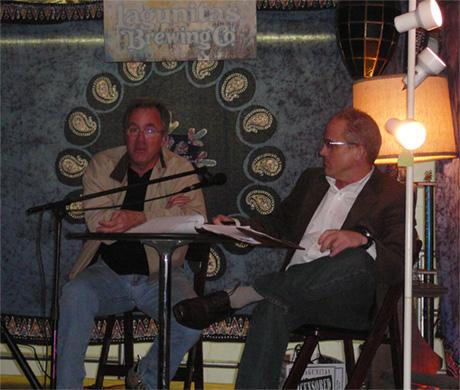
Tony Magee (from Lagunitas) and Mark House (from Pyramid) led a round table panel discussion about issues facing small brewers regarding bottles.
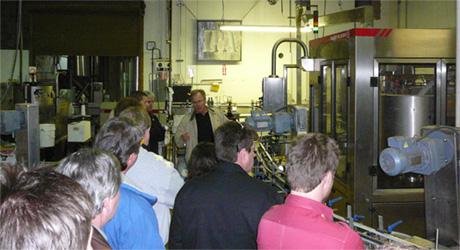
Later Magee led a tour of Lagunitas’ new bottling line, installed last January, by the Italian company Sympak.
After some supplier presentations and an open discussion, the afternoon ended with a beer social. Here Dan Del Grande from Bison Brewing enjoys a pint from Lagunitas.
And here’s a story about an O-I plant in Colorado entitled the House of Glass from the Scripps Howard News Service.
Philly Craft Beer Festival
3.3
Philadephia Cruise Terminal, The Navy Yard, 5100 South Broad Street, Philadelphia, Pennsylvania
first session 12-4 p.m., second session 6-10 p.m.
631.957.7035 [ website ]
Session #1: Not Your Father’s Stout
For our first session of Beer Blogging Friday I chose an old local favorite, San Quentin’s Breakout Stout from Marin Brewing. I must confess that it’s been at least several years since I’d tasted it and, as such, was looking very forward to finding out how much it had changed or I had changed in the intervening time. Since there are no real rules, I’ve decided to approach the Session as I would any session of drinking beer, with good conversation and camaraderie. So while the talk may be imaginary, the beer is not.
|
As far as the theme goes, my father never drank stouts and given that I’m now approaching fifty I’d say very few of our fathers did in fact drink stout at all. I may taking things too literally, but perhaps apart from Guinness, I feel comfortable saying our father’s generation was not one who embraced dark beer. In Dutch Wonderland — the part of eastern Pennsylvania where I grew up — folks were fiercely loyal to local brands. A wholesale distributor in the Keystone State recently quipped that Anheuser-Busch’s market share there is roughly half of what it is in other states. And as he further points out, there are more “old school” breweries and beer brands than any other place. So my father and men of his age drank Yuengling, Reading, Schmidt’s and Schaefer, light (colored) beers one and all. Yuengling did have a Porter but I don’t recall anyone ever drinking it until I was an adult. As far as I know, the only dark beer my father — stepfather, really — ever drank was in fact a Guinness. And that’s because I brought him a bottle of it from New York City, where I discovered it, along with Bass and Pilsner Urquell, at the jazz clubs I frequented when I lived there in the late 1970s. Compared to what I’d drank in my earlier teens, these were like nothing I’d ever tasted — and I liked it. |
I’d had a few ales growing up, Genesee Cream Ale, especially in that minimalist green can, was a teen favorite among my peers, and Yuengling had their Lord Chesterfield Ale. Then there was Ballantine which relatives in New Jersey seemed to prefer. But Bass and Guinness were worlds different from those and seemed positively exotic by comparison. That seems odd now, with the two imports more pedestrian among the exponentially wider field of available beers today, but it really was a different time. But enough about my father.
San Quentin’s Breakout Stout is made by friend Arne Johnson, head brewer at Marin Brewing, who’s been brewing there for a dozen years. I mention this because I’ve been thinking lately about some thoughts Alan McLeod had on “Do We Love The Beer Or Brewer?” He mentioned it in conjunction with a discussion Lew Bryson heated up over what, as writers, we owe the beer industry. And I know this may sound a bit wishy-washy, but I can see merits in both sides of this debate. Certainly we must be honest and forthright in our opinions and free to dislike a beer if we truly believe it to be inferior in some way. But — and Lew pointed this out, too — that doesn’t mean people who hate gueuze should write critically about it or that bad samples should create a bad review, especially if the sample went bad while cellared by the critic. If a brewery sends a bad sample, that’s another matter.
But back to Alan’s query, who do we love? I assume I’m not too atypical among my colleagues in having many close friends who are brewers. In such an insular and incestuous industry it’s all but inevitable that you see the same people at events, tastings, festivals, etc. over and over again. To my mind, it would be stranger still to not have brewer friends under such conditions. There are a lot of great people in this industry. Frankly, it’s one of the reasons I love my job. Among other industries I have known or worked in, brewing has perhaps the lowest ratio of assholes (let’s call in the A-Ratio) I’ve yet encountered. There are a few to be sure — you know who you are — but by and large the brewing community is one I want to be a part of and support precisely because of the people in it. I used to work in the music business once upon a time and by contrast the A-Ratio was quite high. And once you met a “rock star” who was so full of himself and a mess of a human being, it was truly hard to listen to his music in quite the same way afterward. You could still appreciate his talents and artistry, but only up to a point. Because once you knew what a wanker he was and how he treated the people around him, etc. you no longer wanted his music to be in the background of your life anymore. At least that was my reaction.
So what does that mean for brewers versus their brew? Knowing who made a beer I think does indeed influence at least our approach to a beer, even as we try to be as objective as possible. It would be naïve to believe otherwise. Think about it this way. Someone hands you a beer and says try this, it’s a new one from Russian River Brewing. Now if you like other beers you’ve had from them, you’ll likely be more inclined or predisposed to evaluate it, if not more favorably, at least with greater care and latitude than if the beer was presented as being from a brewer whose efforts you generally didn’t care for. That’s just human nature. In effect it’s Aristotle’s syllogisms occurring naturally in the real world.
It’s also the reason that we always evaluate beer in competition blindly, often double blind (meaning we don’t even know whose beers are entered). I do agree with Alan when he writes that we “have to remember that the subject matter itself is the important thing.” But unless you’re tasting it blind, I also think it’s practically impossible to separate it from outside influence, and to me that means other factors are also important to varying degrees. In quantum physics in the first half of the last century, physicists had a problem with light. Sometimes it behaved like a particle and sometimes like a wave. Eventually they figured out that light behaved as one or the other based on the kind of experiment you used to examine it. And this led to the idea that it was impossible to adopt the role of independent observer in any experiment because scientists couldn’t separate themselves from the world they were observing. They couldn’t step out of a door and be outside the universe, and that also meant that there would always be some part of any experiment that was influenced by the observer. This is known as the “observer effect,” which is defined as follows. “The observer effect refers to changes that the act of observing has on the phenomenon being observed.”
And as arcane a reference as that is, I think it also applies to tasting and evaluating beer. We could call it the “taster effect,” and define it as the influences on the act of tasting a beer changes the experience and has an effect on the beer being tasted. Does it mean objectivity is impossible? Maybe, but hopefully as professionals we can get to a very high degree of objectiveness and play down the outside influences, large and small, as best we can. I think that’s the best we can hope for, that with experience and diligent study we reach a point where our evaluations are internally consistent, that is we tend to view the same defects and positive qualities the same way regardless of the beer. You may at this point be thinking I’ve veered off track here, so let’s get back to the brewer. Do we love the brewer or the beer? I think it’s a little of both. The beer may be the primary reason we’re all here but as the creator of the stuff we all love, he or she can’t be ignored entirely either. Different brewers make their beer in different ways, of course, meaning their influence directly effects the final product. Knowing who made a beer also reveals something subtle about it. It tells us about intention, about what they were trying to make. It tells us what ingredients are more likely to have been used. It may tell us something about the water used, or any number of factors that effect the taste of the beer. If you enjoy the beers of a particular brewer then you know at least there’s a high degree of probability that you’ll also enjoy a new effort by that brewer. It’s no guarantee, obviously, but it offers you a reasonable assumption and ultimately I think changes how you approach tasting that beer. I don’t think that’s a bad thing, just something I think we should acknowledge and be aware of. Because we don’t live a vacuum, separated from the rest of the world with just our beer. The whole world conspired together to put that glass of beer in our hands at that particular moment in time. Every single preceding moment influenced what we will do next, whether it gets a good or a bad review. And for that, I love the brewer, too, because he made the beer in my hand. Of course, after I taste it, I may decide I hate him just as passionately, fickle critic that I may be.
|
Speaking of which, I’ve got a stout sitting here in front of me which I’m letting come up to room temperature. Arne’s stout is a beautiful murky black with a mocha-colored head. Thick Brussels lace stick and then cascade down the sides of the glass. It has the aroma of silky smooth chocolate, the kind you’d smell after the milk chocolate is melted in huge vats at the candy factory. There are whiffs of bitter coffee lying underneath, poking through to mix with the cocoa. Swirling it in my mouth, the bitter coffee dominates while his little sister chocolate cries for attention and tugs at my sides. It’s very smooth and creamy, and you only detect its strength — 7% abv — toward the end, as it’s rushing down your throat. The finish is clean, with hints of bitterness lingering pleasantly below the surface, urging you on for another sip. And I give into temptation and indulge myself. It’s a really fine stout and I think I’m enjoying it now more than even when I’d tried it before. It’s easy to see why it’s won so many medals, at least eighteen at last count. Does it matter that the brewer is a friend. I don’t know, but I’d happily have another pint with him tomorrow. |
The Session: Beer Blogging Friday Coming
Happy March! Stan Hieronymus over at Appellation Beer had a wacky idea a couple of weeks back, and invited the beer bloging community to join him in his gentle madness. The idea is simple enough. Once a month, in our case, on the first Friday of each month any beer bloggers who want to participate will all blog on that day on the same subject or theme. For the first time around, we’ll all be writing about stouts, and the theme is “Not Your Father’s Stout.” One blog will play host and the hosts will rotate from month to month. Stan will host the first one tomorrow and Alan McLeod of A Good Beer Blog will host the April gathering, announcing the theme shortly after March 2, and I’ll be tackling May.
I also created a logo for the event in an effort to tie the event together visually. If you’re planning on participating, I’d encourage you to grab the logo from the logo page I set up. The logo is there in different sizes and with slightly different text. I also included the original photoshop file if you want to download it and muck about with it to personalize it for your blog. I’d suggest that we all leave “The Session” text alone and personalize only the rest of the image, either the text on the mat or some other modification. I say that because we want the logo to act as a marker to inform readers of who is participating in the online event. I think we need to maintain some consistency of appearance for it to be easily recognizable and to help this idea be successful.