Brookston Beer Bulletin

Jay R. Brooks on Beer

  • Home
  • About
  • Editorial
  • Birthdays
  • Art & Beer

Socialize

  • Dribbble
  • Email
  • Facebook
  • Flickr
  • GitHub
  • Instagram
  • LinkedIn
  • Pinterest
  • RSS
  • Twitter
  • YouTube

Powered by Genesis

Injecting Opinions, Injecting Beer

September 6, 2006 By Jay Brooks

no-bottles
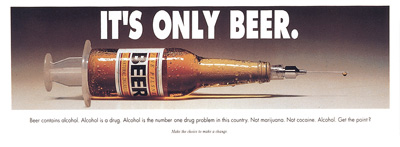
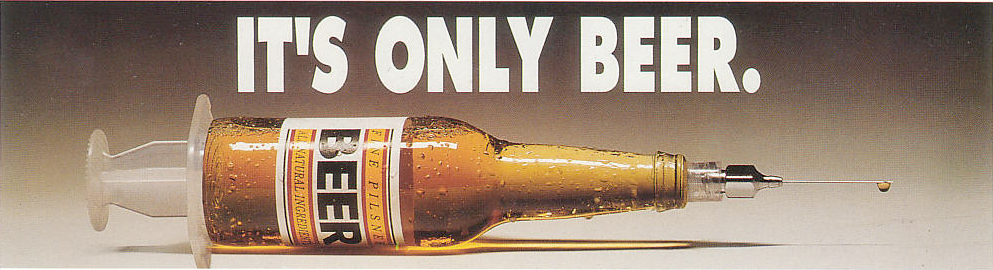
An understandably concerned brewer I know of noticed the image below while searching on the State of Indiana Alcohol & Tobacco website. Apparently it’s on a free flyer that also lists five “facts” about alcohol, but not about beer. I didn’t see the flyer on the website, but the image is taken from a neo-prohibitionist group called Facing Alcohol Concerns Through Education or FACE.
its-only-beer

The caption is a little difficult to read, so here it is: “Beer contains alcohol. Alcohol is a drug. Alcohol is the number one drug in this country. Not marijuana. Not cocaine. Alcohol. Get the point? Make the choice to make a change.”

Of course, even without the text, the message is abundantly clear. Beer is the equivalent of a drug that you inject directly into your veins, like heroin. Sure, that seems reasonable. But it clearly shows the inability of fanatics to recognize the difference. Or perhaps they do know but purposely choose to be so extremely deceitful, dishonest and manipulative.

This image is in poster form, and you can actually buy one for $7.00 on FACE’s website, along with many, many other offensively ridiculous propaganda pieces. You can buy their many items as posters, magnets, billboards, bookmarks and even air fresheners. The amount of merchandise for sale to spread fear is truly staggering. That they present these items as tools to help you in the fight against alcohol underscores the extent to which alcohol is under attack once more in this country.
tap-into Here’s another one attacking beer festivals. Apparently they send a bad message to kids.

Every year, thousands of towns across the country gear up for their annual festivals. Too often these events focus on alcohol. This year, show kids the real meaning of community spirit. And let the good times roll! Make the choice to make a change. Tap into a new community spirit.

Now I go to a lot of beer festivals, probably many more than the average person. And whenever possible, I take my kids along with me because I like having my family around me. Perhaps that makes me strange, who knows? There are a growing number of festivals that because of liability issues and governmental controls are unable to even permit children to attend beer festivals. So soon I won’t be able to spend as much time with my family because neo-prohibitionists are making my parenting decisions for me. Few things anger me as much as being told what’s best for my children. If these people don’t want their kids exposed to alcohol and want to keep them as ignorant as possible about the world, they have an obvious choice. Here’s my simple advice to them. “Don’t go or don’t take your kids. But please, don’t tell me I can’t travel with my family. Don’t decide for me what is ‘dangerous’ for my children. That’s my decision, not yours.”

Frankly, a community spirit that seeks to control and restrict the actions of others is no community. It’s a dictatorship, a neo-fascist police state. Neo-prohibitionists have decided how the world should look and they’re doing everything in their growing power to make it look that way, public opinion be damned. The idea that “annual festivals,” which celebrate all manner of local culture, should not include alcohol — which is still legal the last time I checked — is antithetical to a community’s spirit is spurious at best and downright maliciously evil at worst.

But let’s return to Indiana. As our concerned brewer rightly asks, what is a state governmental agency doing spreading such obvious propaganda? Since when is it the job of our government to push the agenda of a few citizens and not represent the entirety of the population? To me that’s the biggest danger we’re facing right now. It seems like state agencies are being overrun by people who are either neo-prohibitionists themselves or are sympathetic to their ridiculous cause of making all alcohol illegal again. If I were a brewer from Indiana I would ask my state representative and/or senator why the tax dollars from my business and my own personal taxes along with the revenue and jobs I was creating for the state economy were being used to fund propaganda that depicts my livelihood as being comparable to heroin? But check first to see if he accepted any bribes … er, I mean campaign contributions from any neo-prohibitionist organizations. That will help you to judge the honesty of his answer.
its-only-beer-lg

Filed Under: Editorial Tagged With: Law, Midwest

Homelessness, Malt Liquor and Social Policy

August 31, 2006 By Jay Brooks

Well they’ve gone ahead and done it, legislated away malt liquor for several neighborhoods in Seattle, Washington, effective November 1. The state liquor board yesterday banned “29 drink brands” including, of course, malt liquor. Now I’m not a fan of malt liquor (except perhaps for Dogfish Head’s wacky craft malt liquor, but even that I wouldn’t drink under very many circumstances) but the idea that restricting the sale of certain inexpensive, but high alcohol drinks will in any way cure homelessness is ludicrous.

Apparently, the same or similar items were previously banned in the Pioneer Square area of Seattle. The new ban radiates out from Pioneer Square adding the neighborhoods of Belltown, Lower Queen Anne, Capitol Hill, the Central Area, the University District and the International District. This essentially widens the ban area considerably and adds a new ban area adjacent to the University of Washington. But that simply suggests that the previous ban didn’t work and what many residents fear actually happened before, customers for these cheap, high-alcohol drinks — who are primarily, let’s face it, homeless or low-income — simply bought them elsewhere. So now the areas where they took there business will see a ban, as well. It doesn’t take a genius to figure out what will happen next. Attendance at AA meetings will not sharply increase and homelessness will not disappear. Oh, it might be quieter in specific places where drunk homeless people would congregate and buy their vice of choice, but they won’t stop drinking. Heroin is illegal yet thousands and thousands manage to find it.

This will certainly make it easier for authorities to round up and further persecute the homeless. And it may keep them out of “your back yard,” a place nobody seems to want uncomfortable truths to stray into, but without treating the root causes of homelessness, alcoholism and other societal miseries nothing whatsoever will change. Naturally, city officials claim this is “only one step in an overall initiative to curtail homelessness.” When mayoral aide Jordan Royer says “[p]eople think we’re just pushing drunks around,” it shows he knows that’s exactly what he is doing. He goes on to say that the “city will monitor the effect of the new rules to ensure that they don’t simply displace the problems around fortified beer and wines favored by chronic inebriates.” Uh-huh, that’s believable.

The three-member Liquor Control Board defended its actions with such lofty principles as the ban was “needed for the greater good” and “[t]his was a community effort.” Board member Roger Hoen then had this priceless gem. “The fact is it’s a democracy and (the board) kind of went by votes and the majority of the testimony, the majority of the evidence and the majority of the information that came before the board was to support going forward with it.” I’m sure that’s true, but how many homeless people were allowed to speak, I wonder. Without addresses, they rarely vote so I don’t imagine their point of view was much sought after. But if they had, I imagine the more coherent and sane among them would have asked for shelter and perhaps a job. I don’t believe they chose homelessness or alcoholism as a lifestyle. And while this measure may do wonders for the residents who don’t like looking out of their windows and seeing the great unwashed littering “their” streets, it will do absolutely nothing to combat the issue of the homeless themselves, despite the local government’s hollow assurances.

Board member Roger Hoen “acknowledged some businesses would lose money because of the rules. But, in life, there’s a number of restrictions and inconveniences that we have to live with.” Actually, Roger, you won’t be inconvenienced one little bit so by “we,” you actually mean “they.” You should say what you mean or at least know what you’re saying. I think the “restrictions and inconveniences” you speak of will be borne, as usual, by the people with the least voice in our society, the invisible people without homes or a say in their lives.

But that’s depressing. Luckily, Merritt Long, chairman of the board, ends things on an “upbeat note.” “Besides,” he says, “customers can still choose from more than 4,000 other beer products allowed in Washington” Good point, Merritt, albeit cluelessly condescending, I’m sure we’ll see the homeless choosing a nice bottle of Westmalle Triple or a local barleywine. Way to show your compassion.

Filed Under: Editorial, News Tagged With: Business, Law, Washington

Shangy’s Sues Goliath InBev

August 14, 2006 By Jay Brooks

Emmaus, Pennsylvania is a pint-sized town (of just over 11,000) a few miles south of Allentown and about 45 miles from Philadelphia. It’s a seemingly unlikely place for a beer store of this magnitude, but there it is. Tucked away on Main Street in Emmaus is Shangy’s, one of the best beer places in the state. (Side note: Emmaus is also the home of John Hansell’s fine Malt Advocate magazine.)

Started in 1980 by the Hadian family, their son Nima is now at the helm and the 35,000 square foot store carries over 3,000 brands, about double what the average BevMo did when I was there and three to four times the average BevMo store now. And Pennsylvania is a case state which, for those of you unfamiliar with that curious institution, means you can only buy beer by the case. This makes getting customers to take a chance on a new beer very difficult, but Pennsylvania’s liquor laws and state agencies seem to care very little about how its citizens are affected. I grew up there and I can tell you the system is messed up beyond belief and should be overhauled. Every state has its own set of peculiarities when it comes to alcohol laws, but Dutch Wonderland (my personal name for the state) got more than its fair share.

But Shangy’s managed to prosper in that environment for a number of reasons, not least of which is that they honestly care about the beer they’re selling. The word “Shangy,” by the way means “happy” in Nima’s native Farsi language, and it is his father’s nickname.
 

Inside Shangy’s during a trip I took there several years ago during a trip home.

Aisles and aisles of cases of beer at Shangy’s.
 

For the past decade, one of the many beers Shangy’s has done well promoting is Hoegaarden, a wit or white beer created by Pierre Celis in the 1960s when he single-handedly resurrected the style. Over time they have become the largest Hoegaarden wholesaler nationwide, moving as many 2,000 kegs each month. Hoegaarden is owned now by InBev, the world’s largest beer company (by volume of beer sold), with such brands as Beck’s, Brahma, Franziskaner, Labatt’s, Stella Artois, St. Pauli Girl, among more then 75 other local and national brands. They recently sold the Rolling Rock brand to Anheuser-Busch. Since InBev was formed by a merger in 2004, they have enjoyed a 14% share of the total world beer market.


In 1998, Shangy’s settled a lawsuit that “affirmed that Shangy’s was the exclusive wholesale distributor of Labatt products in 17 Pennsylvania counties,” which at the time included Hoegaarden. But with the 2004 merger, Labatt became an InBev subsidiary. Now Shangy’s contends that InBev, who recently gave distribution rights to another of its brands, Stella Artois, to a different beer distributor thus violating the eight-year old agreement. Shangy’s filed a lawsuit in Philadelphia this month seeking monetary damages along with a “court order compelling InBev to abide by the terms of the 1998 agreement.”

As we all know but few will say, “Hadian, who takes glee in ridiculing the mass-market beers, warns that consolidation will ultimately reduce the number of specialty brews on the market. Why? Because wholesalers will inevitably concentrate on selling mass-market, high-volume brands and neglect the craft brews, reducing their chances of survival, he says.”

I’m sure we’ll hear much more about this case as it proceeds. For now, there are more details on this story in an AP Story and a more local take by Lehigh Valley’s The Morning Call.

Filed Under: News Tagged With: Business, Eastern States, Law

Judge Ponders: “What Is Beer?”

August 4, 2006 By Jay Brooks

maps-pa
This may be funny only to me since it happened in my hometown of Reading, Pennsylvania (BTW, it’s pronounced “redding”) — or near enough, I grew up in a small suburb adjacent to Reading.

Back in January, a 17-year old testified that an adult bought him a case of Miller Genuine Draft but Berks County Court Judge Jeffrey K. Sprecher (obviously no relation to the Sprecher Brewery in Wisconsin) dismissed the charges because “the prosecution had failed to provide the state Liquor Control Board’s list of beers to prove the beverage was beer.” Makes sense to me, I consider Miller Genuine Draft to be not really beer, but a highly-engineered industrial food product. The judge also stated that it was “equally plausible that the defendant purchased a nonalcoholic beverage with a flavor similar to beer.” Clearly, he’s never tasted a non-alcoholic beer.

An appeals court has now overturned that ruling, stating that the minor’s “testimony was more than enough to establish that the beverage he was drinking was a malt or brewed beverage.” Wow, they actually believed a minor would know whether or not he was drinking beer or not. Now that’s funny.

mgd

Is it or isn’t it?

Filed Under: Just For Fun, News Tagged With: Eastern States, Law

California SB 1548: Free Beer for Everyone!

August 3, 2006 By Jay Brooks

Though it’s not been much reported, a bill before the California state senate, SB 1548 — and sponsored by Anheuser-Busch — will expand the laws regarding the tasting of alcohol to include beer. Specifically, a wholesaler, brewer or importer will be permitted to give up to 8 oz. of beer to sample in an on-premise retail setting and at no charge. No more than six tasting events per location per year can be held.

The original bill would have allowed a sample of 12 oz. in the original package unlimited times, meaning companies could have gone into bars and bought patrons a bottle or can of their beer as a promotional tool to increase business. Obviously, this would greatly benefit the larger companies with greater resources who could afford to “buy the world a drink.”

The California Small Brewers Association (CSBA) was successful in negotiating an amendment to the bill so that the amount was less than a full bottle or can and — perhaps most importantly — was not in the original packaging and could only be done six times per year in any one location. This makes it harder for companies to simply buy up the market by plying customers with a bottle of their product, but it still doesn’t really remove the impetus for abuse or the uneven way in which this would benefit the large company and further make doing business on a level playing field impossible for the small craft brewer.

The CSBA, who opposed the bill in its original form, is now taking a neutral position on the bill. If they had opposed it outright, they would not have been able to change it at all. In it’s amended form, it has now passed unanimously the first hurdle, the Assembly Government Organizational Committee, and is now on its way the Senate GO committee. After that it goes to the the House floor to be voted on, which should take place before the end of this month when their current session ends. If it passes there, then it’s over to the Governator for signature.

I certainly understand the CBSA’s removal of opposition to this bill, especially since the politics and issues make it such a complicated one. But I think there’s no doubt that their members will still be harmed when it is passed into law. The difficulty in opposing this law is that wine and spirits companies currently operate under essentially similar rules, and so do many other states. Rumor has it that A-B is, in fact, quite unhappy about opposition to this bill. Because in their mind, adding beer to the existing law for wine and spirits will simply — as they argue — “even the playing field.” There certainly are big wineries and small wineries and big spirits companies and small ones, too, so it would appear that inequities would exist there yet I know of no particular burden placed on the smaller producers with presumably smaller resources. Of course, that may be because I don’t follow those industries very closely. But my sense is that there is so much more profit built into wine and especially spirits that the difference between small and large producers — at least with respect to sampling resources — is not dramatic. Beer, on the other hand, is such a volume driven business with small per unit profits that the available resources difference between the big breweries and almost all the craft brewers is quite vast indeed. So at first blush, it may appear that this law will create a level playing field across all alcoholic beverages but I think the reality is that it will do just the opposite. I believe it will only deepen the divide between big and small breweries.

The bill’s language refers to the authorized tastings as “courses of instruction for consumers” which on its face would be a good thing except that I haven’t seen a high level of wine “instruction” in the tasting rooms of wineries across Napa and Sonoma to give me much cause for confidence that this is aimed at creating beer schools.

The idea of a large brewery sponsoring in effect a “free beer night” at bar after bar is a truly frightening one. Radical neo-prohibitionists would have a field day with that one but that could actually help in defeating this bill, along with possible opposition by law enforcement groups. And let’s not forget this is an election year.

It will probably do no good, but I think this bill should be opposed. Personally, I’d like to see a competing bill that would allow educational sampling along lines that make sense and don’t give a huge advantage to the big breweries. Why not 2 oz. samples? That’s enough for most educational purposes, especially if you’re tasting multiple beers. Most beer festivals and judging events don’t require much more than that to get enough of a sample to give you an idea of the beer.

The current bill allows for sampling “up to 8 oz.,” meaning you could give customers four samples of 2 oz. each. That’s probably what craft brewers would be likely to do, but I can’t see the big breweries taking that approach. And make it an 8 oz. sample and I can easily predict we’ll start seeing the big companies making 8 oz. logo tasting glasses for the bars who cooperate (and who wouldn’t?) to serve. Undoubtedly if the bars “buy” the glasses then they’ll be used instead of pint glasses for promotional “pint nights” where when you buy a beer, you keep the glass. If the brewery buys the customer the beer through this new law, and they also get a free tasting glass then you’ve got a system ripe for abuse.

It feels weird arguing that the status quo is adequate but in this case the current laws do provide something of a level playing field with regard to tasting. No one currently has any particular advantage, small, medium or large. This law will, of course, undo that and it’s hard to argue that it won’t give an advantage to the businesses with the most money. There has been a separation of the brewers and distributors from the retailer and this has mostly served the industry well to date. It has kept at least a semblance of distance between the two. If the curtain is occasionally parted by unsavory practices, at least it was there in the first place. Bringing it down now will only serve to move us closer to the end of the second act, by which I mean the rise of craft beer. Because anyone paying real attention to what’s been going on has to conclude that A-B — and perhaps all the big players — are doing their level best to eradicate craft beer and especially the regional breweries, as they did before several decades ago.

If you live in California, please consider contacting your elected officials and asking them to oppose SB 1548. It may sound alarmist, but the very future of craft beer may depend on it. Because if this passes, it will be the first of many legislative changes that will take us down a slippery slope back to the time when good beer was almost impossible to find. And I for one, don’t want to see that world ever again.

Here’s the current language of the bill:

25503.55. (a) A beer manufacturer, a licensed beer and wine importer general or a licensed beer and wine wholesaler may instruct consumers or conduct courses of instruction for consumers, on the subject of beer, including but not limited to, the history, nature, values, and characteristics of beer, and the methods of presenting and serving beer. A beer manufacturer, a beer importer general licensee or a licensed beer and wine wholesaler may conduct such instructions at the premises of a retail on-sale licensee authorized to sell beer.
(b) The instruction of consumers regarding beer may include the furnishing of tastes of beer to an individual of legal drinking age. Beer tastes at any individual course of instruction shall not exceed 8 ounces of beer per person per day. The tasting portion of a course of instruction shall not exceed one hour at any individual licensed retail premises. Tastes of beer may not be served to a consumer in their original container but must be served in an individual glass or cup.
(c) All tastes of beer served to a consumer as authorized in subdivision (b) shall be served only as part of the course of instruction and shall be served to the consumer by an employee of the on-sale retail licensee.
(d) A beer manufacturer, licensed beer and wine importer general or a licensed beer and wine wholesaler may not hold more than 6 courses of instruction per calendar year at any individual on-sale retail licensed premises if the course of instructions includes consumer tastes of beer.
(e) A representative of a beer manufacturer, licensed beer and wine importer general and/or a licensed beer and wine wholesaler must be present and authorize any tastes of beer conducted at an on-sale retail licensed premises pursuant to this section. The representative shall be responsible for paying the retailer for the tastes of beer served at any course of instruction. Such payment shall not exceed the retail price of the beer. For purposes of this section, a licensed beer and wine wholesaler cannot be the representative of a beer manufacturer or a licensed beer and wine importer general.
(f) No on-sale retail licensee shall require one or more courses of instruction pursuant to this section as a requirement to carry a brand or brands of any beer manufacturer or beer and wine wholesaler.
(g) No premium, gift, free goods, or other thing of value may be given away in connection with an authorized course of instruction which includes beer tastes except as authorized by this division. Failure to comply with the provisions of this section shall be presumed to be a violation of section 25500.
(h) A retail licensee may advertise the instructional tasting event using interior signs visible inside the establishment.
(i) A beer manufacturer, a licensed beer and wine importer general and a beer and wine wholesaler shall maintain an individual record of each course of instruction involving tastes of beer for three years. Records shall include the date of the tasting, the name and address of the retail licensee, and the brand, quantity and payments made for beer furnished by the beer manufacturer, the licensed beer and wine importer general or a licensed beer and wine wholesaler.

Filed Under: Editorial, News Tagged With: Business, California, Law

Protecting Minors by Separating Families

August 2, 2006 By Jay Brooks

Neo-Prohibitionists often get help from the authorities, who themselves are increasingly likely to be neo-prohibitionists. Because they’ve learned that one of the most effective ways to control others and further their agenda is to seek office in the various state alcohol control agencies. Despite taking an oath to serve the public good, they more often alter policy to do just the opposite. Witness Oregon’s “minor posting rules,” which led to seeing the following sight at this past weekend’s Oregon Brewers Festival (OBF).

That’s right, that’s not a joke, you’re seeing it correctly. It is not a trick or optical illusion. Here’s a close up of the sticker:

Parents also had to wear a similar sticker making a similar pledge to remove their minor child by 7:00 p.m. So what’s the reason for these draconian measures? According to Ken Palke, Media Relations Liaison for the Oregon Liquor Control Commission (OLCC), it has to do with Oregon’s minor posting rules, where “minors are not allowed into an environment where drinking is the predominant activity. The OLCC feels that after 7, the Portland event is geared much more toward drinking, without much eating.

Here’s the OLCC regulation stating the minor posting rule’s purpose:

845-006-0340 Minor Postings
(1) Purpose. The Commission is charged with regulating the sale of alcohol in a manner which protects the safety and welfare of the citizens, and ensures that alcohol is used legally. As a policy making body, the Commission has a responsibility to send a clear message to the community and its youth that drinking alcohol is an adult activity, and that drinking environments are for adults. At the same time, the Commission recognizes the need to maximize opportunities for minors to eat at licensed premises while minimizing their exposure to drinking environments.

According to the OLCC’s “licensing people, the OLCC did not require that stickers of any kind be put onto minors during the beer festival.” But as Art Larrance, Director of the OBF, points out, the OLCC tacitly approved it by signing off on the procedure the festival used in the voluminous application process the OBF is required to go through in order to put on the festival. “The OLCC did not want any minors at the festival,” Larrance told me, and the procedure we came up with was to placate their concerns and comply with the minor posting rules. They also suggested prohibiting minors ages 14-20 entirely and the arguments Larrance made fell on deaf ears. According to him, he tried to explain how such rules would split family participation and keep many people from being able to attend and the OLCC “just sat there and didn’t say anything.”

Such behavior, I think, is consistent with the intractable and inflexible position that the neo-prohibitionist movements have taken in their efforts to remove alcohol from society. The OLCC’s notion that “drinking alcohol is an adult activity” and the so-called clear message they’re sending is that children should not be present during adult activities. Taken to its extreme, or its logical conclusion depending on your point of view, this will ultimately split society into two: one society which is adults only and one which is kid-friendly with no adult activities whatsoever, lest our youth be corrupted. And there it is again, the ubiquitous “it’s for the children” argument that invariably is used by neo-prohibitionist groups to push their agenda.

If parents wish to bring their children with them to a beer festival, what business is that of the state? Restricting parental authority in this method sends not the message they intend, but that parents cannot be trusted with their own children’s welfare and upbringing. How dare the OLCC presume to tell anyone how to raise their children. That is not their responsibility as they claim, but is the duty and responsibility of each parent. All they’ve done is wrested control from parents and used it to further the goal of prohibition. They’ve certainly perverted the idea of protecting society from itself.

It seems quite obvious to me that if you want to raise children who will become responsible adults, capable of reasonably enjoying what the OLCC calls “adult activities,” they need to witness the example of their parents and other adults doing just that. Keeping minors from ever seeing adults drinking will only serve to make it more of a taboo — thus making abuse more attractive as prohibited activities are always more desirable — and give kids no lessons to learn on “how” drinking responsibly is accomplished. Underage drinking — and especially abuse — is, of course, much less common in nations where alcohol is seamlessly part of the society and in which children are included in all aspects of the adult world. England’s pub culture has, for example, created family gathering spots for entire neighborhoods without managing to corrupt its youth. In fact, almost everywhere alcohol is not restricted but embraced as a part of everyday life, society seems healthier as a result. The frat party alcohol abuses are peculiarly restricted to the U.S., where drinking is such a ridiculous taboo that kids who lack any positive examples of alcohol act irresponsibly in the vacuum of information created by neo-prohibitionist proselytizing.

Ironically, the OLCC’s director, Teresa L. Kaiser, resigned in May of this year after being arrested “on suspicion of driving under the influence and reckless driving.” Following a two-car crash on the west end of Portland’s Sellwood Bridge, “police said a breath test showed her blood-alcohol level was 0.16, twice the legal limit for adults.” She probably never attended a beer festival with her parents to learn how to enjoy alcohol responsibly. But at least she’s gotten that infant alcoholism epidemic under control.

This problem sadly is not, of course, unique to Oregon. Neo-prohibitionists in communites all across America are trying to remove alcohol from public events such as county fairs, outdoor concerts and festivals of all kinds. When such puritanical ideas — like Oregon’s keeping minors away from almost any event involving alcohol — work their way into our laws, it’s the very children such laws claim to protect along with society as a whole that are being harmed. And we should do everything in our power to oppose them. I, for one, will continue to take my kids, Porter and Alice, to as many beer festivals as possible.

Filed Under: Editorial Tagged With: Business, Law

EU Rules in Favor of Bud

June 27, 2006 By Jay Brooks

I saw this yesterday and have been dreading talking about it, because it’s an issue that I have mixed feelings about, but mostly it just pisses me off. The European Union’s Office for Harmonization in the Internal Market Board of Appeal (now that’s a bureaucratic name if ever there was one) has ruled that “Anheuser-Busch can register it’s trademark “Bud” beer throughout Europe.”

This is just the latest salvo in a global slugfest with Czech brewer Budejovicky Budvar. Because of the dispute, Budvar is marketed as Czechvar here in the U.S. as well as many other countries, the ones in which they’ve lost court battles with A-B over the name. An earlier post I did also detailed Budvar’s take on the dispute. Yesterday’s ruling is also subject to appeal so I suspect that Budvar will in fact do just that.

Here’s Wikipedia’s summary of the ongoing dispute:

Although Budějovický Budvar was founded in the 13th century, Anheuser-Busch claims that the Czech brewer has been distributing Budweiser as a commercial brand only since 1895, 19 years after the Budweiser brand was first brewed by Anheuser-Busch [which was 1876]. The Czech company contends that its history, and thus its claim to the Budweiser name, goes back even further. King Otakar II of Bohemia granted independent brewers in the city of Budweis the right to produce beer as early as 1265. They did so in a style that became known as “Budweiser,” much as beers brewed in the fashion of another Czech city, Plzeň (German: Pilsen), are referred to as “Pilsner”, the company says.

In many countries, the beer produced by Budějovický Budvar is the only beer that may be sold as “Budweiser” — in those countries, the American Budweiser is usually marketed as “Bud.” Since both Budějovický Budvar and Anheuser-Busch have trademarks for the name “Budweiser”, they have been party to many lawsuits in a number of countries. In some places where it competes with the American Budweiser it is marketed with the names Budvar and Budweiser Budvar. Separate lawsuits have been filed in dozens of countries, including many in Europe and I’m not sure how this ruling effects the earlier local decisions.

Budějovický Budvar recently started having limited distribution in the USA and Canada under the name Czechvar. Due to its ongoing dispute with Anheuser-Busch, it cannot be sold in A-B’s home state of Missouri; however, customers have crossed borders to Kansas or Illinois, where liquor stores have posted signs reading “Yes, We Have The REAL Budweiser!”

From the AP wire story:

The Czech brewery was founded in 1895 in a town called “Budweis” by the German immigrants who founded it – a beer brewed there would have been known as a Budweiser. Anheuser-Busch launched its own U.S. Budweiser brand in 1876, picking the name because it evoked German brewers but was still easy for U.S. consumers to pronounce.

So A-B in fact acknowledges that the town of Budweis was the inspiration for Budweiser.

The AP wire story continues:

“We are making solid progress in our battle to protect the brand names we’ve developed,” Stephen Burrows, president and chief executive officer of Anheuser-Busch International, said in a news release. “As a result, Anheuser-Busch can sell its flagship brand under the Budweiser or Bud brand in 30 European countries.”

The Czech company has argued that the name “Budweiser” should only refer to beer brewed in a certain area, in the same way Greek Feta cheese can only be produced in certain regions.

Anheuser-Busch has argued that the term Budweiser is simply slang used by German immigrants — the Czech company’s hometown is officially named Ceske Budejovice.

The European appeal board agreed the term Budweiser isn’t a special label, or “appellation” in legal-speak, according to Anheuser-Busch.

In addition, a related dispute has recently been highlighted because of the current World Cup. Bitburger, which has been around since 1817, markets their beer under the name “Bit” or “Bit Beer” which German courts have said is too close to Bud and that Bit has the prior claim in this case. This has caused some trouble for Bud’s sponsorship as the exclusive beer of the World Cup tournament.

As I said, I have mixed feeling about this issue. On the one hand, A-B did start using the name itself in 1876. That may or may not have been before Budvar did. It’s hard to say since their claim of a brewery being in Budweis since the 13th Century seems sound but whether or not the beer from that brewery was called Budweiser (or something similar) is frustratingly hard to prove to everybody’s satisfaction. Was the Nineteenth Century as fanatically obsessive about IP rights and trademarks as we are today? It certainly feels right that a beer made in Budweiss would be called Budweiser. It just rolls of the tongue so easily that it seems obvious, but that may simply be because we’ve all grown up knowing the name Budweiser precisely because of A-B’s efforts to promote the brand name. It’ all but impossible to tell. A-B argues that Budvar wasn’t sold commercially until 1895, but what is the definition of commercially? What was it in the 19th Century? They were probably selling beer in Budweiss/Budvar before 1895. They may not have been bottling it, but they were probably calling it something, even if they didn’t write it down. It’s likely that’s the way business was done all over the region. The industrial revolution didn’t happen all at once all over the world, so pre-industrial business that was less formal and more dependent on relationships and locality doesn’t seem like much of a stretch to me.

But even if we accept A-B’s argument that it’s been using the name longer and therefore Budvar ought not to be allowed to use the name of their town, I don’t quite understand it. Budvar and Bud are clearly not the same name, and both are different from Bit. A-B, of course, fiercely objected to and fought the name “Budvar” as being too close to “Bud.” This is the same trouble with “Bit,” too. Maybe I’m giving mankind too much credit, but I think people can tell the difference between “Bud,” “Budvar” and “Bit” even though they’re all beers. The packaging on all three is very different, bottles are different and certainly they taste differently. “Bit” and “Budvar” taste closer to one another than they do to Budweiser. Again, perhaps this is just me, but if you’re too stupid to notice the difference than maybe you’ve already had enough to drink. I’ve been involved in one of these trademark disputes over a contract beer I used to manage and the thing I noticed was that whoever is trying to protect their trademark is generally incapable of perspective. It’s an all or nothing attitude that makes compromise all but impossible. I’ve been literally screamed at for suggesting just such a thing. But I think most of us consumers could agree that having “Bud,” “Budvar” and “Bit” on our store shelves would not be much of a problem for us. We could figure out what we wanted to buy without too much effort.

Let’s test that, shall we. Let’s say you’re in a store looking at the beer on the shelf. Here’s what you see:

 
Tell the truth, could you easily distinguish which brand was which? Could you tell they’re weren’t the same? If you say no you either work for one of them or need to have your eyesight checked.

Okay, so let’s say now you’re at a bar and you want to order what the fellow has sitting on the table next to you. Here’s what you see there:

 
Is that too confusing for you? Do they all look the same? Do they even look similar? Does seeing this sight lead you to “brand confusion?” Of course not, that’s what we have eyes for.

We roam store after store buying everything under the sun and we manage to get what we want almost all of the time. I don’t mean to seem so condescending and I’ll apologize in advance, but here goes. Once upon a time in what seems like a previous life, I was a record buyer for a large chain of record stores on the east coast. They’re no longer in business but when I was there they were in thirty states and were the second largest record chain in the country. A couple of times a year a salesman from Disney would come by whining that the home office gets complaint after complaint because a customer was in a record store and bought a book and tape of Peter Pan (or whatever) and when they got it home it wasn’t the Disney Peter Pan but some knock off. Gasp! Oh, the horror. Invariably they’d point to it being on a Disney rack that they’d given to the store expecting us to keep it non-Disney free. Well like most retailers, we took a dim view of a supplier telling us what to merchandise and where. But here’s the thing. Even though the Peter Pan knock-off had the same exact name it looked so different from the Disney one that pretty much only a person whose I.Q. dipped safely into single digits could have confused the two. That’s not brand confusion, it’s just confusion period. And on some level, that’s the way I view these trademark catfights.

There will always be people who will be confused and we can’t — and shouldn’t — create a world so simple for them that rest of us are miserable. If you need the instructions printed on your bottle of shampoo, I’m talking to you. If you don’t know coffee is hot, listen up. If you can’t tell Bud, Budvar and Bit apart, it’s your problem and we shouldn’t kill a company’s heritage because some yahoo might get confused and buy a brand different than he intended to.

All three of these brands are legitimate brands who have all been doing business for more than a hundred years. When they were all relatively regional brands or at least stayed within their own country’s borders, there was no problem. But as the world’s commerce grows increasingly global in scope we have to find a better way then simply determining winners and losers. Because invariably whoever has the more aggresive posture and pays more legal fees is going to win. Especially when there is very little black and white to these arguments, who prevails has less to do with justice and more to do with who carries the biggest stick.

Filed Under: News Tagged With: Business, International, Law

NBWA Continues Lobbying for the Rich

June 22, 2006 By Jay Brooks

I knew this issue wasn’t going away. Congress is again moving toward letting the rich get richer while the rest of us get poorer. A compromised version of the repeal of the estate tax passed the House today and while it’s not quite as onerous as outright repeal, it still leaves a very bad taste in my mouth. What’s that flavor? Greed. Bloomberg has a nice overview of today’s events regarding the estate tax vote. Why is this here? Because the National Beer Wholesaler Association continues to make this their top priority. It has very little to do with the beer business per se, apart from keeping a very wealthy few beer wholesalers as rich as Croesus.

From the NBWA press release:

NBWA Applauds House Vote Calling for Permanent Relief from the Death Estate Tax

ALEXANDRIA, Va. – The National Beer Wholesalers Association (NBWA) today applauded House passage of legislation that aims to provide the nation’s small business owners with permanent relief from the onerous death estate tax. H.R. 5638, the Permanent Estate Tax Relief Act of 2006, sponsored by Ways and Means Committee Chair Bill Thomas (CA-22), passed the House with bipartisan support.

“Today’s vote represents recognition by the House that it is high time to deliver a permanent solution to the death estate tax to America’s small business owners,” said NBWA President Craig Purser. “While full outright repeal is the ultimate goal, in this intense political climate we acknowledge that partial relief is better than nothing. Those groups that oppose Chairman Thomas’s bill in favor of holding out for a vote on full repeal must understand that small business owners need permanent relief now, and the window of opportunity is closing.

“The onus is now on the Senate to act swiftly. The Senate asked for legislation from the House and the House answered the call. Now is the time for Senators to stand up for small, family-owned businesses and support this effort to provide permanent relief from the death estate tax once and for all.”

Horse manure. You can read my earlier equally fair and balanced rant entitled “Enough Already: Time to Cry Bullshit” about this issue.

Filed Under: Editorial, News Tagged With: Business, Law, National, Press Release

Washington State Formally Appeals Costco Decision

June 21, 2006 By Jay Brooks

The closely watched Costco decision, which would dismantle the three-tier system in Washington state and would also set the stage to do the same throughout the country, has now been formally appealed by Washington state’s attorney general, Rob McKenna. The Washington Liquor Control Board had earlier indicated that they would appeal, but this now makes it official. Judge Pechman, who made the ruling being appealed, has not yet decided whether to stay her ruling during the appeal process, which could easily take up to two years to wind its way through the legal system.

Filed Under: News Tagged With: Business, Law, Washington

Anheuser-Busch in Dirty Water

June 10, 2006 By Jay Brooks

According to yesterday’s Worcester Telegram (Massachusetts), the Sixties band The Standells are suing Anhueser-Busch for copyright infringement. Apparently A-B used their 1966 hit Dirty Water in advertising without first obtaining the band’s permission. Dirty Water is usually assosciated with the Boston Red Sox because the song is played at Fenway Park every time the Red Sox win. The Standells filed a federal lawsuit on May 31 claiming that Anheuser-Busch used their song Dirty Water “without permission in commercials to try to tap into the song’s connection to the team.”

Filed Under: News Tagged With: Business, Law, National

« Previous Page
Next Page »

Find Something

Northern California Breweries

Please consider purchasing my latest book, California Breweries North, available from Amazon, or ask for it at your local bookstore.

Recent Comments

  • Bob Paolino on Beer Birthday: Grant Johnston
  • Gambrinus on Historic Beer Birthday: A.J. Houghton
  • Ernie Dewing on Historic Beer Birthday: Charles William Bergner 
  • Steve 'Pudgy' De Rose on Historic Beer Birthday: Jacob Schmidt
  • Jay Brooks on Beer Birthday: Bill Owens

Recent Posts

  • Beer In Ads #5187: Ballantine’s Bock Is Here — With Horns! March 26, 2026
  • Historic Beer Birthday: Augustus Hoeveler March 26, 2026
  • Historic Beer Birthday: Bill Siebel March 26, 2026
  • Historic Beer Birthday: Conrad Windisch March 26, 2026
  • Beer Birthday: Rudi Ghequire March 26, 2026

BBB Archives

Feedback

Head Quarter
This site is hosted and maintained by H25Q.dev. Any questions or comments for the webmaster can be directed here.