Brookston Beer Bulletin

Jay R. Brooks on Beer

  • Home
  • About
  • Editorial
  • Birthdays
  • Art & Beer

Socialize

  • Dribbble
  • Email
  • Facebook
  • Flickr
  • GitHub
  • Instagram
  • LinkedIn
  • Pinterest
  • RSS
  • Twitter
  • YouTube

Powered by Genesis

“Lager Carries the Load” or Get a Load of This

June 1, 2006 By Jay Brooks

The New York Times food critic Frank Bruni reviewed Café d’Alsace, the new restaurant in New York City with its own Beer Sommelier. That fact has been written about already and has garnered a bit of press on its own, but the review is another reason I hate it when the mainstream press sends a wine and/or food geek to do a beer man’s job. Jules at The Bruni Digest already did a great job dissecting the review but I want to address the beer aspects of his review.

His review begins in a futile search for cloves:

CLOVE?” I asked, not quite sure I had heard him correctly.

“Clove,” he answered without hesitation.

“Huh,” I said, for two reasons. The first was that I was already hoisting the beer to my lips for another sip, so I had to be quick and economical with my syllables. The second: I was flustered. Try as I might to latch onto them, the promised notes of clove in the brew eluded me.

But I had hope. The beer sommelier had also foretold currents of orange, and their presence in this Leffe Blonde from Belgium was incontrovertible. He had talked about the “aromatics” at work, and there was indeed a citrusy, flowery perfume.

Could he be wrong about the clove? I concentrated. I searched my palate for what was behind the orange or maybe in front of the orange or possibly on the side of the orange.

No clove, at least not for me. But I was having what I suppose I should describe as a heady time rooting around for it.

Frank begins his review with the word “CLOVE?” in all caps with a question mark like he’s found a hair in his soup, like there’s meat in his veggie burger, like he’s surprised as hell that cloves should be one of the aromas in a beer. In other words like he’s an idiot, at least in beer sophistication. Because even your average beer aficionado would be unsurprised, indeed would expect, to find cloves in many different Belgian-style beers (not to mention German and even Americans craft beers making those same styles) and would know it’s not magic, but simply a result of using particular strains of yeast. The fact that he couldn’t find such a pervasive aroma in Leffe Blonde speaks volumes as to how undeveloped his palate is. I might expect that from the average person, but Frank is the food critic for the New York Times for chrissakes. He’s supposed to be familiar with all manner of aromas and tastes. Is it too much to ask that he have some passing familiarity with beer, especially when reviewing a place known for its beers? Hasn’t craft beer and great imported beers been around long enough that no food critic’s education is complete without knowing about beer? We certainly expect a food critic to know wine and spirits, in fact any beverage that compliments the food. So why do so many get a pass when it comes to beer? At a minumum Frank should have been man enough to step aside and let someone else, someone who knows a little about beer — say Eric Asimov — review the restaurant in his place.

We should expect food critics to recuse themselves when in unfamiliar territory just like I would never presume to review a wine. I enjoy wine but lack the sophistication to tell others more than whether or not I like it. If I tried to describe a wine, I’d sound like an unsophisticated wine drinker, which of course is what I am. But at least I know that. And as a result I restrict my wine descriptions to friends and loved ones. Frank Bruni and many of his colleagues do not seem to realize that they should stick to talking about what they know, too. I wish they cared enough to learn about what they don’t know, but that seems fated to never happen. You’d think given the efforts of Garrett Oliver in New York City that so prominent a critic as Bruni would take the time to become a complete food critic. Apparently you’d be wrong.

Next he remarks that Café d’Alsace “has more than 110 kinds” of beer and “[i]t assigns them bin numbers and groups them under different headings: “wheat,” “bock,” “lambic.” Uh, those “headings” are called styles, and they’re like varietals you moron. Think of lagers and ales like whites and reds, if you have to, and “bock” and “lambic” as pinot and cabernet. Is that too hard? If so, how about simply the different “headings” taste different? Is that simple enough? I know I’m sounding churlish, but I find this kind thing completely unacceptable, especially when it’s from someone who’s supposed to be so well respected and associated with one of the most quoted and well-regarded newspapers in the country, if not the world. If they can’t get it right and indeed go so horribly off the tracks then what hope is there that small town newspapers will competently cover beer?

Okay, cut to the finale:

Let’s face it: I also got a buzz from the beers. One night I tried the effervescent Belgian Deus Brut de Flandres, which comes in what looks like a Champagne bottle and is served in Champagne flutes. Another night I ventured into the sour realm of the lambic — and beat a hasty retreat.

And yet another night I heeded the advice of Aviram Turgeman, the beer sommelier (I had to use the phrase just one more time), and started out with the Belgian golden ale Duvel, which he said would “cleanse the palate and awaken the stomach.”

That seemed like a lot of responsibility for a beer. But time and again, we’ve asked as much of wine. Why not, on occasion, let a lager carry the load?

He got a buzz from the beers? Why should we have to face that? Even most of the strongest beers weigh in at 10% a.b.v. or below, well under the strength of your average wine. How many of his reviews contained the phrase “let’s face it: I also got a buzz from the wine?” I’m willing to confidently guess that number is zero. So are we to conclude he can handle his wine but not his beer? Or is it more likely he doesn’t know what he’s talking about?

Next he summarily dismisses sour lambics — they’re called Gueuze, Frank — and while they’re clearly not for everyone he never explains why he “beat a hasty retreat” from them. I could guess, but I’ll leave it to your imagination. Most Gueuze lovers I know have more sophisticated palates than Frank demonstrates, that’s for sure.

But the ending is the real kicker. Frank extolls his enjoyment of Duvel, though he seems hesitant to believe it capable of doing as much for the food and his enjoyment as wine is capable of, despite his admission it does just that. And here it is, his final thought, and it’s about the Duvel and it’s ability to work with food. Frank suggests since wine is so hard working, from time to time we should “let a lager carry the load.” I’ll pause here to give you a chance to throw your head back and laugh heartily. Hey Frank, you bonehead, Duvel is an ale. That’s like confusing Silver Oak Chardonnay with Opus One. You wouldn’t do that would you, Frank? Frank?


Filed Under: Editorial, Food & Beer, News

Memphis Coors Brewery in Jeopardy Again

June 1, 2006 By Jay Brooks

City Brewery of La Crosse, Wisconsin had been negotiating for the purchase of the Memphis brewery owned by Molson Coors. But apparently the deal is off now reportedly because too many concessions, primarily wage cuts and loss of benefits, were asked of brewery employees and their union rejected them.

The brewery in southeast Memphis opened in 1971 as a Schlitz brewery. It was acquired by Coors in 1990. Without a buyer, Molson Coors, which had planned on closing it in 2007, is now moving up the brewery closing date to September of this year.

Filed Under: News Tagged With: Business, Southern States

All of a Sudden, Nothing Happened

June 1, 2006 By Jay Brooks

Here’s an interesting editorial from the Wisconsin State Journal. It concerns the Dane County Fair held last weekend in Wisconsin. It’s the world’s largest brat fest and this year organizers added a beer tent for the first time. Neo-prohibitionists, naturally, had been complaining since at least 2000 when the idea was first floated. The neo-prohibitionists predicted all manner of horrors, none of which came to pass. In the words of Monty Python, “all of a sudden, nothing happened.” As the editorial puts it:

Despite wild predictions of problems, the rides, entertainment and youth exhibits went off just as wholesomely as before.

The editorial continues:

But moderate drinking can be relaxing and healthy, doctors tell us. Drinking responsibly also can set a good example for young people who, before long, will be old enough to drink as they choose.

Family events such as the Brat Fest, Dane County Fair and Rhythm & Booms close before midnight, which discourages heavy drinking. Organizers also tend to use wristbands, designated areas and other precautions to ensure beer is served and consumed sensibly.

The sizeable crowds come for the entertainment first. The beer is just one small option for those adults who want it. It’s not even close to being the main event.

So lighten up, alarmists, and respect the vast number of Wisconsin residents who drink responsibly especially at daytime and early evening events catering to families.

The fact that people can and some people do abuse alcohol has been used by temperance groups and the modern neo-prohibitionists for time immemorial. People abuse food, too, but I’m not about to give it up or argue for its prohibition. For any pursuit, hobby, or activity you can name there’s at least a couple of people who will take things too far. That seems to be a facet of our human nature. But the vast majority can enjoy any pursuit, including drinking beer responsibly, without becoming a burden on society or corrupting our youth. As usual, the potential corruption of our youth was the bulwark that the neo-prohibitionints in Dane County tried to raise to keep beer out of the brat fest. But the reality is that adults should be allowed to enjoy adult pleasures in the presence of children without the fabric of society unraveling. If kids never see their parents or other adults drinking responsibly how will they learn to do so when they reach the arbitrary age of consent?

Filed Under: Editorial, News Tagged With: Midwest

Founders Buy Back Pike Brewery

May 31, 2006 By Jay Brooks

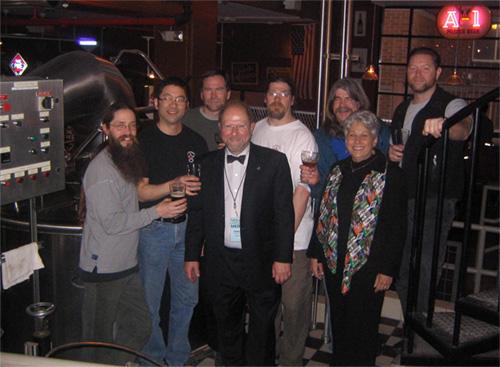
Charles and Rose Ann Finkel were truly two of the prime movers for the beer revolution in America and brought many of the best imported beers to the U.S. via the import company, Merchant Du Vin, that they founded in 1978. They also founded Pike Brewery in Seattle’s famous Pike Place in 1989. The Finkels left the beer business in 1997 to pursue less hectic interests. Perhaps not hectic enough though, because they’re back. The Finkels have reportedly reaquired the Pike Brewery under undisclosed terms. Merchant Du Vin and the Seattle brewery will operate separately going forward.

Charles and Rose Ann Finkel (in front) posing last month during CBC at Pike Brewery with Pike brewers, old and new.

Filed Under: News Tagged With: Business, Washington

Anheuser-Busch Reiterates: No Interest in Rolling Rock

May 31, 2006 By Jay Brooks

As of around Noon today, over 13,000 people had signed the online petition to save the Rolling Rock Brewery in Latrobe Pennsylvania. The effort is being made after Anheuser-Busch bought the Rolling Rock brand on May 19 from InBev.

But as Greg Clow, of The Bar Towel in Toronto, reminded me, the petition is likely doomed to fail for the simple reason that A-B does not own the brewery and is not the one selling it. Christina Gumola, the woman who wrote last week’s open letter to August A. Busch IV, later wrote to tell me that she did also simultaneously write a letter to InBev and attached the letter she wrote to A-B.

Still, Greg brings up an excellent point that I, and many others, haven’t been focusing on. I think we all got caught up in the moment but the truth is A-B can’t sell what they don’t own. It’s still possible, albeit very unlikely, that public pressure could cause A-B to ask InBev to renegotiate the deal to include the brewery in the sale but adding another $50 million to the deal — which is the rumored asking price — seems pretty farfetched at this point. Undoubtedly, that’s why the two were separated in the original deal. A-B doesn’t need another brewery and now InBev has one with nothing to brew in it.

Today’s Pittsburgh Tribune-Review makes even that remote possibility virtually impossible. In the article, Dave Peacock, Anheuser-Busch’s VP of business and finance operations, “yesterday reiterated the company has no interest in buying the brewery.”

“Because Anheuser-Busch owns 12 breweries and has the ability and capacity to brew Rolling Rock, we elected to purchase only the beer recipes and brand names, not the brewery operation,” Peacock said. “Like others, we hope InBev is able to sell (the brewery) to a suitable buyer who will maintain the employment.”

Sure he does. That’s just spin control, as Tom Dalldorf pointed out when we spoke Friday, the big breweries (A-B and Miller primarily) have been gobbling up and shutting down historic breweries for decades. That’s what big corporations do, they crush their competition and damn the consequences. In economics parlance, that’s called “externalities.” It’s a euphemistic term like “collateral damage” or “friendly fire” that disguises its true meaning. Externalities are the costs that society pays when big businesses wheel and deal. They’re the brewery closings and unemployment, the loss of tax revenue for a small community and the loss of heritage for everyone. And it may be the way business is done, but it’s those very decisions that are destroying so much of what used to make America great. As big businesses get bigger and bigger, merging with one another to create ever larger Frankenstein-like mega-corporations and international conglomerates who do their banking offshore to avoid paying taxes, it’s you, me and the people of Latrobe who are picking up the bill.

Anhesuer-Busch, in their negotiations for the purchase of Rolling Rock from InBev, knew exactly what the consequences would be for the brewery and the employees who toiled there making Rolling Rock since 1939. They knew InBev would have a devil of a time trying to sell the brewery, knew the employees would lose their livelihoods, knew another piece of American brewing history would die. They simply didn’t care and indeed weren’t allowed to care. Their shareholders wouldn’t let them. So those costs were externalized, meaning A-B and InBev didn’t have to concern themselves with what happens to Richard Pavlik, Christina Gumola’s father. That he will lose his job of over twenty years is somebody else’s problem.

But despite my dire pessimism and even with so much against it, the fight to save Rolling Rock is still worth fighting. Sometimes hopeless battles must be fought on principle alone. It’s the effort that is important. Sometimes it’s enough to know at least you tried.

In the words of Christina:

Of course my efforts may seem far fetched; however if people just accepted being told “no” and didn’t fight for what they believed in then chances are they are not too happy. I’ve always fought for what I believed in and most of the time had positive results by doing so. I am also a realist and understand that nothing may occur as a result of my efforts. At least I know that I tried! Fight for what you believe in — you won’t have the chance for what you want if you just let it go!!

Amen.

Filed Under: Editorial, News Tagged With: Eastern States, National

Beer is Good for Your Prostate

May 31, 2006 By Jay Brooks

A new study at Oregon State University appears to show that hops is helpful in both preventing prostate cancer and also enlarging your prostate. According to Emily Ho, a professor and researcher at Oregon State’s Linus Pauling Institute, “xanthohumol, a compound found in hops, inhibits NF-kappaB protein in cells along the surface of the prostate gland.” The bad news — or good, depending how you look at it — is you’ll have to drink seventeen 12-oz. beers to get the amount of xanthohumol that the study showed to be beneficial in fighting prostate problems.

Somebody call Ralph at HopUnion. Perhaps they can create a hop variety that’s packed with more xanthohumol. Actually a German brewer, Weihenstephan, is making a beer with ten times the normal amounts of xanthohumol but it is not known if it will actually transmit the health benefits in liquid form.

Xanthohumol was discovered almost one hundred years ago in hops, but it’s health benefits were not realized until the last decade when researchers began examining flavonoid compounds.

German beers with Xanthohumol.

Filed Under: News Tagged With: Health & Beer

Guide to Good Beer at the World Cup

May 30, 2006 By Jay Brooks

Serendipity obviously played her hand in Steve Thomas’ new Good Beer Guide Germany, which was published in the UK May 17 of this year, only a couple of weeks before the start of the World Cup, which is held this year in, of course, Germany. The book is published by CAMRA and will be ideal for anyone traveling to Germany in search of beer other than the official beer of the World Cup. It’s not yet available here in the States, but you can order it online from Amazon UK.

The new CAMRA guide to good beer in Germany. Click here for larger view.

Filed Under: News Tagged With: Beer Books, Europe

Beer Lowers Risk of Heart Disease for Men

May 27, 2006 By Jay Brooks

A Danish study of 50,000 people released yesterday revealed that “men who drank daily had a 41% reduced risk of coronary heart disease compared with a 7% drop in men who drank once a week.” Oddly, the benefits for women were not as dramatic. For them, “the risk of heart disease fell by a third with a weekly drink but did not fall further in daily drinkers.”

According to a BBC article:

But for women, although drinking on at least one day a week was associated with a 36% reduced risk of heart disease compared to those who drank more rarely, the risk was the same whether women had one drink a week or drank moderately each day.

The gender bias is believed to be either “hormonal, or related to the type of alcohol consumed or there may be differences in the way men and women’s bodies process alcohol.”

Also from the BBC article:

Lead researcher Professor Morten Gronbaek from the National Institute of Public Health in Denmark said: “It has been shown that frequency of drinking has a larger role than amount but this points towards the fact there is a gender difference.”

“One or two drinks in men, or one drink a day in women, would be sufficient for heart disease – you wouldn’t get any more beneficial effects from drinking more.”

Filed Under: News Tagged With: Health & Beer

Daughter of Latrobe Brewery Employee Sends Open Letter to August A. Busch IV

May 26, 2006 By Jay Brooks

The letter posted below was forwarded to me by a good friend and colleague. It’s an open letter to August A. Busch IV regarding Anheuser-Busch’s plans to move production of the newly acquired Rolling Rock brand to Newark, New Jersey and sell the Latrobe Brewery. The town of Latrobe is in Western Pennsylvania, a little over 40 miles from Pittsburgh. It’s a small town, with a population of around 9,000 people. Arnold Palmer was born there, and so was Fred “Mr.” Rogers. It is believed the first professional football game was played in Latrobe (September 3, 1895) and the first banana split was made there (in 1894). Since 1893, it has been the home of the Latrobe Brewery and by and large, most people know the town of Latrobe because of Rolling Rock. Having grown up in a small town in Pennsylvania, I understand how seriously people take their history and heritage, how much it means to them. Sure there are economics involved in Latrobe, too, but it isn’t just about that. It’s also about people, small town loyalty and a real sense of community pride. So when the brewery employees were summarily told they had two months and then not only their jobs would be lost, but also a piece of the town’s heritage, it must have felt like the proverbial rug had been pulled out from under them.

That’s why I was surprised that the same day Anheuser-Busch announced the purchase of the Rolling Rock brand from InBev that they would also sour that news by mentioning that the Latrobe Brewery would be sold or closed. I’m sure it was simply an economy of scales argument, a business decision. But it would have been far more prudent to have waited to drop that bombshell until after the purchase story was out of the news cycle. Because, as the letter points out, A-B has been waxing poetic in ads and press releases about their corporate citizenship, their affinity for family, community and heritage. Of course that’s just propaganda, corporations don’t really care about those things, they just want to appear to care about those things because it improves their image. Corporations only have one function, making a profit, and are responsible to only one group of people: their shareholders. Oddly enough, though, when companies spin themselves as good guys, people actually expect them to act that way.

So Christina Gumola, the daughter of a Latrobe Brewing Company employee, sent the letter below to the president, vice president, and other board members at Anheuser-Busch regarding their recent purchase of Rolling Rock last Friday.

An online petition has also been set up to collect signatures with the goal of keeping Rolling Roock in Latrobe and keeping the town’s brewery open. As of 9:30 this morning, almost 6,000 people had signed the petition.

It’s doubtful that any emotional appeals to decency or a sense of family will carry any weight, which is ironic since A-B presents itself as a family company and has had numerous family members at its helm stretching back to its inception in the mid-1800s. I wish I wasn’t so realistic about this — some might say cynical — but unless the shareholders are convinced that profits will suffer by moving production and closing the brewery in Latrobe, I can’t see this decision being changed. But who knows, perhaps if there is enough of a hue and cry they may at least postpone the decision and wait until the furor has died down before closing the brewery.

But hope springs eternal and I certainly support the effort and wish them well, whatever the outcome.

An Open Letter to Anhesuer-Busch from Christina Gumola:

It was on Friday May 19, 2006, when I received a phone call from my father Richard Pavlik, who is a 22 year long employee of Latrobe Brewing Company, when I got the news. “The label was bought by Anheuser-Busch for $82 million.” I quickly asked about the future of his job in which he replied, “I have 60 days then I no longer have a job.” Immediately I broke down in tears for many reasons, one of which was my concern for the well-being of my parents and the effect this job loss will have on their lives. I have to admit that along with my sadness, I was very angry. “How could someone do this to, not only my father and the other 200+ employees of Latrobe Brewing Company, but to a whole community whose livelihood revolved around their pride and commitment to Latrobe Brewing Company-more specifically Rolling Rock beer.”

Despite my anger, I understand that Anheuser-Busch’s purchase of Rolling Rock was a decision based on business. However; I feel that this decision was made without an understanding of the devastating impact that the removal of Rolling Rock would have on the people of Latrobe and the surrounding communities. In addition, I feel that Anheuser-Busch may not have thought enough about how keeping Rolling Rock in Latrobe could help their own company from a business standpoint.

Ever since the announcement of Anheuser-Busch’s purchase of Rolling Rock and the plan to move it out of Latrobe, it’s as if a large dark cloud has settled over Latrobe. Not only has this decision gloomed the employees of Latrobe Brewing Company, but it has gloomed those who are also committed to the greatness that Rolling Rock brings to Latrobe. It feels as if someone took something so important out of our lives that we can never get back. I know that I am speaking for everyone who has pride in Rolling Rock when I say that we are truly hurt and devastated for this loss.

I found a noteworthy quote in an article dated March 30, 2006 from Anheuser-Busch. This article was titled ‘Who Would You Have A Beer With?’ Robert C. Lachky, executive vice president, global industry development, Anheuser-Busch Inc. is quoted saying that “Beer is about sharing moments and creating memories with good friends and family.” This quote could not be truer. Rolling Rock beer has allowed us to create these memories with our friends and family here in Latrobe. Though these moments and memories cannot be taken away, the opportunity to create more of them with our loved ones has been.

After Anheuser-Busch’s purchase of Rolling Rock, Mr. August A. Busch IV, president of Anheuser-Busch Inc. hit the nail head on when he was quoted for saying, “We have an ideal opportunity to grow this historic brand. This beer is not like others, and it’s consumer following is EQUALLY DISTINCTIVE.” It is apparent that Mr. Busch and other’s in Anheuser-Busch see Rolling Rock for what it is and for what THE PEOPLE OF LATROBE have made it. While Anheuser-Busch may be able to brew Rolling Rock beer using the same “time-honored” recipes, it is virtually impossible to replicate the committed employees of Latrobe Brewing Company and people of Latrobe, which go hand-in-hand with Rolling Rocks craftsmanship and heritage.
The history of Anheuser-Busch states that in 1864, Adolphus Busch joined the fledgling brewery that later became known as Anheuser-Busch. Though the early years were demanding, Mr. Adolphus Busch continued to have a keen vision for the success of the company. The history further indicates that the distinctive contributions made by each succeeding generations of the Anheuser-Busch family clearly show that the history of Anheuser-Busch isn’t a story about a company-it’s a story about people. People with dreams and perseverance. Like Anheuser-Busch, the story and history of Rolling Rock is not a story about a company, but a story about people. The Tito brother’s wanted a unique beer that could represent the heart and soul of Latrobe. As a result, Rolling Rock beer was introduced in 1939 and since that time, it has become more than a beer and a product of a company. Rolling Rock indeed became the heart and soul of the people of Latrobe. Telling someone that “I’m from Latrobe” is accompanied with an enormous sense of pride.

August Busch Sr.’s vision and determination to keep his company going during the Prohibition resembles the vision of the Latrobe Brewing Company employees and the people of Latrobe. We are determined to keep producing Rolling Rock beer in Latrobe where it belongs. History reports that August Busch Sr. was able to keep many of his skilled workers employed and his equipment up to date during the difficult time of the Prohibition. Obviously, he was able to see the importance of dedicated and skilled employees. I feel August Busch IV would be proud to employ the current workers at Latrobe Brewing Company. They are, indeed, highly skilled and committed to producing Rolling Rock. It is important to note that there has not been a labor dispute at the Latrobe Brewing Company in over 24 years. This is a clear indication of the dedication and loyalty of the employees in this establishment. Also during the Prohibition, Mr. Busch Sr. kept his equipment up to date. Likewise, recent additions and modifications to the equipment at Latrobe Brewing Company have been made to keep up with the demand of the highly sought after Rolling Rock beer in this competitive field.

After researching Anheuser-Busch’s history and values, I feel that a partnership with Rolling Rock, if kept in Latrobe, can be more beneficial for Anheuser-Busch as a company. The employees at Latrobe Brewing Company have these same values and commitment to the product that they make here.

Anheuser-Busch is known for, and prides itself, for their unique commitment to their belief statement, mission, and values. In fact, the Anheuser-Busch web-site relates that these values are “a concern for people, communities, and the environment.” I am asking that you please follow these values and show your support for our people and our community whose lives and passion revolve around having Rolling Rock Beer brewed in Latrobe. Please rethink your decision of taking the pride and passion out of our lives.

Anheuser-Busch Companies, Inc. Statement of Beliefs includes the following belief: The understanding that well-trained and motivated employees acting with the highest integrity are critical to our success. As a former part-time seasonal employee at Latrobe Brewing Company, I have witnessed first hand how the employees making Rolling Rock beer contribute to the company’s success through the dedication and pride the employees have in their jobs and the product they produce. I’ve also witnessed this dedication from retiree’s, such as Albert Pavlik my grandfather, who is a 35 year veteran of Latrobe Brewing Company.

Finally, The Vision of Anheuser-Busch states: Through all of our products, services and relationships, we will add to life’s enjoyment. We dedicated consumers of Rolling Rock beer and the employees of Latrobe Brewing Company understand how the product adds to life’s enjoyment. Please allow us to work together in Latrobe to accomplish the vision of Anheuser-Busch.

I sincerely thank you for your time,

Christina M. Gumola
Proud daughter of
Richard L. Pavlik-Employee of Latrobe Brewing Company

Filed Under: Editorial, News Tagged With: Business, Eastern States, History, National

Miller Test Markets Caffeinated Malt Liquor

May 26, 2006 By Jay Brooks

Beginning today, Miller Brewing will be test marketing Mickey’s Stinger, a beer containing caffeine, guarana and taurine. The initial test makets will be Arizona, California and Nevada.

From the press release:

The new drink – which launches May 26 initially in Arizona, California and Nevada – features an infusion of caffeine, guarana and taurine. Honey added during the brewing process gives Mickey’s Stinger a light, smooth taste. The new malt beverage contains seven percent alcohol by volume (ABV) and will be distributed in 16-ounce single serve cans and six-packs of 16-ounce cans.

“Today’s 21- to 27-year-old consumer is looking for something different in their alcohol beverages and has responded with great enthusiasm to caffeinated malt beverages,” said Dan Hennessy, marketing manager for Mickey’s Brewing Company. “But these consumers will readily tell you they drink existing brands despite the taste, not because of the taste. That’s where we see real opportunity for Mickey’s Stinger. Mickey’s Stinger is an innovative and smooth tasting product that consumers will enjoy.”

Stinger is the first extension of the Mickey’s brand franchise in years. The brand, traditionally known for its distinctive taste, unique bottle and iconic hornet logo, has been a staple of the malt liquor category for decades.

Mickey’s Stinger will be competing against Anheuser-Busch’s Tilt (a malt beverage with caffeine, guarana, and ginseng), B-to-the-E (a fruit-flavored caffeine beer) and 24 Seven (a malt beverage with caffeine by Mix Master Beverage in Nevada, though it’s made in Wisconsin by City Brewing).

Filed Under: Beers, News Tagged With: Press Release

« Previous Page
Next Page »

Find Something

Northern California Breweries

Please consider purchasing my latest book, California Breweries North, available from Amazon, or ask for it at your local bookstore.

Recent Comments

  • Bob Paolino on Beer Birthday: Grant Johnston
  • Gambrinus on Historic Beer Birthday: A.J. Houghton
  • Ernie Dewing on Historic Beer Birthday: Charles William Bergner 
  • Steve 'Pudgy' De Rose on Historic Beer Birthday: Jacob Schmidt
  • Jay Brooks on Beer Birthday: Bill Owens

Recent Posts

  • Beer In Ads #5138: The Event Of The Year: Jax Bock Beer March 2, 2026
  • Historic Beer Birthday: Anthony Durkin March 1, 2026
  • Historic Beer Birthday: Adam Sander March 1, 2026
  • Beer In Ads #5138: Flower City Bock Beer March 1, 2026
  • Historic Beer Birthday: Regina Wauters March 1, 2026

BBB Archives

Feedback

Head Quarter
This site is hosted and maintained by H25Q.dev. Any questions or comments for the webmaster can be directed here.