Chow, the food magazine, has an interview with Russian River brewer/co-owner Vinnie Cilurzo on their website called Vinnie Cilurzo Gets Funky. It’s a fun little interview, but where dd they get that photo? Sheesh.

Chow, the food magazine, has an interview with Russian River brewer/co-owner Vinnie Cilurzo on their website called Vinnie Cilurzo Gets Funky. It’s a fun little interview, but where dd they get that photo? Sheesh.
Moving one step closer to a reality, Anheuser-Busch shareholders voted earlier today to approve the takeover by InBev, whose shareholders likewise approved the deal on September 29. The merger is now expected to close by the end of this year, pending regulatory approvals and other conditions stipulated under the contract.
From the press release:
“The proposed merger between Anheuser-Busch and InBev under consideration today was a difficult decision for our board to make,” said August A. Busch IV, president and CEO, in comments made during the meeting. “In the end, the board determined that the InBev proposal is in the best interest of our shareholders. The merger also provides a promising future for our beer brands and for all stakeholders — employees, wholesalers, retailers and our consumers.”
“Under the merger, the new company will expand Budweiser into new markets around the world, fulfilling the global ambitions my family has long dreamed about for this great American brand. I’m proud that the Budweiser tradition and our 150-year commitment to delivering the best brewed beer in the world will live on,” said Busch. “I want to sincerely thank our shareholders for the support they have given me and this great company for so many years.”
August A. Busch IV will be a director of the newly combined company, which will take the name Anheuser-Busch InBev.
Despite some recent rumors about problems with obtaining the financing under the present global economic downturn, all seems to be going along smoothly. It now looks like, barring any additional financial market calamity, there’s nothing standing in the way of this merger taking place and closing before 2009.
My one quibble with A-B’s statement today — there’s always something, right — is Busch’s comment that “[t]he merger also provides a promising future for our beer brands and for all stakeholders — employees, wholesalers, retailers and our consumers.” Maybe, but it certainly does not do so equally or evenly. Many of the employees who will be laid off might not feel that their futures have been made better by the merger. Likewise, distributor shakeups will inevitably take place, which I’m skeptical will be for the better. As for how it affects consumers, only time will tell.
Under the title “Pub Crawl,” Men’s Fitness magazine chose “America’s five best bars for beer lovers,” a pretty audacious claim right out of the gate. Their five:
I don’t know if their list was meant to be in any particular order, but this is how they were listed in the article. These would be mine, at least today. Tomorrow I might feel differently, who knows.
Mine are simply in the order that they came to me as I put down the first five that came to mind. It’s been years since I’ve been to the Brickskeller, unfortunately, and that’s probably the only reason they’re not on my list. Sorry Dave, I’ve got to get out East more. As I write this, many more come to mind, but that’s the way these lists are.
As a bonus, they also list the “Best Micro Brews,” but at least these were chosen by Ray Daniels and Julie Bradford Johnson. This list is pretty good, if fairly safe. I like all of these breweries though, naturally I would have chosen perhaps a slightly different list. Also, a lot depends on what criteria you use as to what standards you look at in determining the “best micro brews.” What does that mean exactly? Anyway, here’s their list. I’ll have to think about what ten I’d choose.
Happy Veteran’s Day to all the people who’ve honorably served their country. I spent three years playing in an Army Band, stationed in New York City — on Fort Wadsworth, underneath the Verrazano Narrows Bridge.
|
If nothing else, my time in the military taught me how ridiculous it is that I could serve in the Army yet was not trusted enough to drink alcohol. We were considered mature enough to kill or be killed (theoretically, of course — I was in the band) but not mature enough to drink a beer. We could drink anywhere on base, even at the base bar. But take one step off the military base and once more we were children, or at least treated that way. It was extraordinarily frustrating, and to say we were getting mixed messages would be an understatement. I recall quite clearly feeling a sense of being underappreciated at the time. I can only imagine that the young soldiers shipping off to Iraq and Afghanistan feel that same way even more acutely, especially given the far greater risks they’re taking. In our day room at the band building in New York — a former Civil War-era hospital actually — there was a soda machine. For two quarters it dispensed a can of beer. It was nothing special mind you, something like Rheingold or Schmidt’s, a late 1970s regional brand. But it was right there in the room where we spent most of our down time when we either weren’t rehearsing or in our rooms. Did we binge? Hardly ever, actually. Except for the lifers, most of us were college age. Yet even though there was beer, dirt cheap, staring us in the face most of our day, we rarely overindulged. When it was there all the time it was just commonplace, it wasn’t something we thought too much about. We had a beer when it made sense, on the weekends, after a particularly long day. While there was the occasional exception, we acted responsibly the majority of the time. |
To me, this is the strongest argument for lowering the drinking age to match the age of conscription. We at least owe the men and women putting their lives on the line for you and me the same rights and privileges that we old folk enjoy. It just isn’t fair to ask so much of them, to give them the responsibility of adults and then withhold the rewards, so to speak. There’s always a “but” from the neo-prohibitionists at this point in the argument but it never rings true. It’s a simple quid pro quo. We ask soldiers for adult behavior and responsibility. We should be willing give them all the benefits to which they’re not only entitled but have so admirably earned.
This book from WW II cracks me up. What an odd pair to be the subject of a book.
Now this is the original “Stars and Bars.”
I stumbled upon this interesting piece of digital art by a Maury Schallock. I suppose technically it’s not art, but a computer generated molecular model of a beer molecule. But it is beautiful, and reminded me of a very colorful galaxy.
Pacific Coast Brewing’s 20th annual holiday beer tasting will be held at the brewery in downtown Oakland on December 13, from Noon until 4:00 p.m. Tickets are $50. Call 510.836.2739 for reservations. If you’re planning on going, make your reservations to be there now, because it will sell out quickly.
12.13
Pacific Coast Brewing’s Tasting of Holiday Beers (20th annual)
Pacific Coast Brewing, 906 Washington Street, Oakland, California
510.836.2739 [ website ]
There was an interesting item in BrandWeek last week, giving the results of a survey by YouGovPolimetrix about what brands consumers feel offer them the best value. Not surprisingly, overall the survey revealed that consumer perception is clearly affected by what they refer to as a “slumping economy.” The survey took place for the two months of September and October. YouGovPolimetrix chose these months on purpose, to see what the results would be like during an economic downturn. In general, “budget” brands like Wal-Mart and Old Navy ranked highest, while financial services companies were at the bottom of the list “reflecting the loss of consumer confidence in those brands.”
The Top 5 Brands With the Highest Consumer Perception Value
The Bottom 5 Brands With the Lowest Consumer Perception Value
Additionally, the survey found that over the past two months, value perception scores have increased for Microsoft, Starbucks, Verizon Wireless, Folgers, Bath and Body Works, but the scores decreased most for AIG, Wachovia, Washington Mutual, Foot Locker and Merrill Lynch.
BrandIndex also measured the brands with the best and worst value perception in 19 categories, and here are the results for beer:
The Top Beer Brands With the Highest Consumer Perception Value
The Bottom Beer Brands With the Lowest Consumer Perception Value
Okay, Sam Adams I get, but Corona? I’ve never felt particularly good about Corona … well, ever. A triumph of marketing, a disaster as a beer.
Unless you’ve traveled with me, you probably didn’t know that one of my other geeky hobbies is art. I love going to art museums, especially obscure local ones, whenever I travel. And while I naturally check out what breweries there are wherever I go, I also consult Art Across America, a great reference book of art museums that tells you where they are, their hours and other basic information. So I’ve been thinking lately that I should share that passion and highlight the countless times when beer and art intersect. So once a week, I’ll bring you another work of art that has something to do with beer, alternating between old classics and modern interpretations. If you know of a piece of art featuring beer, please drop me a line or comment here and I’ll work it into the queue for future artistic posts.
We’ll start today with an undisputed masterpiece. Started in 1882, A Bar at the Folies-Bergère, by the French painter Édouard Manet, is a favorite of mine, not least of which because it features prominently bottles of Bass Ale in the painting with their distinctive red triangles.
Click on the image above for a larger view. From Wikipedia:
A Bar at the Folies-Bergère, painted and exhibited at the Paris Salon in 1882, was the last major work by French painter Édouard Manet. It depicts a scene in the Folies Bergère nightclub in Paris.
The painting is filled with contemporaneous details specific to the Folies-Bergère. The distant pair of green feet in the upper left-hand corner belong to a trapeze artist, who is performing above the restaurant’s patrons.
The beer which is depicted would have catered not to the tastes of Parisians, but to those of English tourists, suggesting a British clientèle. Manet has signed his name on the label of the bottle at the bottom left, combining the centuries-old practice of self-promotion in art with something more modern, bordering on the product placement concept of the late twentieth century.
But for all its specificity to time and place, it is worth noting that, should the background of this painting indeed be a reflection in a mirror on the wall behind the bar as suggested by some critics, the woman in the reflection would appear directly behind the image of the woman facing forward. Neither are the bottles reflected accurately or in like quantity for it to be a reflection. These details were criticized in the French press when the painting was shown. The assumption is faulty when one considers that the postures of the two women, however, are quite different and the presence of the man to whom the second woman speaks marks the depth of the subject area. Indeed many critics view the faults in the reflection to be fundamental to the painting as they show a double reality and meaning to the work.
The increased use of the new technology of photography began to free artists such as Manet to do more than merely imitate life. At any rate, Manet was confident enough to take liberties with literal transcription for the sake of composition.
For this great painting, the Getty has some good info, too. If you want to learn more about the artist, the Art Archive or the ArtCyclopedia are both good places to start.

Those nattering nabobs of negativity, the Marin Institute, are gleefully spreading the word that the Governator, Arnold Schwarzenegger, is proposing to raise the tax on beer in order to get California out of the mess that he and the rest of the gang of idiots — collectively known as politicians — got themselves into, dragging us down with them while constantly trying to figure out how to make us pay for their mistakes. So no, I don’t feel too strongly about this issue.
Naturally, they’re characterizing it as a “modest” proposal and continue to justify it with faulty arguments and no understanding of history. But you’ve got to love how they feel about those of us in the beer business. “Despite the whining by industry about a tax increase, the time has come for Big Alcohol to pay its fair share of the cost burden of problem drinking in California. They’ve dodged the bullet for too long.” So I think it’s fair of me to point out that I’ve been quite correct in saying that they’ve been shooting at us, gunning for us, trying to bring us down. They chose the perfect way to phrase that, some old-fashioned honesty for a change. The neo-prohibitionists have been attacking our industry, and we’ve been dodging their bullets. But responding to those premeditated attacks, and trying to defend ourselves, that they consider “whining.” Really? For Schwarzenegger it may be about the money, but for these chuckleheads it’s moral indignation.
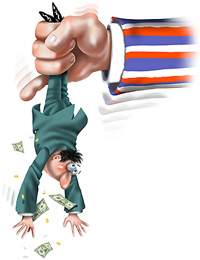
So here’s the lie. The neo-prohibitionists talk about how little taxes are paid on beer, as if breweries are getting away with something. Or that it’s the responsibility of alcohol companies to pay for how a minority of drinkers abuse it and exercise incredibly poor judgment. They don’t seem nearly as quick to make gun makers responsible for a crime committed using one of their guns. They’re not suggesting fast food companies be held accountable for their role in creating an obese, unhealthy populace and placing a huge burden on medical facilities. They want beer companies to pay for medical expenses supposedly caused by a minority of their customers abusing alcohol. Please explain to me how that’s different from the health risks posed by fast food, soda, red meat, and all manner of overindulgences? And what industry does the most harm and places the biggest costs on our society? That would be the automotive industry, along with the the related oil interests.
But let’s assume, just for talking about it, that beer should pay those taxes. Le’s get back to that notion that the industry is getting away with something, underpaying our “fair share,” as it were. The state excise taxes that they’re talking about bumping up a nickel, and saying that they haven’t been raised since 1992 is, of course, nowhere near the whole story.
In addition to those taxes, breweries pay many other taxes on the beer you enjoy. It’s not just that one tax. In fact, about 44% of the cost of your beer goes to taxes of one kind or another. That’s nearly half! Here’s a list of many of the taxes that go into that 44%.
Taxes Paid On Beer
But wait. Don’t other businesses pay all of those taxes, too? Why yes they do, all except the excises taxes, state and federal, and the taxes on the excise taxes. Those are unique to alcohol (and also tobacco) and are, I think, at the heart of what’s wrong with the neo-prohibitionists argument. But I’ll go into that later. For now, what do those additional unique taxes add to what other businesses have to pay in order to do business. “According to a 2005 study by Global Insight and the Parthenon Group, more than 40% of every beer sold in the United States is consumed by taxes. In fact, the total tax burden adds up to nearly 70% more than the average amount of tax paid in the U.S. on all other purchases. That represents well above $10 billion in extra taxes paid on beer.” So much for the beer industry not paying its fair share.
But where did that excise tax come from? Why do brewers pay it now, when no other industry, save tobacco, has to? Well the history of excise taxes stretches back to the Civil War, or War Between the States for my southern readers. During Lincoln’s first term, the North had to raise money to finance the Civil War and they turned to the beer industry, among others, to help finance the war effort. I just wrote about this, shortly before the election, so I’ll just quote myself and pick up the story here.
In Brewing Battles, by Amy Mittleman, she details how in July of 1861, the US Congress (or a least what was left of it in the north) levied the first income tax on the remaining states in order to raise money to fight the war with the southern states. By the end of the year, Congress realized it wasn’t enough and they needed a way to raise more funds for the war. In a special session in December 1861, Congress reviewed a request by the Secretary of the Treasury, Salmon P. Chase, to raise the percentage of income tax slightly and levy excise taxes on a number of goods, including beer, distilled spirits, cotton, tobacco, carriages (the automobiles of the day), yachts, pool tables and even playing cards, to name a few. The amendments passed, and Lincoln signed them into law July 1, 1862. They took effect September 1. Several weeks later, the first trade organization of brewers, the United States Brewers Association (USBA), was founded in New York.
Excise taxes are a “type of tax charged on goods produced within the country (as opposed to customs duties, charged on goods from outside the country).” The excise taxes were intended to be “temporary” but it was the beginning of temperance sentiments in the nation, and many people objected to alcohol on moral grounds. In the decade following the war, most were rescinded, but the taxes on alcohol and tobacco were the only two to remain in force, and in fact are still in effect today.
The only reason these excise taxes remained after the Civil War was primarily on moral grounds, coming from prohibitionist organizations. And I think that’s still relevant in 2008 because today’s neo-prohibitionists are also trying to use a moral sledgehammer to raise taxes on alcohol in an effort to put beer companies out of business and/or bring about another national prohibition. In state legislatures in many states, neo-prohibitionist groups are trying a variety of tactics to further their agenda. Usually it’s couched in propaganda that pretends they’re concerned for the children, or people’s health or some other hollow claim that hides their true aims.
I still find the argument strange that there should be higher taxes on products some people find morally objectionable. I find soda morally objectionable because it’s so unhealthy that it’s contributing to a nation of obese kids (and adults) — not to mention that beer in moderation is much healthier for you. But I wouldn’t argue pop should have an excise tax. The very concept of a so-called “sin” tax seems antithetical to the separation of church and state. Sin is a religious concept, and should play no role whatsoever in our government. Making people pay a higher price for goods that other people don’t like seems not only a little cruel, but also contrary to freedom of religion, because those are the morals people are using to deny people getting (or making prohibitively expensive) certain goods that not everyone agrees are sins. By using one set of morals as the basis for a particular law (in this case an excise tax) it ignores other sets of morals that differ from the prevailing one. That’s how a theocracy works, and we’re not one yet, despite recent efforts to make religion a central issue in government.
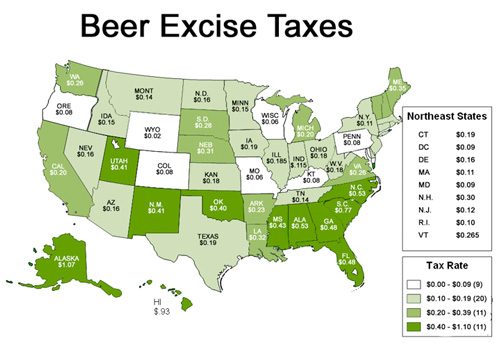
That’s the federal excise tax, and there’s an interesting part of that story, too, which we’ll get to. After Prohibition ended in 1933, most states imposed a new state excise tax as a part of allowing alcohol back into society legally. Today, each state’s excise tax is very different, with Alaska being the highest and Wyoming the lowest. California’s in the middle, tied at 21st (see this chart of State Beer Excise Tax Rates). And it’s that particular tax that California wants to raise a nickel now. So let’s return to the neo-prohibitionist argument that the California excise tax hasn’t been raised since 1991. What they don’t mention is that around the very same time, the tax burden for breweries jumped up considerably, when Congress doubled the federal excise tax in 1991, jumping from $9 per barrel to $18!
Here’s what happened, from Roll Back the Beer Tax:
In 1990, Congress raised taxes on luxury items like expensive cars, fur coats, jewelry, yachts, and private airplanes and doubled the federal excise tax on beer. This was the largest single increase in the tax on beer in American history and resulted in some 60,000 people losing their jobs in brewing, distributing, retailing and related industries.
Today, all of the other luxury taxes have been repealed, but the beer tax remains in place. The tax burden on beer is far higher than the average consumer good in the American economy. Astonishingly, over 40% of the cost of every beer sold is comprised of taxes. This means working Americans continue to reach into their pockets to pay the beer tax … at the rate of $5.2 billion a year.
And here’s why excise taxes are such a bad deal for the economy:
A tax is considered regressive if it falls more heavily on lower- and middle-income families than on the wealthy. And this is certainly true with beer taxes. This has long been recognized, but perhaps underappreciated. Analyses based on recent data from the Consumer Expenditure Survey clearly show that beer taxes are very regressive, as a percentage of income, costing lower- and middle-income households many times more than those with more comfortable incomes. A recent Beer Institute analysis found that beer taxes are actually 6.5 times higher as a percent of income for lower-income households (those earning less than $20,000 per year) compared to higher-income households (earning $70,000+ per year). As a result, the tax on beer is one of the most regressive of all taxes in the federal and states’ tax codes.
Viewed another way, 50% of all beer, is purchased by families with incomes of $50,000 or less, though these households account for less than one-fourth of all income earned in the U.S.
Sadly, the fact that beer taxes are very regressive has been known for quite some time, yet they continue to persist. A strong case can be made for rolling back or reducing beer taxes, based on the simple fact that research has exposed – notably, by Citizens for Tax Justice (CTJ) and the Institute on Taxation and Economic Policy (ITEP) – that the overall tax systems in many cases are already disturbingly regressive with many becoming decidedly more regressive in the past decade or more. According to the report, “sales and excise taxes are the most regressive element in most state and local tax systems.”
But let’s get back to California’s proposal. Here’s the language from the budget proposal (it’s an image because the pdf is locked for copying the text. If you have trouble reading this, download the original pdf for the Budget Proposal):
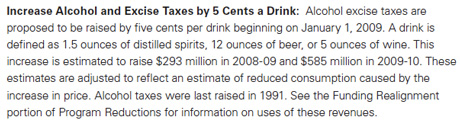
So let’s go the Funding Realignment, as they suggest. This is undoubtedly what the Marin Institute is crowing about when they say revenues from the new tax will be “providing critical support to programs that deal specifically with alcohol-related problems.”
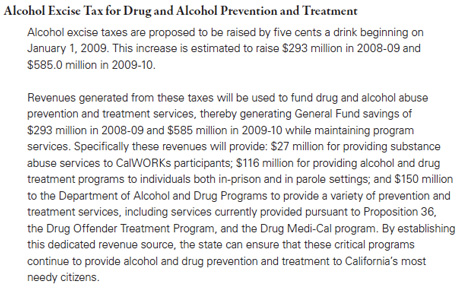
But take a closer look at that language. What is says is that “[r]evenues generated from these taxes will be used to fund drug and alcohol abuse prevention and treatment services.” [my emphasis.] Hmm, why is the brewing industry also funding drug abusers? The argument being advanced to justify all of this is that beer industry is supposed to fund the problems neo-prohibitionists insist they created. Well, I’m pretty sure you can’t pin that on the monkey on your back, that “H” problem or your crack addiction on beer. Even using their own logic, such as it is, that seems incredibly unfair.
This isn’t the first time, even recently, that beer has been tapped to fix budget problems not of their making. For the morally indignant, it apparently fits some weird moral compass to punish an industry they don’t agree with in order to to fix the shortcomings of our politicians. Earlier this year, state congressman Jim Beall proposed raising beer taxes 1400% for “health reasons” and in June the Sacramento Bee weighed in with their own nonsensical proposal, though that time the bogeyman was specifically alcopops. Here’s what I said then, modified slightly:
The idea that beer drinkers should have to pay for our state’s fiscal irresponsibility is so ridiculous that I’m amazed the argument can be made with a straight face. But that’s what many have proposed, in effect, the Sacramento Bee weighed in with their own absurd idea, that goes like this: “Psst! Hey, legislators — looking for some fast cash to ease the budget crisis? Think booze.” The faulty logic, downright incorrect statements and tortured reasoning are in virtually every sentence. It’s as if up really were down in the Bee’s worldview.
The Marin Institute, an alcohol industry watch group [who originally floated this idea], estimates that raising taxes on all alcoholic beverages just 25 cents per drink would raise $3 billion. That’s money the state desperately needs from an industry that has not paid its fair share for a long, long time.
As a colleague of mine put it, “saying the Marin Institute is “an alcohol industry watch group” is like saying the Taliban is a cultural and morality watch group.” The Marin Institute is nothing so grand. They are quite simply a neo-prohibitionist group who wants to return to a time when all alcohol is illegal and they will use any means necessary to achieve that goal. But that aside, saying that taxes should be raised because “the state desperately needs” it is not a valid reason. It may be a result, but what kind of world would we have if every time we needed money, our government looked around for somebody they didn’t like and decided to target them for higher taxes. That’s not a world I’d want to live in. That’s certainly not the high-minded ideals we should be aspiring to.
Where the taxes on any good or product made should be a policy decision based on a variety of factors, none of which should include manufactured hysteria, the agenda of a misinformed and misguided minority, or an opinion based on a lack of truthiness by an apparently biased newspaper.
So no matter how you look at this, it just makes no sense, has no internal logic, and just feel like as an industry we’re being attacked once again. Apart from raising the tax on oil found in California and the sales tax on certain goods that weren’t subject to it in the past — like appliance and furniture repair, automotive repair, amusement parks, sporting events and veterinarians — beer has been singled out for special assessment again. That so many feel that it’s fair to do so, I find remarkable, especially since proponents do not see how they’re using morality to solve political problems. But perhaps they do know full well what they’re doing but just don’t care about fairness. What’s important is their agenda, and the real consequences to those who disagree with them are inconsequential. I sometimes feel like they don’t consider their opponents — you and me — as fully human. Or perhaps they see us as children who need their moral guidance, though meted out with a bludgeon — tough love indeed.
From a purely pragmatic position, placing a burden on a not insignificant part of the state’s economy seems misguided at best. Of California’s $1.6 trillion economy, the beer industry represents $24,646,539,216 or just over 1.5%. In difficult economic times, why would you try to harm such a large percentage of it? For those of us who can look past the moral arguments, it feels a little like shooting oneself in the foot.
The Marin Institute doesn’t see that, of course, and wants to shoot everybody in the foot. They claim “[a]t least 38 other states also face serious budget deficits, totaling more than $60 billion dollars, according to the Center on Budget and Policy Priorities. ‘A nickel a drink — It’s the change we need to fix budgets around the nation,’ said Bruce Lee Livingston, executive director of Marin Institute, the California-based alcohol industry watchdog. ‘The largest states, such as New York and Florida can avoid cutting essential programs through long-overdue alcohol tax increases,’ Livingston added. California’s proposal accomplishes exactly that.” Don’t you believe it. The California budget deficit is $11.2 billion. The Governor’s proposal estimates raising only $293 million from the beer industry. That comes nowhere close to “fixing” our budget, and simply unfairly harms an industry already struggling to recover from record increases of crucial ingredients, like hops and malt.
There’s no doubt we need to fix the budget deficit gripping California, and in the many other states where it’s an issue. And let’s not forget the record federal deficit that eight years of Republican neocon rule have run up, the same folks in favor of us returning us to a national prohibition. As of this morning, it was $10,636,486,383,932.04. According to the U.S. National Debt Clock, the “estimated population of the United States is 305,064,289 so each citizen’s share of this debt is $34,866.38. The National Debt has continued to increase an average of $3.99 billion per day since September 28, 2007!” Our economy is obviously in serious jeopardy. But this is a problem that affects us all equally, and any solutions should likewise be distributed evenly among the citizenry. Any other result is simply patently unfair.
Here’s as quirky a piece of modern art a I’ve ever encountered. It’s by German artist Hannes Broecker, whose recent installation was exhibited in Dresden, Germany. The work is called “Drink Away The Art,” and is a series of flat, glass containers hanging on the wall filled with various colored cocktails, wine and beer. Drinking glasses were a part of the work, and gallery visitors were invited to each drain some of the drinks from off the hanging containers into a glass via a pressure-sensitive tap at the bottom of each one.
Drink Away The Art, a series of nine glass containers of alcoholic beverages.
Here you can see the taps protruding down at the right-hand corner of each container. Throughout each evening at the gallery, the levels of the liquids became lower and lower at varying intervals, creating new patterns every few minutes.
You placed your glass below the framed artwork, and drained some of whatever was in that particular container into it.