Brookston Beer Bulletin

Jay R. Brooks on Beer

  • Home
  • About
  • Editorial
  • Birthdays
  • Art & Beer

Socialize

  • Dribbble
  • Email
  • Facebook
  • Flickr
  • GitHub
  • Instagram
  • LinkedIn
  • Pinterest
  • RSS
  • Twitter
  • YouTube

Powered by Genesis

Firkin Gravity Fest #5

April 6, 2008 By Jay Brooks

The 5th annual Bay Area Firkin Gravity Festival was held yesterday at Triple Rock Brewery in Berkeley, California. Some of the stand out beers for me included Pizza Port’s Imperial Red, 547 Haight St., that Jeff Bagby brewed for the Toronado’s 20th anniversary, 21st Amendment’s Rye, Drake’s Wheatwine, Speakeasy’s Stout, Half Moon Bay’s authentic English-style brown and an interesting California Common from Oakland’s newest brewery, Linden Street Brewing.

This year, nearly thirty casks of real ale were available for sampling.

Triple Rock GM Rachaal with Ken Kelley from North Coast Brewing.


For many more photos from this year’s Bay Area Firkin Gravity Festival, visit the photo gallery.
 

Filed Under: Uncategorized Tagged With: Uncategorized

Session #14: Beer People

April 4, 2008 By Jay Brooks

For our 14th Session, the topic has turned decidedly personal. Our host, Stonch, has chosen the topic “beer people” with the knowing wisdom that “enjoying beer is as much about people as it is malt and hops.” It seems great minds do think alike, because I’ve actually been thinking about this a lot lately, but more on that later on.

In a broad sense, I think the beer industry and its legions of true fans (oh, what to call them, what to call ourselves?) are all so closely involved precisely because of the people. We may all be drawn in by the beer, but we stay because of the people. I’ve worked in many different industries from the military, music, video, retail, and even the law and I’m here to tell you that far and away the finest people I’ve met are beer people. Sure there are great people everywhere, but there is a much lower ratio of assholes in the beer business than in any other I’ve encountered. So great literalist that I am, I’m going to write today not about a single individual but about the great collective beer people. We’re here and we love beer!

I’ve been involved with beer since I was a kid, really, and I started thinking about it in a more studied way when I lived in New York City in the late ’70s. My involvement grew again after moving to California in the mid-80s, but became much more serious for at least the last twenty years sometime after I started homebrewing and wrote a bar guide to Silicon Valley in the early 1990s. Since then, I’ve been a beer buyer, contract brewer, festival volunteer, judge, tasting organizer, magazine manager and writer. In all those pursuits, I’ve encountered great swaths of people from all walks of life, socio-economic groups, ages, etc. all thrown together by one commonality: beer.

Having been on the business side of beer for a number of years, I got to know a lot of the folks at distributors, along with brewery sales representatives, brewery owners, merchandisers, marketers. In many ways, it’s a different world from craft world, the big companies have so many layers of people each doing one small part of the whole. And even though I often criticize the big brewer’s products and especially their business practices, for the most part the on the ground employees are usually pretty terrific people. It’s especially true at Anheuser-Busch, where I’ve met enough fine people to be impressed with their hiring methods. And Miller and Coors have some great people working for them, too. Seriously. You might not think so for all my complaining, but notice I’m rarely ranting against the employees, only the policy and decision-makers, and more often the consequences of those decisions.

With the small companies, as you’d expect, there’s a lot of multi-tasking with most employees (and usually the owner/brewer) doing all of the jobs. With them, there aren’t many layers from top to bottom, and as a result there’s much more transparency, warts and all, with the way they operate. But surprisingly, even with being so overworked, most still manage to have a positive outlook. It’s actually quite amazing to me. I’m sure they must be as busy, stressed out and pulled in many directions as any other overworked, underpaid segment of the economy. But for some reason, they manage to be enjoyable company, too, somehow. Not surprisingly, most are someone you’d like to have a beer with, and it’s remarkable to me that this is nearly universal, at least in my experience. It’s the primary reason I’m so supportive of the industry and generally will do whatever I can to extol the virtues of good beer. It may have been the beer that got me involved in the beer world, but it’s the people that keep me passionate about it and make it a joy to be a part of.

Eight days ago, it was Michael Jackson’s birthday. It would have been his 66th. One of the things I always liked about Michael’s writing was how much of the brewer’s story he liked to tell. Oh, there was always a lot about the beer itself, the process by which it was made, and so forth, but at the heart of his writing was always the personal story about the men and women who made the beer. I’ve always thought knowing the back story about the beer and the brewery adds something intangible to enjoying the beer, too. I suppose the more you know about anything, the more or better you’re able to appreciate it. I know there are a lot of people who insist “it’s all about the beer,” but I strongly disagree. Like anything crafted by the hand of man, the beer did not magically appear in a vacuum. The blood, sweat and tears of the brewer are what brought the beer into existence. His experiences and the decisions he made up to the point he made that beer you love has a lot to do with how he made the beer, why he decided to make it that way, and how it tastes. To deny those factors is like trying to appreciate Van Gogh’s Starry Night without knowing anything of his life, his trials and tribulations, his challenges with mental illness, his relationship with his caring brother and so on. For a fascinating illustration of how knowing more about the artist adds to your appreciation, rent the DVD collection the Power of Art by Simon Schama. He takes eight well-known artists’ most famous pieces and give them context, by telling the story of how each painting came to be. It’s an amazing glimpse into the creative process and brewers are no less artists for using a palette of hops, malt, yeast and water.

INTERNATIONAL BREWER’S DAY

Ever since I saw this “Have You Hugged A Brewmaster Today?” sticker on the door to the brewery at San Francisco’s 21st Amendment Brewery & Restaurant, the idea of starting a holiday to honor the men and women who make the great beer we love has been percolating in my brain. So I’m proposing now that we set aside a day as International Brewer’s Day, a day to raise a toast and honor all the brewers in the world. For the date, I’m proposing July 18, which is the feast day for St. Anou of Metz (also known as Arnulf, Arnould, and most famously as St. Arnold), one of the patron saints of beer. This is the way holidays begin, just by a group of people deciding to start one and spreading it from there. The real trick is acceptance as a holiday. So I suggest we start out small and on July 18, similar to the Sessions (but only once a year), as many who are interested write about a brewer you feel is worthy of recognition.

I’ll post and send out details later this month and I’ll create some graphics and put up a website for everybody to use and link to. If you like the idea, consider helping to spread the word about it. But in the meantime just think about a brewer you’d like to profile. The idea, in my humble opinion, would be to tell their story in whatever fashion you feel comfortable with, be that an interview, essay, video or what have you. Hopefully, over time it will grow. Perhaps one day there will be events honoring the best brewers out there at breweries, bars and restaurants all over the planet. We probably won’t see cards at Hallmark anytime soon, but that doesn’t mean we shouldn’t try.

Brewers have given so many of us the pleasure of their artistry and enriched our lives with their beer since civilization began. So I think it’s time we recognized their efforts by celebrating their lives, their commitment and their craft. We’re all beer people, but without the brewers what would we be drinking?

As the old Czech saying goes:

“Blessed is the mother who gives birth to a brewer.”


Filed Under: Uncategorized Tagged With: Uncategorized

Beer & Campaign Politics

April 4, 2008 By Jay Brooks

To turn to a less controversial subject than autism (believe it or not, I was attacked by a few people for expressing my opinion about the mercury issue) let’s switch to politics. This morning’s San Francisco Chronicle has a very interesting article about republican presidential hopeful John McCain’s wife, Cindy McCain, whose family owns one of the largest Anheuser-Bush distributor in the United States, Hensley & Co. It’s believed to be worth about $250 million, with annual revenue of at least $300 million. From the AP article:

As heiress to her father’s stake in Hensley & Co. of Phoenix, Cindy McCain is an executive whose worth may exceed $100 million. Her beer earnings have afforded the GOP presidential nominee a wealthy lifestyle with a private jet and vacation homes at his disposal, and her connections helped him start his political career — even if the millions remain in her name alone. Yet the arm’s-length distance between McCain and his wife’s assets also has helped shield him from conflict-of-interest problems.

The article claims that not only was the Anheuser-Busch Companies Inc. Political Action Committee one of McCain’s earliest political donors, but James Hensley (Cindy McCain’s father) and his company “gave so much money that the Federal Election Commission ordered McCain to give some of it back.”

As a longtime executive with the beer wholesaler, Cindy McCain is thought to be a multi-millionaire many times over, though the McCains have thus far refused to say exactly how much she’s worth and have kept all of her finances separate from his. “In government records, McCain is permitted to describe his wife’s salary at Hensley as simply ‘more than $1,000’ and, when listing her major assets, say only that they are worth ‘more than $1 million.'”

I’m going to stay away from commenting too much and just point out something about beer distributors and the way they’re usually characterized. It turns out the Chronicle only printed roughly half the story, probably for space reasons, whereas the Baltimore Sun, has much more about the beer angle. To wit:

Cindy McCain is Hensley’s chairwoman and holds at least a 20 percent stake in it, according to Arizona corporate records. She works mostly on strategic planning and corporate vision, said Hensley spokesman Douglas Yonko. The company is family owned, but Hensley won’t say whether Cindy McCain is a majority shareholder.

Family owned, yes, but remember that the NBWA last year campaigned against changes to the estate tax, basing their argument on beer distributors being small, family owned businesses who were being treated unfairly and couldn’t pass their companies on to their sons and daughters. As this makes clear, the real truth is most beer distributors — even the ones that really are family-owned — aren’t that small. The industry is dominated by beer wholesalers that have become increasingly consolidated and very rich.

Of the top 25 beer distributors in the U.S., only three of them (all in the bottom five) are single location wholesalers. The vast majority are multi-location chains of distributors. Hensley may describe itself as the No. 3 A-B house, but they’re 5th (and 8th overall), according to a Beverage World report of the top twenty-five it published in September. The largest, Reyes Holdings, has revenue in excess of $800 million and more than three-fifth of them have annual sales above $200 million.

McCains’ Bud wholesaler is also one that is still on board with the “100% share of mind” program A-B instituted several years ago offering incentives to distributors who sold only A-B products. If McCain is elected, our First Lady will be a Bud Girl.


Filed Under: Uncategorized Tagged With: Uncategorized

World Autism Awareness Day

April 2, 2008 By Jay Brooks

I try not to let my personal life intrude too often into the Bulletin, but as regular readers no doubt know, it does happen from time to time. Today is one of those days, because April 2nd has been designated “World Autism Awareness Day” and I’m going to take this opportunity to help make more people aware of it.

When my son Porter was born the night before 9/11 in 2001, we awoke that next morning in the hospital, exhausted and a little nervous at being new parents. Our nurse came to tell us something was going on in New York, and we turned on the television just in time to watch the the plane fly into the second tower. Like everyone else, our lives were changed forever that day, but my life also changed for a very different reason. My son hit all his physical milestones on time, and a few even earlier, as he began walking at nine months. At times he didn’t react to loud noises and we were worried about his hearing, but were reassured after a hearing test declared all was right with his ears. By his first birthday, he wasn’t saying anything yet, but the pediatrician and our friends all told us not to worry, as every kid develops in his own time. We continued to be concerned, but bided our time, fully expecting him to start chattering away at any moment.

Porter at his first birthday party, trying unsuccessfully to drink some Russian River beer.

Unfortunately, it didn’t work out quite that way. By eighteen months, he’d said only a few words, primarily nouns for the things he wanted; food, milk, etc. By age two, things had not much improved and we took him to the Oakland Children’s Hospital. They said nothing beyond a speech delay and suggested we enroll him in preschool where he’d be around other kids who might encourage him to start talking by example. We did just that, and although things did improve somewhat, he continued to lag farther and farther behind his peers in terms of language development. When I’d pick him up, I’d sometimes watch him off playing quietly by himself while the other kids all played together. It was a heartbreaking sight and one which still chokes me up just remembering it. He looked so lonely in those days. He looked like he wanted to play with the other kids, but because he couldn’t talk to the other children he was essentially isolated much of the time.

Just before he turned three, my sister-in-law, a librarian and crack researcher, started noticing other things about Porter, probably because she didn’t see him as often as we did and so they stood out more for her. For example, he wouldn’t make eye contact with anyone. There were enough other language, behavioral and social skills symptoms on the checklist that fit him that we thought we were finally onto something. So we had a doctor with behavioral expertise examine Porter and also our local school district, who are theoretically bound to provide an “appropriate education” beginning at age 3, did their own analysis. Both came back with a diagnosis of autistic-like symptoms. Despite all the horror stories we’d read about autism, we were at least satisfied that at last we felt we knew what was going on, and that provided some comfort. It was certainly better than having no idea what was wrong. So I quit my job as the GM of the Celebrator Beer News to be home with Porter. He attended a special preschool run by the county where we live and we hired therapists, play tutors, and an occupational therapist. I did flash cards with Porter, read to him and just was there for him as much as possible. Little by little, he improved and began catching up to his peer group. By five, he was nearly caught up, though he was still often the odd kid out because of issues with pragmatics and his poor understanding of social skills. The school district pressured us to have him start kindergarten, but we resisted because we didn’t feel he was quite ready to be thrown into the deep end of the pool. They were worried about their budget; we were worried about our son. They refused to give us any additional assistance (it’s sadly a familiar story) and we considered suing them to force then to follow the law, but decided in the end that the money would be better spent on Porter. So we held him back a year and had him attend another preschool that modeled kindergarten but was more hands on in the hopes that the extra year would make him more prepared to start school.

Five years later at his 6th birthday party, shortly after starting kindergarten.

The extra year ended up being great for him and since we moved to a new school district, we happily now live in a place with a more responsive, caring group of educators. He’s been doing great academically through two report cards and has received all satisfactory and excellent marks. He’s not only caught up with his peers, but is actually doing above average these days, and we couldn’t be prouder of how far he’s come. He still has some social awkwardness and certain difficulty with playing sports and games, and interacting with other kids. He’s made a few friends, and he’s certainly better at it than he used to be, but he may always be the odd kid in his class. Given his parents (you know you were thinking it) that may be inevitable. A more recent evaluation suggests that despite his speech delay he may have Asperger’s Syndrome, a higher functioning spot along the autism spectrum of disorders.

What causes autism is the subject of much heated debate. Personally, I believe that mercury, while certainly not the only cause, is somehow linked to triggering autism. But because of what’s at stake, medical, pharmaceutical and government officials will never (at least not in their lifetime) ever admit that they unwittingly caused a generation of children to become autistic. This failure to even honestly address this possibility is at the heart of what bothers me about all of this. Autism was almost unheard of when I was a kid, but today something like 1 in every 150 kids has some form of it. There are thousands upon thousands of parents who watched their children deteriorate after receiving cocktails of government recommended shots, earlier and more often than during my generation, laced with mercury (as a preservative), one of the most toxic substances on Earth. For an excellent account of this, and the politics surrounding this issue, read Evidence of Harm by David Kirby.

Many autistic kids also have trouble with their stomachs, usually called leaky gut syndrome. A form of a gluten-free diet is sometimes recommended, which is how I originally got interested in gluten-free beer. That’s what led me to write an article for New Brewer last year on these non-barley, non-wheat beers.

But beyond the cause of autism, awareness is growing. There are many fine organizations that have sprung up to spread the word, raise money for research and lobby the government to be truthful. Some of these include the National Autism Association, Autism Speaks, No Mercury, and Safe Minds. There are undoubtedly many more, too. Consider one of them when it comes time to make a charitable donation. If you organize a beer festival and are looking for a charity to partner with, perhaps autism would be a worthwhile one to consider. I’m not familiar with any current beer festivals tied to raising awareness of autism, so perhaps it’s time. I’m certainly willing to help. Thanks for reading.


Filed Under: Uncategorized Tagged With: Uncategorized

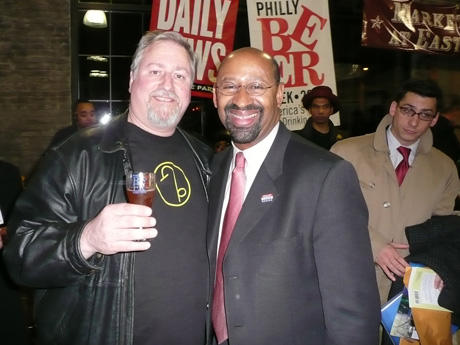
Meeting the Mayor

April 2, 2008 By Jay Brooks

The official opening of Philly Beer Week began with the tapping of the keg by Philadelphia Mayor Michael Nutter. I was on hand at the mini-beer festival held at the Marketplace at East Falls. Among the produce stands were twenty brewers sampling their beers and Don Russell was signing copies of his new book, Joe Sixpack’s Philly Beer Guide: A Reporter’s Notes on the Best Beer-Drinking City in America.

Philly Beer Week organizers Tom Peters and Bruce Nichols, along with Don Russel (on the right) as Mayor Michael Nutter says a few words before tapping the keg.

Me and Philadelphia Mayor Michael Nutter.


For many more photos from opening of Philly Beer Week, visit the photo gallery.
 

Filed Under: Uncategorized Tagged With: Uncategorized

New Belgium To Can Fat Tire

April 2, 2008 By Jay Brooks

There’s been a rumor floating around about this for some time now, but today New Belgium Brewing in Fort Collins, Colorado has made it official. Beginning this summer, they will be offering their popular Fat Tire Amber Ale in cans. As the 9th largest brewery in America, this will make them the largest microbrewery to put their beer in cans to date.

From the press release:

New Belgium, known for its commitment to quality and sustainability, will begin distributing a short run of cans in June, just when concerts, camping trips and other outdoor activities are in full swing.

“Introducing cans was a natural choice given that they are outdoor-friendly, light for transport and readily recyclable,” said Bryan Simpson, spokesperson for New Belgium. “In addition to the lighter carbon footprint, Fat Tire can now travel to places where glass is not an option.”

Distributing cans will continue to help lessen New Belgium’s footprint by saving fuel during transport to other states by lightening the weight of the trucks. New Belgium has begun this process by using biodiesel in its Ft. Collins distribution trucks and in the trucks used during the Tour de Fat traveling events.

The cans, which are 100% recyclable, will feature Fat Tire’s original watercolor artwork. And for those beer lovers worried about Fat Tire’s taste changing in the can, fear not.

“We took a unique can-conditioning approach and its flavor was not compromised in any way,” added Simpson. “We ran a series of tests using our friends at Oskar Blues canning line and there was virtually no flavor differential.”


Filed Under: Uncategorized Tagged With: Uncategorized

Dale’s Pale Ale To Be Bottled

April 1, 2008 By Jay Brooks

April Fool’s Day is a great time for a laugh. I usually get a few good pranks. Greg Koch from Stone Brewing often has a good one. So far, this is my favorite one today.

After five years of great fun and success with our Canned Beer Apocalypse, we’re changing our packaging to glass bottles.
 
“Cans, schmans,” says Oskar Blues founder Dale Katechis. “It’s time we…..
 
Happy April Fools Day.
 
Foolishly,
 
Marty Jones
Oskar Blues Brewery


Filed Under: Uncategorized Tagged With: Uncategorized

Crafting A Lite Beer

March 31, 2008 By Jay Brooks

I received my samples of the Miller Lite Brewers Collection a few weeks ago, but I’d been waiting until I spent some time with my wife’s family before giving them a try. I wanted to be fair to these three new beers under the Miller Lite brand, and I was pretty sure I wasn’t go to find much I liked about them. It may seem prejudicial to not go into trying them with an open mind, but I would argue it’s because I have a problem with the low-calorie beer category itself. I’ve never liked them, not just their lack of flavor, but the very idea of them. I find them an abomination, an aberration, a triumph of marketing over good sense. Despite my strong feelings, I felt I could actually still be objective, but to be doubly sure I thought I’d enlist some family members to give me their opinions. Three out of four of my familial guinea pigs routinely drink mainstream brands of beer, and at least one does so almost exclusively. I felt they’ve be able to give me another perspective, one closer to the target demographic than me, at the very least.

So you probably already know Miller Brewing is test marketing—in Baltimore, Charlotte, Minneapolis and San Diego—three line extensions to their Lite beer. All three are aiming to be “craft-style,” whatever that means. There’s a Blonde Ale, Amber and Wheat, apparently redone as low-calorie concoctions. According to the press release, “Miller Lite’s Trio of Craft-Style Light Beers Provides the Best of Both Worlds.” They also introduced the tagline for the launch, “Craft Beer. Done Lite.” The press release goes on to claim the new beers “offer real craft beer taste and true light beer refreshment” and “it offers the best of both worlds for today’s beer drinkers who want a more complex and flavorful beer without sacrificing the refreshment and drinkability to which they’ve grown accustomed.”

According to the Miller-sponsored Brew Blog, the brewers collection will be targeted at lite beer drinkers.

Miller Lite Brewers Collection is aimed at mainstream light beer drinkers and capitalizes on three beer industry trends: the growth of light beer; the growing popularity of craft beer; and consumers’ growing willingness to pay more for products that deliver a unique or better experience. Miller selected the three styles because they are popular among mainstream beer drinkers looking to experiment with crafts.

The particulars included with the samples is also curious and illuminating. All three of the new Miller Lites are 4.2% abv, 110 calories and 6.2 carbohydrates per 12 oz., quite an engineering feat in itself. As competitors, they’ve chosen New Belgium Fat Tire for the amber, Coors’ Blue Moon for the wheat, and Bass Ale for the blonde ale. The calories for these three are, respectively, 159, 169 and 155 against 110 for the Miller Lites. That seems odd to me. Since they’re supposedly making low-calorie beers, why compare them to regular beers? I suppose the reason must be to highlight the difference in calories and carbs, but to me that only highlights the inanity of the low-calorie beer.

Even with the beer with the highest number of calories, Coors’ Blue Moon at 169, there is still only a difference of 59 calories. But let’s call it 60, just to talk about it. 60 calories is essentially one slice of bread, half a grapefruit or a medium-sized artichoke. Big freaking deal! And how much physical activity does it take to burn off those 60 extra calories? Ten minutes of playing tennis, half an hour of driving, or even just 36 minutes of standing still will all burn about 60 calories. But the real yet often unspoken reason people choose to drink light beers is because of the perception that they can drink more of them. So if people are drinking more beers per session, they’re really not actually saving any calories anyway, now are they? You may not find that reason championed in any low-calorie beer’s advertising, but all the companies that make these beers are well aware of this phenomenon in how people perceive them. Also, since they are the beer with the lightest flavor, and thus contain the fewest ingredients, they are also the most profitable in any company’s portfolio. So from a profit perspective—and let’s face it for any large corporation that is the only perspective that matters—these are the perfect product: lowest cost, perceived as healthy, consumed in higher quantities and sold for the same price as regular versions. Ka-ching!

Or as Don Russell (a.k.a. Joe Sixpack) put it in a recent column:

We all know, of course, it’s not really diet beer. Most of the guys you see guzzling light beer are about as fit as a bag of potato chips. People drink it not because they’re counting calories, but because its watered-down, ordinary flavor allows them to mindlessly pound one after the other without the inconvenience of actually tasting the stuff.

I presume that only the blonde is actually an ale, since otherwise they’d call the amber an amber ale, if it used top fermentation. So I assume the amber is an amber lager. The wheat is probably also a lager, though some wheat beers are actually hybrid styles. But I would guess Miller would choose the more simple path of making it in a lager style.

My motley menagerie of relatives. From left: my sister-in-law Margaret (drinks mostly craft but has the occasional mainstream beer), her husband Roddi (who drinks roughly half craft and half mainstream), my brother-in-law Tucker (who drinks mostly mainstream fare) and my wife Sarah (who drinks exclusively craft, of course). The five of us tried all three beers Easter afternoon, and here’s what we thought.

WHEAT

Miller describes the Wheat as offering “especially appealing flavor dimensions, with a subtle citrus character for a clean, refreshing beer.” They list its characteristics as follows:

  1. APPEARANCE: Golden-yellow, Cloudy. Well-defined carbonation and foam.
  2. AROMA: Invigorating and fresh aroma. Fruity with fresh citrus: – Orange, – Lemon.
  3. FLAVOR: Sessionable wheat. Stimulating citrus and orange. Delicate bitterness and body.
  4. FINISH: Crisp. Clean. Quenching bitterness.

Here’s what my relatives had to say. “Not a wheaty nose, unpleasant. This doesn’t taste a thing like wheat, it has no sweetness, just bitter. It’s not something I would finish. It doesn’t meet the chug test. It’s a sweet Miller Lite, but not as much as a wheat.” I had to agree with them. It seemed to straddle a middle ground where it was neither a wheat beer nor a light beer. It just seemed confused. I didn’t think it had any of the refreshing qualities that I look for in a wheat beer. It was just thin and watery, with hardly any flavorful character at all.

BLONDE ALE

Miller describes the Blonde Ale as offering “a crispness and slight maltiness that’s balanced by a recognizable hop aroma.” They list its characteristics as follows:

  1. APPEARANCE: Amber-copper, Clear, Bright. Well-defined carbonation and foam.
  2. AROMA: Noble aroma. Fruity and delightfully hoppy. Synergistic compliment of hop citrus and spice, and malt.
  3. FLAVOR: Fruity, Hoppy, Citrus, Malty. Purposeful bitterness and refreshing body.
  4. FINISH: Slight bite. Cordial bitterness.

Here’s what my relatives had to say. “It doesn’t look like a blonde. The color’s not quite right. I can barely taste the difference between this and the wheat. The nose reminds me of white wine, and it’s kinda’ sweet. I like it better than the first one.” Is this what Ballantine used to taste like? As the only ale, I think I was expecting more. But it was so similar in taste to the other three, that I was hard-pressed to find any differences. I didn’t get any of the fruity or hoppy character that was listed in the press release. I’ve judged light beers before at GABF and it is a difficult thing to discern between beers, because the flavors are so subtle. Unfortunately, you tend to focus on their flaws, because that’s what stands out.

AMBER

Miller describes the Amber as follows. “The color in the MLBC Amber comes from specially selected caramel and roasted malts; it offers a mild hop character for a bold yet refreshing flavor.” They list its characteristics as follows:

  1. APPEARANCE: Amber-bronze, Clear, Bright. Well-defined carbonation and foam.
  2. AROMA: Rich and distinctive, Fruity, Malty and caramel notes. Distinguished hop character. Suggestion of roasted malt.
  3. FLAVOR: Slight hop character, Malty and caramel notes, Hint of roasted malt, Slightly sweet. Low to moderate bitterness and body.
  4. FINISH: Crisp, Clean. Perceptible and pleasant beer character. Delicate and refreshing bitterness.

Here’s what my relatives had to say. “Some water, some drink. I like the blonde better. There’s not much there. I don’t get it. If I had to drink one I’d choose the amber.” I didn’t think the color was remotely what I’d call amber. The “I don’t get get it” comment got a lot of play, as my relatives all mused on what Miller had in mind for these beers and who might buy them. The consensus was that they knew craft beer drinkers wouldn’t buy them, but they also couldn’t fathom why mainstream drinkers would. And apart from my wife, the other three regularly drink light beers. They felt that if you wanted craft beer flavors, you’d just buy one of those if that’s what you were in the mood for. The Miller Lite Brewers Collection seemed to please no one. Unfortunately, I think that may be its fate.

Don Russell, again from the same column, where he says if craft beer is jazz, the new beers are Kenny G:

Essentially, Miller is attempting to sell a product that wants it both ways. It’s a product that purports to offer all the complexity, depth and quality of a small-batch brew along with the bland, inoffensive, one-dimensional flavor of a factory-made light beer.

Russell, who I suspect does not think these beers are terrific, is still far more kind to them than I feel I can be. He continues.

If you ask Miller how its beer can be both light and craft, the company deftly explains: “It’s important to note that these are not intended to be craft beers and are not targeted at craft drinkers. These are craft-style light beers.”

It continues: “Craft drinkers are happy with the choices they have, and they should be. But mainstream light-beer drinkers who want something with a different taste and drinkability are not happy with their options. Traditional craft beers don’t work for these consumers. Miller Lite Brewers Collection will.”

None of the beers are all-malt—each uses corn—according to Miller brewmaster Manny Manuele, in an interview by Stan Hieronymous on his Appellation Beer Blog.

One question about this all-malt issue stood out for me in Stan’s interview:

All-malt is at the core of how “craft” brewers define their products. Would you say you disagree?

First, it’s important to note that these are not intended to be craft beers and are not targeted at craft drinkers. These are craft-style light beers. Additionally, “all malt” is one, but not the only, criteria that defines craft beer. The Brewers Association describes craft as beers brewed with a traditional process using malted and specialty grains, hops, water and yeast to deliver the aroma, taste and appearance characteristics not typically found in mainstream beers. That’s what we’re delivering — a unique consumer taste experience not typically found in light beers and consistent with craft-style beer.

Hmm, maybe I’m mis-reading that but it sounds like Manuele is suggesting that a brewery could skirt one of the requirements for being considered a craft brewer and still be one. But my understanding of the three-prong definition of a craft brewer (see below) is that all three criteria must be met. Anything less, and you’re not a craft brewer (at least by the BA definition). He interprets the definition of what qualifies as a craft beer as something with flavors “not typically found in mainstream beers” and then suggests that the new craft-style light beers could qualify because they provide a “unique consumer taste experience not typically found in light beers and consistent with craft-style beer.” That’s a pretty tortured bit of logic, I must say. He’s defining by using the negative, saying that since it’s not this, it must be that. Not so fast. Just because something tastes different or isn’t as typical (assuming that point can even be conceded) doesn’t make it something else.

I could make an apple pie with no apples, substituting Ritz crackers, and it might taste something like an apple pie. But I don’t think anyone would let me get away with still calling it an authentic apple pie, because it’s missing a key element of apple pie, namely apples. Likewise, craft beer that isn’t all-malt really isn’t. The only exception to not using all-malt ingredients and having the brew still considered a craft beer is if they “use adjuncts to enhance rather than lighten flavor.” And while Manuele claims they used “wheat and corn for taste, lightness and refreshment” (perhaps trying to combine them), who doesn’t believe that while the wheat may impart taste and refreshment, the corn is only there for lightness.

Craft brewing industry definitions

An American craft brewer is small, independent, and traditional.

Small: Annual production of beer less than 2 million barrels. Beer production is attributed to a brewer according to the rules of alternating proprietorships. Flavored malt beverages are not considered beer for purposes of this definition.

Independent: Less than 25% of the craft brewery is owned or controlled (or equivalent economic interest) by an alcoholic beverage industry member who is not themselves a craft brewer.

Traditional: A brewer who has either an all malt flagship (the beer which represents the greatest volume among that brewers brands) or has at least 50% of it’s volume in either all malt beers or in beers which use adjuncts to enhance rather than lighten flavor.

But it in the end, the Miller propaganda machine keeps pointing out — whenever anybody asks them about what they are — “that these are not intended to be craft beers and are not targeted at craft drinkers. These are craft-style light beers.” That may be true, but is it a coincidence that this disclaimer does not appear in the press release I received? Is it mere happenstance that the word “craft” is used all over the place in marketing these brands? And that tagline. “Craft Beer. Done Lite.” Is that not meant to convey that they are craft beers? Clearly, Miller wants people not familiar with industry definitions to believe that they are craft beers, or at the very least craft beer-like. They’re counting on mainstream beer drinkers unfamiliar with what it means to be a craft beer to conclude that these are, capitalizing on a resurgence of both interest and sales of craft beer.

If the idea really is to target “mainstream light-beer drinkers who want something with a different taste and drinkability,” I can suggest many true craft beers that fit that bill far better. As for all those extra calories, how about just drink fewer beers of better quality with richer flavor? Let’s just stop pretending that low-calorie diet beers are not a sham.
 

UPDATE 4.1: The test is over. Miller’s Brew Blog announced today that based on very successful tests in all four markets, the three Miller Lite Brewers Collection beers will be rolled out nationally in September.


Filed Under: Uncategorized Tagged With: Uncategorized

A Visit To Philadelphia Brewing Co.

March 30, 2008 By Jay Brooks

In early March, during Philly Beer Week, I visited one of Philadelphia’s newest breweries, the Philadelphia Brewing Co., located in the Kensington neighborhood.

Co-owner Nancy Barton, in front of the kegerator. The day we were there, their first beer — Kenzinger — had been tapped for the first time only two days before.

Philadelphia Brewing’s kettles wrapped in heat-saving brick, with brewer John Rehm hard at work.

The exterior of the new Philadelphia Brewing Co., from a flyer.


For more photos of the Philadelphia Brewery, visit the photo gallery.
 

Filed Under: Uncategorized Tagged With: Uncategorized

Beer For the Birds

March 29, 2008 By Jay Brooks

If you saw my last post, about a Czech Ornithologist suggesting a correlation between beer consumption and academic output among his peers, you may have noticed my little joke at the end about him drinking only beer with birds on the label. I knew there were plenty of dogs on beer labels (I recall Stephen Beaumont doing an article about that several years ago, which I helped with infinitesimally by putting together a list of ones I knew about). Then there was Session #7 hosted by Rick Lyke, The Brew Zoo: Part 1, Part 2, Part 3, Part 4, Part 5 and Part 6, where animals of all stripes were found lurking on beer labels.

So I did a little search to see if I could find out if indeed there were a lot of labels with birds on them, and I found more than I bargained for. First, there’s this online collection of Birds on Beer Labels, which features scans of quite a few, including Mendocino’s Red Tail Ale. But then I came across this: The International Bird Beer Label Association, a 15-year old group dedicated to documenting beer labels with birds on them! The IBBLA, as of November of last year, has 296 confirmed sightings of birds on beer labels plus three homebrew labels and three more beers with a bird in the name, but no corresponding image on the label. They’re all listed on their checklist, and a few scans are up on the Species Photos page. The group’s slogan is “Fostering An Appreciation For Birds and Brew.” Talk about a niche hobby. I’m speechless.


Filed Under: Uncategorized Tagged With: Uncategorized

« Previous Page
Next Page »

Find Something

Northern California Breweries

Please consider purchasing my latest book, California Breweries North, available from Amazon, or ask for it at your local bookstore.

Recent Comments

  • Bob Paolino on Beer Birthday: Grant Johnston
  • Gambrinus on Historic Beer Birthday: A.J. Houghton
  • Ernie Dewing on Historic Beer Birthday: Charles William Bergner 
  • Steve 'Pudgy' De Rose on Historic Beer Birthday: Jacob Schmidt
  • Jay Brooks on Beer Birthday: Bill Owens

Recent Posts

  • Historic Beer Birthday: Peter Schemm May 30, 2026
  • Beer Birthday: Chris Crabb May 29, 2026
  • Beer Birthday: Tony Magee May 29, 2026
  • Historic Beer Birthday: John the Fearless May 28, 2026
  • Historic Beer Birthday: Charles Green May 28, 2026

BBB Archives

Feedback

Head Quarter
This site is hosted and maintained by H25Q.dev. Any questions or comments for the webmaster can be directed here.