Brookston Beer Bulletin

Jay R. Brooks on Beer

  • Home
  • About
  • Editorial
  • Birthdays
  • Art & Beer

Socialize

  • Dribbble
  • Email
  • Facebook
  • Flickr
  • GitHub
  • Instagram
  • LinkedIn
  • Pinterest
  • RSS
  • Twitter
  • YouTube

Powered by Genesis

Sacramento Spring Brewmaster’s Dinner

April 9, 2008 By Jay Brooks

Sacramento Brewing will be serving up their Spring Brewmaster’s Dinner on April 23, beginning at 6:30. The dinner will be five courses and the cost is $50. It will be held at their Town & Country location. Call 916.485.4677 for reservations. I’ll probably see you there.


The Menu:


Dinner: 6:30 PM

First Course

Fresh wild Alaskan ivory salmon with spicy pecan butter

Beer: India Pale Ale

Second Course:

Robollita (Italian bean soup)

Beer: Nut Brown Ale

Third Course:

Arugula & spinach salad with sun dried tomatoes, dry salami, and baby mozzarella

Beer: Hefeweizen

Fourth Course:

Seared breast of duck with mushroom cannelloni and golden marsala sauce

Beer: Red Horse Ale

Fifth Course:

Beer poached pear strudel served with Brussels Blonde reduction sauce

Beer: Brussels Blonde

Peter Hoey, brewmaster at Sacramento Brewing (on left), at the GABF Brewer’s Reception last year, along with Rich Norgrove from Bear Republic and Arne Johnson of Marin Brewing.

 
4.23

Sacramento Spring Brewmaster’s Dinner

Sacramento Brewing Co., Town and Country Village, 2713 El Paseo Lane, Sacramento, California
916.485.4677 [ website ]
 

Filed Under: Uncategorized Tagged With: Uncategorized

American Craft Beer Week To Celebrate Community

April 9, 2008 By Jay Brooks

This year’s American Craft Beer Week will be held May 12-18. The focus this time around will be to “celebrate brewers’ community citizenship.” In 2007, craft breweries gave combined donations of more than $20 million to various charities and worthy causes.

From the press release:

“In addition to being recognized for making world-class beer, independent craft brewers are amazing community citizens,” said Julia Herz, a spokesperson for the Brewers Association. ‘Craft brewers are an integral part of many communities’ charitable efforts. They donate to everything from fire departments, disaster relief efforts, local events, educational fundraisers and so much more.

Changed to a weeklong event in 2006, the inaugural American Craft Beer Week was recognized by the U.S. Congress with House Resolution 753. The week has continued to attract interest and support from beer enthusiasts and the media. In 2007, more than 150 brewers registered their community celebrations at the American Craft Beer Week website.

Also new, SAVOR: An American Craft Beer and Food Experience (May 16-17) will be held to commemorate American Craft Beer Week in Washington D.C. The event will showcase craft beer and food pairings with participation from 48 independent craft brewers. SAVOR signifies food and beverage lovers increasing interest and knowledge of beer and food pairings.

Breweries around the country will be hosting events throughout the week to celebrate American craft beer. To find out what’s going on your local area, you can look up events by state.


Filed Under: Uncategorized Tagged With: Holidays

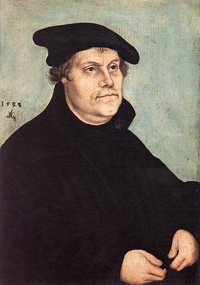
Martin Luther’s Beer

April 9, 2008 By Jay Brooks

lutheran
I stumbled upon this interesting write-up of the Beers of Martin Luther on a Lutheran website, Cyberbrethern. The post is based on notes from a talk given at a Men’s Breakfast at Good Shepherd Lutheran Church, Fayetteville, New York in April of 1997. Keith Villa of Blue Moon Brewing is thanked for “describing how the beers of Martin Luther’s era would have looked and tasted.”

martin-luther

The article discusses German beer in the middle ages, both homebrewed beer and brews made at Abbeys, and then speculates which beer of the time would have been Martin Luther’s favorite. This proved easier than you might imagine.

Frederick Salem, in his Beer, Its History and Its Economic Value as a National Beverage (1880) notes, “Luther’s fondness for beer is well known, and on the evening of that eventful day at Worms, April 18, 1521, the Duke Erich von Braunschweig sent him a pot of Eimbecker (Einbecker) beer, to which he was specially addicted.”

Michael Jackson also mentioned this connection in his New World Guide to Beer, saying “Luther received a gift of Einbeck beer on the occasion of his wedding.”

The article goes on to suggest that Luther preferred homebrew over beer from commercial breweries, finding the latter to be “a curse for Germany.” But in an apparent contradiction, Luther “drank at home.”

One biographer notes, “The German prophet became a patriarch, and the living room was dominated by his presence. He enjoyed his beer and had a great mug with three rings on it, one ‘the Ten Commandments’, the next ‘the Creed’ and third ‘the Lord’s Prayer’. He boasted that he could encompass all three with ease.”

But he was also a champion for moderation, and in sermon he gave in 1539, preached the following:

“It is possible to tolerate a little elevation, when a man takes a drink or two too much after working hard and when he is feeling low. This must be called a frolic. But to sit day and night, pouring it in and pouring it out again, is piggish… all food is a matter of freedom, even a modest drink for one’s pleasure. If you do not wish to conduct yourself this way, if you are going to go beyond this and be a born pig and guzzle beer and wine, then, if this cannot be stopped by the rulers, you must know that you cannot be saved. For God will not admit such piggish drinkers into the kingdom of heaven [cf. Gal. 5:19-21]… If you are tired and downhearted, take a drink; but this does not mean being a pig and doing nothing but gorging and swilling… You should be moderate and sober; this means that we should not be drunken, though we may be exhilarated.”

luther-bier

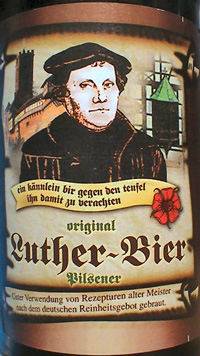
There is at least one Luther-Bier, a German-style pilsner brewed by Einsiedler Brauhaus. I’m not sure what that adds to the story, but I found in interesting all the same. As far as I can tell, it was a special release and there’s even a separate website for Luther-Bier, but there’s almost no additional information there. But you can see the special box it comes in an etched mug at a Wittenberg website.

And I found this great quote on another church’s website:

“We old folks have to find our cushions and pillows in our tankards. Strong beer is the milk of the old.”

     — Martin Luther

Filed Under: Beers, Just For Fun, Related Pleasures Tagged With: Germany, History, Religion & Beer

Belgian Blunch at the Toronado

April 8, 2008 By Jay Brooks


On Sunday, beginning at 11:30 a.m., I sat down with 80 or so beer lovers at the Toronado in San Francisco for a Belgian beer lunch, a blunch? The Toronado has been putting on this mostly word-of-mouth event, which sells out every time, for a number of years, but this was the first year the food was done by Sean Paxton, the Homebrew Chef. The blunch lasted almost six hours through a total of eleven separate courses and at least sixteen Belgian beers (plus a few more American ones). We all agreed that Sean Paxton is a mad man, a culinary alchemist. Read the description of the blunch in the photo gallery and see if you don’t agree.

The blunch was hosted by Toronado owner Dave Keene and the food was done by Sean Paxton.

Vinnie and Natalie Cilurzo, from Russian River Brewing, among the Belgian beer and cheese plate.


For many more photos from the Toronado Belgian Blunch, visit the photo gallery.

Filed Under: Events, Food & Beer Tagged With: California, Northern California, Photo Gallery, San Francisco

The Top 50 Annotated 2007

April 8, 2008 By Jay Brooks

Last year I did an annotated list of the Top 50 so I could see who moved up and down, who was new to the list and who dropped off. Four breweries dropped off the list and there are three new ones who weren’t on last year’s list. The reason that math doesn’t work out is because last year the combined breweries of Gambrinus were listed together but this year they were separated again, with two of them making the top fifty. So here is this year’s list again annotated with how they changed compared to last year.
 

  1. Anheuser-Busch; #1 last year, no surprises
  2. Miller Brewing; ditto for #2
  3. Coors Brewing; And #3, too
  4. Pabst Brewing; And #4, too
  5. Boston Beer Co.; Second year at #5, having moved up 2 spots the previous year
  6. D. G. Yuengling and Son; Same as last year
  7. Sierra Nevada Brewing; Same as last year
  8. New Belgium Brewing; Up 1 spot from #9 last year
  9. High Falls Brewing; Up 1 spot from #10 last year
  10. Spoetzl Brewery; Split off from Gambrinus, which last year was #8
  11. Widmer Brothers Brewing; Same as last year, after shooting up 6 spots the previous year
  12. Redhook Ale Brewery; Same as last year
  13. Pyramid Breweries; Up 1 spot from #14 last year, having moved up 6 spots the previous year
  14. Matt Brewing; Up 2 spots from #16 last year
  15. Minhas Craft Brewery; Same as last year
  16. Deschutes Brewery; Up 1 from #17 last year
  17. Iron City Brewing (fka Pittsburgh Brewing); Down 4 from two years at #13, just coming out of bankruptcy
  18. Boulevard Brewing; Same as last year
  19. Full Sail Brewing; Up 2 from #21 last year
  20. Harpoon Brewery; Same as last year
  21. Alaskan Brewing; Down from #19 last year
  22. Magic Hat Brewing; Up 2 from #24
  23. Anchor Brewing; Down 1 from #22
  24. Bell’s Brewery; Up 2 from #26 last year, after moving up 9 the previous year
  25. Goose Island Beer; Up 6 from #31, the second year in a row they’ve moved up 6
  26. August Schell Brewing; Up 2 from #28
  27. Shipyard Brewing; Up 2 from #29
  28. Summit Brewing; Down 1 from #27
  29. Mendocino Brewing; Up 1 from #30
  30. Abita Brewing; Up 2 from #32
  31. Gordon Biersch Brewing; Down 6 from #25
  32. Brooklyn Brewery; Up 2 from #34
  33. Stone Brewing; Up 4 from #37, after moving up 11 the previous year
  34. Rogue Ales; Up 2 from #36
  35. Long Trail Brewing; Down 2 from #33
  36. New Glarus Brewing; Down 1 from #35, after jumping 10 spots the previous years
  37. Kona Brewing; Down 14 from #23
  38. Dogfish Head Craft Brewery; Up 4 from #42
  39. Firestone Walker Brewing; Up 1 from #40, after rising 7 the previous year
  40. Great Lakes Brewing; Up 1 from #41
  41. Lagunitas Brewing; Up 3 from #44
  42. Flying Dog Brewery; Up 3 from #45
  43. Sweetwater Brewing; Up 3 from #46
  44. BridgePort Brewing; Split off from Gambrinus, which last year was #8
  45. Rock Bottom Brewery Restaurants; Down 6 from #39
  46. Gluek Brewing (now known as Cold Spring Brewery); Not in the Top 50 last year
  47. Straub Brewery; Down 4 from #43
  48. Odell Brewing; Down 1 from #47
  49. BJs Restaurant & Brewery; Not in the Top 50 last year
  50. Victory Brewing; Not in the Top 50 last year

The following breweries dropped off the list, meaning they were on the 2006 list but are not on the 2007 list of the Top 50 breweries.
 

  • Stevens Point Brewery
  • Mac and Jack’s Brewery
  • Big Sky Brewing
  • Otter Creek Brewing
  • Gambrinus; Last year the combined totals of their breweries, Spoetzl Brewery, BridgePort Brewing, Pete’s Wicked, and Trumer Brauerei were #8; this year they were considered separately


Filed Under: Uncategorized Tagged With: Uncategorized

Happy Back To Beer Day

April 7, 2008 By Jay Brooks

At 12:01 a.m., 75 years ago, beer became legal for the first time in thirteen years, but in only 19 states. Though it would be eight more months until Prohibition officially ended (on December 5), President Franklin D. Roosevelt kept his first campaign promise by encouraging Congress to modify the Volstead Act and they passed the Cullen-Harrison bill, which FDR signed into law on March 23. The bill allowed the sale and manufacture of low-alcohol beer (3.2% alcohol by weight/4.0% by volume), along with light wines, too. For brewers, it represented a return to brewing and those that had remained opening making non-alcoholic products quickly retooled. Those that had been shuttered for over a decade had a harder time re-opening, but some did manage it. Ultimately Prohibition did irreparable harm the industry as a whole and less than half of America’s breweries did not survive.

The Brewers Association in Boulder, Colorado, is again celebrating the day, this time as “75 Years of Beer,” marking the 75th anniversary of when 3.2 beer could again legally be sold before the formal repeal of Prohibition eight months later on December 5, 1933. That should gladden the heart of historian Bob Skilnik somewhat, though he’s still hard at work making sure everyone knows the true facts. Less than a month ago, things were still not too good in the media or the blogosphere. Skilnik, writing on March 13. “It’s already started and I find myself this week screaming at my computer screen, the TV and a few newspapers, and as it now appears, beer writers, breweries, and at least one brewing trade organization. April 7 does NOT signify the end of National Prohibition. National Prohibition ended on December 5, 1933.” He also added, magnanimously that “Julia Herz (the Brewers Association’s Craft Beer Program Director) has, however, gone out of her way and changed their website info in an effort to get the history right. And for this, I tip my hat to her and the BA and their 75 Years of Beer celebration.)”

The Brewers Association this year cleverly called the celebration “75 Years of Beer” since this year is the 75th anniversary of 3.2 beer being legalized in 19 states. But that won’t work next year, because “76 Years of Beer” just doesn’t have the same ring to it. From their press release:

Historians note that Prohibition officially ended on December 5, 1933, with the ratification of the 21st Amendment. But earlier that year, newly-elected President Franklin D. Roosevelt took steps to fulfill his campaign promise to end the national ban on alcohol. He spurred Congress to modify the Volstead Act to allow the sale of 3.2 percent beer in advance of the Twenty-first Amendment being ratified. Thus on April 7, 1933, Roosevelt himself received newly legalized beer at the White House to toast what was the beginning of the end for Prohibition. In the 24-hours that followed, more than 1.5 million gallons of beer flowed as Americans celebrated.

“April 7th is a day to recognize the past 75 years of beer and the beer community’s contribution to American’s quality of life. The explosion of creativity and innovation by those who make beer is an American success story,” said Charlie Papazian, President of the Brewers Association.

“As we celebrate this significant day in the history of beer, we also recognize the incredible contributions beer has made to our nation and the economy over the last 75 years,” added Jeff Becker, President of the Beer Institute. “Today, our industry contributes nearly $190 billion annually to the U.S. economy and provides more than 1.7 million jobs to our nation’s workforce.”

“April 7th is the perfect time to highlight the entrepreneurial spirit and economic contributions America’s beer industry brings to our country. Americans now have access to nearly 13,000 labels of beer — within the safest alcohol distribution system in the world — because of the state-based regulatory system that was established 75 years ago,” added Craig Purser, president of the National Beer Wholesalers Association (NBWA).

See, that’s a lot of angles that have little to do with repeal or the specific history of the event but which capture the spirit of the celebration, namely a holiday talking about beer’s virtues.

Another historian that I greatly admire, Maureen Ogle (author of Ambitious Brew: The Story of American Beer) tells the true story of the events surrounding April 7 in an op-ed piece in the L.A. Times.

She writes:

Today, we look back on Prohibition as an exercise in temporary insanity, but the 13-year experiment in sobriety was rooted in our quintessentially American faith that we can perfect the world. A broad cross section of people — men and women, urban and rural, young and old — supported the ban on alcohol because they believed that it would reduce crime, alleviate poverty, strengthen the family and nurture a more perfect union.

That lofty vision collapsed under the weight of reality. Prohibition spawned an underground economy devoted to making, shipping and selling booze. The officials trying to enforce it earned more from bribes, kickbacks and the resale of confiscated alcohol than from their meager salaries. The poison of such corruption permeated daily life. It undermined respect for the Prohibition amendment and, by extension, for the Constitution itself. Worse, Americans realized that in banning the production of alcoholic beverages, one of the nation’s largest and most heavily taxed industries, they had closed the spigot on a significant source of both jobs and revenue.

Maureen also has a number short stories having to do with April 7, 1933 on her blog that are worth reading.

Bob Skilnik also sent out his own press release in an effort to make sure the right story is told.

April 7th is Not the 75th Anniversary of the End of National Prohibition

“What was was once a trite beer history canard has become an outright lie,” says beer historian Bob Skilnik. “I can only hope that the apparent rewriting of U.S. brewing history is either an innocent result of poor research and not a shameful display of industry greed, just for the sake of a bump in beer sales.”

Bob Skilnik, author of “Beer & Food: An American History” (ISBN 0977808610, Jefferson Press, Hardcover, $24.95), argues that industry embellishments and poor research have distorted the true date of Repeal on December 5, 1933, which signified the revocation of the 18th Amendment and the enactment of the 21st Amendment and brought back the manufacture and sale of all alcoholic beverages.

“Congressional events leading up to April 7, 1933 allowed only the resumption of sales for legal beer with an alcoholic strength of no more than 3.2% alcohol by volume (abv), weak by today’s standards. Congress had earlier passed the so-called Cullen-Harrison Bill which redefined what constituted a legally ‘intoxicating’ beverage. President Franklin Delano Roosevelt signed the bill on March 23, 1933. The bill’s passage took the teeth out of the bite of the Volstead Act of 1919 and raised the Prohibition-era legal limit of alcoholic drinks from .05% abv to 3.2% abv.”

“Bringing breweries back online on April 7, 1933 in states whose legislatures agreed to go ‘wet’ again gave a tremendous shot in the arm of an economy in the throes of the Depression. In just forty-eight hours, $25,000,000 had been pumped into various beer-related trades as diverse as bottling manufacturers to the sawdust wholesalers whose product lay strewn on the floors of saloons. For the first day of nationwide beer sales, it was estimated that the federal tax for beer brought in $7,500,000 to the United States Treasury.”

In the next few months, scores of states held constitutional conventions which led to the passage and enactment of the 21st Amendment, the first time a constitutional amendment had nullified another. It also gave municipal, state and federal governments the time to sort out the taxation and regulation of the entire drink trade, a legacy that continues.

On December 5, 1933, the true end of National Prohibition became a reality when Utah signed on to the Repeal amendment, satisfying the requirement of needing at least 36 states for the enactment of the 21st Amendment to the U.S. Constitution.

I certainly admire his tenacity in trying to set and keep the record straight. As a history buff myself, I’m keenly aware that a lot of our history that we take for granted is simply wrong, for a variety of reasons. It’s quite remarkable to contemplate, but much of what was in our history textbooks is simply not correct, not exaggerations or off a little, but completely fabricated or with most of the facts incorrect. I think I’ve mentioned this before, but James W. Loewen’s Lies My Teacher Told Me is a fascinating study on just how wrong is so much of what we were taught in school.

But I’m also a calendar geek (I guess we need a new word for that, too — perhaps holiday head or time bandit?) and the way holidays come about has almost nothing to with reality or the truth of when the events that are being celebrated took place. Christmas is the classic example, with their being no actual certainty when Jesus’ birthday was, and I’ve read accounts placing it in the spring, as well as other times of the year, too. Thanksgiving, if it ever really took place at all, was not when we celebrate it. The Declaration of Independence was actually adopted on July 2, and both John Adams and Thomas Jefferson believed that would be the date we celebrated American independence. It took two more days of making changes to the document which was then ratified with the modifications on the fourth. The rest is, well, history. You get the idea.

But there’s no law or ethic or whatever preventing a group of people from celebrating whatever they want whenever they want. What’s tricky is merely reaching a tipping point where enough other people agree to recognize the date as well. Mother’s Day, for example, is a relatively modern invention, with our version of it originating just after the Civil War, even though its roots are ancient. But different countries celebrate it on very different days. The actual date doesn’t really matter in the end nearly as much as the spirit of what is being celebrated. If we keep alive the notion that prohibition was a failed experiment that exacted a terrible cost on our nation, that legislating morality is a bad idea and you can’t really stop people from doing something that they find pleasurable, then who among us should be bothered by whether it’s remembered on April 7 or December 5? I realize the difference here is that we know with historic certainty that repeal did not take place on April 7, so we should definitely avoid calling it Repeal Day; that honor should go to December 5. But I see no reason not to also celebrate on April 7. With the neo-prohibitionists nipping at our heels once more with the vigor of a junkyard dog, setting aside two days each year to remind our critics that Prohibition will not work and celebrate how much beer enriches our lives, our economy and our society in positive ways seems like a good idea to me. Since it is the day that beer once more legally flowed after thirteen years, we can justifiably called it “The Return of Beer Day” or “3.2 Beer Day” or “Back to Beer Day” or even “New Beer’s Eve” as it was originally known.


To learn more about the history of Prohibition, here are some interesting links:

  • Alcohol Prohibition Was A Failure, Policy Analysis from the Cato Institute
  • Alcohol, Temperance & Prohibition, from Brown University
  • April 7 is NOT the 74th Anniversary of the End of National Prohibition 2008, by Bob Skilnik.
  • April 7 is NOT the 74th Anniversary of the End of National Prohibition 2007, by Bob Skilnik, with an excerpt from his wonderful book Beer & Food.
  • Prohibition: A Lesson in the Futility (and Danger) of Prohibiting, from the book Ain’t Nobody’s Business If You Do
  • Schaffer Library of Drug Policy History of Alcohol Prohibition
  • Temperance & Prohibition History, from Ohio State
  • The Day Beer Flowed Again, by Maureen Ogle
  • Thinkquest’s Prohibition — The “Noble Experiment”
  • Wikipedia


Filed Under: Uncategorized Tagged With: Uncategorized

Schlitz Returns To Chicago

April 7, 2008 By Jay Brooks

The beer that made Milwaukee famous is set to try and do it again. Pabst Brewing, who owns the label, re-released Schlitz today in the brown longneck bottles using what they claim is the original recipe. Having had phenomenal success with Pabst and also recently re-released Primo, Pabst is looking to recreate that success with yet another nostalgic beer.

Schlitz used to be one of the most popular beers in America, but bean-counters in charge of the brewery in the late 1960s and ’70s introduced cost-cutting measure to the ingredients and the brewing process that let to floating particles in the beer. Consumer fled the beer in droves. Late in the 1970s Schlitz try to recover, but the damage was done and consumer confidence at nearly zero. In 1982, the Stroh Brewery Company in Detroit bought the brand, and it was later acquired by Pabst, who owns it today. Pabst is the largest contract brewer in the country, with sales of it’s not popular again Pabst catapulting it to the number 4 spot, where it’s been for the past several years.

Currently, it’s only available in the Chicago area, distributed by Louis Glunz Beers. But if successful, expect to see the old Schlitz longneck bottles everywhere again.

From the press release:

Schlitz, long known as “The beer that made Milwaukee famous” and once the best-selling beer in the United States, makes a comeback today on the 75th anniversary of its return to Chicago following Prohibition. Pabst Brewing Company in Woodridge, Ill., which now produces the iconic brand, is re-launching Schlitz “Classic 1960s Formula” based on the original recipe and packaged in traditional “Brown Glass” — a packaging innovation that Schlitz introduced in 1912 to prevent light from spoiling beer before it can be served. Chicago is third in a phased re-launch of Schlitz that included Florida and Minnesota markets late last year. The initial roll-out of six- and twelve-pack varieties, priced comparable to other premium domestic brands, will be to select Schlitz accounts with a citywide expansion slated for 2009.

Pabst Brewing Company (PBC) is partnering with Louis Glunz Beer, Inc. in Lincolnwood, Ill. to distribute the classic Schlitz formula and has a longstanding and rewarding relationship with the beer distributor, based on Schlitz and other brands within the PBC portfolio.

Founder Louis Glunz I first supplied Schlitz for the 1893 World’s Columbian Expo in Chicago and 40 years later, his eldest son and successor, Louis Glunz II, tapped the first kegs of Schlitz when they arrived by train in Chicago on April 7, 1933. On that date, the Volstead Act was modified allowing the sale of 3.2 percent beer in advance of the ratification of the 21st Amendment which repealed Prohibition. The Brewers Association reports that over 1.5 million barrels of beer was consumed nationwide in the 24-hours following what was the beginning of the end of Prohibition!

Louis Glunz Beer, Inc. has since served as a Schlitz bottler for many years and has continued to distribute Schlitz in spite of the brand’s losing its “Gusto” along the way to keep up with beer trends. General Manager, Jerry Glunz, attributes the steady decline in sales of Schlitz to a changed formula in the mid 1970s and packaging that was converted from a full package line to only cans in 1998. “We’re confident that a return to the original formula and the classic ‘Brown Glass’ longneck bottles will revitalize the Schlitz brand,” said Glunz.

Borrowing a page from their 120-year history, representatives of Louis Glunz Beer, Inc. will deliver the first coveted cases of Schlitz “Classic 1960s Formula” this afternoon from a replica of its original horse-drawn wagon. The route through Chicago’s Lakeview neighborhood includes two old Schlitz tied-houses, Schubas Tavern and Southport Lanes & Billiards, as well as Cardinal Liquors, 1000 Liquors, Chicago Brauhaus, Sheffield’s Bar, The Long Room, Simon’s Tavern, the Green Mill Cocktail Lounge, and Glunz Bavarian Haus. The product will also be available at Louis Glunz’s original shop, since renamed The House of Glunz, at Wells and Division Streets in Chicago’s Old Town.

“Louis Glunz Beer, Inc. introduced Schlitz to Chicago and we’re excited to work with them to re-launch the original formula,” said Brad Hittle, chief marketing officer of Pabst Brewing. “Their heritage with Schlitz is unsurpassed among beer distributors across the country.”

“We are delighted about the comeback of Schlitz, the brand that brought us to the dance,” said Jack Glunz, president of Louis Glunz Beer, Inc. “The ‘Classic 1960s Formula’ is just as we remember from the heydays, a perfect balance between full-flavor and easy drinking with ‘just a kiss of the hops.’ This re-launch is a tribute to my grandfather’s legacy!”

According to Kyle Wortham, senior brand manager for Schlitz, the classic taste profile of Schlitz “Classic 1960s Formula” is the result of research by Pabst Brewmaster, Bob Newman, who was named the 2006 and 2007 Brewmaster of the Year at the Great American Beer Festival. “Bob tracked down and interviewed retired Schlitz brewhouse employees and others to recreate the classic taste,” explained Wortham. Mr. Glunz, who also provided access to Schlitz marketing materials in his company’s archives, was among those interviewed.

In addition to a return to the original taste profile, dedicated to those who miss the full-bodied Schlitz as they knew it, Wortham said that the classic formula will feature heritage-inspired packaging and old-school attitude to reinforce the values that resonate with guys who remember the 1960s. A new print and outdoor advertising campaign includes imagery from that era and suggests that the intended drinker go back to a formula from a time when values mattered: “the cars were cooler, the athletes didn’t cheat, and the beer was better.” Marketing support also includes a new website, www.schlitzgusto.com, public relations, and tasting parties.

“Schlitz coined the phrase ‘Go For The Gusto,’ and we intend this campaign to reach beer drinkers where they live and remind them of some of the best times of their lives when even the beer tasted better,” said Wortham. “We’re setting the stage for a significant comeback.”

Filed Under: Uncategorized Tagged With: Uncategorized

Iron Springs Set To Close August 15

April 7, 2008 By Jay Brooks

According to a story by my friend and colleague, Brent Ainsworth, in today’s Marin I.J., Iron Springs Brewery in Fairfax will be shutting down operations on August 15 of this year, due to a protracted struggle with their landlord in which the rent was to be raised by 53% in this down market.


Filed Under: Uncategorized Tagged With: Uncategorized

Top 50 Craft Breweries For 2007

April 7, 2008 By Jay Brooks

The Brewers Association just announced the top 50 breweries in the U.S. based on sales, by volume, for 2007, which is listed below here. For the first time, they’ve also released a list of the top 50 craft breweries based on the new definition adopted by the Brewers Association last year. Here is the new craft brewery list:

  1. Boston Beer Co.; Boston MA
  2. Sierra Nevada Brewing; Chico CA
  3. New Belgium Brewing; Fort Collins CO
  4. Spoetzl Brewery (Gambrinus); Spoetzl TX
  5. Pyramid Breweries; Seattle WA
  6. Matt Brewing; Utica NY
  7. Deschutes Brewery; Bend OR
  8. Boulevard Brewing; Kansas City MO
  9. Full Sail Brewing; Hood River OR
  10. Harpoon Brewery; Boston, MA
  11. Alaskan Brewing; Juneau AK
  12. Magic Hat Brewing Company; South Burlington VT
  13. Anchor Brewing; San Francisco CA
  14. Bell’s Brewery; Galesburg MI
  15. Shipyard Brewing; Portland ME
  16. Summit Brewing; Saint Paul MN
  17. Abita Brewing; New Orleans LA
  18. Gordon Biersch Brewing; San Jose CA
  19. Brooklyn Brewery; Brooklyn NY
  20. Stone Brewing; Escondido CA
  21. Rogue Ales; Newport OR
  22. Long Trail Brewing; Bridgewater Corners VT
  23. New Glarus Brewing; New Glarus WI
  24. Kona Brewing; Kailua-Kona HI
  25. Dogfish Head Craft Brewery; Lewes DE
  26. Firestone Walker Brewing; Paso Robles CA
  27. Great Lakes Brewing; Cleveland OH
  28. Lagunitas Brewing; Petaluma CA
  29. Flying Dog Brewery; Denver CO
  30. Sweetwater Brewing; Atlanta GA
  31. Bridgeport Brewing; Portland OR
  32. Rock Bottom Brewery Restaurants; Louisville CO
  33. Odell Brewing; Fort Collins CO
  34. BJs Restaurant & Brewery; Huntington Beach CA</li
  35. Victory Brewing; Downingtown PA
  36. Mac and Jack’s Brewery; Redmond WA
  37. Lost Coast Brewery; Eureka CA
  38. Big Sky Brewing; Missoula MT
  39. Pete’s Brewing; San Antonio TX
  40. Otter Creek Brewing; Middlebury VT
  41. Karl Strauss Breweries; San Diego CA
  42. Breckenridge Brewery; Denver CO
  43. Gordon Biersch Brewery Restaurant; Chattanooga TN
  44. Anderson Valley Brewing; Boonville CA
  45. Boulder Beer; Boulder CO
  46. North Coast Brewing; Fort Bragg CA
  47. McMenamins; Portland OR
  48. Utah Brewers Cooperative; Salt Lake City UT
  49. Capital Brewing; Middleton WI
  50. Blue Point Brewing; Patchogue NY

From the press release:

The Brewers Association, which tabulates industry growth data, announced its annual list of the top fifty brewing companies. Released are both a Top 50 Craft Brewing Companies list and a list of the Top 50 Overall Brewing Companies. Statistics are based on sales in 2007.

“The majority of breweries in the U.S. are independent craft brewers who continue to push the envelope in flavor and diversity and who continue to set the pace for the beer category,” states Paul Gatza, Director of the

Filed Under: Uncategorized Tagged With: Uncategorized

Top 50 Breweries For 2007

April 7, 2008 By Jay Brooks

The Brewers Association has just announced the top 50 breweries in the U.S. based on sales, by volume, for 2007. Here is the new list:

  1. Anheuser-Busch; St Louis MO
  2. Miller Brewing; Milwaukee WI
  3. Coors Brewing; Golden CO
  4. Pabst Brewing; Woodridge IL
  5. Boston Beer Co.; Boston MA
  6. D. G. Yuengling and Son; Pottsville PA
  7. Sierra Nevada Brewing; Chico CA
  8. New Belgium Brewing; Fort Collins CO
  9. High Falls Brewing; Rochester NY
  10. Spoetzl Brewery (Gambrinus); Spoetzl TX
  11. Widmer Brothers Brewing; Portland OR
  12. Redhook Ale Brewery; Woodinville WA
  13. Pyramid Breweries; Seattle WA
  14. Matt Brewing; Utica NY
  15. Minhas Craft Brewery; Monroe WI
  16. Deschutes Brewery; Bend OR
  17. Iron City Brewing (fka Pittsburgh Brewing); Pittsburgh PA
  18. Boulevard Brewing; Kansas City MO
  19. Full Sail Brewing; Hood River OR
  20. Harpoon Brewery; Boston, MA
  21. Alaskan Brewing; Juneau AK
  22. Magic Hat Brewing Company; South Burlington VT
  23. Anchor Brewing; San Francisco CA
  24. Bell’s Brewery; Galesburg MI
  25. Goose Island Beer; Chicago IL
  26. August Schell Brewing; New Ulm MN
  27. Shipyard Brewing; Portland ME
  28. Summit Brewing; Saint Paul MN
  29. Mendocino Brewing; Ukiah CA
  30. Abita Brewing; New Orleans LA
  31. Gordon Biersch Brewing; San Jose CA
  32. Brooklyn Brewery; Brooklyn NY
  33. Stone Brewing; Escondido CA
  34. Rogue Ales; Newport OR
  35. Long Trail Brewing; Bridgewater Corners VT
  36. New Glarus Brewing; New Glarus WI
  37. Kona Brewing; Kailua-Kona HI
  38. Dogfish Head Craft Brewery; Lewes DE
  39. Firestone Walker Brewing; Paso Robles CA
  40. Great Lakes Brewing; Cleveland OH
  41. Lagunitas Brewing; Petaluma CA
  42. Flying Dog Brewery; Denver CO
  43. Sweetwater Brewing; Atlanta GA
  44. Bridgeport Brewing; Portland OR
  45. Rock Bottom Brewery Restaurants; Louisville CO
  46. Gluek Brewing (just changed its name Cold Spring Brewery); Cold Spring MN
  47. Straub Brewery; Saint Mary’s PA
  48. Odell Brewing; Fort Collins CO
  49. BJs Restaurant & Brewery; Santa Ana CA</li
  50. Victory Brewing; Downington PA

From the press release:

Twenty-one states are represented in the top 50 brewing companies list, according to the Brewers Association. California hosts eight top breweries. Colorado and Oregon each host five, and Pennsylvania hosts four top producers. The remainder of the top 50 operate from Minnesota (3), New York (3), Wisconsin (3), Illinois (2), Massachusetts (2), Missouri (2), Vermont (2), and Washington (2). Alaska, Delaware, Georgia, Hawaii, Louisiana, Maine, Michigan, Ohio, and Texas each host one.

Filed Under: Uncategorized Tagged With: Uncategorized

« Previous Page
Next Page »

Find Something

Northern California Breweries

Please consider purchasing my latest book, California Breweries North, available from Amazon, or ask for it at your local bookstore.

Recent Comments

  • Bob Paolino on Beer Birthday: Grant Johnston
  • Gambrinus on Historic Beer Birthday: A.J. Houghton
  • Ernie Dewing on Historic Beer Birthday: Charles William Bergner 
  • Steve 'Pudgy' De Rose on Historic Beer Birthday: Jacob Schmidt
  • Jay Brooks on Beer Birthday: Bill Owens

Recent Posts

  • Historic Beer Birthday: Peter Schemm May 30, 2026
  • Beer Birthday: Chris Crabb May 29, 2026
  • Beer Birthday: Tony Magee May 29, 2026
  • Historic Beer Birthday: John the Fearless May 28, 2026
  • Historic Beer Birthday: Charles Green May 28, 2026

BBB Archives

Feedback

Head Quarter
This site is hosted and maintained by H25Q.dev. Any questions or comments for the webmaster can be directed here.