Brookston Beer Bulletin

Jay R. Brooks on Beer

  • Home
  • About
  • Editorial
  • Birthdays
  • Art & Beer

Socialize

  • Dribbble
  • Email
  • Facebook
  • Flickr
  • GitHub
  • Instagram
  • LinkedIn
  • Pinterest
  • RSS
  • Twitter
  • YouTube

Powered by Genesis

Sacramento’s Newest Brewster

January 31, 2008 By Jay Brooks

I love getting good news, especially after the day I had yesterday. Peter Hoey, the head brewer at Sacramento Brewing sent me the news last night that his wife had delivered. Please join me in congratulating Peter and Britany Hoey as they welcome the newest addition to the Sacramento Brewing family. Lorelai Elisabeth Hoey was born Tuesday morning. Mother and daughter are “excited, tired, & nervous all at the same time,” but doing great. They’re home now getting settled in.

Particulars:

Original Gravity: 9 pounds, 3 ounces
IBUs: 20.5 in.
Style: Girl
Release Date: January 29, 2008
Label: Lorelai Elisabeth Hoey

Papa Peter holding his new daughter for the first time. Now that’s something you never forget.

Peter and Britany set to take Lorelai home from the hospital. Notice how well-rested they still look?
 

Filed Under: Uncategorized Tagged With: Uncategorized

Cuckoo for Cocoa & Beer

January 31, 2008 By Jay Brooks

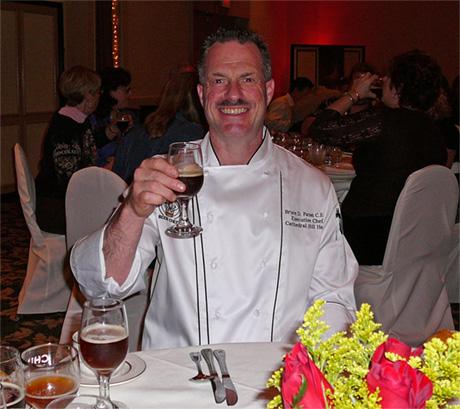
The Beer Chef, Bruce Paton, has released the menu for his annual beer and chocolate dinner, which will feature a selection of at least seven Belgian beers paired with all chocolate-infused dishes. It will be a four-course dinner and well worth the $90 price of admission. It will be held at the Cathedral Hill Hotel on Friday, February 15, 2008, beginning with a reception at 6:30 p.m., just in time to take your sweetheart for a Valentine’s dinner and enjoy some great beers, too. Call 415.674.3406 for reservations as soon as possible, because this one sells out early every year.


The Menu:
 

Reception: 6:30 PM

Beer Chef’s Hors D’Oeuvre Accented with Chocolate

Beer: Bosteels Tripel Karmeliet and Urthel Hop It

Dinner: 7:30 PM

First Course

Roasted Quail with Glazed Parsnips and Ginger Chocolate Port Sauce

Beer: Koningshoeven Bock

Second Course:

Lobster Cake with Milk Chocolate Beurre Blanc and Banana Salsa

Beer: St. Feullien Cuvee De Noel

Third Course:

Braised Creekstone Farms Angus Short Rib with Sweet Potato Flan and Dark Chocolate Ancho Chile Jus

Beer: De Koningshoeven Quadrupel

Fourth Course:

Ménage au Quatre in Chocolate

Beer: Urthel Samaranth

Beer Chef Bruce Paton at last year’s beer and chocolate dinner..

 
2.15

Beer and Chocolate Dinner

Cathedral Hill Hotel, 1101 Van Ness Avenue, San Francisco, California
415.674.3406 [ website ]
 

Filed Under: Uncategorized Tagged With: Uncategorized

Hacked

January 30, 2008 By Jay Brooks

If you did a search for the Bulletin lately, using Google or Yahoo, or any of the common search engines, clicking on the results would take you to a Web Pharmaceutical company. A big thanks to Keith Brainard, who first brought this to my attention almost two weeks ago. After determining that someone had hacked into my website and inserted an insidious script, we tried to remove it, but it kept coming back. It turns out that there was some even more pernicious code that kept re-inserting the script every time you removed it. Today we thought we finally solved it and I upgraded my software to — hopefully — make it more secure and make sure this doesn’t happen again but the code instead ended up bringing down the website for the better part of today. Obviously, we’re back up again but missing everything I’ve written since January 25. And I still have to try upgrading the software again. Hopefully, things will be back to normal in a day or two. Thanks for your patience.


Filed Under: Editorial, Just For Fun Tagged With: Southern States, Strange But True

Fried Beer

January 30, 2008 By Jay Brooks

I got an interesting sounding recipe in a press release today from Houston’s Saint Arnold Brewery. The recipe is for an appetizer called Fried Beer. Now, if you know me, you already know I’ll eat anything fried. There isn’t anything fried that isn’t improved by the process, at least in my opinion. My favorite sandwich is a Monte Cristo; a ham, turkey and cheese sandwich that’s battered and deep-fried. Yum. So this recipe has my name written all over it.

From the press release:

Saint Arnold Brewing Company may not be advertising in this weekend’s Big Game, but it is hoping to win the battle for buzz with an out-of-the-bottle innovation: Saint Arnold Fried Beer. Saint Arnold Brewing Company is the oldest craft brewery in Texas.

Developed by Houstonian Matt Schlabach and his team, the Carnies, Saint Arnold Fried Beer was the winning recipe in Saint Arnold’s One Pot Showdown this past weekend. Made with Saint Arnold Winter Stout, Saint Arnold Fried Beer is a delicious finger food that would make a great addition to any Super Party. Second place went to the Guzzlin’ Gourmets for their “Amberized Green Chili,” with the Backyard Militia’s “Brown Ale Pumpkin Soup,” taking third.

“Saint Arnold is proud to contribute to the growing understanding that beer is a great complement to food and can be a terrific ingredient as well,” said Brock Wagner, founder of Saint Arnold Brewing. “We may not have a Texas team to cheer for this year, but we sure can show our friends in New York and New England how to throw a great party.”

A total of 30 teams participated in the first annual cooking contest. Every recipe had to include Saint Arnold beer as an ingredient and each had to be cooked in a single pot in the Saint Arnold parking lot. The event raised $1,800 for Meals on Wheels.

The recipe is listed below:

Saint Arnold Fried Beer

Recipe by the Carnies, winners of the First Annual Saint Arnold One Pot Showdown.

Ingredients

  • 2 Sticks of Butter
  • 1 Cup White Sugar
  • ¼ Cup Pale Malt Syrup
  • ¼ Cup St. Arnold’s Winter Stout
  • 1 Egg
  • 1 Tsp. Vanilla
  • 2 Cups Flour (+ additional for rolling)
  • 1 Tsp. Salt
  • 1 Tsp. Cinnamon
  • ¼ Tsp. Nutmeg
  • ½ Tsp Baking Soda
  • ½ Tsp. Baking Powder
  • 1-1/2 Cups Oats
  • ¾ Cup Chocolate Chips & Butterscotch Chips (Any Ratio of the two totaling ¾ cup, i.e. 3/8 cup each)


To make the dough

  1. Begin by creaming the sugar and butter together with a mixer on medium speed until light and fluffy.
  2. Turn off the mixer and then add in the malt syrup, stout, egg, and vanilla. Mix until incorporated.
  3. In a separate bowl, combine the flour, salt, cinnamon, nutmeg, baking soda and baking powder.
  4. While the mixer is going, alternate adding the flour and oats to the butter/sugar mixture and mix until everything is incorporated.
  5. On low speed or by hand, mix in the chips until thoroughly incorporated.
  6. Chill cookie in the refrigerator for at least 2 hours.

To make the batter

  1. With a fork or whisk, mix all the dry ingredients until thoroughly incorporated.
  2. Add the beer and beaten egg and mix until no large lumps appear. The mixture will have some pea-sized lumps in it but should have nothing bigger.
  3. Adjust the amount of beer as necessary to achieve a consistency of thin pudding or pancake batter.
  4. Allow batter to sit for 10 minutes before using.

Putting it all together

  1. Take chilled cookie dough and form into a disc a little less than 2 inches in diameter and about ½ an inch thick.
  2. Roll in flour until completely covered and dust off the excess.
  3. Dip discs into beer batter and cover completely. Remove with a fork or slotted spoon to drain the excess batter. Be sure that the dough is completely covered by batter.
  4. Fry in 375˚ F peanut or canola oil for 3 minutes or until golden brown and delicious.


Saint Arnold’s owner, Brock Wagner, in he tasting area of his Houston brewery. My family made the trek there after the Craft Brewers Conference in Austin last year.


Filed Under: Uncategorized Tagged With: Uncategorized

Costco Beers

January 29, 2008 By Jay Brooks

In related Costco news, Miller’s Brew Blog is reporting that the big box store chain will be creating three private label beer brands under the Kirkland name: a hefeweizen, amber ale and pale ale. The Gordon Biersch production brewery in San Jose, California — who also makes competitor Trader Joe’s private label beers — will be brewing the beer for Costco. Private label products tend to have higher profit margins than regular brands, so undoubtedly that’s the motivation here, as well. Given that most Costco stores carry only a very few beers, and even fewer craft beers, this strikes me at first blush as another bad omen for better beer. I doubt they’ll be increasing the number of beer skus each store will carry but more likely will shove less well-established local brands out the door to make room for these.


Filed Under: Food & Beer, Just For Fun Tagged With: Press Release, Southern States

Appeals Court Reverses Washington Costco Decision

January 29, 2008 By Jay Brooks

According to a breaking news press release I received from the National Beer Wholesalers Association (NBWA), the Ninth Circuit Court of Appeals has reached a verdict in the lower court’s earlier decision in Costco v. Hoen (Washington State Liquor Control Board), reversing a majority of it, which, according to the NBWA, “thereby affirm[s] the right of the states to regulate alcohol under the 21st Amendment – a system that works to protect the citizens of each state. While NBWA is still reviewing the totality of the Court’s opinion, it appears that state regulation has been validated.”

Disappointingly, the Seattle Post-Intelligencer’s report on this begins with the following loaded sentence. “A federal appeals court Tuesday dealt Costco Wholesale Corp. a setback on whether the giant warehouse club operator could lower prices of beer and wine for its customers.” I realize that was in the business section, but so much for impartiality. Swallowing Costco’s propaganda entirely, to say they sued the state so they could lower prices to consumers is at best not telling the whole story and at worst and out and out fabrication.

Of the nine laws and regulations Costco claimed restricted competitive practices, U.S. District Court Judge Marsha Pechman agreed and ruled over a year ago in their favor. Today’s appeals ruling reversed eight of those, with the exception of the post-and-hold requirement. It appears likely that it may now be appealed to the Supreme Court. According to the PI, “The 9th Circuit Court of Appeals said the state Liquor Control Board could prohibit discounts, ban central warehousing of beer and wine by retailers, require wholesale distributors to charge uniform prices to all retailers and require a 10 percent markup. The state had said if Costco won it could put into question the systems other states use to control alcohol consumption and safeguard the collection of taxes. At least 30 other states or jurisdictions had filed briefs in support of Washington.”

Reuters, on the other hand, more even-handedly stated that Costco “lost a bid on Tuesday to overturn Washington state liquor rules that control pricing and discounts.”

The Seattle Times and the Wall Street Journal have also now weighed in with stories of their own.

From the Wall Street Journal:

Costco’s 2006 triumph attracted a lot of attention because it suggested that major changes might be in store for the nation’s complex system of regulating alcohol sales. Changes in Washington state could have a ripple effect, because most states have similar laws.

Costco is challenging a regulatory architecture that dates to the repeal of Prohibition and was designed partly to discourage overconsumption of alcohol. Makers of alcoholic beverages sell to a distributor, which marks up the price and trucks it to a bar, restaurant or store, which then sells it to a consumer.

Costco is deciding whether to appeal the ruling. “We are pleased that the central part of the anticompetitive restraints provisions was struck down,” said David Burman, a Seattle-based lawyer handling the case for Costco, referring to the “post and hold” provisions. “It will be good for Costco members and other consumers.”

Seventeen other states have post-and-hold laws, Mr. Burman said. He added that he thinks Washington lawmakers “will likely” consider overturning other provisions.

Washington alcohol regulators may appeal the part of the ruling favoring Costco. “The state got a pretty good deal. It has to decide whether it can live with a regulatory scheme that sort of has one component plucked out and thrown away,” said Richard Blau, a lawyer who specializes in alcohol law with GrayRobinson, a Florida law firm. Regulators could leave it up to state lawmakers to address that aspect of the court’s decision.

The other reason that this so-called “regulatory architecture” was partly created, in addition to discouraging overconsumption, is to level the playing field among different sizes of businesses so that advantages were not given to larger businesses by virtue of their superior bargaining position and resources to make larger buys. That was the real reason Costco went after these laws, not because they were concerned that their customers might be paying too much for the beer and wine they sold. You’d have to be pretty blind to reality to swallow that one as their motivation, yet in mainstream media story after story that continues to be the reason stated.


Filed Under: Beers Tagged With: Bay Area, Business, California, National, Washington

Cognitive Branding

January 29, 2008 By Jay Brooks

This is slightly off topic — it’s more about advertising — but since Anheuser-Busch’s Super Bowl ads are singled out, and also because it’s quite interesting, I thought I’d pass it along just the same. An article in yesterday’s Advertising Age by a Lisa Haverty, titled Don’t Flush Your Ad Down the Super Bowl: Unless Your Spot Has Fundamental Cognitive Elements, No One Will Recall Your Brand, begins with this ominous warning. “If you’re not Bud, don’t bother.” Ouch, if I were spending $2.7 million on an ad promoting the Bulletin during the Super Bowl I wouldn’t be very happy to read that. But apparently unless I’m careful to incorporate “some very fundamental cognitive elements” in my ad, people will end up remembering it as another Bud ad. The Cognitive Science Conference — doesn’t that have fun time written all over it? — held last August in Tennessee (and sponsored by the Cognitive Science Society) revealed in a study that “[a]ds with poor ‘cognitive scores’ were misattributed by consumers, and beer ads were attributed to the huge Super Bowl presence that is Budweiser.” There are ways to avoid this from happening. As Haverty suggests, you have to follow the basic principles of cognitive science to make people remember who you are, or in the jargon, reliable brand recall.

Here’s an interesting example:

Take, for example, the concept of “working memory.” Information has to go through working memory to get into long-term memory, where brand awareness and loyalty reside. One of the principles of cognitive science is that a person can hold and process only about seven items in working memory at any given moment. This actually varies from about five to nine in the general population. If your ad has so much information that it exceeds working-memory capacity, you’ll lose control over what consumers are able to remember. Cog-sci lesson: Respect working memory.

There are a few other examples, read them if you find this sort of thing as fascinating as I do. What I really take away from all this, apart from the simple fact that one must be careful in how to spend $2.7 million, is something I always suspected about any large company’s approach to blitzkrieg advertising. By year after year being the biggest advertiser during the Super Bowl, A-B has set themselves up in a very enviable position. Any other beer or related commercial runs the risk of having their own ad remembered by consumers as being for the competition. Talk about a gamble. They’ve effectively made it almost impossible for any other beer company to reach their audience during one of the most-watched television events of the year. In essence, they now own the event, ad-wise. The cynic in me thinks that if they paid for it, they should reap the rewards, but my idealistic side hates that any big company with vastly more resources than all of his competition can just use a bludgeon to maintain his market position. But that’s what’s happening in virtually any industry you can name. Once upon a time, hundreds and thousands of small local and regional businesses competed more or less on a level playing field, at least more fair than today’s environment. Go anywhere in America today, and the number of national chain stores and other businesses dominating and squashing local competitors is astonishingly near completion. And that’s not good on so many levels. As the science of advertising gets better and better, we’ve truly been manipulated into thinking what’s good for GM is good for America. If that idea is allowed to run its course there will be two or three brands, at most, for literally every type of good you can name, and even at that each will be remarkably similar to one another. Only the cognitive branding, advertising and marketing will be able to identify any difference, and they’ll do so by the most dishonest of methods possible. Geez, I need a beer.

As an aside, there’s a very funny critique of this AdAge article by AdHurl, which as far as I can tell is by a thirty-year veteran of the ad game, George Parker. He calls out Haverty for her overuse of the word “cognitive” throughout her piece. It’s snarky and hilarious. A kindred soul.


Filed Under: News Tagged With: Business, Law, Press Release, Washington

Here Comes the Stagecoach

January 28, 2008 By Jay Brooks

It seems like there’s been a number of brewers taking the next bog step into packaging, and the latest one comes from Mantorville, Minnesota, a small town southeast of Minneapolis and not to far from the border of Iowa. Mantorville Brewing was founded in 1995 and, according to a story in their local Post-Bulletin, has had a difficult road to production. But now the Stagecoach Amber Ale, named for stagecoach stop that is a part of the small town’s history, has started to be delivered to local retailers throughout the area.


Filed Under: Editorial Tagged With: Business, Statistics

Price vs. Value

January 28, 2008 By Jay Brooks

It’s been said that when you buy something, the price is what you pay and value is what you get. But if you want to get people’s attention, charge an astonishingly high price for something. Case in point, ever since Bloomberg News on Friday did a story about Carlsberg’s new $400-per-bottle beer, touting it as the world’s most expensive, it’s been burning up the blogosphere, online news outlets and forums. And with good reason. There’s a lot not to like about this story, and very little to suggest the $400 price tag is anywhere near reasonable, as many, many have already pointed out, from A Good Beer Blog’s Are You An Utter Fool? to Beer Advocate’s forum responding to the question, Are massively expensive beers good for the craft brew world?

What I find curious about this new beer is that, as far as I can tell, Carlsberg is almost completely silent about it. There’s nothing about it on their website, nothing under media or press releases. Wouldn’t you expect at least some PR information on the supposed release of something called the world’s most expensive beer? But all of the press this has gotten seems to be coming from a single source, the Bloomberg piece, which even more oddly appears to be aimed at the Latin American market.

The beer itself may be called Carlsberg Vintage No. 1, and all we know about it is that it’s 10.5% abv and “contains hints of prune, caramel, vanilla and oak tree from the French and Swedish wooden casks in which it [was] stored. It has a chestnut brown color, little foam and goes well with cheeses and desserts.” That’s according to Jens Eiken, the brewer at the Jacobsen Brewhouse (the small boutique brewery housed in the Visitor’s Center), who created the beer. Given that it’s so expensive, he’s surprisingly tight-lipped about giving any details that might convince one that it’s worth that hefty price tag. He says it’s relatively cheap, “considering the amount of time the brewery spent developing it.” Naturally he’s not saying how long that was, but does add “[w]e’re trying to raise the bar for what a beer can be,” which is maddeningly infuriating since he refuses to say how or to where he thinks this beer has moved the “bar” to.

But unlike other efforts to “raise the bar” where the process and rationale for a higher price tag have been spelled out somewhat convincingly, making beer of great value doesn’t appear to be the point one iota. Price appears to be the driving factor, which at least explains the lack of persuasion or transparency. The $400 price is a conversion from the price in Danish kroners, which is 2,008 — a figure arrived at simply to coincide with the year. Next year, the price will go up to 2009 kroners and 2010 the year after that. The 600 bottles initially being sold in three high-end Copenhagen restaurants aren’t even very large. Each bottle is only 37.5 centiliters, which at 12.68 ounces is just north of our standard beer bottle.

The beer was created for no better reason than to “challenge luxury wines in the gourmet restaurant market and capitalize on rising individual wealth.” You can see the visible hand of marketing in every step of this project. Maybe I’m old-fashioned, but I think the way to challenge wine’s perceived supremacy is to make beers that rival the quality of fine wines, not arbitrarily price them as if they did. Frankly, I think one of the best selling points of better beer is precisely that in many cases it really does already rival that of fine wine, and does so at a spectacularly more reasonable price and one which bears some relation to the ingredients and process of manufacture. In other words, it’s a good value. Even Utopias, at $100 or more, because we know what’s involved and how it was made doesn’t seem too out of whack. Carlsberg Vintage No. 1 on the other hand? Whack job, all the way.

Beyond that, look at the tortured way they arrived at the title “world’s most expensive.” From the Bloomberg news article:

Vintage No. 1 will be the world’s most expensive beer, according to Eiken. That title is currently held by Boston Beer Co.’s Utopia, which costs about $100 for a 72 centiliter bottle, according to the Web site Most-expensive.net.

Bierodrome, a London bar, sells Belgian beer Vielle Bon Secours for 635 pounds ($1,260) per 15 liter bottle, which is 12 times less than the liter price of Vintage No. 1.

And according to The Longest List of the Longest Stuff at the Longest Domain Name at Long Last:

A New Zealander paid $2,595.00 USD for a beer in a Hong Kong bar. He must have had one too many and thought the credit card slip read $2.45 when he signed it, but he claims the bar tampered with the bill. Nevertheless his credit card company did not reverse the charges and the man only known as Mr. B paid $2,595.00 for a beer.

But while I don’t think an accidental over-charging can be more than a footnote in this discussion, reducing it to the price per ounce, liter, or whatever measurement doesn’t really work either. The Bon Secours is still the most expensive bottle, no matter how large it is. I guess if your goal is to have the most expensive anything, and you’re a large enough company, you’ll figure out a way to make that happen.

Is it enough that there are only 600 bottles (50 cases at 12 per or 25 cases at 24 per) to justify the price? Certainly supply and demand is a time-honored economic method of determining fair market value. But in this case while the supply is indeed low, the actual demand is non-existent, completely artificial and will have to be manufactured from scratch.

You have to wonder about what they’re not telling us, because a 10.5% beer that’s been aged on wood is not exactly newsworthy. I can find any number of beers similar to that description. There are entire beer festivals here in the U.S. devoted to wood-aged beers. I judged at the Bistro’s Barrel-aged Beer Festival in my own backyard last year and had at least a dozen beers fitting the description of Vintage No. 1, without having to travel to Denmark. So what could be so different about this one to not only justify the cost but also their claim that even at this price they’re losing money. If I wanted people to plunk down a previously unheard of amount for something I made, I’d go out of my way to justify that high price.


But I think the difference between Vintage No. 1 and other high-priced beers, like Deus, Vielle Bon Secours and Boston Beer’s Utopias is the following. I’ve talked to Jim Koch about his Utopias, their earlier Millennium Beer and even the Triple Bock they made in the 1990s. All of those beers are or were relatively expensive beers. But the fact of their high price was at best a secondary consideration, a factor of the cost or making them. Vintage No. 1, from what little we know about it, was just the opposite. The price was created first, as a marketing gimmick (being the same as the year), and specifically to fill a demand by the nouveau riche for something expensive to spend their money on. Jim Koch, on the other hand, at least was truly passionate about the beer he and his team of brewers had made. Love it or hate it — and I’m in the former camp — you have to admit Utopias really does push the boundary of what beer is and can be. Can the same be said of a 10.5% beer aged on wood, without knowing anything more about how it was made?


To give my take on the question of whether or not expensive beer is good for the craft beer industry, I think in general it can be. I think that for the most part the price of beer has been kept artificially low for too long and has helped to maintain the image of beer as a cheap, mass-produced commodity not worthy of respect. There is something to the idea of charging a higher price for something giving it more perceived value by that fact alone. Though I think it’s gotten out of hand, wine has been using perceived value for years instead of a cost of goods to mark-up ratio to come up with a fair market price. Beer, especially among the big breweries, works on volume sales rather than a high mark-up per bottle or per package. And to keep volume up, the big breweries have kept their prices low even as their cost of manufacture and for ingredients has steadily risen. This has also forced craft brewers to likewise keep their profit margins thinner, which has had the effect of keeping perceived value lower, too. Now that there are shortages to both hops and malt, that will have to change and it will be interesting to see how consumers react. I think as long as they perceive that for the price they’re still getting a good value, things shouldn’t be too bad.

That’s where I think Carlsberg’s Vintage No. 1 goes off the rails. There’s just no sense that there’s any reasonable value for the exorbitant price they’re asking. I’m sure there will be someone willing to buy it just to show off or impress others with their success. After all, there’s never been a shortage of fools with more money than sense. That doesn’t justify the price, of course, and in this case the utter lack of perceived value could indeed damage the cause of making fine beer more highly prized and priced. I’d pay almost any reasonable price for something I highly value. But I place almost no value in being tricked into paying ten times (or more) for something just because someone thinks they can get away with it.


UPDATE 1.29: I’ve found a bit more about what the bottle will look like. “Each bottle is labeled with a hand stenciled original lithographic print by Danish artist Frans Kannike, making the empties worth about $100 apiece.”


Filed Under: Beers Tagged With: Midwest, Packaging

Stout & Cheddar Soup

January 28, 2008 By Jay Brooks

This tasty looking recipe was featured on Chicago’s ABC Channel 7, created by Michael Pivoney, Executive Chef at Marion Street Cheese Market.


Stout & Cheddar Soup (makes 6 servings)


  • 2 Tbsp. canola oil
  • 1 stick unsalted butter
  • 3 stalks celery, diced
  • 2 jumbo carrots, diced
  • 1 medium white onion, diced
  • 1 stalk of leek, diced
  • 4 cloves garlic, minced
  • ½ cup all-purpose flour
  • ½ cup rye flour
  • 2 bottles of stout beer (premium quality such as Guinness)
  • 1 quart chicken stock (vegetable stock may be substituted)
  • 1 tsp. thyme
  • dash of Worcestershire sauce
  • dash of tabasco
  • 2 cups finely-shredded cheddar cheese (premium quality)
  • Kosher salt and fresh cracked pepper


Method:

In a large soup pot, heat the oil and butter then saute the celery, carrots, onion, leeks and garlic over medium-high heat for approximately 10 minutes – until the onions are translucent Add the flour and saute over medium-low heat for approximately 8 minutes until flour is slightly brown and has a nutty scent. Whisk-in the stout beer and simmer for five minutes, then add chicken stock and thyme and dashes of Worcestershire sauce and tabasco. Continue to simmer and when mixture begins to thicken, slowly add the cheese, whisking constantly until well-combined. Season to taste with salt and pepper, then allow the soup to simmer over low heat an additional 30 minutes.

Puree the soup in a blender and serve hot.


Filed Under: Beers, Editorial, News Tagged With: Business, Europe

« Previous Page
Next Page »

Find Something

Northern California Breweries

Please consider purchasing my latest book, California Breweries North, available from Amazon, or ask for it at your local bookstore.

Recent Comments

  • Bob Paolino on Beer Birthday: Grant Johnston
  • Gambrinus on Historic Beer Birthday: A.J. Houghton
  • Ernie Dewing on Historic Beer Birthday: Charles William Bergner 
  • Steve 'Pudgy' De Rose on Historic Beer Birthday: Jacob Schmidt
  • Jay Brooks on Beer Birthday: Bill Owens

Recent Posts

  • Beer Birthday: Alan McLeod April 18, 2026
  • Beer In Ads #5225: Fabled Ambrosia Of The Ancients April 17, 2026
  • Historic Beer Birthday: William O. Poth April 17, 2026
  • Beer In Ads #5224: Harvard Bock Beer April 16, 2026
  • Historic Beer Birthday: William H. Biner April 16, 2026

BBB Archives

Feedback

Head Quarter
This site is hosted and maintained by H25Q.dev. Any questions or comments for the webmaster can be directed here.