Brookston Beer Bulletin

Jay R. Brooks on Beer

  • Home
  • About
  • Editorial
  • Birthdays
  • Art & Beer

Socialize

  • Dribbble
  • Email
  • Facebook
  • Flickr
  • GitHub
  • Instagram
  • LinkedIn
  • Pinterest
  • RSS
  • Twitter
  • YouTube

Powered by Genesis

Chateau Jiahu from Dogfish Head

August 25, 2006 By Jay Brooks

dogfish-head-green
There’s another new beer coming out from Dogfish Head. Sam Calagione’s latest creation is Chateau Jiahu, which is based on an ancient beverage discovered in a pottery jar “in the Neolithic villiage of Jiahu, in Henan province, Northern China.” Approximately 9,000 years old, the concoction was a fermented drink made with rice, honey and fruit. Dogfish Head again worked with Dr. Patrick McGovern, a molecular archeologist at the University of Pennsylvania to faithfully recreate — as far as possible — this ancient beverage.

Dogfish Head explains the process they used:

In keeping with historic evidence, Dogfish brewers used pre-gelatinized rice flakes, Wildflower honey, Muscat grapes, barley malt, hawthorn fruit, and Chrysanthemum flowers. The rice and barley malt were added together to make the mash for starch conversion and degredation. The resulting sweet wort was then run into the kettle. The honey, grapes, Hawthorn fruit, and Chrysanthemum flowers were then added. The entire mixture was boiled for 45 minutes, then cooled. The resulting sweet liquid was pitched with a fresh culture of Sake yeast and allowed to ferment a month before the transfer into a chilled secondary tank.

A very limited number of 750 ml bottles are being produced and should be in stores early next month. Artist Tara McPherson (who also did the label for Fort) did a beautiful label for this beer.

jiahu-dogfish-head

Filed Under: Beers, News Tagged With: Eastern States, Press Release

America’s Drunkest Cities! America’s Dumbest Survey?

August 25, 2006 By Jay Brooks

Forbes.com, the online part of the conservative financial organization, announced recently their list of the nation’s “drunkest cities.” Here’s the full list:

  1. Milwaukee
  2. Minneapolis-St. Paul
  3. Columbus, Ohio
  4. Boston
  5. Austin, Texas
  6. Chicago
  7. Cleveland
  8. Pittsburgh
  9. Tie:
    • Philadelphia
    • Providence, R.I.
  10. St. Louis
  11. San Antonio
  12. Seattle
  13. Las Vegas
  14. Denver/Boulder
  15. Tie:
    • Cincinnati
    • Kansas City
  16. Houston
  17. Portland, Oregon
  18. Tie:
    • San Francisco-Oakland
    • Washington-Baltimore
  19. Phoenix
  20. Los Angeles
  21. Tie:
    • New Orleans
    • Tampa
  22. Norfolk
  23. Dallas-Fort Worth
  24. Tie:
    • Atlanta
    • Detroit
  25. Indianapolis
  26. Orlando
  27. New York
  28. Miami
  29. Charlotte, N.C.
  30. Nashville

Setting aside the inanity of such a list, how — one might reasonably wonder — did they come up with such a list and keep a straight face?

Well here’s what they have to say:

Each city was ranked in five areas:

  1. state laws
  2. drinkers
  3. heavy drinkers
  4. binge drinkers
  5. alcoholism

Each metro was assigned a score in each category, based on quantitative data. All five categories were then totaled into a final score, which was sorted into our final rankings. For a fuller explanation, read the methodology used.

But here they are in nutshell, with some of my own commentary.

1. State Laws:

Cities were ranked on a scale of 1 to 8, with states deemed to have the least restrictive laws getting a higher score. They considered such intangibles as whether MADD liked that state’s alcohol laws, whether there was a law banning open containers and if kegs had to be tagged with identifying tags. Well, how scientific. How any of those vague standards can be said to make one state more “drunk” than another is simply ludicrous. The idea that a more permissive society in and of itself causes alcohol abuse or even leads to it is specious at best. Just because open containers are allowed, for example, does not mean citizens will necessarily abuse alcohol. That such a flimsy set of criterion was used and is being reported seriously is astounding.

2. Drinkers:

Cities were ranked from highest to lowest and given a score based on the number of each town’s residents who admitted to having one drink in the last month. One drink! Have we really gone so far down the neo-prohibitionist path that one drink in 30 days is equal to being an alcohol abuser? The idea that the more people who have one drink each month, the more abuse is occurring in a geographic area is so fallacious that it’s downright insulting. They use the seemingly non-judgmental term to describe this as a larger “percentage of [the town’s] population are alcohol consumers.” Well so what? last time I checked alcohol was still legal in this country and I can hardly see how a drink a month rises to the level where any reasonable person would be concerned.

3. Heavy Drinkers:

Scored similar to #2, but this time it was based on “the number of adult men who reported having had more than two drinks per day, and adult women having had more than one drink per day.” Apparently that’s what constitutes a “heavy drinker.” It doesn’t appear to make a difference what type of drink it is which apparently means there’s no difference between three pints of beer and three pints of whiskey per day. Yeah, that seems reasonable. So a beer with lunch and two with dinner and you’re a heavy drinker!

4. Binge Drinkers:

Scored like the previous two, the Forbes survey defined “binge drinking” as five or more drinks on one occasion. Is that ever? Within a year? What? To say that if you’ve ever had five beers at one party makes you a binge drinker is beyond ridiculous. It’s more than a little misleading to suggest that drinking one beer short of a six-pack one time makes you anything bad at all. Take the Super Bowl as an example. With pregame, long commercial breaks, an overblown half-time show and post game analysis it weighs in easily at least as long as five hours. So if you had one beer every hour during that one occasion you were a binge drinker according to Forbes and the CDC. Sure you are. What utter rubbish.

5. Alcoholism:

As laughably contemptible as the first four criteria were, this one takes the cake. Scoring was done “based on the number of Alcoholics Anonymous meetings held in the area, as a proportion of the number of residents over the legal drinking age.” Okay, personally I don’t agree with the idea of AA. To me, people are simply trading one addiction for a more socially acceptable one. But it obviously does work for some people and at least those who go to AA are trying to help themselves. So to measure a town’s relative drunkenness by the number of people trying to help themselves is not only wildly off the mark, it’s highly insulting to those attending the meetings. Is there a calculation or formula that explains how many people are alcoholics but not seeking help through AA. Are there no other methods, perhaps even private ones or clinics, besides AA?

The ways in which these results were calculated is so completely outside the realm of reality that it’s amazing an organization so supposedly respectable would have anything to do with it. I haven’t even scratched the surface on the ways in which these results are misleading and just plain wrong. They’re just too obvious and there are too many ways in which to show how embarrassingly disgraceful this list is.

A report on the survey by television station KPTV Channel 12 in Oregon added the following:

Forbes pointed out some surprising results. Some stereotypically “partying” cities didn’t rank high on the list. Las Vegas came in at only No. 14; New Orleans, home to Bourbon Street and Mardi Gras, only ranked in 24th place. And a town known for spring-break revelers, Miami, was only No. 33 on a list of 35 cities.

Well, perhaps it was the way in which the rankings were created in the first place. Given the amount of alcohol that flows in Las Vegas, couldn’t that fact alone be a clue that the results are erroneous? Saying people drink more in Providence, Rhode Island or Columbus, Ohio than in Vegas isn’t just “surprising,” it’s downright fiction. It could only come out that way if you design the survey to have little or no basis in reality.

So given how obviously absurd this all is, you have to wonder why an outfit like Forbes would put its name on something like this and publish it at all. It’s not exactly obvious what they’re up to. But if you look closely at the other items in Forbes’ “The Business of Nightlife,” of which America’s Drunkest Cities is just one part, there’s a link to an article entitled Cutting Alcohol’s Cost. This article is about the costs that people drinking — not even necessarily on the job — brings to businesses in increased health care and lower productivity. I should have guessed it would return, as things tend to do, to money. And their assertions that people who abuse alcohol do cause those problems may even be correct, but they completely ignore any factors that might cause their workers to drink, as if people generally make conscious choices to become alcoholics. And while there may be a few who are genetically predisposed to drink too much, I’m willing to bet that the stress of their jobs made as many or more drink too much as any other factor.

A study by the George Washington University Medical Center examined the incidence of “problem drinkers” (whatever that means) by different industries broadly defined and found that in the general population for every thousand people, an average of 91 are problem drinkers. The industries with higher than average problem drinking included:

  1. Construction and Mining 135
  2. Wholesale 115
  3. Retail 114
  4. Leisure and Hospitality 109
  5. Repair and Business Services 106
  6. Agriculture 106
  7. Transportation and Utilities 96

At the bottom of the list was professionals with only 54 in every 1,000. But notice the jobs most associated with drinking are also the ones with the highest stress, the lowest wages and/or the lowest respect. Professionals have unquestionably the highest income among the list and so it’s not terribly surprising that the have fewer problems with drinking. But Forbes knows its readers and so is more interested in how to get more productivity out of low-level employees by getting them to stop drinking than addressing the root causes of that drinking. They could just as reasonably suggested that to avoid drinking problems employers should pay them better, treat them with more respect and not put so much pressure on them that severe stress is produced. But sympathy for labor has rarely been considered by big business.

Curiously, but perhaps not surprisingly, big business was generally very supportive of the first temperance movements that agitated for prohibition in the late 1800s and into the early part of the last century. The industrial revolution had recently changed the business landscape and with workers using so many more machines, business owners looked for ways to keep their employees sober. Of course, making the machines safer, having shorter work hours or better working conditions overall might also have been beneficial to the workers, but it would have cost the business owners profits. Better they try to change the workers habits both on the job and more intrusively off the job. So many businesses gave money to support temperance groups and helped usher in a climate where prohibition was possible, all in the name of commerce. Breweries saw it all coming, of course, and tried to counteract the temperance movement with moderation PR campaigns and ads that focused on the tradition and heritage of beer. But it was too little, too late, and Prohibition decimated the industry and probably led to the Great Depression.

Then as now, business didn’t care about why their workers drank. That might focus attention on their own actions and it does nothing for the bottom line. Labor unions were created because so many were treated so unfairly for so long. If it weren’t for labor unions, we’d all still be working six or even seven days a week, far more than 8 hours a day and have far less safe working environments. All of these and more happened because workers fought to improve their lives and business fought these innovations every step of the way.

From the Forbes article:

Each year, alcohol abuse costs the United States an estimated $185 billion, according to the National Institute on Alcohol Abuse and Alcoholism. But only $26 billion, 14% of the total, comes from direct medical costs or treating alcoholics. Almost half, a whopping $88 billion, comes from lost productivity — a combination of all those hangovers that keep us out of work on Monday mornings, as well as other alcohol-related diseases. People who drink too much and too often are at greater risk for diabetes and several kinds of cancer, according to some studies.

“Alcohol is a worthless drug that affects every single cell in your body,” says Harris Stratyner, director of addiction recovery services at Mount Sinai Medical Center. Even hair transplants can fail because of the damage, he says.

“A worthless drug”? I know millions of people who might take issue with that statement. Anything and everything has the capacity to be abused. You could overdose on aspirin. That doesn’t make it a worthless drug, does it? People drink for many different reasons, of course, but certainly its popularity comes at least partly from the temporary positive effects alcohol has on the body. It allows one to relax, feel a little bit less stress for a period of time, give a feeling of euphoria. That some people might crave that feeling more often than others is directly proportional to how they feel about the rest of their lives. If you have a crappy job, a bad love life, etc. you might reasonably seek ways to feel better, and that might include alcohol. To ignore this, and other reasons why people might drink too much, in addressing alcohol’s impact on society is to overlook one of the most important aspects of the problem.

This series of stories by Forbes, and especially this last one addressing the relationship between worker productivity and alcohol, is startlingly reminiscent of big businesses’ support for prohibition groups over a century ago. And like the Anti-Saloon League, American Temperance Society and the Prohibition Party (among many others) the neo-prohibitionist groups of today are gaining power, especially political power. If business is truly once again supporting neo-prohibitionist causes to increase worker productivity, then we may be in for some dark days ahead. Today’s politics, of course, is very closely aligned with business interests so it doesn’t seem too far a leap to suggest that the conditions are once again repeating themselves in such a way that the possibility of another prohibition doesn’t seem as far-fetched as might have even a decade ago. That news alone might drive me to have another drink.

Filed Under: Editorial, News Tagged With: Mainstream Coverage, National

Grupo Modelo to Distribute Tsingtao in Mexico

August 22, 2006 By Jay Brooks

Grupo Modelo, the Mexican brewer who is most famous for making Corona, announced late last week that by the end of the year they will distribute the Chinese beer Tsingtao exclusively throughout Mexico.

Curiously, Anheuser-Busch, who owns half of Modelo (though I understand it’s non-voting stock) also has a 27% stake in the Tsingtao Brewery. With a 13% share of the Chinese beer market, they are the largest brewery there among something like 400 breweries. Yanjing Beer is second and CRE Beer is number three. Less than a decade ago there were over 800 Chinese companies brewing beer, but increasing consolidation has led to the top ten breweries now accounting for 53% of the market vs. 22% in 1996.

The modern beer industry in China began in the 1950s when new facilities were built in most major cities throughout the country. But it wasn’t until the 1970s that true growth started and — due at least in part to its vast population — by 2002 China became the world’s largest beer producer, displacing us at the top spot. The beer industry itself is similar to our own 50-to-100 years ago, with most being regional or local, with few national brands. Partly that’s due to China’s size and partly to its economic system at the time. With changes to the Chinese economy, more nationally recognizable brands are having a greater impact today much in the same way things progressed in the U.S. after World War II, though things are definitely moving more quickly.

Part of that growth is fueled by the the influx of large western beer companies, who began investing in China’s beer market beginning in the 1980s. After several missteps, a second wave of investors started in the early part of this decade and so far has been more successful. Instead of importing unfamiliar brands into China, western breweries are instead buying minority shares in existing local and regional breweries already established there. In the last few years breweries such as Anheuser-Busch, Carlsberg, Heineken, InBev and SABMiller have all made investments in Chinese beer.

Previously the market had been price-driven but a growing economy is leading to greater demand for premium brands, much like what the U.S. is experiencing right now, as well.

Tsingtao was founded in 1903 by German settlers in Qingdao and first began importing its beer to the United States in 1972. In 1996 there were four Tsingtao breweries, but today they operate 48 in China. Tsingtao beer is now sold in more than 50 countries worldwide.

Grupo Modelo, whose headquarters are in Mexico City, exports brands including Corona products, Estrella, Leon Negra, Modelo Especial, Pacifico, Negra Modelo and other beer brands to 150 countries. It is also the exclusive importer and distributor of Anheuser-Busch’s products in Mexico.

Filed Under: News Tagged With: Asia, Business, International

The Budweiser Film Studio?

August 22, 2006 By Jay Brooks

According to Advertising Age — and they should know — Anhesuer-Busch is creating a new film and TV production division within the company to create original content. Initially at least the new programs will be primarily “humorous shorts and sitcom-type programs to be broadcast over the Internet and to cellphones, according to four people familiar with the matter, and could branch into full-length films.”

They’re also reporting that this venture will draw from A-B’s $1.56 billion marketing budget and will be to date its “most ambitious by far.” Several years ago A-B tried “Bud TV” but nothing much came of its single effort. A-B did its first product placement deal in Wedding Crashers last year and it was apparently a big success, leading to other Hollywood alliances. That experience was undoubtedly the impetus to take things even further but also to keep creative control.

Critics hope the venture will distract them from their core business but that doesn’t seem likely. A-B is too big with too many resources for that to be a reasonably probable outcome. I can’t help but wonder what the upcoming film Beerfest would look like if it was a Budweiser film?

Filed Under: News Tagged With: Business, National

Craft Beer Up 11% for First Half of 2006!

August 21, 2006 By Jay Brooks

It’s been exactly ten years since the craft beer industry has seen double-digit growth. Back in the heady days of 1996 it seemed like a new brewery was opening every week. But that came to a screeching halt and things calmed down, the media turned its attention to the next big thing, and brewers got on with the job of making great beer.

Then a curious thing happened several years ago. Slowly but surely the craft beer numbers began to rise. Slowly at first, but more importantly it was happening consistently year after year. Now more great news today. So far in the first half of this year, craft beer sold looks to be 11% over the same period last year.

Said Paul Gatza, Director of the Brewers Association professional division, in a press release today. “The rate of growth in the craft beer segment appears to be accelerating. This is the third straight year we’ve seen an increase in the craft beer growth rate.”

Also from the press release:

The current surge in growth comes on top of strong performance by the nation‚s small, independent and traditional brewers over the last two years. In 2004, the volume of craft beer sold increased by 7 percent and in 2005 it rose by 9 percent.

“This growth represents strong performance by established craft brewers over several years,” said Ray Daniels, Director of Craft Beer Marketing for the Brewers Association. “Unlike the early days of our industry, newly founded breweries do not add significantly to industry-wide production.”

“The current trend in craft beer sales increases demonstrates a growing consumer preference for the diverse and flavorful beers made by craft brewers,” said Gatza.

Now that puts a smile on my face.

Filed Under: News Tagged With: Business, National, Press Release

Organic Beer in Texas

August 21, 2006 By Jay Brooks

There was as interesting overview of the obstacles of buying, selling and making organic beer in the Star-Telegram last week. The article had a special emphasis on its market in Texas, but also had a decent amount of general information.

Filed Under: News Tagged With: Mainstream Coverage, Organic, Southern States

Chugging Contests to Promote Brewfest

August 20, 2006 By Jay Brooks

A few weeks ago I opined that the upcoming movie Brewfest was going to do nothing good for the good beer movement, and might even cause further harm to beer’s already beleaguered image. I even argued that position on a recent interview on the Brewing Network. Even though I’ve not seen the movie, everything I have seen has filled me with a growing sense of dread.

Along comes today’s Patriot-News of Harrisburg, Pennsylvania, the capitol city’s newspaper, with a story about how the co-creators and stars of Brewfest are promoting the film. It seems director Jay Chandrasekhar and “his co-writer/co-star/co-producer Paul Soter, 34, have been touring the country challenging locals to beer-chugging contests.” So to all of you who’ve defended this movie, I ask you. Is that really a good way to promote good beer? Is that good for beer’s image? I can just image how the MADD mothers will use this to their advantage.

“No team has beaten them yet.” The pair of filmmakers told the paper. Well, congratulations. You must be very proud. It’s good to have goals, and such lofty ones at that. That’s exactly what the beer industry needs, high-profile people in the media spotlight with the goal of chugging more beer than anybody else. It may sell newspapers and even the movie, but it does nothing to give beer any respect and in fact even undermines it more that the damage done year after year by the advertising created by the big breweries.

The Patriot-News describes the movie thusly:

The movie “Beerfest,” opening Friday, is most definitely an R-rated comedy that proudly features gratuitous nudity and all sorts of rude behavior, mostly involving imbibing lots of alcohol.

In and out of the movie, chugging beer is a bad idea.

Filed Under: Editorial, News Tagged With: National, Promotions

Beer Only Fit for Guzzling

August 18, 2006 By Jay Brooks

I realize that the Ventura County Reporter isn’t exactly mainstream media, but they’re in print and people believe what they read in print, so they’re fair game as far as I’m concerned, especially when they wear their ignorance on their sleeve. A regular column in the alternative weekly, called Body Politics, is written by Robert Ferguson, who apparently is a diet guru, at least according his byline, which reads:

Robert Ferguson is recognized as the weight loss “guru” and wellness expert, co-author of Fat That Doesn’t Come Back, speaker and has Diet Free Life offices in Southern California. E-mail him at robert@dietfreelife.com, or visit his Web site at www.dietfreelife.com.

Apparently in his column each week he answers questions sent in by readers. This week’s is particularly troubling. The question is innocuous enough, here it is:

You often talk about the benefits of drinking wine, but what about beer?

— Cia W., Thousand Oaks

Okay, Bobby, you got my attention, please tell me. What are the benefits of drinking beer? He brings up only one of the numerous studies showing health benefit for moderate beer drinking, this about “men who drank 11-24 pints” having a 66% reduced chance of getting a heart attack over teetotalers who drank none at all. All well and good, but he also says that the scientists conducting the study were “shocked” by the findings. Hardly. It’s not like the health benefits of beer is a new phenomenon. People have known beer is good for them for millennia and there were centuries when it was preferable to water, health-wise. But it shows his true disdain for beer while at the same time trying to appear unbiased.

Ignoring the many other and different ways beer provides health benefits, he then suggests that “[j]ust because there is a hint [my emphasis] of health associated with beer doesn’t mean it’s to your benefit to rush out and purchase a case of your favorite flavor.” Setting aside that beer doesn’t really come in “flavors,” but styles, just because he apparently knows only about a single study doesn’t mean there’s only a hint of benefits. A simple Google search of “health benefits of beer” would have revealed to him over 9 million hits! Even if only a tiny fraction were legitimate scientific studies, that would still be many more than one. Just in the last few years, there have been many new major findings on the health benefits of beer. But why use facts, when as a “guru” you can pretend to know what you’re talking about.

But Bobby’s not done insulting beer yet, as he ends with this bit of wisdom:

The challenge with beer is that it’s not usually sipped, but guzzled. And guzzling positions you to consume more than if you were to sip it.

Now here was a perfect opportunity to educate Cia and his readers that there are thousands of great beers designed to be sipped rather than knocked back. But instead Bobo, who appears to know precious little about beer, chose instead to recommend the following:

If you want weight loss however, choose a five-ounce glass of wine instead.

Dammit this is the sort of thing that if I were a cartoon would make smoke shoot out of my ears. Why does wine always get trotted out as this saintly stuff, perfect for a diet? Ferguson cautioned earlier in the article that beer had “alcohol and calories,” making it bad for dieting, apparently. But so does wine. And ounce for ounce wine has more calories than beer does. There’s 100 calories in five ounces of wine, while a similar amount of beer contains (depending on the amount of protein) between 50-75 calories which is — say it with me — less. Why couldn’t he have suggested that Cia share a nice bottle of Cuvee de Tomme (Ventura is in Southern California, after all) with some friends, having only five ounces herself in a nice tulip glass? She was asking about beer, after all, not wine. But talk of alcohol and health always seems to work its way back to grapes, despite the mounting evidence of beer’s positive benefits in a myriad of areas. This perception of wine as angelically good and beer as demonically bad is one tough nut to crack. People seem very, very attached to this misconception. We could debate the reasons for this and where the culpability lies, but that’s for another day. The fact is our cause it not helped by so-called experts like this guy who in his zeal to sell diet books, magazines and his online weight loss program, ignores the facts and plays on old stereotypes to misinform the public.
 

Robert Ferguson, the “Diet Guru.” “Remember kids, don’t guzzle that beer, you’ll get fat.“

Filed Under: Editorial, News Tagged With: California, Health & Beer, Mainstream Coverage, Southern California

Ordering Alcohol Online: More Deceptive Shenanigans

August 15, 2006 By Jay Brooks

A few months ago, the NBWA in response to an odd query from the Surgeon General tried to blame underage drinking on the Internet in an effort to both seem caring and also continue to fight interstate alcohol shipping as the bogeyman for the 21st Century. To any trade organization who represents monopoly interests, of course, any hint of legislative change that threatens that control will be a bogeyman. In March it was beer distributors, now it’s wine wholesalers in the form of the Wine & Spirits Wholesalers of America (WSWA) who are attempting to further their own agenda with misleading information, at best, and downright falsehoods, at worst.

They’ve released a study that they sponsored that concluded exactly what they wanted it to. How convenient. How manipulative. Of course they call the survey a “landmark.” I call it what it really is: bullshit. Before you dismiss my assessment out of hand, read John Stauber and Sheldon Rampton’s wonderful books Toxic Sludge is Good For You! and Trust Us, We’re Experts! Both go a long way toward explaining how seemingly scientific and unbiased studies are in reality propaganda created by a very sophisticated public relations industry.

The WSWA, like the NBWA, has one function, and one function only. And it isn’t trumped up concerns about our nation’s youth. It’s sole purpose is to advance the agenda of wine wholesalers and distributors. Almost all of these wholesalers enjoy very profitable monopolies that are threatened by direct sales over the Internet. So that’s the bogeyman. It will corrupt our children. It’s always about the children. It’s never about money or business. My child needs their protection. Hooray. I no longer have to worry because the WSWA is on the case. It’s easy, really. All they have to do is make up some statistics and scare parents who are too busy to think for themselves.

Look at the language they employ. The study “confirmed” findings, it didn’t come to any conclusions based on raw data. Instead it went looking to “confirm” that which supported a predetermined conclusion. Let’s examine their so-called conclusions:

  1. 3.1 million minors (12%) ages 14-20 report having a friend who has ordered alcohol online.
  2. Wow, they have a friend. And that friend has a friend, and so on. That’s how urban legends begin … I have a friend who has a friend and …. This is a statistic that says absolutely nothing. First of all, even if accurate there’s no way to know if these 3.1 million friends are all different or all the same. Perhaps there’s only one guy but everybody knows him. That’s just as plausible as trying to conclude 12% of minors are buying alcohol online. Sure, they don’t come out and say that, but that’s clearly the inference.

  3. Two percent (551,000) of those ages 14-20 say they personally have bought alcohol online.
  4. Since when did 2% of anything become significant. Again, let’s assume that the number is correct and no bragging occurred on the part of those surveyed. Should we restrict adult’s access to legal products because some small percentage of the population will abuse them? How does that number compare to other methods minors use to get alcohol? I’m willing to bet fake IDs and over-21 friends far exceed that number. Can we really stop 100% of minors getting their hands on alcohol? Should we even try? Because every barrier we put up also makes it more it more difficult for adults, too. Kids are kids. They’ll try to do whatever they can to grow up too quickly. I did it. You did it. We’re not going to stop human nature. The more we prohibit something, the more attractive it becomes. So what if these kids bought alcohol online. It’s not the Internet’s fault. It’s the same argument the gun lobby uses so effectively. Guns don’t kill people, people do. The Internet is just a vehicle. You don’t restrict access to it for everyone because a few abuse it. Besides, where were these kids parents? What’s their story? Without that information, raw numbers are meaningless.

  5. As exposure and awareness of buying alcohol online increase, even more minors can be expected to purchase wine, beer and liquor online. This is consistent with a 2003 National Academy of Sciences report which confirmed kids are buying alcohol online and that increasing use of the Internet will make this problem worse in the future.
  6. Again, this is not a fact but a flimsy extrapolation based on questionable (and uncited) information.

  7. Nearly one in 10 (9%) of those ages 14-20 have visited a site that sells alcohol.
  8. So what? It’s not illegal for minors to read about alcohol, is it? Minors are allowed in grocery stores that sell alcohol without being corrupted. What’s the difference? And it’s curious that while 9% have visited an alcohol website, 12% have a friend who’ve bought online, while only 2% have actually done so. Is it just me, or do those figures not quite add up.

  9. One-third – nearly 8.9 million ages 14-20 nationwide – are open to the possibility of an online alcohol purchase before age 21.
  10. When I was 14-20, I would have been open to it, too. When this generation of 14-20-years olds are my age, the next crop of 14-20-year olds will almost certainly also be open to it. So what? It’s meaningless hyperbole.

  11. Seventy-five percent say their parents aren’t able to control what they do on the Internet.
  12. Is that a failure of the internet or parents? We have to realize as a society that we can’t protect our kids from everything. We have to raise them to deal with things on their own. Parents can’t really control their kids at school, either, but nobody’s suggesting we should do away with the public school system and home school everybody.

  13. Among those ages 14-20 who have tried alcohol, 75% tried liquor, followed by wine at 64%, beer at 60% and wine coolers at 55%.
  14. Another head scratcher. I’m not even sure what this adds to the picture. I’m not sure why it’s included here.

Happily, I’m not the only one who thinks this false concern for children is anything but a thinly veiled attempt to maintain the status quo. A grassroots organization known as Free the Grapes has released a counter-statement also calling into question the tactics of the WSWA.

Here’s the bulk of their statement, which was titled “Majority of States Allow Regulated Wine Direct Shipping, But Wine Wholesalers Continue ‘Chicken Little’ Strategy“:

The wine wholesaler cartel today trotted out a tired argument already dismissed by the U.S. Supreme Court, the Federal Trade Commission, and state alcohol regulators.

The intent of the Wine & Spirits Wholesalers of America’s “survey” on underage access is to deflect attention from their real motivation: economic protectionism. Over the past 30 years, the wholesale cartel has consolidated from 11,000 wholesalers to an oligopoly of two or three per state. The wholesalers, not consumers, have been deciding which wines are available. But now, the courts, Federal Trade Commission, and state legislatures are supporting consumer choice and responding with reasonable regulations and controls.

While the WSWA’s press release quoted that the “survey” results showed a “dangerous trend,” USA TODAY was unconvinced. The newspaper reported yesterday that “It’s unclear how many teens were buying alcohol online before the court’s ruling, but the TRU survey suggests such purchases are rare.”

Here are the facts:

  • Fact: Thirty-three states now allow interstate, winery-to-consumer direct shipments, and several more are in the process of creating the legal mechanisms to do so. No state has ever repealed pro direct shipping legislation based on non-compliance, including underage access. See www.wineinstitute.org for a list of the state laws.
  • Fact: The Federal Trade Commission rebuked the underage access argument in its survey of alcohol regulators in 11 states that allow direct shipments, concluding that states with procedural safeguards against shipments to minors report “few or no problems.” Click the following link to read a summary of the FTC’s July 2003 study, “Possible Anticompetitive Barriers to E-commerce: Wine”: http://www.ftc.gov/opa/2003/07/wine.htm
  • Fact: The U.S. Supreme Court’s 2005 ruling in Granholm v. Heald dismissed the underage access red herring, and favored a level playing field and consumer choice in wine via wineries and retailers
  • Fact: The wine industry supports the enforcement mechanisms available to states in the event of an alleged illegal shipment. The “21st Amendment Enforcement Act” was supported by the WSWA and signed into law in October 2000, allowing state Attorneys General to access federal courts to pursue litigation for alleged violations of state law regulating alcohol shipping. No winery or retailer has ever been prosecuted under the 21st Amendment Enforcement Act.

Additionally, alleged violations of state laws governing alcohol shipments can be reported by any state to the Trade & Tax Bureau for investigation. Penalties for infractions can include revocation of a winery’s basic permit to produce wine. Finally, the wine industry’s model direct shipping bill for wine stipulates that the winery or retailer holding a direct shipping license has consented to the jurisdiction of the state issuing the license, and the state’s courts concerning enforcement of the law. A copy of the model bill is located at www.freethegrapes.org.

“Especially now that the courts and capitols support consumer choice in wine, and many more enforcement tools are available, states should be working to ensure that online sellers are complying with all laws,” said Jeremy Benson, executive director, Free the Grapes! “Common sense and the actual experience of state regulators demonstrate that direct shipping is not the common means for illegal youth access to purchase wine, beer or spirits. Underage access is a serious issue, but it won’t be solved by special interest surveys geared to protect their turf by targeting a legal sales channel for adults,” he added.

The Wine Institute also posted a statement questioning the WSWA’s press release and survey findings.

The Wine and Spirits Wholesalers also have another website up called Point. Click. Drink. that is even more egregiously misleading than it’s main website — if you can believe that — which purports to educate young people. Unfortuntately it’s riddled with misinformation and outright fabrications, especially the Fact vs. Fiction section, which is almost entirely creative fiction. I considered going over their so-called facts point by point, but Free the Grapes put up their own counter to it: Point,Click, Think! There’s some great information there. For example, there’s this gem from USA Today, who wasn’t rolling over like NBC as far back as 1999, when they wrote:

“The [wholesaler] industry’s tactics are a civics lesson in how scare stories, lobbying and political money can be used to limit consumer choice through special-interest protections.”

— USA TODAY editorial, July 7, 1999

The WSWA even got NBC to bite on their press release and spread some nonsensical fears in a story entitled “Who is minding the Internet liquor store?” It’s by “Chief consumer correspondent” — whatever that means — Lea Thompson and it tells the tale of some kids who bought a bottle of absinthe online after watching the movie Eurotrip. Like much on the evening news, it spreads fear and highlights breakdowns in security all along the process. But it concludes, of course, by accepting the WSWA survey without question even dismissing the fact that the survey was commissioned by the WSWA by saying simply that “clearly there is a problem.” Not once is it suggested that the problem is with the security systems or other places the process breaks down. It was too easy to order online and the delivery company just gave the alcohol to a fifteen-year old. It didn’t occur to them to examine the breakdown in protocol by the delivery service. They got a free pass. NBC didn’t even mention it as a part of the problem. Yikes. Now that’s hard-hitting journalism.

But even the FTC examined E-commerce and concluded that online alcohol sales “Lowers Prices, Increases Choices in Wine Market.” The report, which was approved 5-0, refutes much, if not all, of the WSWA and NBWA’s ridiculous assertions that not banning the sales of alcohol online will lead to an epidemic of underage drinking. This time around the accusations were leveled by the wine wholesalers but much of it applies similarly to the beer industry. With so much money at stake, this issue isn’t going away anytime soon. The monopolies that constitute our alcohol distributors and wholesalers will defend those monopolies by any means necessary. Sometimes maintaining the status quo does make sense, as it does in certain aspects of the three-tier system, but other times it is clearly bad for consumers. This is one of those times. Direct shipping of alcohol from manufacturers or retailers interstate and intrastate should be legal in every state. That it’s not already shows how powerful the lobbying arms of alcohol distributors and wholesalers really are and how effective propaganda can be.

Filed Under: News Tagged With: Business, Health & Beer, National, Press Release

Shangy’s Sues Goliath InBev

August 14, 2006 By Jay Brooks

Emmaus, Pennsylvania is a pint-sized town (of just over 11,000) a few miles south of Allentown and about 45 miles from Philadelphia. It’s a seemingly unlikely place for a beer store of this magnitude, but there it is. Tucked away on Main Street in Emmaus is Shangy’s, one of the best beer places in the state. (Side note: Emmaus is also the home of John Hansell’s fine Malt Advocate magazine.)

Started in 1980 by the Hadian family, their son Nima is now at the helm and the 35,000 square foot store carries over 3,000 brands, about double what the average BevMo did when I was there and three to four times the average BevMo store now. And Pennsylvania is a case state which, for those of you unfamiliar with that curious institution, means you can only buy beer by the case. This makes getting customers to take a chance on a new beer very difficult, but Pennsylvania’s liquor laws and state agencies seem to care very little about how its citizens are affected. I grew up there and I can tell you the system is messed up beyond belief and should be overhauled. Every state has its own set of peculiarities when it comes to alcohol laws, but Dutch Wonderland (my personal name for the state) got more than its fair share.

But Shangy’s managed to prosper in that environment for a number of reasons, not least of which is that they honestly care about the beer they’re selling. The word “Shangy,” by the way means “happy” in Nima’s native Farsi language, and it is his father’s nickname.
 

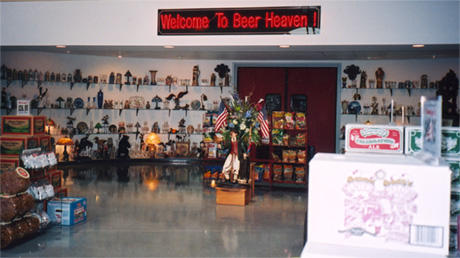
Inside Shangy’s during a trip I took there several years ago during a trip home.

Aisles and aisles of cases of beer at Shangy’s.
 

For the past decade, one of the many beers Shangy’s has done well promoting is Hoegaarden, a wit or white beer created by Pierre Celis in the 1960s when he single-handedly resurrected the style. Over time they have become the largest Hoegaarden wholesaler nationwide, moving as many 2,000 kegs each month. Hoegaarden is owned now by InBev, the world’s largest beer company (by volume of beer sold), with such brands as Beck’s, Brahma, Franziskaner, Labatt’s, Stella Artois, St. Pauli Girl, among more then 75 other local and national brands. They recently sold the Rolling Rock brand to Anheuser-Busch. Since InBev was formed by a merger in 2004, they have enjoyed a 14% share of the total world beer market.


In 1998, Shangy’s settled a lawsuit that “affirmed that Shangy’s was the exclusive wholesale distributor of Labatt products in 17 Pennsylvania counties,” which at the time included Hoegaarden. But with the 2004 merger, Labatt became an InBev subsidiary. Now Shangy’s contends that InBev, who recently gave distribution rights to another of its brands, Stella Artois, to a different beer distributor thus violating the eight-year old agreement. Shangy’s filed a lawsuit in Philadelphia this month seeking monetary damages along with a “court order compelling InBev to abide by the terms of the 1998 agreement.”

As we all know but few will say, “Hadian, who takes glee in ridiculing the mass-market beers, warns that consolidation will ultimately reduce the number of specialty brews on the market. Why? Because wholesalers will inevitably concentrate on selling mass-market, high-volume brands and neglect the craft brews, reducing their chances of survival, he says.”

I’m sure we’ll hear much more about this case as it proceeds. For now, there are more details on this story in an AP Story and a more local take by Lehigh Valley’s The Morning Call.

Filed Under: News Tagged With: Business, Eastern States, Law

« Previous Page
Next Page »

Find Something

Northern California Breweries

Please consider purchasing my latest book, California Breweries North, available from Amazon, or ask for it at your local bookstore.

Recent Comments

  • Bob Paolino on Beer Birthday: Grant Johnston
  • Gambrinus on Historic Beer Birthday: A.J. Houghton
  • Ernie Dewing on Historic Beer Birthday: Charles William Bergner 
  • Steve 'Pudgy' De Rose on Historic Beer Birthday: Jacob Schmidt
  • Jay Brooks on Beer Birthday: Bill Owens

Recent Posts

  • Beer In Ads #5138: Flower City Bock Beer March 1, 2026
  • Historic Beer Birthday: Danny Williams March 1, 2026
  • Historic Beer Birthday: Charles Weyand March 1, 2026
  • Beer In Ads #5137: Bock Is Back… Look For It March 1st February 28, 2026
  • Historic Beer Birthday: John Holme Ballantine February 28, 2026

BBB Archives

Feedback

Head Quarter
This site is hosted and maintained by H25Q.dev. Any questions or comments for the webmaster can be directed here.