Brookston Beer Bulletin

Jay R. Brooks on Beer

  • Home
  • About
  • Editorial
  • Birthdays
  • Art & Beer

Socialize

  • Dribbble
  • Email
  • Facebook
  • Flickr
  • GitHub
  • Instagram
  • LinkedIn
  • Pinterest
  • RSS
  • Twitter
  • YouTube

Powered by Genesis

More Health Benefits Of Beer

March 9, 2009 By Jay Brooks

My friend Spencer (thanks, Spence) forwarded this oldie but goodie, and I needed a laugh.

A biology teacher wished to demonstrate to his students the harmful effects of alcohol on living organisms. For his experiment, he showed them a beaker with pond water in which there was a thriving civilization of worms. When he added some alcohol into the beaker the worms doubled-up and died.

“Now,” he said,” what do you learn from this?”

An eager student gave his answer.

“Well the answer is obvious,” he said ” if you drink alcohol, you’ll never have worms.”


Filed Under: Uncategorized Tagged With: Uncategorized

Reason TV On Beer: An American Revolution

March 9, 2009 By Jay Brooks

A few years ago I did an article for Reason magazine, The Longneck Tail, which was based on a longer post I did analyzing the craft beer industry from the perspective of Chris Andersen’s economic model, The Long Tail, which I called The Long Tail Applied to Craft Beer. It garnered a fair amount of attention at the time, and I was flattered when Chris Anderson himself commented that it was a “spectacularly well done article–many congratulations,” and also mentioned it on his own blog in a separate post, More Beer!, a few days later.

Fast forward to last fall, and I got a call from a producer at Reason TV, a new division of Reason funded by Drew Carey, among others, that’s creating video short stories following Libertarian philosophies, with the goal of “bring[ing] you the latest, most compelling stories about freedom from all corners of the Internet.” They were interested in doing a piece inspired, at least in part, by the article I’d done for the magazine and brought a film crew up to northern California. The video below is the result. You may even be able to spot a few familiar faces. I have only one small quibble with the video, and it’s early in the piece. If you’re a regular Bulletin reader, perhaps you can spot it. Put your guess in the comments. Enjoy.


Filed Under: Uncategorized Tagged With: Video

A-B InBev Redefines Reasonable

March 8, 2009 By Jay Brooks

Dave Peacock, the new president of Anheuser-Busch under InBev, was formerly it’s vice-president of marketing. So he’s no stranger to spin, and boy is he putting his talents to work in a recent interview in the St. Louis Post-Dispatch, in which he tries to explain the rationale for A-B’s new policy of taking four times as long to pay its suppliers “in pursuit of accountability and good stewardship” and states, in a phrase that would make any auditor laugh out loud, “the new terms are not unreasonable.”

Many people might infer from this that A-B has a cash flow problem, and like most companies in our current economic mess, is struggling to obtain short term working capital. So why not force the suppliers, the small businesses that in many cases depend on A-B for their livelihood, to give them the credit they need? That’s in effect what their new policy does, as it provides A-B with as much as a 120-day line of credit that’s equivalent to the amount of money they owe their suppliers. Beyond whatever’s the standard trade payable expectation, most commonly 30-60 days depending on the industry, any amount their supplier has not received and is overdue forces the supplier to take reserves against it. In effect, that takes A-B InBev’s potential cash flow problems and makes them its suppliers’ problems instead. A savvy business strategy, some might say. “Disgraceful,” is what the Brewing, Food and Beverage Industry Suppliers Association called it. And it’s what caused the British business trade group, Forum of Private Business, to add A-B InBev to their “Late Payment Hall of Shame” list.

Under normal circumstances, if a company has short term financing obligations — say, for example, to meet payroll — and they didn’t have enough cash in the bank, they’d draw on their working capital line of credit. But if they either didn’t want to do that or couldn’t do that, another way to create a de facto line of credit is to stretch their trade payables. That’s what the largest beer company in the world, and one of the five largest consumer product companies of any kind, appears to be doing, financing their short term working capital with involuntary interest free loans from their trade creditors, who have little choice but to either accept the new terms dictated to them, or stop doing business with them altogether. At another point in the interview, Peacock says that the “goal is to be collaborative, not dictatorial,” which seems odd considering they’re dictating these new terms to suppliers. But in that quote, Peacock is discussing their distributors, who apparently can be treated differently than their suppliers. Peacock goes on to suggest that distributors simply needed to get to know InBev better since the beer business is such a “people” business, warning that there “should never be a situation where we’re just jamming things down their throat.” Is it just me? Isn’t that exactly what they’re doing with suppliers, taking new terms and jamming them down their throat?

But then Dave Peacock has the stones to say that there’s nothing “unreasonable” in all that. I haven’t heard such tortured use of language and spin since Bill Clinton needed clarification on what the meaning of “is” is. I won’t be surprised to learn that some of the companies eventually go out of business thanks to A-B InBev’s idea of reasonableness, particularly the ones for whom A-B’s business was a major part of their total, and who thus cannot afford to wait four months to get paid so they can pay their own workers. It’s a curious feature of the business culture that powerful corporations demand unquestioning loyalty, but feel not one iota of reciprocal duty to be loyal to their own employees, their suppliers or indeed anyone else, not if those same people get in the way of a profitable quarter. 1,600 of A-B’s St. Louis former employees are looking for work right now, their thanks for being loyal to their employer. That’s over 25% of the work force from a year ago. I guess those people just didn’t have a “chance to get to know them,” before they were thrown out on the street. Now that’s a “‘people’ business.” And I guess using the new business definition, that’s “reasonable,” too.
 

UPDATE: The Hollywood Reporter has a story tonight about how television ad executives have banded together and are refusing to accept A-B InBev’s attempt to slow pay their suppliers as a matter of policy.

From The Hollywood Reporter:

Ad sales execs are defying an Anheuser-Busch InBev directive that would have them wait as many as 120 days to be reimbursed for airtime, telling the brewing giant to stick its ultimatum where the sun don’t shine.

Sources said all major broadcast and cable nets have condemned A-B InBev’s unilateral order, refusing to comply with what one sales exec called “a shakedown.” The brewer has yet to respond to the opposition, which began fermenting Feb. 5 after A-B InBev sent its media suppliers a letter spelling out the new payment schedule. The industry standard usually is 30 days.

“We’re not going to change our policy for one client because if we let A-B get away with this, everyone’s going to want to push their payments back,” one ad sales boss said. “I’d lose more money by agreeing to this than I would if I cut my price.”

This is certainly an interesting development. Can A-B afford to stop advertising on television? I’d say they can’t, and won’t if they can possibly help it. Will A-B cave in to the television industry’s stand-off as an exception or will this lead to more push back causing InBev to back down completely? This should be worth tuning in to watch.


Filed Under: Uncategorized Tagged With: Uncategorized

Beer In Art #18: Pieter Bruegel’s Harvesters

March 8, 2009 By Jay Brooks

art-beer
Today’s work of art is by Pieter Bruegel (the Elder), considered by many to be the greatest Flemish sixteenth-century master. He was born in the Netherlands around 1525 and died in 1569. He was a Renaissance painter who began the Bruegel Dynasty that included six well-known artists. (It was originally spelled Brueghel, but in 1559 he stopped signing his paintings with the “h” in his last name). He was especially known for his landscape paintings that were populated by peasants, and in fact “is often credited as being the first Western painter to paint landscapes for their own sake, rather than as a backdrop for history painting.” Sadly, only 45 of his works survive to the present.

The Harvesters was painted around 1565 and currently is at the Metropolitan Museum of Art in New York City. Click on the image below for a larger, more detailed, view.

The panoramic landscape show the harvesting of wheat underway, with some of the people in the painting still working and some taking a break, possibly for lunch. Or perhaps they worked in shifts? The man in the red shirt, just to the right of the tall tree that divides the painting is drinking from a large jug, which could be beer. The man in the white shirt, sleeping in front of the same tree, might be sleeping one off, or just tired from working. The man walking out of the wheat field is carrying a similar looking jug and there’s an another one just standing at the edge of the field on the painting’s bottom left. And of course, wheat is a common grain used in brewing.

The Harvesters is believed to represent the months of August/September and is believed to be part of a series of six paintings known as The Month. Only five of the six are still around, the sixth has been lost to history.

Here’s a list of the five:

  • The Hunters in the Snow (December-January), 1565, Kunsthistorisches Museum, Vienna
  • The Gloomy Day (February-March), 1565, Kunsthistorisches Museum, Vienna
  • The Hay Harvest (June-July), 1565, Lobkowicz Palace at the Prague Castle Complex, Czech Republic
  • The Harvesters (August-September), 1565, Metropolitan Museum of Art, New York
  • The Return of the Herd (October-November), 1565, Kunsthistorisches Museum, Vienna

 
This is the story told about the painting at the Met:

This is one of six panels painted by Pieter Bruegel the Elder for the suburban Antwerp home of the wealthy merchant Niclaes Jongelinck, one of the artist’s most enthusiastic patrons—Jongelinck owned no less than sixteen of Bruegel’s works. The series, which represented the seasons or times of the year, included six works, five of which survive. The other four are: Gloomy Day, Return of the Herd, Hunters in the Snow (all Vienna, Kunsthistorisches Museum), and Haymaking (Nelahozeves, Czech Republic, Roudnice Lobkowicz Collection). Through his remarkable sensitivity to nature’s workings, Bruegel created a watershed in the history of Western art, suppressing the religious and iconographic associations of earlier depictions of the seasons in favor of an unidealized vision of landscape. The Harvesters probably represented the months of August and September in the context of the series. It shows a ripe field of wheat that has been partially cut and stacked, while in the foreground a number of peasants pause to picnic in the relative shade of a pear tree. Work continues around them as a couple gathers wheat into bundles, three men cut stalks with scythes, and several women make their way through the corridor of a wheat field with stacks of grain over their shoulders. The vastness of the panorama across the rest of the composition reveals that Bruegel’s emphasis is not on the labors that mark the time of the year, but on the atmosphere and transformation of the landscape itself. The Seasons series continued to be cherished even after it left its original setting: by 1595, the panels, having been purchased by Antwerp, were presented as a gift to Archduke Ernst, governor of the Netherlands, on the occasion of his triumphal entry into the city. From there they entered the illustrious collection of Holy Roman Emperor Rudolf II at Prague.

And here is what one of my favorite art critics, Sister Wendy, had to say about The Harvesters in her book, American Masterpieces:

“Bruegel is the most deceptive of the old masters; his work looks so simple, yet is infinitely profound. The Harvesters is one of a series of paintings representing the months. Five of the series remain, and in Vienna, you can view three of them on one long wall in the Kunsthistorisches Museum (which is lucky enough to own another eleven of Bruegel’s paintings, representing nearly a third of his surviving works). Seeing the three in all of their majesty — each a world in itself — made me doubt Bruegel’s wisdom in attempting a series. Each one is overwhelming, though it is easier to feel its impact than to explain it.

“The Harvesters is basically, I think, a visual meditation on the near and the far. The near is the harvesters themselves – painted as only Bruegel can paint. He shows us real people: the man slumped with exhaustion, or intoxication; the hungry eaters; the men finishing off their work before their noontime break. Yet he caricatures them just slightly. He sees a woman with grain-like hair, and women walking through the fields like moving grain stacks. He smiles, but he also sighs. There is not a sentimental hair on Bruegel’s paintbrush, but nobody has more compassion for the harsh life of the peasant. His faces are those of people who are almost brutalized — vacant faces with little to communicate.

“He sets this “near” in the wonder of the “far”: the rolling world of corn and wood, of small hills spreading in sunlit glory to the misty remoteness of the harbor. Into this distance, the peasants disappear, swallowed up. They cannot see it, but we – aloft with the artist – can see it for what it is: the beautiful world in which we are privileged to live. He makes us aware not just of space, but of spaciousness – an immensely satisfying, potential earthly paradise. No other landscape artist has treated a landscape with such intellectual subtlety, yet Bruegel states nothing. He simply stirs us into receptivity.”

If you want to learn more about the artist, Wikipedia, the Art Archive or the ArtCyclopedia are all good places to start. And to see more of his work, both Ricci-Art and Art Show Magazine have good collections, and Pieter-Bruegel.com seems to have most of his known works, but it’s in French.


Filed Under: Art & Beer Tagged With: Europe

Session #25: Love Lager

March 6, 2009 By Jay Brooks

session-the
March comes in like a lager for our 25th monthly Session, a.k.a. Beer Blogging Friday, thanks to John Duffy, a.k.a. The Beer Nut, whose theme this time around is “Love Lager,” by which he means the cheap stuff, the mass-produced swill, the … well, let’s let him tell us:

It’s the world’s most popular style of beer and can be found in abundance in almost every corner of the globe. For millions of people the word “beer” denotes a cold, fizzy, yellow drink — one which is rarely spoken of among those for whom beer is a hobby or, indeed, a way of life.

So for this Session, let’s get back to basics. I’m sure I’m not the only one whose early drinking career featured pale lager in abundance, so consider this a return to our roots as beer drinkers. Don’t even think about cheating the system: leave your doppelbocks and schwarzbiers out of this one: I want pilsners, light lagers, helleses and those ones that just say “beer” because, well, what else would it be?

I want to know what’s so great about them, and what’s awful. Are we talking just lawnmowers, barbecues and sun holidays here, or is there a time for some thoughtful considered sipping of a cold fizzy lager?

session_logo_all_text_200 Well, I suppose there’s some truth to what he says. I assume like most people of my generation, at least, I did grow up on interchangeable light-bodied lagers, in my case mostly regional brands that are no longer with us from where I hail from, the southeastern area of Pennsylvania that I refer to as “Dutch Wonderland.” There’s no real area that’s been given that name, except in my mind. Dutch Wonderland is actually a C-rate amusement park in Lancaster. But to me, that seems the perfect appellation because it was a wonderful place to grow up and the Dutch refers not to the Netherlands, but to its German heritage. It’s Dutch like Pennsylvania Dutch, a corruption of Deutsch, meaning German. And I grew up near the heart of Amish Pennsylvania. In fact, my relatives emigrated there in the early 1700s from Bern, Switzerland, which is in the German-speaking part of Switzerland. They were Anabaptists and settled on a farm in what today is Bernville. My relatives were essentially Mennonites, which are like reformed Amish. Or perhaps more correctly, the Amish are conservative Mennonites who rejected certain technologies and, unlike most immigrants, managed to avoid assimilation.

By the time I came along, the family farm was sold, and the relatives of my grandparents’ generation had scattered. I grew up just outside of Reading, and that’s “red-ding,” NOT “reed-ding” for all you Monopoly players who remember it was the first railroad on the board. My hometown, from age 5 up, was Shillington, a one-square mile plot housing around 6,000 people. Its most famous son was author John Updike, who recently passed away. It’s about a one and a quarter-hour drive northwest from Philadelphia.

All over Eastern Pennsylvania in the 1960s and 70s, there were quite a number of regional brands that were either still going, or which were still being brewed under license by someone bigger who’d acquired the brand name. Just off the top of my head, there was Carling, Fyfe & Drum, Ortlieb, Schaefer, Schmidt’s, Sunshine and Yuengling. Who knows how many names are lost due to the systematic killing off of my brain cells.

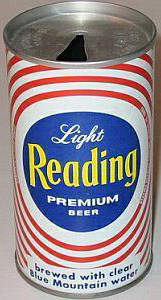
But it was hometown favorite Reading Beer that I remember so clearly. Advertising for the brand was everywhere throughout town. Actually, it still is in many of the old corner bars that continue to dot the city. They had those concentric circles on the cans that really made them stand out. My memory, actually, is that the beer wasn’t very good. They went out of business in 1976, when I began my senior year of high school (though I think Schaefer continued brewing it in Fogelsville). At that age, my friends and I weren’t terribly picky about our beer. But because Reading Premium was fairly ubiquitous and pretty cheap, it was not unusual that that’s what we’d end up with. Even to my untrained palate and at an age when I’d drink whatever I could manage to get my hands on, I don’t remember the taste of Reading Premium all that fondly.

reading-circle

I don’t recall great variation in the many different regional beers that were available at the time. We had our favorites, though I believe now they must have been all based on perceptions created by marketing and advertising. For us, it was about image. We all had relatives who had their particular brands they were more or less loyal to. My stepfather gravitated toward Carling Black Label, my Mom — when she drank at all — liked Sunshine, and I had an uncle who drank only Schmidt’s. Why? Beats me, I couldn’t really see the why they were loyal to their brands; they were virtually indistinguishable as far as I could tell.

reading I have great nostalgia for the brand, but almost entirely for their image, the cool graphics, the slogan: “Friendly Beer for Modern People,” and the fact that it was my hometown.

Given Anheuser-Busch’s rise to prominence, it’s curious to recall that when I was a youth, it was a brand that had almost no presence in my area. In fact, it was generally perceived, especially as I entered the teens as a new beer, as a brand with rebellious overtones because it was new to us and was definitely not our father’s beer. In fact, the marketing of that perception was so successful that I once wore a Budweiser t-shirt to church one Sunday, for which my Mother later went apoplectic when she learned of my immature act of rebellion.

But in the end I suppose it was that sameness that made me so receptive to new beers when I left home and lived in New York City in the late 1970s. The only beer that tasted any different than almost every beer available when I was a teenager was Genesee Cream Ale, and even then it was a favorite simply because it was different; a little less bitter, a little more sweet, a least in fond memory. So when I encountered newly imported beers like Bass, Guinness and Pilsner Urquell in jazz clubs throughout New York City, they were a revelation. And that’s what led me down the beer-soaked path I’m on now.

The commodification of beer, like so many other foods and beverages, is ultimately a doomed idea. It may be, and in this case has been, successful for a long time. But eventually people will rebel against that kind of conformity. It happens in music, in fashion, in everything. No matter how popular, diversity will eventually win out over bland sameness. That’s in part what fueled the microbrewery revolution; a desire to drink beers that didn’t all taste the same. The same thing happened in bread when people tired of Wonder bread; in cheese when Kraft individual slices ceased to be the height of sophistication; and when fast food hamburgers were no longer the highest purpose put to cows.

But in an apparent contradiction, nostalgia is also a potent draw for beer these days. It speaks volumes about just how effective and successful marketing and adverting has been in creating positive associations and connections to brands. Witness the recent success of Pabst, and the re-introductions of Rheingold, Narragansatt, Primo and Schllitz, to name just a few. Happily, Reading Premium also made a comeback in 2007, brewed once again in Reading by a small brewer, Legacy Brewing. (And by coincidence, the Berks County Historical Society is currently having an exhibition called Beer and Pretzels, about Reading’s rich history of brewing and pretzel-making.)

I had a chance to try the beer last year while I was in Philadelphia for the first Philly Beer Week, which as it happens begins again today for the second years’ festivities. And it tasted pretty good, I must say. Certainly, it’s better than when I was a teenager. Like virtually all of the re-introductions, it’s formula has been updated to modern sensibilities, thank goodness. It no longer had the harsh aftertaste I associated with it as a kid. Now it’s just a simple, well-made but inoffensive beer. It’s not complex or rich with big flavors. But it has as much “drinkability” as any other light-flavored lager macro brand, probably a little bit more, since it’s all-malt, at least.

friendly-beer

So what’s the takeaway in all this meandering? It was light lagers that I first loved, like almost everybody, when I had an immature, undeveloped palate. Their inoffensive character wasn’t necessarily what initially drew them to me, since that’s all that was available at the time, unlike today. (Which I guess is my curmudgeonly way of saying young people are better off today, beer-wise, then when I was first 21. We had to walk to the bar, uphill, both ways.) But eventually, that sameness made me want more, and once I found that beer could be so much more, I never looked back, except through the eyes of nostalgia. Not everyone makes that leap, sadly, as evidenced by 95% of Americans still drinking mostly swill, well-made swill perhaps, but still largely unchanged in the fifty years I’ve walked the planet. That’s the power of the big company’s access to market, their juggernaut of marketing and advertising, and most people’s apathy in choosing what to eat and drink.

There are certainly more flavorful lagers than the macro-ones masquerading as pilsners, but they’re as rare as ales, at least in terms of market share. Bland lagers are the worldwide favorite it would seem, and more’s the pity. It’s hard to love that fact, no matter how much nostalgia I can muster.

Filed Under: Beers, Editorial, The Session Tagged With: Beer Styles, Pennsylvania

Top Ten Tuesday: Top 10 Favorite Food & Beer Pairings

March 3, 2009 By Jay Brooks

You may have noticed that today’s my 50th birthday, and it’s also time for another Top Ten list. I’m hungry … really hungry, so I thought I’d make that the topic for my eighth Top 10 list — my favorite foods to pair with beer. I’m not talking specifics, just the best overall types of food that seem to naturally lend themselves to being improved by being paired with beer, at least to my eccentric palate. These might not all necessarily be the best pairings, but my favorites, and I lean toward comfort food, fried food and anything that’s really bad for you. And since I tend to pair beer with almost all the food I love, this list is perhaps more about the food I prefer than the pairings. But it’s my birthday, and I’m hungry, so whattayagonnado? Anyway, here’s List #8:
 

Top 10 Favorite Food & Beer Pairings
 

Ice Cream This is an especially fun pairing to share with someone who’s never tried it, I guess because most people don’t think it will actually be good. But then they try it and make that surprised “hey, this is good” face, like I was trying to punk them into trying something awful. Vanilla with a porter or stout is good, but so are bourbon barrel-aged beers with almost anything so that the vanilla adds to the mix. Blue Moon, believe it or not, had a peanut butter beer at GABF last year that I’d wager would be terrific over some chocolate ice cream.
Pizza, Etc. Pizza is almost too obvious, but it is a terrific combination. It’s no accident that so many brewpubs serve pizza. But there are also several pizza-like Italian dishes that work equally as well in my mind, like Lasagna and Calzone, the heavier the dish, the better they work for me, at least.
Cheesesteaks, Etc. I grew up not too far from Philly, so I tend to believe that the cheesesteak is one of the finest expressions of comfort food ever invented. But there are differences in them from town to town, and the ones I grew up on used real cheese rather than the cheese whiz type you usually see at Pat’s and other central Philly locations. I acknowledge what most people believe, that the bread is probably the key to getting the taste right, though I confess I prefer a soft roll to a hard one, too. Before I could drink, I found that I loved pairing Orange Juice with cheesesteaks, but only later discovered how good beer works with them, too. Of course, you also need good potato chips to make the meal perfect. Generally speaking, many heavy beef dishes go spectacularly well with beer in my mind, especially a thick steak heavily laden with mushrooms, beef chili or a good meatloaf.
Chocolate It often surprises people how well chocolate works with beer, especially rich, dark ales like porters and stouts. But those same people rarely know that those beer styles already often naturally have chocolate notes in them, so it seems incredibly obvious that they’d pair up nicely. And boy do they, especially when the chocolate has some fruit, nuts or other component that draws out the complexity in the beer.
Pulled Pork, Etc. I love pork, and barbecue, but also have an aversion to bones. Just typing the words “biting down on a bone” here causes me to physically shudder, so I tend to gravitate toward pulled pork and other BBQ that no longer has its bones attached. But that pork and its attendant sauce or sauces marry up incredibly well with beer, especially palate cleansing beers heavy with hops. But even non-barbecued pork, like a good baked ham, can be a great dish to pair with beer.
Turkey Of all the edible fowl, turkey is hands down my favorite. I assume chicken is the clear winner worldwide, and I have nothing against it or duck, goose, pheasant or quail, but I could eat turkey all year round, and in fact, I do. For me, a spicy beer like Anchor’s Christmas Ale or Pike’s Auld Acquaintance brings out the flavors of turkey and all the trimmings perfectly, especially when the turkey’s dry (and I don’t use gravy, either).
Shepherd’s Pie How could you not love a dish that takes one of the best meals — meat, potato and vegetables — and bakes them all in a pie? I know traditional British pub food is much-maligned, but I love it. And especially a good Shepherd’s pie which, again, has that rich, heaviness that makes it an ideal foil for beer.
Monte Cristo This is my favorite sandwich hands-down. If you’ve never had one, it’s a turkey, ham and cheese sandwich that’s then deep-fried and sprinkled with powdered sugar. For extra goodness, it’s usually served with strawberry jam that you dip the sandwich into. If it’s on a menu, I order it. No questions asked. The only thing that could make it better is French Fries and a beer.
Frittes Take beer out of the equation, and potatoes jump to the top spot. I love potatoes no matter what the form, but I’m especially partial to potato chips. Where I grew up, there were dozens of small, local potato chip makers, some just farmers, in effect micro-chippers or craft chipperies. But warm frittes, especially with multiple sauces for dipping, work far better with beer as far as I’m concerned. Whether Belgian-style frittes, steak fries, shoestring fries, crinkle cut, or even waffle-cut, I can make a meal out of that.
Cheese How could anything top the singular joy of combining two of life’s already greatest pleasures — cheese and beer — and discovering that they are so much better together than the sum of their parts. They are true synergy, the perfect pairing. I could almost live on cheese and beer, but ‘d miss potatoes, bacon and so much more way too much.


I also can appreciate oysters and stout, but I’m not a big fan of seafood generally so that’s why so few things from the sea make my list. I do love Fish & Chips, of course, because anything fried is good in my mind, even Calamari, but still ranks below many other dishes. And while Bacon improves any dish, it’s magic is as an additive, not as a stand-alone dish, otherwise it would probably make the list.

What are your favorite pairings?


Also, if you have any ideas for future Top 10 lists you’d like to see, drop me a line.
 

Filed Under: Top 10

Shaun O’Sullivan’s Ken Kesey Tribute To Bll Brand

March 3, 2009 By Jay Brooks

bill-brand-logo
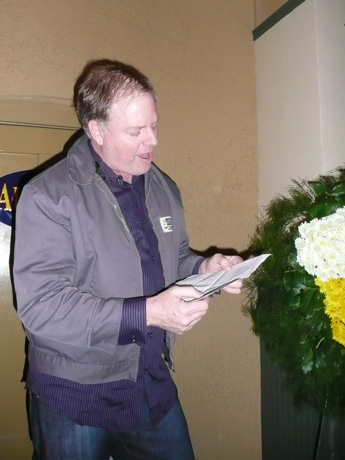
A number of people have expressed regret at not having heard Shaun O’Sullivan’s Ken Kesey-ian rant in tribute to Bill Brand at the memorial the beer community had for him on Sunday at The Trappist in Oakland.

billmemorial-08
I did manage to capture the last third to a half of it on video, so you can at least get a feel for it by clicking on the image below. It was certainly one of the highlights of the day. Enjoy.

 
UPDATE: Justin Crossley from The Brewing Network sent me a video of Shaun’s entire rant that he took using his mobile phone. As Justin notes, the sound quality isn’t great, but at least the whole enchilada has been preserved for posterity. Thanks, Justin.


Filed Under: Events, SF Beer Week Tagged With: Video

The Big 5-0

March 3, 2009 By Jay Brooks

Today is my 50th birthday. Usually it’s me posting embarrassing photos of my friends, so in a spirit of fair play, I put up a gallery of some less than flattering photos of me culled from the last fifty years of my life. Just click on the photo or link below. Join me in a toast to me, this time. Perhaps I’ll see you at my Hawaii 5-0 birthday party this Saturday?

Cheers!

I was only a little older than my son Porter in this picture. That’s my Mom looking on as I tinkle the ivories in an outfit Liberace must have picked out. And what’s with the haircut and those ears. Sheesh, I don’t ever remember having ears like that.


For many more embarrassing photos from my fifty years on the Earth, visit the photo gallery.
 

Filed Under: Uncategorized Tagged With: Uncategorized

Beer Community Memorial For Bill Brand

March 2, 2009 By Jay Brooks

Yesterday afternoon The Trappist in downtown Oakland, California, opened their doors and hearts for a memorial to honor our fallen comrade, beer writer Bill Brand. It was a gathering of the Bay Area beer community to pay our respects to Bill’s memory and tell stories of Bill’s life and how his infectious enthusiasm and passion for good beer intersected in so many of our own lives. I was honored to be asked to MC and got the ball rolling with a toast and some of my own reminiscences and then for a little over an hour, a parade of brewers, writers, and assorted friends and fans stood on a chair and told their personal stories of Bill to the assembled throng, a veritable who’s who of the Bay Area beer scene. We were also honored to have Bill’s wife, Daryl, in the audience, along with Bill’s two daughters, Amanda and Meredith. The event ended up being a fitting and moving tribute to Bill’s life and his involvement with the beer community, as we drank toast after toast with one of Bill’s favorite beers, Anchor Porter. L’Chaim, Bill. You will be missed.

Jim Koch, from Boston Beer, generously sent a wreath of beer flowers that made a terrific centerpiece. Thanks, Jim — it was appreciated by all.

A friend of Bill’s, Mike Condie, put up a display of recent articles celebrating Bill’s life in various local papers along with a couple of framed photos taken at beer events. These and a guest book signed by everyone who attended the memorial were then given to the family.

Chuck, co-owner of The Trappist (at right), served up pints of Anchor Porter, from a keg tapped especially for the event.

Steve Bruce, from the Toronado, and Jen Garris, were early arrivers and managed to secure seats.

Ed Chainey graciously donated a 3L bottle of Chimay Blue.

I started things off with a toast and a story.

The toast.

Last up was Shaun O’Sullivan, who had written a Ken Kesey-ian rant for the occasion.

Bill’s daughter Amanda, wife Daryl and Shaun O’Sullivan after the memorial.


Filed Under: Uncategorized Tagged With: Uncategorized

Beer in Art #17: Peter French’s Anchor Brewery

March 1, 2009 By Jay Brooks

In a few hours I’ll be attending a memorial for the beer community celebrating the life of fellow beer writer and friend Bill Brand at The Trappist in Oakland. Someone discovered in Bill’s archives, a column in which he discloses Anchor Porter to be his favorite beer, so today’s work of art is the entitled the Anchor Brewery, by British artist Peter French. Sadly, it’s not our Anchor Brewery, but one from England, though I’m not entirely sure which one.


As for which Anchor Brewery this is, perhaps one of my Brit friends knows? There was an Anchor Brewery in Southwark owned by Barclay Perkins, and another, Charrington’s Anchor Brewery on Mile End Road, both in north London. According to the book British Breweries by Lynn F. Pearson, Courage also had one in Horsleydown and Charrington had another one in Tower Hamlets. Then there was Bullard & Sons Anchor Brewery in Norwich and yet another in Hull, by Freeman, Gaskell & Sons. The name Anchor, I suspect, was quite common, s there could have been many more for all I know.

Which makes it all the more infuriating that the artist doesn’t tell us which Anchor Brewery he’s painted. C’est la vie. Still, it’s a nice watercolor and you could even buy yourself a print of it at Art.com, among others.

There’s not much more about the artist, Peter French, and even the biography at his own website is blank, though you can see a number of his other works, most of which are watercolors of buildings. You can also see a number of his architectural drawings, cityscapes and landscapes on the Artist’s Web,


Filed Under: Art & Beer

« Previous Page
Next Page »

Find Something

Northern California Breweries

Please consider purchasing my latest book, California Breweries North, available from Amazon, or ask for it at your local bookstore.

Recent Comments

  • Bob Paolino on Beer Birthday: Grant Johnston
  • Gambrinus on Historic Beer Birthday: A.J. Houghton
  • Ernie Dewing on Historic Beer Birthday: Charles William Bergner 
  • Steve 'Pudgy' De Rose on Historic Beer Birthday: Jacob Schmidt
  • Jay Brooks on Beer Birthday: Bill Owens

Recent Posts

  • Beer In Ads #5222: O’Keefe’s Bock Beer April 15, 2026
  • Historic Beer Birthday: George Schmitt April 14, 2026
  • Beer In Ads #5221: Bowler Brothers’ Bock April 14, 2026
  • Historic Beer Birthday: George W. Bashford April 14, 2026
  • Beer In Ads #5220: Hello People! I Am The Centlivre Bock Beer Goat April 13, 2026

BBB Archives

Feedback

Head Quarter
This site is hosted and maintained by H25Q.dev. Any questions or comments for the webmaster can be directed here.