Brookston Beer Bulletin

Jay R. Brooks on Beer

  • Home
  • About
  • Editorial
  • Birthdays
  • Art & Beer

Socialize

  • Dribbble
  • Email
  • Facebook
  • Flickr
  • GitHub
  • Instagram
  • LinkedIn
  • Pinterest
  • RSS
  • Twitter
  • YouTube

Powered by Genesis

Five Guys Not Named Moe

March 27, 2008 By Jay Brooks

The next beer dinner by the Beer Chef will probably sell out faster than any he’s done before. That’s because it will feature five … count ’em, five … of the most well-known brewers of strong and Belgian-style beers in the country. The “Five Guys and a Barrel” beer dinner will feature Rob Tod (from Allagash), Adam Avery (from Avery), Sam Calagione (from Dogfish Head), Tomme Arthur (from the Lost Abbey) and Vinnie Cilurzo (from Russian River Brewing) all together for one special evening of food and beer.

It will be a four-course dinner, plus a toast at the end of the evening, and well worth the $95 price of admission. It will be held at the Cathedral Hill Hotel on Sunday, April 20, 2008, beginning with a reception at 6:30 p.m. Call 415.674.3406 for reservations by April 10. I’ll see you there.


The Menu:


Reception: 7:00 PM

Beer Chef’s Hors D’Oeuvre

Beer: Allagash White and Russian River Blind Pig

Dinner: 7:30 PM

First Course

Citrus Cured Curraun Blue Sea Trout with Accoutrements

Beer: Dogfish Head 90 Minute IPA and Avery The Maharaja

Second Course:

Selection of Artisanal Cheeses with House Made Condiments

Beer: Allagash Interlude and Russian River Supplication

Third Course:

A Study in Duck

Beer: Port Brewing Cuvee de Tomme and Dogfish Head Palo Santo Marron

Fourth Course:

Warm Chocolate Mocha Cake with Blood Orange Sabayon and Fig Syrup

Beer: Avery The Beast Grand Cru and Lost Abbey Older Viscosity

Toast:

Beer: Isabelle Proximus

 
4.20

Dinner with the Brewmasters: Five Guys and a Barrel

Cathedral Hill Hotel, 1101 Van Ness Avenue, San Francisco, California
415.674.3406 [ website ]
 

Filed Under: Uncategorized Tagged With: Uncategorized

Bud Ale Takes Aim At “Experimenters”

March 27, 2008 By Jay Brooks

You’ve probably already heard that come this October, Anheuser-Busch will launch yet another Budweiser line extension, Budweiser Ale, which will be available in 12 oz. bottles and three keg sizes. Whatever happened to their promise to shareholders to focus on the core brands? Anyway, they got label approval on St. Patrick’s Day and, according to the label, it will be 5.1% abv. The price point will reportedly be higher than regular Budweiser. They almost launched this beer (or at least a beer with the same name) just over ten years ago, but changed their minds at the eleventh hour.

So who is a Bud Ale aimed at? Just who does A-B think will be the customer for this product? According to an article in last Friday’s St. Louis Post-Dispatch, the target audience is “what A-B’s marketing department calls ‘experimenters’ — drinkers who bounce around among various beers such as Yuengling, Fat Tire, Hoegaarden and Budweiser.”

“They love beer, they just try a lot of different things,” said Dave Peacock, vice president of marketing at A-B’s domestic beer subsidiary. Although Peacock acknowledged that some craft beer enthusiasts won’t try a Bud-branded ale, the company expects that a sizable portion of the market will have no problem with the concept.

I don’t know who A-B’s marketing department is consulting with but most so-called experimenters I know wouldn’t ordinarily switch between so wide a range of products. Yuengling and Bud drinkers—to my way of thinking—tend to be more loyal to their respective brands. As craft beers go, Fat Tire is about as mainstream a beer as one could find and Hoegaarden, since getting the InBev treatment has itself become fairly mainstream for an import. My point is that these are hardly the brands that experimenters switch back and forth between. Even if they’re meant to just be representative, it’s still not the type of brands beer lovers “experiment” with.

To be honest, I’m not thrilled with term “experimenter,” either. In this context it feels condescending and makes it sound like we’re performing science experiments every time we crack open a beer. Most craft beer enthusiasts do like to sample the many different flavors that brewers come up with, or taste new versions of existing styles. That’s part of the better beer culture, trying new and different things. But when I’m out with friends and just enjoying an evening out, I don’t suddenly start drinking one, and only one kind or brand of beer. The reality, at least for myself (and I’m going to hazard a guess that I’m not alone on this), is that people simply don’t just want one kind of anything, not all the time.

Whenever people I meet discover that I’m involved in the beer business, invariably the question they can’t help but ask is “what’s your favorite beer?” This question just exhausts me—I hate answering it—but I put on my brave face and try to explain why I don’t have one, and why I never will. My wife insists that it’s an “opportunity” to educate someone and I suppose she’s right, but I can’t help but view it as someone asking me if I have a favorite child. I know they mean well, but just asking this question says more about them than they realize. That so many people think there is—or should be—just one favorite anything shows how notions of brand loyalty and marketing have worked their way into our thinking. Do people have a favorite food, one food they’d eat every single meal? Of course not, so how is this any different? That so many people find it a reasonable question to ask about beer tells me that not only do they expect that I will actually have one but also that they see nothing wrong with limiting oneself in the face of such diversity. Corporations whose marketing has created such ideas must be absolutely giddy with their success in planting this idea so deeply into our collective psyche.

There are, of course, dozens of very different beer styles and some are better with this food or that, are better during a particular season or weather, or might just be the right match for whatever else we’re doing or what mood we’re in. It’s as if A-B can’t get past their own self-imposed notion that beer is just one thing, the industrial light, nearly half rice lager version of a pilsner that they call beer. To anyone who’s moved beyond that narrow definition of what beer is, there are many different flavors and no earthly reason to stick to just one. That’s not experimentation, but a common sense approach to making beer a part of a diverse, healthy lifestyle that includes many different breads, cheese, wine and all manner of local and artisanal products.

In today’s world, the type of brand loyalty A-B used to enjoy is an anachronism. But creating brand loyalty through expensive advertising and marketing campaigns is what’s made and kept A-B on top. They outspend every other beer company by a wide margin. If you’re a large, old-style corporation you stick with what’s worked in the past, even if the world is changing around you. It would be quite interesting to see what would happen to their market share if their advertising wasn’t a ubiquitous part of our world.


So what will American Ale actually taste like? There’s no actual style known as American Ale, though there are American-style pale ales, amber ales, brown ales and others. I suspect it probably won’t be an all-malt beer, because that would make it too different from the flagship lager. If I had to guess, I’d say a version of a blonde (or golden) ale or perhaps a cream ale, since those are two of the lightest ale styles. To sell it widely, it’s also likely that any hop character will be greatly restrained, to say the least. That would also be consistent with the Budweiser brand.

So will “experimenters” try Budweiser American Ale? Marlene Coulis, A-B’s VP-consumer strategy and innovation, believes it will bring “new drinkers to the Budweiser brand family.” She adds. “We believe this will positively reflect on Budweiser,” she said. “It’ll help us reach a whole new set of consumers.” That sentiment somewhat contradicts Dave Peacock’s acknowledgment that “some craft beer enthusiasts won’t try a Bud-branded ale.” The “sizable portion of the market” that Peacock believes will be down with the concept don’t seem like they’ll be the “experimenters” that they’re targeting with this launch. More likely they’ll be the same consumers who already drink Budweiser. But if the new Bud Ale really is “a darker, richer beer than Budweiser lager,” as Coulis promises, will current Bud drinkers react positively to the beer having flavor?


Filed Under: Uncategorized Tagged With: Uncategorized

HBO Doing Sam Adams No Favors

March 26, 2008 By Jay Brooks

If you’re as much of a history buff as I am, you’re no doubt aware that HBO is currently airing a seven-part miniseries on John Adams, based on the popular Pulitzer-winning book of the same name by David McCullough. I confess I haven’t watched it yet. It’s building up in my Tivo queue so I can watch it all at once. I also didn’t read the book, though I’ve read McCullough’s 1776 and plenty of other books about the same period in history. I’ve always been fascinated by that time in our history, not least of which because my ancestors came to Pennsylvania from Switzerland in the early 1700s. The son of my original descendant in America—at least on my mother’s side—even fought in the war before returning to take over the family farm near what today is Bernville, Pennsylvania.

Samuel Adams, as portrayed by Danny Huston in the new HBO miniseries John Adams.

But what’s interesting about the new series is not about John Adams, but what is being said about the portrayal of his cousin, Samuel Adams. In my own reading, I recall him being portrayed as totally committed to the cause of revolution—to the point of obsession—and that he worked tirelessly toward that end. My memory is that he was beloved by his friends, though not everyone thought his methods (he was notoriously unwilling to compromise or negotiate) to be the best approach. I believe it was Samuel who got John Hancock, one of the richest men in New England, involved in the revolutionary cause and, eventually, his now more famous cousin John.

When he was chosen to be represent in the first Continental Congress his friends got together and bought him a new suit, because he cared so little for his own appearance. The fact that he later receded into the background of history is a shame, because apparently he was very instrumental in bringing about our independence from England. It’s quite possible that without the Boston Beer Company using him on their beer labels, he might even be less well-known today than he already is. But I’m sure there are many such men whose early efforts have been overshadowed by the politicians who signed the Declaration of Independence and hammered out the Constitution. Those are the people we tend to remember as our founding fathers.

But according to some reviews, Samuel Adams is portrayed as “little more than a common thug whose idea of a good time is watching British dudes get Gatoraded with tar” and as “a leering, ranting, even dangerous fanatic … the very image of the corrupt urban politician.” Another reviewer says Samuel is “a character who seems at once both sinister and benign” and wonders when he’ll “finally give the others a taste of that new ale he’s been raving about?”

But Jeremy A. Stern, a historian writing on the History News Network, tells a different tale. His article, entitled What’s Inaccurate About the New HBO Series on John Adams, points out a number of inaccuracies from the first episode alone, before launching into his Sam Adams defense.

Most egregious, however, is the all-too-typical depiction of Samuel Adams, often a symbol for these mistrusted early years of the Revolution, as a leering, ranting, even dangerous fanatic. Samuel may be the most misunderstood figure of the Revolutionary generation, still generally regarded as a disingenuous, scheming, unprincipled and Machiavellian rabble-rouser, manipulating the mobs and fomenting disorder for sinister purposes — the very image of the corrupt urban politician. It is an image straight from the words of his enemies, fostered and perpetuated by neo-Tory historians such as Hiller Zobel, and so deeply ingrained in the assumptions of scholars that few have even questioned it. (The notable exception is Pauline Maier, whose 1976 article, “Coming to Terms with Samuel Adams,” in the American Historical Review and 1980 book, The Old Revolutionaries: Political lives in the age of Samuel Adams, should have thoroughly discredited these distortions decades ago, had her arguments received the attention they deserve.)

In reality, none other than John Adams, notorious for rarely praising anyone, wrote of his cousin Samuel with frank admiration — except to note his own superior legal knowledge — and was particularly aware of Samuel’s distaste for violence: “[Samuel] Adams is zealous, ardent and keen in the Cause, is always for Softness, and Delicacy, and Prudence where they will do, but is stanch and stiff and strict and rigid and inflexible, in the Cause …. Adams I believe has the most thorough Understanding of Liberty, and her Resources, in the Temper and Character of the People, tho not in the Law and Constitution, as well as the most habitual, radical Love of it, of any of them — as well as the most correct, genteel and artful Pen. He is a Man of refined Policy, stedfast Integrity, exquisite Humanity, genteel Erudition, obliging, engaging Manners, real as well as professed Piety, and a universal good Character, unless it should be admitted that he is too attentive to the Public and not enough so, to himself and his family” (in John Adams’s diary, Dec. 23, 1765).

A portrait of Samuel Adams by one of the most well-known artists of the time, John Singleton Copley, painted around 1774, two years before the events in episode one of the HBO miniseries, when he would have been 50 years of age. Today it hangs in the Boston Museum of Fine Arts.

Certainly, this testimony to Samuel’s ‘gentility’ is absent from the HBO program, which shows him practically as a dockyard thug – and yet at the same time ironically suggests that he is rich, and thus at leisure to pursue his devious wiles. This contradictory claim ignores John’s actual worry about Samuel’s neglect of himself and his own: Samuel was in fact in constant financial trouble, often dependent on the charity of his friends. Praise for Samuel’s character went beyond Massachusetts. In 1819, Thomas Jefferson, who had no reason to polish Samuel’s record, wrote almost as fulsome a tribute: “I can say that he was truly a great man, wise in council, fertile in resources, immoveable in his purposes.”

In the Boston Globe’s own condemnation of the series’ inaccuracies, they also mention a local historical researcher, James Bell, and his blog, Boston 1775. He, too, has posted a raft of inaccuracies not only about the miniseries itself, but specifically about Samuel Adams.

There’s more, too, both by Stern and Bell, but I’ll let you read that at your leisure, if you’re interested. Suffice it to say that historical dramas are almost always riddled with inaccuracies, that’s certainly nothing new. Usually, the excuse is something like “dramatic license” or “pacing” or some other story-driven nonsense. Of course, people watch history shows like this expecting them to be accurate, so I think it’s doubly bad when they’re not. But accepting that it’s just entertainment is harder to justify when you realize that HBO sent out leaflets to 10,000 teachers with “John Adams” agitprop urging them to show it to their classes. Of course, history textbooks are already riddled with mistakes, inaccuracies and propaganda, so maybe it doesn’t matter (for a wonderful book on this subject, see James W. Loewen’s Lies My Teacher Told Me). But it still seems weird that a Pulitzer Prize winning novel would be so compromised, but such is the way of the entertainment business. I’m thirsty now. Who wants to join me for a Samuel Adams Boston Lager.


Filed Under: Uncategorized Tagged With: Uncategorized

Pubs Across Britain Ban Politician

March 26, 2008 By Jay Brooks

Hilarious. I love this story of British publicans taking matters into their own hands. It seems the Chancellor of the Exchequer, Alistair Darling, placed a 4p increase on the price of a pint, at a time when a pint already costs 25p more than it did one month ago, plus has “pledged to raise duty on alcohol by 2% above inflation for the next four years.” His budget is seen as only helping supermarket chains, whose share of the beer market has increased due to cheap pricing, which many have termed “pretty irresponsible alcohol retailing.” Pubs had already been losing ground to retail pricing wars and had asked for a freeze on prices to hep save pubs. Apparently, Darling was deaf to their concerns and now they’ve responded by banning him from every pub in England (or at least in all the participating ones—which after one day numbers 170). Obviously, the actual banning will do little to change things, but presumably the attendant publicity might.

They’ve created a poster which they’re encouraging pub owners to display in the window of their establishment featuring Darling behind bars and the word BARRED in large block letters.

It’s even spread to Brussels, where at least one pub—O’Farrells—has also put the poster in their front window. UK Independence Party head Nigel Farage noticed while there earlier today, about which he is quoted.

“Every politician who voted for the smoking ban and an increase in alcohol taxes at this difficult time for our pubs should be banned,” said Farage.

“However, most of our politicians are so detached from reality that they probably don’t visit pubs.”

They’ve also set up a group about the ban on Facebook.

I can think of plenty of our own politicians we should do likewise with.


This is the poster is available for download.
 

Filed Under: Uncategorized Tagged With: Uncategorized

Montana Microbrews

March 25, 2008 By Jay Brooks

Here’s a fun project. Admittedly, it wouldn’t work very well in a lot of places, but it’s ideal for Montana. Journalist Bill Schneider has set out to visit and write about every brewery in Montana. His column begins today in the New West, which styles itself as the “Voice of the Rocky Mountains.” His first stop is Lewis & Clark Brewing in Helena and he also provides a good overview of his plan. The fact that there are only around seventeen breweries in the state helps, but it’s still a fun and worthwhile endeavor.


Filed Under: Uncategorized Tagged With: Uncategorized

Portland Spring Beer Awards

March 24, 2008 By Jay Brooks

On Saturday the Portland Spring Beer & Wine Festival took place at the Oregon Convention Center. Awards were given in eight categories, with a gold and silver awarded in each. The results are listed below:

Amber, Brown & Red
Gold – Pelican Pub & Brewery Anglers Amber
Silver – Lost Coast Brewery Downtown Brown

Belgian-Style
Gold – North Coast Brewing PranQster
Silver – Widmer Belgian Golden Ale

Double IPA and other Strong Ales
Gold – Stone Brewing Ruination IPA
Silver – Lang Creek Brewing Zeppelin Imperial Ale

Golden & Pale Ales
Gold – Stone Brewing Pale Ale
Silver – Pyramid Curve Ball Blond Ale

IPA
Gold – Laurelwood Public House & Brewery Organic Green Elephant IPA
Silver – Henry Weinhard’s IPA

Lager
Gold – Pabst Blue Ribbon
Silver – Kona Longboard Lager

Porter & Stout
Gold – Stone Brewing Imperial Stout
Silver – Deschutes Obsidian Stout

Wheat
Gold – Deschutes Wolf Mountain Wit
Silver – Blue Moon Belgian White


Filed Under: Uncategorized Tagged With: Uncategorized

Beer For Easter

March 23, 2008 By Jay Brooks

easter
On St. Patrick’s Day a few years ago I wrote about how many American holidays have been ruined by by overzealous marketing campaigns by the big alcohol companies, suggesting that there were very few not tainted. Well, Easter is one of those that has few beer associations. Less than a couple dozen breweries, most from Europe, make a special beer for Easter.

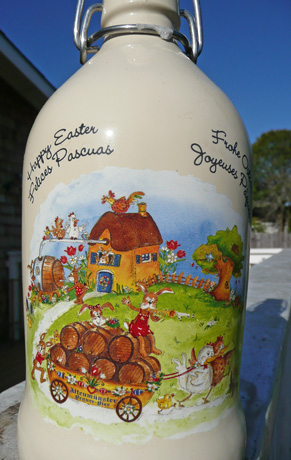
sailer-jubelfest

Given our track record for trying to ban labels for Christmas beers because they might also appeal to kids, it’s hardly surprising that so few of these beers make it to our shores. I’m frankly somewhat surprised this old bottle of Jubelfest from the now defunckt Privatbrauerei Franz Joseph Sailer in Germany I pulled off of my shelf managed to get label approval. Those are cartoons of bunnies on the label for chrissakes, children might pick one of these up and — gasp — look at it.

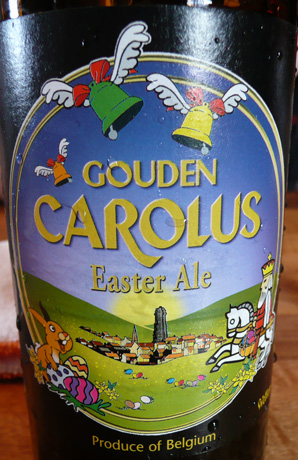
kingtaste08-08

Goudon Carolus Easter Ale, a Belgian beer that I sampled at the annual Keene Tasting in Seattlefive years ago. This one, so far as I know, has not been imported to the U.S. (at least not with this label), and I suspect if they even tried it would make the average neo-prohibitionist’s head spin. You can at least buy the beer in Ontario, but because of the asinine regulation that “graphics that might be appealing to children” are forbidden, with a censorship sticker covering the bunny in the lower left-hand corner. You can read all about it by Greg Clow from Toronto’s beer, beats & bites post entitled LCBO: Let’s Censor Bunnies, OK? . I guess there’s some consolation in knowing we’re not the only idiots when it comes to these things.

Filed Under: Beers, Editorial, Just For Fun, Politics & Law Tagged With: Holidays

Flashes of Green Food & Beer

March 22, 2008 By Jay Brooks

Last night, the Beer Chef, Bruce Paton, held his latest beer dinner with Chuck Silva and the beers from Green Flash Brewing near San Diego. With some new Green Flash beers to try, and some wonderful food, it was another terrific evening of beer and food.

The beer chef, Bruce Paton, with Chuck Silva, from Green Flash Brewing.


For more photos from the Green Flash beer dinner, visit the photo gallery.
 

Filed Under: Uncategorized Tagged With: Uncategorized

Brewing Is the World’s Oldest Biotechnology

March 21, 2008 By Jay Brooks

This month’s online version of The Scientist magazine has an interesting historical piece entitled Beer, and the Biochemists Behind It. Despite beginning with the now discredited Franklin beer quote, the article is a nice overview of brewing science historically and talks about Charlie Bamforth’s advocacy on behalf of beer, too. I love the assertion that because of beer’s 8,000-year heritage, it may be “quite possibly the world’s oldest biotechnology.” I’d like to see brewers start saying, when asked what they do for a living, respond casually, “oh, I’m in biotech.”


Filed Under: Uncategorized Tagged With: Uncategorized

Sierra Club Acknowledges Green Breweries

March 20, 2008 By Jay Brooks

The Green Life, which is the official blog of the Sierra Club, did a long post on St. Patrick’s Day about the other real green beer, organic beer, along with a number of breweries whose sustainable practices they applauded. New Belgium was mentioned, of course, and so was Sierra Nevada, Great Lakes, Brooklyn and Orlio. There’s also a number of comments listing even more green breweries that people knew about. It’s interesting to note that people interested enough to read the Sierra Club’s daily blog were so aware of so many breweries whose operations were green.


Filed Under: Uncategorized Tagged With: Uncategorized

« Previous Page
Next Page »

Find Something

Northern California Breweries

Please consider purchasing my latest book, California Breweries North, available from Amazon, or ask for it at your local bookstore.

Recent Comments

  • Bob Paolino on Beer Birthday: Grant Johnston
  • Gambrinus on Historic Beer Birthday: A.J. Houghton
  • Ernie Dewing on Historic Beer Birthday: Charles William Bergner 
  • Steve 'Pudgy' De Rose on Historic Beer Birthday: Jacob Schmidt
  • Jay Brooks on Beer Birthday: Bill Owens

Recent Posts

  • Beer In Ads #5228: All Together For Newark April 21, 2026
  • Beer Birthday: Steve Parkes April 21, 2026
  • Beer In Ads #5227: It’s Here! Bock Beer By Bosch April 20, 2026
  • Beer Birthday: Drew Beechum April 20, 2026
  • Beer Birthday: Des De Moor April 20, 2026

BBB Archives

Feedback

Head Quarter
This site is hosted and maintained by H25Q.dev. Any questions or comments for the webmaster can be directed here.