Brookston Beer Bulletin

Jay R. Brooks on Beer

  • Home
  • About
  • Editorial
  • Birthdays
  • Art & Beer

Socialize

  • Dribbble
  • Email
  • Facebook
  • Flickr
  • GitHub
  • Instagram
  • LinkedIn
  • Pinterest
  • RSS
  • Twitter
  • YouTube

Powered by Genesis

Ordering Alcohol Online: More Deceptive Shenanigans

August 15, 2006 By Jay Brooks

A few months ago, the NBWA in response to an odd query from the Surgeon General tried to blame underage drinking on the Internet in an effort to both seem caring and also continue to fight interstate alcohol shipping as the bogeyman for the 21st Century. To any trade organization who represents monopoly interests, of course, any hint of legislative change that threatens that control will be a bogeyman. In March it was beer distributors, now it’s wine wholesalers in the form of the Wine & Spirits Wholesalers of America (WSWA) who are attempting to further their own agenda with misleading information, at best, and downright falsehoods, at worst.

They’ve released a study that they sponsored that concluded exactly what they wanted it to. How convenient. How manipulative. Of course they call the survey a “landmark.” I call it what it really is: bullshit. Before you dismiss my assessment out of hand, read John Stauber and Sheldon Rampton’s wonderful books Toxic Sludge is Good For You! and Trust Us, We’re Experts! Both go a long way toward explaining how seemingly scientific and unbiased studies are in reality propaganda created by a very sophisticated public relations industry.

The WSWA, like the NBWA, has one function, and one function only. And it isn’t trumped up concerns about our nation’s youth. It’s sole purpose is to advance the agenda of wine wholesalers and distributors. Almost all of these wholesalers enjoy very profitable monopolies that are threatened by direct sales over the Internet. So that’s the bogeyman. It will corrupt our children. It’s always about the children. It’s never about money or business. My child needs their protection. Hooray. I no longer have to worry because the WSWA is on the case. It’s easy, really. All they have to do is make up some statistics and scare parents who are too busy to think for themselves.

Look at the language they employ. The study “confirmed” findings, it didn’t come to any conclusions based on raw data. Instead it went looking to “confirm” that which supported a predetermined conclusion. Let’s examine their so-called conclusions:

  1. 3.1 million minors (12%) ages 14-20 report having a friend who has ordered alcohol online.
  2. Wow, they have a friend. And that friend has a friend, and so on. That’s how urban legends begin … I have a friend who has a friend and …. This is a statistic that says absolutely nothing. First of all, even if accurate there’s no way to know if these 3.1 million friends are all different or all the same. Perhaps there’s only one guy but everybody knows him. That’s just as plausible as trying to conclude 12% of minors are buying alcohol online. Sure, they don’t come out and say that, but that’s clearly the inference.

  3. Two percent (551,000) of those ages 14-20 say they personally have bought alcohol online.
  4. Since when did 2% of anything become significant. Again, let’s assume that the number is correct and no bragging occurred on the part of those surveyed. Should we restrict adult’s access to legal products because some small percentage of the population will abuse them? How does that number compare to other methods minors use to get alcohol? I’m willing to bet fake IDs and over-21 friends far exceed that number. Can we really stop 100% of minors getting their hands on alcohol? Should we even try? Because every barrier we put up also makes it more it more difficult for adults, too. Kids are kids. They’ll try to do whatever they can to grow up too quickly. I did it. You did it. We’re not going to stop human nature. The more we prohibit something, the more attractive it becomes. So what if these kids bought alcohol online. It’s not the Internet’s fault. It’s the same argument the gun lobby uses so effectively. Guns don’t kill people, people do. The Internet is just a vehicle. You don’t restrict access to it for everyone because a few abuse it. Besides, where were these kids parents? What’s their story? Without that information, raw numbers are meaningless.

  5. As exposure and awareness of buying alcohol online increase, even more minors can be expected to purchase wine, beer and liquor online. This is consistent with a 2003 National Academy of Sciences report which confirmed kids are buying alcohol online and that increasing use of the Internet will make this problem worse in the future.
  6. Again, this is not a fact but a flimsy extrapolation based on questionable (and uncited) information.

  7. Nearly one in 10 (9%) of those ages 14-20 have visited a site that sells alcohol.
  8. So what? It’s not illegal for minors to read about alcohol, is it? Minors are allowed in grocery stores that sell alcohol without being corrupted. What’s the difference? And it’s curious that while 9% have visited an alcohol website, 12% have a friend who’ve bought online, while only 2% have actually done so. Is it just me, or do those figures not quite add up.

  9. One-third – nearly 8.9 million ages 14-20 nationwide – are open to the possibility of an online alcohol purchase before age 21.
  10. When I was 14-20, I would have been open to it, too. When this generation of 14-20-years olds are my age, the next crop of 14-20-year olds will almost certainly also be open to it. So what? It’s meaningless hyperbole.

  11. Seventy-five percent say their parents aren’t able to control what they do on the Internet.
  12. Is that a failure of the internet or parents? We have to realize as a society that we can’t protect our kids from everything. We have to raise them to deal with things on their own. Parents can’t really control their kids at school, either, but nobody’s suggesting we should do away with the public school system and home school everybody.

  13. Among those ages 14-20 who have tried alcohol, 75% tried liquor, followed by wine at 64%, beer at 60% and wine coolers at 55%.
  14. Another head scratcher. I’m not even sure what this adds to the picture. I’m not sure why it’s included here.

Happily, I’m not the only one who thinks this false concern for children is anything but a thinly veiled attempt to maintain the status quo. A grassroots organization known as Free the Grapes has released a counter-statement also calling into question the tactics of the WSWA.

Here’s the bulk of their statement, which was titled “Majority of States Allow Regulated Wine Direct Shipping, But Wine Wholesalers Continue ‘Chicken Little’ Strategy“:

The wine wholesaler cartel today trotted out a tired argument already dismissed by the U.S. Supreme Court, the Federal Trade Commission, and state alcohol regulators.

The intent of the Wine & Spirits Wholesalers of America’s “survey” on underage access is to deflect attention from their real motivation: economic protectionism. Over the past 30 years, the wholesale cartel has consolidated from 11,000 wholesalers to an oligopoly of two or three per state. The wholesalers, not consumers, have been deciding which wines are available. But now, the courts, Federal Trade Commission, and state legislatures are supporting consumer choice and responding with reasonable regulations and controls.

While the WSWA’s press release quoted that the “survey” results showed a “dangerous trend,” USA TODAY was unconvinced. The newspaper reported yesterday that “It’s unclear how many teens were buying alcohol online before the court’s ruling, but the TRU survey suggests such purchases are rare.”

Here are the facts:

  • Fact: Thirty-three states now allow interstate, winery-to-consumer direct shipments, and several more are in the process of creating the legal mechanisms to do so. No state has ever repealed pro direct shipping legislation based on non-compliance, including underage access. See www.wineinstitute.org for a list of the state laws.
  • Fact: The Federal Trade Commission rebuked the underage access argument in its survey of alcohol regulators in 11 states that allow direct shipments, concluding that states with procedural safeguards against shipments to minors report “few or no problems.” Click the following link to read a summary of the FTC’s July 2003 study, “Possible Anticompetitive Barriers to E-commerce: Wine”: http://www.ftc.gov/opa/2003/07/wine.htm
  • Fact: The U.S. Supreme Court’s 2005 ruling in Granholm v. Heald dismissed the underage access red herring, and favored a level playing field and consumer choice in wine via wineries and retailers
  • Fact: The wine industry supports the enforcement mechanisms available to states in the event of an alleged illegal shipment. The “21st Amendment Enforcement Act” was supported by the WSWA and signed into law in October 2000, allowing state Attorneys General to access federal courts to pursue litigation for alleged violations of state law regulating alcohol shipping. No winery or retailer has ever been prosecuted under the 21st Amendment Enforcement Act.

Additionally, alleged violations of state laws governing alcohol shipments can be reported by any state to the Trade & Tax Bureau for investigation. Penalties for infractions can include revocation of a winery’s basic permit to produce wine. Finally, the wine industry’s model direct shipping bill for wine stipulates that the winery or retailer holding a direct shipping license has consented to the jurisdiction of the state issuing the license, and the state’s courts concerning enforcement of the law. A copy of the model bill is located at www.freethegrapes.org.

“Especially now that the courts and capitols support consumer choice in wine, and many more enforcement tools are available, states should be working to ensure that online sellers are complying with all laws,” said Jeremy Benson, executive director, Free the Grapes! “Common sense and the actual experience of state regulators demonstrate that direct shipping is not the common means for illegal youth access to purchase wine, beer or spirits. Underage access is a serious issue, but it won’t be solved by special interest surveys geared to protect their turf by targeting a legal sales channel for adults,” he added.

The Wine Institute also posted a statement questioning the WSWA’s press release and survey findings.

The Wine and Spirits Wholesalers also have another website up called Point. Click. Drink. that is even more egregiously misleading than it’s main website — if you can believe that — which purports to educate young people. Unfortuntately it’s riddled with misinformation and outright fabrications, especially the Fact vs. Fiction section, which is almost entirely creative fiction. I considered going over their so-called facts point by point, but Free the Grapes put up their own counter to it: Point,Click, Think! There’s some great information there. For example, there’s this gem from USA Today, who wasn’t rolling over like NBC as far back as 1999, when they wrote:

“The [wholesaler] industry’s tactics are a civics lesson in how scare stories, lobbying and political money can be used to limit consumer choice through special-interest protections.”

— USA TODAY editorial, July 7, 1999

The WSWA even got NBC to bite on their press release and spread some nonsensical fears in a story entitled “Who is minding the Internet liquor store?” It’s by “Chief consumer correspondent” — whatever that means — Lea Thompson and it tells the tale of some kids who bought a bottle of absinthe online after watching the movie Eurotrip. Like much on the evening news, it spreads fear and highlights breakdowns in security all along the process. But it concludes, of course, by accepting the WSWA survey without question even dismissing the fact that the survey was commissioned by the WSWA by saying simply that “clearly there is a problem.” Not once is it suggested that the problem is with the security systems or other places the process breaks down. It was too easy to order online and the delivery company just gave the alcohol to a fifteen-year old. It didn’t occur to them to examine the breakdown in protocol by the delivery service. They got a free pass. NBC didn’t even mention it as a part of the problem. Yikes. Now that’s hard-hitting journalism.

But even the FTC examined E-commerce and concluded that online alcohol sales “Lowers Prices, Increases Choices in Wine Market.” The report, which was approved 5-0, refutes much, if not all, of the WSWA and NBWA’s ridiculous assertions that not banning the sales of alcohol online will lead to an epidemic of underage drinking. This time around the accusations were leveled by the wine wholesalers but much of it applies similarly to the beer industry. With so much money at stake, this issue isn’t going away anytime soon. The monopolies that constitute our alcohol distributors and wholesalers will defend those monopolies by any means necessary. Sometimes maintaining the status quo does make sense, as it does in certain aspects of the three-tier system, but other times it is clearly bad for consumers. This is one of those times. Direct shipping of alcohol from manufacturers or retailers interstate and intrastate should be legal in every state. That it’s not already shows how powerful the lobbying arms of alcohol distributors and wholesalers really are and how effective propaganda can be.
Filed Under: News Tagged With: Business, Health & Beer, National, Press Release

Shangy’s Sues Goliath InBev

August 14, 2006 By Jay Brooks

Emmaus, Pennsylvania is a pint-sized town (of just over 11,000) a few miles south of Allentown and about 45 miles from Philadelphia. It’s a seemingly unlikely place for a beer store of this magnitude, but there it is. Tucked away on Main Street in Emmaus is Shangy’s, one of the best beer places in the state. (Side note: Emmaus is also the home of John Hansell’s fine Malt Advocate magazine.)

Started in 1980 by the Hadian family, their son Nima is now at the helm and the 35,000 square foot store carries over 3,000 brands, about double what the average BevMo did when I was there and three to four times the average BevMo store now. And Pennsylvania is a case state which, for those of you unfamiliar with that curious institution, means you can only buy beer by the case. This makes getting customers to take a chance on a new beer very difficult, but Pennsylvania’s liquor laws and state agencies seem to care very little about how its citizens are affected. I grew up there and I can tell you the system is messed up beyond belief and should be overhauled. Every state has its own set of peculiarities when it comes to alcohol laws, but Dutch Wonderland (my personal name for the state) got more than its fair share.

But Shangy’s managed to prosper in that environment for a number of reasons, not least of which is that they honestly care about the beer they’re selling. The word “Shangy,” by the way means “happy” in Nima’s native Farsi language, and it is his father’s nickname.
 

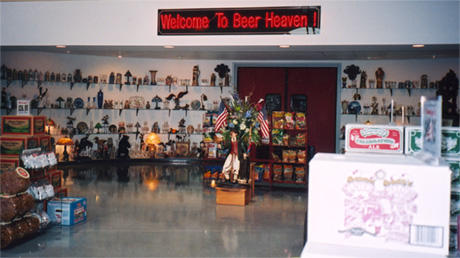
Inside Shangy’s during a trip I took there several years ago during a trip home.

Aisles and aisles of cases of beer at Shangy’s.
 

For the past decade, one of the many beers Shangy’s has done well promoting is Hoegaarden, a wit or white beer created by Pierre Celis in the 1960s when he single-handedly resurrected the style. Over time they have become the largest Hoegaarden wholesaler nationwide, moving as many 2,000 kegs each month. Hoegaarden is owned now by InBev, the world’s largest beer company (by volume of beer sold), with such brands as Beck’s, Brahma, Franziskaner, Labatt’s, Stella Artois, St. Pauli Girl, among more then 75 other local and national brands. They recently sold the Rolling Rock brand to Anheuser-Busch. Since InBev was formed by a merger in 2004, they have enjoyed a 14% share of the total world beer market.


In 1998, Shangy’s settled a lawsuit that “affirmed that Shangy’s was the exclusive wholesale distributor of Labatt products in 17 Pennsylvania counties,” which at the time included Hoegaarden. But with the 2004 merger, Labatt became an InBev subsidiary. Now Shangy’s contends that InBev, who recently gave distribution rights to another of its brands, Stella Artois, to a different beer distributor thus violating the eight-year old agreement. Shangy’s filed a lawsuit in Philadelphia this month seeking monetary damages along with a “court order compelling InBev to abide by the terms of the 1998 agreement.”

As we all know but few will say, “Hadian, who takes glee in ridiculing the mass-market beers, warns that consolidation will ultimately reduce the number of specialty brews on the market. Why? Because wholesalers will inevitably concentrate on selling mass-market, high-volume brands and neglect the craft brews, reducing their chances of survival, he says.”

I’m sure we’ll hear much more about this case as it proceeds. For now, there are more details on this story in an AP Story and a more local take by Lehigh Valley’s The Morning Call.

Filed Under: News Tagged With: Business, Eastern States, Law

Stone Brewing in SD Business Journal

August 13, 2006 By Jay Brooks

There was in interesting profile of Stone Brewing in last week’s San Diego Business Journal. The article begins by suggesting that “San Diego has earned the distinction of being one of the top craft beer capitals in the country” which is correct, but it’s still nice to see it acknowledged by the business press.

Filed Under: Uncategorized Tagged With: Business, California, Mainstream Coverage, Southern California

Sapporo to Buy Canadian Sleeman

August 12, 2006 By Jay Brooks

Sleeman Breweries, of course, has had a for sale sign around it since May so this announcement came as no surprise. Only who had an element of surprise to it. Late Friday, the Japanese company Sapporo announced it has offered $17.50 a share in cash, which works out to $400 million (though some reports say $300 million), for the purchase of Sleeman Breweries.

If the sale is approved and completed, the three largest Canadian breweries will be owned by foreign companies. Molson Coors in number one and number two, Labatt’s, is owned by the Belgian company InBev. Sleeman is currently in the number three spot.


John Sleeman, CEO of Sleeman Breweries, holding a bottle of Trois Pistoles from Unibroue, the best brewery in Sleeman’s portfolio.

Filed Under: News Tagged With: Asia, Business, Canada

The Next Big Little Niche

August 8, 2006 By Jay Brooks

Well I’ve known it’s been coming for a while now and have been sitting on it, because I’ve been researching a story about gluten-free beers. Today, Miller’s BrewBlog broke the story that Anheuser-Busch is readying a gluten-free beer for the market.

From the BrewBlog:

The brewer [A-B] on July 31 filed a brand label registration with the state of Missouri for a product called Red Bridge Sorghum beer. A-B previously had filed a trademark application with the U.S. Patent and Trademark Office.

A-B appears intent on jumping on a small bandwagon of brewers making beer with sorghum instead of barley. The dominant industry leader already has demonstrated its commitment to attacking tiny niches by rolling out organic beers.

Beers made with sorghum can be consumed by people with a condition called celiac disease. Exposure to gluten — a protein found in barley — triggers digestive problems in people with the disease.

Several craft brewers currently produce gluten-free beers. Unfortunately, because of ridiculously puritanical labeling restrictions that forbid any health claims on alcohol labels along with the fact the FDA has been criminally slow to adopt any standard of what gluten-free means (Europe by contrast has had a standard in place for years), they can’t really be labeled as gluten-free. Here’s a sample of gluten-free beers currently available from U.S. craft brewers:

  • Dragon’s Gold, from Bard’s Tale Beer
  • Hooligan Pale Ale, from Widmer Brothers Brewing
  • New Grist, from Lakefront Brewery
  • Passover Honey Beer, from Ramapo Valley Brewery

In addition, brewers in Australia, Belgium, France, Italy and the United Kingdom are all producing gluten-free beers. The gluten-free seminar at this year’s Craft Brewers Conference was surprisingly well-attended. When I queried several brewers there, I got the same response from all of them. “We get a lot of customers asking about this.”

My interest in these beers comes originally from my son, Porter, who is autistic. In reading about Autism Spectrum Disorder, I’ve discovered that a common symptom among the constellation of autistic indicators is stomach problems and often times a gluten-free diet helps immensely. Like much about autism, scientists and doctors aren’t exactly sure why this happens but I’m glad so far Porter doesn’t show signs of having this problem. But there are also millions of Celiac sufferers worldwide, and the number is growing. People with celiac disease, likewise, must also abstain from gluten, a part of most grains like barley and wheat. One out of every 133 people in the U.S. has celiac disease.

Here’s a short description of celiac disease from the Celiac Disease Foundation:

A lifelong autoimmune intestinal disorder, found in individuals who are genetically susceptible. Damage to the mucosal surface of the small intestine is caused by an immunologically toxic reaction to the ingestion of gluten and interferes with the absorption of nutrients. Celiac Disease (CD) is unique in that a specific food component, gluten, has been identified as the trigger. Gluten is the common name for the offending proteins in specific cereal grains that are harmful to persons with CD. These proteins are found in all forms of wheat (including durum, semolina, spelt, kamut, einkorn, and faro), and related grains, rye, barley, and triticale and must be eliminated.

It seems obvious to me that this is the next big small niche beer. I know that last statement was oxymoronic, but hear me out. Gluten-free beers aren’t going to be as popular as light beer or even porters, but with 1-in-133 Americans with celiac disease combined with thousands, perhaps millions, of autistic kids on gluten-free diets who will begin reaching the age of majority in the coming years, and you’ve got a sizable little market that’s likely to emerge. Now that A-B is entering this market, more attention will surely be focused on it. And A-B, regardless of anything else you can say about them, doesn’t take any action without first having thoroughly researched, tested and studied the market. So look for many more gluten-free beers in the market soon.

Filed Under: Beers, News Tagged With: Business, National

Foster’s Closing Ranks Again

August 8, 2006 By Jay Brooks

Back in June, Foster’s announced it was pulling out of its last remaining brewery in China. Now they’re also leaving India and Vietnam. Reportedly, Foster’s wants to concentrate on their domestic beer market and on selling wine.
 

Vietnam

The Vietnam operations are being sold to Asia Pacific Breweries. According to their press release, APB “will be purchasing the Vietnam assets of the Foster’s Group for $105 million. This transaction includes the rights to brew, market and distribute Foster’s Lager, Biere Larue, BGI, Flag and Song Han, in Vietnam.” This acquisition brings APB’s total ownershio to 29 breweries in ten countries.
 

India

Foster’s India is being sold to SABMiller for $120 million.

From the SABMiller press release:

Foster’s India currently operates one brewery based in Aurangabad in the state of Maharashtra with a licenced annual capacity of 350,000 hectolitres. The company produces, distributes and supports Foster’s Lager, Amberro Mild and Amberro Strong beer brands in the Indian market. In the year ended 30 June 2006, total beer sales were 236,000 hectolitres (2005: 209,000 hl) with Foster’s Lager representing 88% of total production and sales (2005: 85%).

India is the third largest market for the Foster’s brand globally and it has achieved a CAGR of 13% since operations commenced in 1998. It has a presence in 19 Indian states and has a substantial share of the mild beer segment in the strategic state of Maharashtra.

SABMiller India will look to extend Foster’s Lager nationally through its network of ten breweries and seek significant cost benefits from brewing and distributing the brand locally. The Aurangabad brewery will also provide additional capacity for SABMiller’s presence in Maharashtra as well as a platform for access to the Mumbai market.

SABMiller India is the subcontinent’s second largest brewer. Its brand portfolio includes Royal Challenge, Haywards 5000, Castle and the recently launched Haywards Black, India’s first stout beer.

The Foster’s Brand

First brewed in 1888 by the Foster brothers in Melbourne, Australia, Foster’s Lager is one of the world’s best beers. As one of only a handful of truly global beer brands, Foster’s in now available in over 150 countries. Foster’s is one of the fastest growing international premium beer brands in the world and has enjoyed international growth of 40% since 1997. Foster’s is brewed in 12 countries, at 17 locations with over 100 million cases of Foster’s sold annually.

Filed Under: News Tagged With: Asia, Business, Press Release

Beer Attacks Continue

August 6, 2006 By Jay Brooks

Less than two weeks after the newest Gallup poll showed that beer is indeed the most popular alcoholic beverage reversing last year’s poll which suggested wine was more popular, another attack on beer took place. This despite the fact that beer outsells wine 4-to-1, and has for decades if not longer. Today’s Pittsburgh Post-Gazette has a story in the business section entitled Beer sales falling flat as wine, other beverages grow in popularity. Business writer Len Boselovic begins by offering that if the term “Sophisticated Beer Drinker” “leaves an oxymoronic aftertaste on your palate, you have an idea of what beer makers are up against.” That’s his knee-slapping way of acknowledging that his paper along with almost every mainstream media source in the country have been doing an embarrassingly bad job of educating their readers about beer. For some reason his little joke just leaves a bad taste in my mouth. It’s like he’s saying “ha ha, we suck at covering beer and now breweries are having trouble getting people to take beer seriously. Isn’t that funny?” Not when it’s partly your fault, you sanctimonious halfwit. Yeah, I know I lack perspective on this, but I’m just sick to death of the way the media treats beer so badly time and time again and then wonders why it has a poor image.

For support for the piece’s title, Boselovic offers the following:

U.S. beer shipments last year were flatter than a stale ale, falling 0.1 percent according to the Beer Institute. The industry group says shipments to the U.S. market — which accounted for about 86 percent of overall business — declined 2.2 percent to 178.8 million barrels. The drop was offset by a 7.2 percent increase in imports and an 8 percent increase in exports.

Meanwhile, the Wine Institute reports wine consumption grew 5.2 percent in 2005 while the Distilled Spirits Council says sales rose 2.9 percent based on the volume of alcohol sold.

But Boselovic barely mentions that craft beer has shown positive growth near 10% for the past two years and appears to be on track to threepeat this year.

The article also offers the following chart:


In it the author makes the blanket statement that “brewers have been losing customers in recent years,” by which he means the big brewers. Craft brewers have not only NOT been losing customers but have been slowly building their business over the last decade. But to mainstream media, especially the bigger outlets covering national or regional areas, the craft brewers are hardly ever on their radar at all. Fourteen hundred individual brewers in countless markets making 65+ different styles of beer and they hardly even rate a mention and are not even taken into account when discussing the beer business as a whole. But notice how every little boutique winery merits a full page profile as the next “it” business and it’s no wonder I’m pulling my hair out.

Apparently so-called “marketing experts” believe the cause of big beer’s decline is “changing consumer tastes” and they say “[d]rinkers are more sophisticated, willing to try something new, and looking for different beverages that are appropriate for different occasions.” Yet the craft beer segment of the industry is literally filled with complex, sophisticated beers in dozens of distinct styles perfect for the ideal circumstance, weather, food, event, holiday, etc. But the mainstream media repeatedly ignores this fact and turns instead to wine and spirits whenever the talk turns to sophistication. So it’s no wonder people can’t connect the two.

Auburn University professor Michael R. Solomon, who specializes in “consumer behavior” trots out this old saw. “When you drink a lot of wine, you’re refined. When you drink a lot of beer, you’re just a beer drinker.” And while he correctly points out that this problem is a perceptual one, he fails to notice that it was the media itself that helped to create this perception and continues to perpetuate it today.

While it’s certainly true that advertising by the major beer companies has done much of the damage to the perception of beer over many decades, the media has certainly been in collusion through the way they’ve ignored craft beer while embracing wine. So it’s really no surprise when this article does in fact suggest that it’s beer advertising that’s at fault and it’s only now that the big breweries are realizing what craft brewers have know for twenty-five years, that consumers “don’t want to be seen as a guzzler, a dumb guy, six-pack drinker. They want to be seen as a connoisseur.”

Jim Forrest, VP of Synovate, a market research firm, states that wine and distilled spirits producers have done a good job of fashioning strategies around occasions to consume their products.” He even mentions that “craft and import beer producers have done the same” yet neither he nor the article’s author mention that the media has all but ignored these “strategies around occasions to consume” with regard to beer while scarcely a holiday goes by without being inundated with stories on the right wine pairing or spirit needed to properly celebrate.

They all show remarkable restraint at ignoring their own role in the poor perception beer has after decades of neglect by everyone but a small, loyal cadre of connoisseurs.

Toward the end of the article, things turn decidedly rife with the unintentionally funny. To wit:

The industry hopes to capitalize on more discriminating palates through its Here’s To Beer campaign, an initiative spearheaded largely by Anheuser-Busch. Advertising features Spike Lee and other famous people describing who they’d like to share a beer with.

The Here’s to Beer campaign was, of course, solely created by Anheuser-Busch, not “spearheaded largely by” them as the article incorrectly claims. Originally, the trade organization The Beer Institute was involved but removed their support right after the initial ad ran on Super Bowl Sunday. The other brewers A-B approached about participating in the Here’s to Beer campaign all famously declined.

Judy Ramberg of Iconoculture has the following to say:

Anheuser-Busch realizes it has to grow by increasing its portfolio of specialty products, not by getting more people to drink its flagship brands. The danger is that the specialty brands will lose some of their appeal if drinkers realize who’s making them. “If beer drinkers find out they’re involved in some of these craft beers, they’ll lose all of their cachet,” says Ms. Ramberg, a Heineken drinker.

Well Judy, they’re taking your advice with many of their products, most notably their new organic beer, Wild Hop Lager, which fails to disclose it’s an A-B product on the label. But that’s also a problem for A-B since back in 1997 they stated publicly that “beer drinkers have the right to know who really brews their beer. We, along with many other traditional brewers and beer enthusiasts, object to those who mislead consumers by marketing their beers as ‘craft brewed,’ when in fact their beers are made in large breweries.” Oh, and Judy, Heineken is a terrible choice for a favorite beer. I don’t know why you volunteered that information or why the author included it, perhaps it was to show you were no shill for the domestic beer companies. People who like it generally — at least in my opinion — prefer the illusion of sophistication without going through the long, drawn-out process of actually being sophisticated enough to know how bad it is. So that’s at least in part why I have a hard time accepting your version of reality. But it’s interesting to note that their marketing campaign has worked on even a “marketing expert.”

On the other hand:

Mr. Forrest disagrees, arguing many drinkers don’t connect the dots. He says many people in the industry don’t realize Blue Moon Belgian White is made by Molson Coors, the world’s fifth-largest brewer. Protests from diehard Rolling Rock aficionados notwithstanding, the iconic brew should give Anheuser-Busch a buzz. “From a consumer standpoint, as long as they stay true to what that brand represents … they’ll still have the following,” Mr. Forrest says.

Jim, baby, I don’t know who you’re talking to but I don’t know anybody in the industry (including most beer connoisseurs) who isn’t aware that Blue Moon is a Coors product. It’s only been around for over ten years, so you must think the people in the beer industry are all pretty stupid. I’m surprised you’d condescend to speak to us lower forms of life. Oh, wait, you didn’t. You’re just sharing the results of having studied us mere mortals.

And please Jim, please, explain to me how from any point of view moving Rolling Rock’s production to New Jersey while continuing to say on the label “from the glass lined tanks of Old Latrobe” yet listing the point of origin as St. Louis is staying “true to what that brand represents?” Perhaps that’s how things look in the ivory tower you’ve constructed for yourself, but here on Earth … not so much, Jimbo.

It’s pretty hard not to read these so-called “business experts” without feeling disgusted. I know market research is like the way sausage is made, the less you know the better. My skin crawls every time one of these yahoos claims some insight into the beer industry after floating a few polls or studying some data points they’ve collected. Time and time again the business press reports on beer as if they actually know what they’re talking about but, rarely, if ever, interviews actual people in the industry preferring instead to use analysts as their sources. And if this is how they report on an industry I have some familiarity with, why should I trust anything they have to say on ones I know nothing about? It’s enough to drive me to drink, if I wasn’t already sitting here with a pint of something yummy. Oh, and it’s not Blue Moon. Did you know Coors makes that?

Filed Under: Editorial, News Tagged With: Business, Mainstream Coverage, National

Canadian Cans a Hit in Hamilton

August 5, 2006 By Jay Brooks

Not being a Canuck, I wasn’t too familiar with the Ontario-based Lakeport Brewing, whose full name is the scary-sounding Lakeport Brewing Income Fund. Based on what I’ve read today and from looking at their website, they appear to be a regional brewery that makes primarily industrial light lagers, in other words not a craft brewery. But what I found interesting is that they added canned beer to their portfolio this spring and, according to several stories today in the Canadian press, apparently it’s exceeding their wildest expectations. There are articles in today’s Toronto Star and the Hamilton Spectator. Three of their styles were made available in 355 ml cans — Pilsner, Honey Lager and Lakeport Light.

Filed Under: News Tagged With: Business, Canada

New Glarus Brewing Woes

August 3, 2006 By Jay Brooks

Last January, when New Glarus Brewery was contemplating building a new brewery, the Village of New Glarus promised brewery owner Deb Carey that “they would chip in $2 million to pay for the utilities … things like water and a sewage treatment facility,” according to a story by local television station WMTV Channel 15 in Madison, Wisconsin. Business has been terrific for the small brewery in recent years, in part because they make some of the best beers in the world. I don’t think I’ve ever had a bad beer Dan and Deb have brewed. As a result they’re at capacity and planning to build a new brewing facility on the south side of New Glarus over looking the village. The pricetag for the brewery is $19 million and they needed the village’s help to make it work.

But now the Village appears to be reneging on its earlier promise as the $2 million is suddenly subject to a further decision. The brewery’s fate hangs on a “closed meeting Thursday night at the New Glarus village hall, when village president Tom Myers says the council will discuss the plans for the brewery, and whether the two million dollars are worth keeping it.”

Myers claims to want the brewery to stay, because the brewery increases tourism and the bigger brewery will add 60 new jobs, too. But he’s also now claiming that if the $2 million is given to the brewery, then it will have to be taken from somewhere else in the village’s meager budget. So “Carey says they are looking at other options, including moving the brewery out of New Glarus.” And that would be a shame.

UPDATE 8.4: The Capital Times is reporting that an agreement has been reached between the Village and New Glarus Brewing, so the brewery will be staying in town.

Filed Under: News Tagged With: Business, Midwest

California SB 1548: Free Beer for Everyone!

August 3, 2006 By Jay Brooks

Though it’s not been much reported, a bill before the California state senate, SB 1548 — and sponsored by Anheuser-Busch — will expand the laws regarding the tasting of alcohol to include beer. Specifically, a wholesaler, brewer or importer will be permitted to give up to 8 oz. of beer to sample in an on-premise retail setting and at no charge. No more than six tasting events per location per year can be held.

The original bill would have allowed a sample of 12 oz. in the original package unlimited times, meaning companies could have gone into bars and bought patrons a bottle or can of their beer as a promotional tool to increase business. Obviously, this would greatly benefit the larger companies with greater resources who could afford to “buy the world a drink.”

The California Small Brewers Association (CSBA) was successful in negotiating an amendment to the bill so that the amount was less than a full bottle or can and — perhaps most importantly — was not in the original packaging and could only be done six times per year in any one location. This makes it harder for companies to simply buy up the market by plying customers with a bottle of their product, but it still doesn’t really remove the impetus for abuse or the uneven way in which this would benefit the large company and further make doing business on a level playing field impossible for the small craft brewer.

The CSBA, who opposed the bill in its original form, is now taking a neutral position on the bill. If they had opposed it outright, they would not have been able to change it at all. In it’s amended form, it has now passed unanimously the first hurdle, the Assembly Government Organizational Committee, and is now on its way the Senate GO committee. After that it goes to the the House floor to be voted on, which should take place before the end of this month when their current session ends. If it passes there, then it’s over to the Governator for signature.

I certainly understand the CBSA’s removal of opposition to this bill, especially since the politics and issues make it such a complicated one. But I think there’s no doubt that their members will still be harmed when it is passed into law. The difficulty in opposing this law is that wine and spirits companies currently operate under essentially similar rules, and so do many other states. Rumor has it that A-B is, in fact, quite unhappy about opposition to this bill. Because in their mind, adding beer to the existing law for wine and spirits will simply — as they argue — “even the playing field.” There certainly are big wineries and small wineries and big spirits companies and small ones, too, so it would appear that inequities would exist there yet I know of no particular burden placed on the smaller producers with presumably smaller resources. Of course, that may be because I don’t follow those industries very closely. But my sense is that there is so much more profit built into wine and especially spirits that the difference between small and large producers — at least with respect to sampling resources — is not dramatic. Beer, on the other hand, is such a volume driven business with small per unit profits that the available resources difference between the big breweries and almost all the craft brewers is quite vast indeed. So at first blush, it may appear that this law will create a level playing field across all alcoholic beverages but I think the reality is that it will do just the opposite. I believe it will only deepen the divide between big and small breweries.

The bill’s language refers to the authorized tastings as “courses of instruction for consumers” which on its face would be a good thing except that I haven’t seen a high level of wine “instruction” in the tasting rooms of wineries across Napa and Sonoma to give me much cause for confidence that this is aimed at creating beer schools.

The idea of a large brewery sponsoring in effect a “free beer night” at bar after bar is a truly frightening one. Radical neo-prohibitionists would have a field day with that one but that could actually help in defeating this bill, along with possible opposition by law enforcement groups. And let’s not forget this is an election year.

It will probably do no good, but I think this bill should be opposed. Personally, I’d like to see a competing bill that would allow educational sampling along lines that make sense and don’t give a huge advantage to the big breweries. Why not 2 oz. samples? That’s enough for most educational purposes, especially if you’re tasting multiple beers. Most beer festivals and judging events don’t require much more than that to get enough of a sample to give you an idea of the beer.

The current bill allows for sampling “up to 8 oz.,” meaning you could give customers four samples of 2 oz. each. That’s probably what craft brewers would be likely to do, but I can’t see the big breweries taking that approach. And make it an 8 oz. sample and I can easily predict we’ll start seeing the big companies making 8 oz. logo tasting glasses for the bars who cooperate (and who wouldn’t?) to serve. Undoubtedly if the bars “buy” the glasses then they’ll be used instead of pint glasses for promotional “pint nights” where when you buy a beer, you keep the glass. If the brewery buys the customer the beer through this new law, and they also get a free tasting glass then you’ve got a system ripe for abuse.

It feels weird arguing that the status quo is adequate but in this case the current laws do provide something of a level playing field with regard to tasting. No one currently has any particular advantage, small, medium or large. This law will, of course, undo that and it’s hard to argue that it won’t give an advantage to the businesses with the most money. There has been a separation of the brewers and distributors from the retailer and this has mostly served the industry well to date. It has kept at least a semblance of distance between the two. If the curtain is occasionally parted by unsavory practices, at least it was there in the first place. Bringing it down now will only serve to move us closer to the end of the second act, by which I mean the rise of craft beer. Because anyone paying real attention to what’s been going on has to conclude that A-B — and perhaps all the big players — are doing their level best to eradicate craft beer and especially the regional breweries, as they did before several decades ago.

If you live in California, please consider contacting your elected officials and asking them to oppose SB 1548. It may sound alarmist, but the very future of craft beer may depend on it. Because if this passes, it will be the first of many legislative changes that will take us down a slippery slope back to the time when good beer was almost impossible to find. And I for one, don’t want to see that world ever again.

Here’s the current language of the bill:

25503.55. (a) A beer manufacturer, a licensed beer and wine importer general or a licensed beer and wine wholesaler may instruct consumers or conduct courses of instruction for consumers, on the subject of beer, including but not limited to, the history, nature, values, and characteristics of beer, and the methods of presenting and serving beer. A beer manufacturer, a beer importer general licensee or a licensed beer and wine wholesaler may conduct such instructions at the premises of a retail on-sale licensee authorized to sell beer.
(b) The instruction of consumers regarding beer may include the furnishing of tastes of beer to an individual of legal drinking age. Beer tastes at any individual course of instruction shall not exceed 8 ounces of beer per person per day. The tasting portion of a course of instruction shall not exceed one hour at any individual licensed retail premises. Tastes of beer may not be served to a consumer in their original container but must be served in an individual glass or cup.
(c) All tastes of beer served to a consumer as authorized in subdivision (b) shall be served only as part of the course of instruction and shall be served to the consumer by an employee of the on-sale retail licensee.
(d) A beer manufacturer, licensed beer and wine importer general or a licensed beer and wine wholesaler may not hold more than 6 courses of instruction per calendar year at any individual on-sale retail licensed premises if the course of instructions includes consumer tastes of beer.
(e) A representative of a beer manufacturer, licensed beer and wine importer general and/or a licensed beer and wine wholesaler must be present and authorize any tastes of beer conducted at an on-sale retail licensed premises pursuant to this section. The representative shall be responsible for paying the retailer for the tastes of beer served at any course of instruction. Such payment shall not exceed the retail price of the beer. For purposes of this section, a licensed beer and wine wholesaler cannot be the representative of a beer manufacturer or a licensed beer and wine importer general.
(f) No on-sale retail licensee shall require one or more courses of instruction pursuant to this section as a requirement to carry a brand or brands of any beer manufacturer or beer and wine wholesaler.
(g) No premium, gift, free goods, or other thing of value may be given away in connection with an authorized course of instruction which includes beer tastes except as authorized by this division. Failure to comply with the provisions of this section shall be presumed to be a violation of section 25500.
(h) A retail licensee may advertise the instructional tasting event using interior signs visible inside the establishment.
(i) A beer manufacturer, a licensed beer and wine importer general and a beer and wine wholesaler shall maintain an individual record of each course of instruction involving tastes of beer for three years. Records shall include the date of the tasting, the name and address of the retail licensee, and the brand, quantity and payments made for beer furnished by the beer manufacturer, the licensed beer and wine importer general or a licensed beer and wine wholesaler.

Filed Under: Editorial, News Tagged With: Business, California, Law

« Previous Page
Next Page »

Find Something

Northern California Breweries

Please consider purchasing my latest book, California Breweries North, available from Amazon, or ask for it at your local bookstore.

Recent Comments

  • Bob Paolino on Beer Birthday: Grant Johnston
  • Gambrinus on Historic Beer Birthday: A.J. Houghton
  • Ernie Dewing on Historic Beer Birthday: Charles William Bergner 
  • Steve 'Pudgy' De Rose on Historic Beer Birthday: Jacob Schmidt
  • Jay Brooks on Beer Birthday: Bill Owens

Recent Posts

  • Beer In Ads #5154: Mr. Boh’s Bock Is Here! March 9, 2026
  • Historic Beer Birthday: William Cobbett March 9, 2026
  • Beer In Ads #5153: Roll In A Barrel Of Spring! March 9, 2026
  • Beer In Ads #5152: A Message From Over The Sea About Genuine Bock Beer March 8, 2026
  • Beer In Ads #5151: March Is Bock Beer Time March 8, 2026

BBB Archives

Feedback

Head Quarter
This site is hosted and maintained by H25Q.dev. Any questions or comments for the webmaster can be directed here.