Brookston Beer Bulletin

Jay R. Brooks on Beer

  • Home
  • About
  • Editorial
  • Birthdays
  • Art & Beer

Socialize

  • Dribbble
  • Email
  • Facebook
  • Flickr
  • GitHub
  • Instagram
  • LinkedIn
  • Pinterest
  • RSS
  • Twitter
  • YouTube

Powered by Genesis

Carlsberg to Import Faux Micros

October 20, 2006 By Jay Brooks

Denmark’s Carlsberg Brewery was founded in 1847 by J. C. Jacobsen. It’s the largest brewery in Denmark by a wide margin, with something like 75% of the market, and is the fifth largest brewer worldwide. Carlsberg beers are sold in over 50 countries. In addition to the flagship Carlsberg brand, they also make Elephant, Tuborg and many others. That makes them the Budweiser of Denmark, in terms of size, market share and dominating business practices.

But craft breweries are slowly gaining a toehold throughout the Denmark with over 40 of them currently in operaion plus around 17 brewpubs sharing 2% of the total market. So last year in response, Carlsberg set up the Jacobsen Brewhouse as a separate entity within the main brewery in Valby. As reported earlier this year, by 2008 Carlsberg will be moving all of its production to its Frederica facility, which now mainly brews Tuborg and a few others, and will close the Valby plant. But the Jacobsen line along with the administrative offices will remain in Valby. The new venture is “located in a building dating from 1878 in the old part of the Carlsberg brewery” and part of the Carlsberg Visitors Centre. Undoubtedly this was done to create positive PR for the brewing giant.

So like Pacific Ridge, Plank Road and Blue Moon before them, Carlsberg is making “specialty beers” under the brand name Jacobsen Brewhouse. To their credit, they make no secret of this fact and proudly display the Carlsberg logo alongside the newer Jacobsen one. The unique shape of the bottle is based on the old lighthouse building at the entrance to the old brewery and no expense appears to have been spared on packaging and marketing, which is one of the dangers of these type of beers, in my opinion. Currently four styles are being made: Bramley Wit, Brown Ale, Saaz Blonde and Original Dark Lager. And so far three seasonals have been made under the name “Jacobsen Limited Edition” with more to follow. The initial seasonals were Chocolate Mint Stout, Golden Christmas Ale and Imperial Barley Wine. And according to the website, they “will also produce four beers from Carlsberg’s successful Semper Ardens series: Criollo Stout, IPA First Gold, Abbey Ale, Winter Rye and Christmas Ale.”

Carlsberg just announced that two of the Jacobsen Brewhouse beers, Saaz Blonde and Bramley Wit, will be imported to England this year, and no doubt America may follow. I’ve never tried any of these beers, so I can’t knock their taste. They may very well be fine, well-made and tasty beers.

Here’s how Carlsberg describes these two beers on the Jacobsen Brewhouse website:

Jacobsen Bramley Wit

Jacobsen Bramley Wit is inspired by the Belgian wheat beer tradition, but with a North European touch in the form of Bramley apples for a flesh, sour flavour and Belle de Boskoop apples for a rounded finish. The Belgian wheat beers use dried orange peel, but we have preferred fresh orange peel for a less bitter impression. Jacobsen Bramley Wit has a light colour, an attractive creamy head and a muted bouquet of cloves and coriander.

Jacobsen Saaz Blonde

Jacobsen Saaz Blonde is brewed according to Belgian traditions for light, top-fermented beers. “Blonde” is the traditional French word for light-coloured beers, while the distinguished Czech malt Saaz with its character of pine needles gives a rounded, aristocratic flavour. Extract of angelica adds a juniper flavour to complement the fruity taste of the yeast. The colour derives from the Pilsner malt characteristic of the Belgian “blonde” tradition, and from a touch of caramel malt to add a slight sweetness.

But all of this brings up the larger issue of big breweries competing with smaller ones on an uneven playing field. Because not only do they try to compete by imitation but also with their larger resources, bigger marketing budgets and a host of other advantages that make the fight anything but fair.

I have no problem with the big breweries making flavorful beers instead of the same old insipid industrial light lagers that dominate the market worldwide, especially when they disclose who’s making them. I have equally no doubt that the big breweries are technically capable of making flavorful beers.

But the heart of the problem is often that the big breweries are big businesses, very big businesses. And all big businesses share a similar ethos and culture that chant the same mantras. Keep costs (ingredients, labor, etc.) low, manipulate the public through advertising and marketing, grow the business every quarter, and the main one (especially for corporations), keep the share price up no matter what.

So it begs the question why in 2005 did Carlsberg feel the need to create a “specialty line of beer” to compete with a handful of tiny breweries catering to very small segment of the market? Why after almost 150 years of making primarily the same products was this decision made now? According to the propaganda, it was “to give people new taste experiences, and we want to challenge and develop beer culture. It’s about making the most of what nature has to offer.” Uh, huh. Sure it is. But let’s assume brewmaster Jens Eiken, head of the new brewhouse (whose quote that is), really believes that — which indeed he probably does — why now? Why not ten years ago, or 50?

In Carlsberg’s the press release when they initially opened the Jacobsen Brewhouse, Nils S. Andersen, Carlsberg’s President, had the following to say:

“In keeping with Carlsberg’s traditions, this is a full and wholehearted venture. This is not some overgrown microbrewery or an exhibition centre — it’s a state-of-the-art brewery where our brewers’ ideas can be brought to fruition with consistently high standards of quality. After all, this is Carlsberg — which means that we have an obligation to maintain the highest quality even when it comes to specialty products and experiments.

“Naturally the Jacobsen brewhouse can draw on all of our expertise at Carlsberg and on the research results from our laboratories, but Jacobsen is to be its own brewery with both the freedom and a duty to create and produce the best and most exciting specialty products in the world — or at least ‘probably the best’, given that these things are always a matter of taste!”

If you’re a regular reader of the Bulletin, you no doubt already know I view large corporations with a great deal of cynicism. I question their ability to make moral or even fair and honest choices when their legal duty to the shareholders is so strikingly singular. They are bound by legal precedent to do only what is in the best interests of the company, and everything and everyone else be damned. Taken to its logical conclusion, that’s how we ended up with so many Enrons, Adelphias, WorldComs and so on. Institutionalized greed with a legal mandate creates environments that cannot tolerate any competition or any erosion of market share. And last year, many larger breweries began to see their customers abandoning their core brands for craft beer, imports (at least here in the U.S.) and even wine and spirits. So as many countries around the world begin to follow the American model and start their own microbrewery revolutions, the status quo big breweries will react in much the same way as they have here in the U.S.

That’s almost certainly the reason why a multi-national company like Carlsberg, with three-quarters of the market in their home country, would feel threatened by 2% of the beer market shifting to craft brewers. They’re incapable of perspective. It’s not permitted any more than losing even an infinitesimal portion of the market can be tolerated. All of the lofty ideals expressed in their marketing is just propaganda, which is what almost all marketing is in reality. In the early days, pioneers like Edward Bernays called it what it was, propaganda. But Hitler had been very impressed with the U.S. War Department’s Office of Public Information (which was headed by Bernays) and its amazing ability to sway public opinion for war just before and during World War One. In fact, so much so, that he adopted many of the same techniques after seizing power in Germany and as a result the term propaganda took on negative connotations and was superseded by the less tainted “Public Relations,” of which marketing is just one part. But as they say, “a rose by any other name …”

So it’s hard not to view the world’s fifth largest brewer waltzing down the same garden path as A-B, SABMiller and Molson Coors (2nd, 3rd and 6th largest, respectively) with anything but suspicion. The beer may, indeed, be good. It may use no adjuncts and be quite delicious. And, if so, I would not hesitate to drink it or support it as I might any well-made craft beer. By the real underlying reasons for making the beer, propaganda aside, are to maintain control and domination of the market and I believe these Goliaths will try to crush every one of their David-like competitors however they can. They may appear to hold out the olive branch of cooperation, tolerance and even support but look behind their back and in the other hand is very large hammer. The only uncertainty is when the hammer will fall.

The Jacobsen Brewhouse at the Carlsberg Visitors Centre in Valby, Denmark.

Filed Under: Editorial, News Tagged With: Business, Europe, International

Jesus Was a Homebrewer

September 15, 2006 By Jay Brooks

jesus-drinks-beer
Many people think that Jesus may have been a homebrewer. I have heard that when the Greeks first translated the bible from ancient Hebrew, that they lacked a word for beer and thus substituted the Greek word for wine in its place, perhaps thinking what difference would it make, an alcoholic drink is an alcoholic drink. I’m not sure this is directly on point, but the article Beer, Barley and [Hebrew symbols] in the Hebrew Bible certainly shows that this would have been quite possible and that there is some confusion about translations of this type for centuries.

So when Jesus turned the water into wine (in the Gospel of John 2:1-11), perhaps he was simply a homebrewer and making beer for the wedding party. It certainly seems more plausible to take vats of water and make beer out them than magically turn one liquid into a completely different one. It’s my understanding that the priests of the day would have been the ones who possessed the knowledge of how to make ancient beer so it follows that Jesus would have known this ancient art, as well. That’s probably why Jamie Floyd’s new Ninkasi Brewing in Eugene, Oregon has “Jesus Was a Homebrewer” printed on the back of his brewery t-shirts. And no less a beer luminary than Michael Jackson has also ruminated on this subject.

But while I’m very open to this possibility and believe it makes far more sense than the conventional story, I gather that many people of a more religious bearing than myself do not look upon this debate with anything but contempt. My understanding of fundamentalism is that many adherents refuse to entertain the idea that mistranslations may have occurred because they believe the translators themselves were divinely inspired and somehow led by the hand of god in their work. Whatever your own take on this theory, it follows that religion and beer are generally not fast friends, notwithstanding many christians do enjoy a pint from time to time. So I was mildly amused when I saw the new ad campaign for this year’s holiday season by the Churches Advertising Network (or CAN), an English group whose mission, in their own words, is to be “an independent, ecumenical group of Christian communicators which exists to provide high quality national Christian advertising campaigns, especially around major festivals, and to provide the means for local churches to share in and receive the benefit of such national campaigns.”

Apparently each year, CAN creates an ad campaign around Christmas to try to bring people back into the fold. “Previous CAN campaigns include a poster depicting Jesus as the revolutionary leader Che Guevara and one suggesting Mary was having a “bad hair day” when she discovered she was pregnant.”

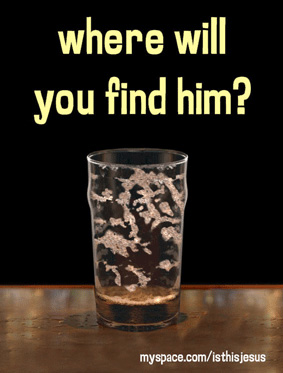
This year’s campaign features a pint glass with the image of Jesus in the Brussels lace stuck to the side of the empty glass and a MySpace.com website for Jesus. CAN chairman Francis Goodwin said he hoped the poster and accompanying radio adverts would spark a debate about religion.

“The message is subtle but simple – where is God in all the boozing at Christmas?” said Goodwin.

“For many, Christmas is just drinking and partying and God is excluded, yet many young people are interested in finding deeper meaning and exploring faith.”

The poster is a nod to the occasional discoveries of holy images in everyday objects, from the face of Jesus in a frying pan, toast or fish finger, his mother Mary on a toasted cheese sandwich and even Mother Teresa in a sticky bun.

jesus-beer-poster

According to the group’s literature, here is their take on this image:

This year’s poster picks up on the current media preoccupation with finding images of Jesus in everything from egg yolks to currant buns. Next to an empty beer glass in which a face can be seen are the words “Where will you find him?” and pointing to the web address myspace.com/isthisjesus.

The poster aims to provoke thought and debate about where and how people find God. The myspace.com webspace will include a link to the rejesus website, which has creative features and reliable information on the Christian faith. Rejesus is supported by all the mainstream UK churches.

So why the image of an empty beer glass? Francis Goodwin, Chair of the Churches Advertising Network (CAN) says: “The message is subtle, but simple: where is God in all the boozing at Christmas? For many, Christmas is about drinking and partying, and God is excluded. Yet many young people are interested in finding deeper meaning and exploring faith. We hope the link to myspace.com will offer a fresh venue for them to discuss their feelings and debate the issues.”

Richard Johnston and Mark Gilmore, who produced the poster at Radioville, the ad agency for the campaign, say…

“We took the traditional silly-season news story in which people find images of Jesus in the side of trees, in a slice of toast or even within the bubbles of cheese on a pizza, and developed a number of new images showing Jesus’ face in unexpected places. Because of the season, CAN chose the beerglass route, where Jesus’ face is captured in the froth running down the side of an empty pint glass. The responses expected on myspace.com when the campaign launches should be quite illuminating.”

Yes, they should be quite “illuminating.” It will quite interesting to see what people say about this. I can’t imagine many American fanatics being very happy about this since so many neo-prohibitionists are also highly religious. One bit of unintentional humor is that when you visit the MySpace page, Jesus has “0” friends. Jesus has no friends? I’m sure that will change shortly, but for now I feel kinda bad for him. Perhaps I should buy him a beer.

Filed Under: Just For Fun, News Tagged With: Europe, Great Britain, International, Strange But True

EU to Increase Beer Tax

September 8, 2006 By Jay Brooks

Beer taxes have rarely been doled out fairly. They’ve been used to support war efforts such as the very first beer tax in America, which was leveled to help pay for our Civil War in the 1860s. And while most brewers didn’t mind supporting their country, the fact that other industries were not asked to similarly help out was what led to the first U.S. trade association among brewers. Then there’s the so-called “sin tax” on many luxury goods deemed to be either bad for you or having some moral questionability — at least to the more pious elements of society.

So in a way it comes as no suprise that the European Union announced a 31% increase on the duty for beer and spirits. Proponents say it will add only about one Euro cent to the price of a beer (half-litre size). Critics say it will hurt small breweries. If passed by the 25 member states (it needs to be unanimous) it likely wouldn’t go into effect until 2008 or even 2010, with grace periods.

Some interesting facts about Europe’s beer industry from a Reuter’s report:

Europe’s brewing industry employs 2.6 million people directly or indirectly in 3,000 breweries. Over a third of the breweries are in Germany, where they already face a 3 percent rise in value-added sales tax (VAT) from next year.

But here’s the kicker. There’s no duty whatsoever on wine, because the industry has such enormous political influence. Yeah, that seems fair, doesn’t it?

Filed Under: News Tagged With: Business, Europe, International

Ecosteep Saves 30% Water During Malting

August 11, 2006 By Jay Brooks

Holland’s Bavaria Brouwerij, the same brewery that was briefly in the international spotlight during the World Cup because of their orange leiderhosen, has installed a new malting system developed by the Swiss company Buhler. The new malting system, dubbed “Ecosteep,” will reportedly save as much as 30% of water consumption during the malting process. The process uses a flat-bottomed, steeping system developed by Buhler, along with several universities in an operation called “The Holland Malt Project.” Buhler also claims Ecosteep will produce improved uniformity of malt quality. Food Production Daily of Europe has a story about the new system and the Buhler Group’s website has additional information on the project.

Bavaria Brouwerij’s new malthouse towers, seen from above.

Filed Under: News Tagged With: Europe

Icons of England: The Pub and a Pint

August 10, 2006 By Jay Brooks

I’ve always been fascinated by symbols, so I was immediately drawn to the Icons of England Project, a project to identify and select the symbols that are instantly recognizable as being a part of England and England’s heritage. Throughout the course of 2006, people are invited to nominate icons for England and they will be chosen in four waves, three of which have already been selected. That quintessentially English establishment, the Pub was selected earlier this year, along with such other stalwarts as tea, Big Ben, the FA Cup, the miniskirt and Alice in Wonderland. The third wave was just announced and it included a Pint, along with the perfect pairing of pub food, Fish & Chips. The latest wave also included Monty Python, bowler hats, Robin Hood and the OED. A total of 53 icons have been chosen so far with one more round of icons to be selected. A staggering 667 nominations have been made online and my favorites so far are cheddar cheese, cider, James Bond, real ale, the red phone box, shepherd’s pie, the tube map, and Wallace and Gromit. What great fun.
 

Two of the Icons of England, the pub and a pint.

Filed Under: Just For Fun, News Tagged With: Europe, Great Britain

GBBF Winners Announced

August 2, 2006 By Jay Brooks

The winners of this year’s Great British Beer Festival were announced yesterday. Here’s the list:

CHAMPION BEERS:

GOLD: Crouch Vale Brewers Gold
SILVER: Harveys Sussex Best Bitter
BRONZE: Triple fff Moondance
 

CATEGORY WINNERS:

Milds:

  1. Mighty Oak’s Oscar Wilde Mild (Essex)
  2. Elgood’s Black Dog (Cambridgeshire)
  3. Grainstore Rutland Panther (Rutland)

Bitters:

  1. Elgood’s Cambridge Bitter (Cambridgeshire)
  2. Acorn Barnsley Bitter (South Yorkshire)
  3. TIE
    • Sharp’s Doombar Bitter (Cornwall)
    • Woodforde’s Wherry (Norfolk)

Best Bitters:

  1. Harveys Sussex Best Bitter (East Sussex)
  2. Triple fff Moon Dance (Hampshire)
  3. TIE
    • Kelburn, Red Smiddy (East Renfrewshire)
    • Surrey Hills Shere Drop (Surrey)

Strong Bitters:

  1. York Brewery, Centurions Ghost Ale (Yorkshire)
  2. Thornbridge Jaipur IPA (Derbyshire)
  3. Weetwood Oasthouse Gold (Cheshire)

Speciality Beers:

  1. Cairngorm Trade Winds (Highlands)
  2. Wolf Straw Dog (Norfolk)
  3. William Brothers Fraoch Heather Ale (Alloa)

Golden Ales:

  1. Crouch Vale Brewers Gold (Essex)
  2. Hop Back Summer Lightning (Wiltshire)
  3. Holden’s Golden Glow (West Midlands)


BOTTLED BEER:

  1. White Shield: White Shield Brewery (Staffordshire)
  2. Hen’s Tooth: Greene King (Suffolk)
  3. Titanic Stout: Titanic (Staffordshire)

The scene at this year’s Great British Beer Festival.

Filed Under: Events, News Tagged With: Awards, Europe, Festivals, Great Britain

Crouch Vale Brewers Gold Best Beer in Britain

August 2, 2006 By Jay Brooks

For the second year in a row, Crouch Vale Brewers Gold has won Champion Beer of Britain. Crouch Vale’s website describes the beer as “pale, refreshing and hoppy beer with gorgeous aromas of tropical fruits.”

From the CAMRA press release:

The beer is described in the 2006 edition of CAMRA’s Good Beer Guide as: “Honey-toned golden ale, with grapefruit sharpness offset by suggestions of melon and pineapple.”

The Essex brewed beer was chosen as the overall winner from over fifty finalists in eight categories including beers from tiny micros to major regional brewers.

Roger Protz, one of the finalist judges and Editor of the Good Beer Guide said: “It’s a tremendous victory for a brewery committed to its cask beer and richly deserved for this marvelous hoppy and fruity beer.”

Colin Bocking, Managing Director of Crouch Vale brewery said, “I am speechless. It was enough of a surprise to have won Champion Beer of Britain in 2005, but to have been voted Britain’s best beer for a second year in a row is truly unbelievable.

“Thanks to all the people who have supported the brewery over the years, especially those that have enjoyed this remarkable beer. This great news could not have come at a better time for us as we are in the middle of expanding the brewery.”

The Silver award went to Harveys brewery in Sussex for their Sussex Best Bitter. The Bronze was awarded to Triple fff brewery in Hampshire for Moondance.

Colin Bocking from Crouch Vale Brewery accepting this year’s Champion Beer of Britain Award.

Filed Under: News Tagged With: Awards, Europe, Great Britain

Square Beer Bottles

July 11, 2006 By Jay Brooks

According to an item on Vestal Design’s blog, Alfred Heineken, who is credited with making Heineken beer an international brand, had a unique, if somewhat bizarre, idea to make square beer bottles that could be fitted together and stacked to build houses after people finished drinking them. It was mentioned briefly in his BBC News obituary, but with few details (Heineken passed away in 2002). According to Vestal Design’s account, Alfie was wandering the beach in Jamaica and was struck by the large number of beer bottles littering the beach. He was also apparently “concerned with the lack of cheap building materials, and at the resulting living conditions for the poor.” In one of those same leaping kind of moments that produced Reese’s Peanut Butter Cups (you’ve got chocolate in my peanut butter!) he put two and two together and got five. Voila, the square beer bottle was born. Or it would have been, except that Heineken’s board of directors didn’t share his vision. He thought square Heineken bottles would be imported around the world and then they’d stay there and be used to build houses. They thought he was nuts, or at least the idea was.

Vestal Design speculates that you would need one thousand bottles to build a house ten feet square. They also note glass is a good insulator and the bottle was designed in such a way that the bottle neck fit into a groove in the bottom of the bottle so they would essentially fit together. They would certainly stack in your refrigerator better, too, wouldn’t they?

Alfred Heineken’s World Beer bottles, which he envisioned using to build houses.

Filed Under: Just For Fun Tagged With: Europe

Not Sneering

June 28, 2006 By Jay Brooks

belgium
There was a decent article about beer and food pairing in today’s St. Petersburg (Florida) Times called “Don’t Sneer at Beer.” It starts out a little bizarre and I found the headline off-putting, but perhaps the author’s assuming people don’t know you can eat … and drink beer, too. His first sentence. “This may come as a shock, but you can drink beer and eat food at the same time.” Happily, he talks about Belgian beers and how well they work with cheese and many other foods. There’s some decent information for the uninitiated and does a better job than others I’ve read.

Filed Under: Food & Beer, News Tagged With: Belgium, Europe, Mainstream Coverage, Southern States

Coors: Destroying Beer on Purpose?

June 26, 2006 By Jay Brooks

If your product is virtually indistinguishable from most of your major competitors, then you make yourself stand out through marketing and advertising. No gimmick is off-limits if it will steer customers to pick up your product instead of the other guys. This seems especially true of the makers of American-style lagers like Bud, Miller and Coors along with the pilsner-derived imports like Heineken, Corona and Stella Artois, to name but a few. Over the years we’ve seen some entertaining — if pointless — ad campaigns for all of them. Creative promotions, merchandising, sponsorships of sports teams and events, logo’d clothing, hats, towels — you name it — and a new product for every new trend of the moment (remember the dry beers, ice beers, low-carb beers, etc.). We’ve come to expect the ridiculous and shake our heads at the inanity. Unfortunately, many times the ads and novelties seem to undermine beers very image and over time have contributed to beer being perceived as something wholly different than it really is.

But even with all that history and low expectations behind it, the latest move by Coors to bring to market — at great expense — a beer to be served at below freezing simply boggles the mind. Now generally when beer dips below freezing ingredients begin to break down, primarily the proteins which come out of solution. This causes them to separate and form small flakes that swim around in the beer and make it cloudy. Of course, because of the alcohol beer freezes at a point that’s already slightly below freezing, the exact point depending on the percentage of alcohol. Alcohol itself freezes at -173° F.

This is also the reason frosted, frozen glasses stored in the freezer are such a terrible idea. They also chemically alter the beer and change its taste. The reason you generally don’t notice it is simply because drinking any liquid at that temperature also numbs many of your taste buds. Several volatile components in the beer aren’t released in your mouth and disappear undetected down your throat. The beer’s flavor profile is considerably narrowed and some tastes disappear completely. Cold beer also effects the beer’s balance because hop character survives better than malt or fruity esters. This is the reason bland lagers, which are generally less well-hopped, do better at cold temperatures and explains why ales are generally served at warmer temperatures. A good rule of thumb is the colder the beer, the less of it you can actually taste.

So Coors has launched Coors Sub-Zero, a beer that is chilled down to -2.5° C (27.5° F)

According to Coors’ press release, it “uses space age technology developed in Britain [at Burton-on-Trent]; its patented pouring process naturally forms soft crystals of the crispest, cleanest, ultra-cold lager that melt away in the mouth. Best of all, they keep Coors Sub Zero cooler for longer, giving sensational refreshment and taste.” The pricetag was more than £10 million (over $18 million USD).

The beer delivers an entirely new taste experience. The soft frozen lager crystals create a subtle sensation of snow on your tongue. And the super-chilling, along with the clean, clear taste of the lager, combine to create an extraordinary, refreshing crispness.

The way Coors Sub Zero is poured is technically and physically unlike anything else behind a bar in Britain. During the one-minute, fully automated pour-process, the specially made beer glass constantly revolves on a turntable – creating what must be the most impressive beer-pouring spectacle ever seen.

Hmm, frankly I’m more impressed by taste than space-age technology and a magic show, but maybe that’s just me.

Coors describes what the experience will look like in a bar:

To serve the beer, as either a pint or a half, the bartender puts on a ‘science show’ for the customer:

  1. The glass is placed on the turntable and the launch button is pressed [which cools it with a spray of cold water]
  2. [The lager is stored at high pressure and is poured into the glass at a temperature of -2.5C.]
  3. The glass is rinsed with chilled water before the lager is dispensed at sub zero temperature [high pressure makes the beer stay cold and keeps it from freezing]
  4. Two seconds before the end of the pour comes the ‘sonic trigger’ – a process of ‘supernucleation’ which causes soft frozen lager crystals to gather in the top of the glass [these are ultrasonic waves which form crystals of ice around the gas bubbles]
  5. Finally, the condensation that has formed during the pour is removed — and a crystal clear pint is presented to the customer

[my additional explanations]

What’s stranger still is where the beer is being launched. Great Britain’s wonderful ales are best consumed at temperatures much, much warmer than freezing. In fact, the English consume very few beverages at even a cool temperature, much less at freezing. Trying to find ice in a British restaurant is maddeningly impossible for us uncouth Americans. So it’s strange to see quotes that people there want colder beer. That seems a bit odd to me.

Here’s the Coors spin machine at work:

Said Stuart Renshaw, Head of Marketing for International & Portfolio Brands for Coors Brewers: “We have listened to consumers and their requests for colder and colder beer. With Coors Sub Zero the cold beer lover’s dream has finally come true – a pint that stays cold right to the bottom of the glass and the first ever pint that actually seems to get colder in your hand.

“Coors Sub Zero is the perfect ice cold refreshment. It brings together traditional brewing excellence and 21st century dispense technology to deliver a unique drinking sensation”.

Scientist Dr Alan Samson, who has worked on Sub Zero since 1998, said: ‘For years companies have been trying to pull a truly cold pint, but now the technology has caught up.

‘It is a natural phenomenon ‘ nothing is added or taken away to the lager. The only problem is that we wasted 8 million pints getting it right.’

It seems to me they spent a lot of money and are now trying to create a market for it, rather than the other way around. One hundred pubs are expected to have the special system installed by the year’s end with the first in sometime next month.

In the end, it’s hard not to view this development as an abomination since it perpetuates the myth that beer must be as cold as possible, or now perhaps even colder. This is bad for the perception of beer in general and helps only those beers that would suffer for being consumed at a warmer temperature. And we all know who they are.

Filed Under: Beers, Editorial, News Tagged With: Business, Europe, Great Britain

« Previous Page
Next Page »

Find Something

Northern California Breweries

Please consider purchasing my latest book, California Breweries North, available from Amazon, or ask for it at your local bookstore.

Recent Comments

  • Ernie Dewing on Historic Beer Birthday: Charles William Bergner 
  • Steve 'Pudgy' De Rose on Historic Beer Birthday: Jacob Schmidt
  • Jay Brooks on Beer Birthday: Bill Owens
  • Steve 'Pudgy' De Rose on Beer Birthday: Charles Finkel
  • Steve 'Pudgy' De Rose on Beer Birthday: Bill Owens

Recent Posts

  • Historic Beer Birthday: Robert Burns January 25, 2026
  • Historic Beer Birthday: Christian Heuser January 25, 2026
  • Historic Beer Birthday: Jacob Knecht January 25, 2026
  • Beer In Ads #5181: Turn Winter Into Spring January 24, 2026
  • Historic Beer Birthday: Philip Bissinger January 24, 2026

BBB Archives

Feedback

Head Quarter
This site is hosted and maintained by H25Q.dev. Any questions or comments for the webmaster can be directed here.