Brookston Beer Bulletin

Jay R. Brooks on Beer

  • Home
  • About
  • Editorial
  • Birthdays
  • Art & Beer

Socialize

  • Dribbble
  • Email
  • Facebook
  • Flickr
  • GitHub
  • Instagram
  • LinkedIn
  • Pinterest
  • RSS
  • Twitter
  • YouTube

Powered by Genesis

Historic Beer Birthday: Louis Pasteur

December 27, 2025 By Jay Brooks

pasteurized
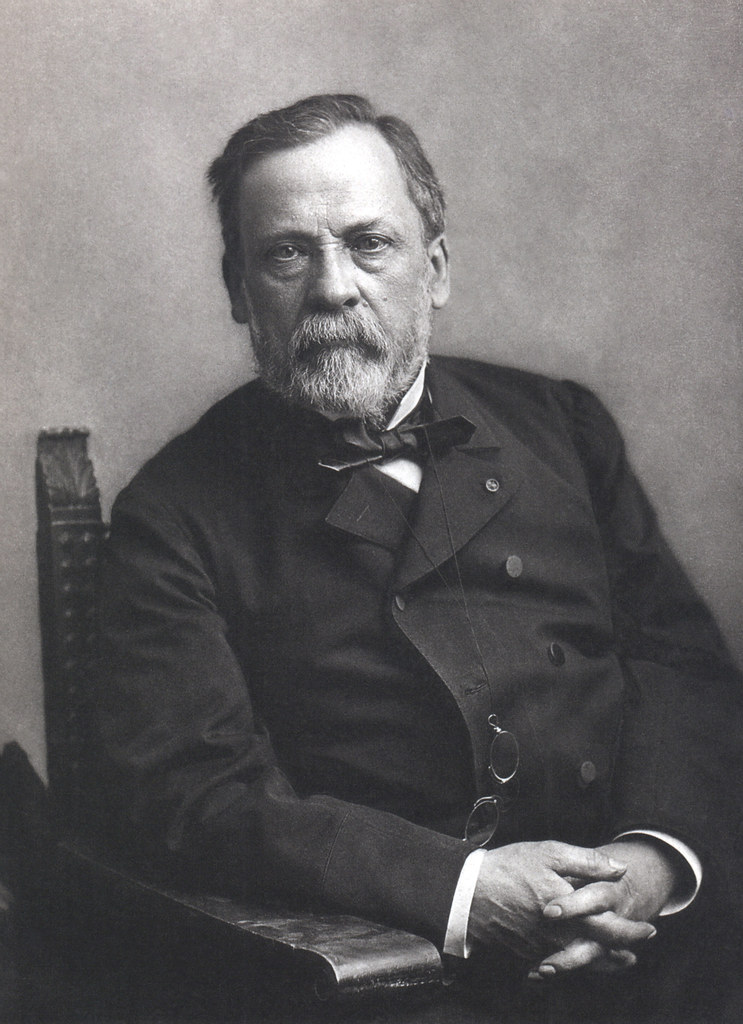
Today is the birthday of Louis Pasteur (December 27, 1822–September 28, 1895). He “was a French chemist and microbiologist renowned for his discoveries of the principles of vaccination, microbial fermentation and pasteurization. He is remembered for his remarkable breakthroughs in the causes and preventions of diseases, and his discoveries have saved countless lives ever since. He reduced mortality from puerperal fever, and created the first vaccines for rabies and anthrax. His medical discoveries provided direct support for the germ theory of disease and its application in clinical medicine. He is best known to the general public for his invention of the technique of treating milk and wine to stop bacterial contamination, a process now called pasteurization. He is regarded as one of the three main founders of bacteriology, together with Ferdinand Cohn and Robert Koch, and is popularly known as the ‘father of microbiology.'”

Portrait of Louis Pasteur

But, of course, for the brewing industry, he’s best remembered for his “Studies on Fermentation,” which he published in 1876.

In 1876, Louis Pasteur published his ground-breaking volume, Études sur la Bière, soon translated into English as Studies On Fermentation. The book changed the course of brewing during the late 19th and early 20th centuries, representing a huge leap forward in the scientific understanding of the processes involved in beermaking. Brewers around the globe put Pasteur’s findings to work in their breweries, and thus plunged the industry headlong into the modern era.

In tribute to Pasteur’s tremendous contributions to brewing science, BeerBooks.com has reprinted Studies On Fermentation exactly as it appeared when first released in English, complete with all of Pasteur’s illustrations. An original 1879 edition was digitally scanned, professionally enhanced and reproduced in a hard cover format.

In his preface, Pasteur modestly wrote, “I need not hazard any prediction concerning the advantages likely to accrue to the brewing industry from the adoption of such a process of brewing as my study of the subject has enabled me to devise, and from an application of the novel facts upon which this process is founded. Time is the best appraiser of scientific work, and I am not unaware that an industrial discovery rarely produces all its fruits in the hands of its first inventor.”

But, of course, the brewing industry recognized almost immediately the impact that Pasteur’s work would have on the art and science of beermaking. Frank Faulkner, the British brewing scholar who performed the English translation, wrote, “Seeing the vast importance of Pasteur’s work from a practical point of view, after writing a review of it for the Brewers’ Journal, I determined to procure, at any rate for the use of my own pupils, a literal translation, illustrated by photo-lithographic copies of the original plates…It was on the completion of this translation that my views and desires expanded. The more I studied the work, the more I was convinced of its immense value to the brewer as affording him an intelligent knowledge of the processes and materials with which he deals…I determined accordingly to publish the work if I could secure the consent of its distinguished author…The debt which we English brewers owe to M[r]. Pasteur can hardly be over-estimated.”

While I’m sure there are probably many more, he had patents I highlighted last year, Patent No. 135245A: Improvement in Brewing Beer and Ale from 1873, and Patent No. 141072A: Manufacture of Beer and Yeast, in the same year.

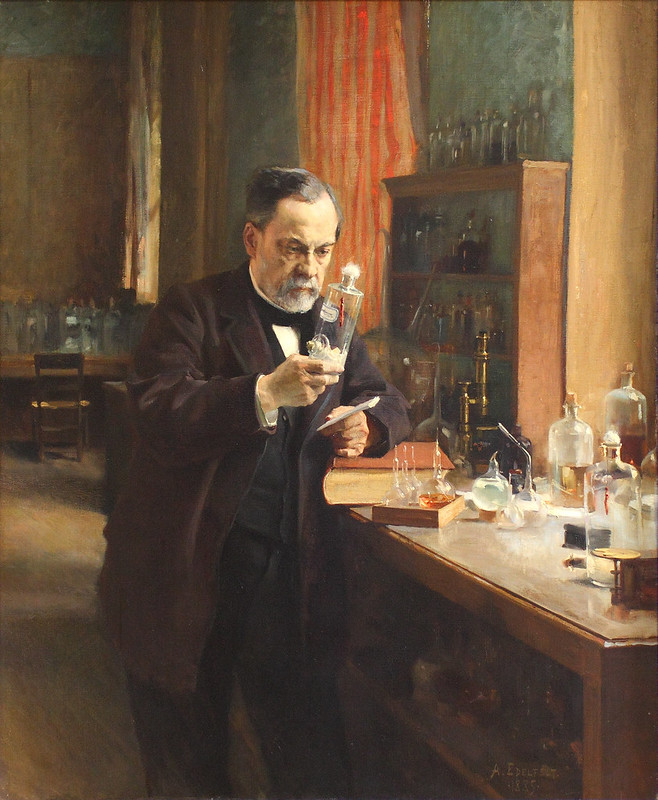
Albert_Edelfelt_-_Louis_Pasteur_-_1885
A portrait of Louis Pasteur painted by Swedish-speaking Finnish artist Albert Edelfelt, in 1886.

Fermentation and germ theory of diseases

Pasteur demonstrated that fermentation is caused by the growth of micro-organisms, and the emergent growth of bacteria in nutrient broths is due not to spontaneous generation, but rather to biogenesis (Omne vivum ex vivo “all life from life”). He was motivated to investigate the matter while working at Lille. In 1856 a local wine manufacturer, M. Bigot, the father of his student, sought for his advice on the problems of making beetroot alcohol and souring after long storage. In 1857 he developed his ideas stating that: “I intend to establish that, just as there is an alcoholic ferment, the yeast of beer, which is found everywhere that sugar is decomposed into alcohol and carbonic acid, so also there is a particular ferment, a lactic yeast, always present when sugar becomes lactic acid.” According to his son-in-law, Pasteur presented his experiment on sour milk titled “Latate Fermentation” in August 1857 before the Société des Sciences de Lille. (But according to a memoire subsequently published, it was dated November 30, 1857). It was published in full form in 1858. He demonstrated that yeast was responsible for fermentation to produce alcohol from sugar, and that air (oxygen) was not required. He also demonstrated that fermentation could also produce lactic acid (due to bacterial contamination), which makes wines sour. This is regarded as the foundation of Pasteur’s fermentation experiment and disprove of spontaneous generation of life.

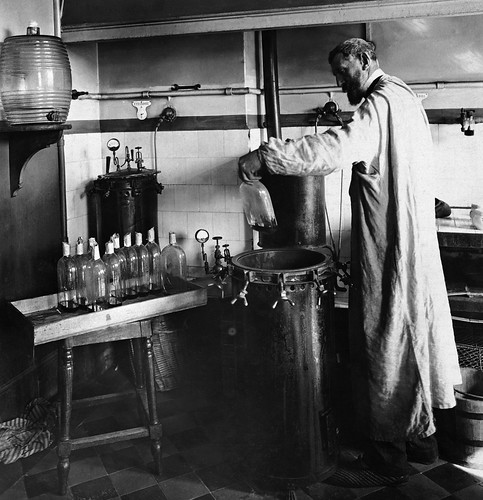
Louis_Pasteur_experiment

Pasteur’s research also showed that the growth of micro-organisms was responsible for spoiling beverages, such as beer, wine and milk. With this established, he invented a process in which liquids such as milk were heated to a temperature between 60 and 100 °C. This killed most bacteria and moulds already present within them. Pasteur and Claude Bernard completed the first test on April 20, 1862. Pasteur patented the process, to fight the “diseases” of wine, in 1865. The method became known as pasteurization, and was soon applied to beer and milk.

Beverage contamination led Pasteur to the idea that micro-organisms infecting animals and humans cause disease. He proposed preventing the entry of micro-organisms into the human body, leading Joseph Lister to develop antiseptic methods in surgery. Lister’s work in turn inspired Joseph Lawrence to develop his own alcohol-based antiseptic, which he named in tribute Listerine.

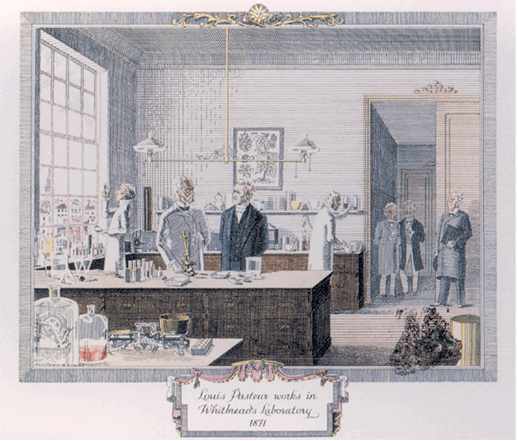
whitbread-pasteur-1937cal

This is an ad is for Whitbread, from 1937, showing an illustration of Louis Pasteur working on his fermentation studies in a laboratory at Whitbread Brewing in 1871, nine years after he completed his first test of pasteurization, which took place April 20, 1862.

On his Wikipedia page, under the heading “Controversies, there’s this paragraph about his research into fermentation:

When Pasteur published his theory and experiments on fermentation in 1858, it was not new to science, neither the idea nor the experiment. In 1840 a German chemist Justus von Liebig had noted that yeast could induce fermentation in water. However, he did not know that yeasts were organisms. In 1856 another German, Friedrich Wilhelm Lüdersdorff, reported that yeasts were microorganisms that convert sugar into alcohol. In 1855, Antoine Béchamp, Professor of Chemistry at the University of Montpellier, showed that sugar was converted to sucrose and fructose in a closed bottle containing water and when he added calcium or zinc chloride to it, no reaction occurred. He also noticed moulds developing in the solution, but could not fathom the significance of it. He concluded that water was the factor for fermentation. He changed his conclusion in 1858 that water was not the main factor, in fact, fermentation was directly related to the growth of moulds, and moulds required air for growth. He regarded himself as the first to show the role of microorganisms in fermentation. Pasteur started his experiments only in 1857 and published his findings in 1858 (April issue of Comptes Rendus Chimie, Béchamp’s paper appeared in January issue), which, as Béchamp noted, did not bring any novel idea or experiments that earlier works had not shown. On the other hand, Béchamp was probably aware of Pasteur’s 1857 preliminary works. With both scientists claiming priority on the discovery, a bitter and protracted dispute lasted throughout their lives. Their rivalry extended to ideas on microbiology, pathogenesis, and germ theory. Particularly on the spontaneous generation because Pasteur in his 1858 paper explicitly stated that the lactic acid bacteria (he named them “lactic yeasts”), which caused wine souring, “takes birth spontaneously, as easily as beer yeast every time that the conditions are favourable.” This statement directly implied that Pasteur did believe in spontaneous generation. He condemned the ideas of Pasteur as “‘the greatest scientific silliness of the age”. However, Béchamp was on the losing side, as the BMJ obituary remarked: His name was associated with bygone controversies as to priority which it would be unprofitable to recall. Pasteur and Béchamp believed that fermentation was exclusively cellular activity, that is, it was only due to living cells. But later extraction of enzymes such as invertase by Marcellin Berthelot in 1860 showed that it was simply an enzymatic reaction.
Pasteur’s ground-breaking “Studies on Fermentation” is in the public domain, of course, so you can read the entire work, or just browse through it, at the Internet Archive.

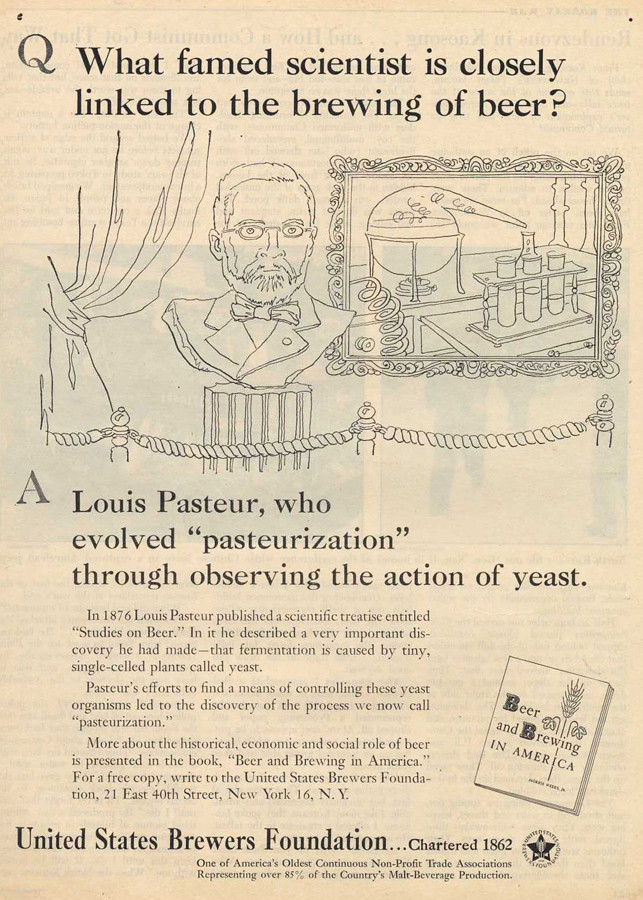
USBF-1951-qa9
In 1951, the United States Brewers Foundation featured Louis Pasteur in an ad, which was part of a series that used a Q&A format aimed at highlighting different positive aspects of beer and the brewing industry.

Filed Under: Birthdays, Just For Fun, Related Pleasures Tagged With: France, History, Science, Science of Brewing, Yeast

Historic Beer Birthday: Emil Schmitt

October 21, 2025 By Jay Brooks

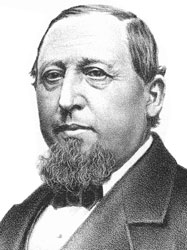
john-kauffman
Today is the birthday of Emil (sometimes spelled Emile) Schmitt (October 21, 1851-November 13, 1898). He was born in Lorraine, France, and emigrated to America in 1853 with his family, settling in Cincinnati, Ohio. Having married Maria Elizabeth “Mary” Kauffman, he was the son-in-law of John Kauffman, who was part of the group that bought the Franklin Brewery in Cincinnati, Ohio in 1856. By 1859, it was called the John Kaufman & Co. Brewery, and it became the fourth largest brewery in Cincinnati. Eventually, he remained as the sole owner, and in 1882 renamed it the John Kauffman Brewing Co. Emil Schmitt was the manager of the brewery. When he died in 1886, Emil assumed control of it. It was closed by prohibition, and never reopened, although it was used as the Husman Potato Chip factory, so at least it was put to good use.

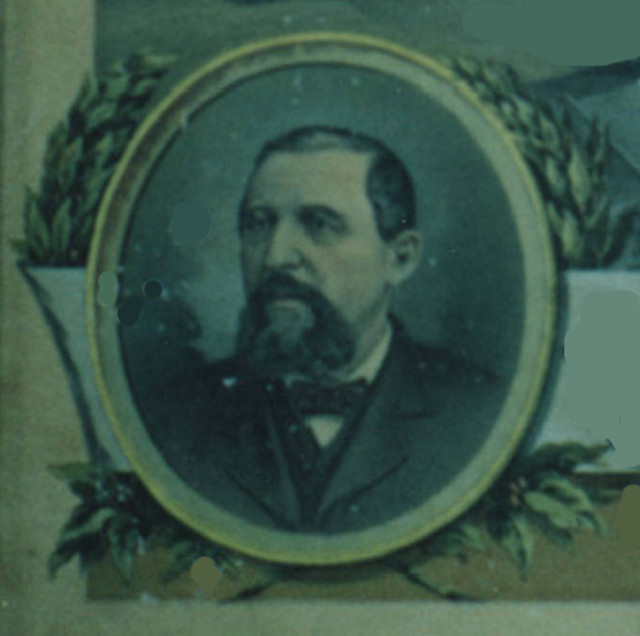
Emil-Schmitt
The name confusion is particularly odd, since some accounts, notably his page on Ancestry.com, claims that he was a twin, and that he, Emile, had a twin sister named Emil. But even the illustration accompanying his obituary, shown above, is titled Emil, and you’d be hard-pressed to conclude that’s a woman. There’s also some suggestion that she also died at the same time as her brother Emile. There’s definitely some conflicting reports on this.

Here’s his obituary, from the Cincinnati Enquirer:

Emil-Schmitt-obit
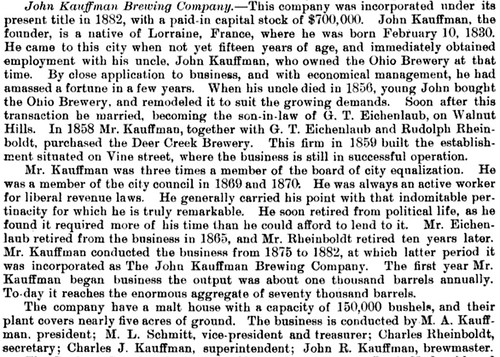
There’s an entry for the John Kauffman Brewery in the “History of Cincinnati and Hamilton County, Ohio,” published in 1894:

john-kauffman-brewery-history
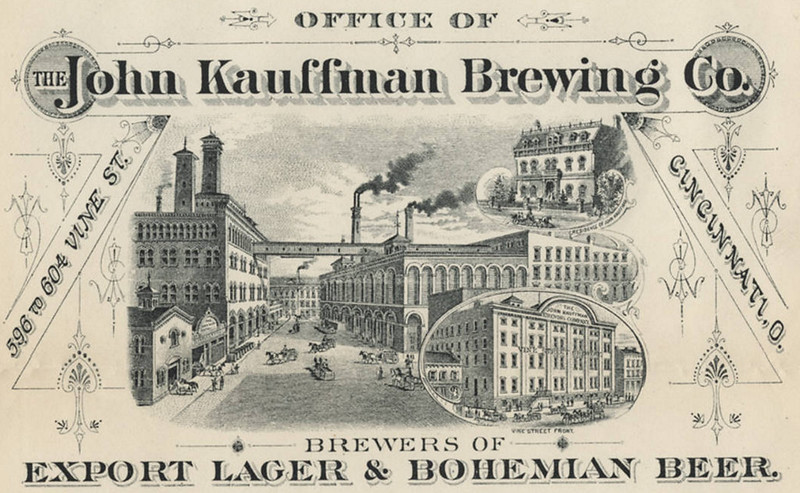
Kauffman-brewery-letterhead

Cincinnati Brewing History has this account of the brewery’s history, taken from Cincinnati Breweries, by Robert J. Wimberg, from 1989:

“In 1856 John Kauffman, George F. Eichenlaub, and Rudolf Rheinbold purchased the Franklin Brewery on Lebanon Road near the Deer Creek from Kauffman’s aunt. Her husband, John Kauffman, estabished the brewery in 1844. He died in 1845. In 1859 under the name Kauffman and Company, they began to build a new brewery on Vine Street and soon left the Deer Creek location. The first structure on Vine was completed in 1860.

In 1871 the Kauffman Brewery was the city’s fourth largest with sales amounting to $30,930. It was located on both the west and east sides of Vine north of Liberty and south of Green Street.

In 1860 Kauffman also bought the Schneider grist mill on Walnut Street near Hamilton Road (McMicken Avenue), but leased it out before long to another company.

In its first year on Vine Street, the brewery produced only about 1000 barrels. By 1877 the number grew to 50,000 barrels of beer. Kauffman’s beer was sold in Nashville, Montgomery, Atlanta, Charleston, Savannah, and New Orleans.

In 1865 Eichenlaub retired from the business and he was followed by Rheinbold in 1877. John Kauffman then took over the leadership by himself. After his oldest son Johnn studied brewing in Augsburg, Germany, he went to work at the family brewery. Emil Schmidt, Kauffman’s son-in-law, was superintendent by 1877.

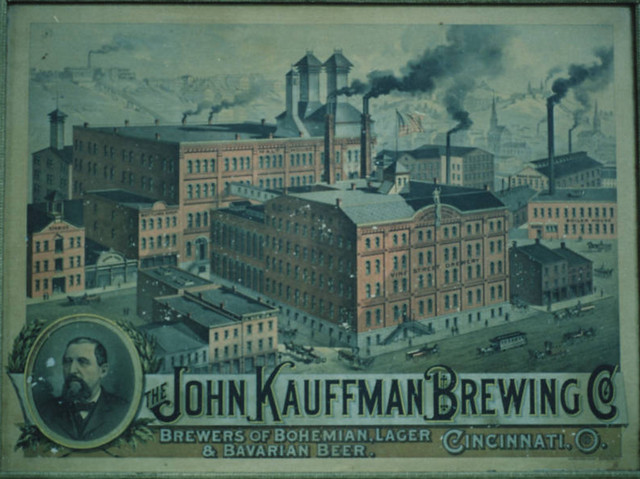
In 1882 the brewery was incorporated as the John Kauffman Brewing Company with a paid-in capital stock of $700,000. In 1888 the brewery building at 1622 Vine was enlarged. Note it is occupied by the Schuerman Company today. The office and family residence was at 1625-27 Vine, which was razed and replaced about 75 years ago.

John Kauffman died in 1892 and his wife Marianne Eichenlaub Kauffman took over. She was president of the corporation; Emil Schmidt, vice-president; and treasurer; Charles Rheinbold, secretary; Charles J. Kauffman, superintendent; and John R. Kauffman, brewmaster. By 1894 the brewery produced 70,000 barrels of beer. The malt house had a capacity of 150,000 bushels of barley and the brewery plant covered five acres of ground.

By 1913 John R. Kauffman was president of the company. The brewery produced ‘Gilt Edge’, ‘Columbia’ and ‘Old Lager’ beers. It closed in 1919 when Prohibition became law and never reopened.”

John-Kauffman-Brewery-poster

The brewery is also mentioned briefly in a History of the Brewery District for Cincinnati:

Industry continued to be an important factor in Over-the-Rhine’s development. The canal area was still the location of many diversified industries, including lumberyards, foundries, pork packers, tanneries, and glycerin works. The brewing industry tended to concentrate along McMicken Avenue and the Miami and Erie canal (what is now the Brewery District). By 1866 the Jackson Brewery, J. G. John & Sons Brewery, Christian Moerlein Brewing Company, and John Kauffman Brewing Company dominated the industrial use of the area. In close association on the west side of the canal were the John Hauck and Windisch-Mulhauser Brewing Companies. Between 1875 and 1900 seventeen breweries were located in Over-the-Rhine and West End.

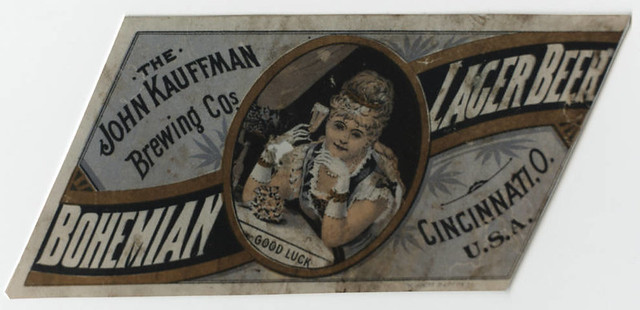
John_Kauffman_Brewing_Company_beer_label

Filed Under: Birthdays, Breweries, Just For Fun Tagged With: France, History, Ohio

Historic Beer Birthday: C.L. Centlivre

September 27, 2025 By Jay Brooks

old-crown
Today is the birthday of C.L. Centlivre (September 27, 1827-January 13, 1894). Centlivre was born in France, and settle in Fort Wayne, Indiana, where he founded the C.L. Centlivre Brewing Company with his brother, Frank. It was also known as the French Brewery and much later as the Old Crown Brewery.

The Wikipedia page for the Old Crown Brewing Corporation includes this short biography:

Charles Louis Centlivre was born in Dannemarie, Haut-Rhin, France, September 27, 1827. He was trained as a cooper (profession) and initially came to America in 1847, having settled in New Orleans, Louisiana. After a cholera epidemic he returned to France, returning to America via New York City with his father and two brothers. After living in Massillon, Ohio and working as a cooper in Louisville, Ohio, he founded a brewery in McGregor, Iowa in 1850 and operated it until he came to Fort Wayne, Indiana in 1862 and founded the C. L. Centlivre Brewing Company with his brother, Frank. He died in 1894 at the age of 67.

A statute of Centlivre that used to be on the brewery but now resides above a Fort Wayne restaurant.

The brewery was first known as the French Brewery when it was founded in 1862, but Charles L. Centlivre’s name was associated with it from the very beginning. In 1893, the name was formally changed to the C.L. Centlivre Brewing Co., which it remained until it was shut down in 1918 by the Indiana State Prohibition, two years before it was national. During Prohibition the brewery was called Centlivre Ice & Storage Co. After repeal in 1933, it was rebranded as the Centlivre Brewing Corp., until 1961, when it was changed to the Old Crown Brewing Co.. That was still its name when it closed for good in 1973.

Here’s a biography from “The Pictorial History of Fort Wayne,” published in 1917.

c-l-centlivre-brewery

The website Fort Wayne Beer has a great account of the history of the Centlivre Brewery.

CHARLES LOUIS CENTLIVRE was french, Monsieur Centlivre (His surname has been anglicized to rhyme with “river”) was born in 1827 in Lutran, a small town in the northeast of France about nine miles from the German border and 90 miles south of the 349-year-old Kronenbourg Brewery in Strasbourg. When he was 12, his family father, stepmother, five siblings and a stepbrother-moved to neighboring Valdieu, where he apparently apprenticed as a cooper.

BON…JOUR AMERICA

Charles, along with his sister Celestine and stepbrother Henri Tonkeul sailed from France and arrived in the Port of New Orleans on December 24, 1850. Charles and Henri would soon relocate to Louisville, OH near Canton (now home of the NFL Hall of Fame), where they reportedly met up with other relatives, and where Charles found work as a cooper. In 1854 they were joined by Charles’ father, stepmother and younger siblings. It was here that Centlivre wed Marie Houma ire, a young French woman who spoke no English. The newlyweds had met by accident on a train reroute to Louisville. Marie had boarded the wrong train; she was supposed to be heading to Louisville, Kentucky’ Late in 1854 or early 1855, Charles and Marie moved to McGregor, Iowa, where he purchased some land. McGregor, located on the Mississippi, was becoming a hub where grain from Iowa and Minnesota was transported across the river and sent on to Milwaukee via railroad; by the 1870s it had become the busiest shipping port west of Chicago. A number of family members also moved to Iowa, including Centlivre’s brothers Francois and Denis, sister Celestine and his father Louis. Marie gave birth to their first two children, Amelia and Louis, in Iowa. Charles met Christian Magnus, a German emigrant and brewer, while in Dubuque County, Iowa. Magnus helped Centlivre start a brewery in Twin Springs, Iowa about 1857 and served as its foreman until 1858. Magnus was known to age beer in caves, which may be how Centlivre learned to lager beer. Also while in Twin Springs, Centlivre declared his intent to become a United States citizen. More than a brewer, Charles L. Centlivre was an entrepreneur, and while in Fort Wayne, Indiana, possibly to visit his stepbrother Henri Tonkeul, (Tonkel Road still exists in Fort Wayne), he saw a greater business potential than existed in Iowa. Fort Wayne had a large German population, a total population at the time of about 10,000, rail service connecting Fort Wayne to Chicago and Pittsburgh and three rivers from which to draw water and ice for brewing. In February 1862 he purchased 320 acres in Fort Wayne from Rufus French.

THE FRENCH BREWERY

It was here that Charles, his father, and his brother Frank literally built a primitive Brewhouse with their own hands. Located next to the St. Mary’s river on Lima Plank Road, now known as Spy Run Avenue, the French Brewery opened on September 27, 1862. By 1864 all the Centlivre property in Iowa would be sold. Charles’ brother Denis relocated to southwestern Wisconsin and established the Platteville Brewery in the town of the same name. In Fort Wayne, the French Brewery grew in both size and popularity, and the Centlivre’s continued to purchase land there to expand the brewery and other ventures. A malting plant was installed at the brewery in 1868. In 1869 Louis Centlivre had a deed drawn up that granted his son 80 additional acres of land and all the buildings and stock contained thereon. For nine years the Centlivre family, which numbered as many as nine, lived in a section of the brewery until a family home was built in 1871. With the 1871 Chicago fire and the destruction of many Chicago breweries, Charles saw an opportunity to recruit Peter Nussbaum as Brewmaster at the French Brewery. Nussbaum, who had learned his craft in Luxembourg, accepted the position. Until his arrival, the only products of the French Brewery were French Lager and Excelsior. Nussbaum added XX Brand, Bohemian, Munchener, and Kaiser to the brewery’s menu. Centlivre Special and Nickel Plate replaced the latter two. Nussbaum served as a Brewmaster for the Centlivre brewery for 37 years and worked for three generations of the family. Less than half a mile south of the brewery is Nussbaum Street, where “Herr Nussbaum” lived. Centlivre was continually improving his brewing facilities. He erected a new bottling plant, one of the first in the area, in 1876. Two years later, the brewery received Fort Wayne’s first artificial refrigeration units. The French Brewery produced approximately 500 barrels of beer in its first year of operation. By 1880, popularity and expansion ramped that number up to 20,000 barrels annually. In the late 1870s and early 1880s the Centlivre family turned 28 acres along Spy Run Ave. into Centlivre Park, a place for families to gather and enjoy picnics, sports and music. Rowboats could be rented for $1.00 a day, and, of course, Centlivre Beer was available for a modest price.

The Centlivre’s had a strong interest in boating. Charles’ son Joseph rowed competitively until he developed typhoid after his skiff was swamped during a race in the Detroit River. Joseph died in September 1882; just four years later Marie Centlivre passed after a brief illness. By the mid- 1880s Charles Centlivre was preparing his remaining sons to run the brewery. Charles F. was a delivery clerk and then superintendent of the bottling works; Louis Alphonse worked as the brewery manager. Daughter Amelia’s husband, John Reuss, became the French Brewery’s corporate secretary and treasurer. In spring 1887 construction of the C. L. Centlivre Street Railway Co. began. Two rail cars would replace the old horse-drawn trolleys that took people to Centlivre Park. The line also played a role in the brewery’s business, as it carried beer deliveries to the Nickel Plate Railroad station and saloons downtown. Later that year the family celebrated another milestone. On August 6, Charles Louis Centlivre, now 60 years old, became a naturalized U.S. citizen.

Also, Hoosier Beer has some additional information about the brewery’s history.

centlivre-nickel-plate

Here’s another short account from Field Tripper:

In 1862 a French immigrant, Charles L. Centlivre, established one of Fort Wayne’s most well-known industries on the west bank of the St. Joseph River, just north of where the State Street Bridge crosses the river. Known initially as the “French Brewery,” Centlivre’s enterprise, along with the Berghoff Brewery on the east side of town, made Fort Wayne a leading beer producer in the Midwest by the end of the nineteenth century. Employees of the brewery honored the founder by placing a statue of Charles Centlivre on top of the factory building. The brewery ceased operations in 1974, and the business-related buildings were subsequently razed. The 1888 Queen Anne–style Charles Centlivre residence that appears in this view could still be seen as of 2000 on Spy Run Avenue north of the intersection with State Street. A used car lot, as of 2000, occupied the site where the brewery once stood.

Filed Under: Birthdays, Breweries, Just For Fun Tagged With: France, History, Indiana

Historic Beer Birthday: St. Arnulf of Metz

August 13, 2025 By Jay Brooks

halo
While records going back this far in time are notoriously unreliable, some sources put the birthday of St. Arnulf of Metz at August 13, 583 C.E., such as Find-a-Grave, among others. He’s also known as Anou, Arnould, Arnold of Metz, and his feast day is July 18. Although even the year is not settled, and some sources give it as 580 or 582 C.E., so the actual likelihood that any of this is correct is pretty low.

“Saint Arnulf of Metz (c. 582 – 640) was a Frankish bishop of Metz and advisor to the Merovingian court of Austrasia, who retired to the Abbey of Remiremont. In French he is also known as Arnoul or Arnoulf. In English he is also known as Arnold.” Metz is located in northeastern France.

arnulf-of-metz

Also, Arnulf is one of at least three patron saints of brewers with similar names, although he is the oldest, and essentially first one. That’s one of the reasons I chose his feast day, July 18, for the holiday I created in 2008, International Brewers Day.

The Saint Arnold most people are familiar with is Arnold of Soissons, and he’s from much later, almost 500 years, and is thought to have been born around 1040 C.E. Less is known about the third, St. Arnou of Oudenaarde (or Arnouldus), and he’s also a patron saint of beer and specifically Belgian brewers, because Oudenaarde is in Flanders. His story takes place in the 11th century.

Here’s his bio from Find-a-Grave:

Saint Arnulf of Metz (c 582 — 640) was a Frankish bishop of Metz and advisor to the Merovingian court of Austrasia, who retired to the Abbey of Remiremont.

Saint Arnulf of Metz was born of an important Frankish family at an uncertain date around 582. In his younger years he was called to the Merovingian court to serve king Theudebert II (595-612) of Austrasia and as dux at the Schelde. Later he became bishop of Metz. During his life he was attracted to religious life and he retired as a monk. After his death he was canonized as a saint. In the French language he is also known as Arnoul or Arnoulf. Arnulf was married ca 596 to a woman who later sources give the name of Dode or Doda, (whose great grandmother was Saint Dode of Reims), and had children. Chlodulf of Metz was his oldest son, but more important is his second son Ansegisen, who married Saint Begga daughter of Pepin I of Landen.

Arnulf was canonized as a saint by the Roman Catholic Church. In iconography, he is portrayed with a rake in his hand.

He was the third great grandfather of Charlemagne.

Metz_Cathedral_002
St. Arnulf in the Metz Cathedral.

The Legend of the Beer Mug

It was July 642 and very hot when the parishioners of Metz went to Remiremont to recover the remains of their former bishop. They had little to drink and the terrain was inhospitable. At the point when the exhausted procession was about to leave Champigneulles, one of the parishioners, Duc Notto, prayed “By his powerful intercession the Blessed Arnold will bring us what we lack.” Immediately the small remnant of beer at the bottom of a pot multiplied in such amounts that the pilgrims’ thirst was quenched and they had enough to enjoy the next evening when they arrived in Metz.

And here’s another account from Nobility and Analogous Traditional Elites:

During an outbreak of the plague a monk named Arnold, who had established a monastery in Oudenburg, persuaded people to drink beer in place of water and when they did, the plague disappeared.

Arnold spent his holy life warning people about the dangers of drinking water. Beer was safe, and “from man’s sweat and God’s love, beer came into the world,” he would say.

The small country of Belgium calls itself the ‘Beer Paradise’ with over 300 different styles of beer to choose from. Belgium boasts of centuries old tradition in the art of brewing. In the early Middle Ages monasteries were numerous in that part of Europe, being the centers of culture, pilgrimage and brewing. Belgium still has a lot of monasteries and five of these are Trappist, a strict offshoot of the Cis­tercian order, which still brews beer inside the monastery.

During one outbreak of the plague St. Arnold, who had established a monastery in Oudenburg, convinced people to drink beer instead of the water and the plague disappeared as a result. Saint Arnold (also known as St. Arnoldus), is recognized by the Catholic Church as the Patron Saint of Brewers.

St. Arnold was born to a prominent Austrian family in 580 in the Chateau of Lay-Saint-Christophe in the old French diocese of Toul, north of Nancy. He married Doda with whom he had many sons, two of whom were to become famous: Clodulphe, later called Saint Cloud, and Ansegis who married Begga, daughter of Pépin de Landen. Ansegis and Begga are the great-great-grandparents of Charlemagne, and as such, St. Arnold is the oldest known ancestor of the Carolin­gian dynasty.

St. Arnold was acclaimed bishop of Metz, France, in 612 and spent his holy life warning people about the dangers of drinking water. Beer was safe, and “from man’s sweat and God’s love, beer came into the world,” he would say. The people revered St. Arnold. In 627, St. Arnold retired to a monastery near Remiremont, France, where he died on August 16, 640.

In 641, the citizens of Metz requested that Saint Arnold’s body be exhumed and ceremoniously carried to Metz for reburial in their Church of the Holy Apostles. During this voyage a miracle happened in the town of Champignuelles. The tired porters and followers stopped for a rest and walked into a tavern for a drink of their favorite beverage. Regretfully, there was only one mug of beer to be shared, but that mug never ran dry and all of the thirsty pilgrims were satisfied.

A modern portrait of St. Arnulf by American artist Donna Haupt.

Filed Under: Birthdays, Just For Fun, Related Pleasures Tagged With: Austria, Belgium, France, History, Religion & Beer

Beer Saints: St. Urban of Langres

April 2, 2021 By Jay Brooks

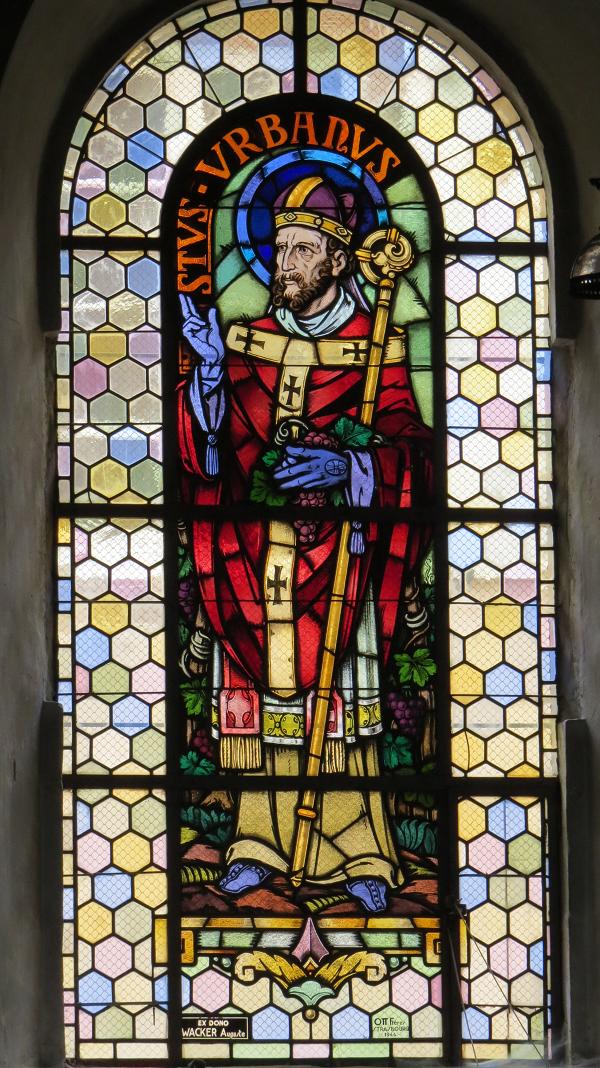
Today is the feast day of St. Urban of Langres (327 CE– c. 390 CE) was a French saint and bishop. He served as the sixth bishop of Langres from 374 until his death. Saint Leodegaria was his sister. During a period of persecution of the Church, Urban hid for a while in a vineyard. There he converted the vine dressers, who then helped him in his covert ministry. Due to their work, and to Urban’s devotion to the Holy Blood, he developed great affection to all the people in the wine industry, and they for him, which is why he’s a patron saint of vine dressers, vine growers, vintners, but also coopers and barrel-makers.

Wooden sculpture of St. Urban.

While Urban is probably more associated with the wine industry, the fact that coopers and barrel-makers consider him to be their patron, he’s also clearly part of the beer world, as well.

Most depictions of Urban show him with grapes.

Filed Under: Art & Beer, Just For Fun, Related Pleasures Tagged With: France, History, Religion & Beer

Beer Saints: St. Amand

February 6, 2021 By Jay Brooks

Today is also the feast day of St. Amand (c. 584 CE–679 CE). He was known for his hospitality, and is the patron saint of all who produce beer: brewers, innkeepers and bartenders and was also known as Amandus, Amandus of Elnon and Amantius. He was a bishop of Tongeren-Maastricht and one of the great Christian missionaries of Flanders. He is venerated as a saint, particularly in France and Belgium. He was born in Poitou, France, and died in the monastery at Elnone-en-Pevele (modern Saint-Amand-les-Eaux), France.

This account of his life is by T.J. Campbell from the Catholic Encyclopedia:

One of the great apostles of Flanders; born near Nantes, in France, about the end of the sixth century. He was, apparently, of noble extraction. When a youth of twenty, he fled from his home and became a monk near Tours, resisting all the efforts of his family to withdraw him from his mode of life. Following what he regarded as divine inspiration, he betook himself to Bourges, where under the direction of Saint Austregisile, the bishop of the city, he remained in solitude for fifteen years, living in a cell and subsisting on bread and water. After a pilgrimage to Rome, he was consecrated in France as a missionary bishop at the age of thirty-three. At the request of Clotaire II, he began first to evangelize the inhabitants of Ghent, who were then degraded idolaters, and afterwards extended his work throughout all Flanders, suffering persecution, and undergoing great hardship but achieving nothing, until the miracle of restoring the life of a criminal who had been hanged, changed the feelings of the people to reverence and affection and brought many converts to the faith. Monasteries at Ghent and Mt. Blandin were erected. They were the first monuments to the Faith in Belgium. Returning to France, in 630, he incurred the enmity of King Dagobert, who he had endeavoured to recall from a sinful life, and was expelled from the kingdom. Dagobert afterwards entreated him to return, asked pardon for the wrong done, and requested him to be tutor of the heir of the throne. The danger of living at court prompted the Saint to refuse the honour. His next apostolate was among of the Slavs of the Danube, but it met with no success, and we find him then in Rome, reporting to the pope what results had been achieved.

While returning to France he is said to have calmed a storm at sea. He was made Bishop of Maastricht about the year 649, but unable the repress the disorders of the place, he appealed to the Pope, Martin I, for instructions. The reply traced his plan of action with regard to fractious clerics, and also contained information about the Monothelite heresy, which was then desolating the East. Amandus was also commissioned to convoke councils in Neustria and Austrasia in order to have the decrees which had been passed at Rome read to the bishops of Gaul, who in turn commissioned him to bear the acts of their councils to the Sovereign Pontiff. He availed himself of this occasion to obtain his release from the bishopric of Maastricht, and to resume his work as a missionary. It was at this time that he entered into relations with the family of Pepin of Landen, and helped Saint Gertrude and Saint Itta to establish their famous monastery of Nivelles. Thirty years before he had gone into the Basque country to preach, but had met with little success. He was now requested by the inhabitants to return, and although seventy years old, he undertook the work of evangelizing them and appears to have banished idolatry from the land. Returning again to his country, he founded several monasteries, on one occasion at the risk of his life. Belgium especially boasts many of his foundations. Dagobert made great concessions to him for his various establishments. He died in his monastery of Elnon, at the age of ninety. His feast is kept 6 February.

And this history is from Catholic Online:

This great missionary was born in lower Poitou about the year 584. At the age of twenty, he retired to a small monastery in the island of Yeu, near that of Re. He had not been there more than a year when his father discovered him and tried to persuade him to return home. When he threatened to disinherit him, the saint cheerfully replied, “Christ is my only inheritance.” Amand afterward went to Tours, where he was ordained, and then to Bourges, where he lived fifteen years under the direction of St. Austregisilus, the bishop, in a cell near the cathedral. After a pilgrimage to Rome, he returned to France and was consecrated bishop in 629 without any fixed See, receiving a general commission to teach the Faith to the heathens. He preached the gospel in Flanders and northern France, with a brief excursion to the Slavs in Carinthia and perhaps, to Gascony. He reproved King Dagobert I for his crimes and accordingly, was banished. But Dagobert soon recalled him, and asked him to baptize his newborn son Sigebert, afterwards to become a king and a saint. The people about Ghent were so ferociously hostile that no preacher dared venture among them. This moved Amand to attempt that mission, in the course of which he was sometimes beaten and thrown into the river. He persevered, however, and in the end people came in crowds droves to be baptized.

As well as being a great missionary, St. Amand was a father of monasticism in ancient Belgium, and a score of monasteries claimed him as founder. He found houses at Elnone (Saint-Amand-les-Eaux), near Tournai, which became his headquarters, St. Peters on Mont-Blendin at Ghent, but probably not St. Bavo’s there as well; Nivells, for nuns, with Blessed Ida and St. Gertrude, Barisis-au-Bois, and probably three more. It is said, though possibly apocryphal, that in 646 he was chosen bishop of Maestricht, but that three years later, he resigned that See to St. Remaclus and returned to the missions which he had always had most at heart. He continued his labors among the heathens until a great age, when, broken with infirmities, he retired to Elnone. There he governed as Abbot for four years, spending his time in preparing for the death which came to him at last soon after 676. That St. Amand was one of the most imposing figures of the Merovingian epoch, is disputed by no serious historian; he was not unknown in England, and the pre-Reformation chapel of the Eyston family at east Hendred in Birkshire is dedicated in his honor.

St. Amandus and the serpent, from a 14th-century manuscript.

He has quite a few patronages, including the Boy Scouts, bar staff, barkeepers, bartenders, brewers, grocers, hop growers, hotel keepers, innkeepers, merchants, pharmacists, druggists, vinegar makers, vine growers, vintners, wine-makers, and wine merchants; plus he’s against diseases of cattle, against fever, against paralysis, against rheumatism, against seizures, against skin diseases, against vision problems; and of the places: Flanders, Belgium; Maastricht, Netherlands; Salzburg, Austria; Utrecht, Netherlands; and Wingene, Belgium.

Leaded glass window (detail) of St. Amand in the Catholic parish church of Saint-Vincent-de-Paul in Clichy, France.

Modern Usage

There are several examples of beers named for St. Amand and at least one beer importer.

  1. St. Amand French Country Ale from Brasserie Castelain, though it’s no longer on their website so maybe they discontinued it.

2. Brasserie Brunehaut also used to make an Abbaye de St Amand beer.

3. There’s also a St Amand Imports that imports a few beer brands.

Filed Under: Art & Beer, Just For Fun, Related Pleasures Tagged With: Belgium, France, Religion & Beer

Beer In Ads #3595: Grande Brasserie Mapataud Centaur’s Dancing

December 31, 2020 By Jay Brooks

Thursday’s ad is for “Grande Brasserie Mapataud,” from maybe the early 1920s or 30s. From the late 1800s until the 1960s, poster art really came into its own, and in Europe a lot of really cool posters, many of them for breweries, were produced. This poster was made for Brasserie Bertrand-Mapataud in Limoges, which is in central France. It was founded in 1765. Unfortunately, I couldn’t find out any more information about the French brewery. I’m not sure who created this poster of the brewery, and I wish I could find a larger image of it because I love that it appears to be showing a large floating pint of beer, with centaurs with wings flying around it, hand-in-hand, like it was a maypole.

Filed Under: Art & Beer, Beers Tagged With: Advertising, France, History

Beer In Ads #3594: Brasserie Mapataud

December 30, 2020 By Jay Brooks

Wednesday’s ad is for “Brasserie Mapataud,” from maybe the early 1920s or 30s. From the late 1800s until the 1960s, poster art really came into its own, and in Europe a lot of really cool posters, many of them for breweries, were produced. This poster was made for Brasserie Bertrand-Mapataud in Limoges, which is in central France. It was founded in 1765. Unfortunately, I couldn’t find out any more information about the French brewery. I’m not sure who created this poster of the brewery. It appears to be signed under the table by an artist whose name begins with the letter “S” but I can’t make out the rest.

Filed Under: Art & Beer, Beers Tagged With: Advertising, France, History

Beer In Ads #3593: Grand Brasserie Mapataud

December 29, 2020 By Jay Brooks

Tuesday’s ad is for the “Grand Brasserie Mapataud,” from 1933. From the late 1800s until the 1960s, poster art really came into its own, and in Europe a lot of really cool posters, many of them for breweries, were produced. This poster was made for Brasserie Bertrand-Mapataud in Limoges, which is in central France. It was founded in 1765. Unfortunately, I couldn’t find out any more information about the French brewery. I’m not sure who created this poster of the brewery.

Filed Under: Art & Beer, Beers Tagged With: Advertising, France, History

Beer In Ads #3592: Bieres Mapataud Grand Prix Brune & Blonde

December 28, 2020 By Jay Brooks

Monday’s ad is for “Bieres Mapataud Grand Prix,” from maybe the 1890s. From the late 1800s until the 1960s, poster art really came into its own, and in Europe a lot of really cool posters, many of them for breweries, were produced. This poster was made for Brasserie Bertrand-Mapataud in Limoges, which is in central France. Unfortunately, I couldn’t find out any information about the French brewery. I’m not sure who created this poster. It appears to be signed but it’s stylized and I can’t make it out.

Filed Under: Art & Beer, Beers Tagged With: Advertising, France, History

« Previous Page
Next Page »

Find Something

Northern California Breweries

Please consider purchasing my latest book, California Breweries North, available from Amazon, or ask for it at your local bookstore.

Recent Comments

  • Bob Paolino on Beer Birthday: Grant Johnston
  • Gambrinus on Historic Beer Birthday: A.J. Houghton
  • Ernie Dewing on Historic Beer Birthday: Charles William Bergner 
  • Steve 'Pudgy' De Rose on Historic Beer Birthday: Jacob Schmidt
  • Jay Brooks on Beer Birthday: Bill Owens

Recent Posts

  • Beer In Ads #5276: Last Call For Bock Beer June 26, 2026
  • Beer Birthday: Jamil Zainasheff June 26, 2026
  • Historic Beer Birthday: Isaac Leisy June 26, 2026
  • Historic Beer Birthday: James Anderton June 26, 2026
  • Beer Birthday: Alan Moen June 26, 2026

BBB Archives

Feedback

Head Quarter
This site is hosted and maintained by H25Q.dev. Any questions or comments for the webmaster can be directed here.