Brookston Beer Bulletin

Jay R. Brooks on Beer

  • Home
  • About
  • Editorial
  • Birthdays
  • Art & Beer

Socialize

  • Dribbble
  • Email
  • Facebook
  • Flickr
  • GitHub
  • Instagram
  • LinkedIn
  • Pinterest
  • RSS
  • Twitter
  • YouTube

Powered by Genesis

Beer Saints: St. Amand

February 6, 2021 By Jay Brooks

Today is also the feast day of St. Amand (c. 584 CE–679 CE). He was known for his hospitality, and is the patron saint of all who produce beer: brewers, innkeepers and bartenders and was also known as Amandus, Amandus of Elnon and Amantius. He was a bishop of Tongeren-Maastricht and one of the great Christian missionaries of Flanders. He is venerated as a saint, particularly in France and Belgium. He was born in Poitou, France, and died in the monastery at Elnone-en-Pevele (modern Saint-Amand-les-Eaux), France.

This account of his life is by T.J. Campbell from the Catholic Encyclopedia:

One of the great apostles of Flanders; born near Nantes, in France, about the end of the sixth century. He was, apparently, of noble extraction. When a youth of twenty, he fled from his home and became a monk near Tours, resisting all the efforts of his family to withdraw him from his mode of life. Following what he regarded as divine inspiration, he betook himself to Bourges, where under the direction of Saint Austregisile, the bishop of the city, he remained in solitude for fifteen years, living in a cell and subsisting on bread and water. After a pilgrimage to Rome, he was consecrated in France as a missionary bishop at the age of thirty-three. At the request of Clotaire II, he began first to evangelize the inhabitants of Ghent, who were then degraded idolaters, and afterwards extended his work throughout all Flanders, suffering persecution, and undergoing great hardship but achieving nothing, until the miracle of restoring the life of a criminal who had been hanged, changed the feelings of the people to reverence and affection and brought many converts to the faith. Monasteries at Ghent and Mt. Blandin were erected. They were the first monuments to the Faith in Belgium. Returning to France, in 630, he incurred the enmity of King Dagobert, who he had endeavoured to recall from a sinful life, and was expelled from the kingdom. Dagobert afterwards entreated him to return, asked pardon for the wrong done, and requested him to be tutor of the heir of the throne. The danger of living at court prompted the Saint to refuse the honour. His next apostolate was among of the Slavs of the Danube, but it met with no success, and we find him then in Rome, reporting to the pope what results had been achieved.

While returning to France he is said to have calmed a storm at sea. He was made Bishop of Maastricht about the year 649, but unable the repress the disorders of the place, he appealed to the Pope, Martin I, for instructions. The reply traced his plan of action with regard to fractious clerics, and also contained information about the Monothelite heresy, which was then desolating the East. Amandus was also commissioned to convoke councils in Neustria and Austrasia in order to have the decrees which had been passed at Rome read to the bishops of Gaul, who in turn commissioned him to bear the acts of their councils to the Sovereign Pontiff. He availed himself of this occasion to obtain his release from the bishopric of Maastricht, and to resume his work as a missionary. It was at this time that he entered into relations with the family of Pepin of Landen, and helped Saint Gertrude and Saint Itta to establish their famous monastery of Nivelles. Thirty years before he had gone into the Basque country to preach, but had met with little success. He was now requested by the inhabitants to return, and although seventy years old, he undertook the work of evangelizing them and appears to have banished idolatry from the land. Returning again to his country, he founded several monasteries, on one occasion at the risk of his life. Belgium especially boasts many of his foundations. Dagobert made great concessions to him for his various establishments. He died in his monastery of Elnon, at the age of ninety. His feast is kept 6 February.

And this history is from Catholic Online:

This great missionary was born in lower Poitou about the year 584. At the age of twenty, he retired to a small monastery in the island of Yeu, near that of Re. He had not been there more than a year when his father discovered him and tried to persuade him to return home. When he threatened to disinherit him, the saint cheerfully replied, “Christ is my only inheritance.” Amand afterward went to Tours, where he was ordained, and then to Bourges, where he lived fifteen years under the direction of St. Austregisilus, the bishop, in a cell near the cathedral. After a pilgrimage to Rome, he returned to France and was consecrated bishop in 629 without any fixed See, receiving a general commission to teach the Faith to the heathens. He preached the gospel in Flanders and northern France, with a brief excursion to the Slavs in Carinthia and perhaps, to Gascony. He reproved King Dagobert I for his crimes and accordingly, was banished. But Dagobert soon recalled him, and asked him to baptize his newborn son Sigebert, afterwards to become a king and a saint. The people about Ghent were so ferociously hostile that no preacher dared venture among them. This moved Amand to attempt that mission, in the course of which he was sometimes beaten and thrown into the river. He persevered, however, and in the end people came in crowds droves to be baptized.

As well as being a great missionary, St. Amand was a father of monasticism in ancient Belgium, and a score of monasteries claimed him as founder. He found houses at Elnone (Saint-Amand-les-Eaux), near Tournai, which became his headquarters, St. Peters on Mont-Blendin at Ghent, but probably not St. Bavo’s there as well; Nivells, for nuns, with Blessed Ida and St. Gertrude, Barisis-au-Bois, and probably three more. It is said, though possibly apocryphal, that in 646 he was chosen bishop of Maestricht, but that three years later, he resigned that See to St. Remaclus and returned to the missions which he had always had most at heart. He continued his labors among the heathens until a great age, when, broken with infirmities, he retired to Elnone. There he governed as Abbot for four years, spending his time in preparing for the death which came to him at last soon after 676. That St. Amand was one of the most imposing figures of the Merovingian epoch, is disputed by no serious historian; he was not unknown in England, and the pre-Reformation chapel of the Eyston family at east Hendred in Birkshire is dedicated in his honor.
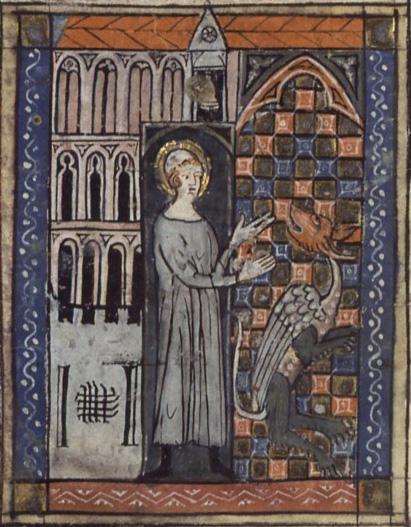
St. Amandus and the serpent, from a 14th-century manuscript.

He has quite a few patronages, including the Boy Scouts, bar staff, barkeepers, bartenders, brewers, grocers, hop growers, hotel keepers, innkeepers, merchants, pharmacists, druggists, vinegar makers, vine growers, vintners, wine-makers, and wine merchants; plus he’s against diseases of cattle, against fever, against paralysis, against rheumatism, against seizures, against skin diseases, against vision problems; and of the places: Flanders, Belgium; Maastricht, Netherlands; Salzburg, Austria; Utrecht, Netherlands; and Wingene, Belgium.

Leaded glass window (detail) of St. Amand in the Catholic parish church of Saint-Vincent-de-Paul in Clichy, France.

Modern Usage

There are several examples of beers named for St. Amand and at least one beer importer.

  1. St. Amand French Country Ale from Brasserie Castelain, though it’s no longer on their website so maybe they discontinued it.

2. Brasserie Brunehaut also used to make an Abbaye de St Amand beer.

3. There’s also a St Amand Imports that imports a few beer brands.
Filed Under: Art & Beer, Just For Fun, Related Pleasures Tagged With: Belgium, France, Religion & Beer

Beer In Ads #3595: Grande Brasserie Mapataud Centaur’s Dancing

December 31, 2020 By Jay Brooks

Thursday’s ad is for “Grande Brasserie Mapataud,” from maybe the early 1920s or 30s. From the late 1800s until the 1960s, poster art really came into its own, and in Europe a lot of really cool posters, many of them for breweries, were produced. This poster was made for Brasserie Bertrand-Mapataud in Limoges, which is in central France. It was founded in 1765. Unfortunately, I couldn’t find out any more information about the French brewery. I’m not sure who created this poster of the brewery, and I wish I could find a larger image of it because I love that it appears to be showing a large floating pint of beer, with centaurs with wings flying around it, hand-in-hand, like it was a maypole.

Filed Under: Art & Beer, Beers Tagged With: Advertising, France, History

Beer In Ads #3594: Brasserie Mapataud

December 30, 2020 By Jay Brooks

Wednesday’s ad is for “Brasserie Mapataud,” from maybe the early 1920s or 30s. From the late 1800s until the 1960s, poster art really came into its own, and in Europe a lot of really cool posters, many of them for breweries, were produced. This poster was made for Brasserie Bertrand-Mapataud in Limoges, which is in central France. It was founded in 1765. Unfortunately, I couldn’t find out any more information about the French brewery. I’m not sure who created this poster of the brewery. It appears to be signed under the table by an artist whose name begins with the letter “S” but I can’t make out the rest.

Filed Under: Art & Beer, Beers Tagged With: Advertising, France, History

Beer In Ads #3593: Grand Brasserie Mapataud

December 29, 2020 By Jay Brooks

Tuesday’s ad is for the “Grand Brasserie Mapataud,” from 1933. From the late 1800s until the 1960s, poster art really came into its own, and in Europe a lot of really cool posters, many of them for breweries, were produced. This poster was made for Brasserie Bertrand-Mapataud in Limoges, which is in central France. It was founded in 1765. Unfortunately, I couldn’t find out any more information about the French brewery. I’m not sure who created this poster of the brewery.

Filed Under: Art & Beer, Beers Tagged With: Advertising, France, History

Beer In Ads #3592: Bieres Mapataud Grand Prix Brune & Blonde

December 28, 2020 By Jay Brooks

Monday’s ad is for “Bieres Mapataud Grand Prix,” from maybe the 1890s. From the late 1800s until the 1960s, poster art really came into its own, and in Europe a lot of really cool posters, many of them for breweries, were produced. This poster was made for Brasserie Bertrand-Mapataud in Limoges, which is in central France. Unfortunately, I couldn’t find out any information about the French brewery. I’m not sure who created this poster. It appears to be signed but it’s stylized and I can’t make it out.

Filed Under: Art & Beer, Beers Tagged With: Advertising, France, History

Beer In Ads #3591: Bieres Mapataud Brune & Blonde

December 27, 2020 By Jay Brooks

Sunday’s ad is for “Bieres Mapataud,” from the 1890s. From the late 1800s until the 1960s, poster art really came into its own, and in Europe a lot of really cool posters, many of them for breweries, were produced. This poster was made for Brasserie Bertrand-Mapataud in Limoges, which is in central France. Unfortunately, I couldn’t find out any information about the French brewery. This poster may have been created by artist Sam Marcoz, at least that what the signature looks like.

Filed Under: Art & Beer, Beers Tagged With: Advertising, France, History

Beer In Ads #3590: Bieres Mapataud

December 26, 2020 By Jay Brooks

Saturday’s ad is for “Bieres Mapataud,” from 1928. From the late 1800s until the 1960s, poster art really came into its own, and in Europe a lot of really cool posters, many of them for breweries, were produced. This poster was made for Brasserie Bertrand-Mapataud in Limoges, which is in central France. Unfortunately, I couldn’t find out any information about the French brewery. This poster may have been created by French artist Paul Igert.

Filed Under: Art & Beer, Beers Tagged With: Advertising, France, History

Beer In Ads #3587: G. Amos Brauerei

December 23, 2020 By Jay Brooks

Tuesday’s ad is for Biere de la Brasserie Amos, a.k.a. the G. Amos Brauerei, from late 1800s. From the late 1800s until the 1970s, poster art really came into its own, and in Europe a lot of really cool posters, many of them for breweries, were produced. This poster was created for Brasserie Amos, which was founded in 1868 in Metz, in the department of Moselle, which is located in the Lorraine region of Eastern France. The brewery was founded by Gustave Amos, and remained in the Amos family until 1988, when it was sold to the German company Karlsberg, which is known as Karlsbräu outside of Germany to avoid confusion with the Danish Carlsberg. They closed the brewery in 1993, but continue to brew the beer at one of their other breweries, Brasserie Licorne, located in the Alsace. I’m not sure who created this poster.

Filed Under: Art & Beer, Beers Tagged With: Advertising, France, History

Beer In Ads #3586: Amos Hundred Years Of Health

December 22, 2020 By Jay Brooks

Tuesday’s ad is for Biere de la Brasserie Amos, from 1960. From the late 1800s until the 1970s, poster art really came into its own, and in Europe a lot of really cool posters, many of them for breweries, were produced. This poster was created for Brasserie Amos, which was founded in 1868 in Metz, in the department of Moselle, which is located in the Lorraine region of Eastern France. The brewery was founded by Gustave Amos, and remained in the Amos family until 1988, when it was sold to the German company Karlsberg, which is known as Karlsbräu outside of Germany to avoid confusion with the Danish Carlsberg. They closed the brewery in 1993, but continue to brew the beer at one of their other breweries, Brasserie Licorne, located in the Alsace. The text at the bottom, “Cent Ans De Santé,” Google translates as “Hundred Years Of Health.” This poster was created by French artist Raymond Gay.

The poster also sometimes appears with a lighter blue background.

Filed Under: Art & Beer, Beers Tagged With: Advertising, France, History

Beer In Ads #3585: Biere de la Brasserie Amos

December 21, 2020 By Jay Brooks

Monday’s ad is for Biere de la Brasserie Amos, from 1962. From the late 1800s until the 1970s, poster art really came into its own, and in Europe a lot of really cool posters, many of them for breweries, were produced. This poster was created for Brasserie Amos, which was founded in 1868 in Metz, in the department of Moselle, which is located in the Lorraine region of Eastern France. The brewery was founded by Gustave Amos, and remained in the Amos family until 1988, when it was sold to the German company Karlsberg, which is known as Karlsbräu outside of Germany to avoid confusion with the Danish Carlsberg. They closed the brewery in 1993, but continue to brew the beer at one of their other breweries, Brasserie Licorne, located in the Alsace. I don’t know who created this poster.

And here’s another version of the poster as a sign:

Filed Under: Art & Beer, Beers Tagged With: Advertising, France, History

« Previous Page
Next Page »

Find Something

Northern California Breweries

Please consider purchasing my latest book, California Breweries North, available from Amazon, or ask for it at your local bookstore.

Recent Comments

  • Bob Paolino on Beer Birthday: Grant Johnston
  • Gambrinus on Historic Beer Birthday: A.J. Houghton
  • Ernie Dewing on Historic Beer Birthday: Charles William Bergner 
  • Steve 'Pudgy' De Rose on Historic Beer Birthday: Jacob Schmidt
  • Jay Brooks on Beer Birthday: Bill Owens

Recent Posts

  • Historic Beer Birthday: John L. Hoerber October 24, 2026
  • Historic Beer Birthday: Antonie van Leeuwenhoek October 24, 2026
  • Historic Beer Birthday: Elias Daniel Barnitz October 24, 2026
  • Historic Beer Birthday: Warren Marti October 23, 2026
  • Historic Beer Birthday: William Anderton October 23, 2026

BBB Archives

Feedback

Head Quarter
This site is hosted and maintained by H25Q.dev. Any questions or comments for the webmaster can be directed here.