
Monday’s ad is a 1948 ad for Rheingold Beer, featuring Miss Rheingold for that year, Pat Quinlan. In the ad, Miss Quinlan is on board a boat of some kind, hoisting maritime signal flags spelling out “D-R-Y,” as in Rheingold Extra Dry.


Monday’s ad is a 1948 ad for Rheingold Beer, featuring Miss Rheingold for that year, Pat Quinlan. In the ad, Miss Quinlan is on board a boat of some kind, hoisting maritime signal flags spelling out “D-R-Y,” as in Rheingold Extra Dry.

Our 79th Guinness uses the tagline “Opening Time Is Guinness Time.” In this case, the opening refers to the oyster, with a smiling pint of Guinness resting inside. The slogan at the bottom is the common “Guinness is good for you.” My one question, is since when did oysters have eyes?

Friday’s ad is a 1951 ad for Rheingold Beer, featuring Miss Rheingold for that year, Elise Gammon. In the ad, Miss Gammon is ready for the hunt, surrounded by hound dogs. Did Americans ever do the full British fox hunts? Because old ads sure seem to use the theme a lot.

Thursday’s ad is a 1956 ad for Rheingold Beer, featuring Miss Rheingold for that year, Millie Merritt. In the ad, Miss Merritt is wearing an exotic red dress sitting in the old barn with her squeeze box accordion, waiting for the performance, as the sign behind her promises, to take place “tonig.”

Wednesday’s ad is a 1948 ad for Rheingold Beer, featuring Miss Rheingold for that year, Pat Quinlan. In the ad, Miss Quinlan is carrying two baskets with three puppies and kittens in each. With the garden in the background, it almost looks like she’s just come back from picking them.

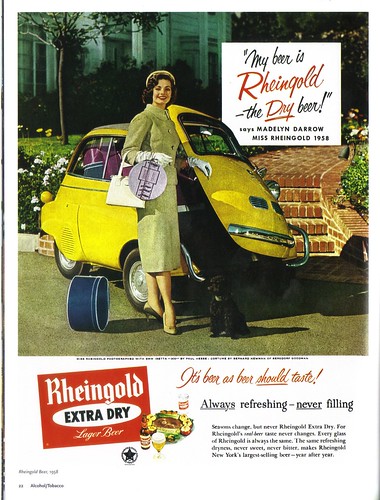
Tuesday’s ad is a 1958 ad for Rheingold Beer, featuring Miss Rheingold for that year, Madelyn Darrow. In the ad, Miss Darrow is apparently trying to figure out how many hats she can fit into a three-wheeled precursor to the smart car.
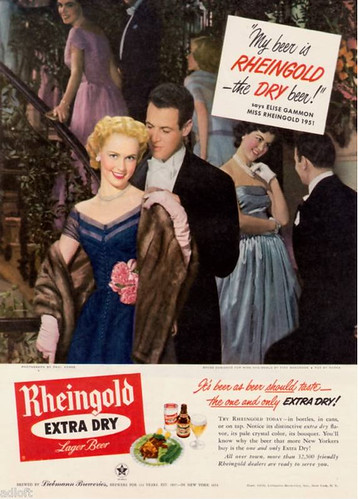
Monday’s ad is a 1951 ad for Rheingold Beer, featuring Miss Rheingold for that year, Elise Gammon. In the ad, Miss Gammon is arriving — or leaving? — a cocktail party and is either taking her mink off or putting on — it could be either, maybe that was the point?
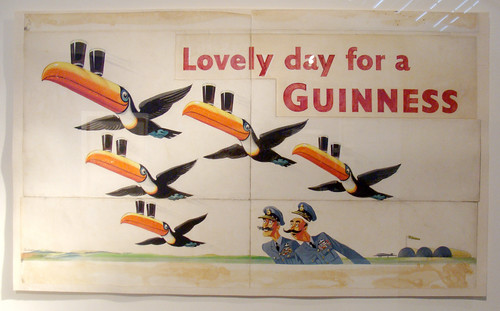
Our 78th Guinness is the scan of an original mock-up using the tagline “Lovely day for a Guinness.” Most likely it was meant for the time period during World War II given the military men and the Toucans flying in formation.
Thursday’s ad is another one for Schlitz, this time much later, from 1968. Using their popular “When you’re out of Schlitz, you’re out of beer” slogan. The image, though, is a less-than-flattering angle.


Charlie Papazian had an interesting series of posts (See Part 1, Part 2 and Part 3) a few years back that I thought was worth revisiting about what he refers to as “heritage breweries,” a term that he used to describe the few small breweries that not only survived prohibition but are still in business today, over 75 year later. According to his research, when prohibition summarily closed down thriving businesses in 1919, at a stroke 1,179 breweries were out of business, or at least no longer allowed to make their primary product: beer.
Of the ones that reopened thirteen years later, when prohibition was repealed only a handful managed to make it into the present, braving untold challenges, merger-manias, fickle consumers and ever more oppressive attacks by neo-prohibitionists unconvinced of prohibition’s massive failure. Papazian divides the heritage brewers into four types:
Of the first type, those still owned by the original family, only four remain.
For the second type, breweries still considered independent but no longer owned by their original founders or their family, there are a mere seven left.
Of the third type, breweries “no longer owned by the original family, nor independent of a large brewing company,” only one remains, and I’m not sure if it really does fit in the third group.
I say that because it seems to me that while MillerCoors does own the brewery outright, the family, led today by Jake Leinenkugel, does maintain a certain amount of autonomy and makes a lot of their own decisions about the business. I interviewed Jake a number of years ago for an article I wrote for American Brewer magazine, and that was certainly the impression I was left with. It may not be “owned” by the family any longer, but they do seem to control their own destiny, and that has to count for something.
The fourth, and final category, as outlined by Papazian, is one in which the “original family ownership and location is far removed from the current operation.” Of this type, there are only two remaining.
Totaled up, there are only thirteen breweries still in existence that were in business 92 years ago, when prohibition began. Twelve, if you discount brands that are contract brewed, such as Dixie is now post-Katrina. Now that’s just small breweries, but the picture’s not much rosier even if you include everybody, big and small.
Even pulling everybody, big or small, contract beer company or actual brewery, that’s still only 18 remaining from the original 1,179 left. That’s only 1.5% still in business after 82 years. Back out the big guys, and it’s 1.2%. I’m an inveterate pessimist, so I find that sad. I know that’s business in general, and many of the brewery mergers are the result of the cannibalistic nature of many of the big brewers (and corporate business more generally), but I’m a romantic pessimist, the worst kind. As much as I don’t really like the beers so many of the fallen breweries (and many of the remaining big ones, too) make, I still think we lose some part of our history every time yet another one closes or is bought out.