Brookston Beer Bulletin

Jay R. Brooks on Beer

  • Home
  • About
  • Editorial
  • Birthdays
  • Art & Beer

Socialize

  • Dribbble
  • Email
  • Facebook
  • Flickr
  • GitHub
  • Instagram
  • LinkedIn
  • Pinterest
  • RSS
  • Twitter
  • YouTube

Powered by Genesis

Sober Statistics

January 24, 2010 By Jay Brooks

no-drinking-pint
Here’s an interesting list. Usually, we hear about the top drinking cities, but this is the top ten (or bottom ten, depending on your perspective) cities for NOT drinking, that is the cities and towns that don’t drink very much. I found the list in a U.S. News & World Report article but the data comes from the CDC (and is for communities of 10,000 or more people). The first four are pretty clear, but then it’s a four-way tie for fifth followed by a two-way tie.

  1. Provo-Orem, UT (99.4)
  2. Idaho Falls, ID (97.9)
  3. Hickory, NC (97.8)
  4. Ogden, UT (97.5)
  5. Brownsville, TX (97.2)
  6. Fayetteville, NC (97.2)
  7. Raleigh, NC (97.2)
  8. Wichita, KS (97.2)
  9. Cheyenne, WY (97.0)
  10. Farmington, NM (97.0)

Not many surprises from what you might guess, except that when you look deeper at the statistics, something odd emerges, at least to me. Those parenthetical numbers represent the percentage of people surveyed who said they don’t drink “more than two drinks per day” (if adult males) or “more than one drink per day” (if adult females). Otherwise — get this — they’re considered “heavy drinkers.” That’s right, have more than two drinks on the same day ever and you’re a heavy drinker. It’s hard to imagine a more useless way to define this, unless you’re trying to inflate the numbers and make it appear that problem drinking is more of a … well. problem, than it actually is. Defining heavy drinkers as “adult men having more than two drinks per day and adult women having more than one drink per day” undoubtedly accomplishes that, especially when you consider that the CDC defines binge drinkings as five or more drinks during one session (4 if you’re female). This is how to create a problem that doesn’t exist. (Note: I don’t mean that there aren’t problem drinkers, I only question that it’s as epidemic as these statistics suggest.) The way it is now, drink one or two beers a day, you’re fine. But have a third and you’re a “heavy drinker.” Have two more for a total of five and you’re — gasp — a “binge drinker.” Really?

stay-sober

Using the same data from the CDC survey, the top 10 heaviest drinking cities are:

  1. Reno, NV
  2. Palm Bay-Melbourne, FL
  3. Boulder, CO
  4. Austin, TX
  5. Charleston, SC
  6. McAllen, TX
  7. Naples-Marco Island, FL
  8. Riverside, CA
  9. Cape Coral, FL
  10. Barnstable Town, MA

That’s a strange list, too, and not what I would have predicted. Three in Florida and six total from the southern states. You just have to wonder how truthfully people answer a question like this when it’s posed.

Filed Under: Beers, Just For Fun Tagged With: Prohibitionists, Statistics

Falling Beer Sales?

January 23, 2010 By Jay Brooks

graphchart
I meant to comment on this more fully before now, but my friend and colleague Stephen Beaumont beat me to the punch with his post, A Victory for Boire Moins, Boire Mieux. He had nearly the exact same thought I had, too, though not in French. Boire Moins, Boire Mieux translates as Drink Less, Drink Better, the unofficial ad hoc motto of craft beer.

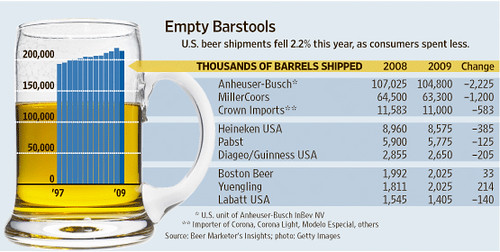
I’m referring to a Wall Street Journal article published Thursday, Falling Beer Sales Have Brewery Mergers Over a Barrel, where they detailed how beer sales have fallen 2.2%, the first year since 2003 that showed negative growth in total beer sales volume (and the highest negative number since the 1950s). And sure that’s what the numbers say, from one perspective, at least. The Journal, an unabashedly pro-business paper, lost no time decrying the terrible implications for big business and especially the on-going merger-mania the big beer companies are engaging in. There’s also a handy chart.

wsj-chart-1001

And sure, they all show declining volume, except for two near the bottom, Boston Beer and Yuengling. And that’s the tip of an iceberg that tells a very different story than the one the Wall Street Journal is telling. As Beaumont notes, “nearly every craft brewer I speak with is sounding quite happy with their sales figures from the preceding year and optimistic about 2010.” And that’s exactly what I’ve been hearing all along the hopvine, too. The 1500+ breweries that didn’t brew more than 2-million barrels a year, are doing quite well, thank you very much. Not all of them, of course — some brewpubs have been struggling with less people eating out — but overall they’re trending positively. And that’s a very different story than the Journal is telling.

So I’ll leave you with Stephen’s conclusion:

The BBC and Yuengling numbers are important because they represent what I believe is really going on, which is not so much a literal “worsening” of demand, but rather a shift in demand, coupled with a growing endorsement of the old French axiom boire moins, boire mieux, or “drink less, drink better.” Simply, the battle is between style and substance, and right now, substance appears to be winning!

The WSJ doesn’t see this because they’re used to looking only at the large, public corporation side of things, rather than the successful entrepreneur side. Then again, weren’t they the ones who years ago predicted that the craft beer craze was finished?

Filed Under: Breweries, Editorial Tagged With: Statistics

Stuff & Nonsense, Part 10

January 19, 2010 By Jay Brooks

Last week, you probably recall I was following Pete Brown’s brilliant refutation of his national health service’s attack on alcohol, beginning with, Stuff & Nonsense: The UK Health Select Committee Report On Alcohol. The first nine parts of Pete’s rebuke were posted last week and today part ten, the last one, was also posted.

In part 10, Pete tackles an issue that isn’t entirely relevant in the U.S., because as far as I know there aren’t any states that allow it. The issue is Binge drinking has been made much worse by 24 hour licensing. Despite that, it’s a still a great read an interesting peek into the window of manipulation that’s taking place at the hands of the UK Parliament. This, sadly, is similar to our shores where neo-prohibitionists have worked their way — and their agenda — into politics at all levels. The rest of us, understandably were busy just trying to enjoy our lives, and so missed seeing what was going on until it was nearly too late.

Part of the problem here, at least in comparison to the UK, is we don’t have the same tradition of pub culture. When we separated from mother England, our two drinking cultures diverged dramatically. England’s stayed something that was part of their culture, something to be proud of, that had national associations. Ours fractured into taverns, pubs, dive bars, biker bars, fern bars, niteclubs, pool halls, chain bars, etc. And from the beginning of the temperance movements, all those were demonized and continue to be demonized. It’s a rare bar in the U.S. that can call itself a family place. And that’s at least part of the reason why so many can’t see alcohol as part of society, but something to be feared and separated, especially from — gasp — the little children.

That’s also why it was great seeing Pete’s addendum to his series, Answering the Neo-Prohibitionists — A Series Disclaimer. In it, Pete relates some personal stories of how alcohol abuse has affected him. It sounds like he didn’t want to recall such painful memories, but felt he had to do so, so that people criticizing him understood where he was coming from and that he did understand that alcohol can be destructive. I get that, too; the criticism for talking about neo-prohibitionists too much. But for whatever reason, I don’t mind talking about my own history with alcohol abuse. I grew up with an abusive, alcoholic, violent, clinically psychotic stepfather. He surrounded himself with other alcoholics and I all but grew up in bars around eastern Pennsylvania.

I’ve even written about it before, both here and as a semi-fictional memoir I did for NaNoWriMo a few years ago. The rough draft I wrote extemporaneously is still online, actually. It’s called Under the Table and hasn’t been edited since 2006, so expect lots of typos, run-on sentences and all manner of grammar horrors, assuming you’ve got a lots of spare hours to kill and have any desire to crawl inside my head (don’t say you haven’t been warned).

But the reason for bringing this up now is that even as a child I understood something the average neo-prohibitionist can’t seem to wrap his or her head around. And that’s the fact that my stepfather was — and indeed most alcoholics are — that way for reasons that have nothing to do with the booze itself. Attacking the product and its manufacturers and consumer’s access to them does absolutely nothing to stop people from drinking. If anything, it exacerbates those problems. Witness American Prohibition. Did it stop people from drinking? No. Did it increase crime? Yes. Did it work? Not even a little, yet there are people for whom that lesson counts for nothing and want to give it another go.

Here’s Pete’s take:

Firstly, because having witnessed it close up, I know that when people step up to fight alcohol abuse, they go for the wrong targets. People don’t drink harmfully because alcohol is there, or because it’s cheap, or because it’s advertised. Restricting the availability of alcohol won’t help alcoholics. These people live for alcohol – it’s the only thing they care about. Make it expensive and they’ll go without food, sell their house, Christ, they’d sell their fucking kids for a drink. Prohibit it altogether and they’ll drink meths, or nail varnish remover, or after shave.

Alcoholics drink not because it’s there, or cheap, or tastes nice, but because they have deeper trauma and/or unhappiness in their lives. Even if you were studying this at GCSE level, if you look at it scientifically, if availability/pricing/advertising of booze caused problem drinking, then everyone exposed to it would be more likely to problem drink. But most people in theUK are drinking less. A minority are drinking to harmful levels. And as far as I can tell, no one is studying that minority in detail and asking what it is about them that makes them different from the majority.

It’s easy to blame the availability of booze. And it is shameful that problem drinkers are not being researched in a way that can highlight what it is that’s different about them that makes them more likely to problem drink.

People drink to excess because they are unhappy, because they feel empty inside, because they are lonely, because they are stressed, because they have shit jobs being bullied in call centres and alcoholic oblivion is the only escape they can see. Why is no one helping them? Because it’s a bit more complicated than just blaming drink, that’s why.

Secondly, I’m doing this because for the vast majority of people, drink is an innocent pleasure with minimal health risks beyond a few extra pounds or the odd hangover. My father died of smoking-related lung cancer when he was 58 and I was 27. I’ve read the science, and I know that there is a direct linear relationship between smoking and ill health – every single cigarette you smoke causes you damage. Drink is not the same. There are healthy levels of alcohol consumption.

My close quarters witnessing of the destruction alcoholism can cause makes me more keenly aware of the benefits of moderate consumption, and the stark difference between the two. So it makes me very angry indeed when someone who doesn’t know what they’re talking about tars all habitual drinkers with the same brush. And even angrier when newspapers distort the facts even further for nothing more than a sensationalist story.

Thirdly – quite simply, because it needs doing. A quick review of press stories about alcohol over the last week alone will show you how drinking is being demonised and made socially unacceptable. It’s based on lies and distortions. The figures say the problem is not getting any worse – if anything, the situation is improving. No one in the media seems to want to report this truth. No one questions press releases from avowedly anti-drink organisations. My blog posts might seem excessive if you’ve been staying tuned over the last week or so, but they amount to a fart in the face of a hurricane compared to the anti-drink propaganda that’s out there every single day.

In summary then – I know the ill effects of alcohol abuse as well as anyone, and care about them as much as anyone. I’ll never deny that there’s a problem, and am not seeking to do so on this blog.

But if that problem is going to be dealt with effectively, it has to be understood properly. I think the neopros are acting against the interests of the majority of drinkers. But worse, because they are approaching the problem over-simplistically, wilfully distorting the evidence, and confusing personal beliefs with real health issues, I don’t think their antics will do anything to help the people who really need helping. And that is just shameful.

That’s why I’m doing this.

Amen, brother.

To sum up, if this is new to you, start with Pete Brown’s Health Select Committee Report on Alcohol. Part One (of 10) was published Sunday, Alcohol consumption in the UK is increasing. On Monday, parts two, 25% of the UK population is drinking at hazardous or harmful levels, and three, Binge drinking is increasing, were published. Tuesday saw part four: Alcohol is becoming cheaper/more affordable, and yesterday part five, Alcohol related hospital admissions — and the cost of alcohol to the NHS — are soaring, was published online. Overnight and today, part six, Alcohol abuse costs the country £55bn a year, part seven, The best way to reduce the harmful effects of alcohol is to reduce overall consumption, part eight, Alcohol advertising and promotion must be tightly regulated because it encourages underage drinking, and part nine, Pubs are a problem, went up. And finally, part ten, Binge drinking has been made much worse by 24 hour licensing.

Filed Under: Editorial, Politics & Law Tagged With: Prohibitionists, Statistics, UK

Stuff & Nonsense, Parts 6 Through 9

January 14, 2010 By Jay Brooks

By now, even the casual Bulletin reader has likely noticed that I’ve been following Pete Brown’s brilliant refutation of his national health service’s attack on alcohol, beginning with, Stuff & Nonsense: The UK Health Select Committee Report On Alcohol. The first five parts of Pete’s rebuke have been published over the past few days, and overnight and this morning, west coast time, parts six through nine were posted.

In part 6, Pete tackles the assertion that Alcohol abuse costs the country £55bn a year
Today’s rebuke. In the U.S., this is claim made with alarming regularity, charging alcohol for all manner of sins, and ignoring personal responsibility, common sense and even logic. If there’s a whiff of alcohol anywhere in the vicinity, then by gum the whole thing is alky’s fault. Last year, the Marin Institute did their own study claiming in California alone alcohol costs $38 billion each year. It’s as self-serving a document you’ll ever read. In the UK report, they claim alcohol costs Britain either £20 or £55 billion pounds (which is 32.5 billion dollars or 89.5 billion dollars). This should give you some idea about who whacked our anti-alcohol folks are. The are just over 61 million people in the UK, but almost 37 million in California, yet they assert that, using the UK’s lower figure, alcohol costs more than the entire nation of Great Britain, with roughly half the number of people. It’s just so easy to lie with statistics, and, more profoundly sad, even easier to get the government and the media to swallow those lies without questioning them. But in any event, take a look at Pete’s analysis.

In part 7, the government trots out yet another old favorite, the wolf in sheep’s clothing that is the best way to reduce the harmful effects of alcohol is to reduce overall consumption. All we need to do to get rid of some people doing something we don’t like is make it illegal for everybody. Problem solved. Except that alcohol has been around since before the dawn of civilization and maybe 99.9% (full disclosure, I made that number up but the idea is that the vast majority) of people enjoy the occasional without ruining their lives, their loved ones, their careers, or even their livers. And numerous medical studies confirm a wide range of health benefits, not least of which is the fact that people who drink alcohol in moderation tend to outlive those who never touch the stuff.

In the case of the UK report, they claim to be advising just toward reducing consumption, but to where? To what level? It’s already be shown beyond doubt that the recommended levels that the UK advises were made up wholesale, pulled out of thin air. Just the notion that recommended safe amounts are the same for any two men or women is patently absurd, yet that’s the standard. The other problem I see with arguing for less overall consumption is that it’s a slippery slope. Today’s reduction is tomorrow’s outright ban. If less is more, then none must be best of all, right?

Part eight brings up to the most pernicious argument of all, and the one that always sticks in my craw. “It’s for the children,” they cry. “Doesn’t anybody think of the children.” What the UK says, is Alcohol advertising and promotion must be tightly regulated because it encourages underage drinking. While the report says the opposite, the truth is drinking is declining in the UK, and I suspect that’s true here, too. But it’s Pete’ summary that is most telling, showing the chain of absurdity.

The HSC says drinking among children is increasing. But recent official figures suggest it is falling.

The HSC simply asserts that advertising encourages young people to drink. But there is no evidence of a causal link, despite people looking very hard to try to find one.

So they imply that there is a link between awareness of alcohol brands and propensity to drink underage, because they can prove awareness. But there’s no evidence of this either.

So after having spent a long time discussing the content of alcohol ads, they then say it’s not the content, but the quantity of it that has an effect. There’s no evidence of this either.

So in the end, they disregard testimony from advertising professionals, and simply choose to believe the testimony of people who want alcohol advertising to be banned, say it is damaging to children, but can produce no evidence to back up their assertion.

Which brings us to part 9, Pubs are a problem. If alcohol is a problem, then the places where people drink it must also be dens of inequity, mustn’t they?

To sum up, if this is new to you, start with Pete Brown’s Health Select Committee Report on Alcohol. Part One (of 10) was published Sunday, Alcohol consumption in the UK is increasing. On Monday, parts two, 25% of the UK population is drinking at hazardous or harmful levels, and three, Binge drinking is increasing, were published. Tuesday saw part four: Alcohol is becoming cheaper/more affordable, and yesterday part five, Alcohol related hospital admissions — and the cost of alcohol to the NHS — are soaring, was published online. Overnight and today, part six, Alcohol abuse costs the country £55bn a year, part seven, The best way to reduce the harmful effects of alcohol is to reduce overall consumption, part eight, Alcohol advertising and promotion must be tightly regulated because it encourages underage drinking, and part nine, Pubs are a problem, went up. Once again, stay tuned. There’s one more part to go.

Filed Under: Editorial, Politics & Law Tagged With: Health & Beer, Prohibitionists, Statistics, UK

Stuff & Nonsense, Part 5

January 13, 2010 By Jay Brooks

By now, even the casual Bulletin reader has likely noticed that I’ve been following Pete Brown’s brilliant refutation of his national health service’s attack on alcohol, beginning with, Stuff & Nonsense: The UK Health Select Committee Report On Alcohol. The first four parts of Pete’s rebuke have been published over the past few days, and now part five is up.

Today’s rebuke concerns hospital admissions and the burden on the health care system, a facetious claim made on both sides of the pond. Over here, for example, an accident where one of the passengers had been drinking is often classified as an alcohol-related accident. In the UK:

In terms of official figures, what they don’t tell you is that when they are compiled, there’s a sharp difference between hospital admission and deaths that are considered wholly attributable to alcohol, and those where alcohol is a secondary or partial factor. And guess what? Only 25% of total ‘alcohol related’ hospital admissions are judged to be entirely due to alcohol.

At best, that simply misleads the statistics, making them sound more alarming than they really are. But it gets even worse, and in some ways goes beyond what American Neo-Prohibitionsts have been willing to say, at least so far.

The Report [implies] that if you drink, you are more likely to be a rapist, a child abuser, a wifebeater, a suicide, and that the fact that you drink makes you so. As Phil [Mellows] pointed out when he addressed the rape issue, this is not only inaccurate, it is astonishingly offensive to drinkers.

We’ve had groups here use images of a syringe filled with beer, equating beer with heroin, but so far as I know, they haven’t called those of us who drink rapists … yet. But they do seem to believe that virtually every societal ill can be pinned on alcohol.

But when someone does something appalling and then says, “The drink made me do it,” they are denying personal responsibility for their actions and we tend to dismiss this as a lame excuse. The Report seems to buy it 100%.

I could go on and on, but it’s best if I just suggest at this point that you go over and read part 5, Alcohol related hospital admissions — and the cost of alcohol to the NHS — are soaring. It’s the longest so far, but definitely worth your time.

If this is new to you, start with Pete Brown’s Health Select Committee Report on Alcohol. Part One (of 10) was published Sunday, Alcohol consumption in the UK is increasing. On Monday, parts two, 25% of the UK population is drinking at hazardous or harmful levels, and three, Binge drinking is increasing, were published. Tuesday saw part four: Alcohol is becoming cheaper/more affordable, and today part five, Alcohol related hospital admissions — and the cost of alcohol to the NHS — are soaring, was published online. Once again, stay tuned.

Filed Under: Editorial, Politics & Law Tagged With: Health & Beer, Prohibitionists, Statistics, UK

Stuff & Nonsense, Part 4

January 12, 2010 By Jay Brooks

If you’ve been following along from my posts the last couple of days, beginning with, Stuff & Nonsense: The UK Health Select Committee Report On Alcohol, and more specifically Pete Brown’s wonderfully telling and insightful rebuke of it all — and you should be — then I’m pleased to report that part four is now available.

Today’s rebuke is one I’d long wondered about, and it’s an argument often trotted out on our shores whenever the hue and cry goes up for more taxes on alcohol, as it inevitably and incessantly does. For me, perhaps the most annoying aspect to the neo-prohibitionist attacks is the never-ending nature of them. They’re like the psycho killer in every modern horror movie. There’s seemingly no way to make them stop. There’s no reasoning with them. They’re not susceptible to logic. California’s own version of a neo-prohibitionist Jason, state representative Jim Beall, said last year after his bill to raise beer taxes 560% was defeated. “They’ve given me a bloody nose. But I’m going to wipe it off and come back in a few weeks with something different.”

In today’s counter to the UK report’s assertion that Alcohol is becoming cheaper/more affordable, Pete leads with the following:

Well, alcohol is becoming more affordable because average household income is increasing. Alcohol is becoming more affordable because everything is becoming more affordable.

It’s my sense that’s what’s going on in the U.S., too. The “taxes haven’t been keeping pace with inflation” argument is likewise untrue for the UK.

[A]ffordability and price are being treated as the same thing — they’re not. By deliberately confusing ‘affordability’ (which is a function of rising disposable income) and price (which is a function of — well, price, but controlled chiefly by duty), you allow newspapers like the Telegraph to interpret these findings in the following syntax-strangled bullet point:

  • “69 – percentage alcohol is cheaper by than it was in 1980.”

This is a lie. Alcohol is NOT cheaper. It is already increasing by more than inflation, and in recent decades, it always has.

I’m going to have to see if that holds true here, too, though I suspect it does.

If this is new to you, start with Pete Brown’s Health Select Committee Report on Alcohol. Part One (of 10) was published yesterday, Alcohol consumption in the UK is increasing. Yesterdday, parts two, 25% of the UK population is drinking at hazardous or harmful levels, and three, Binge drinking is increasing, were published. Today, here’s part four: Alcohol is becoming cheaper/more affordable. Again, stay tuned.

Filed Under: Editorial, Politics & Law Tagged With: Prohibitionists, Statistics, UK

Stuff & Nonsense, Parts 2 & 3

January 11, 2010 By Jay Brooks

If you’ve been following along from my post yesterday, Stuff & Nonsense: The UK Health Select Committee Report On Alcohol, and more specifically Pete Brown’s wonderfully telling and insightful rebuke of it all — and you should be — then I’m happy to report that parts two and three are now available.

If this is new to you, start with Pete Brown’s Health Select Committee Report on Alcohol. Part One (of 10) was published yesterday, Alcohol consumption in the UK is increasing. Today, parts two, 25% of the UK population is drinking at hazardous or harmful levels, and three, Binge drinking is increasing, were published. Again, stay tuned.

Filed Under: Editorial, Politics & Law Tagged With: Prohibitionists, Statistics, UK

Stuff & Nonsense: The UK Health Select Committee Report On Alcohol

January 10, 2010 By Jay Brooks

The stuff and nonsense that neo-prohibitionist groups incessantly attack the unsuspecting public with to further their misguided agenda continues to heat up in Great Britain. Happily, Pete Brown is once again on the case. Last week the Parliament Health Select Committee released a report on alcohol in the UK. Surprising no one, it’s riddled with misleading statistics and statements and even outright lies. I’m continually amazed at how gullible the media is when they want to be, swallowing their nonsense wholesale and not questioning it for reasons that pass understanding. In this interminable war between drink and dry, the dry side appears willing to do nearly anything, no matter how reprehensible. I realize I’m biased, but people who enjoy alcohol are on my mind generally more reasonable about this. We recognize and freely admit that some people abuse alcohol and may be a danger to themselves and others. That’s true not just of alcohol, but virtually everything. That’s the price if living in a free society. Not everyone will act, at least all the time, with the highest ideals and best interests at heart. People are … well, people. We’re human, which means fallible, prone to stupidity and even engage in self-destructive behavior from time to time. But while rational people accept his fact, neo-prohibitionists are determined to use this minority when it comes to alcohol to extrapolate their behavior and insist it means everyone who drinks is ruining society. Every single example of individual bad behavior seems to their addled minds to prove alcohol will and does have this effect on everyone equally. And they have the statistics to support that (never mind that they themselves created those statistics). But enough of my ranting.

Pete Brown gives his critique of the overall report, pointing out basic inconsistencies and fabrications. The initial takeaway for him — and me as well, frankly — is this:

Liam Donaldson told the committee (with his usual utter disregard of any factual substantiation whatsoever) that there are “no safe limits of drinking,” and that “alcohol is virtually akin to smoking as one of the biggest public health issues we have to face in this country.”

Bollocks of course. But officially published, sanctioned, and undisputed bollocks.

And that comparison with smoking is quite deliberate. Not all the measures listed above [see original post] will come to pass, but arguably the most important line in the report is this one:

“Education, information campaigns and labelling will not directly change behaviour, but they can change attitudes and make more potent policies more acceptable.”

Smoking hasn’t been banned form British society. But consistent campaigning against smoking eventually changed social attitudes towards it. The smoking ban came in because the majority of people were in favour of it. Nobody but the ad industry minded when advertising and sponsorship were banned. Making smoking socially unacceptable was far more effective than trying to ban it outright. The anti-drink lobby have learned from this, and this report is a naked attempt to make drinking socially unacceptable.

But drinking is NOT the same as smoking. The BMA itself acknowledges the beneficial effects of moderate drinking. Nevertheless, this report seeks to persuade people to treat it the same way, and is meeting with little resistance.

Pete’s become a man obsessed, definitely making him my kind of bloke, and promises to taking apart the arguments in the report in greater detail, with charts and logic, including at least the following topics. The first of the is now up, and it’s linked below. I’ll continue to update these as they come. Regardless of where you live, these are worth your time, because it’s become increasingly obvious that the tactics used cross national orders and are used universally.

  1. “Alcohol consumption in the UK is increasing”
  2. “Binge drinking is increasing”
  3. “25% of the UK population is drinking at hazardous or harmful levels“
  4. “Alcohol is becoming cheapermore affordable”
  5. “Alcohol related hospital admissions — and the cost to the NHS — are soaring”
  6. “Alcohol abuse costs the country £55bn a year”
  7. “The best way to reduce the harmful effects of alcohol is to reduce overall consumption“
  8. “Alcohol advertising and promotion must be tightly regulated because it encourages underage drinking”
  9. “Pubs are a problem“
  10. “Binge drinking has been made much worse by 24 hour licensing”

Stay tuned.

Filed Under: Editorial, Politics & Law Tagged With: Prohibitionists, Statistics, UK

Bud Light Wheat Vs. Blue Moon

December 16, 2009 By Jay Brooks

bud-light-wheat
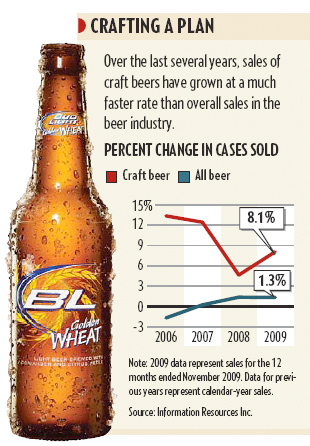
I confess that when Bud Light Golden Wheat first appeared in the market, I gave it almost no notice. It was yet another line extension in an increasingly crowded portfolio. If I had noticed that it also included citrus and coriander it might have been more apparent that it was conceived, at least in part, to attack Coors’ Blue Moon. Given Anheuser-Busch’s track record of going after literally every product on the market — no matter how small the niche — what’s more surprising in hindsight is that it took so long. Blue Moon first debuted in 1995.

Crain’s Chicago Business had an interesting article on Monday about the battle, entitled Budweiser Takes On MillerCoors’ Blue Moon In Craft Beer Brew-Haha.

crafting-a-plan

But since its debut last October, Bud Light Golden Wheat has made significant progress, showing just how important distribution and access to market can be.

Anheuser-Busch showed last month that it has the marketing muscle and distribution wingspan to make up lost ground quickly. It sold 263,000 cases of Bud Light Golden Wheat in November, nearly equaling Blue Moon’s total, IRI data show.

It’s an interesting read, and to me the takeaway is Harry Schuhmacher’s thoughts, as quoted in the article:

“It’s very important because craft beers are the only growing part of the business,” says Harry Schuhmacher, editor of San Antonio-based trade publication Beer Business Daily. “This is where the future of beer is going, and they want to make sure they are well-established in the category.”

Filed Under: Beers, Breweries Tagged With: Big Brewers, Mainstream Coverage, Statistics

Charting Beer With Infographics

November 30, 2009 By Jay Brooks

piechart
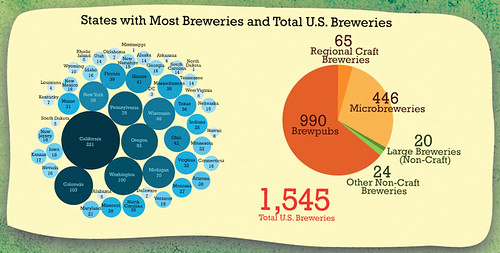
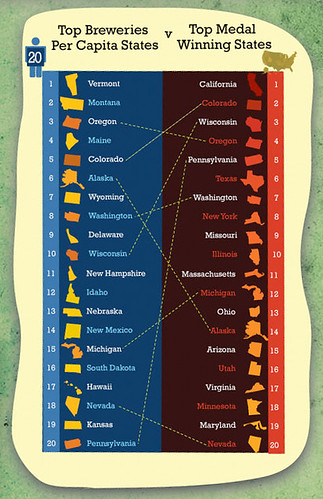
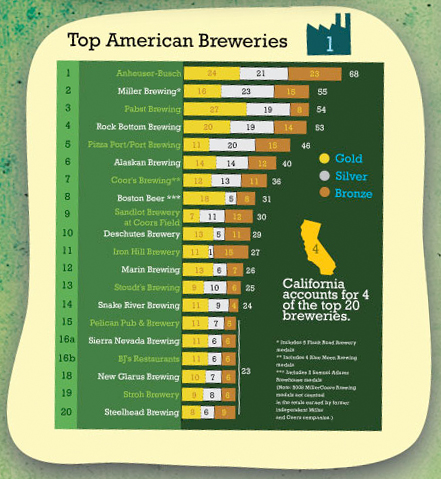
My friend and colleague Rick Lyke has the good fortune to have a son-in-law who’s a graphic designer and really, really good at creating graphs or infographics, which is essentially a chart that tell a story. For the second year in a row, Rick has persuaded his son-in-law, Mike Wirth, to create an awesome infographic of various GABF medal statistics for his Lyke2Drink blog. Since he introduced this back in August, about a month before this year’s GABF, hopefully he won’t mind my sharing it. I’ve parsed some of the most interesting mini-charts within the infographic and displayed them below.

most-breweries-vs-total
These charts show the number of breweries by state and the total number by type or size of brewery.

breweries-vs-medals
This is a chart of states with the most per capita breweries vs. the states that have won the most cumulative medals since they began awarding medals through 2008.

top-amer-breweries-09
This is a chart of the breweries that have won the most cumulative medals since they began awarding medals through 2008.

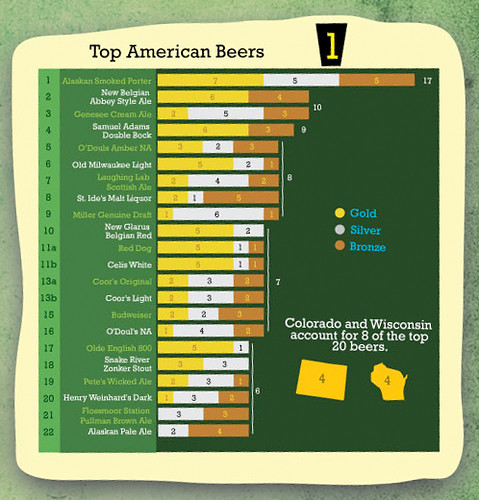
top-amer-beers-09
This is a chart of the individual beers that have won the most cumulative medals since they began awarding medals through 2008.

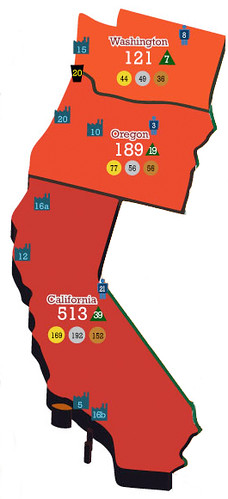
west-coast-gabf-medals
Lastly, here is a detail of the west coast and the medals won by breweries in California, Oregon and Washington.

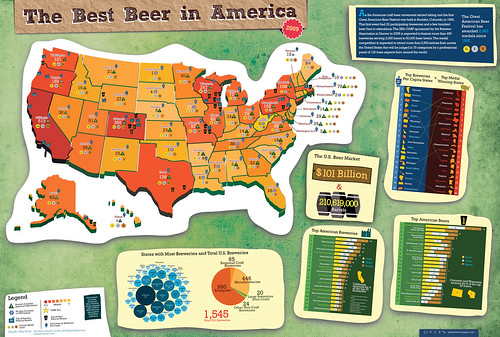
best-beer-america-2009
This is the entire infographic, show smaller of course, but click here to see it full size or see it at Mike Wirth’s website or with Rick Lyke’s original analysis.

Filed Under: Beers, Breweries, Just For Fun Tagged With: Awards, GABF, Statistics

« Previous Page
Next Page »

Find Something

Northern California Breweries

Please consider purchasing my latest book, California Breweries North, available from Amazon, or ask for it at your local bookstore.

Recent Comments

  • Bob Paolino on Beer Birthday: Grant Johnston
  • Gambrinus on Historic Beer Birthday: A.J. Houghton
  • Ernie Dewing on Historic Beer Birthday: Charles William Bergner 
  • Steve 'Pudgy' De Rose on Historic Beer Birthday: Jacob Schmidt
  • Jay Brooks on Beer Birthday: Bill Owens

Recent Posts

  • Beer In Ads #5154: Mr. Boh’s Bock Is Here! March 9, 2026
  • Historic Beer Birthday: William Cobbett March 9, 2026
  • Beer In Ads #5153: Roll In A Barrel Of Spring! March 9, 2026
  • Beer In Ads #5152: A Message From Over The Sea About Genuine Bock Beer March 8, 2026
  • Beer In Ads #5151: March Is Bock Beer Time March 8, 2026

BBB Archives

Feedback

Head Quarter
This site is hosted and maintained by H25Q.dev. Any questions or comments for the webmaster can be directed here.