Friday’s Independence Day ad is for Ballantine Ale, from 1955. That’s a happy-looking man watching the 4th of July fireworks, as he sips his beer. That’s ale, brother! Happy Independence Day!


Friday’s Independence Day ad is for Ballantine Ale, from 1955. That’s a happy-looking man watching the 4th of July fireworks, as he sips his beer. That’s ale, brother! Happy Independence Day!
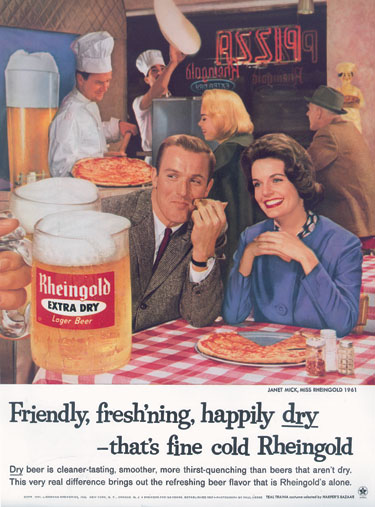
Thursday’s ad is for Rheingold Beer, from 1961, when beer, and other things, were still “friendly.” In this case, not just friendly, but also “fresh’ning” and “happily dry,” too. Interesting to see pizza and beer, I remember pizza still be fairly exotic at least until the 1970s.
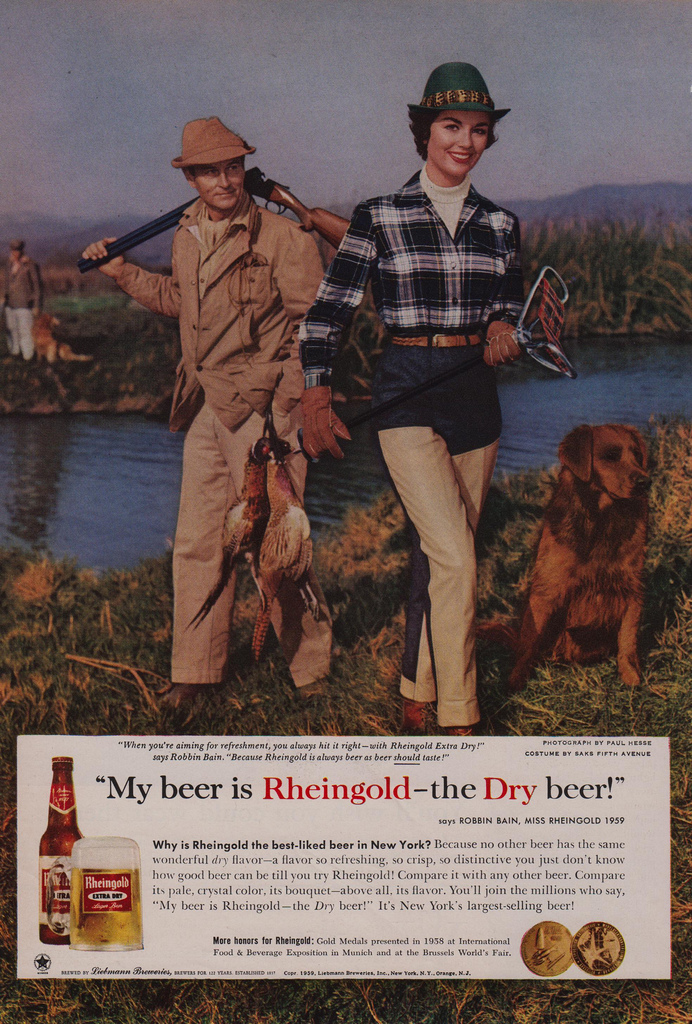
Wednesday’s ad is yet another one for Rheingold Beer, this one also from 1959, and features Miss Rheingold from that year, Robbin Bain. In this ad, she’s “aiming for refreshment,” but the guy behind her is carrying the gun, while she’s got a portable chair in her two gloved hands. And how about that nifty green hat?
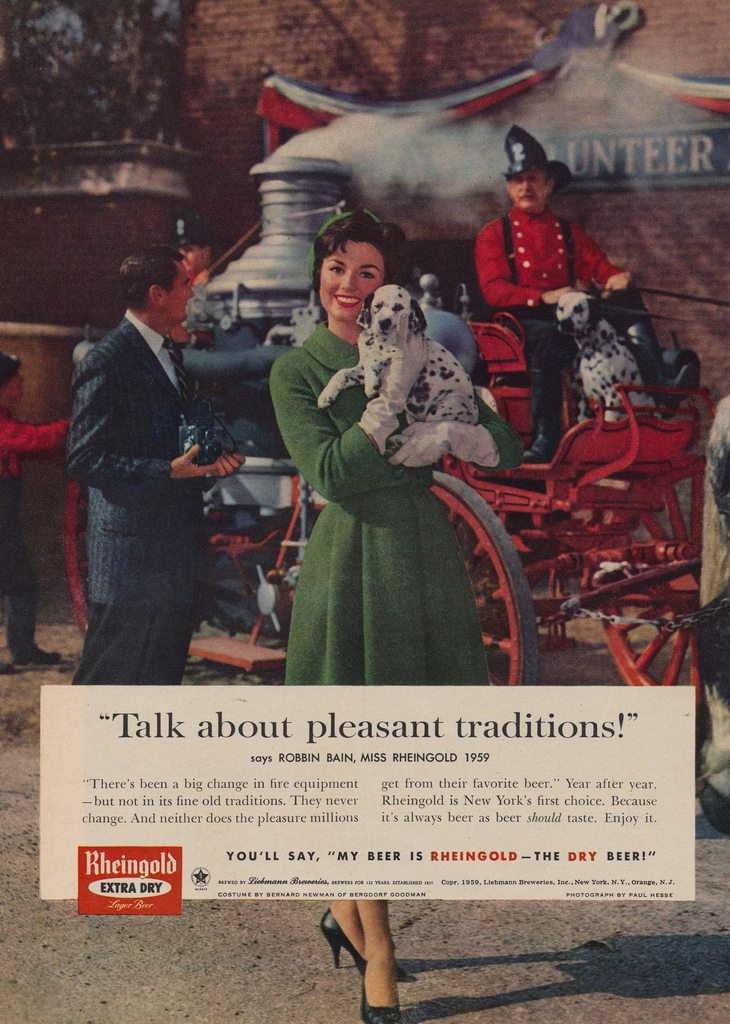
Tuesday’s ad is another one for Rheingold Beer, this one also from 1959, and features Miss Rheingold from that year, Robbin Bain. In this ad, she’s holding a Dalmatian puppy in front of a scene of an old-fashioned fire truck. Even the fireman is wearing a retro firefighter’s uniform, and I wonder if that’s the puppy’s Mom on the truck with him?
Monday’s ad for Rheingold Beer, this one from 1959, and features Miss Rheingold from that year, Robbin Bain. In this ad, she’s out for a night of bowling, then a far more popular pastime. “Between frames or games — nothing scores like a refreshing glass of beer!”
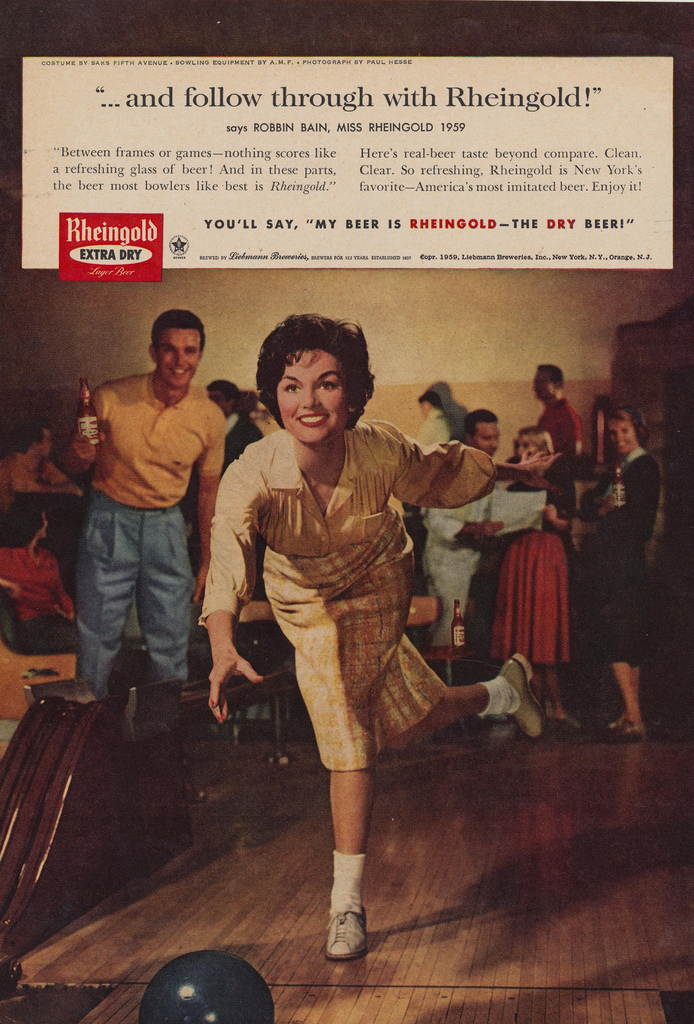
Sunday’s ad is for Oland’s Schooner Beer. The Oland Brewery is from Nova Scotia, Canada, though today it’s owned by Labatt Brewing, and ultimately ABI. They still make this beer today, though it’s now known as Schooner Lager. This ad, I think, looks like it’s from the 1950s.
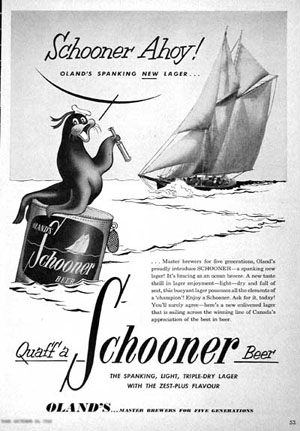
Saturday’s ad is for Schlitz, from 1904. It’s an unthinkable ad in today’s world, where health claims are strictly forbidden in beer advertising, even if they’re true. In a fictional, or hypothetical at best, conversation between a doctor and his patient, the physician unequivocally endorses Schlitz beer because it’s so pure. How does he know? Because he’s seen it being brewed, which of course makes no sense. But my favorite advice the doc gives is about why pure beer is good for you. “The hops form a tonic; the barley a food. The trifle of alcohol os an aid to digestion. And the custom of drinking beer supplies the body with fluid to wash out the waste. People who don’t drink beer seldom drink enough fluid of any kind. A great deal of ill-health is caused by the lack of it.” And no, it doesn’t cause biliousness, which is a “term used in the 18th and 19th centuries pertaining to bad digestion, stomach pains, constipation, and excessive flatulence.” Whew, dodged a bullet there.
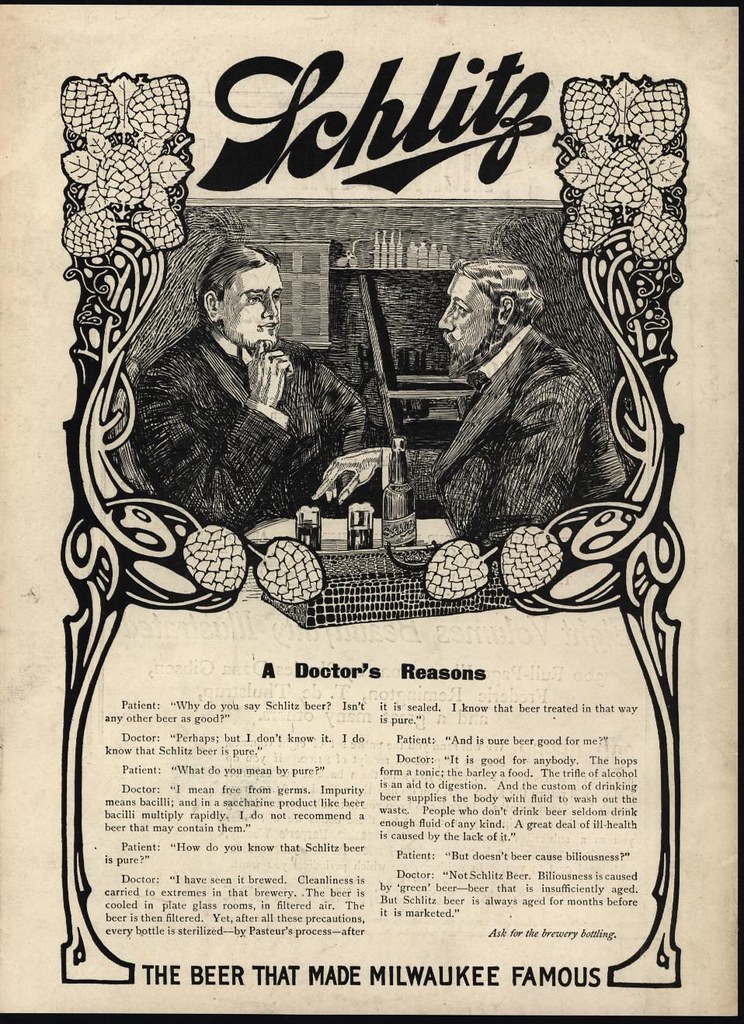
Friday’s ad is for the U.S. Brewers Industry Foundation, from the 1940s, sometime during World War II. This is from the brewing industry’s “Morale is a Lot of Little Things,” their award-winning campaign that talks about the little things that help people’s morale during the war. Not surprisingly, beer is usually one of them.
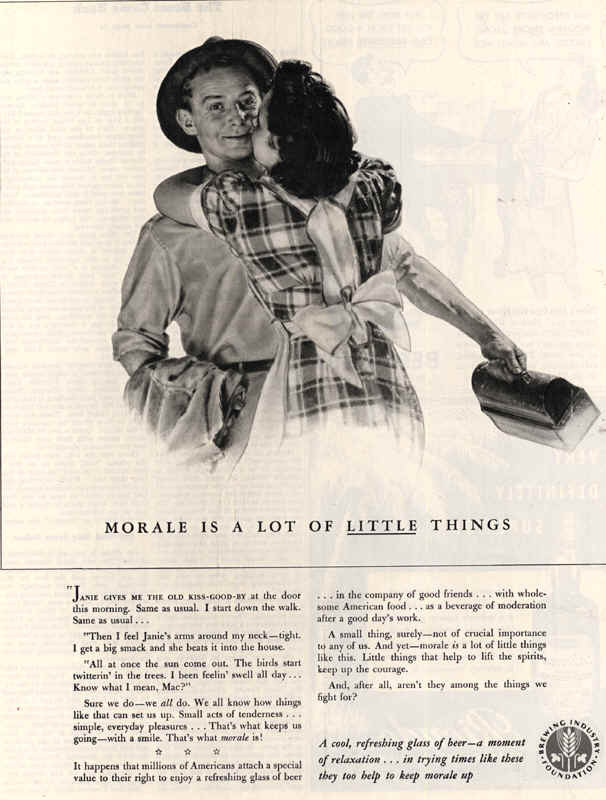
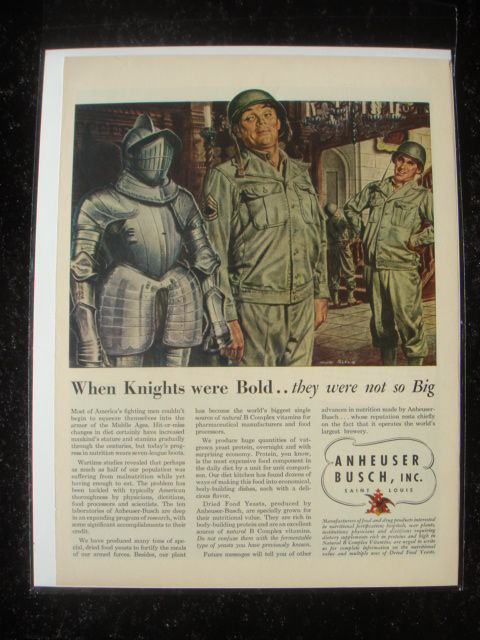
Thursday’s ad is for Anheuser-Busch, from 1945. A World War 2 ad, showing a modern soldier — a Sergeant First Class — in which he compares himself to a suit of armor, most likely while liberating a European castle. The tagline reads “When Knights were Bold .. they were not so Big.” I guess the big strapping enlisted man is taller than the knight would been, based on the armor’s size.
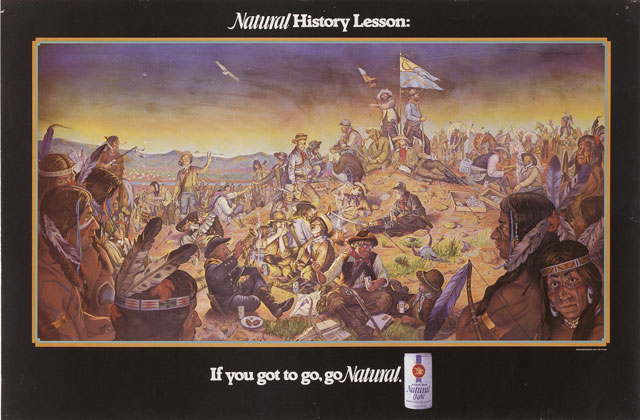
Wednesday’s ad is for Anheuser-Busch brand Natural Light, from 1996. The ad depicts a scene from the Battle of the Little Big Horn, more commonly known as “Custer’s Last Stand,” which took place today in 1876. The ad can be found, oddly enough, in the Autry Library in southern California. Anheuser-Busch apparently created a reproduction of an 1892 pamphlet with the lengthy title Authentic history of the Indian campaign which culminated in “Custer’s last battle,” June 25, 1876 : from comments by General Fry, Captain E.S. Godfrey (Seventh Cavalry, U.S.A.), (volume XLIII, the Century monthly magazine, January, 1892), Captain Charles King, Adjutant-General State of Wisconsin, Olin D. Wheeler, of the Northern Pacific Railroad, and others. The “specially numbered reprint” was done exclusively for the 23rd annual conference of the Little Big Horn Associates, July 18-21, 1996, which was held in St. Louis, Missouri, and included the “Natural History Lesson” ad. The original pamphlet was distributed with another painting, Otto Becker’s Custer’s Last Fight in 1896,” which was used to create a poster in 1896 that AB distributed to its customers and bars, making it the first example of brewery advertising. As a result, it has become one of the most highly sought after pieces of breweriana. This newer painting appears less serious in tone, and there’s no additional information I can find about who created the illustration for the Natural Light ad.