Brookston Beer Bulletin

Jay R. Brooks on Beer

  • Home
  • About
  • Editorial
  • Birthdays
  • Art & Beer

Socialize

  • Dribbble
  • Email
  • Facebook
  • Flickr
  • GitHub
  • Instagram
  • LinkedIn
  • Pinterest
  • RSS
  • Twitter
  • YouTube

Powered by Genesis

Stoudt’s Seasonals … and More

October 19, 2006 By Jay Brooks

Stoudt’s Brewing of Adamstown, Pennsylvania has announced expansion plans. According to their press release, at the end of the year they will increase the size of their fermentation cellar by 25%.

And by the holiday season, 750 ml cork finished bottles will return with the release of two styles. Fat Dog Imperial Oatmeal Stout and Old Abominable Barleywine, both aged in whiskey barrels, will be available at the brewery.

Also, Stoudt’s holiday seasonal this year will be Chocolate Nut Brown Winter Ale. “This cocoa infused, highly aromatic brew will be tapped in November.”


Stoudt’s Brewery in Adamstown, Pennsylvania

Filed Under: Beers, News Tagged With: Eastern States, Press Release, Seasonal Release

Dowd on Beer

October 19, 2006 By Jay Brooks

I must confess until a week or so ago I’d never heard of William M. Dowd and his Dowd on Drinks column. He’s got ten blogs — seven of which have something to do with alcohol — under a business umbrella he calls Circle 7 Associates. Based on his resume it appears most of his writing is about wine and spirits, which may explain why I’m not familiar with him. His writing is apparently very widely distributed by both the New York Times News Service and the Hearst News Service. His website lists dozens of newspapers and websites that carry his work. But one of his blogs is “Dowd’s Brews Notebook” and purports to cover beer. And here’s where I think his knowledge is on thinner ice.

The last time I mentioned Dowd was when he wrote that “startled gasps” would occur to being told James Bond might actually drink beer. He was one of the legion of media duped by Heineken (and the film company) that Bond drank beer in Fleming’s first novel, Casino Royale, and only in that novel. Both claims were not true but no one in the press questioned the propaganda.

In his latest missive, on the very same day it was published, Dowd took the ABC story about Miller’s new chocolate beer and re-worked it, using some of the same phrases and not attributing the original story. I don’t wish to suggest it rises to the level of plagiarism, because it doesn’t. Rather Dowd appears to have taken the ABC story and re-wrote a smaller part of it using some of the same quotes and using some of the same specific language in his piece, all without ever mentioning the original story. Maybe that’s okay legally, since it’s certainly different enough but is seems to me a little unseemly at best.

For example, here’s his first sentence. “Fans of unusually flavored beers are largely limited to small craft products.” The ABC story was the first time I’d ever heard craft beer described or defined as “unusually flavored” and it was this phrase that first put me on the trail of Dowd’s story origin. The original press release Miller released the previous day has none of the language in the ABC piece. Dowd then goes on to describe Miller’s chocolate beer and mentions Anheuser-Busch’s Michelob Honey Lager and Michelob Amber Bock as competing beers. These are the same beers also mentioned in the ABC story, though it would have made more sense to compare A-B’s new chocolate and vanilla-flavored beers, which I sampled at the A-B event in Denver at the end of last month. But Dowd appears to have only one source for this story, and it didn’t talk about those beers.

To be fair, there are original bits in his piece when he mentions Miller’s medal for this beer last year and at the end, when Dowd does acknowledge that Miller didn’t invent chocolate beer, listing Samuel Adam Chocolate Bock and Brooklyn Black Chocolate Stout as earlier chocolate beers.

But I think the larger problem here is another drinks writer who appears quite fluent with wine and spirits trying to write about something he is not quite as expert on as his main oeuvre. A quick glance at his recent beer musings reveal he’s writing about many of the top stories and has some generally decent content, but it all seems somewhat rehashed. Now I realize I’m always complaining that wine writers don’t write about beer so perhaps I shouldn’t be complaining here. And I am glad he is writing about beer since, unlike most beer writers, he appears to have access to the mainstream press. But in the last two pieces I noticed by Dowd, he’s regurgitated two beer stories and added little to the stories. And he appears to be selling himself as an expert on beer when he describes himself as a “veteran newspaper journalist and editor as well as a competition judge and writer in the fields of food, restaurants and alcoholic beverages.” And while he may be doing a better job than many wine and food writers, he’s still got a long way to go before we “fans of unusually flavored beers” can consider him an expert on beer.

Filed Under: Editorial, News Tagged With: Mainstream Coverage, Websites

Lagunitas Labels Trashed by Beer Man

October 18, 2006 By Jay Brooks

The Beer Man, Todd Haefer, is at it again. A few weeks ago he wrongly accused wood-aged beers of being a passing fad, despite record numbers of them entered at GABF. The upcoming Barrel Age Beer Festival at The Bistro was expecting to get about 50 beers entered and as of a few days ago 65 were coming. So for that reason I was a bit suspect of his using a moniker that implied expertise and respect. He may be “a” beer man, but I don’t think he’s “the” beer man.

Today’s prouncement confirms that, I think. In a review of Lagunitas’ Censored Ale (f.k.a. Kronick) which in and of itself wasn’t bad, he attacked brewery owner Tony Magee’s delightful beer label ramblings with a no-holds-barred, tell-me-how-you-really-feel, full-frontal-assault. Here’s what Todd had to say:

I do have to mention that Lagunitas has some of the dumbest beer-style descriptions I’ve ever seen on a Web site. Just check out this link for Censored Ale and you’ll see what I mean. It’s not funny, not cool, not cute, it’s just … dumb and doesn’t tell you anything about the beer.

Here on the left coast, Lagunitas’ labels have something of a cult following and articles have been written on the labels alone. Not the beer, mind you, just about the labels. Of course, we also have the benefit of context and knowing Tony. Oh, and we have a sense of humor, too. Because Tony’s labels are often hysterical, and many times confounding and perplexing. But the one thing they never are is dull. Who said beer labels have to tell you something about the beer or the beer style? Go in your refrigerator right now. How many beers have a story about the beer on the label? Half, maybe less? So why can’t Lagunitas let the beer speak for itself and have a little fun on the labels? After re-reading this label I’m a little confused as to why Beer Man thought it was a beer description, albeit a “dumb” one, in the first place. Here is the label rant from Lagunitas Censored Ale:

Anyway, we were going out to, uh,the ,uh, you know, thing, and all, and when we got there, well, uh, the dude was, like- “whoa man!” I mean, and we were all, uh, you know – “whoa!” and stuff, and when I said to him, like, you know, “hey man”, and all they, I mean he, was all “what?” and stuff- and I just told him what you said and all and they were all man- “not cool dude”, but whatever- so, uh, we split and went back to my lair and just hung out and whatever, but the whole thing was, like, just SUCH a bummer and all but, you know, it was cool and stuff, but you just gotta, you know, about the dude and all, like, it’s cool and all you know, but what’s up with that “blah blah blah”? Whatzit got to do with beer and all? I mean, really, dude, whatever…but, it’s cool and all…

So what part of that did Beer Man think was a “beer-style description?” Honestly, even if you don’t find it funny, cool, cute or informative, you can’t really believe it’s trying to describe the beer, can you? You’d have to figure it was ironic and not serious wouldn’t you? But it proves once again Tony Magee’s most prophetic quote.

“Beer Speaks. People Mumble.“

Filed Under: Editorial, News Tagged With: Bay Area, California, Mainstream Coverage, Midwest

Hip Trip Trips Up on Beer Pairings

October 16, 2006 By Jay Brooks

The Sunday edition of the Philadelphia Inquirer ran a syndicated feature news service for daily newspapers called the Rand McNally Travel News. As near as I can tell, a division of Rand McNally produces travel pieces for a number of prominent newspapers, including the Chicago Tribune, the Dallas Morning News and others. With dwindling readership and severe under-staffing at many daily newspapers as most struggle to remain economically viable these days, they’re increasingly turning to syndicated content to supplement original staff-generated stories. It’s a bit of a self-fulfilling prophecy, in my opinion. As less and less people get their news from newspapers, they turn increasingly to AP, Reuters and other wire services, especially for their national and regional coverage, which has the effect of making them all look more and more the same. This homogenization loses them more readers which in turn causes them to layoff more staff and generate still less original content, which again causes a drop in readership.

Yesterday’s example of this cheap excuse for original content was by Mary Lu Laffey for the Rand McNally Travel News and the name of her monthly series is called “Hip Trip.” It’s apparently travel tips for younger people and presumably younger people with money since they would be the only ones who would plan their vacations. The “Hip Trip’s” tagline advice is simple. “Time and money may be in short supply for many younger travelers. Each month, Hip Trip brings you advice on how not to waste either.”

But whether by accident or design, her article is nothing short of an infomercial where in some cases she acts as a foil to corporate propaganda and at other times displays total ignorance for the subject at hand. It’s as if she took a press release, did no research or fact-checking, added a few sentences to personalize it and then added her byline. Of course, she appears to be writing in the first person as if she actually attended a beer dinner, but what we get is her impressions of the experience, what her host tells her and little else. There’s certainly no questions from Laffey as misinformation and laughable advice flows freely from Brent Wertz, chief executive chef at Kingsmill Resort. The Williamsburg, Virginia resort is, of course, an Anheuser-Busch company, a fact Laffey fails to disclose (or perhaps she’s not even aware of it). But it certainly makes what follows more understandable, if no less absurd. She undoubtedly had her beer dinner at the Eagles Restaurant, which lists three beer dinner menus on their website, one with Budweiser, one with Michelob Ultra Light and one with World Select.

So without further ado, let’s begin the show.

Laffey’s first few paragraphs are doozies, and they set an unquestioning tone that permeates the whole article. Here they are, in their entirety.

Brent Wertz doesn’t flinch as he twists open a bottle of ultra light, low-carb beer and pours it straight down the middle of a chardonnay glass. He tilts his head only slightly as he watches it splash big at the bottom. Wertz says the big splash is necessary to break the carbonation and to open the nose of the beer.

Stemmed glass? Nose? Beer?

That’s a big “yes” from Wertz, chief executive chef at Kingsmill Resort. He plans menus around beer, marinates and cooks with it, and passionately recommends beer whether you’re dining plain or fancy.

That’s a big “whoa” from me. In the bigger picture, does drinking beer with dinner mean I have to put keggers behind me?

Just out of curiosity, do many people “flinch” when opening a twist-off cap? Or is the pouring it into a chardonnay glass that should cause the twitch in her mind? Her next reaction — her quizzical “Stemmed glass? Nose? Beer?” aside — is becoming the standard neophyte knee-jerk in virtually every one of these type of pieces. Some ignorant journalist is shown beer in a different light for the first time (where were all these people living for the last 25 years, in a box? The Moon? Prison?) and their first reaction is always one of great surprise that someone might even be capable of taking beer seriously. Worldwide, people have been drinking beer from stemmed glassware for centuries. And did it never occur to anyone that at least the people making the beer would be smelling it, checking it’s “nose,” to insure they were making a consistent product? How out-of-touch with the real world and common sense do you have to be in order to be surprised that people might smell beer to gauge it’s quality? And finally there’s the kicker reaction, that it’s beer and that someone might think of it as more than cheap swill with no discernible flavors worth talking about. The pervasiveness today of this manufactured stereotype of beer as unworthy is frankly quite astonishing, especially from presumably educated journalists who one would assume would be paying a little more attention to the news than the average person that good craft beer has been around for over 25 years? How could anyone have completely missed that phenomenon to present actual shock when confronted with better beer? But here it is on display again, proving once again that the depths of ignorance in the press know no bounds.

When she gets her “big yes” from Kingsmill’s chef she responds with a “big whoa” and wonders whether she has to give up her apparently precious keggers, I feel like I’ve fallen into “Mary Lu’s Excellent Adventure” and I’m reading the term paper of a failing high school student. How bogus is that? Why she thinks that you can’t have fine beer with a meal and also enjoy beer from a keg in a totally different context is beyond my grasping. Perhaps she thinks there’s only one way to do anything, who knows? And the sentence seems to infer that this is the very first time she’s ever had a beer with dinner! How is that even possible?

Of course, I’m using the term “fine beer” here metaphorically since the only beers mentioned in the article by name are Michelob Ultra Light, Budweiser, and Michelob Amber Bock, not exactly “big” beers by any stretch of the imagination. But to our intrepid author, in her “90-minute sojourn into silver-placed settings on table linen, with stemmed glasses, haute cuisine – and beer” she does just that. She describes “swirling the contents of [her] burgundy glass” with its full-bodied Bud coat[ing] the sides of the glass” and imagined herself “talking about how the big flavor of this big beer exhaled deeper with each twirl.” Stop, stop, my sides are aching with laughter. Okay, no matter how much you love Budweiser it can’t reasonably be called “full-bodied.” Its flavor — if you can even call it that — is so light as to be almost non-existent. But to Mary Lu, this is “big beer” with “big flavor.” I wonder what she’d think of an Old Rasputin Imperial Stout? Or even Sierra Nevada Pale Ale?

For dessert, chef Wertz suggested that they needed “a lager big enough to stand up against chocolate” and gave them Michelob Amber Bock. I hope the double-fudge brownie torte they had for dessert wasn’t too chocolately, because that’s not a beer that can stand up to very much flavor and hold its own. She claims to have “found a rich, full lager that smelled a lot like coffee and caramel.” Uh-huh, that’s not my memory of this beer’s nose. And while I’m generally cautious about using the beer rating websites as a source, I think the Beer Advocate reviews of Michelob Amber Bock are pretty amusing and show a great disparity between the inexperienced beer drinker vs. the more experienced ones. Frankly, her description sounds like it came from a sale sheet provided by A-B.

But let’s turn now to her finale:

What a finale, I thought as I turned my attention to my double-fudge brownie torte. The dessert would put my taste buds to the test. Would they dare use beer in brownies? I bit into the brownie and tasted the caramel sauce that was hiding beneath it. I should have known that even a chef like Wertz would not mess with brownies.

That you’d have to “dare” to use beer in making brownies, implying more broadly that dessert really shouldn’t have beer it, once again demonstrates that we’re back to a high school mentality. Wow, what a revelation. I guess I’ll have to take back all the wonderful desserts I’ve enjoyed over the years made with beer in them. Because beer chef Bruce Paton, among many others, have made some amazing dishes using chocolate and beer. This spring he did an entire chocolate and beer dinner with Chimay and Scharffen Berger chocolate. And chef Eddie Blyden, when he was at 21st Amendment (he’s now at Magnolia), did a terrific multi-course meal in which every dish used both beer and chocolate, including the soup, salad and dessert with Cocoa Pete’s chocolate. And that’s just a small sampling in one city. All across the nation — and the world — people are and have for many years been cooking with beer, including desserts. Beer cook Lucy Saunders, for example, has two recipes for chocolate and beer dishes on her website. This is only news to the monumentally myopic and uninformed.

To be fair, her piece is aimed at young travelers, who apparently in the author’s mind would be as ignorant as she is, and there may be some element of truth to that. I’m no expert on youth culture. But with craft beer’s sales on the rise and a generation of young people turning 21 never having known a time when there wasn’t craft beer, such a position seems harder and harder to maintain. Come on, Rand McNally, why not get some writers who know about beer to write about beer. I double dare you.

Filed Under: Editorial, Food & Beer, News Tagged With: Business, Eastern States, Mainstream Coverage, National

Reading About Reading Beer

October 13, 2006 By Jay Brooks

Don Russell, a.k.a. Joe Sixpack, had a startling piece of news in his latest Philadelphia Daily News column, my hometown beer is making a comeback! Reading (that’s pronounced “red-ding“) Beer’s advertising and merchandising stuff were about as ubiquitous as it gets for me growing up because I spent a lot of my youth in bars with my alcoholic stepfather (there, now you know). My memory of the beer is that it wasn’t any better or worse than most of what was available at that time. And by the time I was paying attention, it was already being brewed outside Reading, in Fogelsville, which at that time was still a Schaefer brewery, if memory serves.

The Reading Brewery opened in 1886 on South 9th and Little Laurel Streets and closed ninety years later in 1976, when I was a junior in high school. As Don points out, it had a very loyal following in the area. As recently as the late 1990s, I was home for a visit around the winter holidays and went bar-hopping with some old friends who were also in town. Most of the bars we went to not only still had quite a bit of Reading Beer breweriana on their walls but several still used Reading Beer and other local brewery coasters. I must confess I even pocketed a couple of them for myself, I was so taken aback that they were still using them and wanted proof.

So the new Legacy Brewing Co. (who are the same folks that previously owned Pretzel City Brewery) have announced that they will be bringing back Reading Beer in all its adjunct glory. (I confess I’d prefer if it was all-malt, but I won’t quibble.) They’ve even set up a new company just to handle the Reading Beer and keep it separate from the Legacy craft beers. Initially it will be draft only but if it proves popular — and quite frankly I can’t see how it won’t be — then bottles (or better still, cans) will follow in wider distribution. According to Russell’s article, since it was first announced in the local paper, The Reading Eagle, last week, the brewery has been inundated with inquiries.

And I must agree with Jack Curtin when he writes “I definitely like the way these guys think” about brewer Scott Baver’s rationale for bringing back Reading Beer.

“Look, we’re brewers. For me, I just love making beer and being part of the beer industry. But we’re business people, so why not make a product that covers every end of the spectrum?

“If my customer wants it, what am I, an idiot for not doing it?”

I know this was just a regional beer even in its heyday, and that very few people are likely to get worked up about it. But since I’m one of them, you’re reading about Reading here.

The can of Reading Beer that sits on a shelf next to where I typed these very words.

Filed Under: Beers, News Tagged With: Announcements, Business, Eastern States, History

Craft Beer Defined as “Unusually Flavored”

October 13, 2006 By Jay Brooks

In ABC News’ online Money section, business writer Eric Noe has a piece entitled For Dessert, How About a Beer?. In the middle of the article, Noe makes the following revelation:

Sales of craft beers, the industry term given to unusually flavored or seasonal beers, grew at 11 percent during the first half of the year.

Let that sink in. ABC defines craft beer as either “unusually flavored” or “seasonal beers.” Perhaps if you listen very carefully you can hear a faint thumping sound. That’s me banging my head repeatedly against my keyboard. The only thing keeping my head from spinning completely around are the laws of physics.

Remind me not to go drinking with Eric Noe. “Here, Eric, try this Sierra Nevada Pale Ale. How about those unusual flavors? We call them hops.” I can only assume by “unusually flavored” he means that they actually have flavor, which is the reason sales of industrial light lagers are down — they don’t have much in the way of flavor at all.

The rest of the article is banal stuff — and old hat — about Miller’s new chocolate beer (Frederick Miller Classic Chocolate Lager), Anhesuer-Busch’s chocolate beer, etc., something the craft beer segment has been doing for years. But, of course, to ABC it’s only news once the big players (you know, the ones who advertise on ABC) begin to make beer with chocolate or chocolate-like flavors. The article also touches on the recent spate of infused beers, beers with added vitamins, caffeine, etc. and manages to confuse those beers with ones having different flavors, too. Last time I checked vitamins don’t have a particular flavor, do they?

As far as I can tell, the author isn’t really sure what flavor is, I mean he seems confused about its very definition. For example, he reports that “Anheuser-Busch has gotten in on the act, too, introducing flavored beers like Michelob Honey Lager and Michelob Amber Bock.” The honey lager may have “a touch of honey,” as A-B claims, but does that really make it a “flavored beer?” More to the point, what flavors have been added to the Amber Bock? Malt?

Eric Shepard, executive editor of the industry trade publication Beer Marketer’s Insights remarks in the article that “[p]eople are saying they want something more flavorful than just malt, yeast, hops and water.” No offense, Eric, but I don’t think that is what people are saying. Malt, yeast, hops and water are more than sufficient to make a bewildering array of rich, flavorful beers. This year’s Great American Beer Festival judged 69 distinct and different beer styles, only a handful of which used anything more than the classic four ingedients. This is exactly what craft brewers have been doing for twenty-five years. People do want those ingredients used to produce something that tastes like … well, something. They want it to taste like beer, for example. That would be a good start.

Noe concludes:

For the major breweries, creating specialty brands isn’t the problem.

But while microbreweries, which have lower operating expenses, can turn a profit by selling relatively small amounts of specialty beers, the bigger operations like Miller and Anheuser-Busch probably won’t see immediate profits from these newer products.

For now, the goal of offering craft beers may be to lure customers back to the major brands.

“So far, the big breweries haven’t proved particularly adept at selling craft beers,” Shepard said. “But it makes a whole lot of sense — this is where the market is going.”

I love the honesty of his remark, “the goal of offering craft beers may be to lure [my emphasis] customers back to the major brands.” People must be “lured” to drink the major brands. That says it all, don’t you think?

Filed Under: Editorial, News Tagged With: Business, Mainstream Coverage

Bob Lachky: “Here’s to Advertising”

October 12, 2006 By Jay Brooks

Bob Lachky, the man responsible for Anheuser-Busch‘s Here’s to Beer public relations campaign, has a new job. According to a report in today’s AdAge Lachky has been named Anheuser-Busch’s chief creative officer by Augie IV, who has worked closely with him for twenty years. This means he will be responsible for “all the brewer’s agency relationships and creative output” and, as one insider put it, “Bob is going to be an integral part of the new regime.”

It will be interesting to see what will happen to the Here’s to Beer campaign, since much of it was closely associated with Lachky personally.

Bob Lachky

Filed Under: News Tagged With: Business, National

Stephen Beaumont vs. New York Magazine

October 12, 2006 By Jay Brooks

Earlier today I got an e-mail from my friend and colleague, Stephen Beaumont:

I like it when consumer magazines publish stories about beer, I really do, even when I don’t write them. But it pisses me off when they accord such a noble and respected beverage about one-twentieth of the respect and consideration they would wine or cognac or gourmet chocolate bars.

Case in point is the new issue of New York Magazine and its panel review of 21 beers. On the surface, it looks like an okay story, but the more you get into it, the more its flaws are exposed. Which is why I’ve written a rebuttal to the piece.

At the most basic, I’m sending you this simply to bring these stories to your attention and get your reaction. At the most, I’d love to spread the message around a bit so that hopefully these kind of review pieces might eventually become the exception rather than the rule.

Amen. This is the same kind of hatchet job I’ve been complaining about a lot lately. Read the original story in New York Magazine first and then Stephen’s rebuttal. Go ahead, I’ll wait. When you come back, I’ve got a few things to add to Beaumont’s wonderful critique.

Finished? Good, here’s a few random observations I can add. First off, the article is titled Ales in Comparison. But of the 21 beers reviewed — the ones “in Comparison” — nine are lagers and four are hybrid wheat styles, meaning more than half are not ales. That would be like having a tasting of eight red wines, nine white wines and four champagnes and calling the whole thing “Red Wines in Comparison.” That would be ridiculous, of course, but it’s exactly what New York Magazine did here in their zeal to be clever.

In his introduction, author Ben Mathis-Lilley claims Budweiser and Stella Artois taste the same. While I’m not a great fan of Stella Artois, on any given day it does taste decidedly different from Budweiser. And though both are adjunct beers, I’ll drink Stella Artois whereas I’d pass on a Bud, the point being they’re different enough that they can’t reasonably be called “taste-alikes” as Mathis-Lilley does.

The tasters are described as a “panel of untrained but enthusiastic drinking aficionados.” Well how scientific. Forget for a moment that calling an “enthusiastic” drinker an “aficionado” is probably oxymoronic, but what value is there in the opinion of people not trained to judge and/or evaluate the quality of a beer? Why is is you never see wine evaluated by enthusiastic amateurs, but it’s fairly common for newspaper articles to assemble an unnamed group of people to taste beer with no training and then report their findings as if they were all Robert Parker? Why do they assume one needs no training to evaluate beer? It’s preposterous, of course, and one more reminder of how ignorant the wine and food media is about beer. Wine takes years of training to learn, its nuanced flavors reveal themselves only to the sophisticated, discerning palate. But beer? That swill can be tasted by anybody — no training necessary — just throw a bunch of random bottles in a styrofoam cooler and voilà, you’ve got a story.

Even if I knew nothing about beer, why should I care if another person, equally ignorant, didn’t like a particular beer. In the New York Magazine article, negative descriptors such as “sissy,” “too girlie” or “eh” are used to describe some of the beers. What does that tell me about how they taste? Absolutely nothing, of course, which makes this entire exercise all but meaningless. In the first group of random beers, some of the panelists even correctly described one of the beers which was revealed in an aside as “accurately, according to our moderator.” So if they comment that on one of the beers some of the tasters actually got it right, showing by mentioning it they were surprised, what does that say about how wrong they got all the others? And if they got it wrong most of the time, as I suspect they must have, why report on it at all? What value does having the opinions of people with no training and no proficiency for what they’re tasting being used to educate others about what they taste like? Isn’t that like asking a blind person to describe a color?

And as Beaumont points out, the tasting flights have almost no logic to them and the beers tasted against one another bear no relation to each other, which would make it difficult for the seasoned taster, and all but impossible for the neophyte. It’s a process doomed to fail from the start, and another reason why this tasting is so comical. I’d be laughing except for the fact that some people will probably take this seriously and base their buying decisions on the article in what is otherwise considered an influential publication.

Also, in the article, the author gives the following advice. “Beer-pairing rule of thumb: Match up similar flavors.” Which is the same as saying white wines with fish. While such a rule of thumb may sometimes work, it’s extremely limiting and rigid, and ignores what choosing a contrasting beer might add to the experience.

For one of the beers, the only thing said about it was it “had a funny name.” How condescending. Thanks. That’s very helpful for me if I might want to drink it. But it’s indicative of the tone of the entire piece. There’s very little here that’s actually useful and they seem to have a great deal of trouble taking the subject seriously so I’m left with one final question. Exactly what is the point of this article?


UPDATE: New York Magazine invited Stephen to write a letter to the editor for their next issue. In the hopes of having it carry more weight, he graciously invited other beer writers to also sign the letter. Six of us agreed to sign it. In addition to me and Beaumont, the letter was also signed by Julie Bradford (All About Beer), Lew Bryson, Tom Dalldorf (Celebrator Beer News) and John Hansell (Malt Advocate).

 
UPDATE (10.27): New York Magazine has now printed Stephen Beaumont’s letter to the editor.

Filed Under: Editorial, News Tagged With: Mainstream Coverage, National, Websites

James Bond’s Beer

October 12, 2006 By Jay Brooks

007-1
I’ve been a huge fan of James Bond since I was a kid. I read all of Ian Fleming’s novels and even the later ones when John Gardner took over the series, among others. And, of course, I’ve seen all of the films many times. Not only am I aware that Sean Connery was not the first James Bond — it was an American, Barry Nelson — I’ve had a videotape of the show for decades. It was originally aired as a teleplay on live television in 1954 (eight years before Sean Connery debuted as James Bond in 1962’s Dr. No) on the show “Climax!.” It was based on Fleming’s novel Casino Royale and Peter Lorre played the villain, Le Chiffre. Suffice it to say I’m a big fan.

So when I read that in the new adaptation of Casino Royale (due in theaters November 17) Bond will drink a Heineken in a six-figure cross-promotion, I must say my first reaction was suspicion. Suspicion because every single time this story was reported it contained a justification for this move, saying that in Fleming’s novel his character James Bond does drink beer for the first and only time. If they want to have Heineken be a sponsor for the film and have the character drink one, that’s their decision even though I really hate these type of deals where products are featured prominently in films for big bucks. To me the insertion of the products into the action is way too obvious so that it distracts you from what makes movies so enjoyable, which is allowing you to escape into the story. It’s hard to feel swept away into a story when a giant bus drives by behind the action with a billboard reading “Drink Coke” every time the characters are walking outdoors. And in Pierce Brosnan’s second film as James Bond, Tomorrow Never Dies, during a “rooftop motorcycle chase in Saigon, Bond returns the bike to street level by using a parked truck which carries cases of Heineken beer as a ramp. Cans fly in every direction. Several kegs of Heineken are seen when the motorcycle briefly skids.” The Amsterdam brewer’s relationship with the Bond films has thus been going on for some time now, so it’s really no surprise that they’d want to crank it up a notch for the new movie.

But trying to justify such a greedy, commercial intrusion by saying it will make the film more accurate since the news stories all claim Bond did drink a beer in the novel seems to me avarice run amuck. A common element all of these news stories shared was that while they all claimed that Bond drank beer in Fleming’s Casino Royale novel, not one of them gave any specifics. For example, in Dowd on Drinks, by William M. Dowd, he writes the following:

In the first Bond novel, “Casino Royale,” the character who became known for his knowledge and enjoyment of wines and spirits actually drank beer. (Pause here for startled gasps by those reading this sacrilege for the first time.)

How opprobrious. “Startled gasps? Sacrilege?” Now why someone who knows and enjoys wine and spirits also drinking beer would be a sacrilege is never explained, perhaps Dowd thinks it self-evident. But it’s highly insulting and it displays that media prejudice I’m always going on about. Here’s another drinks writer who apparently thinks all beer is bad and all wine (and spirits) are good. Must be nice to live in such a black and white world in which reality has no place in your version of things.

Another account, this one from the Hearst Group, said “[i]n the first Bond novel, Casino Royale, the super spy who became known for his knowledge and enjoyment of wines and spirits actually (my emphasis) drank beer.” Oh, he actually drank beer, he didn’t pretend to drink it, or he didn’t just order but actually choked it down, too. What on earth is wrong with these people? Can they not see how ignorant they appear?

The reason, of course, they’re falling all over themselves to justify this move is obvious. The vodka martini, shaken not stirred, is part of the Bond ethos, a big part of his coolness, his personality and his popularity. So tampering with that is obviously risky but since there’s a lot of money at stake, they will do anything to keep the money without losing the fans. So by saying Bond actually did have a beer in the book makes it much easier to sell, as many of the reports have offered. For example, here’s how one wire service put it.

James Bond purists will be grateful to know that the beer plot is not just a money grab by the movie’s makers. Casino Royale was the first Bond book written by Ian Fleming and the only one in which Bond drinks beer.

So then the real question is, is it true? Did Bond drink a beer in the novel Casino Royale? I grabbed my dog-eared copy of Casino Royale from the attic in search of the answer and read it again, because it had been years since I’d cracked it open although I certainly couldn’t remember any reference to beer. I still have my old “complete and unabridged” Signet paperback that was in my parents house growing up. It’s a sixth printing from October 1962. Here’s what I found.

  1. In Chapter 5, on page 30, Bond orders his first drink in the book, an Americano. An Americano is a cocktail made with bitters, sweet vermouth, and soda water.
  2. In Chapter 7, on page 40, Bond orders C.I.A. man Felix Leiter a “Haig-and-Haig” (which is scotch whisky) and himself a “A dry martini” … “One. In a deep champagne goblet.” Then he gives the bartender more detailed instructions on how to make it. “Three measures of Gordon’s, one of vodka, half a measure of Kina Lillet. Shake it very well until it’s ice-cold, then add a large thin slice of lemon-peel.” Have I stumbled upon the origin of Bond’s famous “shaken not stirred” predilection? Bond tells Leiter that the drink is his “own invention” and that he plans “to patent it when [he] can think of a good name” demonstrating there are some subjects on which Bond is quite ignorant, patent law for example.
  3. In Chapter 8, on page 46, Bond shared a “cold carafe of vodka, very cold” with fellow agent and Bond girl “Vesper Lynd.”
  4. Later in the same chapter, on pages 47-48, Bond orders a bottle of champagne, a “Taittinger 45” but the waiter persuades him that the “Brut Blanc de Blanc 1943” would be better and Bond agrees.
  5. After long expositions about playing baccarat, Bond returns to drinking finally in Chapter 13, on page 75, when he ordered a bottle of champagne for himself and Felix Leiter to celebrate his victory at cards.
  6. Then in Chapter 14, at page 78, Bond orders another bottle of champagne, this time Veuve Cliquot, to have with his scrambled eggs and bacon, which he shared with Vesper.
  7. Shortly after that, Vesper is abducted and Bond gives chase, getting captured and tortured in the process. For many pages nothing is drunk, as Bond can’t even get a drink of water from his torturers. Eventually he gets away and after recovering in the hospital, goes on a holiday on the French coast with Vesper. In Chapter 24, on page 129, she and Bond share yet another bottle of champagne which he chased a page later with some brandy.
  8. Finally, in the second last chapter, number 26 on page 138, they share a final bottle of champagne before the story concludes unexpectedly (and I won’t give away the ending).

So unless I missed it somehow, there’s not one mention of beer in the novel I can find, much less a scene in which Bond actually drinks one. I skimmed through the book many times before resorting to re-reading the whole thing cover to cover trying to be thorough and not miss finding a bottle in a haystack. It was an awful lot of trouble just to prove a point. (The wonderful website Make mine a 007 also details the drinks Bond has in Casino Royale and reaches the same conclusion). So the propaganda spin machine is in high gear and not one news organization bothered to check the facts or even ask where in the novel Bond drinks this seminal beer that apparently makes crass commercialism justifiable. They all just reported what the press release said and didn’t question a thing, even though a moment’s pause should have been enough to suggest it might be too convenient. What are the odds that the story they were re-making just happened to be the only James Bond novel in which the main character drinks a beer as Heineken was paying them an undisclosed six-figure amount to depict him doing just that. Not one reporter considered exploring that angle? It’s good to know our nation’s media is the hands of such a capable, inquisitive bunch.

But let’s look at the story’s other claim, that Casino Royale is the one and only novel in which Bond chooses beer.

  • In Diamonds Are Forever, Fleming’s fourth Bond novel, 007 takes Bill Tanner to lunch at Scotts where he orders a Black Velvet, which is a mixed pint of champagne and Guinness.
  • Later in the same novel, while driving to Saratoga with C.I.A. compatriot Felix Leiter, they stop at roadside greasy spoon called “Chicken in a Basket” where Leiter and Bond have Miller High Life with their lunch.
  • In Goldfinger, the seventh novel, while chasing the villian through Europe, Bond washed down his lunch at Geneva’s Bavaria brasserie with Löwenbräu beer.
  • In The Hildebrand Rarity, one of the short stories in the collection published under the title For Your Eyes Only, after circling an island in a boat Bond stops for a chicken salad sandwich and a “cold beer” from a cooler. This story first appeared in Playboy magazine in 1960.
  • In On Her Majesty’s Secret Service, the 11th novel (excluding the short stories), Bond has four steins of Franziskaner at the Franziskaner Keller with his taxi driver to celebrate his engagement to Tracy. It is in effect his bachelor party and when he’s reunited with his fiancee, she accuses him of smelling “like a pig of beer and sausages.”
  • In The Man With the Golden Gun, Fleming’s 13th novel, while searching for Scaramanga, Bond orders a Red Stripe in the Dreamland Cafe and has two more before he leaves.
  • In The Living Daylights, part of a second short story collection, this one published under the title Octopussy and the Living Daylights, Bond has a lunch of salted herring and two draft Löwenbräus.

That’s a total of seven instances where James Bond has a beer in six different Fleming stories (four novels and two short stories). So not only does Bond not have a beer in Casino Royale, it was also not the only instance of his doing so as virtually all of the recent news stories have claimed. And lest you think they can weasel their way out of this lie by claiming they meant the Bond films, Bond has also had beer on screen before, too. In the film On Her Majesty’s Secret Service, after escaping from Piz Gloria, Bond orders and drinks a beer from an outdoor stand while trying to blend into the crowd. So at every level, the moneyed interests of the film production company and the beer sponsor, with the media’s complicity, is simply rewriting history to fit their short term goals of having Bond drink a Heineken for money in the latest film.

Propaganda aside, I’m certainly in favor of James Bond drinking beer. If they’re trying to re-invent (or reboot) James Bond — which is my understanding of what the new film represents — it makes sense that a modern Bond would have embraced good beer along with the other pleasures of life today. That would be in keeping with the character’s philosophy. Undoubtedly one of the reasons that Bond was not a beer drinker in 1953 and beyond, when Fleming began writing the Bond novels, was that there were not many good beers widely available worldwide and what was available was not often written about. Remember Michael Jackson’s first beer book wasn’t published until 1977. And American wines were held in no better regard during that time period, either. So keeping Bond’s tastes and preferences rooted in a time fifty years ago, when the diversity and quality of alcohol beverages was vastly different than it is today, doesn’t make sense anymore, if indeed it ever did.

But Heineken? Not Heineken. Bond’s character would never drink such swill. He wouldn’t be a snob about wine, food, clothes, cars and practically everything else and then drink such a pedestrian beer. In fact, in the novel Casino Royale, in Chapter 8, just after ordering champagne, Bond makes the following pronouncement:

“You must forgive me,” he said. “I take a ridiculous pleasure in what I eat and drink. It comes partly from being a bachelor, but mostly from a habit of taking a lot of trouble over details. It’s very pernickety and old-maidish really, but then when I’m working I generally have to eat my meals alone and it makes them more interesting when one takes trouble.”

So there is absolutely no way someone who would say that would turn around and order a skunked green-bottle of Heineken. Maybe a Thomas Hardy 1968, a Samuel Adams Utopias, a Deus, or a Cantillon Rose de Gambrinus. He’d more likely order something showy, expensive and impressive; something that showed he had good taste. And that would never be a Heineken. Often Bond orders local specialties in the novels and films, and Casino Royale takes place in northern France. The fictional resort town where most of the novel takes place is supposedly near the mouth of the Somme River in the Picardie region, which is only about two hours from Belgium. So while France is not known for its beers, a good selection of Belgian beers would likely be available at the casino and area restaurants. That’s what a beer savvy Bond would order.

The way I see it, this is simply a money grab despite — or perhaps because of — all of the protestations that it’s not. As entertainment news goes, this seems to be important to a lot of fans, which is no doubt why the spin was necessary in the first place. The story was certainly picked up by a lot of news outlets, both in print and online. That not one I could find got the story right but did the spin doctor’s bidding so completely says quite a lot about the state of our media, I think. Sure, in the end, who cares if a film and the media hoodwinked people into thinking one thing while another was true? It doesn’t really matter in the grand scheme of life. It is, after all, just a movie. And while that all may be true, I can’t help but think that in a media culture where the truth seems to have no bearing in editorial decisions that lying to the public about something that really does matter is getting easier and easier to do. Because if the media can lie to the public so unabashedly here, what else are we being lied to about? What else are we not being told? What else is the media not bothering to check or follow up on? And most importantly, when will they start taking beer seriously?

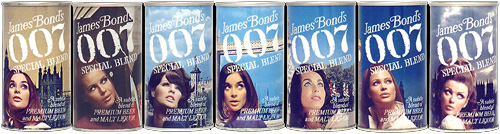
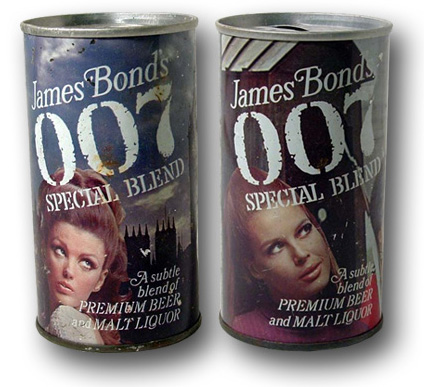
For trivia’s sake, there was also a Bond beer once upon a time. In 1968, there was “James Bond’s 007 Special Blend,” brewed by National Brewing Co. of Baltimore, Maryland. They’re highly collectible because they were produced for only a short time, which was due to having never been officially licensed.

007-3

“A subtle blend of premium beer and malt liquor.” Umm, what will they think of next?

007-cans

Filed Under: Editorial, Just For Fun, News Tagged With: Business, Cans, Film, Mainstream Coverage

Miller Expands Import Selection in U.S.

October 10, 2006 By Jay Brooks

SABMiller announced yesterday their intention to bring four of the beer brands they own worldwide into the United States, presumably to bolster sagging sales of their core brands. Beginning next year, “Colombia’s Águila, two Peruvian brands, Cristal and Cusqueña, and Polish brew Tyskie will join SABMiller’s global brand Pilsner Urquell and Peroni on US shelves.”

All four will be sold in the New York market, whereas Tyskie will also be sold in the Chicago area and the three Latin American beers will also be in the Florida market.

According to Just Drinks, “SABMiller’s stable of US beers has struggled domestically. For the three months to the end of June, domestic sales to retailers fell 2.4%. Miller Lite brand volumes were level in the period.”


Miller’s press release has the following information about the four brands:

Águila is Colombia’s No. 1 brand with a 56 percent market share. It is a cultural icon, dominating the Colombian social and sports landscape. With nearly 2 million expatriate Colombians living in the US, there is a sizable market to pursue

Brewed since 1922, Cristal is Peru’s No. 1 selling beer with 52 percent share, combining a light-bodied profile with strong Andean imagery. It has been the No. 1 US import from South America for the last seven years, primarily appealing to the approximately one million Peruvian consumers in the US

Cusqueña – or “Gold of the Incas” – is the premium beer of Peru, and originates from Cuzco, the seat of the Inca empire

Tyskie, currently celebrating its 377th anniversary, is the No 1. brand in Poland, Central Europe’s leading beer growth market. The brand is rich in heritage from its origins near the beautiful city of Krakow and has since been elevated to national prominence, appealing to discerning consumers as the finest Polish beer with a full, satisfying taste

Filed Under: News Tagged With: Business, International

« Previous Page
Next Page »

Find Something

Northern California Breweries

Please consider purchasing my latest book, California Breweries North, available from Amazon, or ask for it at your local bookstore.

Recent Comments

  • Bob Paolino on Beer Birthday: Grant Johnston
  • Gambrinus on Historic Beer Birthday: A.J. Houghton
  • Ernie Dewing on Historic Beer Birthday: Charles William Bergner 
  • Steve 'Pudgy' De Rose on Historic Beer Birthday: Jacob Schmidt
  • Jay Brooks on Beer Birthday: Bill Owens

Recent Posts

  • Historic Beer Birthday: Charles Weyand March 1, 2026
  • Beer In Ads #5137: Bock Is Back… Look For It March 1st February 28, 2026
  • Historic Beer Birthday: John Holme Ballantine February 28, 2026
  • American Craft Beer Hall of Fame: 2nd Year Inductees February 28, 2026
  • Beer Birthday: Jeff Bell February 28, 2026

BBB Archives

Feedback

Head Quarter
This site is hosted and maintained by H25Q.dev. Any questions or comments for the webmaster can be directed here.