

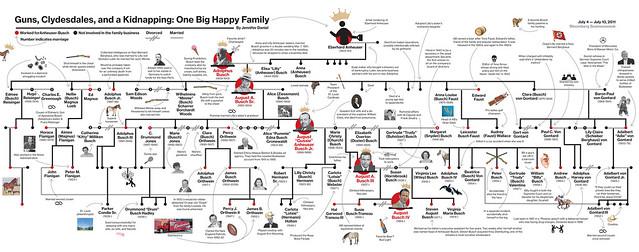
Today’s infographic is entitled “Guns, Clydesdales, and a Kidnapping: One Big Happy Family.” It was created by Jennifer Daniel, who’s currently a visual journalist at the New York Times, but did this one when she worked for Bloomberg BusinessWeek.
Why Are Doctors So Afraid Of Admitting Beer’s Health Benefits?

There was an article in the New York Daily News earlier this week, though actually it was a question answered by a physician who refers to himself as “The Running Doc™.” The fact that it’s trademarked is, I think, pretty funny, but I suppose there’s no reason why he can’t brand himself like anyone else.
A reader from upstate New York asks the doc if “beer is a cure for an upset stomach and kidney stones” and “[i]s drinking beer now a medical treatment?” But he begins his question with a request. “Please don’t laugh!” In this day and age, I suppose I should be happy enough with Dr. Maharam’s response. “I am really NOT laughing. Your friends are smart — beer actually does have some medicinal purposes. In moderation, obviously.” The Running Doc™ goes on to mention a handful of scientific studies that suggest drinking in moderation is good for what ales you, though considering how much there is now in the scientific literature, it’s a very small drop in the ocean of the body of ways in which responsible alcohol consumption can provide health benefits. And naturally he mentions the recent studies that suggest a beer after exercising — or running — but not the pièce de résistance, that total mortality is improved by moderate drinking.
Honestly, re-reading Lewis G. Maharam, MD’s response in The Running Doc says beer — especially ginger beer — has medicinal value but only in moderation, I think his answer is pretty good, and he at least treats the question seriously and also mentions that there is a body of scientific work that supports the idea of health benefits for drinking alcohol.
What bothers me, and was more of a camel’s back-breaking straw, was that he felt the need to mention, over and over again, moderation. It’s in the title, it’s the photo caption, and he mentions it twice more in the body of a very short article. Does it need mentioning? Maybe, but every time anyone from the medical or scientific community talks about any health benefits from drinking alcohol, they always qualify their statements with warnings like this. Really, they go out of their way to hit you over the head with them, as if we all need to hear it multiple times, or we might not understand. Is there really anyone alive today who’s missed the prohibitionist’s message that drinking too much is bad for you? It’s like the warning labels on packs of cigarettes; totally unnecessary, but covering their asses.
If the mounting evidence is showing, overwhelmingly, that alcohol can be good for you, then let’s just say so. We all know that a hamburger is a good source of protein but no one’s confused or has to be told that eating a ton of red meat might not be the best thing for your heart. Can they really be worried someone will go on a binge and blame the doctor for telling them it was okay to drink, saying they didn’t realize that they couldn’t just drink as much as they wanted? Honestly, this is, I think, the results of the bullying tactics of the prohibitionists, who’ve shouted down anyone who has a kind word to say about alcohol. They’ve made any health claims on beer labels verboten, tried their damnedest to limit where alcohol can be advertised, sold and even consumed, even by consenting adults. They’ve made it illegal in some states for parents to even educate their own children about it, while at the same time using only alarmist, fraudulent educational materials to lie to those same kids in public schools.
At this point, we all know that a beer or two a day can be good for us, both for physical and mental health, and over the past few decades, the scientific literature has caught up with what beer lovers have known all along. The only way to stop a bully is to stop giving him his power. Stand up to him, or her. If beer can be healthy, let’s say so. Sure, it’s best in moderation, but let’s not forget that numerous studies have shown that even drinking too much is, in the long run, better for you than not drinking at all. Overall mortality is improved most by moderate drinking, more so than by people who completely abstain, and yet even people who overindulge tend to live longer than the teetotalers, so all this qualifying of the results by medical science is not really helping anyone, it’s just continuing to pander to the prohibitionists, keeping the bullies mollified.
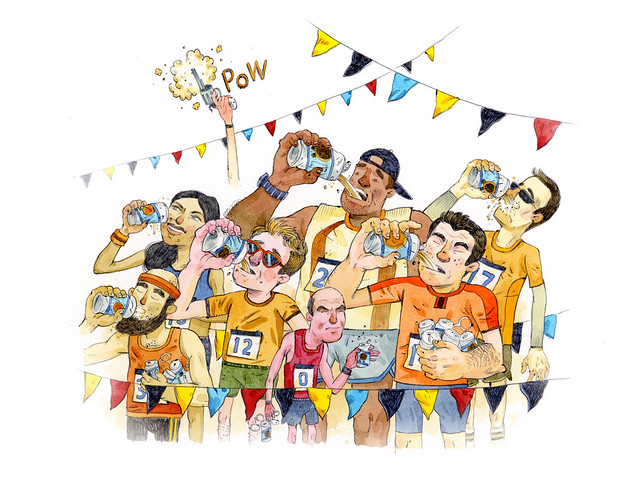
[Illustration by artist John Hendrix in the September 2012 issue of Runner’s World.]
Since When Is Being Uninhibited A Disease?

The prohibitionist propaganda machine that is Alcohol Justice is out in full swing today. They just sent out a tweet to the faithful, telling them. “Raising alcohol taxes reduces harm…it’s a fact.” We obviously have a different definition of what constitutes a “fact.” I tend to think of a fact as something not open to debate, not a position that everyone doesn’t agree with, or for which there is no counter-argument.
But the tweet also included the graphic below, which is a bottle showing all of the bullshit “harms” that AJ insists are caused by alcohol. I won’t get into each of them, or how almost all of them are potential things that can happen to a person who drinks immoderately, or can happen to any person for as many other reasons as there are people. They aren’t caused by the drink any more than a hamburger causes a heart attack. They may be a contributing factor for some people, but their continuing insistence that they are directly caused by any amount of alcohol goes a long way toward proving how out of touch with reality they are and just how fanatical and intrenched they’ve become in more recent years. Most people you and I know have been enjoying alcohol our entire lives without contracting any of these diseases or devolving to a life of crime. In fact, the moderate consumption of alcohol might actually make one healthier, a “fact” that Alcohol Justice now refuses to acknowledge, even as the FDA’s latest dietary recommendations make clear.
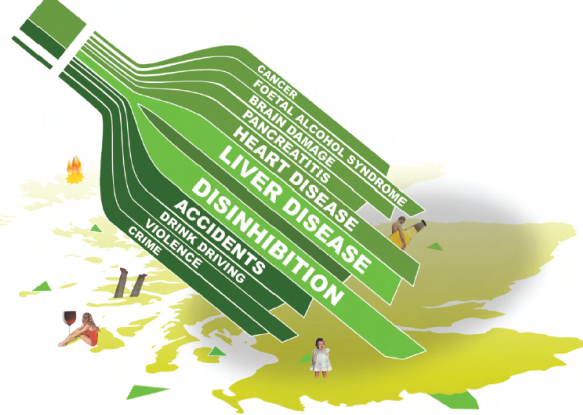
But look at the biggest one on the bottle, just below “liver disease.” Disinhibition? WTF? Since when is loosening up and not being such a tight-ass a disease that not only rivals brain damage, but given its prominent position on the bottle and the size of the type, appears to be one of the worst problems they associate with drinking. How many mental issues and how much stress is relieved by the occasional drink after work or with dinner, bringing about a “loss or reduction of an inhibition,” which is the Merriam-Webster definition of disinhibition. How is letting one’s hair down, so to speak, something to be feared and avoided? Given the company it’s keeping on their bottle of harms, it certainly seems clear that they regard it as a disease. I continue to marvel at the new and inventive ways that prohibitionists can try to pass judgement and make those of us actually “living” our lives feel guilty for enjoying ourselves.
The Science Behind Sobriety Tests

Today’s infographic is all about the Science Behind Sobriety Tests, and especially the three most common field tests that police officers administer on the side of the road when they suspect that someone might be driving with blood alcohol over the legal limit. It was created by Total DUI, a legal website specializing in helping people facing DUI/DWI charges.


Craft Beer Vs. Crafty Beer Infographic

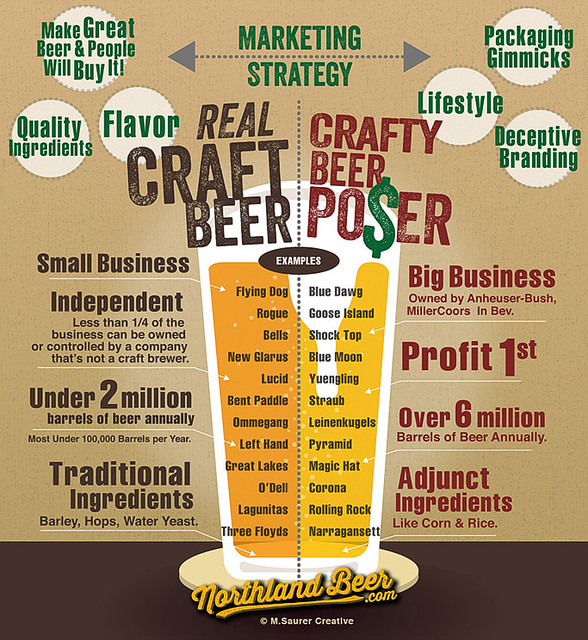
Today’s infographic tackles the recently controversial debate about Craft Beer versus Crafty Beer, beer created by the larger beer companies to resemble smaller brands. It was created by M. Saurer Creative for Northland Beer.
Click here to see the infographic full size.
The Belgian Kings

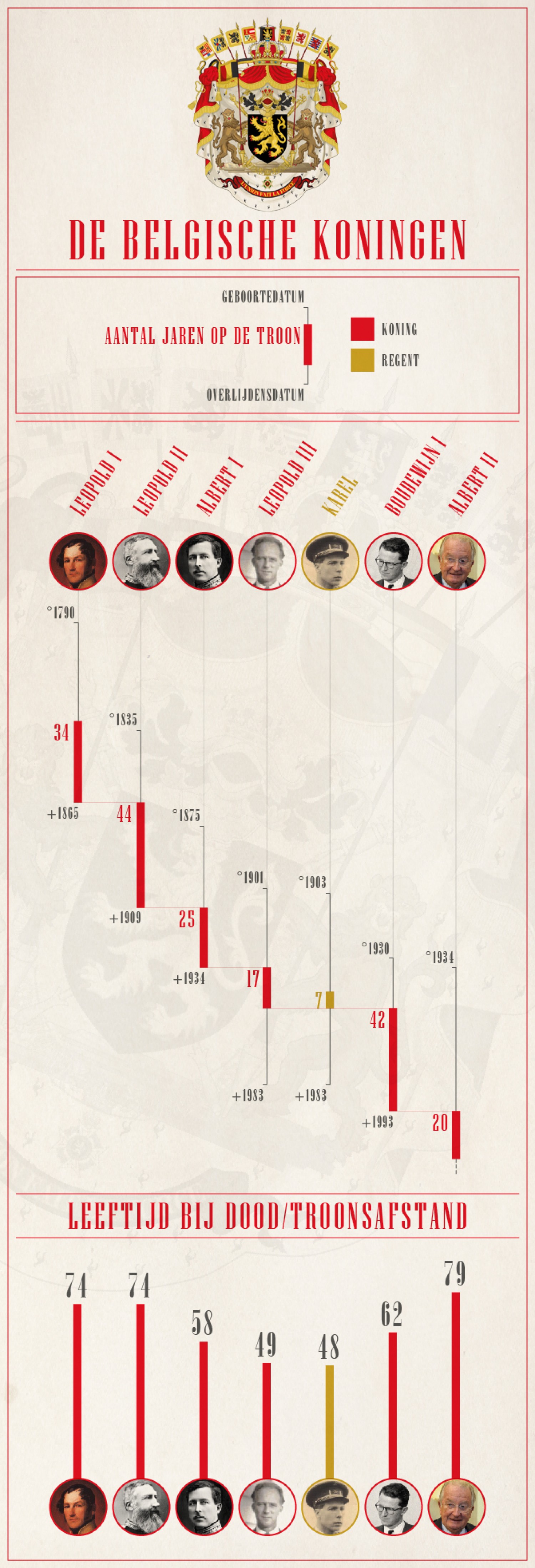
Today’s infographic, De Belgische Koningen, is a chart of Belgium’s six kings, although a seventh was crowned earlier this year. I met King Philippe this past June, when he was still just the crown prince and was leading a trade delegation to San Francisco. Plus, today is last full day in Belgium, though so far we’ve had no sign of the king.
Click here to see the chart full size.
Belgium: A Nation Divided

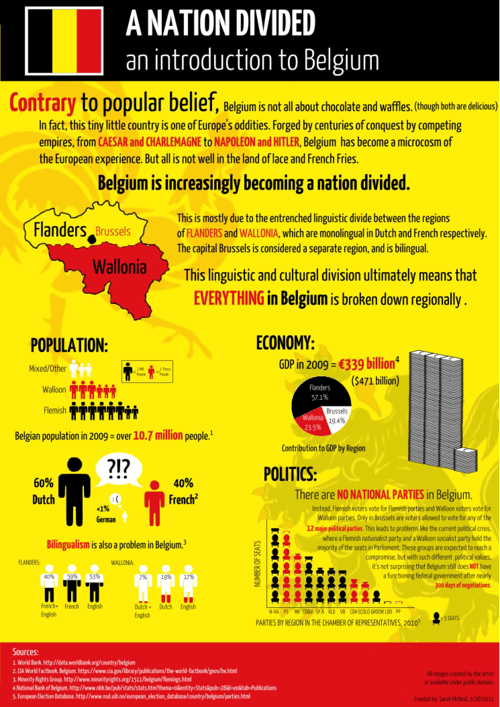
Today’s infographic isn’t strictly about beer, but the politics of Belgium. But I thought it was relevant because I’m in Belgium this week, visiting breweries throughout the Northern part of the country.
Click here to see the infographic full size.
Curious Cautions On Consumption Of Alcohol

It’s not sure what to make of some news that’s being reported based on a new report by the Alcohol Research Group of Emeryville, California. Several news outlets have picked up the story, including the San Francisco Chronicle, in Sobering tip – drink makers alter alcohol content; Join Together, in Drinks Often Contain More Alcohol Than People Realize; and Health magazine, in How Much Alcohol In Your Drink? Stronger Beverages Make It Tough to Tell.
The first curiosity is some articles say the report was done by the Public Health Institute’s Alcohol Research Group while others claim it was the National Alcohol Beverage Control Association. Curiouser still is the fact that neither organization has any information I can find about the alleged report, which is odd since the news reports quote people involved in it and from it. It’s not uncommon for only a summary to be available, especially if they’re trying to sell it to people, but I can’t even find any reference to it at all. It’s also fairly common for there to be a press release summarizing the report, but I can’t locate one of those, either. The NABCA in their news section has a link to a report on their report on Health24, the same syndicated article by Brenda Goodman that many news outlets are using. You’d think they’d at least have their own story about their own report.
Although the articles concern themselves with this new report, not one of them even mentions its name, although they each quote the report’s author, William Kerr, who’s billed as “a senior scientist with the Alcohol Research Group.” Scientist seems like a stretch, since his background is not in the hard sciences, having a BA and a PhD, both in economics. Now I have nothing against economics whatsoever, in fact I love the dismal science, and am fascinated by it. I know it’s a social science, a concept I fully accept, but when’s the last time you ever heard an economist referred to as a scientist, or even a social scientist? Having the title “senior scientist” strikes me as just a tad misleading, or is that just me?

Anyway, the point of the report, from what I can piece together, is that the standard drink sizes that are generally used determine as a single drink (mind you, for purposes of research and making people feel guilty, not for our real lives) are not as effective as they once were, because the alcoholic strength of beer and wine varies, and many people are too stupid to realize that. It honestly strikes me as a tempest in a teacup at the very least, and an attempt to fan the flames of anti-alcohol mischief at worst.
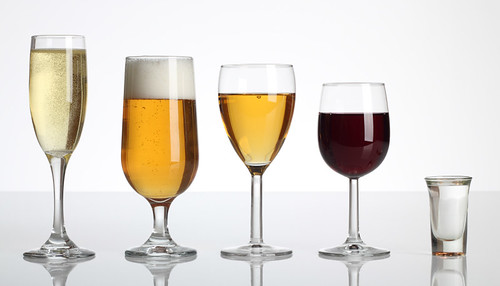
Here’s how one of the articles begins. “Thanks to rising alcohol levels in wine and beer, the drinks served in bars and restaurants are often more potent than people realize, a new report shows.” Seriously, just now rising? I know there are perhaps more higher strength beers than before the 1980s, when most beer was all the same, and certainly since craft beer is getting more popular arguably more of it’s being sold, but it’s still a drop in the ocean of the 5% beer majority. And really, is wine getting stronger? The report’s author, William Kerr, is quoted, saying “A lot of the wines now are 14 percent or even 15 percent commonly, and the standard 5-ounce glass of wine doesn’t apply to that level.” Um, as long as I can remember 14% has been the average wine strength. Seriously, if you had asked me how strong wine typically is, that would have been my immediate response. Of course, I’m no wine expert, by any stretch of the imagination, so I’ll defer to my wine brethren on that one. A Guardian article from 2011 reveals that it’s closer to 13% worldwide and 13.65% in the “New World,” by which I assume they mean us upstarts in the colonies. But if the averages are higher than what the “guidelines” are based on, wouldn’t it make more sense to argue for changing them, instead of complaining that people aren’t converting them properly? If they’re really concerned that people are drinking too much because of their own information, then changing it seems a more obvious solution to me.
Here’s another one I don’t quite understand. “Beer drinkers may find themselves in the same boat. A 12-ounce bottle of Bud Light beer has 4.2 percent alcohol, but the same-size bottle of Bud Light Platinum has 6 percent alcohol by volume, a nearly 50 percent increase.” I know math is hard, but that seems to skew the numbers to stretch a point. A 4.2% beer would contain .0504 ounces of alcohol, while at 6 percent, the amount would be 0.72. While ordinary rounding you could argue might make sense in other contexts, when you’re talking about such small numbers, the effect of rounding is inflating by one-half a percent (0.5%), not an inconsequential amount when the difference between the two examples is only 1.8%. That seems designed to make that example seem worse than it really is.
They also mention that it “matters whether you’re drinking a standard 12-ounce bottle, or downing draft beer in pints, which are 16 ounces each.” And that’s partly true, it does make a difference, but most good beer bars don’t serve higher alcohol beers in pint glasses, but in a smaller glass that’s less than that.
The Chronicle’s report claims that “craft beers and European imported beers usually have alcohol content a few percentage points higher than major American beers.” Some, sure, but their point is that beer strength varies widely, but then they give this absurd generality that’s not remotely true.
Also in the Chronicle, Kerr tells us that “Federal law requires hard alcohol manufacturers to list the alcohol content by volume on labels, but it’s optional for beer and most wines.” Actually, it’s the states that determine that, and in California it is indeed required on the label. Given that Kerr is in California, and the article was written by and for a California audience, that seems like it could have been useful information. It’s not optional here, nor do I believe that’s the case for any other state.
One thing I do agree with is the statement by Robert Pandina, director of the Rutgers Center of Alcohol Studies, who posits that the “dietary guidelines aren’t very useful. They don’t parallel the drinking habits of the American public.” So why we keep using them, I think, has more to do with people involved in the addiction business and anti-alcohol groups, then wanting to honestly come up with something that most people can actually use. Tellingly, Pandina is not part of the report that’s the subject of the articles.
The overall tone of the advice from the report, at least as gleaned from the quotes from it, is that people should be ridiculously fastidious in monitoring their intake of alcohol. But the guidelines are not that exact, nor should they be. The UK’s recommended amounts in fact were simply made up, while ours were more likely based on average drink sizes from once upon a time, and became fixed in stone along the same lines as binge drinking became increasingly narrowly defined. This, I can only guess, is the result of working with or around people with drinking problems. Most of us can manage to drink responsibly and moderately without a measuring cup or journal. If the majority of people who drink alcohol are not problem drinkers, which is the case, then being sensible doesn’t require a calculator. Most people know their limits and can, and do, moderate their own behavior and probably do so intuitively, having learned their own limits. I know mine, don’t you?
The headline that the “alcohol content of beer and wine varies widely” seems almost insulting in its assumption that most people think it’s all the same. I may not be among the average drinkers, but the news that different drinks have varying strengths seems too obvious, especially when you consider that the usual argument for not listing strength is that everyone will start shopping the labels and buy the strongest drinks to get drunk faster. So on one hand, us drinkers are smart enough to game the system by reading the labels to get drunk quicker, yet we’re too stupid to realize that different drinks have different amounts of alcohol in them. How many people honestly still believe that all beer is the same in 2013? Maybe it’s just the air of superiority that the prohibitionists and parts of the medical community adopt when they talk down to us in the world that continues to rankle. But I’ll sleep better tonight in the knowledge that by drinking moderately and responsibly, I’ll most likely live longer than the teetotalers who look down upon me and my ilk.
The Legal Drinking Age Around The World

Today’s infographic is a world map, showing the Legal Drinking Age Around the World. The darker the color, the higher the age at which you’re legally allowed to drink alcohol. Notice that America is one of the darkest regions on the map. Sheesh, sometimes we’re backwards.
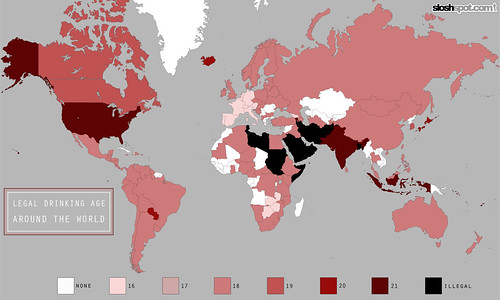
Click here to see the map full size.
It’s October: Time To Make The Beer Community Feel Guilty

Ah, it’s October again, Breast Cancer Awareness Month, and right on cue, it’s time to be insulted once more by the anti-alcohol bunch that can’t let any good deed go unpunished. This time around it’s Alcohol Justice — boy, have they been busy lately — who’s telling us how hypocritical we are for wanting to do anything to support the quest to find a cure for breast cancer. Alcohol Justice calls any such efforts a “mockery of public health, breast cancer advocacy, and alcohol policy,” and most importantly, a “mockery of breast cancer survivors and their loved ones.” Well, given that I lost my own mother to breast cancer and I love the fact that so many breweries, many of whom are my friends, take the time and effort to raise money for that cause, I have only two words for Alcohol Justice: “fuck you.”
You don’t get to decide how people spend their money, where they make their charitable donations or how. In the example highlighted in “If It Makes You Wealthy: Sheryl Crow & Treasury Wine Estates Sell Out Women’s Health,” the promotion they’re objecting to is a large wine conglomerate raising money for breast cancer research with Sheryl Crow’s support and participation, something that was announced this past July. Crow herself is a breast cancer survivor so they’re really thumbing their nose at her, too. If a cancer survivor chooses to try and do some good to raise money for a cause she feels personally invested in, it’s pretty shameless of you to try to grab headlines by calling her names and publicly telling her not to support that cause unless she does it the way they think it should be done.
They also take issue with Crow because the promotion is promising to “donate up to $100,000 to breast cancer charities,” an amount that Alcohol Justice derisively has decided is not nearly enough. I guess their first choice would be for her not to raise any money for breast cancer, but if she does, it had better be a large enough amount to satisfy them. They’re taking this page out of the playbook of Breast Cancer Action, who a few years ago declared that everyone of us in the alcohol industry trying to do good, and raise money for breast cancer, should be “ashamed of ourselves.” I wrote about that when they went on television and insulted us, in Biting the Hand That Feeds You.
In the paragraph before Alcohol Justice calls me, and the rest of us in the alcohol industry who care about breast cancer, a mockery, they claim that “[p]romoting alcohol as a healthy product is a harmful public relations tactic,” and suggest that the problem is “cancer advocate Crow is applying her considerable celebrity capital to increase sales of a product that contributes to the incidence of breast cancer in women.” The study they cite is from 2011, Moderate alcohol consumption during adult life, drinking patterns, and breast cancer risk, which did indeed conclude that “[l]ow levels of alcohol consumption were associated with a small increase in breast cancer risk,” which other studies have also shown, but that’s not the entire story, of course. One thing these incidents tend to have in common is relying on just one particular study as the foundation for why we in the alcohol industry should be feeling guilty for trying to help raise awareness or money for breast cancer. But what about the bigger picture? Here’s what I wrote about this three years ago.
[A]t least one [study] done by Kaiser Permanente shows that it’s the amount that matters, the higher the intake the greater the risk, meaning moderate drinking has less risk.
Still others show just the opposite. For example, a 2008 study at the Universidade do Porto, Porto, Portugal showed that Compounds in Beer and Wine Slow Breast Cancer Cell Growth. Still another suggests that “xanthohumol found in hops [has] the potential to lower the risk of prostate cancer, [and] researchers believe it could also reduce breast cancer risk in a similar manner — by binding to the receptors on breast cancer cells and blocking the effects of estrogen which stimulates the growth of certain types of breast cancer.” That’s about the discovery that xanthohumol, a Cancer-fighting agent found in beer.
In a fact sheet about the relationship between Alcohol and the Risk of Breast Cancer at Cornell University, there’s this sage advice:
Researchers have reported that women who consume light to moderate amounts of alcohol have a decreased risk of developing and dying from cardiovascular disease. Since more women are affected by and may die from cardiovascular diseases than breast cancer, the recommendations regarding alcohol and breast cancer may seem to contradict the reports regarding cardiovascular disease. The 1996 Guidelines on Diet, Nutrition and Cancer Prevention from the American Cancer Society suggest that most adults can drink, but they should limit their intake. Given the complex relationship between alcohol consumption and different diseases, any recommendations should be based on information about all health risks and benefits.
Exactly. Of course women should make individual decisions based upon their family history and/or other personal factors, but making a pronouncement for everyone is wrong. The overall positive effects of moderate alcohol consumption have to be weighed against individual risk factors. For example, total mortality is effected positively by moderate alcohol consumption, that is numerous studies and meta-studies have shown that people who drink in moderation will most likely live longer than people who abstain completely or who regularly binge drink. And that’s taking into account both the negative and positive risks and rewards.
So once again Alcohol Justice is bending the truth for their own purposes, and making the world black and white, in which it’s their way or the highway. They know best. You don’t have to worry about thinking for yourself, not when they can do the thinking for you. I love that they refer to the wine company as “posing as a health advocate,” as if anyone is “anti-health.” As if the people, and yes those of us in the alcohol industry are indeed people, even if Alcohol Justice paints us as less than human, wanted people to get breast cancer. Even if it were true that everyone who drank alcohol would get cancer (it’s not) why would anyone object to us donating money to finding a cure for it or helping to build awareness? So many people’s lives have been touched by cancer generally, and breast cancer in specific, but the way Alcohol Justice frames it, none of us should have anything to do with alcohol, or we’re mocking our loved ones. How many other professions or industries would they want to ban people from engaging in if they might result a potential danger. Should people who work for gun companies be ashamed of themselves because others may use a gun in a crime or to murder someone? Should fast food workers feel guilty because the people who buy their food might be eating the wrong kinds of food, leading to health problems, obesity and disease, and might place a burden on the healthcare system. Do you know what the ultimate cause of death is? Living. As R.D. Laing quipped. “Life is a sexually transmitted disease and the mortality rate is one hundred percent.” We all make choices about how we use the time that’s afforded each of us. And Alcohol Justice can jump down off their high horse and stop telling the rest of how to live our lives. That would certainly improve the time I have left on this world, so I can get back to enjoying myself with a good beer.