Brookston Beer Bulletin

Jay R. Brooks on Beer

  • Home
  • About
  • Editorial
  • Birthdays
  • Art & Beer

Socialize

  • Dribbble
  • Email
  • Facebook
  • Flickr
  • GitHub
  • Instagram
  • LinkedIn
  • Pinterest
  • RSS
  • Twitter
  • YouTube

Powered by Genesis

Stuff & Nonsense, Part 4

January 12, 2010 By Jay Brooks

If you’ve been following along from my posts the last couple of days, beginning with, Stuff & Nonsense: The UK Health Select Committee Report On Alcohol, and more specifically Pete Brown’s wonderfully telling and insightful rebuke of it all — and you should be — then I’m pleased to report that part four is now available.

Today’s rebuke is one I’d long wondered about, and it’s an argument often trotted out on our shores whenever the hue and cry goes up for more taxes on alcohol, as it inevitably and incessantly does. For me, perhaps the most annoying aspect to the neo-prohibitionist attacks is the never-ending nature of them. They’re like the psycho killer in every modern horror movie. There’s seemingly no way to make them stop. There’s no reasoning with them. They’re not susceptible to logic. California’s own version of a neo-prohibitionist Jason, state representative Jim Beall, said last year after his bill to raise beer taxes 560% was defeated. “They’ve given me a bloody nose. But I’m going to wipe it off and come back in a few weeks with something different.”

In today’s counter to the UK report’s assertion that Alcohol is becoming cheaper/more affordable, Pete leads with the following:

Well, alcohol is becoming more affordable because average household income is increasing. Alcohol is becoming more affordable because everything is becoming more affordable.

It’s my sense that’s what’s going on in the U.S., too. The “taxes haven’t been keeping pace with inflation” argument is likewise untrue for the UK.

[A]ffordability and price are being treated as the same thing — they’re not. By deliberately confusing ‘affordability’ (which is a function of rising disposable income) and price (which is a function of — well, price, but controlled chiefly by duty), you allow newspapers like the Telegraph to interpret these findings in the following syntax-strangled bullet point:

  • “69 – percentage alcohol is cheaper by than it was in 1980.”

This is a lie. Alcohol is NOT cheaper. It is already increasing by more than inflation, and in recent decades, it always has.

I’m going to have to see if that holds true here, too, though I suspect it does.

If this is new to you, start with Pete Brown’s Health Select Committee Report on Alcohol. Part One (of 10) was published yesterday, Alcohol consumption in the UK is increasing. Yesterdday, parts two, 25% of the UK population is drinking at hazardous or harmful levels, and three, Binge drinking is increasing, were published. Today, here’s part four: Alcohol is becoming cheaper/more affordable. Again, stay tuned.

Filed Under: Editorial, Politics & Law Tagged With: Prohibitionists, Statistics, UK

Stuff & Nonsense, Parts 2 & 3

January 11, 2010 By Jay Brooks

If you’ve been following along from my post yesterday, Stuff & Nonsense: The UK Health Select Committee Report On Alcohol, and more specifically Pete Brown’s wonderfully telling and insightful rebuke of it all — and you should be — then I’m happy to report that parts two and three are now available.

If this is new to you, start with Pete Brown’s Health Select Committee Report on Alcohol. Part One (of 10) was published yesterday, Alcohol consumption in the UK is increasing. Today, parts two, 25% of the UK population is drinking at hazardous or harmful levels, and three, Binge drinking is increasing, were published. Again, stay tuned.

Filed Under: Editorial, Politics & Law Tagged With: Prohibitionists, Statistics, UK

Stuff & Nonsense: The UK Health Select Committee Report On Alcohol

January 10, 2010 By Jay Brooks

The stuff and nonsense that neo-prohibitionist groups incessantly attack the unsuspecting public with to further their misguided agenda continues to heat up in Great Britain. Happily, Pete Brown is once again on the case. Last week the Parliament Health Select Committee released a report on alcohol in the UK. Surprising no one, it’s riddled with misleading statistics and statements and even outright lies. I’m continually amazed at how gullible the media is when they want to be, swallowing their nonsense wholesale and not questioning it for reasons that pass understanding. In this interminable war between drink and dry, the dry side appears willing to do nearly anything, no matter how reprehensible. I realize I’m biased, but people who enjoy alcohol are on my mind generally more reasonable about this. We recognize and freely admit that some people abuse alcohol and may be a danger to themselves and others. That’s true not just of alcohol, but virtually everything. That’s the price if living in a free society. Not everyone will act, at least all the time, with the highest ideals and best interests at heart. People are … well, people. We’re human, which means fallible, prone to stupidity and even engage in self-destructive behavior from time to time. But while rational people accept his fact, neo-prohibitionists are determined to use this minority when it comes to alcohol to extrapolate their behavior and insist it means everyone who drinks is ruining society. Every single example of individual bad behavior seems to their addled minds to prove alcohol will and does have this effect on everyone equally. And they have the statistics to support that (never mind that they themselves created those statistics). But enough of my ranting.

Pete Brown gives his critique of the overall report, pointing out basic inconsistencies and fabrications. The initial takeaway for him — and me as well, frankly — is this:

Liam Donaldson told the committee (with his usual utter disregard of any factual substantiation whatsoever) that there are “no safe limits of drinking,” and that “alcohol is virtually akin to smoking as one of the biggest public health issues we have to face in this country.”

Bollocks of course. But officially published, sanctioned, and undisputed bollocks.

And that comparison with smoking is quite deliberate. Not all the measures listed above [see original post] will come to pass, but arguably the most important line in the report is this one:

“Education, information campaigns and labelling will not directly change behaviour, but they can change attitudes and make more potent policies more acceptable.”

Smoking hasn’t been banned form British society. But consistent campaigning against smoking eventually changed social attitudes towards it. The smoking ban came in because the majority of people were in favour of it. Nobody but the ad industry minded when advertising and sponsorship were banned. Making smoking socially unacceptable was far more effective than trying to ban it outright. The anti-drink lobby have learned from this, and this report is a naked attempt to make drinking socially unacceptable.

But drinking is NOT the same as smoking. The BMA itself acknowledges the beneficial effects of moderate drinking. Nevertheless, this report seeks to persuade people to treat it the same way, and is meeting with little resistance.

Pete’s become a man obsessed, definitely making him my kind of bloke, and promises to taking apart the arguments in the report in greater detail, with charts and logic, including at least the following topics. The first of the is now up, and it’s linked below. I’ll continue to update these as they come. Regardless of where you live, these are worth your time, because it’s become increasingly obvious that the tactics used cross national orders and are used universally.

  1. “Alcohol consumption in the UK is increasing”
  2. “Binge drinking is increasing”
  3. “25% of the UK population is drinking at hazardous or harmful levels“
  4. “Alcohol is becoming cheapermore affordable”
  5. “Alcohol related hospital admissions — and the cost to the NHS — are soaring”
  6. “Alcohol abuse costs the country £55bn a year”
  7. “The best way to reduce the harmful effects of alcohol is to reduce overall consumption“
  8. “Alcohol advertising and promotion must be tightly regulated because it encourages underage drinking”
  9. “Pubs are a problem“
  10. “Binge drinking has been made much worse by 24 hour licensing”

Stay tuned.

Filed Under: Editorial, Politics & Law Tagged With: Prohibitionists, Statistics, UK

Hickenlooper Gubernatorial Run A Possibility?

January 7, 2010 By Jay Brooks

colorado
For those of you, like me, who’ve known Wynkoop founder John Hickenlooper for a number of years, this is potentially great news. By all accounts, he’s been a very effective mayor for Denver, and has for some time been urged to run for Governor of Colorado, though so far he’s declined.

The most likely candidate for the next election had been thought to be Ken Salazar, currently Secretary of the Interior in the Obama administration. But according to the Denver Post today, Salazar will not be running, preferring to stay at his cabinet post, and has endorsed John Hickenlooper as a candidate for Colorado governor. There’s a picture on the Post’s website of both Salazar and Hickenlooper at the press conference where he made the announcement, fueling further speculation that the Denver mayor may indeed choose to run this time.

In a statement released by Salazar, he said of Hickenlooper. “John Hickenlooper is a uniter. He transcends political and geographic divides to bring people together to develop solutions. If he decides to run, he will make an excellent Governor for the State of Colorado.” Still no official word from Hickenlooper, but I assume he’s giving it careful consideration and we should know something soon. Finger crossed, I think a (former — he’s divested himself of Wynkoop) brewery owner governor would be great.

Filed Under: News, Politics & Law Tagged With: Colorado

UK Neo-Prob’s Go Nuts … Again

January 3, 2010 By Jay Brooks

There’s a great post today by Pete Brown concerning more nonsense from Great Britain’s neo-prohibitionist-leaning government flacks. Yet again confirming, at least to me, his status as a kindred spirit regarding this issue, Pete begins with this understandably anger-fueled assessment of the situation. This story comes at the beginning of the year, when people are stopping to take stock of their lives, but instead “the neo-prohibitionists go completely fucking apeshit, pouncing on the moment when many moderate drinkers prove they don’t have a drink problem by taking a few weeks off the sauce, and use it to ram fear and alarm down the nations throats as never before.”

Effectively, the tortured math from the UK’s National Health Service suggests that one-and-a-half pints of lager constitutes “hazardous behavior,” even if that amount is consumed over a week’s time! Congratulations to England, they’ve finally beaten us in being completely ridiculous about drinking guidelines. Read Pete’s post, it’s brilliant stuff.

Filed Under: Beers, Editorial, Politics & Law Tagged With: Prohibitionists, UK

When All Else Fails, Blame Society

December 30, 2009 By Jay Brooks

crime-dog
Here’s another troubling development in the drive to erase alcohol from society. A study to be published next March in Alcoholism: Clinical and Experimental Research was featured in Science Daily last week based on an early view of the study online. (Thanks to Bulletin reader Pete M. for sending this to me.) That account was titled Alcohol Outlets Lead to Specific Problems Among Youth and Young Adults suggesting the issue is settled but the study’s title is a more vague: Ecological Associations of Alcohol Outlets With Underage and Young Adult Injuries. The Science Daily account is based on the study, but being unwilling to shell out the necessary doubloons for a subscription so I can read the whole thing means only the abstract is available to me, and it’s one of the least useful ones I’ve ever read, having almost no real information about the study at all. Here it is in its entirety.

Objective: This paper argues that associations between rates of 3 specific problems related to alcohol (i.e., accidents, traffic crashes, and assaults) should be differentially related to densities of alcohol outlets among underage youth and young adults based upon age-related patterns of alcohol outlet use.

Methods: Zip code-level population models assessed local and distal effects of alcohol outlets upon rates of hospital discharges for these outcomes.

Results: Densities of off-premise alcohol outlets were significantly related to injuries from accidents, assaults, and traffic crashes for both underage youth and young adults. Densities of bars were associated with more assaults and densities of restaurants were associated with more traffic crash injuries for young adults.

Conclusions: The distribution of alcohol-related injuries relative to alcohol outlets reflect patterns of alcohol outlet use.

From Science Daily’s account:

“Over the past four decades, public health researchers have come to recognize that although most drinkers safely purchase and enjoy alcohol from alcohol outlets, these places are also associated with serious alcohol-related problems among young people and adults,” said Paul J. Gruenewald, senior research scientist at the Prevention Research Center and corresponding author for the study.

“In the early studies, researchers believed associations were due to increased alcohol consumption related to higher alcohol outlet densities,” added Richard Scribner, D’Angelo Professor of Alcohol Research at the LSU School of Public Health. “However, as the research area has matured, the relations appear to be far more complex. It seems that alcohol outlets represent an important social institution within a neighborhood. As a result, their effects are not limited to merely the consequences of the sale of alcohol.”

So while admitting the problem is very complex, they nonetheless go on to leap to some pretty simple conclusions, that don’t seem at all supported by the evidence. At a minimum, their conclusions are only one of many possible reasons for the results their data seems to show, but which in no way leads to one inescapable conclusion, as they seem to think.

As my Bulletin reader Pete succinctly puts it:

It strikes me as another example of a giant leap of logic between an observed correlation and implied causation. There’s a link between, on the one hand, the residential ZIP Codes of patients of certain ages discharged from hospital for certain injuries, and on the other, the number of bars, restaurants, and liquor stores in those same ZIP Codes. Interesting, perhaps, but the real question is why?

Exactly. Why indeed?

But the truly scary bit is in their half-baked conclusions.

The key message, said both Gruenewald and Scribner, is that a neighborhood’s alcohol environment plays a role in regulating the risks that youth and young adults will be exposed to as they mature.

“From a prevention perspective, this represents an important refocusing of priorities, away from targeting the individual to targeting the community,” said Scribner. “This is hopeful because a community-based approach that addresses the over concentration of alcohol outlets in a neighborhood where youth injuries are a problem is relatively easy compared with interventions targeting each youth individually.”

So liquor stores are already subject to strict zoning in many places, will this be used to further isolate them next to the adult bookstores at the edge of towns? Won’t that just increase drunk driving?

Again, I turn to Pete’s assessment.

With no other supporting evidence, the study’s authors appear to suggest that more of these “alcohol outlets” in your neighborhood lead to more assaults, accidents, etc. They make this assertion despite the fact that the hospital data they used doesn’t say whether or not alcohol was even involved in those cases. Moreover, the ZIP Code of one’s residence is often not the ZIP Code where one purchases and consumes their alcohol; where we live and where we drink are not the same, particularly at the spatial resolution of ZIP Codes.

If they really want to explain the empirical patterns they found, I suggest the researchers look at other factors that might correlate with the geography of alcohol outlets. Check zoning ordinances, for example, and the neighborhoods in which such outlets are allowed. My guess is you’d find nearby residences populated disproportionately by less affluent households, ones who are either: (a) at more risk of being involved in an accident or assault regardless of any connection to alcohol, and/or (b) are less likely to have health insurance and thus more likely to end up in a hospital emergency room following minor altercations and accidents that would be treated on an outpatient basis in a more affluent part of town.

There are no doubt plenty of possible explanations; the quickness with which researches will jump to the conclusion that it’s the alcohol’s fault never ceases to amaze me.

Indeed, that is the mystery and the trouble, especially as this is the sort of thing that neo-prohibitionist groups, spearheaded by the Robert Wood Johnson Foundation, have been spending millions of dollars on, and not surprisingly getting the results that they want to further their agenda. There are research groups funded by the brewing industry that come to opposite conclusions, of course, but those are usually discounted or discredited for that affiliation, yet the media rarely does the same to studies like this one, not even bothering to ask about the funding or the agenda of the group. That such studies can then be published in “legitimate” science journals makes them even less likely to be questioned, even though that’s exactly what the media should be doing.

Don’t worry, it’s the not the individual person who abuses alcohol and good sense that’s at fault here, it’s the community where he lives. As a Monty Python skit once suggested, with a Bobby investigating a murder: “society’s to blame? Let’s lock them up instead.”

Filed Under: Editorial, Politics & Law Tagged With: Prohibitionists, Science

Brewing Up A Civilization

December 24, 2009 By Jay Brooks

history
There’s a wonderful article today in Germany’s Der Speigel showcasing University of Pennsylvania Archaeologist Patrick McGovern’s theory that alcohol is responsible for nothing short of civilization itself. Titled Alcohol’s Neolithic Origins: Brewing Up a Civilization, the story begins:

Did our Neolithic ancestors turn to agriculture so that they could be sure of a tipple? US Archaeologist Patrick McGovern thinks so. The expert on identifying traces of alcohol in prehistoric sites reckons the thirst for a brew was enough of an incentive to start growing crops.

It turns out the fall of man probably didn’t begin with an apple. More likely, it was a handful of mushy figs that first led humankind astray.

Here is how the story likely began — a prehistoric human picked up some dropped fruit from the ground and popped it unsuspectingly into his or her mouth. The first effect was nothing more than an agreeably bittersweet flavor spreading across the palate. But as alcohol entered the bloodstream, the brain started sending out a new message — whatever that was, I want more of it!

This is nothing new if you’ve been following McGovern and other scientists coming to similar conclusions as new evidence is continually being found to support the idea that it was the desire to brew beer that caused man to settle down and grow crops, leading to civilization’s genesis. But it’s quite nice to see it gaining traction in mainstream media.

McGovern’s latest book, Uncorking the Past: The Quest for Wine, Beer, and Other Alcoholic Beverages, is a fascinating read and I highly recommend it. McGovern is also the scientist that worked with Dogfish Head Brewery to create Midas Touch, Chateau Jiahu, along with their other historically based beers.

egyptian-brewery
An Egyptian wooden funerary model of a beer brewery in the National Archaeological Museum in Athens.

Filed Under: Beers, Just For Fun, Politics & Law Tagged With: History, Mainstream Coverage, Middle East

British Hypocrisy On Beer & Health

December 17, 2009 By Jay Brooks

uk
I take no pleasure, though a certain perverse comfort, in the fact that America is not alone in its hypocrisy when it comes to alcohol policy and its government heath organizations. Today in the BBC News is another example of this phenomenon. (Thanks to Pete Brown for pointing this one out.)

In a title no doubt intended to inspire fear and paranoia, Parents Giving Children Alcohol Fuels Binge Drinking, Sir Liam Donaldson, England’s chief medical officer, warned parents that “letting children taste alcohol to ready them for adulthood was ‘misguided'” and claimed “[e]vidence showed that this could lead to binge drinking in later life.” Curiously, he offered no support whatsoever for this so-called evidence apart from saying it. You’d think the reporter might have asked him for that evidence, but no. Way to probe for the story, Marty.

Donaldson also claimed, again without any support, that “[t]he science is clear – drinking, particularly at a young age, a lack of parental supervision, exposing children to drink-fueled events and failing to engage with them as they grow up are the root causes from which our country’s serious alcohol problem has developed.” The problem with that statement is that what he’s complaining about is that some parents give their children alcohol in a controlled environment, specifically NOT with a “lack of parental supervision,” etc. that he then claims is the problem. That makes it a problem that’s effectively the opposite of the one he starts out fomenting about and is indicated in the article’s headline. I should also mention that unlike most U.S. states, UK parents can legally “give their children alcohol at home from the age of five onwards.”

But, they continue, “[r]ates of teenage drunkenness are higher amongst both the children of parents who drink to excess and the children of parents who abstain completely.” So read that again. Kids drink more later in life if their parents either drink too much or not at all. That suggests that children of moderate drinkers do not, and the only way those children would know their parents are moderate drinkers if if they actually saw them drinking, something neo-prohibitionists are decidedly against.

Then again, as if forgetting that he began with the premise that parents giving their kids alcohol was the problem, he acknowledges. “Whilst parents have a greater influence on their children’s drinking patterns early on, as they grow older their friends have a greater influence. It is therefore crucial for parents to talk to their children about alcohol and its effects.” Talk, apparently, but not model responsible behavior or educate their children about alcohol.

But the upshot at the end is another opinion altogether, and one that contradicts everything that’s come before it.

Professor Ian Gilmore, president of the Royal College of Physicians and chair of the Alcohol Health Alliance, said: “We know that adults who drink sensibly tend to pass these habits on and that some families choose to introduce alcohol to their children younger than 15 in a supportive environment.”

Well, if moderate drinking parents pass their responsible habits to their children — which I also believe they do — and some accomplish that by introducing alcohol to their kids successfully, then how exactly is this the problem that Dr. Donaldson seems to think it is? I tend to put my faith in the doctor who specializes in alcohol and health — Gilmore — rather than the administrator at the top, but perhaps that’s just me. I may simply be responding to the most reasonable position, and the one I happen to agree with.

So essentially, this article starts out with a bold headline and scary quotes from one of the country’s top docs, offered with no support whatsoever, and yet it turns out if you read all the way through it, that what they started out trying to scare people about isn’t even really true, settled or consistent. Of course, I learned in my college journalism classes that many readers tend to read the headline and maybe a paragraph or two, before their interest wanes and they move on. That’s why I was taught to put all the pertinent information in the early paragraphs and not leave it for a trick ending that contradicts the premise. (To be fair, I often ignore that advice, too, but not when I’m writing for a newspaper.) To me, that suggests an agenda on the part of either the author or the publisher. Surely an editor would have noticed the article wasn’t even internally consistent. But whatever the reason it was written this way, it certainly did beer or the truth no favors.

Filed Under: Editorial, Politics & Law Tagged With: Health & Beer, Prohibitionists, UK

Tactical Penguin Goes Nuclear

November 30, 2009 By Jay Brooks

brew-dog
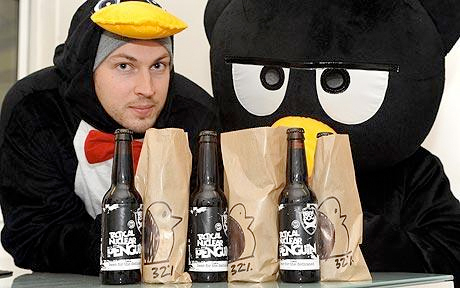
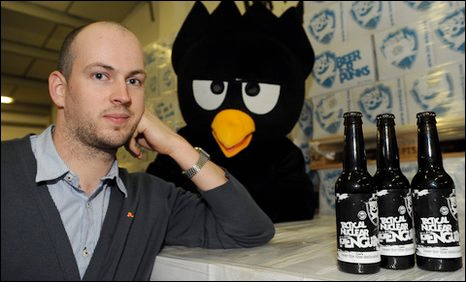
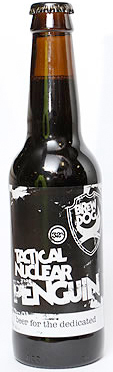
Unless you’ve been ducking and covering under a rock, you no doubt saw that, while we were sitting down to eat turkey on Thursday, Scotland’s BrewDog released Tactical Nuclear Penguin, which they’re touting as the new champion “world’s strongest beer.” Weighing in at a robust 32% a.b.v., it bested the current American contender, Samuel Adams Utopias, by a whopping 5%. As is typical of the self-styled punks of beer, the release was amid controversy. Predictably, anti-alcohol groups in the UK wasted no time denouncing the beer’s strength as irresponsible, a laughable claim given Scotland’s whisky industry. Jack Law, head of Scotland’s own Alcohol Focus Scotland, said “it is child-like attention-seeking by a company that should be more responsible. The fact that they have achieved a new world record is not admirable. It is a product with a lot of alcohol in it – that’s all. To dress it up as anything else is cynical. It’s as strong as whisky, so you have to ask whether this is actually a beer or a spirit – it’s clearly a spirit.” So obviously the Scots have no shortage of ignorant blowhards in their neo-prohibitionist organizations, too. The fact that there are only 500 bottles and each one sells for £30 (almost $50) and is only a 330 ml (roughly 11.2 oz.) would suggest this is not cause for widespread panic, as it’s hardly going to be selling out of the local Tesco anytime soon.

Perhaps more surprising, one of BrewDog’s bitterest critics of late has been Roger Protz, the grand old man of CAMRA and British beer writing generally. I usually have great respect for Roger and all he’s done for beer, but he seems to have lost his mooring on this one and drifted out into the waters off insaneland. In today’s BrewDog Go Bonkers , he calls the BrewDog lads all sorts of unflattering names and accuses them of all manner of impropriety, even incorrectly accusing the new beer of not actually being a beer — it clearly is — and gets the barest details of its manufacture wrong, despite the fact that BrewDog’s website includes a video explaining how they created Tactical Nuclear Penguin.

He even throws his hat into the ring with the likes of Jack Law, head of Alcohol Focus Scotland, which I find almost unforgivable, especially given Law’s churlish quote about BrewDog’s “childlike attention-seeking.” Um, gentlemen, what exactly do you think marketing is? The very point is to get attention. You can disagree with the way a company goes about the marketing of their products, but calling it “childlike” or suggesting that it’s seeking attention is like saying the goal of advertising is to sell things. Duh. Paging Captain Obvious.

tnp-1
James Watt in his penguin suit, with his newest beer.

Just two weeks earlier, in Enough Is Enough, Protz was again telling BrewDog’s James Watt and Martin Dickie it was time they “grew up and stopped behaving like a couple of precocious teenagers standing on a street corner with back-to-front baseball caps screaming for attention.” Wow. Watts referred to Protz, when he retweeted this, as “Grandpa Protz” and I think he may be onto it. I can’t imagine telling a brewer to grow up in print. That takes more cheek than I possess. They’re all adults, conducting their business the way they want to. But apparently taking their cue more from American sensationalist brewers than the often stodgy traditions of UK beer really ruffled Protz’s feathers. I know Roger to have strong opinions and to be a great champion of English brewing traditions, but these two anti-BrewDog posts seem more like personal attacks, as if they’ve offended him directly. As much as I hate to say it, he comes across as out of touch, a sentiment apparently shared by a great number of people who left comments to his posts. There were an enormous number pointing out the flaws in his reasoning and calling him on being set in his ways and unable to appreciate anything outside classic English beer’s range. Read the comments, they’re as illuminating as Protz himself, and are in many cases highly entertaining on their own.

tnp-2
James Watt out of his penguin suit, with bottles of Tactical Nuclear Penguin.

From the press release:

This beer is about pushing the boundaries, it is about taking innovation in beer to a whole new level. It is about achieving something which has never before been done and putting Scotland firmly on the map for progressive, craft beers.

This beer is bold, irreverent and uncompromising. A beer with a soul and a purpose. A statement of intent. A modern day rebellion for the craft beer proletariat in our struggle to over throw the faceless bourgeoisie oppression of corporate, soulless beer.’

The Antarctic name inducing schizophrenia of this uber-imperial stout originates from the amount of time it spent exposed to extreme cold. This beer began life as a 10% imperial stout 18 months ago. The beer was aged for 8 months in an Isle of Arran whisky cask and 8 months in an Islay cask making it our first double cask aged beer. After an intense 16 month, the final stages took a ground breaking approach by storing the beer at -20 degrees for three weeks to get it to 32%.

For the big chill the beer was put into containers and transported to the cold store of a local ice cream factory where it endured 21 days at penguin temperatures. Alcohol freezes at a lower temperature than water. As the beer got colder BrewDog Chief Engineer, Steven Sutherland decanted the beer periodically, only ice was left in the container, creating more intensity of flavours and a stronger concentration of alcohol for the next phase of freezing. The process was repeated until it reached 32%.

Pete Brown, by contrast, has a far more measured reaction to BrewDog’s new beer. We agreed on what was the best part of the press release.

Beer has a terrible reputation in Britain, it’s ignorant to assume that a beer can’t be enjoyed responsibly like a nice dram or a glass of fine wine. A beer like Tactical Nuclear Penguin should be enjoyed in spirit sized measures. It pairs fantastically with vanilla bean white chocolate it really brings out the complexity of the beer and complements the powerful, smoky and cocoa flavours.

Pete takes the right approach IMHO, wanting to focus on the beer itself, which he describes as “an Imperial Stout that has been matured in wooden casks for eighteen months. It has then been frozen to minus twenty degrees at the local ice cream factory in Fraserburgh. By freezing the beer to concentrate it this way, they get the alcoholic strength.” Hard to say what it might taste like, but Pete speculates it will have “very rich, smooth, mellow and complex flavour.” Also, like him, I’m certainly keen to find out. I recently attended a Utopias beer dinner, my third tasting of this year’s version, which is 27%, tantalizingly close to Penguin’s 32%. It’s a wonderful beer, but its release was not accompanied by the frenzy of this beer. Likewise, other very strong beers like Schorschbräu (at 31%), Hair of the Dog Dave (at 29%), as far as I know, did not cause any beer writers to scold them for their efforts. So what’s the difference?

As to the question of whether or not it’s beer, Pete continues:

I once attended a breakfast hosted by Jim Koch, founder of Samuel Adams, father of the awesome Utopias. I asked him a similar question — is this still beer? — and was inspired by his answer. He said something along the lines of beer has been around for thousands of years. Over that time it has evolved continually, and the pace of evolution has picked up considerably in the last couple of centuries. “How arrogant would we have to be to say that in this time, our time, we’ve done everything with beer that can be done? That we’ve perfected beer?” he asked me.

This is why when I love Brew Dog, I really do love them. It’s easy — and not always inaccurate — to accuse them of arrogance. But not when they do something like this. It’s far more arrogant to say ‘we can’t possibly improve on our beer’ than it is to never stop trying to do precisely that. In my marketing role, I often hear brewers talk about something like a slightly different bottle size and refer to it as ‘innovation’. Brew Dog are genuine innovators on a global stage, redefining what beer can actually be.

I guess I just don’t understand the bombastic reaction the release of this beer produced and the way in which it and the brewer’s intentions have been misinterpreted. Why wouldn’t any beer lover want to try it? After all, it really should be about the beer.

brewdog-penguin

Filed Under: Beers, Editorial, News, Politics & Law Tagged With: England, Scotland, UK

Inventing Binge Drinking

November 30, 2009 By Jay Brooks

drunk
I’ve long railed against the various governmental health department definitions of “binge drinking” as being out of touch with reality and self-serving to anti-alcohol groups. In the U.S., the CDC defines binge drinking as “five drinks in a row” and in the UK it’s too many “units of alcohol” in a given day (or number of hours). But that wasn’t always how it was defined.

In a recent issue of the Social History of Medicine, an Oxford Journal, social scientists Virginia Berridge, Rachel Herring and Betsy Thom published Binge Drinking: A Confused Concept and its Contemporary History.

Here’s the summary of the article:

Binge drinking is a matter of current social, political and media concern. It has a longterm, but also a recent, history. This paper discusses the contemporary history of the concept of binge drinking. In recent years there have been significant changes in how binge drinking is defined and conceptualised. Going on a ‘binge’ used to mean an extended period (days) of heavy drinking, while now it generally refers to a single drinking session leading to intoxication. We argue that the definitional change is related to the shifts in the focus of alcohol policy and alcohol science, in particular in the last two decades, and also in the role of the dominant interest groups.

To me, one of the key points of this article is how the definition has changed to create a panic of increasing binge drinkers when it’s far more likely rates are roughly the same, only the definition has changed so that it not only seems like the problem has grown worse, but so that anti-alcohol advocates have a convenient new method by which they can base ever more draconian policy demands.

Binge drinking as a concept has a distant history: but it also has a recent one. The term has come in recent years to describe two quite distinct phenomena. First, it is used to describe a pattern of drinking that occurs over an extended period (usually several days) set aside for the purpose. This is the ‘classic’ definition, linked to clinical definitions of the disease of alcoholism, as in Jellinek’s 1960 classification. Secondly, binge drinking has come to be used to describe a single drinking session leading to intoxication, often measured as the consumption of more than a specific number of drinks on one occasion, often by young people. There is no consensus on how many drinks constitutes this version of binge drinking—how much alcohol—and a variety of ‘cut-offs’ are used.

The second meaning has become prominent in recent years, is used extensively in research and informs UK policy. The ‘new’ definition has largely, but by no means entirely replaced the ‘classic’ definition, and both terms co-exist, if somewhat uneasily at times, in the alcohol field. Thus, it was evident from our research that there has been a shift in recent history in the meaning of the term. What was less clear was how the current confused definition of binge drinking has come to hold sway in public and policy discussions when it seems to be different from definitions which operated in the past. This is an issue which has implications for policy. But it is also a change which throws light on the relationship between science and policy. Our overall hypothesis, which is set out in this discussion paper, is that the definitional change must be related to the shifts in the focus of alcohol policy and alcohol science, in particular in the last two decades, and also to the role of the dominant interest groups in the alcohol field. It is not a change simply in the types of people drinking and the ways in which they drink, but rather an issue of perception which tells us something about the ways in which science and policy interact. [My emphasis.]

And the perception, as well as the target, has indeed changed. While binge drinkers used to be thought of as solitary older males, today the binge drinking “focus is on women and young people.” Although they’re careful in the wording of the article, I think it’s clear they’re saying that the shift in defining binging has been a bad idea, as it’s taken the focus away from the people who really need help and placed it on a more convenient target that allows neo-prohibitionist groups to sound the alarm about the problems of underage drinking — the children, always the children. People naturally want to protect kids from harm, and so it’s much easier to advance destructive alcohol policy under the rubric of underage drinking issues. I’d argue that this is even likely the reason for the shift in the definition, to advance the anti-alcohol agenda more effectively. Fear is always more effective than truth, sadly, in motivating people.

Among the journal article’s conclusions:

Policy makers should be aware of the context in which they operate. Concepts do not appear out of thin air, but have their own history. This study can in fact be seen as feeding in ‘evidence’ to policy on the rational model. On a more theoretical level, this change of definitions over time is also a case study of evidence and policy itself. It tells us how science interacts with policy making and the policy environment.

Exactly. In this case, the science was manipulated and created to further a specific anti-alcohol agenda over the last two decades. As a result, everyone I know is a binge drinker. That’s what happens when science no longer reflects reality but instead is used to remake it.

Filed Under: Beers, Editorial, Politics & Law Tagged With: Health & Beer, Prohibitionists

« Previous Page
Next Page »

Find Something

Northern California Breweries

Please consider purchasing my latest book, California Breweries North, available from Amazon, or ask for it at your local bookstore.

Recent Comments

  • Bob Paolino on Beer Birthday: Grant Johnston
  • Gambrinus on Historic Beer Birthday: A.J. Houghton
  • Ernie Dewing on Historic Beer Birthday: Charles William Bergner 
  • Steve 'Pudgy' De Rose on Historic Beer Birthday: Jacob Schmidt
  • Jay Brooks on Beer Birthday: Bill Owens

Recent Posts

  • Beer In Ads #5225: Fabled Ambrosia Of The Ancients April 17, 2026
  • Historic Beer Birthday: William O. Poth April 17, 2026
  • Beer In Ads #5224: Harvard Bock Beer April 16, 2026
  • Historic Beer Birthday: William H. Biner April 16, 2026
  • Historic Beer Birthday: Alan Eames April 16, 2026

BBB Archives

Feedback

Head Quarter
This site is hosted and maintained by H25Q.dev. Any questions or comments for the webmaster can be directed here.