Brookston Beer Bulletin

Jay R. Brooks on Beer

  • Home
  • About
  • Editorial
  • Birthdays
  • Art & Beer

Socialize

  • Dribbble
  • Email
  • Facebook
  • Flickr
  • GitHub
  • Instagram
  • LinkedIn
  • Pinterest
  • RSS
  • Twitter
  • YouTube

Powered by Genesis

Olympics & Beer

February 26, 2010 By Jay Brooks

olympics
I may have some of the facts here wrong or may simply be missing something, but over the last week of paying some passing attention to the 2010 Winter Olympics in Vancouver — especially Curling — an odd picture has emerged concerning beer and America at the Olympics. A few nights on the Stephen Colbert Report, Colbert visited several nation’s International Houses, places for the athletes, visitors and sponsors from individual countries to go and relax with their fellow citizens and watch the competitions they don’t have tickets to, as well. Usually, they show off part of their culture — or the sponsor’s products — and they’re also places to celebrate. For example, at the Swiss House they had fondue, the Irish House featured folk music and the Russian House had foosball hockey. After visiting several houses, Colbert ends the segment back at the Irish House, saying it was because USA House didn’t have a bar.

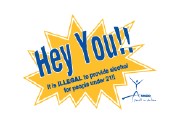
That’s right, even after doubling the size of USA’s hospitality and having two separate houses (one in Vancouver and one in Whistler) there was no bar for American athletes or sponsors. Now, I don’t know for certain that we’re the only international house without a bar, but it certainly wouldn’t surprise me. We’ve done our level best to separate alcohol and move it into this otherworld that’s separate from the regular world that everyone lives in. So besides the fact that every other country can handle having alcohol be a part of their celebrations, at USA Central it’s believed that sports and alcohol can’t mix. You see it in college sports. You see it in the drive to eliminate drinking at professional sporting events. It’s always motivated by the fact that because some people can’t handle themselves, so then the logic is everyone should be prohibited from enjoying themselves. I’m sure other countries have their share of people trying to ruin it for everyone else — but somehow they’ve managed to make it the problem of those individual people and not the majority who can just get on with it. I, too, cringe whenever I see a bad drunk but not because I fear for that person, but because I know that neo-prohibitionists will look at that person and extrapolate his problem to include everyone who drinks. And so one result is the American Olympic Committee concludes it’s too risky for there to be a bar in our international house, despite the fact that craft beer is something America should be justly proud of.

Filed Under: Beers, Editorial, Politics & Law Tagged With: International, National, Prohibitionists, Sports

Sticker Shocking

January 29, 2010 By Jay Brooks

under-21
It appears MADD is up to their old tricks and actually this has probably been going on for some time albeit somewhat under the radar. In 1996, MADD created a youth organization of indoctrinated kids to do their dirty work for them called Youth In Action. One of their many “projects” is called Sticker Shock, which is described on their website:

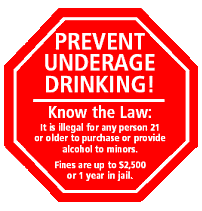
YIA teams meet with local retailers that sell alcohol and ask permission to place warning stickers on the packaging of alcohol products (primarily beer). The stickers are very visible and warn of the consequences of purchasing alcohol for people under the age of 21. This project is designed to remind adults that they can be arrested for purchasing alcohol for minors.

Thanks for the “reminder” kids, but surely you could do something more constructive with your time. Maybe it’s the old curmudgeon in me, but it’s times like these when I miss the old days when children were to be seen and not heard. Do we really need these Stepford teens to lecture adults on the law?

This practice has apparently heated up in Massachusetts, with the state chapter there conducting raids of stores that sell alcohol to sticker the beer there.
madd-sticker-ma
Happily, Todd and Jason Alstrom, from Beer Advocate, take them to task in a recent column in Boston’s Dig entitled Fascist Youth Vandalize Liquor Stores. It almost reads like a headline from The Onion, except that it’s true. After detailing MADD’s Hitler youth in action, they strike the right note of indignation, certainly the same one I had.

Shocked? No, we’re pissed off! This is wrong on so many levels! First, while we agree that selling alcohol to minors is not cool, these sticker shock campaigns are outright acts of vandalism. Who cares if the storeowner gave permission? Who cares if these neo-prohibitionists are accompanied by an adult? Who cares if the adult’s a cop? Their little stunt is still illegal: Brewers must get approval from federal agencies for all packaging, including labels. Not only do these stickers alter the packaging, but sloppy placement could cover crucial information that, by law, must be visible to consumers.

And what about that cop? C’mon, with a cop backing these kids up, it’s no wonder that storeowners are consenting. And why “primarily beer”? Show us stats proving that kids are more likely to be hitting up adults for beer than for spirits. And why sticker all the beer in stock? Why not restrict it to the brands most popular with teen drunks? And why do we, the adult consumers, need to be “reminded” that purchasing beer for minors is illegal in the first place? Who said we forgot? Who decided this crap should be shoved in our faces? The YIA site says: “YIA teams look for community solutions instead of focusing their attention on their peers” — but isn’t that exactly where the primary focus should be?

This is not “reminding,” it’s intimidation, pure and simple.

madd-sticker-nm

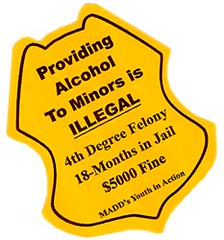
The stickers read “Providing Alcohol to Minors is ILLEGAL. 4th Degree Felony. 18 Months in Jail. $5000 Fine. MADD’s Youth in Action.” All true, but why stop there. Why not sticker cans of soda with warnings that they can cause obesity. Coke and Pepsi would never sit still for that. In the UK several years ago McDonald’s sued a couple of activists literally for years because they had the audacity to criticize their food in what became known as the McLibel trial. But criticizing alcohol is perfectly acceptable because law enforcement and especially politicians are afraid to be reasonable thanks to the very vocal and active temperance minority, bowing to almost their every demand.

madd-sticker-va

Jason and Todd conclude with an excellent suggestion.

So we’re challenging all true beer lovers to refuse to buy any product that has been vandalized by YIA, and to tell shop owners you’ll be boycotting their establishments until they get their beer from under MADD’s thumb — literally.

Amen to that. Don’t buy if you see the sticker. We have to start standing up to these bullies. I know in some cases the retailers had little choice in reality, but if they know there are consequences for acquiescence, ones that hit their bottom line, then they’ll begin to do the right thing, which is tell these gang of youths to go “remind” somebody else. That the police give these stunts the imprimatur of legality is quite frankly Orwellian and more than a little frightening.

Filed Under: Editorial, Politics & Law Tagged With: Massachusetts, National, Prohibitionists

Drinking All Over The Map

January 27, 2010 By Jay Brooks

world-map
If you’re a regular Bulletin reader, you know I believe that the drinking age in the U.S. is too high, that the age a person can vote and fight and/or die for one’s country should also be the age he or she can drink, as well. I lived through this ridiculous hypocritical double-standard when I was in the military thirty years ago, and I still hold a grudge. It was absurd then, and it’s absurd now.

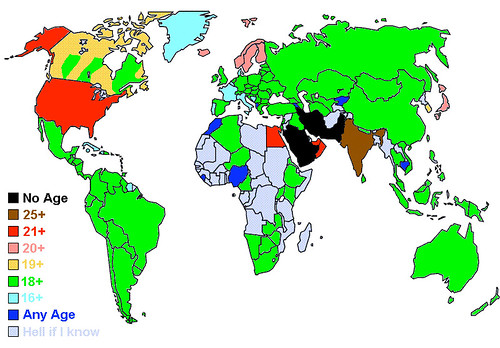
I think most of us believe that America is a progressive country where freedom is something we take for granted, that it’s the lynchpin of our society with free speech, free assembly, freedom of religion, and on and on. But not when it comes to our puritanical view of alcohol, there we are nearly the most backward country in the world. When you take out the handful of countries that allow no alcohol consumption — which are all in the Middle East — only India has a drinking age higher than ours, and even that’s not nationwide, but on a state by state basis. I could talk about this ’till I’m blue in the face, but nothing shows this inequity better than a visual representation of drinking ages by country. Happily, Drinking Map went to the trouble of creating a world map showing the drinking age by country, where known. To see it larger, click through the image, then click on “all sizes.”

drinking-age-map

As you can see, the vast majority of the world is at a sensible 18, with only a few other nations (all in the Middle East, too) that are 21 like us. Japan and most of Scandinavia set the age at 20 and South Korea along with parts of Canada are at 19.

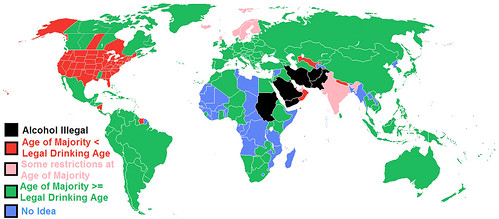
But perhaps more interesting is the map below, also by the folks at Drinking Map, called Where “Adults” Can’t Drink. This map shows the relationship between a country’s age of majority (when a person is considered an “adult”) and the age at which they are permitted to drink alcohol. Notice that for a majority of nations (in green) that age is the same, as I believe it should be. A few more (in pink), like India and most of Scandinavia, allow some drinking but with certain restrictions. Then we, along with parts of Canada and a handful of other nations (in red), stand out as having a drinking age that’s higher than the age of majority. To see it larger, click through the image, then click on “all sizes.”

age-of-majority-map

Would it not be perhaps a reasonable compromise to allow 18-year olds to drink beer, or wine and beer, but not spirits until they’re 21? Anyway, just some food for thought.

Filed Under: Editorial, Just For Fun, Politics & Law Tagged With: International, Prohibitionists, Statistics

Facebook A Tool For Big Brother?

January 24, 2010 By Jay Brooks

facebook
In trying to catch up with everything going on in the world, here’s one that fell through the cracks. Drew Beechum, of the Maltose Falcons homebrew club fame sent me this over the holidays and it’s still relevant. It appears law enforcement is monitoring social media like Facebook to catch crooks … well, not crooks, exactly, but underage drinkers. And not just monitoring Facebook, but according to the LaCrosse Tribune, police actually created fake Facebook profiles then tried to friend underage kids (with or without probable cause, it doesn’t say) to look for mentions and photos of underage drinking. They’ve even made arrests. Beechum wades into the questions raised by this practice in a post titled We’ve Always Been At War With Eastasia. There are a lot of privacy issues raised by this, I think, and it bears watching IMHO.

Filed Under: Editorial, Politics & Law Tagged With: Law, Strange But True

Beer To Flow Again In Belgium

January 23, 2010 By Jay Brooks

belgium
I’ve been avoiding this story over the last few weeks, mostly because I’ve been busy with other work and it’s a complicated one. I’ve sure you’ve seen it and pieces of it, though. It’s even gone mainstream, with Time magazine wading into it, mostly because of the big business angle. In a nutshell, Anheuser-Busch InBev announced more layoffs despite having also recently announced just over $1.5 billion in profit for Q3 2009. The latest proposed layoffs, about 800 jobs at ABIB’s European breweries included about a third in Belgium. But unlike here in the U.S., labor unions still have a bit of actual power in the EU. And they decided to fight back. At several breweries in Belgium — Stella Artois, Jupiler and Hoegaarden — workers have barricaded the breweries, and even took management hostage overnight at one plant.

After two weeks, supplies of Stella Artois and other beer brands owned by ABIB were running low, though most headlines seemed to suggest that beer itself was almost out in the nation. Obviously, with hundreds of breweries still open there was hardly a shortage of beer, just a shortage of a few popular ones, but none that true beer-loving Belgians would even miss. But on Friday, the union agreed to stand down and enter into negotiations, for the time being “they struck a deal that postpones the brewer’s plans to reduce 303 jobs in Belgium — some 10 per cent of its work force there. It says it will also create 40 call centre sales positions, bringing net job losses to 263.” According to the AFP, “‘After the blockade is lifted, the unions and management will start from scratch with meetings of the works council that will deal with problems site by site,’ union representative Tangui Cornu told AFP.” Reuters also had an update.

Filed Under: Breweries, News, Politics & Law Tagged With: Anheuser-Busch InBev, Belgium, Europe

Balls Beer For Health Care Reform

January 22, 2010 By Jay Brooks

humor
This is hilarious, especially so depending on which way you lean on the issue of health care reform. My wife found it on Daily Kos, but apparently it’s popping up everywhere on political blogs.

Filed Under: Beers, Just For Fun, Politics & Law Tagged With: Humor, Parody, Video

Stuff & Nonsense, Part 10

January 19, 2010 By Jay Brooks

Last week, you probably recall I was following Pete Brown’s brilliant refutation of his national health service’s attack on alcohol, beginning with, Stuff & Nonsense: The UK Health Select Committee Report On Alcohol. The first nine parts of Pete’s rebuke were posted last week and today part ten, the last one, was also posted.

In part 10, Pete tackles an issue that isn’t entirely relevant in the U.S., because as far as I know there aren’t any states that allow it. The issue is Binge drinking has been made much worse by 24 hour licensing. Despite that, it’s a still a great read an interesting peek into the window of manipulation that’s taking place at the hands of the UK Parliament. This, sadly, is similar to our shores where neo-prohibitionists have worked their way — and their agenda — into politics at all levels. The rest of us, understandably were busy just trying to enjoy our lives, and so missed seeing what was going on until it was nearly too late.

Part of the problem here, at least in comparison to the UK, is we don’t have the same tradition of pub culture. When we separated from mother England, our two drinking cultures diverged dramatically. England’s stayed something that was part of their culture, something to be proud of, that had national associations. Ours fractured into taverns, pubs, dive bars, biker bars, fern bars, niteclubs, pool halls, chain bars, etc. And from the beginning of the temperance movements, all those were demonized and continue to be demonized. It’s a rare bar in the U.S. that can call itself a family place. And that’s at least part of the reason why so many can’t see alcohol as part of society, but something to be feared and separated, especially from — gasp — the little children.

That’s also why it was great seeing Pete’s addendum to his series, Answering the Neo-Prohibitionists — A Series Disclaimer. In it, Pete relates some personal stories of how alcohol abuse has affected him. It sounds like he didn’t want to recall such painful memories, but felt he had to do so, so that people criticizing him understood where he was coming from and that he did understand that alcohol can be destructive. I get that, too; the criticism for talking about neo-prohibitionists too much. But for whatever reason, I don’t mind talking about my own history with alcohol abuse. I grew up with an abusive, alcoholic, violent, clinically psychotic stepfather. He surrounded himself with other alcoholics and I all but grew up in bars around eastern Pennsylvania.

I’ve even written about it before, both here and as a semi-fictional memoir I did for NaNoWriMo a few years ago. The rough draft I wrote extemporaneously is still online, actually. It’s called Under the Table and hasn’t been edited since 2006, so expect lots of typos, run-on sentences and all manner of grammar horrors, assuming you’ve got a lots of spare hours to kill and have any desire to crawl inside my head (don’t say you haven’t been warned).

But the reason for bringing this up now is that even as a child I understood something the average neo-prohibitionist can’t seem to wrap his or her head around. And that’s the fact that my stepfather was — and indeed most alcoholics are — that way for reasons that have nothing to do with the booze itself. Attacking the product and its manufacturers and consumer’s access to them does absolutely nothing to stop people from drinking. If anything, it exacerbates those problems. Witness American Prohibition. Did it stop people from drinking? No. Did it increase crime? Yes. Did it work? Not even a little, yet there are people for whom that lesson counts for nothing and want to give it another go.

Here’s Pete’s take:

Firstly, because having witnessed it close up, I know that when people step up to fight alcohol abuse, they go for the wrong targets. People don’t drink harmfully because alcohol is there, or because it’s cheap, or because it’s advertised. Restricting the availability of alcohol won’t help alcoholics. These people live for alcohol – it’s the only thing they care about. Make it expensive and they’ll go without food, sell their house, Christ, they’d sell their fucking kids for a drink. Prohibit it altogether and they’ll drink meths, or nail varnish remover, or after shave.

Alcoholics drink not because it’s there, or cheap, or tastes nice, but because they have deeper trauma and/or unhappiness in their lives. Even if you were studying this at GCSE level, if you look at it scientifically, if availability/pricing/advertising of booze caused problem drinking, then everyone exposed to it would be more likely to problem drink. But most people in theUK are drinking less. A minority are drinking to harmful levels. And as far as I can tell, no one is studying that minority in detail and asking what it is about them that makes them different from the majority.

It’s easy to blame the availability of booze. And it is shameful that problem drinkers are not being researched in a way that can highlight what it is that’s different about them that makes them more likely to problem drink.

People drink to excess because they are unhappy, because they feel empty inside, because they are lonely, because they are stressed, because they have shit jobs being bullied in call centres and alcoholic oblivion is the only escape they can see. Why is no one helping them? Because it’s a bit more complicated than just blaming drink, that’s why.

Secondly, I’m doing this because for the vast majority of people, drink is an innocent pleasure with minimal health risks beyond a few extra pounds or the odd hangover. My father died of smoking-related lung cancer when he was 58 and I was 27. I’ve read the science, and I know that there is a direct linear relationship between smoking and ill health – every single cigarette you smoke causes you damage. Drink is not the same. There are healthy levels of alcohol consumption.

My close quarters witnessing of the destruction alcoholism can cause makes me more keenly aware of the benefits of moderate consumption, and the stark difference between the two. So it makes me very angry indeed when someone who doesn’t know what they’re talking about tars all habitual drinkers with the same brush. And even angrier when newspapers distort the facts even further for nothing more than a sensationalist story.

Thirdly – quite simply, because it needs doing. A quick review of press stories about alcohol over the last week alone will show you how drinking is being demonised and made socially unacceptable. It’s based on lies and distortions. The figures say the problem is not getting any worse – if anything, the situation is improving. No one in the media seems to want to report this truth. No one questions press releases from avowedly anti-drink organisations. My blog posts might seem excessive if you’ve been staying tuned over the last week or so, but they amount to a fart in the face of a hurricane compared to the anti-drink propaganda that’s out there every single day.

In summary then – I know the ill effects of alcohol abuse as well as anyone, and care about them as much as anyone. I’ll never deny that there’s a problem, and am not seeking to do so on this blog.

But if that problem is going to be dealt with effectively, it has to be understood properly. I think the neopros are acting against the interests of the majority of drinkers. But worse, because they are approaching the problem over-simplistically, wilfully distorting the evidence, and confusing personal beliefs with real health issues, I don’t think their antics will do anything to help the people who really need helping. And that is just shameful.

That’s why I’m doing this.

Amen, brother.

To sum up, if this is new to you, start with Pete Brown’s Health Select Committee Report on Alcohol. Part One (of 10) was published Sunday, Alcohol consumption in the UK is increasing. On Monday, parts two, 25% of the UK population is drinking at hazardous or harmful levels, and three, Binge drinking is increasing, were published. Tuesday saw part four: Alcohol is becoming cheaper/more affordable, and yesterday part five, Alcohol related hospital admissions — and the cost of alcohol to the NHS — are soaring, was published online. Overnight and today, part six, Alcohol abuse costs the country £55bn a year, part seven, The best way to reduce the harmful effects of alcohol is to reduce overall consumption, part eight, Alcohol advertising and promotion must be tightly regulated because it encourages underage drinking, and part nine, Pubs are a problem, went up. And finally, part ten, Binge drinking has been made much worse by 24 hour licensing.

Filed Under: Editorial, Politics & Law Tagged With: Prohibitionists, Statistics, UK

Stuff & Nonsense, Parts 6 Through 9

January 14, 2010 By Jay Brooks

By now, even the casual Bulletin reader has likely noticed that I’ve been following Pete Brown’s brilliant refutation of his national health service’s attack on alcohol, beginning with, Stuff & Nonsense: The UK Health Select Committee Report On Alcohol. The first five parts of Pete’s rebuke have been published over the past few days, and overnight and this morning, west coast time, parts six through nine were posted.

In part 6, Pete tackles the assertion that Alcohol abuse costs the country £55bn a year
Today’s rebuke. In the U.S., this is claim made with alarming regularity, charging alcohol for all manner of sins, and ignoring personal responsibility, common sense and even logic. If there’s a whiff of alcohol anywhere in the vicinity, then by gum the whole thing is alky’s fault. Last year, the Marin Institute did their own study claiming in California alone alcohol costs $38 billion each year. It’s as self-serving a document you’ll ever read. In the UK report, they claim alcohol costs Britain either £20 or £55 billion pounds (which is 32.5 billion dollars or 89.5 billion dollars). This should give you some idea about who whacked our anti-alcohol folks are. The are just over 61 million people in the UK, but almost 37 million in California, yet they assert that, using the UK’s lower figure, alcohol costs more than the entire nation of Great Britain, with roughly half the number of people. It’s just so easy to lie with statistics, and, more profoundly sad, even easier to get the government and the media to swallow those lies without questioning them. But in any event, take a look at Pete’s analysis.

In part 7, the government trots out yet another old favorite, the wolf in sheep’s clothing that is the best way to reduce the harmful effects of alcohol is to reduce overall consumption. All we need to do to get rid of some people doing something we don’t like is make it illegal for everybody. Problem solved. Except that alcohol has been around since before the dawn of civilization and maybe 99.9% (full disclosure, I made that number up but the idea is that the vast majority) of people enjoy the occasional without ruining their lives, their loved ones, their careers, or even their livers. And numerous medical studies confirm a wide range of health benefits, not least of which is the fact that people who drink alcohol in moderation tend to outlive those who never touch the stuff.

In the case of the UK report, they claim to be advising just toward reducing consumption, but to where? To what level? It’s already be shown beyond doubt that the recommended levels that the UK advises were made up wholesale, pulled out of thin air. Just the notion that recommended safe amounts are the same for any two men or women is patently absurd, yet that’s the standard. The other problem I see with arguing for less overall consumption is that it’s a slippery slope. Today’s reduction is tomorrow’s outright ban. If less is more, then none must be best of all, right?

Part eight brings up to the most pernicious argument of all, and the one that always sticks in my craw. “It’s for the children,” they cry. “Doesn’t anybody think of the children.” What the UK says, is Alcohol advertising and promotion must be tightly regulated because it encourages underage drinking. While the report says the opposite, the truth is drinking is declining in the UK, and I suspect that’s true here, too. But it’s Pete’ summary that is most telling, showing the chain of absurdity.

The HSC says drinking among children is increasing. But recent official figures suggest it is falling.

The HSC simply asserts that advertising encourages young people to drink. But there is no evidence of a causal link, despite people looking very hard to try to find one.

So they imply that there is a link between awareness of alcohol brands and propensity to drink underage, because they can prove awareness. But there’s no evidence of this either.

So after having spent a long time discussing the content of alcohol ads, they then say it’s not the content, but the quantity of it that has an effect. There’s no evidence of this either.

So in the end, they disregard testimony from advertising professionals, and simply choose to believe the testimony of people who want alcohol advertising to be banned, say it is damaging to children, but can produce no evidence to back up their assertion.

Which brings us to part 9, Pubs are a problem. If alcohol is a problem, then the places where people drink it must also be dens of inequity, mustn’t they?

To sum up, if this is new to you, start with Pete Brown’s Health Select Committee Report on Alcohol. Part One (of 10) was published Sunday, Alcohol consumption in the UK is increasing. On Monday, parts two, 25% of the UK population is drinking at hazardous or harmful levels, and three, Binge drinking is increasing, were published. Tuesday saw part four: Alcohol is becoming cheaper/more affordable, and yesterday part five, Alcohol related hospital admissions — and the cost of alcohol to the NHS — are soaring, was published online. Overnight and today, part six, Alcohol abuse costs the country £55bn a year, part seven, The best way to reduce the harmful effects of alcohol is to reduce overall consumption, part eight, Alcohol advertising and promotion must be tightly regulated because it encourages underage drinking, and part nine, Pubs are a problem, went up. Once again, stay tuned. There’s one more part to go.

Filed Under: Editorial, Politics & Law Tagged With: Health & Beer, Prohibitionists, Statistics, UK

Stuff & Nonsense, Part 5

January 13, 2010 By Jay Brooks

By now, even the casual Bulletin reader has likely noticed that I’ve been following Pete Brown’s brilliant refutation of his national health service’s attack on alcohol, beginning with, Stuff & Nonsense: The UK Health Select Committee Report On Alcohol. The first four parts of Pete’s rebuke have been published over the past few days, and now part five is up.

Today’s rebuke concerns hospital admissions and the burden on the health care system, a facetious claim made on both sides of the pond. Over here, for example, an accident where one of the passengers had been drinking is often classified as an alcohol-related accident. In the UK:

In terms of official figures, what they don’t tell you is that when they are compiled, there’s a sharp difference between hospital admission and deaths that are considered wholly attributable to alcohol, and those where alcohol is a secondary or partial factor. And guess what? Only 25% of total ‘alcohol related’ hospital admissions are judged to be entirely due to alcohol.

At best, that simply misleads the statistics, making them sound more alarming than they really are. But it gets even worse, and in some ways goes beyond what American Neo-Prohibitionsts have been willing to say, at least so far.

The Report [implies] that if you drink, you are more likely to be a rapist, a child abuser, a wifebeater, a suicide, and that the fact that you drink makes you so. As Phil [Mellows] pointed out when he addressed the rape issue, this is not only inaccurate, it is astonishingly offensive to drinkers.

We’ve had groups here use images of a syringe filled with beer, equating beer with heroin, but so far as I know, they haven’t called those of us who drink rapists … yet. But they do seem to believe that virtually every societal ill can be pinned on alcohol.

But when someone does something appalling and then says, “The drink made me do it,” they are denying personal responsibility for their actions and we tend to dismiss this as a lame excuse. The Report seems to buy it 100%.

I could go on and on, but it’s best if I just suggest at this point that you go over and read part 5, Alcohol related hospital admissions — and the cost of alcohol to the NHS — are soaring. It’s the longest so far, but definitely worth your time.

If this is new to you, start with Pete Brown’s Health Select Committee Report on Alcohol. Part One (of 10) was published Sunday, Alcohol consumption in the UK is increasing. On Monday, parts two, 25% of the UK population is drinking at hazardous or harmful levels, and three, Binge drinking is increasing, were published. Tuesday saw part four: Alcohol is becoming cheaper/more affordable, and today part five, Alcohol related hospital admissions — and the cost of alcohol to the NHS — are soaring, was published online. Once again, stay tuned.

Filed Under: Editorial, Politics & Law Tagged With: Health & Beer, Prohibitionists, Statistics, UK

Hickenlooper Running For Governor

January 12, 2010 By Jay Brooks

colorado
Last week, Secretary of the Interior Ken Salazar, who many believed might make a run for governor of Colorado, announced he would not run, instead endorsing Denver mayor John Hickenlooper. For several years, Hickenlooper has been urged to seek the governor’s office, but has said he didn’t want to be governor. Today, the Denver Post announced that former owner and Wynkoop Brewpub founder John Hickenlooper has changed his mind, and will run for Colorado governor.

Current Colorado governor, Democrat Bill Ritter, had earlier decided not to seek reelection, which sparked a flurry of possible democrats for the office. Ritter was on hand for Hickenlooper’s announcement, suggesting he may have the governor’s support as well. The Post also reported that “President Barack Obama called Hickenlooper last Friday to encourage him to run.”

Filed Under: News, Politics & Law Tagged With: Colorado, Denver

« Previous Page
Next Page »

Find Something

Northern California Breweries

Please consider purchasing my latest book, California Breweries North, available from Amazon, or ask for it at your local bookstore.

Recent Comments

  • Bob Paolino on Beer Birthday: Grant Johnston
  • Gambrinus on Historic Beer Birthday: A.J. Houghton
  • Ernie Dewing on Historic Beer Birthday: Charles William Bergner 
  • Steve 'Pudgy' De Rose on Historic Beer Birthday: Jacob Schmidt
  • Jay Brooks on Beer Birthday: Bill Owens

Recent Posts

  • Beer In Ads #5225: Fabled Ambrosia Of The Ancients April 17, 2026
  • Historic Beer Birthday: William O. Poth April 17, 2026
  • Beer In Ads #5224: Harvard Bock Beer April 16, 2026
  • Historic Beer Birthday: William H. Biner April 16, 2026
  • Historic Beer Birthday: Alan Eames April 16, 2026

BBB Archives

Feedback

Head Quarter
This site is hosted and maintained by H25Q.dev. Any questions or comments for the webmaster can be directed here.