Brookston Beer Bulletin

Jay R. Brooks on Beer

  • Home
  • About
  • Editorial
  • Birthdays
  • Art & Beer

Socialize

  • Dribbble
  • Email
  • Facebook
  • Flickr
  • GitHub
  • Instagram
  • LinkedIn
  • Pinterest
  • RSS
  • Twitter
  • YouTube

Powered by Genesis

The Yule Lads of Iceland #3: Stubby

December 14, 2023 By Jay Brooks

Hopefully you already saw my post on Tuesday with an overview of the Icelandic tradition of the Yule Lads. If you haven’t, go back and read that first so this will make more sense. According to folklore, today — December 14 — is the day when the third Yule Lad arrives.

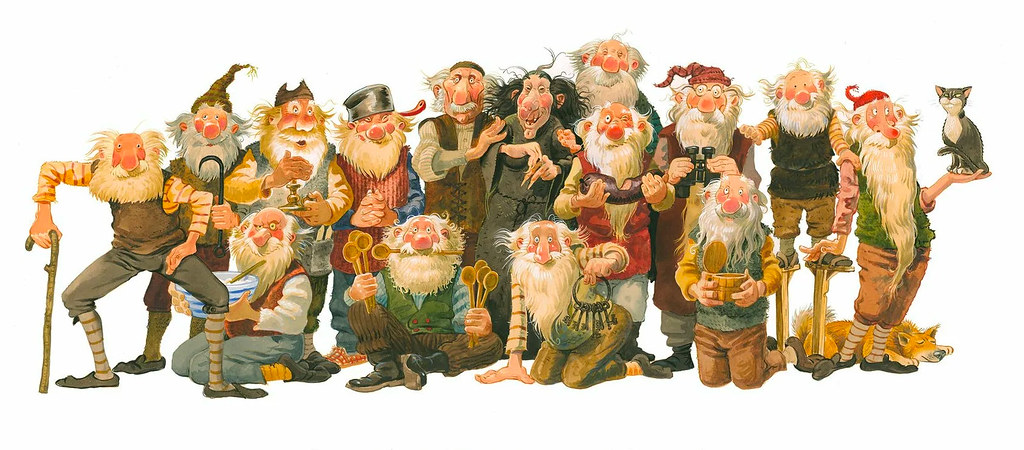
The third Yule Lad’s name is Stúfur, which translates as Stubby or Shorty. He’s described as “abnormally short.” His particular brand of mischief is stealing pans to eat the crust left on them.
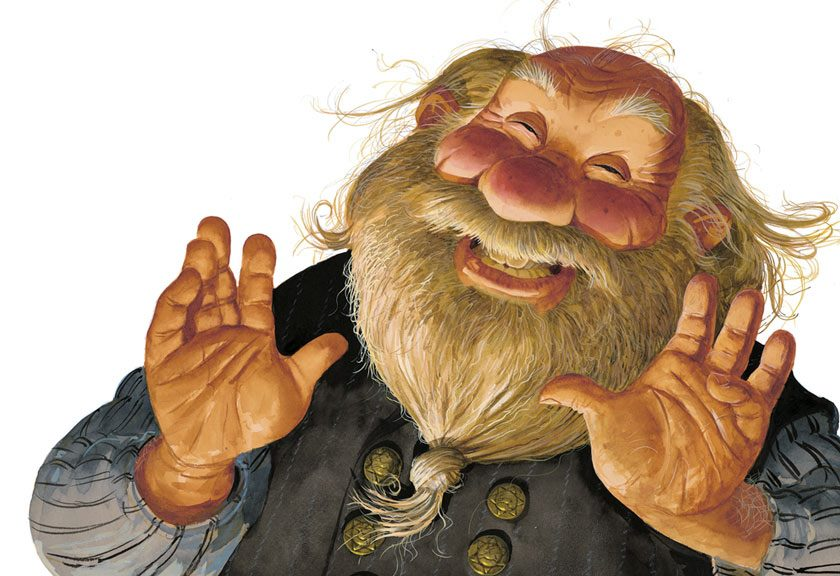
Here’s how he’s described in the 1932 Icelandic poem, “Yule Lads,” by Jóhannes úr Kötlum:

Stubby was the third called,
a stunted little man,
who watched for every chance
to whisk off a pan.
And scurrying away with it,
he scraped off the bits
that stuck to the bottom
and brims – his favorites.

Stubby arrives each year on December 14, and leaves again on December 27.

And here’s a more thorough explanation, by Robert Nelson, on Medium.

He is also abnormally short, which should, in theory, make it easier to sneak into your kitchen during high volume seasons like the holiday festivals.

Stúfur’s particular brand of mischief involves stealing away into your home to scrape the remains from your unwashed pans. There is some disagreement over whether he prefers sweet remains (i.e. the remains of cakes and sweetbreads) or savory remains (i.e. the leftovers from dinner).

And here’s another, from Iceland24:

Itty Bitty was the third,
That short fellow.
He borrowed a pan,
When he could do so.

He ran away with it
And picked and ate the food-bits
That sometimes stick
To a pan here and there.

This is the favorite Yule Lad of most Icelanders.. Stúfur! The name means Shorty in Icelandic.

Stúfur is the Hiccup of the Yule Lads, the acknowledged runt of the litter. He is the smallest and stubbiest of the Yule Lads in form. However, his troll and elf ancestry have also made him very strong. He may be small and not too powerful in appearance but, in reality, he can really beat up anyone he chooses. He can even knock out a Monstrous Nightmare better than Stoick can. In his sleep while chewing gum.

But the great irony is that the miniature warrior… that tiny Beowulf of a Yule Lad… is on a great quest to steal… uh… grease spattered frying pans.

It certainly is a weird hobby. Stúfur has a harder journey than the other Yule Lads. His little legs have to work harder. He often is covered by snow as he journeys to the villages and has to use a telescope poked up through the snow so he knows where is going. And he has to beat up all the dragons and Vikings he meets along the way.

And the reason Stúfur beats the odds and steals those frying pans? Well, it is because he likes to lick off the grease and drippings that are left in the frying pan. It’s rather humbling when you think about it… all that tough journeying and fighting to lick off a bit of bacon fat?

There is a parable in there for sure. But it’s kind of a weird one. Anyway, if you fry up anything on Dec. 14 and through Dec. 27, just don’t be surprised if your frying pan disappears moments after you set it aside. It’s Stúfur style recycling!

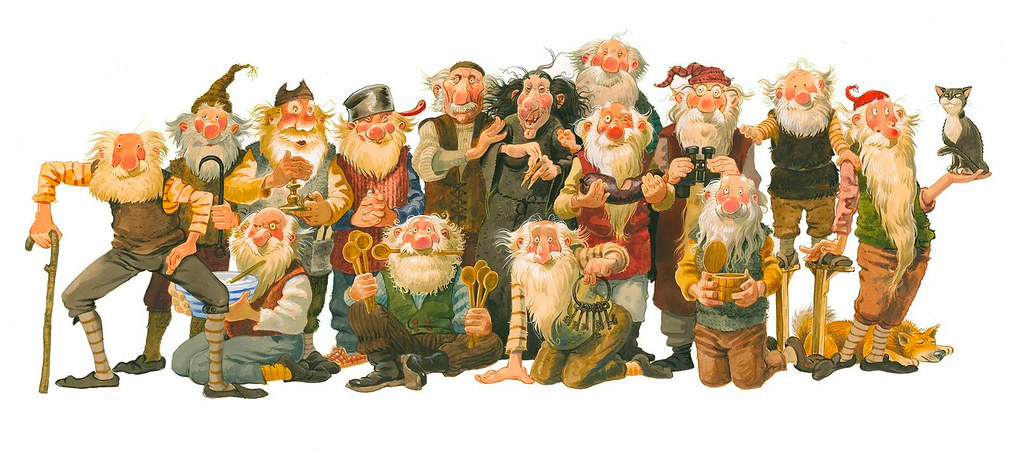
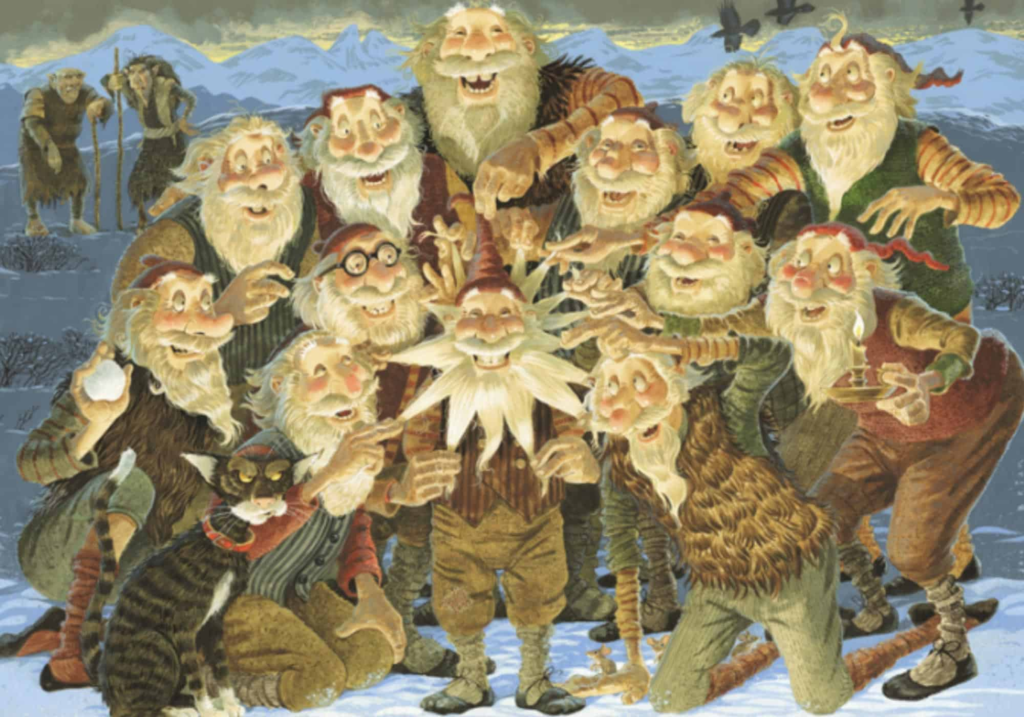
The 13 Yule Lads, Mom, Dad and Cat:
Filed Under: Just For Fun, Related Pleasures Tagged With: Christmas, History, Holidays, Iceland

Beer In Ads #4647: Clang Clang Goes Miss Rheingold 1962

December 13, 2023 By Jay Brooks

Wednesday’s ad is for “Rheingold Beer,” from 1962. This ad was made for the Rheingold Brewery, which was founded by the Liebmann family in 1883 in New York, New York. At its peak, it sold 35% of all the beer in New York state. In 1963, the family sold the brewery and in was shut down in 1976. In 1940, Philip Liebmann, great-grandson of the founder, Samuel Liebmann, started the “Miss Rheingold” pageant as the centerpiece of its marketing campaign. Beer drinkers voted each year on the young lady who would be featured as Miss Rheingold in advertisements. In the 1940s and 1950s in New York, “the selection of Miss Rheingold was as highly anticipated as the race for the White House.” The winning model was then featured in at least twelve monthly advertisements for the brewery, beginning in 1940 and ending in 1965. Beginning in 1941, the selection of next year’s Miss Rheingold was instituted and became wildly popular in the New York Area and beyond. In 1962, Kathy Kersh won the contest and became Miss Rheingold for that year. She was born Kathleen Kroeger Kersh on December 15, 1942 in Los Angeles, California (though one source claimed it was Hawaii). She attended a theatrical school, studying dance and acting. In 1959, she won the title of Miss Junior Rose Bowl, and became a professional model, and later an actress and singer. After her year as Miss Rheingold 1962, she married actor Vince Edwards, best known as Dr. Ben Casey on the TV show of the same name. But they were married for only four months before divorcing, and her daughter was born shortly thereafter when she became a single mother. Some of her more memorable appearances were on Burke’s Law, My Favorite Martian, The Beverly Hillbillies, The Man from U.N.C.L.E., and a small part in the film “The Americanization of Emily.” In 1967, she signed a record deal with Power Records, and released two singles. After a small role as Cornelia, one of the Joker’s henchmen, on Batman, she married Burt Ward, who played Robin. That marriage last two years, and afterwards she attended business school and embarked on successful a career in commercial real estate. As far as know, she still lives in Sherman Oaks, California. In this ad, still from July, Miss Rheingold 1962, Kathy Kersh, is still on her whirlwind tour of New England, this time in Maine. She’s at the Seashore Trolley Museum in Kennebunkport and ringing the bell as she rides one of the working trolleys at the museum. The tagline reads: “Clang, clang your bell and move over to the really better beer.”

Filed Under: Art & Beer, Beers Tagged With: Advertising, History, Rheingold

The Yule Lads of Iceland #2: Gully Gawk

December 13, 2023 By Jay Brooks

Hopefully you already saw yesterday’s post with an overview of the Icelandic tradition of the Yule Lads. If you haven’t, go back and read that first so this will make more sense. According to folklore, today — December 13 — is the day when the second Yule Lad arrives.

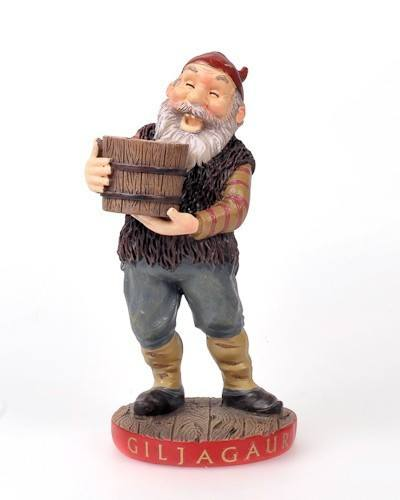
The second Yule Lad’s name is Giljagaur, which translates as Gully Gawk. “His particular brand of mischief involves harassing sheep, but he is ultimately stopped by his stiff peg-legs.”Hides in gullies, waiting for an opportunity to sneak into the cowshed and steal milk.”

Here’s how he’s described in the 1932 Icelandic poem, “Yule Lads,” by Jóhannes úr Kötlum:

The second was Gully Gawk,
gray his head and mien.
He snuck into the cow barn
from his craggy ravine.
Hiding in the stalls,
he would steal the milk, while
the milkmaid gave the cowherd
a meaningful smile.

Gully Gawk arrives each year on December 13, and leaves again on Boxing Day, December 26.

And here’s a more thorough explanation, by Robert Nelson, on Medium.

Giljagaur isn’t the only peeper, as we will come to find out later. His particular form of troublemaking is to hide in the “gullies” or the ravines that carve the landscape of Icelandic farms, and wait for an opportune moment to steal into the cowshed and slurp the foam off the top of the milk bucket.

He is also a continuation of the theme that Stekkjarstaur first introduced us to…barnyard milk thieves. Whereas Stekkjarstaur prefers the company of sheep, Giljagaur opts for the relatively more rare milk from cows.

Sheep are the classic Icelandic herd animals. They were brought in the middle ages and continue to visibly dot the Icelandic countryside, and réttir is still a nationally recognized festival where shepherds on horseback (or in an SUV) will head out to the countryside to retrieve their sheep and bring them back to pasture. Cows, on the other hand, were a luxury for the few wealthy kulaks.

Hálldor Laxness, in his seminal Independent People, describes the conflict between husband and wife over whether to buy a cow. Bjartur, the practical and frugal husband, finds the very idea ridiculous, while his new wife Rósa dreams of the comfort a cow might provide.

And here’s another, from Iceland24:

Gully Imp was the second,
With his grey old head.
He crept down from the mountain,
and into the cow shed.

He hid in the stables
– And stole the froth,
While the milkmaid chatted
Up the stable boy.

Giljagaur arrives on Dec 13. His name means “Gully Oaf.” He is usually portrayed with gray hair and wearing very plain colored clothes. As his name implies, he hides in the gullies and ditches and canyons near farmsteads. Then, after the cows have been milked, he sneaks into the barn and skims the rich cream from the top of the milk buckets. He hides again and, after morning milking, sneaks back for another creamy snack.

Sometimes his job is very easy to do, especially if you have young dairymaids and handsome warriors and lots of Viking hormones on hand. Giljagaur waits till the flirting gets started, the young people get distracted, and then he runs in and steals the cream.

He also has a fondness for cows, too. And he speaks bovinese, so he and Búkolla here are swapping some stories. Icelandic cows are a special breed, unchanged since the Vikings brought them to the island. They are quite small and can live in mountainous areas, but they are sweet natured and provide a lot of good quality milk. They also come in an amazing variety of colors, and some even have brindle stripes!

Vikings rarely drank milk. They used it for baking and to make other products that kept well in storage, like cheese, sour milk (tastes like buttermilk) and a thick low-fat curd called “skyr.” They also used the whey from cheesemaking as a way to preserve meat products, a tradition that continues to this day in Iceland. The resulting “pickled” meats were an unpleasant grey in color, but they kept well, tasted quite all right, and were nutritious. The whey itself actually has a taste similar to white wine.

The people of Berk managed to always keep a few cows on hand, but they had to hide them in caves and canyons and then make a difficult trek twice a day to milk them. Now, the dragons know to leave cows alone (a few dragons even like cheese as a treat), so once again Giljagaur can raid the stables.

So, keep your fresh cream locked away and make sure that the dairy personnel who work between Dec 13 and 26 are not the kind to be easily impressed by a well turned out pair of biceps.

The 13 Yule Lads, Mom, Dad and Cat:

Filed Under: Just For Fun, Related Pleasures Tagged With: Christmas, History, Holidays, Iceland

Beer In Ads #4646: Miss Rheingold 1962 Scuba Diving

December 12, 2023 By Jay Brooks

Tuesday’s ad is for “Rheingold Beer,” from 1962. This ad was made for the Rheingold Brewery, which was founded by the Liebmann family in 1883 in New York, New York. At its peak, it sold 35% of all the beer in New York state. In 1963, the family sold the brewery and in was shut down in 1976. In 1940, Philip Liebmann, great-grandson of the founder, Samuel Liebmann, started the “Miss Rheingold” pageant as the centerpiece of its marketing campaign. Beer drinkers voted each year on the young lady who would be featured as Miss Rheingold in advertisements. In the 1940s and 1950s in New York, “the selection of Miss Rheingold was as highly anticipated as the race for the White House.” The winning model was then featured in at least twelve monthly advertisements for the brewery, beginning in 1940 and ending in 1965. Beginning in 1941, the selection of next year’s Miss Rheingold was instituted and became wildly popular in the New York Area and beyond. In 1962, Kathy Kersh won the contest and became Miss Rheingold for that year. She was born Kathleen Kroeger Kersh on December 15, 1942 in Los Angeles, California (though one source claimed it was Hawaii). She attended a theatrical school, studying dance and acting. In 1959, she won the title of Miss Junior Rose Bowl, and became a professional model, and later an actress and singer. After her year as Miss Rheingold 1962, she married actor Vince Edwards, best known as Dr. Ben Casey on the TV show of the same name. But they were married for only four months before divorcing, and her daughter was born shortly thereafter when she became a single mother. Some of her more memorable appearances were on Burke’s Law, My Favorite Martian, The Beverly Hillbillies, The Man from U.N.C.L.E., and a small part in the film “The Americanization of Emily.” In 1967, she signed a record deal with Power Records, and released two singles. After a small role as Cornelia, one of the Joker’s henchmen, on Batman, she married Burt Ward, who played Robin. That marriage last two years, and afterwards she attended business school and embarked on successful a career in commercial real estate. As far as know, she still lives in Sherman Oaks, California. In this ad, also from July, Miss Rheingold 1962, Kathy Kersh, is on the seashore, probably in New England somewhere based on recent ads, having just come out of the ocean from scuba diving. She feeding her companion some beer, and there’s a can for her sitting next to her, as well.

Filed Under: Art & Beer, Beers Tagged With: Advertising, History, Rheingold

The Yule Lads of Iceland #1: Sheep-Cote Clod

December 12, 2023 By Jay Brooks

Hopefully you already saw my earlier post with an overview of the Icelandic tradition of the Yule Lads. If you haven’t, go back and read that first so this will make more sense. According to folklore, today — December 12 — is the day when the first Yule Lad arrives.

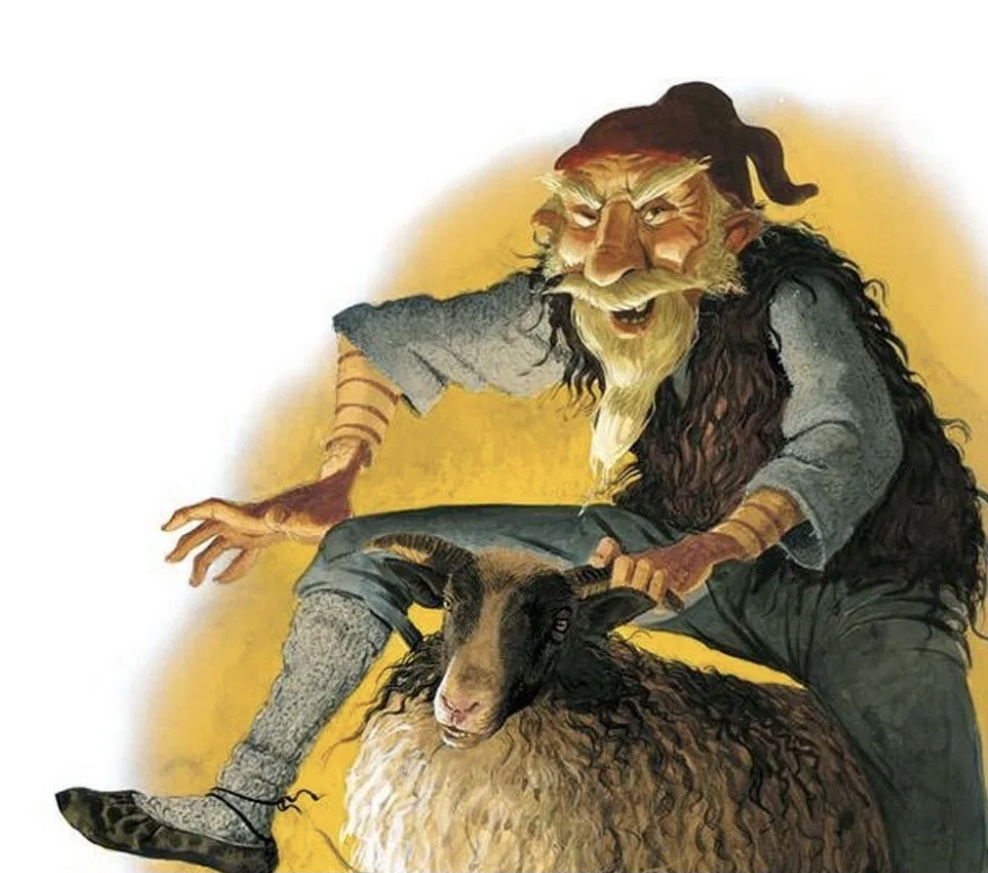
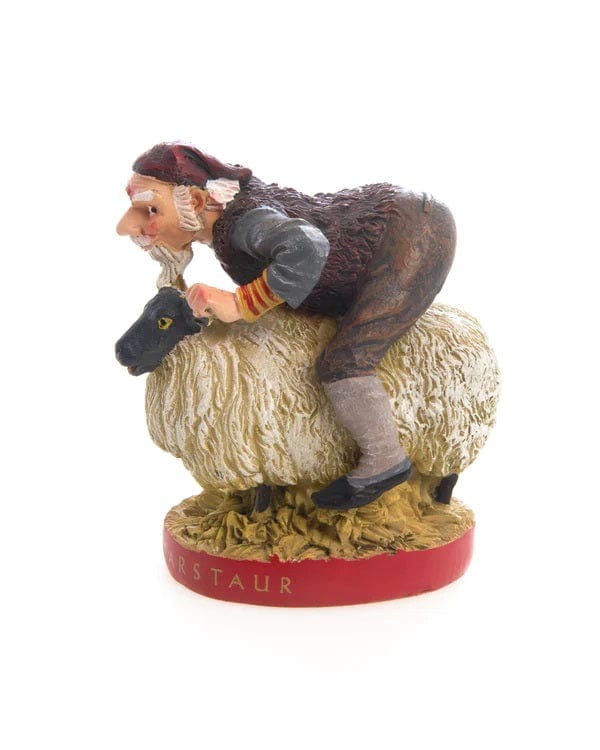
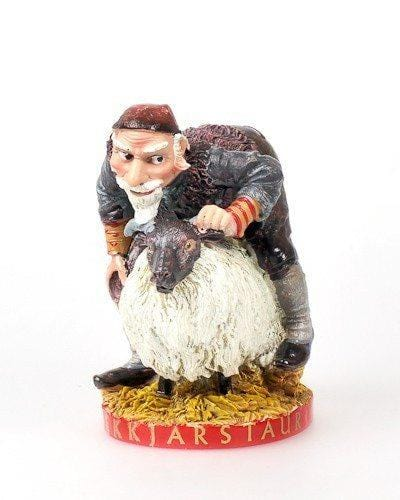
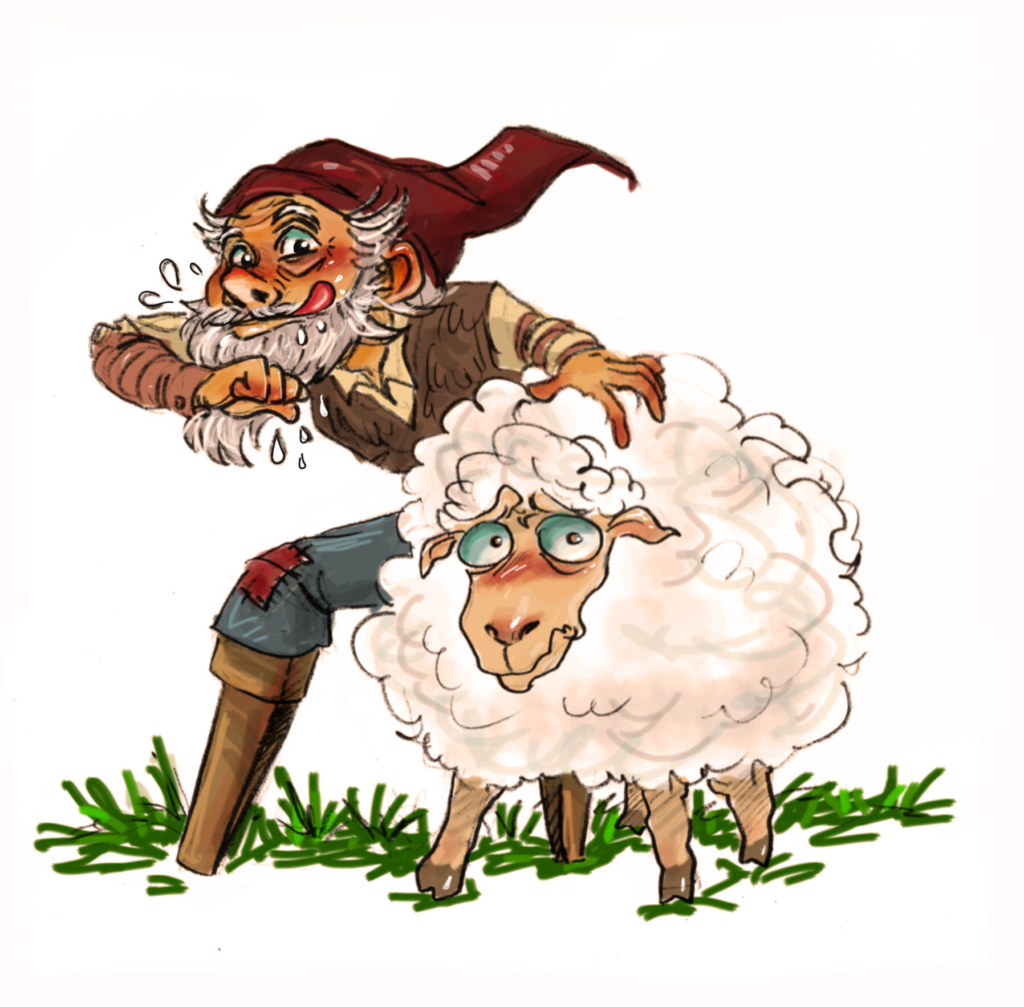
The first Yule Lad’s name is Stekkjarstaur, which translates as Sheep-Cote Clod. His particular brand of mischief involves harassing sheep, but he is ultimately stopped by his stiff peg-legs.

Here’s how he’s described in the 1932 Icelandic poem, “Yule Lads,” by Jóhannes úr Kötlum:

The first of them was Sheep-Cote Clod.
He came stiff as wood,
to prey upon the farmer’s sheep
as far as he could.
He wished to suck the ewes,
but it was no accident
he couldn’t; he had stiff knees
– not too convenient.

Sheep-Cote Clod arrives each year on December 12, and leaves again on Christmas Day, December 25.

And here’s a more thorough explanation, by Robert Nelson, on Medium.

Stekkjarstaur establishes a theme that will run throughout this series; a trouble-making imp breaks into your residence to steal some sustenance. In this case, sheep’s milk. He is, however, quite inept, as the poem shows, as a result of his disability. You see, he has two wooden legs, and as such, cannot properly bend down to suck the milk straight from the ewe’s teet.

By way of explanation, Icelandic farms historically did not look like their Anglo-American counterparts. When settlers arrived in Iceland in the middle ages, they made use of Iceland’s indigenous trees for fuel and building supplies. It takes trees rather long to grow in Iceland anyhow, but the armies of sheep that were brought to pasture in Iceland prevented any new forests from growing on the island until planned and protected plantings in the 20th century.

Farms were sod-houses, often not very large. For smaller, yeoman farms, sheep would probably live in the same structure, or possibly an adjacent structure, as the family. Very close living quarters. And so, Stekkjarstaur isn’t just raiding a barn. He’s raiding a residence.

And here’s another, from Iceland24:

Gimpy was the first,
Stiff like a tree.
He snuck into the stables,
And fooled the farmer’s sheep.

He wanted to suck milk from them,
– They did not care for that,
And because he had peg-legs
– It did not go too well.

Stekkjarstaur harbours a stiff temperament, is stiff temperament, is stiffly set in his ways and very conservative. Some claim he secretly practices yoga, but this has never been confirmed.

He’s the tallest of the brothers. That cross of troll, elf and human ancestry gave him a very long and rather stiff pair of legs. Legend says he walks as though they were made of wood, and he has to use a long walking stick to be able to walk properly. Some folk art portrays him as having two wooden prosthetic limbs, but I go more for him just having long, straight legs. They do help him take enormous strides, so he can travel further than anyone else in his family.

His specialty is in terrifying sheep and, on occasion, stealing them. So, starting on this evening and running through Christmas, Vikings make sure their sheep are well locked away or the next morning they might have some very terrified sheep … or, even missing sheep.

The 13 Yule Lads, Mom, Dad and Cat:

Filed Under: Just For Fun, Related Pleasures Tagged With: Christmas, History, Holidays, Iceland

The Yule Lads of Iceland

December 12, 2023 By Jay Brooks

Because I’ve been “collecting” dates for several decades, I was already familiar with Iceland’s peculiar tradition of the Yule Lads (sometimes referred to as Yuletide Lads) and have been listing them on my daily calendar for many years. Essentially it’s an ancient tradition in their folklore that for thirteen days in the lead up to Christmas, beginning on December 12, a different Yule Lad appears each day with his own story and brand of mischief that he gets up to while he’s visiting, and then they leave, again one per day, in the thirteen days following Christmas. But after visiting Iceland earlier this year, I decided to do my part to make them more widely known, because they’re an awfully cool and fun tradition that more people should know about and celebrate.

Origins of the Yule Lads

So who are the Yule Lads, and where did they originate? According to Wikipedia, “[t]he first mention of the Yule Lads can be found in the 17th-century Poem of Grýla. Grýla had appeared in older tales as a troll but had not been linked to Christmas before. She is described as a hideous being who is the mother of the gigantic Yule Lads, a menace to children.”

“In the late 18th century, a poem mentions 13 of them. In the mid-19th century, author Jón Árnason drew inspiration from the Brothers Grimm and began collecting folktales. His 1862 collection is the first mention of the names of the Yule Lads. In 1932, the poem “Yule Lads” was published as a part of the popular poetry book Christmas is Coming (Jólin koma) by Icelandic poet Jóhannes úr Kötlum. The poem was popular and established what is now considered the canonical 13 Yule Lads, their names, and their personalities.”

The lads themselves were the offspring of two giants, Grýla and Leppalúði.

Grýla is an ogress, first mentioned in 13th-century texts such as Íslendinga saga and Sverris saga, but not explicitly connected with Christmas until the 17th century. She is enormous, and her appearance is repulsive.

The oldest poems about Grýla describe her as a parasitic beggar. She walks around asking parents to give her their disobedient children. Her plans can be thwarted by giving her food or chasing her away. Originally, she lived in a small cottage, but in later poems, she appears to have been forced out of town and into a remote cave.

Current-day Grýla can detect children who are misbehaving year-round. She comes from the mountains during Christmas time to search nearby towns for her meal. She leaves her cave, hunts children, and carries them home in her giant sack. She devours children as her favourite snack. Her favorite dish is a stew of naughty kids, for which she has an insatiable appetite. According to legend, there is never a shortage of food for Grýla.

According to folklore, Grýla has been married three times. Her third husband Leppalúði is said to be living with her in their cave in the Dimmuborgir lava fields, with the big black Yule Cat and their sons. Leppalúði is lazy and mostly stays at home in their cave. Grýla supposedly has dozens of children with her previous husbands, but they are rarely mentioned nowadays.

The Yule Cat

Naturall, Grýla and Leppalúði, and the Yule Lads have a family pet, Jólakötturinn — or simply The Yule Cat, who similarly terrorizes unruly children, especially ones without any new clothing.

The Yule cat (Icelandic: Jólakötturinn, also called Jólaköttur and Christmas cat) is a huge and vicious cat from Icelandic Christmas folklore that is said to lurk in the snowy countryside during the Christmas season and eat people that do not receive any new clothing to wear before Christmas Eve. In other versions of the story, the cat just eats the food of people without new clothes. Jólakötturinn is closely associated with other figures from Icelandic folklore, as the house pet of the ogress Grýla and her sons, the Yule Lads.

The Popular Poem

While the idea of the Yule Lads in Icelandic folklore has been around for centuries, what cemented it into modern Iceland’s culture was a poem written in 1932 by Jóhannes úr Kötlum, who “was an Icelandic author/poet and a member of parliament. The poem was included in collection of poetry for children called Jólin Koma (which essentially means “Christmas is Coming”) and is titled “The Yules Lads.” It remains very popular to this day. Before this poem was published , the Yule Lads differed from story to story, but this poem had the effect of fixing the thirteen Yule Lads and their story into the one that’s agreed upon today. Here’s the introduction:

Let me tell the story
of the lads of few charms,
who once upon a time
used to visit our farms.

Thirteen altogether,
these gents in their prime
didn´t want to irk people
all at one time.

They came from the mountains,
as many of you know,
in a long single file
to the farmsteads below.

Creeping up, all stealth,
they unlocked the door.
The kitchen and the pantry
they came looking for.

Grýla was their mother –
she gave them ogre milk –
and the father Leppalúdi;
a loathsome ilk.

They hid where they could, with a cunning look or sneer,
ready with their pranks
when people weren´t near.

They were called the Yuletide lads
– at Yuletide they were due –
and always came one by one,
not ever two by two.

And even when they were seen,
they weren´t loath to roam and play their tricks – disturbing
the peace of the home.

The poem continues by detailing each of Grýla and Leppalúði’s thirteen children, who arrive — one each day — beginning on December 12, with the last one arriving on Christmas Eve, December 24. Then beginning on Christmas Day, they begin to leave — again one each day — which takes until January 6 until the final one leaves.

They used to me a lot more violent, in the way most fairy and folktales were originally, but the modern Yule Lads, and the Yule Cat, are more mischievous and pull pranks rather than do actual harm. As such, they’ve become a pretty fun tradition in Iceland, and the wider world. Does this have anything to do with beer? Not really, although there is a tenuous connection with one of the Lads. But it’s enough for me to have some fun with it, and so I will be sharing each of the thirteen Yule Lads beginning today and continuing until the last one’s arrival on December 24. Enjoy.

Filed Under: Just For Fun, Related Pleasures Tagged With: Christmas, History, Holidays, Iceland

Beer In Ads #4645: Miss Rheingold 1962 Visits Vermont

December 11, 2023 By Jay Brooks

Monday’s ad is for “Rheingold Beer,” from 1962. This ad was made for the Rheingold Brewery, which was founded by the Liebmann family in 1883 in New York, New York. At its peak, it sold 35% of all the beer in New York state. In 1963, the family sold the brewery and in was shut down in 1976. In 1940, Philip Liebmann, great-grandson of the founder, Samuel Liebmann, started the “Miss Rheingold” pageant as the centerpiece of its marketing campaign. Beer drinkers voted each year on the young lady who would be featured as Miss Rheingold in advertisements. In the 1940s and 1950s in New York, “the selection of Miss Rheingold was as highly anticipated as the race for the White House.” The winning model was then featured in at least twelve monthly advertisements for the brewery, beginning in 1940 and ending in 1965. Beginning in 1941, the selection of next year’s Miss Rheingold was instituted and became wildly popular in the New York Area and beyond. In 1962, Kathy Kersh won the contest and became Miss Rheingold for that year. She was born Kathleen Kroeger Kersh on December 15, 1942 in Los Angeles, California (though one source claimed it was Hawaii). She attended a theatrical school, studying dance and acting. In 1959, she won the title of Miss Junior Rose Bowl, and became a professional model, and later an actress and singer. After her year as Miss Rheingold 1962, she married actor Vince Edwards, best known as Dr. Ben Casey on the TV show of the same name. But they were married for only four months before divorcing, and her daughter was born shortly thereafter when she became a single mother. Some of her more memorable appearances were on Burke’s Law, My Favorite Martian, The Beverly Hillbillies, The Man from U.N.C.L.E., and a small part in the film “The Americanization of Emily.” In 1967, she signed a record deal with Power Records, and released two singles. After a small role as Cornelia, one of the Joker’s henchmen, on Batman, she married Burt Ward, who played Robin. That marriage last two years, and afterwards she attended business school and embarked on successful a career in commercial real estate. As far as know, she still lives in Sherman Oaks, California. In this ad, also from July, Miss Rheingold 1962, Kathy Kersh, is on a whirlwind trip through New England, and this stop is at the Shelburne Museum in Vermont, where she’s learning to be a blacksmith.

Filed Under: Art & Beer, Beers Tagged With: Advertising, History, Rheingold

Beer In Ads #4644: Miss Rheingold 1962 Cruising Lake Winnipesaukee

December 10, 2023 By Jay Brooks

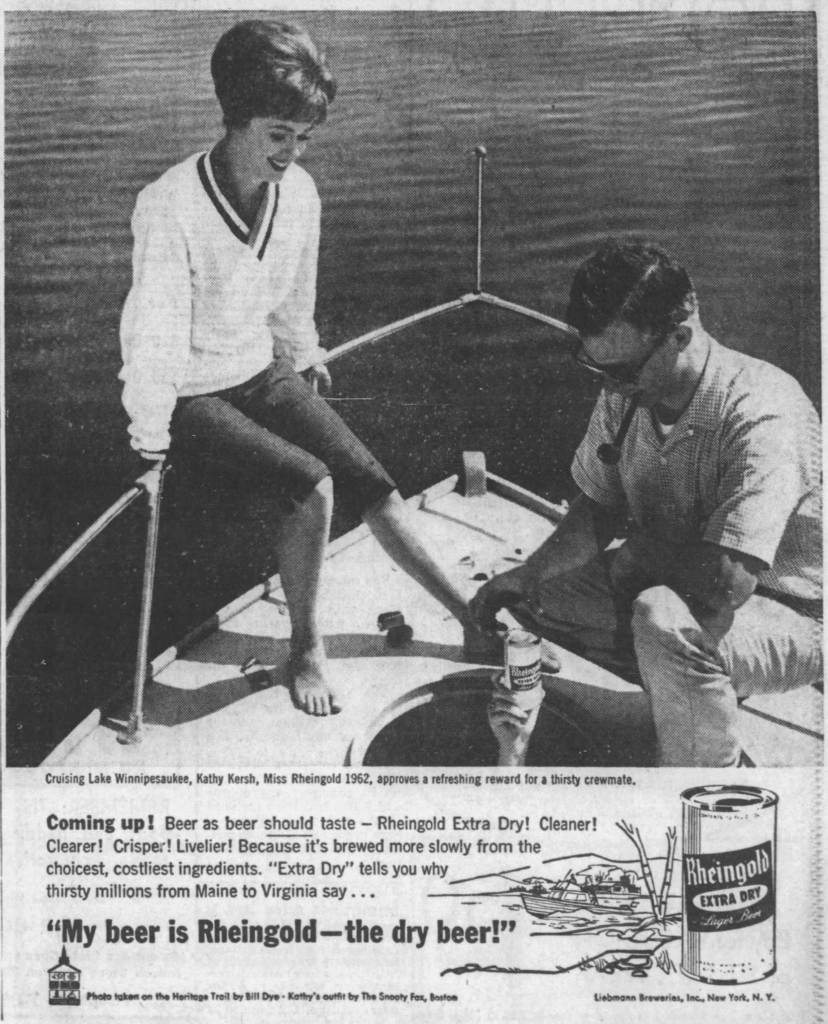
Sunday’s ad is for “Rheingold Beer,” from 1962. This ad was made for the Rheingold Brewery, which was founded by the Liebmann family in 1883 in New York, New York. At its peak, it sold 35% of all the beer in New York state. In 1963, the family sold the brewery and in was shut down in 1976. In 1940, Philip Liebmann, great-grandson of the founder, Samuel Liebmann, started the “Miss Rheingold” pageant as the centerpiece of its marketing campaign. Beer drinkers voted each year on the young lady who would be featured as Miss Rheingold in advertisements. In the 1940s and 1950s in New York, “the selection of Miss Rheingold was as highly anticipated as the race for the White House.” The winning model was then featured in at least twelve monthly advertisements for the brewery, beginning in 1940 and ending in 1965. Beginning in 1941, the selection of next year’s Miss Rheingold was instituted and became wildly popular in the New York Area and beyond. In 1962, Kathy Kersh won the contest and became Miss Rheingold for that year. She was born Kathleen Kroeger Kersh on December 15, 1942 in Los Angeles, California (though one source claimed it was Hawaii). She attended a theatrical school, studying dance and acting. In 1959, she won the title of Miss Junior Rose Bowl, and became a professional model, and later an actress and singer. After her year as Miss Rheingold 1962, she married actor Vince Edwards, best known as Dr. Ben Casey on the TV show of the same name. But they were married for only four months before divorcing, and her daughter was born shortly thereafter when she became a single mother. Some of her more memorable appearances were on Burke’s Law, My Favorite Martian, The Beverly Hillbillies, The Man from U.N.C.L.E., and a small part in the film “The Americanization of Emily.” In 1967, she signed a record deal with Power Records, and released two singles. After a small role as Cornelia, one of the Joker’s henchmen, on Batman, she married Burt Ward, who played Robin. That marriage last two years, and afterwards she attended business school and embarked on successful a career in commercial real estate. As far as know, she still lives in Sherman Oaks, California. In this ad, also from July, Miss Rheingold 1962, Kathy Kersh, is on another boat, possibly the one we saw in yesterday’s ad, and is perched on the bow as a crewman hands up a can of Rheingold beer from below. According to the ad copy, she’s “cruising Lake Winnipesaukee,” which is the largest lake in New Hampshire.

Filed Under: Art & Beer, Beers Tagged With: Advertising, History, Rheingold

Beer In Ads #4643: Miss Rheingold 1962 On A Racing Yacht

December 9, 2023 By Jay Brooks

Saturday’s ad is for “Rheingold Beer,” from 1962. This ad was made for the Rheingold Brewery, which was founded by the Liebmann family in 1883 in New York, New York. At its peak, it sold 35% of all the beer in New York state. In 1963, the family sold the brewery and in was shut down in 1976. In 1940, Philip Liebmann, great-grandson of the founder, Samuel Liebmann, started the “Miss Rheingold” pageant as the centerpiece of its marketing campaign. Beer drinkers voted each year on the young lady who would be featured as Miss Rheingold in advertisements. In the 1940s and 1950s in New York, “the selection of Miss Rheingold was as highly anticipated as the race for the White House.” The winning model was then featured in at least twelve monthly advertisements for the brewery, beginning in 1940 and ending in 1965. Beginning in 1941, the selection of next year’s Miss Rheingold was instituted and became wildly popular in the New York Area and beyond. In 1962, Kathy Kersh won the contest and became Miss Rheingold for that year. She was born Kathleen Kroeger Kersh on December 15, 1942 in Los Angeles, California (though one source claimed it was Hawaii). She attended a theatrical school, studying dance and acting. In 1959, she won the title of Miss Junior Rose Bowl, and became a professional model, and later an actress and singer. After her year as Miss Rheingold 1962, she married actor Vince Edwards, best known as Dr. Ben Casey on the TV show of the same name. But they were married for only four months before divorcing, and her daughter was born shortly thereafter when she became a single mother. Some of her more memorable appearances were on Burke’s Law, My Favorite Martian, The Beverly Hillbillies, The Man from U.N.C.L.E., and a small part in the film “The Americanization of Emily.” In 1967, she signed a record deal with Power Records, and released two singles. After a small role as Cornelia, one of the Joker’s henchmen, on Batman, she married Burt Ward, who played Robin. That marriage last two years, and afterwards she attended business school and embarked on successful a career in commercial real estate. As far as know, she still lives in Sherman Oaks, California. In this ad, from July, Miss Rheingold 1962, Kathy Kersh, is still in apparently Massachusetts, and on something of a nautical summer, is now on board a racing yacht at the beginning of “the New England boating season”

Filed Under: Art & Beer, Beers Tagged With: Advertising, History, Rheingold

Beer In Ads #4642: Miss Rheingold 1962 On The Nantucket Steamer

December 8, 2023 By Jay Brooks

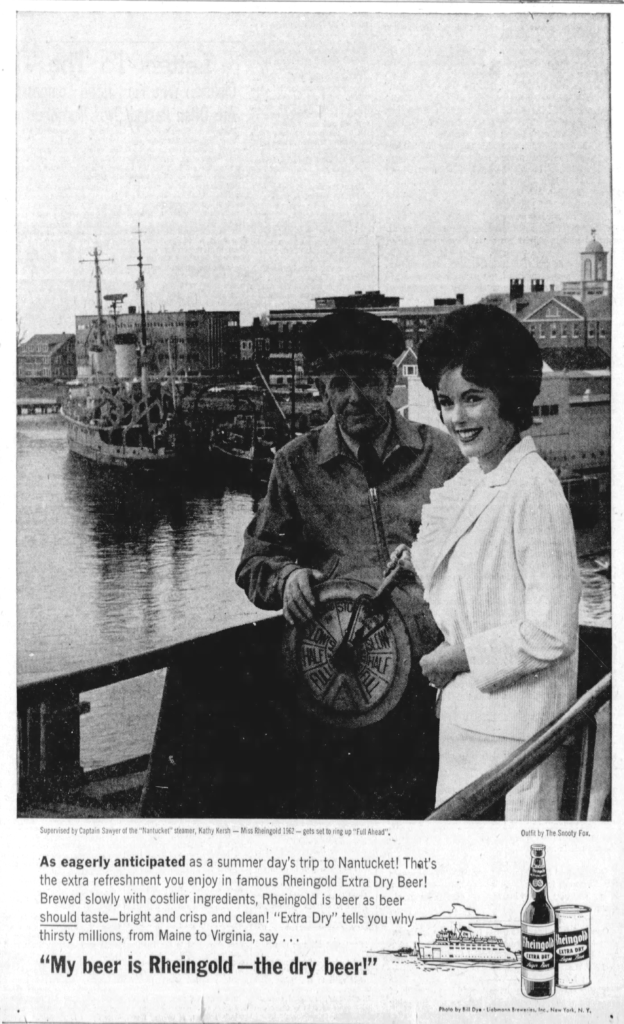
Friday’s ad is for “Rheingold Beer,” from 1962. This ad was made for the Rheingold Brewery, which was founded by the Liebmann family in 1883 in New York, New York. At its peak, it sold 35% of all the beer in New York state. In 1963, the family sold the brewery and in was shut down in 1976. In 1940, Philip Liebmann, great-grandson of the founder, Samuel Liebmann, started the “Miss Rheingold” pageant as the centerpiece of its marketing campaign. Beer drinkers voted each year on the young lady who would be featured as Miss Rheingold in advertisements. In the 1940s and 1950s in New York, “the selection of Miss Rheingold was as highly anticipated as the race for the White House.” The winning model was then featured in at least twelve monthly advertisements for the brewery, beginning in 1940 and ending in 1965. Beginning in 1941, the selection of next year’s Miss Rheingold was instituted and became wildly popular in the New York Area and beyond. In 1962, Kathy Kersh won the contest and became Miss Rheingold for that year. She was born Kathleen Kroeger Kersh on December 15, 1942 in Los Angeles, California (though one source claimed it was Hawaii). She attended a theatrical school, studying dance and acting. In 1959, she won the title of Miss Junior Rose Bowl, and became a professional model, and later an actress and singer. After her year as Miss Rheingold 1962, she married actor Vince Edwards, best known as Dr. Ben Casey on the TV show of the same name. But they were married for only four months before divorcing, and her daughter was born shortly thereafter when she became a single mother. Some of her more memorable appearances were on Burke’s Law, My Favorite Martian, The Beverly Hillbillies, The Man from U.N.C.L.E., and a small part in the film “The Americanization of Emily.” In 1967, she signed a record deal with Power Records, and released two singles. After a small role as Cornelia, one of the Joker’s henchmen, on Batman, she married Burt Ward, who played Robin. That marriage last two years, and afterwards she attended business school and embarked on successful a career in commercial real estate. As far as know, she still lives in Sherman Oaks, California. In this ad, also from June, Miss Rheingold 1962, Kathy Kersh, is still in Nantucket, Massachusetts, on a steamer called “The Nantucket,” the same one behind her when she was standing on the dock in yesterday’s ad. Now she’s standing with Captain Sawyer as he explains how to operate the ship.

Filed Under: Art & Beer, Beers Tagged With: Advertising, History, Rheingold

« Previous Page
Next Page »

Find Something

Northern California Breweries

Please consider purchasing my latest book, California Breweries North, available from Amazon, or ask for it at your local bookstore.

Recent Comments

  • Ernie Dewing on Historic Beer Birthday: Charles William Bergner 
  • Steve 'Pudgy' De Rose on Historic Beer Birthday: Jacob Schmidt
  • Jay Brooks on Beer Birthday: Bill Owens
  • Steve 'Pudgy' De Rose on Beer Birthday: Charles Finkel
  • Steve 'Pudgy' De Rose on Beer Birthday: Bill Owens

Recent Posts

  • Historic Beer Birthday: Joseph Ibach February 17, 2026
  • Beer In Ads #5206: What Is Rainier Bock Beer? February 17, 2026
  • Historic Beer Birthday: John A. White Jr. February 17, 2026
  • Historic Beer Birthday: Ernest Davis February 17, 2026
  • Beer In Ads #5205: Bock Time Is Schmidt’s Time February 16, 2026

BBB Archives

Feedback

Head Quarter
This site is hosted and maintained by H25Q.dev. Any questions or comments for the webmaster can be directed here.