Brookston Beer Bulletin

Jay R. Brooks on Beer

  • Home
  • About
  • Editorial
  • Birthdays
  • Art & Beer

Socialize

  • Dribbble
  • Email
  • Facebook
  • Flickr
  • GitHub
  • Instagram
  • LinkedIn
  • Pinterest
  • RSS
  • Twitter
  • YouTube

Powered by Genesis

Enough Already: Time to Cry Bullshit

June 6, 2006 By Jay Brooks

Okay, I’ve had enough. Time to speak out. I’ve been getting press releases from the National Beer Wholesalers Association for many months now about the [expletive deleted] estate tax (it’s correct name by the way; they keep calling it the “death tax,” which alone pisses me off). I’ve been simply deleting them but the sheer number of the e-mails I’ve gotten over the last few months is truly staggering, maybe one every other week. There is no other issue facing the beer industry that’s received that kind of attention from a trade organization since they talked about changing the way that breweries are taxed. And it doesn’t even directly relate to beer, just the companies themselves. Today I got yet another one and it was the straw that broke the proverbial camel’s back. There has simply been far to much attention paid to this issue and far too much misinformation given the small number of people it will benefit. Even though the NBWA is a trade organization of companies that distribute beer, it’s seldom that I agree with their agenda, and this is a perfect example. It happens — take the Costco case in Washington — but generally they advocate for their members and that’s not always the same as what it is in the best interests of craft brewers, which is where my sympathies lie.

But their relentless pursuit of this estate tax agenda framed in terms of protecting family businesses from having their hard-earned money taken from them is, simply put: bullshit. The only people effected by the estate tax will be people whose estates are valued above a certain amount and chances are if you’re reading this you’re not someone who will be effected by it. 99% of the people in the U.S. will pass their estates on to their loved ones and pay zero income tax. So that begs the question “why is the NBWA so hot about this issue?” And the answer is simple. Because their membership is choked with a few mega-huge distributors who are part of the 1% that might have to pay something when one of their patriarchs (or matriarchs) sadly passes away. The “small family-owned businesses” that the NBWA goes on about saving is just propaganda. But at this point I’m beyond that epithet. Let’s call a spade a spade. It’s just bullshit. This is a few rich families using a trade organization for their own selfish ends. When their press release talks about “92,000 hardworking Americans” almost none of them will be effected by the estate tax, unless of course, the family decides to fire some of them rather than lose their country club membership.

To read the facts about about this issue, try Myths and Facts About the Estate Tax at Fair Economy. Or try Nolo Press’ assessment. And here’s an estate tax calculator at Americans for a Fair Estate Tax. There is also information at the IRS.

A report in late April by Public Citizen revealed that:

18 families worth a total of $185.5 billion have financed and coordinated a 10-year effort to repeal the estate tax, a move that would collectively net them a windfall of $71.6 billion.

Here’s the propaganda-filled NBWA press release:

As the Senate prepares for a possible vote on the [estate] tax this week, the National Beer Wholesalers Association (NBWA) is ensuring Senators know that America’s beer distributors need permanent relief from this onerous tax.

Earlier today, NBWA’s Federal Affairs team delivered a bottle of Blue Moon beer to each Senator. Each bottle was accompanied by a message urging Republicans and Democrats to set aside their differences and provide small businesses with permanent relief from the death tax once and for all.

“Beer distributors around the country have waited a long time for the Senate to act on the death tax,” said NBWA President Craig Purser. “Since it happens only once in a blue moon, we wanted to take the opportunity to remind Senators how important permanent death tax relief is to the small family-owned businesses that NBWA represents.”

Permanent relief from the federal death tax is a top legislative priority for the nation’s beer distributors. Many beer distribution companies have been family-owned and -operated since the repeal of Prohibition in 1933. Today, beer distributors employ more than 92,000 hardworking Americans. Aside from stripping these small business owners of their livelihood, the death tax can also cost the community jobs and economic output.

At the left is the marketing piece sent to every member of Congress urging them to repeal the estate tax, along with a bottle of Blue Moon beer. Below is the label to Blue Moon Belgian White Ale, the stealth micro owned by Coors, itself a rich family-owned company. Kind of ironic, isn’t it?

So what are we to conclude from the facts vs. the propaganda spewing out of the NBWA? I think it tells us a lot about the make-up of beer distributors nationwide. There are, of course, small beer distributors doing a great job of promoting and selling great beer. I personally know several of them, past and present, in California, Oregon and Washington. But I don’t think any of their interests are being served by squandering NBWA funds on fighting the estate tax. But I guess the little distributors don’t have much of a voice in a trade organization so obviously dominated by giant companies.

I think the reason this pisses me off so much is the misuse of emotional imagery about “America’s family-owned businesses.” All the rhertoric paints a distorted picture of reality that benefits a few rich families which — and this should not be overlooked — if they’re successful means the rest of us will be picking up their tab. If the estate tax is repealed and that money is no longer collected from these super-rich families then one of two things will occur. Either the services that money would have paid for will be cut or you and I will be paying higher taxes to make up the difference. That means small craft brewers and beer consumers will have to pay so that these super-rich beer distributor families can stay super-rich. Now how fair does that sound?

Filed Under: Editorial Tagged With: Business, National, Press Release

Update on Latrobe Brewery

June 6, 2006 By Jay Brooks

I was away this weekend camping with the family and some friends — which also meant I missed a great beer festival in Santa Rosa — and I’ve been trying to catch up on what I’ve missed. It seems there’s a lot of information flying around about what’s going on with the Latrobe Brewery sale/closing.

I read one forum post on the BrewBoard by a prominent (or at least active) member who took the position that Rolling Rock’s beer isn’t actually great craft beer and the Latrobe Brewery hasn’t been owned by the community for a long time now so what’s the big deal that it may be closed. It may be an unpopular position, but there is a lot of truth to it. InBev has owned the brewery for years and even my first post when the sale was announced I wrote about Rolling Rock’s faux micro status. It’s been marketed as a craft beer but generally the only people who bought that were bridge buyers and casual beer buyers. No hardcore beer geek thinks of Rolling Rock as a craft beer. But the potential closing of a an over sixty-year old brewery is another matter and erases any negative thoughts I have about the beer itself. Why? For one simple reason. I believe our brewing heritage should not disappear. I have mourned too many brewery closings in my brief lifetime. Back in the golden age of brewing — the latter quarter of the 19th Century — there were something like almost two-thousand breweries in this country. After Prohibition we lost more than half of them in one fell thirteen-year swoop. Over the subsequent half-century the number of breweries continued to steadily decrease until by the early 1980s there were only a few dozen left. If you read the Breweriana magazines you’ll quickly see how many abandoned and ruined breweries there are out there. And not all of them closed a long time ago. My wife and I visited the Olympia Brewery in Washington on our honeymoon not quite ten years ago. Olympia, of course, didn’t make a great beer but the brewery itself was beautiful and they had an unbelieveably amazing collection of beer steins. But it’s closed now. The Henry Weinhard brewery in downtown Portland — itself a beautiful brick building — was torn down only a few years ago. Now I didn’t drink either of those beers, either, but I still mourned their passing. And the same is quite appropriate for the Latrobe Brewery, too. The effort to save should be supported by all of us who love beer, regardless of personal feelings about Rolling Rock itself. It’s the history and heritage that is worth saving.

Here’s a round-up of recent news about the efforts to save the brewery:

On June 1, according to the Pittsburgh Tribune-Review, John Murtha, Democratic Congressman from Pennsylvania’s 12th District, announced his intention to broker a deal for the Latrobe Brewery and Pittsburgh Brewing, itself in financial trouble. The makers of Iron City Beer have been in Chapter 11 (reorganiztion) bankruptcy since last December. Funding would likely have to come from state resources. Latrobe Mayor Tom Marflak doubted this plan out of hand.

The next day, the Tribune-Review quoted Pittsburgh Brewing president Joseph Piccirilli was willing to meet with Representative Murtha regarding the purchase of the Latrobe Brewery. Piccirilli further stated, in the Pittsburgh Post-Gazette, that “The Latrobe Brewery is a beautiful facility. I’m in the beer business and it’s practically in my back yard. We are in the midst of union negotiations and we are working very hard to turn our financial situation around. But if we can schedule something, I’ll speak with the congressman.”

Friday, June 2, a spokesperson for Pennsylvania Governor Ed Rendell told reporters that Renaissance Partners, LLC, of Pittsburgh, “has been contacted by the state to study the Latrobe beermaking facility. Renaissance Partners works with the Governor’s Action Team on a regular basis.”

Yesterday, Governor Rendell said “he’ll offer incentives to any company that wants to buy Latrobe Brewing,” according to WTAE Channel 4 in Pittsburgh. From their coverage:

“The commonwealth’s going to come in and sweeten the pot a little bit and give some training money and incentive money so we can keep the jobs in Latrobe,” Rendell said. “There’s no guarantee, but we’re sort of getting our battle plan together.”

Monday, the Governor had spoken to InBev — the current owners of the brewery — and they informed him that “they had some interested investors in the facility.” According to the Tribune-Review report, InBev is “supposed to get back to [the state] this week.”

Today in a news brief, Governor Rendell says he is “guardedly optimistic” that a buyer can be found for the Latrobe Brewery, “including possibly finding another brewer to take over production or convincing private investor groups to buy the facility and develop a new brand.” The Governor’s made these remarks after a speech at the United Steelworkers Building in downtown Pittsburgh yesterday.

And as of this afternoon — around Noon — almost 18,000 people had signed the online petition to save the Latrobe Brewery. That’s three times as many signatures since the petition began almost two weeks ago.

With less than two months before the deadline passes and the brewery closes, at least there’s a lot of activity going on to try to save it. I tend to be pessimistic about these things but, as they say, hope springs eternal. Let’s prepare for the worst, but strive to do whatever each of us can to support the efforts to save the brewery. We owe it to every worker who ever set foot in a brewery to preserve what we can of the heritage that has brought each of us so much enjoyment throughout our lives.

Filed Under: Editorial, News Tagged With: Business, Eastern States, National

What Makes Beer Organic?

June 3, 2006 By Jay Brooks

Since I’ve been talking about Wild Hop Lager and Stone Mill Pale Ale, and the fact that it’s being sold to an unsuspecting organic customer, I thought it would be worthwhile to examine exactly what makes a beer organic. Unsurprisingly, it’s the ingredients used to make whatever product is going to be called or labeled “organic.” Several years ago, the standards for organic products varied from state to state, but in 2002 the federal government instituted the National Organic Program (NOP) that standardized the requirements for organic labeling nationwide. This made it easier for companies to sell across state lines without having to worry about individual and possibly conflicting standards between states. Some states did complain, of course, because it undermined their own efforts at defining what it means to be an organic product. The standards in Oregon prior to the NOP, for example, were more rigid than the national standard adopted by the U.S. Department of Agriculture. But this intervention did make it easier for regional and national breweries to more easily meet the requirements for a larger market.

The USDA does not do the certification process directly, but rather they have “deputized” independent certifying agents, which in some cases do include the former state certifying agencies. Currently, there are about sixty such agencies. Among these are the California Certified Organic Farmers (CCOF) and the Oregon Tilth. In addition to the actual certifying, they also investigate noncompliance complaints and check records, monitor label usage, etc. There are now essentially four levels of organic labeling: “100% organic,” “organic,“ “made with organic materials,” and “some organic ingredients.” The differences in these four are listed in the table below:

Organic Labeling Differences

100% Organic

Must contain 100 percent organically produced ingredients, not counting added water and salt.

Organic

Must contain at least 95% organic ingredients, not counting added water and salt.

Must not contain added sulfites.

May contain up to 5% of:

  1. nonorganically produced agricultural ingredients which are not commercially available in organic form; and/or
  2. other substances, including yeast, allowed by 7 CFR 205.605
Made with Organic Ingredients

Must contain at least 70% organic ingredients, not counting added water and salt.

Must not contain added sulfites; except that, wine may contain added sulfur dioxide in accordance with 7 CFR 205.605.

May contain up to 30% of:

  1. nonorganically produced agricultural ingredients which are not commercially available in organic form; and/or
  2. other substances, including yeast, allowed by 7 CFR 205.605
Some Organic Ingredients

May contain less than 70% organic ingredients, not counting added water and salt.

May contain over 30% of:

  1. nonorganically produced agricultural ingredients; and/or
  2. other substances, without being limited to those in 7 CFR 205.605


While this is undoubtedly a good step, the fact that there are four of these and they sound so similar it seems to me this is still confusing for consumers, especially the casual consumer who is not likely to be familiar with the precise differences. The “made with organic ingredients” designation, for example — which only requires 70% of its ingredients to actually be organic — seems to convey a false impression of how organic the product really is, at least in my opinion. A company could use 30% of complete crap and still make a consumer believe their purchase is organically sound. This undermines the very idea of organic products. It seems to me products should either be organic or not. This slippery slope of degrees is bound to cause nothing but confusion and perhaps even ill will. The FDA has approved some sixty plus chemicals for use in the manufacture of beer. Are they all bad? Certainly not, and even craft brewers use some of them on occasion. But health and beer is all about perception. A brewery could theoreticaly use many of them and so long as it’s less than 30% of the total ingredients say their concoction is “made with organic ingredients.”

All beer is in effect natural, especially those that use only the four basic ingredients. This begs the question of how much better is organic beer vs. a typical craft beer? I’d say in the end it has to do with how it makes the customer feel on an emotional level. I think that’s true of almost all organic products. People buy them because it makes them feel good, like they’re doing something good, both for themselves, the environment and perhaps even society as a whole. They feel like they’re helping out small farmers. This is why the labeling is so important. And not just the organic designation but also the truthiness of the entire package. A customer should be able to feel good about what they’re buying, but if details are left out — no matter how legal it is to do so — then this damages the emotional response that is so central to buying organic.

This is the very reason big companies hide behind dba’s and buy up health food companies. Colgate recently bought Tom’s of Maine. Will that make Tom’s a bad product now? Probably not, unless Colgate takes over production and relaxes standards. But some people will likely still think twice about buying Tom’s knowing it’s just another product line in Colgate’s massive portfolio. It’s all a matter of what perception will be created in the mind of the consumer based on that new information and what the change of ownership means to them. Some may not care at all, of course. But what happens if this information is not disclosed on Tom’s packaging? At that point it goes beyond simple ignorance and becomes a calculated lie-by-omission.

There will almost certainly continue to be a market for organic and healthier products that maintain a small niche within the wider market. What will allow it to grow is directly proportional to the confidence that the market has for the products within the niche market. That’s the exact reason the labeling standards are so important. But doing the minimum required for purely business reasons in order to sell a product is just not enough. Common sense standards will also have to be adhered to as well in order to gain customer confidence. This will vary from company to company but makes sense in relation to the product. For example, an organic farmer who refrains from using pesticides but hires slave labor would not be adhering to a common sense standard, in my opinion.

By and large, I think the majority of organic beers available today do adhere to a good set of standards, both the mandated ones and the common sense ones. But as larger companies begin to compete for these niche markets, the line becomes blurred. Some will leave the smaller companies they’ve purchased alone and some will swallow them whole. New ones created within larger companies will suffer the same problems. And then who knows what will happen to common sense standards.

Below is a list of many of the organic beers and beer producers available today.

Some Organic Beer Producers

Domestic Organic Breweries

  • Bison Brewing; Berkeley, California
  • Blackfoot River Brewing; Helena, Montana
  • Butte Creek Brewing; Chico, California
  • Eel River Brewing; Fortuna, California
  • Elliott Bay Brewing; Seattle, Washington
  • Fish Brewing; Olympia, Washington
  • Laurelwood Brewing; Portland, Oregon
  • North Coast Brewing; Fort Bragg, California
  • Peak Organic Brewing; Burlington, Massachusetts
  • Pisgah Brewing; Black Mountain, North Carolina
  • Roots Organic Brewery; Portland, Oregon
  • Wolaver’s Certified Organic Ales; Middlebury, Vermont
  • Santa Cruz Mountain Brewing; Santa Cruz, California
  • Ukiah Brewing; Ukiah, California


Domestic Organic Beers

  • Big “O” Organic, Snake River Brewing; Jackson Hole, Wyoming
  • Biologique Dupont Beers (5), Brasserie Dupont; Tourpes, Belgium
  • Kaya Organic Pale, Fitger’s Brewhouse; Duluth, Minnesota
  • Kraftbräu Summer Moon Organic Ale, Kraftbräu Brewery; Kalamazoo, Michigan
  • Mothership Wit, New Belgium Brewing; Fort Collins, Colorado
  • OGA (Organic Golden Ale), Lucky Labrador; Portland, Oregon
  • Organic Amber, Bluegrass Brewing; Louisville, Kentucky
  • Organic Bock, Big Horse Brewpub; Hood River, Oregon
  • Organic ESB, Lakefront Brewery; Milwaukee, Wisconsin
  • Organic Porter, Brooklyn Brewery; Brooklyn, New York
  • Tree Hugger Organic IPA, Redfish New Orleans Brewhouse; Boulder, Colorado


Organic Breweries Abroad

  • Arkell’s; Swindon, England
  • Black Isle Brewery; Munlochy, Scotland
  • Brauerei Pinkus Mueller; Munster, Germany
  • Crannog Ales; Sorrento, BC, Canada
  • Clarke’s Organic Brewery; Dewsbury, England
  • Founders Organic Brewery; Nelson New Zealand
  • Marble Beers; Manchester, England
  • Mongozo Exotic Beers; Venray, Netherlands
  • O’Hanlon’s Brewing; Devon, England
  • Pacific Western Brewing; Burnaby, BC, Canada
  • Pitfields Organic Brewery; London, England
  • The 4 Elements; Richelbach, Germany
  • Thisted Bryghus; Thisted, Denmark
  • Waedenswiler Bierwelt; Wädenswil, Switzerland
  • Wild Rose Brewery; Calgary, Alberta, Canada


Organic Beers Abroad

  • Border Gold & Angel Lager, Broughtan Ales; Broughtan, Scotland
  • Brakspear Organic Beer, Brakspear Brewery, Witney, England
  • Cantillon Gueuze 100% Lambic-Bio, Brasserie Cantillon, Brussels, Belgium
  • Duchy Originals Organic, Wychwood Brewery; Witney, England
  • Eisenbahn Natural, Eisenbahn; Brazil
  • Emerson’s Organic Pilsner, Emerson’s Brewery; Dunedin, New Zealand
  • Golden Promise Organic, Caldonian Brewery; Edinburgh, Scotland
  • Mill Street Original Organic Lager, Mill Street Brewery; Toronto, Canada
  • Organic Ale, Brasserie Rancho El Paso; Hokkaido, Japan
  • Organic Ale & Best Bitter, St. Peter’s Brewery; Suffolk, England
  • Organic Beer Shinshu Sansan, Yo-Ho Brewing; Japan
  • Organic Honeydew, Fuller’s; London, England
  • Samuel Smith Organic Ale & Lager, Old Brewery at Tadcaster; Yorkshire, England
  • Yella Bella Organic Ale, Batemans Brewery; Wainfleet, England


Filed Under: Editorial Tagged With: Business, Organic

Statistics Damned Statistics

June 2, 2006 By Jay Brooks

piechart
Somehow I missed this little tidbit in last Sunday’s paper — oh, yeah, I was out of town for Memorial weekend — but I feel compelled to address it now. The S.F. Chronicle quotes a statistic from a survey by Merrill Research of San Francisco that a “survey of 1,398 wine consumers shows that between 2000 and 2005, the U.S. wine drinking population increased by 31 percent among adults in households with income greater than $35,000.” This is cited to support the statement that “[w]ine continues to steal drinkers’ attention from beer and spirits.”

Okay, let’s break that down. It’s a survey of “wine drinkers,” that is people who already drink wine rather than other alcoholic beverages. Does that strike anyone else as odd to use in an article comparing the rate of consumption of different drinks? Essentially the way I read it people who already prefer wine drank more of it over a five year period. Hooray! So what? Not exactly ground breaking, is it? Am I missing something? Plus, it further narrows the study by restricting it to households that make more that $35K, which is almost twice the amount where the poverty line is drawn and falls somewhere in between the second and third fifths of median income nationwide. So basically the study further says that people in the middle-class or upper middle-class (depending on where you draw that line) and up to and including the über-rich are the only people whose opinions were counted in determining wine drinking was up. So what was everybody whose income was below $35,000 drinking? Apparently is doesn’t matter, but I’m going to go out on a limb and say perhaps beer might be involved.

Of course, this number manipulation skews the results and thus the conclusions being drawn therefrom. We all know statistics lie, so why bother? I think the reason is twofold. First, it may be simply that people only read headlines and maybe the first paragraph or so and they tend to look for support for their beliefs and so would be expected to read this much less critically than I would. After all, this article was part of the newspaper’s wine section. Where is the newspaper’s beer section? Don’t ask. Second, putting statistics out there in print, even false or misleading ones, gives them a kind of legitimacy. One thing I learned as a Billboard reporter in the 1980s when I ran a record store was that people are often sheep. They want to be seen doing whatever is popular which is why sales charts, popularity contests, etc. are so useful to business. There’s a kind of snowball effect when something is perceived to be popular, that very fact makes it more popular as people jump on the bandwagon to be “with it” or whatever. So just by saying something is more popular and saying it with statistics, even questionable ones, can go a long way to making it a self-fulfilling prophecy.

But the Chronicle article isn’t finished mangling things:

“Wine continues to steal drinkers’ attention from beer and spirits, according to a recent survey, with three varietals proving particularly enticing to novices. Consumers who are decreasing their beer and spirits consumption but increasing their wine consumption are drinking more Cabernet Sauvignon, Syrah/Shiraz and Pinot Grigio than the rest of the wine-drinking population.”

I’m not sure what the point of this is, and the study mentioned is never cited but I don’t think it’s the same study that began the article. The article continues. ” At the same time, the percentage of U.S. adults who drink beer and spirits but not wine declined by 25 percent.” Again, where is this data coming from? It appears on the small amount of information and citations used that these conclusions are drawn from comparing two and possibly three different studies, a fool’s game if ever there was one.

But when you look at the dollars involved, the numbers paint a different picture. In 2004, for example, American consumers spent $82 billion on beer, $49 billion on spirits and only $23 billion on wine. And the price of many wine bottles exceeds, and in some cases greatly exceeds, that of the average six-pack. This suggests to me that the actual number of beer purchases vs. wine purchases is even greater than the disparity in total sales indicates. There are all sorts of reasons to suggest that people answer poll questions with a certain bias. As a result, sales figures seem far more accurate a measure to me.

Given wine’s incessant snob appeal, I’m not really sure why they’re trying to use statistics to turn it into the people’s drink. Perhaps the media is trying to justify its pathetic coverage of beer. And I guess stories that buck conventional wisdom, and indeed logic and the real unvarnished statistics, are deemed more interesting. After all, that’s why famously nobody wants to read a story about a dog biting a man but vice versa it’s front page news. Everyone already knows beer is the second most consumed manufactured (meaning not water) beverage in the world (tea is number one) so anything that throws that into question is likely to become news because it goes against conventional wisdom. Plus — and this may be a California thing — alcohol law differences between beer, wine and spirits make it very difficult for beer to spend money on advertising but frighteningly easy for wine and spirits. Thus, wine and spirits advertising spending greatly outnumbers beer and newspapers are keenly aware of who pays the bills. No matter how you slice it, beer seems to be perpetually on the losing end of of our media’s coverage.

Filed Under: Editorial, News Tagged With: Business, California, National, San Francisco

Memphis Coors Brewery in Jeopardy Again

June 1, 2006 By Jay Brooks

City Brewery of La Crosse, Wisconsin had been negotiating for the purchase of the Memphis brewery owned by Molson Coors. But apparently the deal is off now reportedly because too many concessions, primarily wage cuts and loss of benefits, were asked of brewery employees and their union rejected them.

The brewery in southeast Memphis opened in 1971 as a Schlitz brewery. It was acquired by Coors in 1990. Without a buyer, Molson Coors, which had planned on closing it in 2007, is now moving up the brewery closing date to September of this year.

Filed Under: News Tagged With: Business, Southern States

Founders Buy Back Pike Brewery

May 31, 2006 By Jay Brooks

Charles and Rose Ann Finkel were truly two of the prime movers for the beer revolution in America and brought many of the best imported beers to the U.S. via the import company, Merchant Du Vin, that they founded in 1978. They also founded Pike Brewery in Seattle’s famous Pike Place in 1989. The Finkels left the beer business in 1997 to pursue less hectic interests. Perhaps not hectic enough though, because they’re back. The Finkels have reportedly reaquired the Pike Brewery under undisclosed terms. Merchant Du Vin and the Seattle brewery will operate separately going forward.

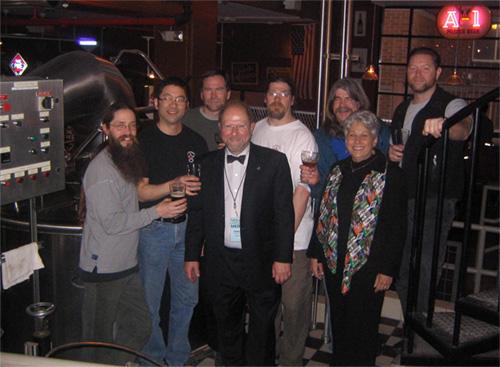
Charles and Rose Ann Finkel (in front) posing last month during CBC at Pike Brewery with Pike brewers, old and new.

Filed Under: News Tagged With: Business, Washington

Daughter of Latrobe Brewery Employee Sends Open Letter to August A. Busch IV

May 26, 2006 By Jay Brooks

The letter posted below was forwarded to me by a good friend and colleague. It’s an open letter to August A. Busch IV regarding Anheuser-Busch’s plans to move production of the newly acquired Rolling Rock brand to Newark, New Jersey and sell the Latrobe Brewery. The town of Latrobe is in Western Pennsylvania, a little over 40 miles from Pittsburgh. It’s a small town, with a population of around 9,000 people. Arnold Palmer was born there, and so was Fred “Mr.” Rogers. It is believed the first professional football game was played in Latrobe (September 3, 1895) and the first banana split was made there (in 1894). Since 1893, it has been the home of the Latrobe Brewery and by and large, most people know the town of Latrobe because of Rolling Rock. Having grown up in a small town in Pennsylvania, I understand how seriously people take their history and heritage, how much it means to them. Sure there are economics involved in Latrobe, too, but it isn’t just about that. It’s also about people, small town loyalty and a real sense of community pride. So when the brewery employees were summarily told they had two months and then not only their jobs would be lost, but also a piece of the town’s heritage, it must have felt like the proverbial rug had been pulled out from under them.

That’s why I was surprised that the same day Anheuser-Busch announced the purchase of the Rolling Rock brand from InBev that they would also sour that news by mentioning that the Latrobe Brewery would be sold or closed. I’m sure it was simply an economy of scales argument, a business decision. But it would have been far more prudent to have waited to drop that bombshell until after the purchase story was out of the news cycle. Because, as the letter points out, A-B has been waxing poetic in ads and press releases about their corporate citizenship, their affinity for family, community and heritage. Of course that’s just propaganda, corporations don’t really care about those things, they just want to appear to care about those things because it improves their image. Corporations only have one function, making a profit, and are responsible to only one group of people: their shareholders. Oddly enough, though, when companies spin themselves as good guys, people actually expect them to act that way.

So Christina Gumola, the daughter of a Latrobe Brewing Company employee, sent the letter below to the president, vice president, and other board members at Anheuser-Busch regarding their recent purchase of Rolling Rock last Friday.

An online petition has also been set up to collect signatures with the goal of keeping Rolling Roock in Latrobe and keeping the town’s brewery open. As of 9:30 this morning, almost 6,000 people had signed the petition.

It’s doubtful that any emotional appeals to decency or a sense of family will carry any weight, which is ironic since A-B presents itself as a family company and has had numerous family members at its helm stretching back to its inception in the mid-1800s. I wish I wasn’t so realistic about this — some might say cynical — but unless the shareholders are convinced that profits will suffer by moving production and closing the brewery in Latrobe, I can’t see this decision being changed. But who knows, perhaps if there is enough of a hue and cry they may at least postpone the decision and wait until the furor has died down before closing the brewery.

But hope springs eternal and I certainly support the effort and wish them well, whatever the outcome.

An Open Letter to Anhesuer-Busch from Christina Gumola:

It was on Friday May 19, 2006, when I received a phone call from my father Richard Pavlik, who is a 22 year long employee of Latrobe Brewing Company, when I got the news. “The label was bought by Anheuser-Busch for $82 million.” I quickly asked about the future of his job in which he replied, “I have 60 days then I no longer have a job.” Immediately I broke down in tears for many reasons, one of which was my concern for the well-being of my parents and the effect this job loss will have on their lives. I have to admit that along with my sadness, I was very angry. “How could someone do this to, not only my father and the other 200+ employees of Latrobe Brewing Company, but to a whole community whose livelihood revolved around their pride and commitment to Latrobe Brewing Company-more specifically Rolling Rock beer.”

Despite my anger, I understand that Anheuser-Busch’s purchase of Rolling Rock was a decision based on business. However; I feel that this decision was made without an understanding of the devastating impact that the removal of Rolling Rock would have on the people of Latrobe and the surrounding communities. In addition, I feel that Anheuser-Busch may not have thought enough about how keeping Rolling Rock in Latrobe could help their own company from a business standpoint.

Ever since the announcement of Anheuser-Busch’s purchase of Rolling Rock and the plan to move it out of Latrobe, it’s as if a large dark cloud has settled over Latrobe. Not only has this decision gloomed the employees of Latrobe Brewing Company, but it has gloomed those who are also committed to the greatness that Rolling Rock brings to Latrobe. It feels as if someone took something so important out of our lives that we can never get back. I know that I am speaking for everyone who has pride in Rolling Rock when I say that we are truly hurt and devastated for this loss.

I found a noteworthy quote in an article dated March 30, 2006 from Anheuser-Busch. This article was titled ‘Who Would You Have A Beer With?’ Robert C. Lachky, executive vice president, global industry development, Anheuser-Busch Inc. is quoted saying that “Beer is about sharing moments and creating memories with good friends and family.” This quote could not be truer. Rolling Rock beer has allowed us to create these memories with our friends and family here in Latrobe. Though these moments and memories cannot be taken away, the opportunity to create more of them with our loved ones has been.

After Anheuser-Busch’s purchase of Rolling Rock, Mr. August A. Busch IV, president of Anheuser-Busch Inc. hit the nail head on when he was quoted for saying, “We have an ideal opportunity to grow this historic brand. This beer is not like others, and it’s consumer following is EQUALLY DISTINCTIVE.” It is apparent that Mr. Busch and other’s in Anheuser-Busch see Rolling Rock for what it is and for what THE PEOPLE OF LATROBE have made it. While Anheuser-Busch may be able to brew Rolling Rock beer using the same “time-honored” recipes, it is virtually impossible to replicate the committed employees of Latrobe Brewing Company and people of Latrobe, which go hand-in-hand with Rolling Rocks craftsmanship and heritage.
The history of Anheuser-Busch states that in 1864, Adolphus Busch joined the fledgling brewery that later became known as Anheuser-Busch. Though the early years were demanding, Mr. Adolphus Busch continued to have a keen vision for the success of the company. The history further indicates that the distinctive contributions made by each succeeding generations of the Anheuser-Busch family clearly show that the history of Anheuser-Busch isn’t a story about a company-it’s a story about people. People with dreams and perseverance. Like Anheuser-Busch, the story and history of Rolling Rock is not a story about a company, but a story about people. The Tito brother’s wanted a unique beer that could represent the heart and soul of Latrobe. As a result, Rolling Rock beer was introduced in 1939 and since that time, it has become more than a beer and a product of a company. Rolling Rock indeed became the heart and soul of the people of Latrobe. Telling someone that “I’m from Latrobe” is accompanied with an enormous sense of pride.

August Busch Sr.’s vision and determination to keep his company going during the Prohibition resembles the vision of the Latrobe Brewing Company employees and the people of Latrobe. We are determined to keep producing Rolling Rock beer in Latrobe where it belongs. History reports that August Busch Sr. was able to keep many of his skilled workers employed and his equipment up to date during the difficult time of the Prohibition. Obviously, he was able to see the importance of dedicated and skilled employees. I feel August Busch IV would be proud to employ the current workers at Latrobe Brewing Company. They are, indeed, highly skilled and committed to producing Rolling Rock. It is important to note that there has not been a labor dispute at the Latrobe Brewing Company in over 24 years. This is a clear indication of the dedication and loyalty of the employees in this establishment. Also during the Prohibition, Mr. Busch Sr. kept his equipment up to date. Likewise, recent additions and modifications to the equipment at Latrobe Brewing Company have been made to keep up with the demand of the highly sought after Rolling Rock beer in this competitive field.

After researching Anheuser-Busch’s history and values, I feel that a partnership with Rolling Rock, if kept in Latrobe, can be more beneficial for Anheuser-Busch as a company. The employees at Latrobe Brewing Company have these same values and commitment to the product that they make here.

Anheuser-Busch is known for, and prides itself, for their unique commitment to their belief statement, mission, and values. In fact, the Anheuser-Busch web-site relates that these values are “a concern for people, communities, and the environment.” I am asking that you please follow these values and show your support for our people and our community whose lives and passion revolve around having Rolling Rock Beer brewed in Latrobe. Please rethink your decision of taking the pride and passion out of our lives.

Anheuser-Busch Companies, Inc. Statement of Beliefs includes the following belief: The understanding that well-trained and motivated employees acting with the highest integrity are critical to our success. As a former part-time seasonal employee at Latrobe Brewing Company, I have witnessed first hand how the employees making Rolling Rock beer contribute to the company’s success through the dedication and pride the employees have in their jobs and the product they produce. I’ve also witnessed this dedication from retiree’s, such as Albert Pavlik my grandfather, who is a 35 year veteran of Latrobe Brewing Company.

Finally, The Vision of Anheuser-Busch states: Through all of our products, services and relationships, we will add to life’s enjoyment. We dedicated consumers of Rolling Rock beer and the employees of Latrobe Brewing Company understand how the product adds to life’s enjoyment. Please allow us to work together in Latrobe to accomplish the vision of Anheuser-Busch.

I sincerely thank you for your time,

Christina M. Gumola
Proud daughter of
Richard L. Pavlik-Employee of Latrobe Brewing Company

Filed Under: Editorial, News Tagged With: Business, Eastern States, History, National

Texas Allows Direct Beer Shipments

May 25, 2006 By Jay Brooks

A Texas judge’s ruling yesterday allows direct shipping by out-of-state retailers, without a permit. That’s all the detail I’ve been able to find out so far, so I’m not sure yet what this decision will mean. It doesn’t sound similar to the Washington Costco decision, but simply sounds like it will allow mail-order and web-based company shipments from outside the state. The headline read “Texas Throws Out Three Tier” but what little the story revealed seems to contradict that. Of course, the source was a Texas-based business catering to the larger players, so undoubtedly that’s the reason for the deceptive headline. I’ll update this as soon as I have additional information.

Filed Under: News Tagged With: Business, Law, Southern States

Fat Tire Grows Fatter: New Belgium to Expand Brewery

May 24, 2006 By Jay Brooks

Today’s Fort Collins Coloradoan has two, count ’em, two stories about New Belgium Brewing’s expansion plans. On June 1, New Belgium will begin construction on its biggest expansion to date. In fact, the expansion is expected to cost $21.5 million ($11.5 million for the building and $10 million in new equipment) for a new 55,000 sq. ft. facility directly northeast of the exisiting brewing facilities.

From the Coloradoan story:

An automated, high-speed bottling line will be installed in the new building. KHS, a brewery equipment manufacturer based in Germany with a presence in the United States, was hired for the equipment installation.

By May 2007, the microbrewery will put out 700 bottles a minute, compared to the current 300 bottles per minute, said [Jim] Spencer.

The brewery is on track for an estimated 400,000 barrels produced this year, said [Bryan] Simpson. With the expansion, the microbrewery could eventually reach up to 800,000 barrels maximum per year.

The front of the present brewery in Fort Collins, Colorado.

Using Google Earth, this is a satellite view of the brewery (bottom center). There are two possible spots I can see for where the new building will be situated. Either directly to the right or across the street and in the upper righthand corner of this view.

Filed Under: News Tagged With: Business, Colorado

400-Year Old Ram Brewery to Close in Merger

May 23, 2006 By Jay Brooks

Two rival British brewers, Charles Wells and Young’s announced today that they will be merging, effective October 2 of this year. The new company will be named Wells & Young’s Brewing Company Ltd. All operations will be moved to Charles Wells’ Bedfordshire brewery and the Wandsworth Ram Brewery will be closed.

The Ram Brewery in Wandsworth (south London) is the oldest brewing site in England, having had a brewery at the location for over 400 years, since 1581, which was during the reign of Queen Elizabeth I. The Young’s family acquired the brewery in 1831 and have operated it there ever since.

The BBC is reporting the closure will cost about ninety jobs and will leave London with only two brewing giants, Fuller’s and Anheuser-Busch.

Reports in This is Money, a UK financial site, and The Morning Advertiser, a website dedicated to licensee’s (pubs), both have additional details on the merger.

From the press release:

The company will be owned 40 per cent by Young’s and 60 per cent by Charles Wells, reflecting the assets being contributed by each shareholder, which for Charles Wells include the freehold land and production facilities of the Eagle Brewery.

Wells & Young’s will be operated as an independent company, at arms length from its two shareholders. Both Young’s and Charles Wells will continue to operate their pub estates independently of each other and both have entered into separate three-year rolling (five-year minimum) supply agreements with Wells & Young’s.

Paul Wells and John Young toast the merger of their two companies.

Filed Under: News Tagged With: Announcements, Business, Great Britain, History, Press Release

« Previous Page
Next Page »

Find Something

Northern California Breweries

Please consider purchasing my latest book, California Breweries North, available from Amazon, or ask for it at your local bookstore.

Recent Comments

  • Bob Paolino on Beer Birthday: Grant Johnston
  • Gambrinus on Historic Beer Birthday: A.J. Houghton
  • Ernie Dewing on Historic Beer Birthday: Charles William Bergner 
  • Steve 'Pudgy' De Rose on Historic Beer Birthday: Jacob Schmidt
  • Jay Brooks on Beer Birthday: Bill Owens

Recent Posts

  • Beer In Ads #5154: Mr. Boh’s Bock Is Here! March 9, 2026
  • Historic Beer Birthday: William Cobbett March 9, 2026
  • Beer In Ads #5153: Roll In A Barrel Of Spring! March 9, 2026
  • Beer In Ads #5152: A Message From Over The Sea About Genuine Bock Beer March 8, 2026
  • Beer In Ads #5151: March Is Bock Beer Time March 8, 2026

BBB Archives

Feedback

Head Quarter
This site is hosted and maintained by H25Q.dev. Any questions or comments for the webmaster can be directed here.