Brookston Beer Bulletin

Jay R. Brooks on Beer

  • Home
  • About
  • Editorial
  • Birthdays
  • Art & Beer

Socialize

  • Dribbble
  • Email
  • Facebook
  • Flickr
  • GitHub
  • Instagram
  • LinkedIn
  • Pinterest
  • RSS
  • Twitter
  • YouTube

Powered by Genesis

Beer In Art #122: Johann Georg Hinz Still Lifes

April 10, 2011 By Jay Brooks

art-beer
This week’s works of art are by Johann Georg Hinz, a German painter from Hamburg. His last name was also sometime spelled Hintz, Hainz or Heintz. He was born in 1630, in Altona, but spent most of his life painting in Hamburg, where he’s best known for his still life paintings. Many of them had beer in the painting — it was Germany after all — like the first one below: Still Life with Beer Glass.

Hinz_still-life-with-beer-glass

And the second is simply Still Life.

Hinz_Still-life-4

And here’s a third, also titled simply Still Life.

Hinz_still-life

There’s no dates for any of them, though Hinz is believed to have spent some time in Amsterdam and came to Hamburg in the 1660s. I was in Amsterdam he picked up the idea for still life painting and was the first to paint them in Hamburg, and possibly in Germany, too. You can see a few more of paintings at WikiGallery.

Filed Under: Art & Beer, Beers Tagged With: Germany

Celtic Beer: 500 B.C.

January 19, 2011 By Jay Brooks

celtic-blue
Science News last week had a fascinating tale from 2,500 years ago, about ancient Celtic breweries in present-day Germany. It was revealed in a new paper by Hans-Peter Stika, entitled Early Iron Age and Late Mediaeval malt finds from Germany—attempts at reconstruction of early Celtic brewing and the taste of Celtic beer, that early Celts built breweries “capable of turning out large quantities of a beer with a dark, smoky, slightly sour taste.”

Published earlier this month in the journal, Archaeological and Anthropological Sciences, here’s the abstract:

In this paper, we discuss specialised ditch structure from the early Iron Age settlement of Eberdingen–Hochdorf (early La Tène Period, fifth–fourth century BC), that contained large numbers of evenly germinated hulled barley grains. This malt appears to be the result of deliberate germination, given the purity of the finds and the associated unusual archaeological structure, which may have been used for germination and/or as a drying kiln for roasting the malt. The Hochdorf malt most probably was produced for the purpose of beer brewing. To learn more about the morphology of malt and the effects of carbonisation on it, experiments on modern barley grains were undertaken. Their results are compared to the ancient Hochdorf malt. Based on the excavated findings and finds as well as theoretical reflections on the early Iron Age brewing process, attempts at reconstructing the possible taste of early Celtic beer are presented. Additionally, a malt find from late mediaeval Berlin in northeast Germany is presented. A mixture of deliberately sprouted hulled barley as well as rye and oat grains, which were not germinated, was found. The three different cereals could have been used for brewing a typical mediaeval/early modern beer since the use of mixed crops for producing beer has been quite common. Because of a lack of further evidence, it remains unclear whether or not the half-timbered house in the late mediaeval town was a trading place and storehouse for malt or the brewery itself, where the malt was processed to make beer.

A large store of charred grains of barley were discovered at a site in northeast Germany, near Berlin. The barley was found in ditches, suggesting a “large malt-making enterprise.”
barley-iron-age
He then reconstructed the steps he believes the early Celts would have used to brew their beer.

  1. Dig a ditch, in an oblong shape.
  2. Soak barley in the specially constructed ditches until it sprouts.
  3. Grains were then dried by lighting fires at the ends of the ditches (providing dark color & a smoky taste).
  4. Lactic acid bacteria stimulated by slow drying of soaked grains, a well-known phenomenon, adding sourness to the brew.
  5. Mash up the barley to maximize the sugar content.
  6. Flavor it with henbane — a.k.a. stinking nightshade — which was found at the site. Henbane would also have made the beer more intoxicating. It could possibly have contained other spices such as mugwort or carrot seeds.
  7. Boil the ingredients with the mashed grains, towards the beginning to flavor the beer.
  8. Heated stones may have been placed in liquefied malt during the brewing process (though so far none have been found at the site). Otherwise, it would probably have been heated over a low fire.
  9. Separate out the lumpiest bits of grain.
  10. Fermentation then my have been triggered by using yeast-coated brewing equipment or by adding honey or fruit, both of which would have contained wild yeast.
  11. Let the yeast settle to the bottom.
  12. Cool the beer and drink.

Not all of the steps have been confirmed by the evidence yet, but the search goes on.

Filed Under: Breweries, News Tagged With: Germany, History, Science of Brewing

Beer In Art #112: Max Liebermann’s Beer Garden In Brannenburg

January 16, 2011 By Jay Brooks

art-beer
This week’s work of art by German artist Max Libermann. The painting, Beer Garden in Brannenburg, was created in 1893 and is currently in the Musee d’Orsey in Paris, France.
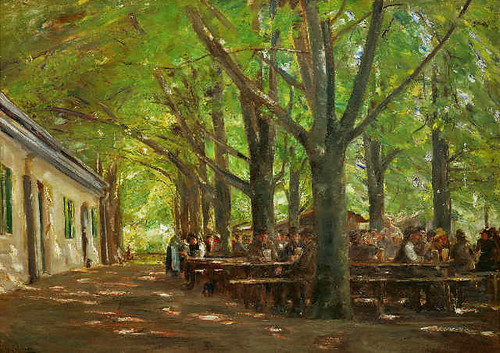
Liebermann-beer-garden-in-brannenburg

Though it’s referred to by the title “Beer Garden in Brannenburg” or “Biergarten in Brannenburg,” according to the Paris museum, the actual title is “Brasserie de campagne à Brannenburg” or “Country Pub in Brannenburg.” Here’s a description of the painting from Musee d’Orsey.

During his visit to Italy in the spring of 1893, Liebermann stopped in Bavaria, very near to Brannenburg. There he found the tables of a pub set out in the shade of some tall trees, the subject of a number of his paintings. That same year, the young painter Erich Hancke, met Liebermann and discovered the still unfinished Country Pub in Brannenburg as well as the preparatory works for the painting, in particular a sketch in black chalk. Having decided to paint this motif, Liebermann “drew it again, in a larger format and in much more detail In its turn this drawing was transposed on to canvas using a grid”. Astonished that such an unspontaneous method should have been used, so at odds with the look of the painting, Hancke was even more surprised when hearing the painter talk about the small figures in it: “First the shape must be there, he said, and then it has to be taken away”.

In general, it is the space, punctuated by the rows of trees with sunlight filtering through, which is the constant subject in Liebermann’s work. However, when this painting was done, this motif was never used in a pure landscape, but accompanied, like here, by a scene bristling with anecdotal details and movements. This characteristic places Liebermann’s work in the same area as Menzel (1815-1905), who has a similar acute sense of observation and an ability to reproduce scenes of everyday life.

There’s a biography of Max Lieberman at his Art Directory. You can also see more of Liebermann’s paintings at the WikiGallery, Zeno and also the Canvaz. There are also additional links at the ArtCyclopedia.

Filed Under: Art & Beer, Beers Tagged With: Germany

Beer In Ads #247: Bergschloss Bock

November 20, 2010 By Jay Brooks

ad-billboard
Friday’s ad is from around 1910 for a Germany brewery, Bergschloss. It’s for their Berschloss Bock and was painted by an artist by the name of Riemery.

Bergschloss-bock

Filed Under: Art & Beer, Beers Tagged With: Advertising, Germany, History

Beer In Ads #204: Pilse Etzer

September 28, 2010 By Jay Brooks

ad-billboard
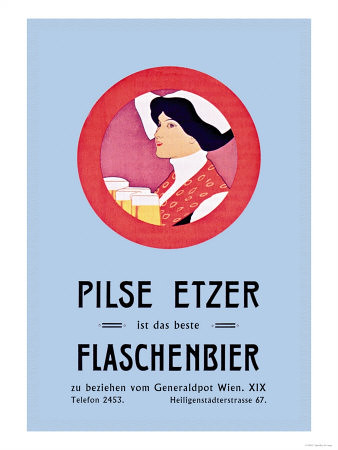
Tuesday’s ad is for a German brewery — I think — Pilse Etzer, so it says, is the best bottled beer. The woman in the red circle, however, looks like Dutch.

f-sperl-pilznetzer-is-das-beste-flaschenbier

Filed Under: Art & Beer, Beers Tagged With: Advertising, Germany, History

Beer In Ads #193: Biere Adelshoffen

September 13, 2010 By Jay Brooks

ad-billboard
Monday’s ad is unusual insofar as its for a beer brewed in a village that no longer exists. Adelshoffen used to be in the Lower Rhine region of Germany. The most famous beer they made was Adelscott, which was launched in 1982. Heineken acquired the brewery through Fischer in 1996 and closed the brewery in 2000.

biere-adelshoffen

Filed Under: Art & Beer, Beers Tagged With: Advertising, Germany, History

Beer In Ads #177: Ludwig Hohlwein’s Spaten

August 20, 2010 By Jay Brooks

ad-billboard
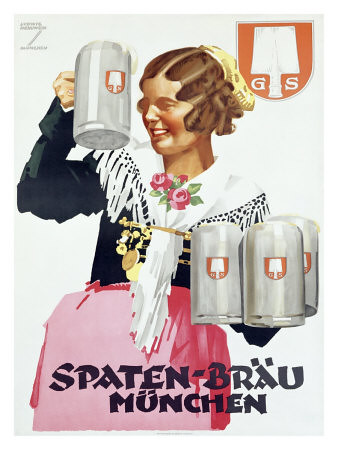
Friday’s ad is for the German brewery Spaten from either 1924 of 1933 (accounts differ). It’s by the famous German poster artist Ludwig Hohlwein. I love the stylized server and just the timeless quality of the art.

ludwig-hohlwein-spaten-brau

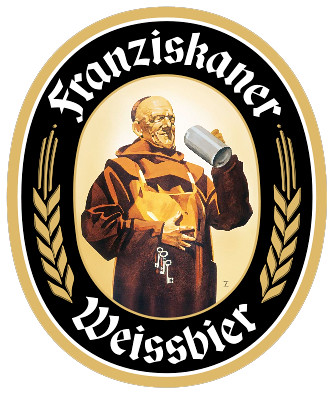
As far as beer is concerned, Hohlwein is probably best know for creating the artwork of the monk used in the label for Franziskaner Weissbier.

franziskaner-weissbier

Filed Under: Art & Beer, Beers Tagged With: Advertising, Germany, History

Session #42: A Special Place, A Special Beer

August 6, 2010 By Jay Brooks

location
Our 42nd Session is hosted by Derrick Peterman, from Ramblings of a Beer Runner. He’s chosen “A Special Place, A Special Beer” as his topic, which Derrick describes geographically, as follows:

The Session provides a unique opportunity to explore this connection between the beer in our glasses and the place it comes from with perspectives from all over the world.

So I ask for this 42nd Session that you write about a special place in your life, and a beer or brewery that connects you to that place. It can be the beer from your childhood home, a place you once lived, your current hometown, a memorable vacation you once took, or a place you’ve always wanted to go to but never had the chance. Please take a few moments to think about the how the beer connects you to this place, and share this with us. Of course, the definition of “place” is rather open ended, and in some cases, highly debatable, so it will be interesting to see the responses on what constitutes a place.

session_logo_all_text_200

This was actually a simpler question than I expected, once I stopped to think about it. For me, I believe the most special place to have a beer, any beer, is at the source. The place where it was created — the brewery — I always find is my favorite place to try their beer, especially for the first time. Plus, in certain places the brewery has beers available that can’t be found anywhere else.

A number of years ago, for example, I visited the Radeberger Brauerei just outside Dresden, Germany. Their pilsner is one of the best in the world, at least in my opinion. But even better is the unfiltered zwickel version that they have only at the brewery. To be fair, they also used to sell it at one bar in downtown Dresden but last I heard a flood had closed it.

I love drinking beer at home, at the bar, at the restaurant — okay, anywhere — but not quite as much as in the brewery itself. That’s hallowed ground, in a sense. I’m not really a “ticker,” so I have no idea how many breweries I’ve visited over the years but it’s certainly a fair number. And they’re almost always where I’ve had the most memorable experiences. I don’t know if it’s the setting — I do love the feeling of being in a brewery — or being with the brewer, or some other intangible, but I inevitably get the sense that that’s the beer’s home. And things just always taste better when they’re home.

Filed Under: Breweries, The Session Tagged With: Germany

Beer In Ads #134: Gusset’s Summer Beer

June 21, 2010 By Jay Brooks

ad-billboard
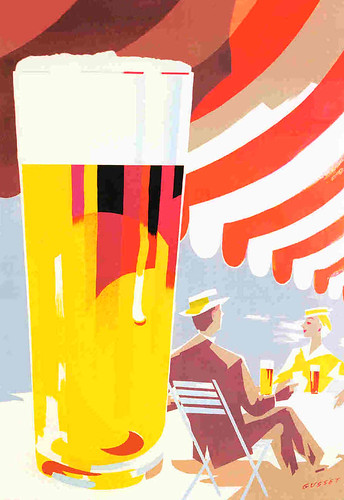
Monday’s ad is for an unknown beer, created by Paul Gusset in 1956. Since today is the summer solstice, the poster reminded me of summer itself. Happy summer.

gusset-summer-beer

Filed Under: Art & Beer, Beers Tagged With: Advertising, Germany, History

Beer In Ads #129: Lowenbrau Try The Dark

June 14, 2010 By Jay Brooks

ad-billboard
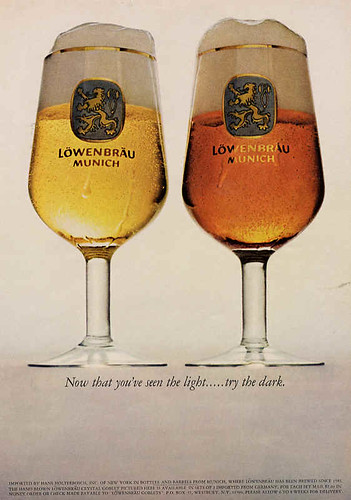
Monday’s ad is for Lowenbrau, a Munich brewery. Today is the day Munich was founded in 1158. It could be from the 1960s or 70s, but my money’s on the Seventies. Showing both kinds — country and western, alright light and dark — the ad features the tagline. “Now that you’ve seen the light …. try the dark.” But really, they’re actually trying to sell the glasses.

lowenbrau-dk

Filed Under: Art & Beer, Beers Tagged With: Advertising, Germany, History, Munich

« Previous Page
Next Page »

Find Something

Northern California Breweries

Please consider purchasing my latest book, California Breweries North, available from Amazon, or ask for it at your local bookstore.

Recent Comments

  • Bob Paolino on Beer Birthday: Grant Johnston
  • Gambrinus on Historic Beer Birthday: A.J. Houghton
  • Ernie Dewing on Historic Beer Birthday: Charles William Bergner 
  • Steve 'Pudgy' De Rose on Historic Beer Birthday: Jacob Schmidt
  • Jay Brooks on Beer Birthday: Bill Owens

Recent Posts

  • Beer Birthday: Mark Edelson March 11, 2026
  • Beer In Ads #5156: It’s Springtime! It’s Party Time! It’s Genesee Bock Beer Time March 10, 2026
  • Beer In Ads #5155: … A Real Bock Beer! March 10, 2026
  • Beer In Ads #5154: Mr. Boh’s Bock Is Here! March 9, 2026
  • Historic Beer Birthday: William Cobbett March 9, 2026

BBB Archives

Feedback

Head Quarter
This site is hosted and maintained by H25Q.dev. Any questions or comments for the webmaster can be directed here.