Brookston Beer Bulletin

Jay R. Brooks on Beer

  • Home
  • About
  • Editorial
  • Birthdays
  • Art & Beer

Socialize

  • Dribbble
  • Email
  • Facebook
  • Flickr
  • GitHub
  • Instagram
  • LinkedIn
  • Pinterest
  • RSS
  • Twitter
  • YouTube

Powered by Genesis

Beer in Fiji

December 13, 2006 By Jay Brooks

fiji
Currently only Foster’s brews on the island of Fiji, but that’s about to change as Flour Mills of Fiji Limited (FMF) has announced it will be entering the beer market. Rumor has it that FMF is in talks with India’s United Breweries, which owns the Kingfisher brand. I mention that because FMF recently applied to register the following brand names: Ahista, FB or Fiji Beer, Iguana, Kingfisher, Kings Beer, Polar, BB or Bobs Beer and Thums Up.

fiji

I’m up for visiting this one. Who’s with me?

Filed Under: News Tagged With: Business, International

Anheuser-Busch to Import Corona in China

December 5, 2006 By Jay Brooks

Grupo Modelo, the makers of Corona, will be partnering with Anheuser-Busch (who owns 50% of non-voting stock in Modelo) in China. As of next month, January 2007, A-B will import Grupo Modelo beers throughout China.

Modelo also distributes Anheuser-Busch beers in Mexico and beginning shortly, will also bring Tsingtao to Mexico. Not surprisingly, A-B also owns a piece the Chinese brewer, too.

From the press release:

“This new partnership ideally complements the international strategy that Modelo has successfully implemented for several decades. We are very pleased with this association, which offers excellent long-term growth opportunities for Grupo Modelo’s brand portfolio in China, a very important market for our company,” stated Carlos Fernandez, chairman of the board of directors and chief executive officer of Grupo Modelo.

“The popularity and high quality of Corona Extra makes it an excellent complement to our Budweiser and Harbin beers,” said August A. Busch IV, president and CEO of Anheuser-Busch Cos. Inc. “Corona Extra competes in the super-premium segment of the market, which is experiencing strong growth. With our continued success in this segment, and our 10 years of sales, marketing and distribution experience, we expect to significantly increase the sales of Corona.”

Filed Under: News Tagged With: Asia, Business, International, Press Release

Canadian Brewery to Donate Beer to Compatriots in Afghanistan

December 2, 2006 By Jay Brooks

The Steam Whistle Brewery, of Toronto, Canada, has announced its employees have decided to send a week’s worth of their beer rations, an employee benefit, to Candian soldiers stationed in Afghanistan. The company has stated that they’ll match the employee donations. According to the The Canadian Press, “troops are allowed to have liquor on the base three times during the year, including Christmas,” even though as a Muslim nation beer is hard to come by.
 

Canadian troops will receive limited edition Steam Whistle pilsner holiday twelve-packs like the one pictured here.

Filed Under: Just For Fun, News Tagged With: Canada, International

The Santa Hypocrisy

December 2, 2006 By Jay Brooks

shelton-brothers
Anybody want to venture a guess where our modern image of Santa Claus comes from? It’s not the church. It’s not from literature. It’s not from the art world. The image of Santa Claus that generally springs to mind was created by illustrator Haddon Sundblom in 1931 for the Coca-Cola company.

santa-coke
Haddon Sundblom’s illustration of Santa Claus for his client, Coca-Cola, painted in the 1930s.

Santa Claus’ origins as we know him today in the U.S. stem from a variety of sources, both pagan and religious. While some urban legends and apparently serious accounts claim that Coca-Cola created Santa, Snopes has debunked that and I want to be clear that that’s not what I’m suggesting, either. Our Santa evolved over time, though most accounts of his modern personage start with Clement C. Moore’s 1822 poem “An Account of a Visit from St. Nicholas” although most people know it by the first line, “Twas the night before Christmas.” Moore fixed the number of reindeer at eight and came up with the names we know today (minus Rudolph, who was added much later in 1938). And like many facets of our melting pot amalgamated society, we freely borrowed from different cultures and Santa continued to evolve as Christmas became increasingly secularized and commercial. Of course, our version of Christmas, including Santa Claus, is now exported around the world.

So look at Sundblom’s image. That is what most of us think of if pressed to picture Santa Claus in our mind. If you look at drawings and paintings of Santa Claus, Saint Nicholas, Kris Kringle and Father Christmas before that time and in other cultures, you’ll see flowing robes of blue, green and other colors. You’ll see a variety of beards or even no beard. You’ll see different headdresses, staff’s, and other symbolic implements and accessories. My point is that the American version of Santa Claus is our creation and has its roots in crass commercialism, which began at least seventy-five years ago.

Today Santa Claus is used to sell everything under the sun from cigarettes to soda pop. Why bring this up? What does it have to do with beer? I mention this because once again several states will not approve beer labels that depict Santa Claus on them. These states — this year so far it’s New York and Maine — claim that showing Santa Claus on the label “might appeal to underage drinkers,” “the Christmas themes … would appeal to children,” and are “undignified and improper.” That last one, from Maine, is one of fourteen mostly ridiculous standards such as “Advertisements of liquor shall not contain any undignified or improper illustration.”

Setting aside the label itself for the moment, let’s just talk about the hypocrisy in these state’s assertions, that it might somehow make underage kids want to drink beer. First of all, what age group believes in Santa Claus? I know it varies, but let’s assume that it’s under ten, which seems to be pretty common. At that age, when Santa is something a child is drawn to, how many have an interest in beer? I’d say next to none. And if you’ve done your job as a parent, your kids would know the difference between an adult drink and one they’re allowed to have. Alcoholic beverages, when they’re even allowed to be sold where children are — like the more enlightened states that allow them to be sold in grocery stores and other general retail outlets — are still segregated together and kept separate from soda, juice and milk. So unless you choose to take your kid down the beer aisle, then I’d say the average kid will be protected from accidentally seeing a beer label with Santa on it. As for older kids, let’s say an underaged kid is interested in buying a beer with Santa on the label. I’m pretty sure it would still be illegal for him to do so. It doesn’t become legal if the label is cute, does it? Did I miss another meeting? Children aren’t permitted to buy whatever appeals to them, are they? So why the hell are these states wasting their time on such utter non-issues? Beer is intended for adults and it’s labels should reflect that. Period. The fact that a minor might accidentally see the label does not and should not matter one whit. The state has no business trying to turn the world into such a kid-friendly place that no adult only things are permitted to be seen by those of us who are, in fact, adults. We should not all be forced to live like ten-year olds in order to “protect” our children. Not only is it impossible, but it’s not even desirable. Overly protected children grow up to be adults with no idea how to deal with controversy, differences of opinion or offense. We already see the effects of this as every subgroup of humanity cries foul whenever their point of view is not completely tolerated. The amount of insult that has led to fatal retaliation is staggering in the world. We need to live with our differences, not try to erase them or pretend they don’t exist.

And why every time a controversy of this kind surfaces, do the authorities conclude — with no evidence whatsoever — that cartoons are exclusively for children. The first newspaper cartoons were for adults and comic strips remained adult-themed for many years. The first animated cartoons were all made for adults. Back before television assumed its place of prominence as the altar of the living room, people went to the cinema far more often than today. And before the film began, they were treated to a newsreel and a cartoon. All of the early cartoons by Disney, Warner Brothers, MGM and the underrated Flesicher Studios were made for adults. Many adults still love cartoons today. I know that’s true because I’m one of them. In America, as usual, the 1950s saw fringe groups censor the violence and adult themes out of comic books with the creation of the “Comics Code” which made comic books suitable only for children until the 1980s, when companies started ignoring the Code and producing works for adults again. In Japan and France, and undoubtedly many other countries, comics for adults in the form of magazines, graphic novels and manga are a very popular medium for adults. In France, for example, the number one magazine is Metal Hurlant (Heavy Metal), which contains ongoing graphic stories for adults. In the U.S., the best-selling magazine is TV Guide. Some of the most popular Japanese films for adults today are animated, films like Akira. Adults there know the best directors and illustrators of anime the way we know football players. The point is that it’s absurd for our government agencies to assume that if it’s a cartoon image that it will automatically appeal to children more than adults, or that kids are the target. Adults love cartoons, too, and we should be allowed to see ones created specifically for us without fear that a child might see it, too.

But I also want to make one more bold assertion about this controversy. All things being equal, and if there were no minimum age to drink alcohol, it would probably be better for kids to drink a beer versus a soda. I know that’s not going to be a popular suggestion, but the fact is beer is healthier than the average soda, which is loaded with caffeine, sugar and all manner of chemicals. Take a look at the label. It reads like a chemistry experiment. I once read that there is so much sugar in a 12 oz. serving of cola that after drinking one, your body will crave additional liquids to dilute all of the sugar you just swallowed in the soda. This leads to you drinking even more soda — a great boon to the companies selling this swill — but a tragic health epidemic for the rest of us. And many schools now accept money from the major soft drink companies to put soda machines right there in school. That’s doing far more harm to our kids than beer is. So why aren’t Maine and New York (and the rest of the states) up in arms over Santa Claus being so closely associated with Coca-Cola or being used to sell cigarettes the way they are with beer? Simple, it’s not really about any concern over the kids. It’s about neo-prohibitionist agendas and the desire to keep alcohol away from everyone, using children as the excuse. [NOTE: I want to be clear that I’m not advocating that we should give beer to kids, just that in terms of protecting them from harm beer is probably less harmful than soda. It’s just an argument. Please, no more misunderstanding e-mails calling me the devil.]

But let’s get back to the labels.

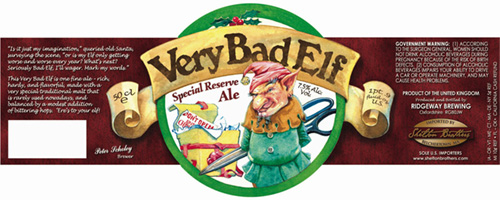
All of the labels in question are imported by Shelton Brothers of Massachusetts. I’ve known Dan Shelton since he first called on me when I was the beer buyer at BevMo around ten years ago. He and two brothers, Will and Joel, import some of the best beers in the world. Just ask them, they’ll tell you. Dan has a much-deserved reputation for speaking his mind. He believes in the beers he sells probably more passionately than any other person I know. Shelton is now suing both states, New York and Maine, over this ridiculous label issue. So I’m certainly glad to see him fighting for his beers.

very-bad-elf

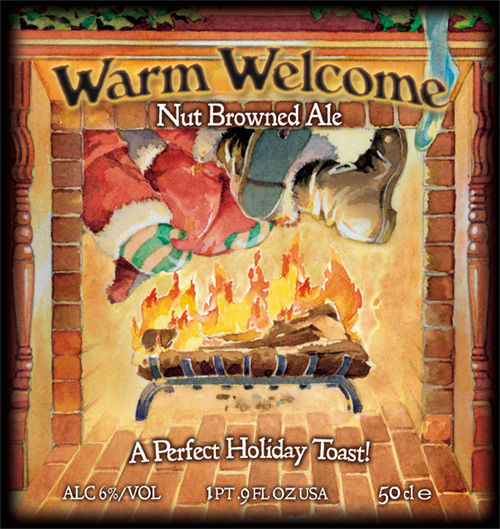
He’s had to fight this fight before, so he at least knows what he’s up against. He’s had similar difficulties with Missouri, New York, North Carolina and Ohio. Last year, the state of Connecticut initially wouldn’t approve the label for Seriously Bad Elf, but then backed off. This year, New York state is saying no to Bad Elf, Very Bad Elf, Criminally Bad Elf (a barleywine), Warm Welcome Nut Brown Ale, Santa’s Butt Winter Porter and Rudolph’s Revenge. The first five are all from a single brewery, Ridgeway Brewery in Oxfordshire, England, and the last is from Cropton Brewery in Yorkshire. Shelton Brothers have filed suit seeking a reversal of the State Liquor Authority’s decision along with damages and legal fees.

warm-welcome

Albany’s Times Union has an overview of the conflict in New York. And Stan at the Real Beer Blog has also weighed in, as has Joe Sixpack. Don Russell’s piece also has an excellent list of other Christmas-themed beers divided into those also depicting Santa Claus, local ones (he’s in Philadelphia), and some of his other favorites from around the country.

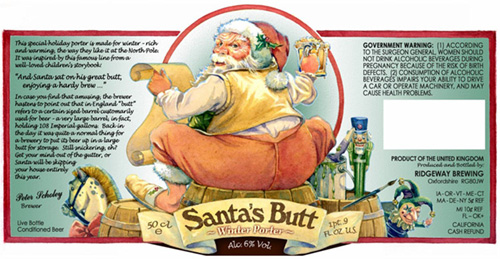
santas-butt

But for some reason (no pun intended) the one causing the most trouble is Santa’s Butt to the state officials apparently unaware that a “butt” is a brewing term for a measure of beer. A butt is the equivalent of 2 hogsheads, or 108 imperial gallons (129.7 U.S. gallons). Both New York and Maine are objecting to this label. In Maine, the local Civil Liberties Union has also taken up the fight saying “the beer labels are entitled to First Amendment protection.” According to an AP article, “[t]here is no good reason for the state to censor art, even art found on a beer label,” said Zachary Heiden, staff attorney for the MCLU.

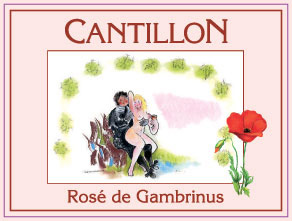
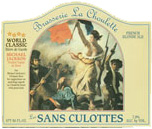
You might at this point be thinking, art? Yes, art, because in addition to Santa’s Butt, the State of Maine is also objecting to two other labels for non-Christmas beers, Cantillon Rose de Gambrinus and Brasserie Les Choulette’s Les Sans Culottes because, according to the state, “they show bare-breasted women.” Gasp!

cantillon-rose
Cantillon webpage for Rose de Gambrinus

The Cantillon label is from a painting by famous Belgian artist Raymond Coumans, who is a friend of Cantillon’s owners and created it specifically for the label. The subject is the legendary King of Flanders, who was a patron of beer and brewing. For a long while, here in California to be sold legally, the naked woman on the king’s lap had to wear a blue dress printed over her body. I cringe every time I think what prudes we are as a nation and how ridiculous we must seem to the rest of the civilized world.

The Associated Press has an overview of the Maine conflict, as does the more local Bangor Daily News.

la-choulette-sans

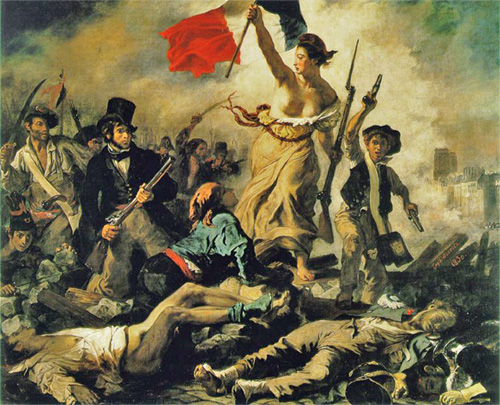
The other beer, Les Sans Culottes from the French brewery, Brasserie Les Choulette, is a Biere de Garde style beer. The label is a detail from the iconic Eugene Delacroix painting Liberty Leading the People that hangs in the Louvre. That the people of Maine might be offended by this image is, in and of itself, offensive to reason and common sense. That they feel their citizens need to be protected from seeing this image on a bottle of beer is ludicrous in the extreme.

This whole episode points out yet another oddity in our nation’s alcohol laws. Most states have this extra layer of the approval process that often denies basic First Amendment rights because the states claim some higher purpose, simply because it’s alcohol. Some of the reasons for the process make a modicum of sense, say, for example, so that labels are not misleading. But to bring in such subjective standards as decency, offensiveness or inappropriateness should never be a part of the procedure. And to pretend to be protecting “the children” is the flimsiest of reasons of all for a product already reserved for only adults. If the rationale is that by using an image that appeals to a child it will create a situation where nothing can stop a minor from obtaining the beer, then fine.

But there are already numerous — I would frankly say too many — impediments to insure alcohol can be obtained only by those adults entitled to buy it. Endless education and programs are created by retailers, distributors and the manufacturers to ensure it never happens, and the penalties imposed to a business when it does are often quite substantially punitive (certainly out of perspective with the actual harm done) so that no business wants to risk selling to a minor. Yet to people in organizations like MADD and other neo-prohibitionists that is still not considered to be enough. Not if there’s even one chance that a teenager might lay his hands on a bottle of beer. That is apparently worse than nuclear war in these people’s minds. I drank alcohol as a teenager, years before it was legal for me to do so. Am I an alcoholic today, a burden on society? Did I ruin my life? No. I am so f*&#ing sick of not being able to buy a beer or it being unreasonably inconvenient to do so just because we’re trying to keep it out of the hands of our kids. Why doesn’t the rest of the world have this problem, or at least doesn’t have it to this degree? Because the rest of the world isn’t quite as preoccupied with controlling the lives of everyone around them, foisting their own set of values on everybody else. Geez, this is pissing me off. Hey Dan, I think it’s time to open up some Christmas beers just so I can relax. Where’s my Santa suit.

delacroix-liberty

Eugene Delacroix’s famous painting Liberty Leading the People, which is apparently inappropriate for the people in the state of Maine to see.

Filed Under: Editorial, News Tagged With: History, International, Law

Grupo Modelo to Build New Brewery on the Rio Grande

November 30, 2006 By Jay Brooks

According to today’s International Herald Tribune, Grupo Modelo, the Mexican brewer responsible for the abomination that is Corona, announced plans to build a new brewery by 2010. The new brewery will be built in Piedras Negras, a city located near the border of Texas, just across the Rio Grande River, in the Mexican state of Coahuila. The new brewery will be built to meet a growing demand for its flagship beer, Corona, and will add approximately 260 million gallons of capacity for the company.

Filed Under: News Tagged With: Business, International

(Not) The Top 10 Cities for Beer Lovers

November 10, 2006 By Jay Brooks

travel
I somewhat optimistically assume the slight that beer receives at the hands of our intrepid mainstream media will never get as bad as the last example of it, and yet more often than not I am proved wrong. Take MSNBC’s list today of their choices for the world’s Top 10 cities for beer lovers. Or rather the advertisement pretending to be news, because MSNBC’s list has no discernible author but instead appears to have been compiled and written by Sherman’s Travel, making it more like an infomercial than actual news, though it’s shamelessly made to look exactly the same as any real news item. But maybe it’s a good thing it’s not real news, because as news it’s laughably bad. As travel suggestions, at least it makes a little more sense since the goal is not to educate but to sell vacations. As a consequence accuracy or even logic is not only unnecessary but might get in the way of their ultimate goal. It’s a little sad that MSNBC, which at least is masquerading as a real news outlet, would “partner” with a travel agency to essentially hoodwink their readers into believing an author who knows what they’re talking about is sharing the inside track on beer destinations. But unfortunately the blurring between commerce and the media is all but complete.

Here’s the list Sherman’s Travel offers up as the best ten places worldwide for people who love beer:

  1. Amsterdam
  2. Berlin
  3. Brugge
  4. Burlington (Vermont)
  5. Dublin
  6. Mexico City
  7. Montreal
  8. Portland (Oregon)
  9. Prague
  10. Sapporo

Notice anything funny about that list. It’s not immediately apparent on MSNBC, but when you see them as a straight list then it’s obvious the list isn’t even trying to put them in any kind of order, because they’re alphabetical. There’s already been a lively debate about the order of the choices but I think we can dispense with any further discussions about rankings since there really aren’t any. Viewed in that light, it becomes obvious they were more concerned about a list that was spread out across the globe, the better to sell travel packages, the bread and butter of travel agencies.

But let’s look at their choices and the reasons they give for them.

1. Amsterdam: After listing the best known Dutch beers as “Heineken, Grolsch, and Amstel” (hardly the reason to visit Amsterdam, not that there aren’t good reasons to go) they suggest trying instead “artisanal blends [huh?] and witte (wheat) beers from neighboring Belgium.” Um, wouldn’t it make more sense to go to Belgium and drink there? I’m not planning a trip to France so I can sample the Napa Valley wines.

2. Berlin: Since this is the only German city on the list, apart from mentioning Munich in the introduction, it seems reasonable to assume they think it’s the best city for beer in Germany. There are places all throughout Germany, of course, rich with brewing heritage and Munich alone is a better choice than Berlin, as is almost anywhere in Bavaria.

3. Brugge: While it’s good that there is a Belgian city on the list, sadly there is no beer brewed today in Brugge so it seems an odd choice. Perhaps they have a good airport.

4. Burlington: This one is a bit of a head-scratcher. While I think Magic Hat Brewing does indeed make some very fine beers, and I’ve enjoyed my trips to Vermont immensely, I cannot fathom by what possible criteria this small college town has a better beer scene than San Francisco, Seattle, New York, Philadelphia or any number of other American cities.

5. Dublin: While there is indeed history aplenty in Dublin, it’s all pretty one-dimensionally Guinness, apart from the few recent craft brewers in town. There are lot of great pubs here, but diversity is not this city’s hallmark. And given what Diageo has done to Guinness’ reputation and the beer itself, it’s pretty hard to justify Dublin as one of the ten best, beer-wise.

6. Mexico City: Ha, ha, ha , ha. Mexico City as a beer town. Stop, you’re making my sides split. The article suggests trying “Corona, the signature Mexican brew” could be the height of your trip. Now why anyone even drinks the stuff is beyond me, but that aside why on Earth would you go to Mexico to get one, when every 7-11 and corner liquor store has stacks of it? Well Sherman’s Travel suggests you can try the Dos Equis or the Bohemia, also ubiquitous north of the border. Ridiculous.

7. Montreal: Okay, I’ll buy this one. I’m not sure it quite makes my personal top ten list, but it would be close and given how bad some of the other choices are, this has obvious merits.

8. Portland: No question Portland should be on the list, and probably near the top.

9. Prague: Okay, I’ve got nothing against Prague but here’s how the articles sells it. After giving the dubious reason that it’s inexpensive it’s “also home to the original (and many would say better) Budweiser.” Um, Prague is the home of Budvar? Did I miss a meeting? Did the town of České Budějovice merge with Prague? Given that it’s at least 40 miles south as the crow flies, I’d say that’s a bit of a stretch.

10. Sapporo: The reason they chose this Japanese town is because you can “purchase [beer] from vending machines on the street.” Now that’s a reason to spend fourteen hours on an airplane, so I can buy a can of beer from a vending machine. No thanks.

What a joke this list is, and as much for what they left off as what they chose. There’s not one British city, not even London, where ale is king. How is that possible? And several (Berlin, Burlington, Mexico City and Sapporo) have absolutely no business being on this list. MSNBC should be embarrassed to lend their name on something this grotesque. I’d be curious how much it costs to pretend your advertisement is news.

Filed Under: Editorial, News Tagged With: International, Mainstream Coverage

Craft Beer at Salone del Gusto

November 1, 2006 By Jay Brooks

If you’re not familiar with the Slow Food organization or its American counterpart, Slow Food USA, you should be. The idea started in Italy but has spread around the world. Essentially, they celebrate food in its more traditional guise, using natural and local ingredients, taking time to both prepare and enjoy the meal, paired with the finest beverages, whether it’s beer, wine or something else that compliments the meal perfectly. Their three guiding principles are good, clean and fair.

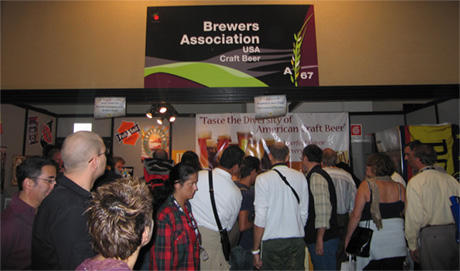
It’s also a perfect fit for the craft beer industry and the Brewers Association has been sending a team of representatives armed with some of our best beers to the Salone del Gusto in Torino (a.k.a. Turin), Italy for the last four times the event has been held, which is every two years. This year’s event was the sixth biennial festival and celebrates all manner of great food and drink from around the world. The five-day event includes opportunities to taste hundreds of flavors, taste workshops, full dinner experiences, lectures, education along with much more.

In addition, another event was taking place the same week nearby, called Terra Madre, that is a world meetup of people and organizations that produce good, clean and fair food with an emphasis on sustainable farming and food. The city of Santa Rosa selected Vinne and Natalie Cilurzo from Russian River Brewing to be their representatives at Terra Madre. The whole experience sounds fantastic and hopefully I’ll be able to attend one of these years. The pictures below are courtesy of Shaun O’Sullivan from 21st Amendment Brewery. Thanks Shaun.

The Brewers Association booth at Salone del Gusto in Torino, Italy

Eric Wallace from Left Hand Brewing works the booth. It was very popular with the Italians, Expats, students and visitors from the U.S. You could get a taster of three beers for 3 Euros. Half the proceeds from the booth were donated to the Slow Food Movement. You could also purchase beer which was very popular with the Americans living abroad.

Shaun O’Sullivan from 21st Amendment in San Francisco, California poses with Charlie Papazian and a fuzzy Nancy Johnson of the Brewers Association.

Lorenzo Dabove, the “Michael Jackson” of Italy, along with Cantillon owners Claude and Jean-Pierre Van Roy.

Filed Under: Events, Food & Beer Tagged With: Europe, Festivals, International, Photo Gallery

Beer Goes Wireless

October 30, 2006 By Jay Brooks

Heineken and IBM, along with a few other companies, have partnered together to test wireless tracking of beer shipments. Dubbed “The Living Beer Lab,” the scheme will allow Heineken to know the exact location of any shipment of its beer, even in the middle of the ocean, using “triangulation techniques of both satellites and cellular base stations to locate exactly where the cargo is.”

The first test is currently underway, with ten containers of Heineken in the water and in transit from both the Netherlands and Great Britain en route to the United States.

According to ZDNet UK, “Integration has been completed with IBM WebSphere service oriented architecture (SOA) to maintain a paperless trail of the beer’s journey from customs in Europe through US customers and into the distribution centre on the other side of the Atlantic. The process will eliminate the need to fill in up to 30 documents on each journey, and could vastly decrease the amount of time the beer spends in transit.”

Here’s a more thorough explanation of how it all works, complete with impenetrable business jargon from The Retail Bulletin:

IBM’s Secure Trade Lane solution will provide real-time visibility and interoperability through an advanced wireless sensor platform and Services Oriented Architecture (SOA), based on IBM’s WebSphere platform. The project’s SOA, called the Shipment Information Services, leverages the EPCglobal network and EPCIS (Electronic Product Code Information Services) standards, so rather than build and maintain a large central database with huge amounts of information, distributed data sources are linked, allowing data to be shared in real time between Heineken, Safmarine and customs authorities in the Netherlands, England and The United States.

In this project, Safmarine will ship ten containers of Heineken beer from locations in both Netherlands and England, through their Customs Authorities, to the Heineken distribution center in United States. Vrije Universiteit Amsterdam will coordinate the project and provide best practices documentation to share across the European Union.

“The Beer Living Lab is setting a roadmap for the next generation e-Customs solutions. We test innovative solutions, based on IBM’s Tamper Resistant Embedded Controller (TREC) and SOA developed by IBM that could revolutionize customs,” said Dr. Yao-Hua Tan, professor of Electronic Business, Vrije Universiteit Amsterdam. “Companies using these solutions could benefit greatly due to less physical inspections by customs; thus these e-customs solutions greatly facilitate international trade.”

According to the Organisation for Economic Co-operation and Development, more than 30 different documents are associated with one single container crossing a border, which equals roughly five billion documents annually. The findings of the project will provide a viable alternative to manufacturers, shippers, retailers and customs administrations as they look to move to a paperless trade environment. Once accepted and implemented widely, paperless trade will support initiatives such as Green Lane, which will eliminate most inspections on arrival, thus significantly speeding up ocean fright shipments and improving the profit margins for shippers.

“Because efficient collaboration is a paramount requirement to making this work, IBM built the Shipment Information Services to address interoperability. If governments around the world are serious about electronic customs and paperless trade, they need to encourage each country to adopt open standards environments to enable collaboration and data sharing throughout the trade lane,” said Stefan Reidy, Manager, Secure Trade Lane, IBM. “The Beer Living Lab project is the first step in building the Intranet of Trade, which will help to substantially improve efficiency and security in the global supply chain.”

Now if only they’d stop using those green bottles that result in Heineken being such a skunked beer most of the time.

Filed Under: News Tagged With: Business, Europe, International, Strange But True

How Craft Beer Can Save the World

October 25, 2006 By Jay Brooks

The world’s cup runneth over with living beer traditions. But this vast repository of cultural brewing capital is under attack by global corporations. The top five brewing companies, all of which are American- or European-owned, control 41% of the world market. Perversely, economists and politicians calculate the conquest by industrial breweries as economic growth while the value of small-scale traditional brewing goes uncounted. Much will be lost if this global “beerodiversity” is lost to the forces of corporate-led homogenization.

So begins a very interesting essay at Foreign Policy in Focus (FPIF), a think tank, which, according to it’s website, “brings together scholars, advocates, and activists who strive to make the United States a more responsible global partner.” The essay, The Perils of Globeerization, is by Chris O’Brien, who first contacted me a few months ago to tell about his beer activism at his cleverly titled Fermenting Revolution website. The essay is heavy on foreign policy, big business, history and local traditions of alcohol. It may seem somewhat radical to the more conservative, but it certainly agrees with my own view of how the world works. His take on the history and economics of brewing, and especially how the dominant breweries are effecting brewing traditions across the globe is fascinating. And perhaps most importantly, there are obvious parallels to the craft beer industry in America, as well.

O’Brien also has just published a new book, Fermenting Revolution, too, which is available from the publisher, New Society Publishers, or from Amazon. The subject matter seems pretty interesting, I’m looking forward to reading and reviewing it.


Filed Under: Editorial Tagged With: Business, History, International, Websites

Carlsberg to Import Faux Micros

October 20, 2006 By Jay Brooks

Denmark’s Carlsberg Brewery was founded in 1847 by J. C. Jacobsen. It’s the largest brewery in Denmark by a wide margin, with something like 75% of the market, and is the fifth largest brewer worldwide. Carlsberg beers are sold in over 50 countries. In addition to the flagship Carlsberg brand, they also make Elephant, Tuborg and many others. That makes them the Budweiser of Denmark, in terms of size, market share and dominating business practices.

But craft breweries are slowly gaining a toehold throughout the Denmark with over 40 of them currently in operaion plus around 17 brewpubs sharing 2% of the total market. So last year in response, Carlsberg set up the Jacobsen Brewhouse as a separate entity within the main brewery in Valby. As reported earlier this year, by 2008 Carlsberg will be moving all of its production to its Frederica facility, which now mainly brews Tuborg and a few others, and will close the Valby plant. But the Jacobsen line along with the administrative offices will remain in Valby. The new venture is “located in a building dating from 1878 in the old part of the Carlsberg brewery” and part of the Carlsberg Visitors Centre. Undoubtedly this was done to create positive PR for the brewing giant.

So like Pacific Ridge, Plank Road and Blue Moon before them, Carlsberg is making “specialty beers” under the brand name Jacobsen Brewhouse. To their credit, they make no secret of this fact and proudly display the Carlsberg logo alongside the newer Jacobsen one. The unique shape of the bottle is based on the old lighthouse building at the entrance to the old brewery and no expense appears to have been spared on packaging and marketing, which is one of the dangers of these type of beers, in my opinion. Currently four styles are being made: Bramley Wit, Brown Ale, Saaz Blonde and Original Dark Lager. And so far three seasonals have been made under the name “Jacobsen Limited Edition” with more to follow. The initial seasonals were Chocolate Mint Stout, Golden Christmas Ale and Imperial Barley Wine. And according to the website, they “will also produce four beers from Carlsberg’s successful Semper Ardens series: Criollo Stout, IPA First Gold, Abbey Ale, Winter Rye and Christmas Ale.”

Carlsberg just announced that two of the Jacobsen Brewhouse beers, Saaz Blonde and Bramley Wit, will be imported to England this year, and no doubt America may follow. I’ve never tried any of these beers, so I can’t knock their taste. They may very well be fine, well-made and tasty beers.

Here’s how Carlsberg describes these two beers on the Jacobsen Brewhouse website:

Jacobsen Bramley Wit

Jacobsen Bramley Wit is inspired by the Belgian wheat beer tradition, but with a North European touch in the form of Bramley apples for a flesh, sour flavour and Belle de Boskoop apples for a rounded finish. The Belgian wheat beers use dried orange peel, but we have preferred fresh orange peel for a less bitter impression. Jacobsen Bramley Wit has a light colour, an attractive creamy head and a muted bouquet of cloves and coriander.

Jacobsen Saaz Blonde

Jacobsen Saaz Blonde is brewed according to Belgian traditions for light, top-fermented beers. “Blonde” is the traditional French word for light-coloured beers, while the distinguished Czech malt Saaz with its character of pine needles gives a rounded, aristocratic flavour. Extract of angelica adds a juniper flavour to complement the fruity taste of the yeast. The colour derives from the Pilsner malt characteristic of the Belgian “blonde” tradition, and from a touch of caramel malt to add a slight sweetness.

But all of this brings up the larger issue of big breweries competing with smaller ones on an uneven playing field. Because not only do they try to compete by imitation but also with their larger resources, bigger marketing budgets and a host of other advantages that make the fight anything but fair.

I have no problem with the big breweries making flavorful beers instead of the same old insipid industrial light lagers that dominate the market worldwide, especially when they disclose who’s making them. I have equally no doubt that the big breweries are technically capable of making flavorful beers.

But the heart of the problem is often that the big breweries are big businesses, very big businesses. And all big businesses share a similar ethos and culture that chant the same mantras. Keep costs (ingredients, labor, etc.) low, manipulate the public through advertising and marketing, grow the business every quarter, and the main one (especially for corporations), keep the share price up no matter what.

So it begs the question why in 2005 did Carlsberg feel the need to create a “specialty line of beer” to compete with a handful of tiny breweries catering to very small segment of the market? Why after almost 150 years of making primarily the same products was this decision made now? According to the propaganda, it was “to give people new taste experiences, and we want to challenge and develop beer culture. It’s about making the most of what nature has to offer.” Uh, huh. Sure it is. But let’s assume brewmaster Jens Eiken, head of the new brewhouse (whose quote that is), really believes that — which indeed he probably does — why now? Why not ten years ago, or 50?

In Carlsberg’s the press release when they initially opened the Jacobsen Brewhouse, Nils S. Andersen, Carlsberg’s President, had the following to say:

“In keeping with Carlsberg’s traditions, this is a full and wholehearted venture. This is not some overgrown microbrewery or an exhibition centre — it’s a state-of-the-art brewery where our brewers’ ideas can be brought to fruition with consistently high standards of quality. After all, this is Carlsberg — which means that we have an obligation to maintain the highest quality even when it comes to specialty products and experiments.

“Naturally the Jacobsen brewhouse can draw on all of our expertise at Carlsberg and on the research results from our laboratories, but Jacobsen is to be its own brewery with both the freedom and a duty to create and produce the best and most exciting specialty products in the world — or at least ‘probably the best’, given that these things are always a matter of taste!”

If you’re a regular reader of the Bulletin, you no doubt already know I view large corporations with a great deal of cynicism. I question their ability to make moral or even fair and honest choices when their legal duty to the shareholders is so strikingly singular. They are bound by legal precedent to do only what is in the best interests of the company, and everything and everyone else be damned. Taken to its logical conclusion, that’s how we ended up with so many Enrons, Adelphias, WorldComs and so on. Institutionalized greed with a legal mandate creates environments that cannot tolerate any competition or any erosion of market share. And last year, many larger breweries began to see their customers abandoning their core brands for craft beer, imports (at least here in the U.S.) and even wine and spirits. So as many countries around the world begin to follow the American model and start their own microbrewery revolutions, the status quo big breweries will react in much the same way as they have here in the U.S.

That’s almost certainly the reason why a multi-national company like Carlsberg, with three-quarters of the market in their home country, would feel threatened by 2% of the beer market shifting to craft brewers. They’re incapable of perspective. It’s not permitted any more than losing even an infinitesimal portion of the market can be tolerated. All of the lofty ideals expressed in their marketing is just propaganda, which is what almost all marketing is in reality. In the early days, pioneers like Edward Bernays called it what it was, propaganda. But Hitler had been very impressed with the U.S. War Department’s Office of Public Information (which was headed by Bernays) and its amazing ability to sway public opinion for war just before and during World War One. In fact, so much so, that he adopted many of the same techniques after seizing power in Germany and as a result the term propaganda took on negative connotations and was superseded by the less tainted “Public Relations,” of which marketing is just one part. But as they say, “a rose by any other name …”

So it’s hard not to view the world’s fifth largest brewer waltzing down the same garden path as A-B, SABMiller and Molson Coors (2nd, 3rd and 6th largest, respectively) with anything but suspicion. The beer may, indeed, be good. It may use no adjuncts and be quite delicious. And, if so, I would not hesitate to drink it or support it as I might any well-made craft beer. By the real underlying reasons for making the beer, propaganda aside, are to maintain control and domination of the market and I believe these Goliaths will try to crush every one of their David-like competitors however they can. They may appear to hold out the olive branch of cooperation, tolerance and even support but look behind their back and in the other hand is very large hammer. The only uncertainty is when the hammer will fall.

The Jacobsen Brewhouse at the Carlsberg Visitors Centre in Valby, Denmark.

Filed Under: Editorial, News Tagged With: Business, Europe, International

« Previous Page
Next Page »

Find Something

Northern California Breweries

Please consider purchasing my latest book, California Breweries North, available from Amazon, or ask for it at your local bookstore.

Recent Comments

  • Ernie Dewing on Historic Beer Birthday: Charles William Bergner 
  • Steve 'Pudgy' De Rose on Historic Beer Birthday: Jacob Schmidt
  • Jay Brooks on Beer Birthday: Bill Owens
  • Steve 'Pudgy' De Rose on Beer Birthday: Charles Finkel
  • Steve 'Pudgy' De Rose on Beer Birthday: Bill Owens

Recent Posts

  • Historic Beer Birthday: A.J. Houghton February 8, 2026
  • Historic Beer Birthday: Charles Tascher February 8, 2026
  • Historic Beer Birthday: Lüder Rutenberg February 8, 2026
  • Beer In Ads #5195: It’s The Time Of Year For Pearl Bock Beer February 7, 2026
  • Beer Birthday: Tom Acitelli February 7, 2026

BBB Archives

Feedback

Head Quarter
This site is hosted and maintained by H25Q.dev. Any questions or comments for the webmaster can be directed here.