Brookston Beer Bulletin

Jay R. Brooks on Beer

  • Home
  • About
  • Editorial
  • Birthdays
  • Art & Beer

Socialize

  • Dribbble
  • Email
  • Facebook
  • Flickr
  • GitHub
  • Instagram
  • LinkedIn
  • Pinterest
  • RSS
  • Twitter
  • YouTube

Powered by Genesis

Patent No. 502835A: Porter Or Beer Tap

August 8, 2016 By Jay Brooks

patent-logo
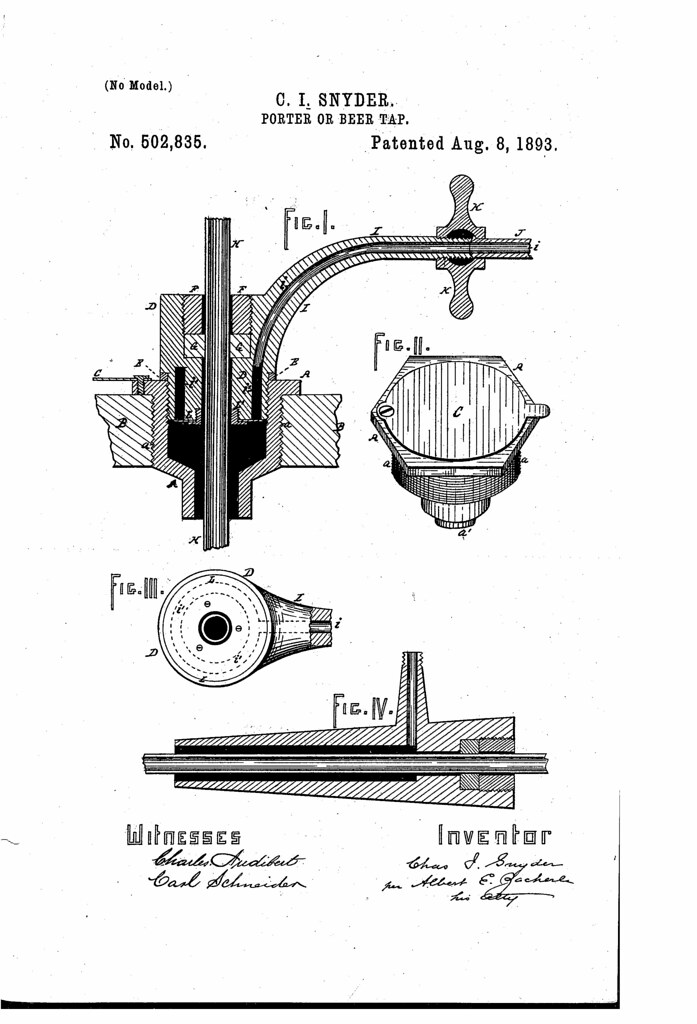
Today in 1893, US Patent 502835 A was issued, an invention of Charles I. Snyder, for his “Porter or Beer Tap.” There’s no Abstract, although in the description it includes these claims:

Before filling the keg, was closed ordinarily by means of a cork. This latter was forced in as the tap was driven into the keg, the tap itself being provided with a stopper (to prevent the escape of the liquor) which also was forced into the keg upon the insertion of the ordinary tap rod which communicates with the bar cock or faucet the liquor being forced through said tap rod by the pressure introduced into the keg, through the air passage and chamber of the tap, from the air pump with which the tap is connected.

Now in order that the tap shall operate successfully, it is essential that the joint between it and the keg shall be perfect to prevent the escape of the air or gas which is being forced into the keg insuring the passage of the liquor through the tap rod as the faucet is turned on. To attain this air tight joint, it is customary to use a packing of paper around the tap. This packing becomes saturated with the-liquor in a very little while and exceedingly offensive; besides does not always suffice for the purpose. Further: more, every time a tap is driven into a keg, the tap hole is more and more enlarged until the tap can no longer be used, when it be comes necessary to insert anew head. All these defects are overcome by my invention which consists: in certain details of construction, arrangement and combination of parts, all of which are more fully described hereinafter.
US502835-0

Filed Under: Beers, Just For Fun, Politics & Law, Related Pleasures Tagged With: History, Kegs, Law, Patent

Patent No. 1969643A: Beer Cooling And Dispensing Apparatus

August 7, 2016 By Jay Brooks

patent-logo
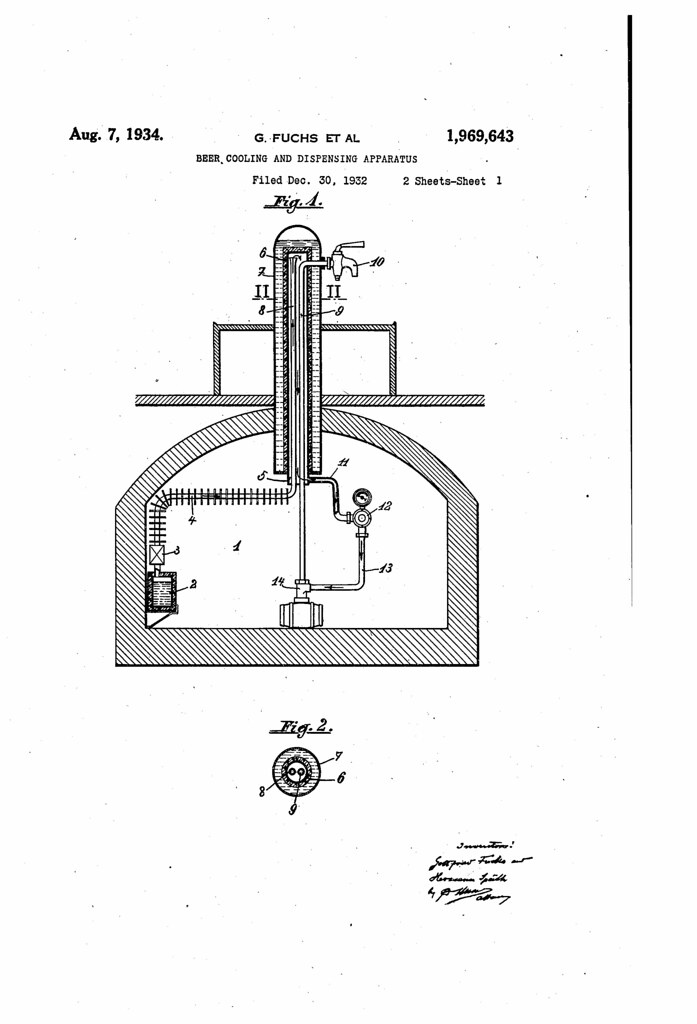
Today in 1934, US Patent 1969643 A was issued, an invention of Gottfried Fuchs and Hermann Spath, for their “Beer Cooling and Dispensing Apparatus.” There’s no Abstract, although in the description it includes these claims:

This invention relates toan automatic cooling and pressure plant for beer conduits and cold storage rooms with employment of frozen carbon dioxide.

It is already known, to employ frozen carbon dioxide for cooling chill rooms. These plants, however, are open to the objection that the carbon dioxide becomes lost as soon as it is no longer frozen. This circumstance renders very l0 questionable the economy of this cooling method, because, as is known, carbon dioxide is very expensive.

The invention relates to a plant, in which the gaseous carbon dioxide liberated by evaporation cools the chill room and also the beer conduit in the tapping device and at the same time serves as pressure medium for the beer in the barrel. ‘The dry ice is accommodated in the cold storage room in a. receptacle with insulated walls, from which go vessel the gaseous carbon dioxide liberated by evaporation is conducted into the beer conduit cylinder through a cooling pipe conduit extending through the cold storage room. The beer conduit cylinder is surrounded by a jacket accommodating the cooling water. The gaseous carbon dioxide is conducted-as pressure medium from the beer conduit cylinder in to the barrel. Posterior the receptacle accommodating the dry ice and anterior the cooling pipe conduit a known thermostat is arranged, by means of which the passage from the ice receptacle to the cooling pipe conduit is automatically regulated.

The jacket of the beer conduit is surrounded by a further jacket, the internal space of which is filled with cooling water which, owing to the expansion of the carbon dioxide in the cylinder, is cooled to freezing point, so that an ice jacket is formed around the beer conduit. The ice jacket is surrounded by a further jacket the internal space of which is filled with cooling water in order to protect the ice jacket against the external heat.

By means of this plant the dry ice is employed for three purposes, i.e. to cool the cold storage room and the beer conduit and to place under pressure the beer conduit, so that the dry ice is utilized in the most economical manner.

US1969643-0
US1969643-1

Filed Under: Beers, Breweries, Just For Fun, Politics & Law, Related Pleasures Tagged With: Brewing Equipment, History, Law, Patent, Science of Brewing

Patent No. 655330A: Hop Bleaching And Drying Kiln

August 7, 2016 By Jay Brooks

patent-logo
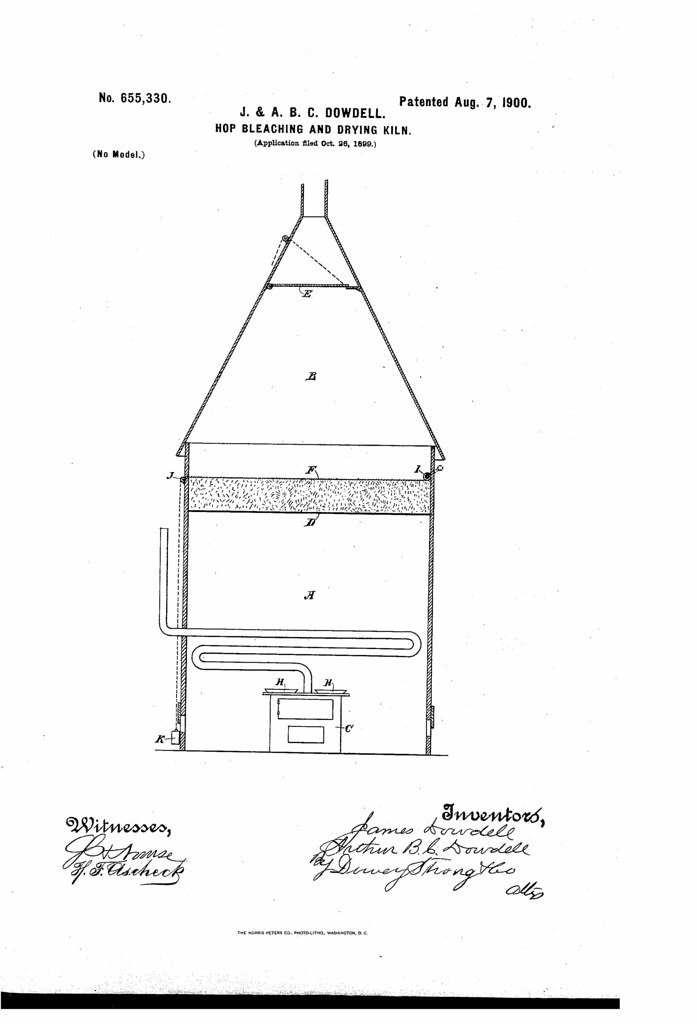
Today in 1900, US Patent 655330 A was issued, an invention of James Dowdell and Arthur B.C. Dowdell, for their “Hop Bleaching and Drying Kiln.” There’s no Abstract, although in the description it includes these claims:

Our invention relates to a means for bleaching and drying hops or other material.

It consists, essentially, of a room or compartment having a foraminous floor adapted to support the hops to be dried and in conjunction therewith a covering which may be drawn over the surface of the hops to confine and prevent heat and moisture from escaping therefrom during the process of bleaching. The sulfur fumes produced in any usual or suitable manner are caused to rise into the hops and are there retained until the bleaching is perfected, after which the covering may be removed, and heat being applied the drying will be completed.

US655330-0

Filed Under: Beers, Just For Fun, Politics & Law, Related Pleasures Tagged With: Brewing Equipment, History, Hops, Law, Patent

Patent No. 194010A: Improvement In Beer Pumps

August 7, 2016 By Jay Brooks

patent-logo
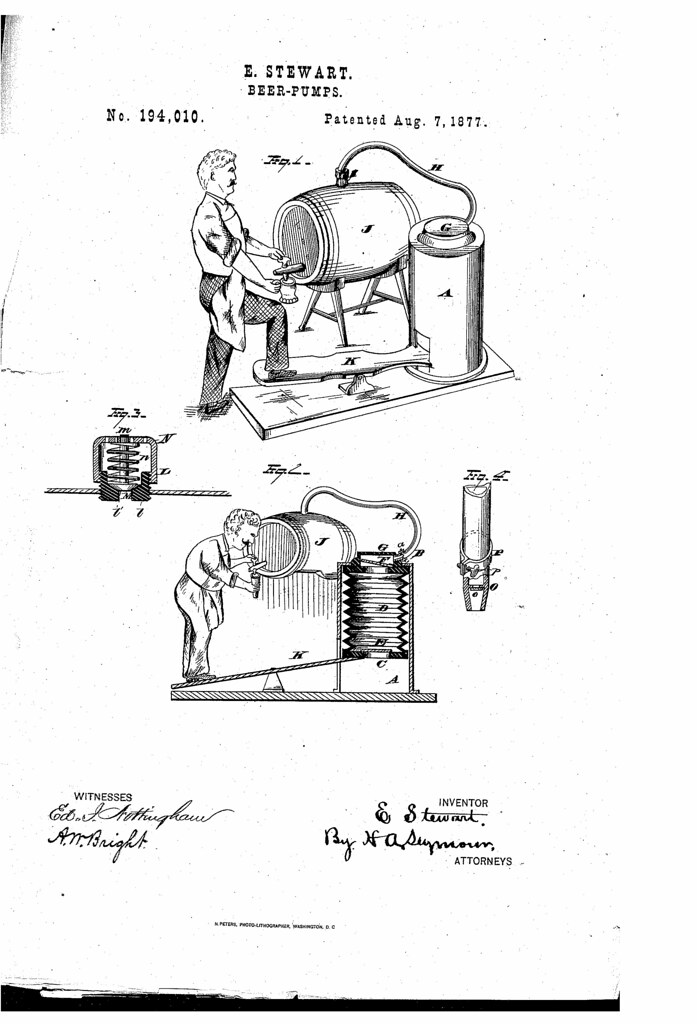
Today in 1877, US Patent 194010 A was issued, an invention of Edward Stewart, for his “Improvement in Beer Pumps.” There’s no Abstract, although in the description it includes these claims:

My invention relates to an improvement in beer-pumps, the object being to provide a beer pump of such construction that the vacuum formed within a barrel or keg of beer or other liquid as the same is drawn therefrom maybe supplied with air, and any desired pressure maintained within the keg, thereby preventing the escape of the contained gases and rendering the beer pleasant to the taste.

My invention consists in the combination, with an air-pump, the upper end of which is provided with a flexible tube to connect with a barrel or keg, of a pivoted platform, one end of which rests in contact with the lower head of the bellows or piston, While the opposite or free end of the platform projects outwardly to allow the party engaged in drawing the beer to stand on the treadle and operate the pump by his weight to force air into the keg as the beer is being drawn therefrom, whereby the hands of the operator are entirely free to hold the glass or other vessel into which the beer is to be drawn, and also to regulate the faucet and accurately govern the flow of beer, the weight of the operator on the movable platform serving to force a sufficient quantity of air into the barrel or cask to effect the desired object.

US194010-0

Filed Under: Beers, Just For Fun, Politics & Law, Related Pleasures Tagged With: Cask, History, Kegs, Law, Patent

Patent No. 1034557A: Beer Spraying Device

August 6, 2016 By Jay Brooks

patent-logo
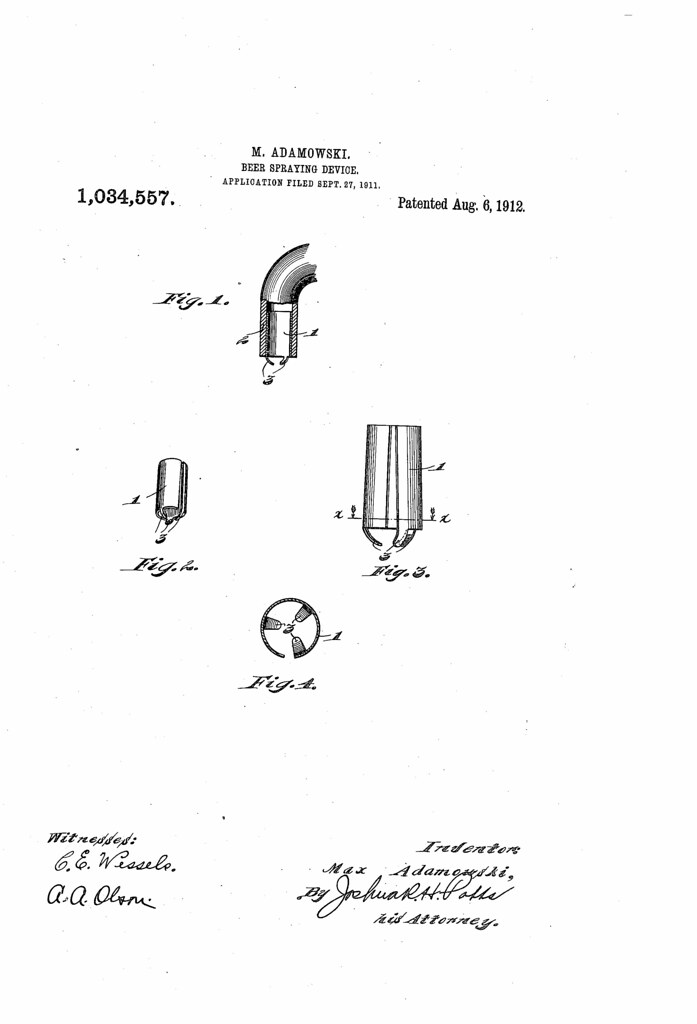
Today in 1912, US Patent 1034557 A was issued, an invention of Max Adamowski, for his “Beer Spraying Device.” There’s no Abstract, although in the description it includes these claims:

My invention relates to improvement-s in spraying devices for faucets and more specifically to devices of this character especially designed for use in beer faucets. a

Ordinarily spraying of beer at the faucet as it is drawn is not desired since such spraying results in the formation of foam. However, Where a large bucket or can trade is carried on this spraying to facilitate the formation of foam is desired since the buckets or cans brought by the purchasers are of greater capacity than the amount which is purchased. The bartender in catering to this class of trade is desirous of filling the can or bucket irrespective of the size thereof for-.the amount tendered. This being so the object in forming a large amount of foam in the top of the can or bucket is obvious.

The object of my invention then is the production of the spraying device of the character mentioned, which will be effective in the formation of foam in the receptacle into which the liquid or beer is disposed, and further, a spraying device which will be of simple and economical construction, hence of low cost to manufacture.

US1034557-0

Filed Under: Beers, Breweries, Just For Fun, Politics & Law, Related Pleasures Tagged With: Brewing Equipment, History, Law, Patent, Science of Brewing

Patent No. 3100056A: Reusable Bottle Cases

August 6, 2016 By Jay Brooks

patent-logo
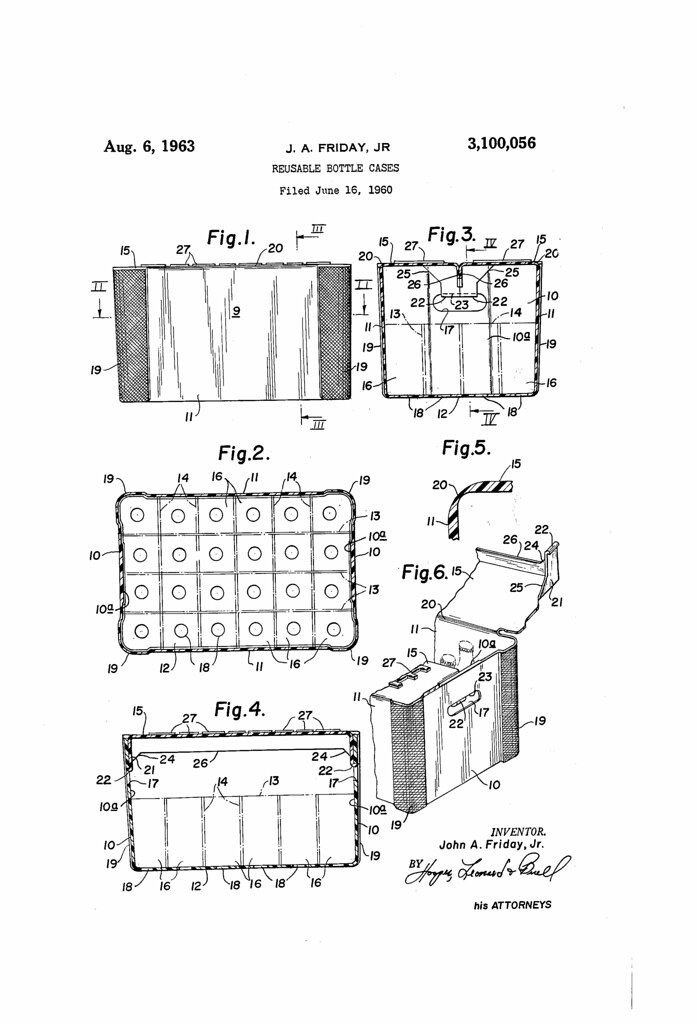
Today in 1963, US Patent 3100056 A was issued, an invention of John A. Friday Jr., assigned to the Duquesne Brewing Company Of Pittsburgh, for his “Reusable Bottle Cases.” There’s no Abstract, although in the description it includes these claims:

This invention relates broadly to reusable containers for bottles and the like and is particularly useful for beverage bottle cases, such as beer cases where the container is subjected to frequent reuse.

In my invention, I provide a reusable case for bottles and the like comprising, in combination, a unitary molded container having side walls, end walls, a bottom wall and opposed top flap elements, all of said elements and walls being integrally formed complete in a single piece of plastic material and a plurality of longitudinal and lateral cell-forming partition members disposed in said container, said end walls having handle means comprising openings in the upper central portions thereof, said top flap elements having lockable closing means selectively engageable with said handle means. I further provide hinge means comprising thinned flexible portions in said top flap elements adjacent said side walls. In addition, I provide convex bulges in the side and end walls at the corners of the container. Further, I provide roughened surfaces on particular portions of the container to prevent slippage between the cases from occurring when stacking or transporting them.

Thus, I have invented a bottle case that is a unitary container which is integrally formed as a single piece of plastic, which is tough and durable and may be used many times over and above the ordinary case. My case ice has a lockably closable top for the complete protection of the bottles contained therein and bulged corners for the protection of the printed material on the sides and ends of the container.

The advantages of a unitary structure are, inter alia, that the case is free of connections that are weaker than the case itself. There is less likelihood of weak spots. It also eliminates costly assembly operations and thus, is not only stronger but less expensive.

US3100056-0

Filed Under: Beers, Just For Fun, Politics & Law, Related Pleasures Tagged With: Bottles, History, Law, Packaging, Patent

Patent No. 2291980A: Beer Barrel

August 4, 2016 By Jay Brooks

patent-logo
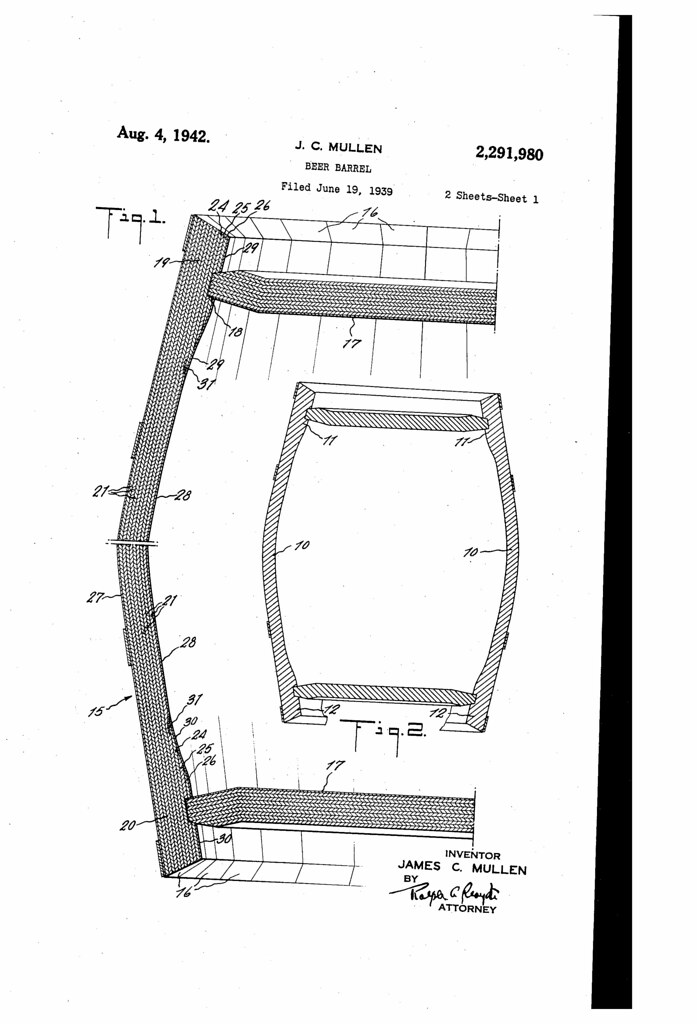
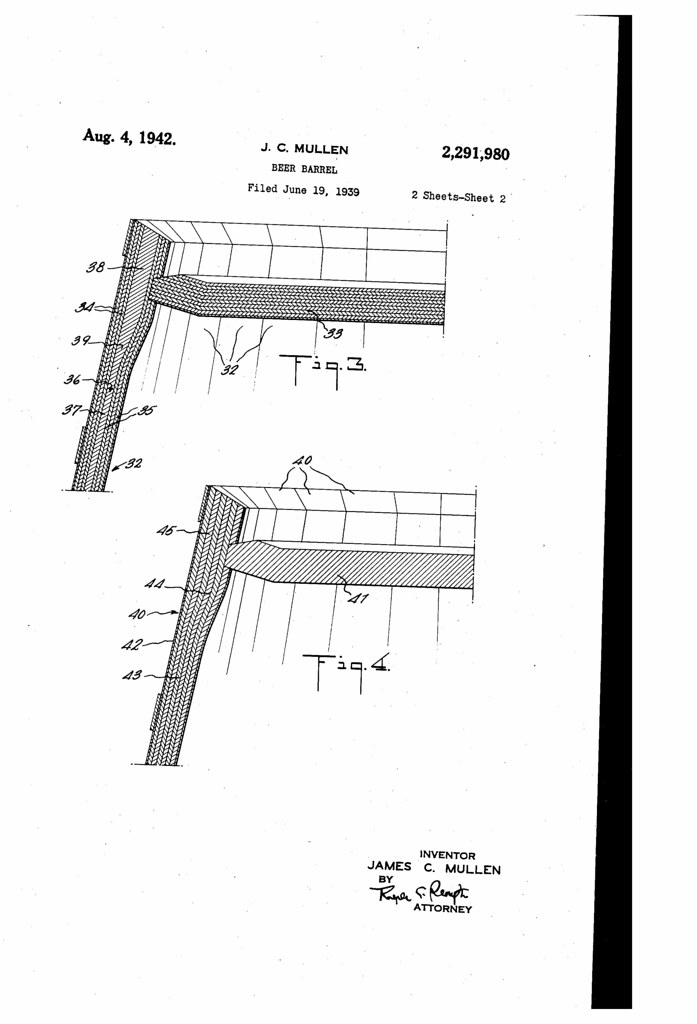
Today in 1942, US Patent 230815 A was issued, an invention of James C. Mullen, assigned to the Verdi Bros Cooperage Company, for his “Beer Barrel.” There’s no Abstract, although in the description it includes these claims:

This invention relates to barrels, vats and the like and more particularly to the type of barrels employed in the shipment and dispensation of malt-liquors and similar products.

This invention specifically relates to barrels made up of ply Wood laminations.

It is a common practice that barrels, used for the purposes referred to, are preferably built up of barrel staves of which their end portions are made much heavier than their middle portions, whereby to resist the severe handling in shipment.

When employing ply wood laminations in the manufacture of barrel staves, a thickening and thereby strengthening of their end portions introduces however certain mechanical difficulties.

One of the objects of this invention is to provide a practical barrel stave comprising wood ply laminations and of which the physical contour of said stave, approximates or duplicates those of the conventional one-piece, oaken staves.

A further object is to provide a stave adapted for the manufacture of barrels, and of which the wood ply lamination utilized therein are formed and arranged in a manner to give to the barrel all of the desirable characteristics of the conventional oaken barrel, while being cheaper to manufacture, stronger in construction and therefore more enduring.

US2291980-0
US2291980-1

Filed Under: Beers, Just For Fun, News, Politics & Law Tagged With: Barrels, History, Law, Patent

Patent No. 457243A: Beer Pump

August 4, 2016 By Jay Brooks

patent-logo
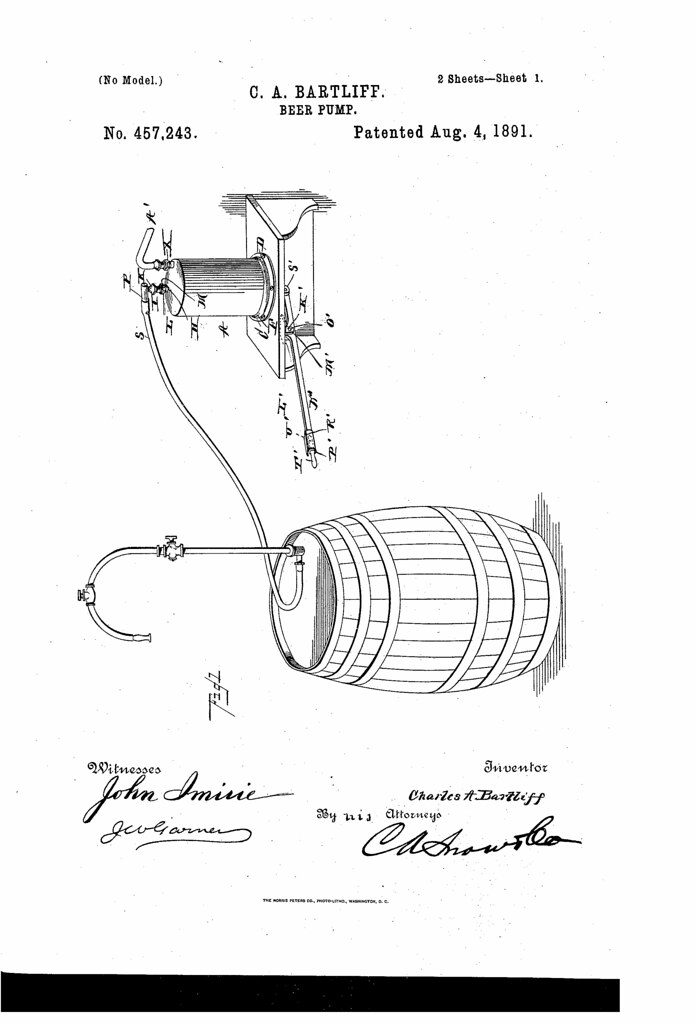
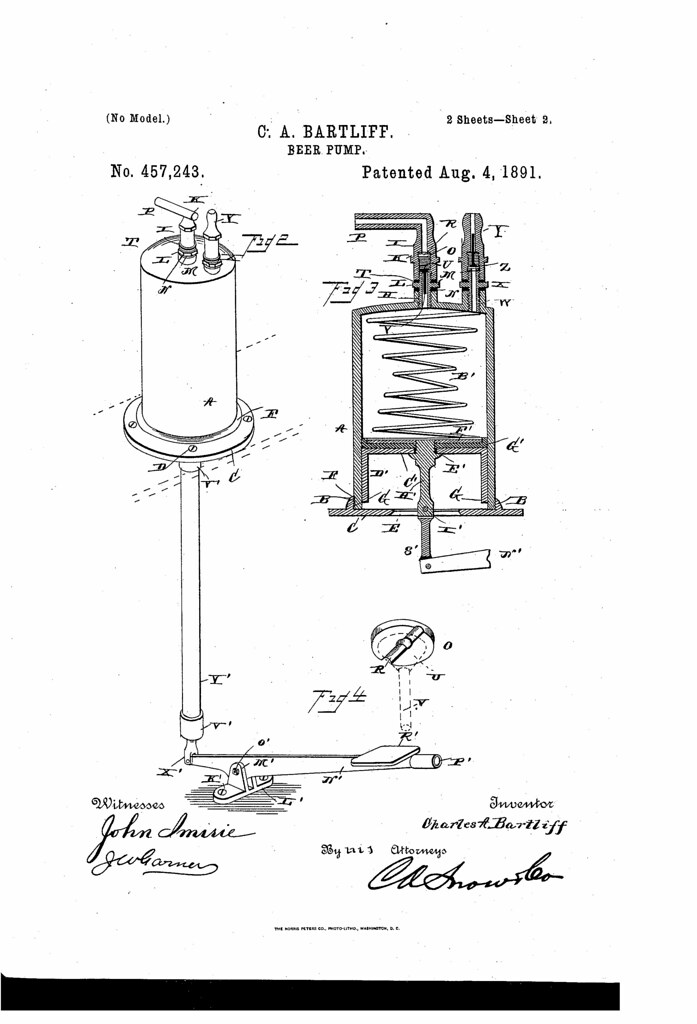
Today in 1891, US Patent 457243 A was issued, an invention of Charles A. Bartliff, for his “Beer Pump.” There’s no Abstract, although in the description it includes these claims:

My invention relates to an improvement in air-pumps for forcing and compressing air in a cask; and it consists in the peculiar construction and novel combination of parts, that will be more fully set forth hereinafter, and particularly pointed out in the claim.

The object of my invention is to provide an air-pump which is adapted to force beer or other liquid from the cask by atmospheric pressure; and a further object of my invention is to provide a simple, effective, and inexpensive pump which may be operated either by foot or by hand power.

US457243-0
US457243-1

Filed Under: Beers, Just For Fun, Politics & Law, Related Pleasures Tagged With: Brewing Equipment, History, Law, Patent, Science of Brewing

Patent No. 230815A: Beer Cooler

August 3, 2016 By Jay Brooks

patent-logo
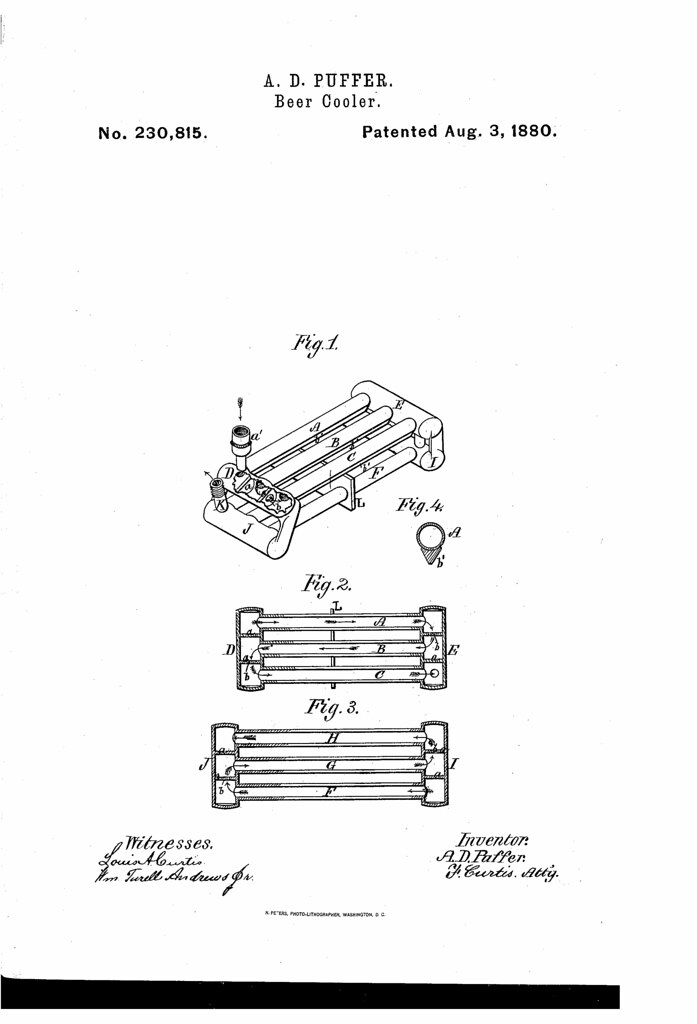
Today in 1880, US Patent 230815 A was issued, an invention of Alvin D. Puffer, for his “Beer Cooler.” There’s no Abstract, although in the description it includes these claims:

This invention relates to improvements in a class of apparatus for reducing the temperature of soda-water or other liquids manufactured by myself, and shown and described in Letters Patent of the United States issued to me on the 6th day of December, 1870, and the 3d day of April, 1877, respectively, the purpose of the invention shown in the first-named patent being to economize the waste of ice used in cooling liquids; and it consists, primarily, in conducting the liquid to be refrigerated through a preliminary or auxiliary series or coil of pipes or cylinders situated within the ice-water which accumulates from the melting of the ice with which the primary cylinders or coolers are packed, or otherwise taking advantage of the low degree of temperature of such ice water to reduce the temperature of the soda water or other liquid previous to its entering the primary coolers, which receive cold directly from the ice, while the invention embraced in the second-named patent consists in a new or peculiar manner of conducting ,soda water through a cooler or refrigerating apparatus, the purpose of the invention being to thoroughly and effectually carry or force the water, in its passage through a series of cooling-cylinders, against the refrigerated sides or inner surfaces of such cylinders, or to prevent the formation of a central or inner current through the body of water in such cylinders.

US230815-0

Filed Under: Beers, Breweries, Just For Fun, Politics & Law, Related Pleasures Tagged With: Brewing Equipment, History, Law, Patent, Science of Brewing

Patent No. 6769981B1: Hop Vine Processor

August 3, 2016 By Jay Brooks

patent-logo
Today in 2004, US Patent 6769981 B1 was issued, an invention of Kenneth J. Perrault and Charles J. Perrault, for their “Hop Vine Processor.” Here’s the Abstract:

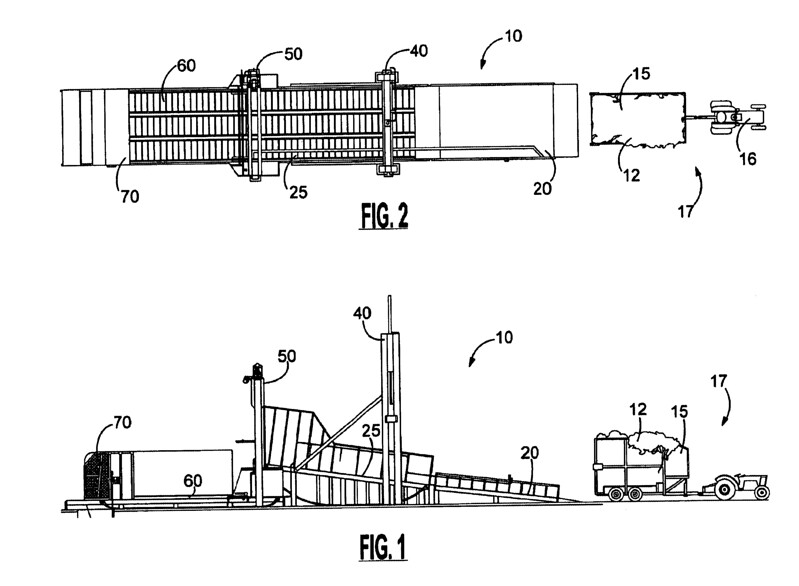
A method and apparatus for the processing of hop vines. An automated hop processor cuts bulk-harvested hop vines into manageable segments with a minimum of handling operations. The bulk of hop vines are off-loaded onto an in-feed conveyor by positioning a transport on the in-feed conveyor. After verifying proper position of the transport a fork can be inserted into the transport. The transport is moved off of the in-feed conveyor and the fork removed from the bulk of hop vines. The Hop vines are then moved on the in-feed conveyor to a cutter, after verifying the transport is clear of the in-feed conveyor. The in-feed conveyor is stopped when the hop vines are in position for cutting and the hops are cut with a cutting mechanism. The cut hop vines are then conveyed to a shredder for shredding and further processing into component hop cones and hop vine silage.

US06769981-20040803-D00001

Filed Under: Beers, Just For Fun, Politics & Law, Related Pleasures Tagged With: Brewing Equipment, History, Hops, Law, Patent

« Previous Page
Next Page »

Find Something

Northern California Breweries

Please consider purchasing my latest book, California Breweries North, available from Amazon, or ask for it at your local bookstore.

Recent Comments

  • Steve 'Pudgy' De Rose on Historic Beer Birthday: Jacob Schmidt
  • Jay Brooks on Beer Birthday: Bill Owens
  • Steve 'Pudgy' De Rose on Beer Birthday: Charles Finkel
  • Steve 'Pudgy' De Rose on Beer Birthday: Bill Owens
  • Steve "Pudgy" De Rose on Beer Birthday: Pete Slosberg

Recent Posts

  • Beer In Ads #5130: Bishop And Smitty Says Bock Beer December 2, 2025
  • Beer Birthday: Bob Pease December 2, 2025
  • Beer In Ads #5129: Call For Gem Bock Beer December 1, 2025
  • Beer Birthday: Susan Boyle December 1, 2025
  • Historic Beer Birthday: William Krug December 1, 2025

BBB Archives

Feedback

Head Quarter
This site is hosted and maintained by H25Q.dev. Any questions or comments for the webmaster can be directed here.