Brookston Beer Bulletin

Jay R. Brooks on Beer

  • Home
  • About
  • Editorial
  • Birthdays
  • Art & Beer

Socialize

  • Dribbble
  • Email
  • Facebook
  • Flickr
  • GitHub
  • Instagram
  • LinkedIn
  • Pinterest
  • RSS
  • Twitter
  • YouTube

Powered by Genesis

Patent No. 3044879A: Anactinic Malt Product And Hop Extract Therefor

July 17, 2016 By Jay Brooks

patent-logo
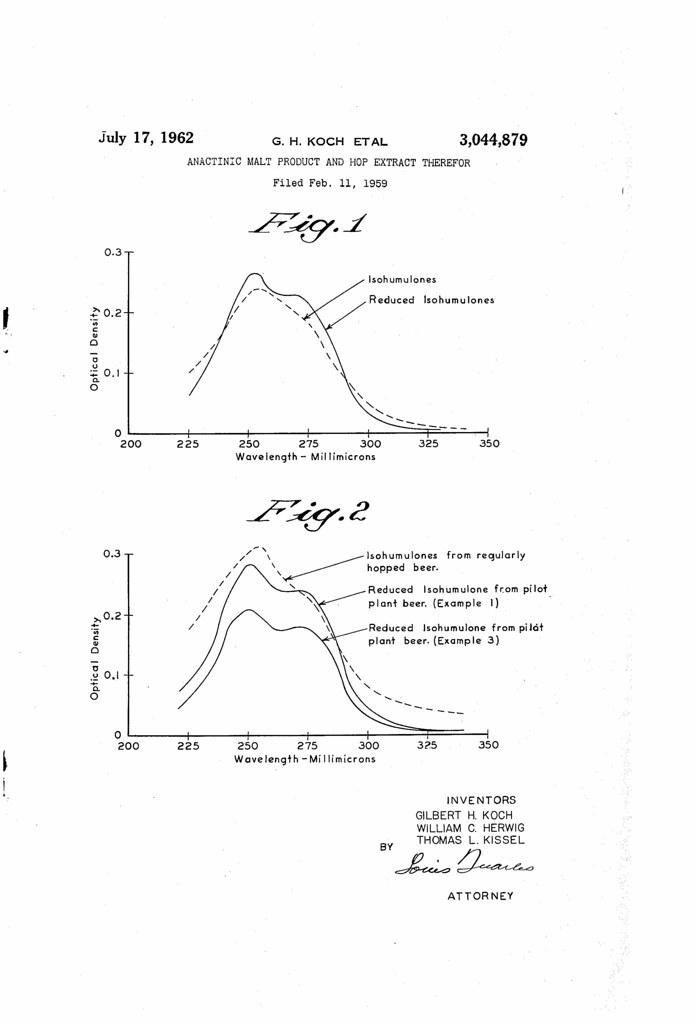
Today in 1962, US Patent 3044879 A was issued, an invention of William C. Herwig, Thomas L. Kissel, and Gilbert H. Koch, assigned to Miller Brewing, for his “Anactinic Malt Product and Hop Extract Therefor.” There’s no Abstract, although in the description it includes these claims:

This invention relates to manufacture of anactinic malt beverages such as beer and ale, and to intermediate products.

It is well known that beer and ale and similar malt beverages are produced from water, barley malt, adjuncts and hops. The malt and adjuncts furnish the carbohydrates and other growth essentials which make up the wort. This wort, boiled with hops, in turn forms the basic substance for fermentation in the fermenting tanks. The hops give the characteristic bitter flavor and pleasant aroma to the beer. They assist in preserving the beer and improve its foam holding capacity.

Unfortunately, beer and ale and other similar malt beverages are not stable to light. Light of both visible and-invisible wave lengths affects them adversely producing actinic damage in the form of a characteristic skunky odor. Such a beer is commonly known as light struck. The actinism is caused by chemical changes, producing compounds probably mercaptans in nature. Tests show that the olfactory threshold level of odoriferous compounds of this character is very low, in the range of a few parts per billion. This shows clearly the acute nature of the problem. 7 Many efforts have been made in the past to overcome this difficulty. Much time has been expended on packaging of beer and ale to exclude light. Colored bottles have been used and opaque packages are common. It is not uncommon to label them Do Not Expose to Light.

To compete with modern day merchandising, a malt beverage has to be removed from the case and put on the shelf, or at least a portion of the container is exposed for easy vision and access. Modern reach-in coolers have clear glass windows and fluorescent lights which aggravate the problems. Even canned beer or keg beer can be adversely affected by sunlight if, as is usually the’ case, it is drunk from a glass. glass to direct sunlight for a short a time as a few minutes will result in the impairment of the taste and production of the characteristic skunky odor. Beer at picnics and sporting events is often exposed for hours to direct sunlight. In such cases, the deleterious effects can be very marked.

q We have discovered a way to overcome the hazard of product exposure to light which forms the basis of our invention, and have thereby achieved a substantially anactinic malt beverage. The term anactinic is intended The exposure of beer in the 3,044,879 Patented July 17, 1962 bitterness in the finished product, but eliminate the photoactive elements thereof.

A still further object of the, present invention is to provide a method of treating hop extract in the presence of a reducing agent to provide a concentrated product having particular application in malt beverages production, whereby its use will not affect the desired characteristics of the beverage, but will eliminate photoactive elements therein.

The soft resins and oils, which are contained in the glands produced on the hops and known as lupulin glands, are valuable constituents of the hops as used ,in the brewing process. The soft resins consist principally of (a) the alpha acids, (b) the beta acids, and (c) the uncharacterized soft resins. The alpha acids are known as humulones and the beta acids are known as lupulones. The alpha acids are the source of antiseptic and bitter substances in beer. The beta acids or lupulones have low solubility in kettle wort and beer, thus do not appreciably enter into the brewing process.

It is known that chemical changes are made in the humulones during brewing resulting in the compounds known :as isohumulones, i.e. isohumulone, isocohumwlone, isoadhurnulone, and isoprehumulone. These isocompounds are formed in the kettle during the boiling stage of the brewing process, and we have discovered that these compounds are the ones that cause the beer to become sensitive to light in the presence of sulfhydryl comhumulone, and prehumulone, is isomerized to the corresponding isohumulones. It is known that during the isomerization of the humulones to isohumulones, a new side chain is formed which now contains a carbonyl group.

It is these isohumulones-isohumulone, isocohumuloue isoadhumulone, and isoprehumulone which we have found to be involved in the photochemical reaction with sulfhydryl compounds to produce the ‘actinic damage resulting in the characteristic light struck aroma.

to succinctly describe a beverage which will not be subject to actinic damage. The word is herein coined and is derived from the word -actinic plus the prefix an, meaning not. This is the Greek equivalent to the Latin in and consists of alpha privative plus nu movable.

We have found that three factors are necessary for the reaction causing malt beverages. to become light struck. They are photo energy in the wave length region of 1,000 to 10,000 angstroms, a sulfhydryl bearing compound, and a chemical component derived from the raw materials, hops, during the brewing process.

The primary object of the invention is to provide a hop extract and malt beverage that is stable to light and will not produce unpleasant olfactory characteristics.

A further object of the invention is to so treat the hops in malt beverages so as to retain the aroma, bouquet and We are of the belief that when the isohumulones are group can be altered by means of reduction to a secondary alcohol, and by such alternation, be prevented from reacting with the sulfhydryl groups normally present in beer components.
US3044879-0

Filed Under: Beers, Just For Fun, Politics & Law, Related Pleasures Tagged With: History, Hops, Law, Patent, Science, Science of Brewing

Patent No. 523274A: Apparatus For Collecting Dripping From Beer Faucets And Returning Same To Kegs Under Gas Pressure

July 17, 2016 By Jay Brooks

patent-logo
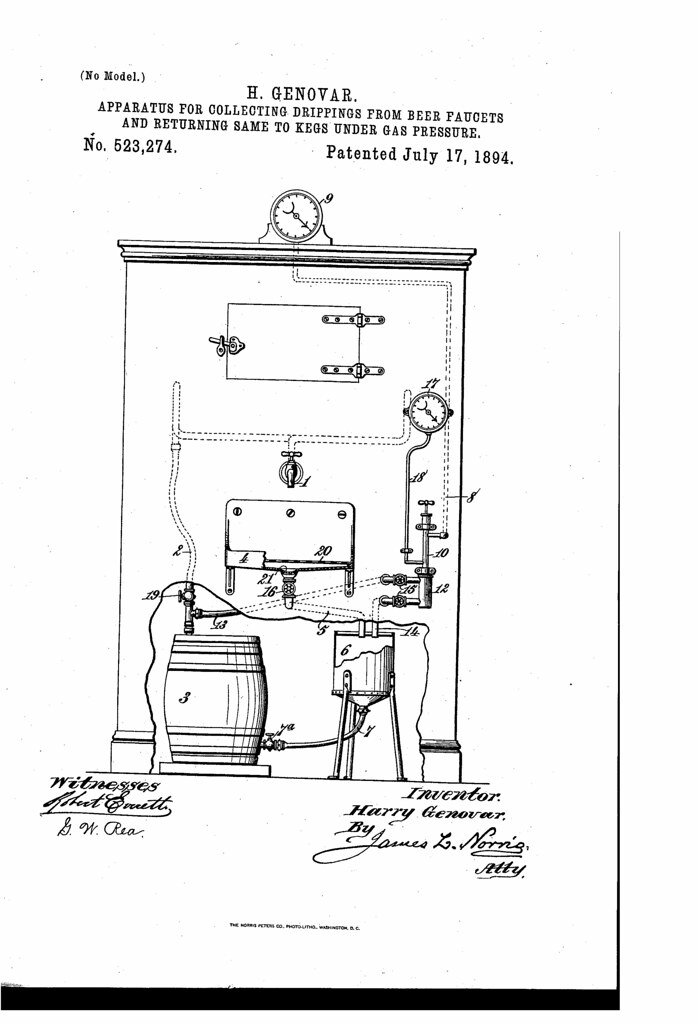
Today in 1894, US Patent 523274 A was issued, an invention of Harry Genovar, for his “Apparatus for Collecting Dripping from Beer Faucets and Returning Same to Kegs Under Gas Pressure.” There’s no Abstract, although in the description it includes these claims:

The object of my invention is to provide means whereby the drippings and waste from beer faucets and other sources may be easily and quickly returned to the keg, without loss of gas from the latter and Without impairing the quality of the beer.

In retailing beer by the glass, it is usually drawn directly from the keg through pipes which traverse a refrigerating chamber, carbonic acid gas being supplied to the keg at a substantially uniform pressure. The presence of large quantities of foam, as the beer comes from the faucet, and the necessity of running off the larger part of the foam, entails a considerable waste, as the beer into which this foam is resolved soon parts. with its gas and becomes stale.

It is the purpose of my invention to provide means whereby this waste may be entirely avoided without involving more than an extremely moderate expense for apparatus which may be easily operated by any person with a small expenditure of time and labor.

The invention consists in the several novel features of construction and new combinations of parts hereinafter fully explained and then particularly pointed out and defined in the claims which follow this specification.

US523274-0

Filed Under: Beers, Just For Fun, Politics & Law, Related Pleasures Tagged With: History, Kegs, Law, Patent

Patent No. 3392879A: Beer Dispenser

July 16, 2016 By Jay Brooks

patent-logo
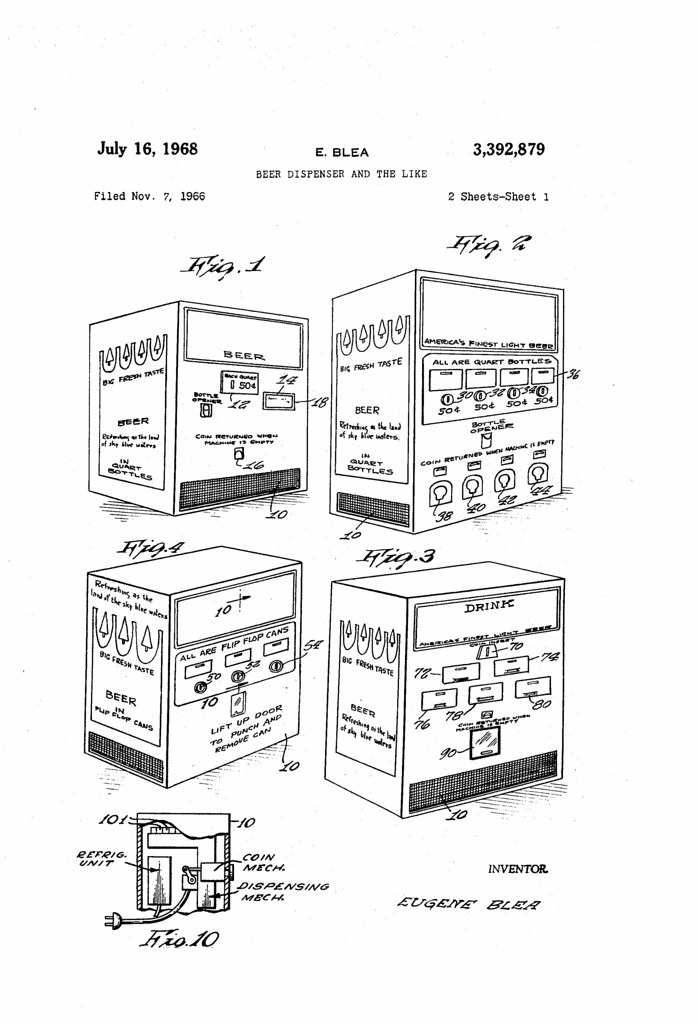
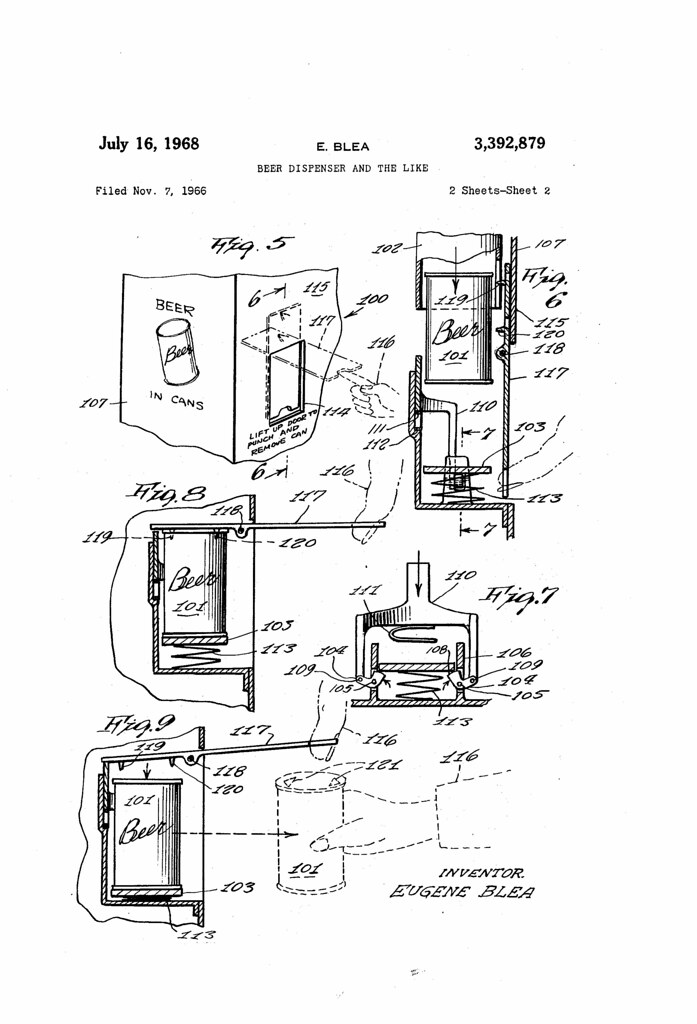
Today in 1968, US Patent 3392879 A was issued, an invention of Eugene Blea, for his “Beer Dispenser and the Like.” There’s no Abstract, although in the description it includes these claims:

This invention relates generally to vending machines. More specifically it relates to machines for vending beer in bottles or in cans.

US3392879-0
US3392879-1

Filed Under: Beers, Just For Fun, Politics & Law, Related Pleasures Tagged With: Bottles, Cans, History, Law, Packaging, Patent

Patent No. 301860A: Valve For Regulating The Supply Of Liquor

July 15, 2016 By Jay Brooks

patent-logo
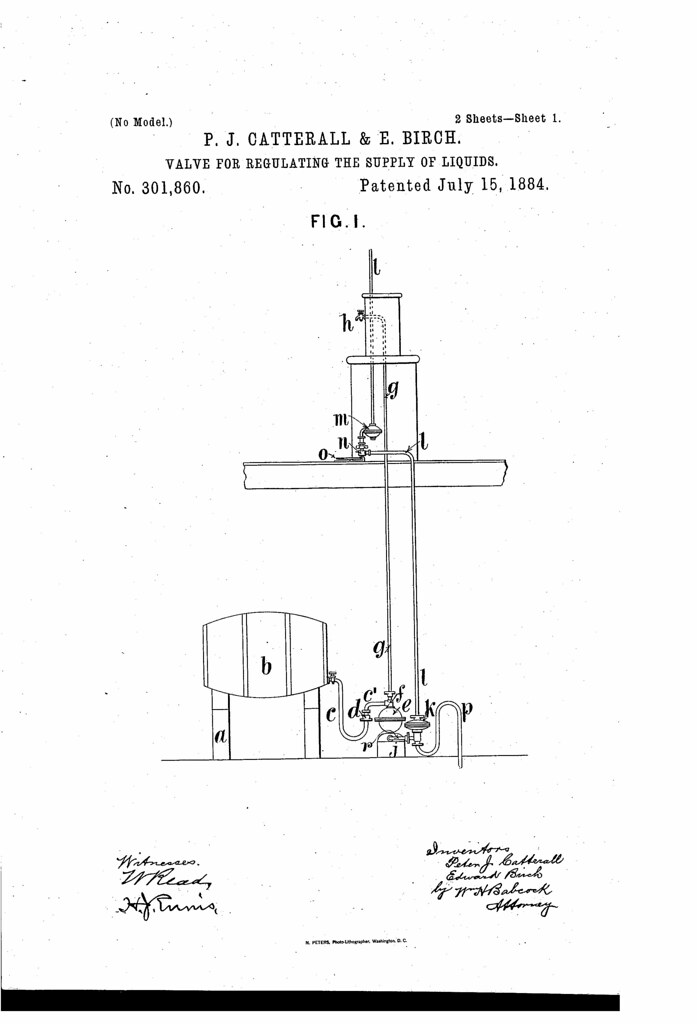
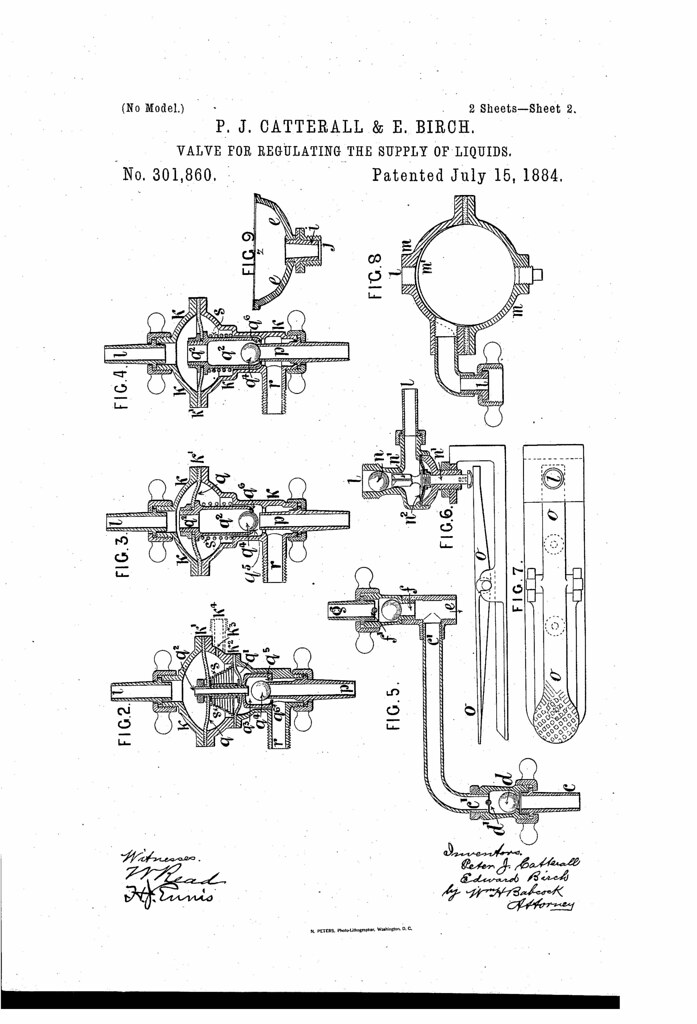
Today in 1884, US Patent 301860 A was issued, an invention of Peter James Catterall and Edward Birch, for their “Valve for Regulating the Supply of Liquor.” There’s no Abstract, although in the description it includes these claims:

Our improvement relates to the invention for which we obtained Letters Patent of the United States No.’ 253,683, dated February 14, 1882, and is partly or wholly applicable for other purposes and the object of our invention is to form an improved valve for regulating the supply of beer, water or other liquid. We attain this object by the mechanism illustrated in the accompanying drawings, in which Figure 1 is an elevation showing the valve applied to apparatus for raising beer or other liquid. Fig. 2 is a sectional elevation upon a larger scale of the valve. Figs. 3 and 4 are sectional elevations of a modified form of the valve. Fig. 5 is a sectional elevation of the back-pressure valves. Fig. 6 is an elevation, partly in section, of the ball-valve in the water-supply pipe, and of the treadle for actuating the same. Fig. 7 is a plan of Fig. 6. Fig. 8 is a sectional elevation of an air-vessel for the prevention of concussion in the water-supply pipe; and’Fig. 9 is a detached view in section, showing our arrangement for connecting the chamber to the water-chest.

US301860-0
US301860-1

Filed Under: Beers, Just For Fun, Politics & Law, Related Pleasures Tagged With: History, Kegs, Law, Patent

Patent No. 733732A: Screen For Hop Separating Machines

July 14, 2016 By Jay Brooks

patent-logo
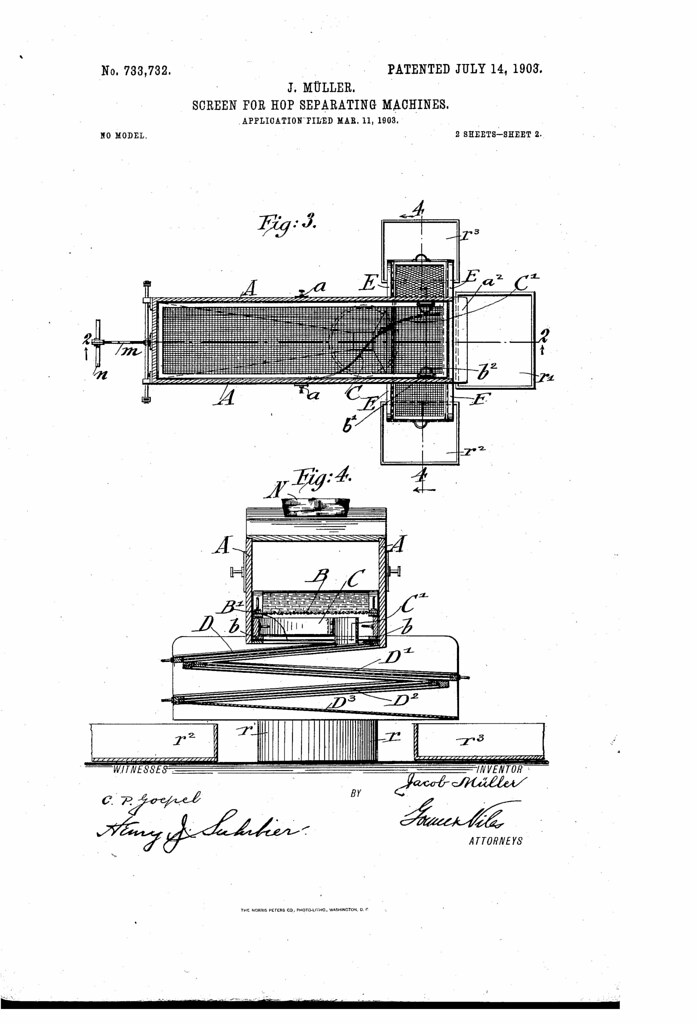
Today in 1903, US Patent 733732 A was issued, an invention of Jacob Mueller, for his “Screen For Hop Separating Machines.” There’s no Abstract, although in the description it includes these claims:

This invention relates to an improved screen for separating hops from the seeds after they have been separated from their stems by one of the well-known machines used for this purpose, such as the one for which Letters Patent were granted to me, No. 314,116, and dated March 17, 1885, or any other suitable machine; and the invention relates more specifically to a compound screen by which the larger leaves of the hop-scales are separated from the seeds and the smaller leaves from the lupulin or fine gummy particles in a very effective manner in four separate receptacles, so that the seeds and other parts which are not used in brewing processes are separated from the lupulin, scales, and leaves, which permits thereby a better utilization of the hop seeds in the brewing process, as the objectionable parts of the same have been separated and for this purpose the invention consists of a screen for separating hop-scales after they are removed 0 from their stems which comprises an oscillating shaker provided with a bottom screen and conveying-hopper and a plurality of inclined screens arranged below the lower end of the shaker, said screens being of different character and degrees of fineness,so as to separate the hop-scales from the seeds, lupulin, and smaller particles and pass each into suitable receptacles; and the invention consists, further, of certain details of construction and combinations of parts, which will be fully described hereinafter and finally pointed out in the claims.

US733732-0
US733732-1

Filed Under: Beers, Just For Fun, Politics & Law, Related Pleasures Tagged With: Brewing Equipment, History, Hops, Law, Patent

Patent No. 2683594A: Grain Drying Machine

July 13, 2016 By Jay Brooks

patent-logo
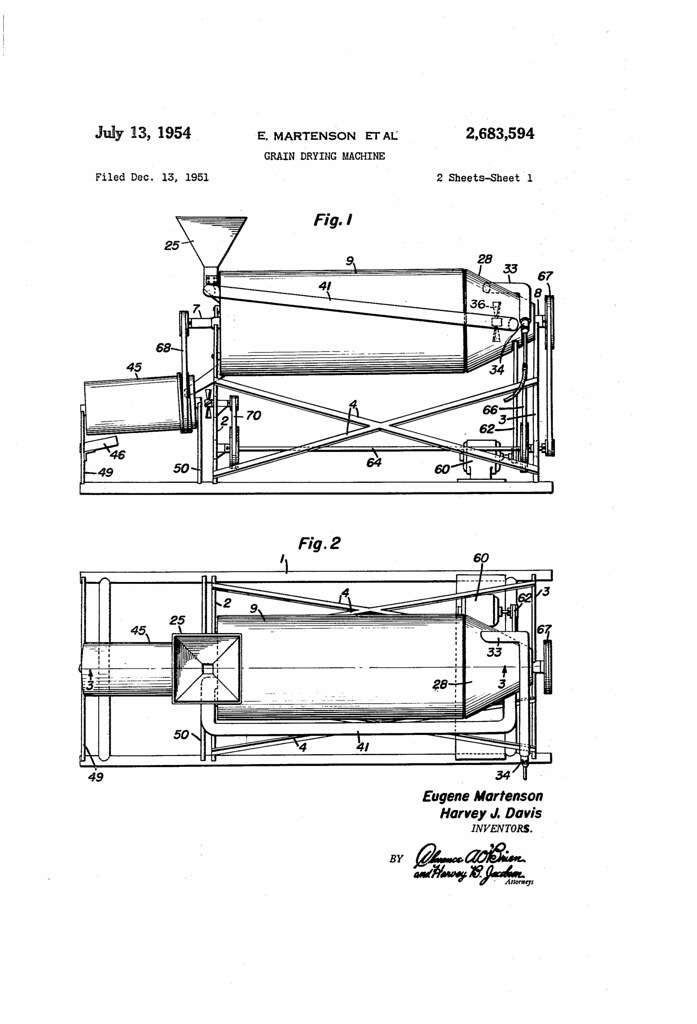
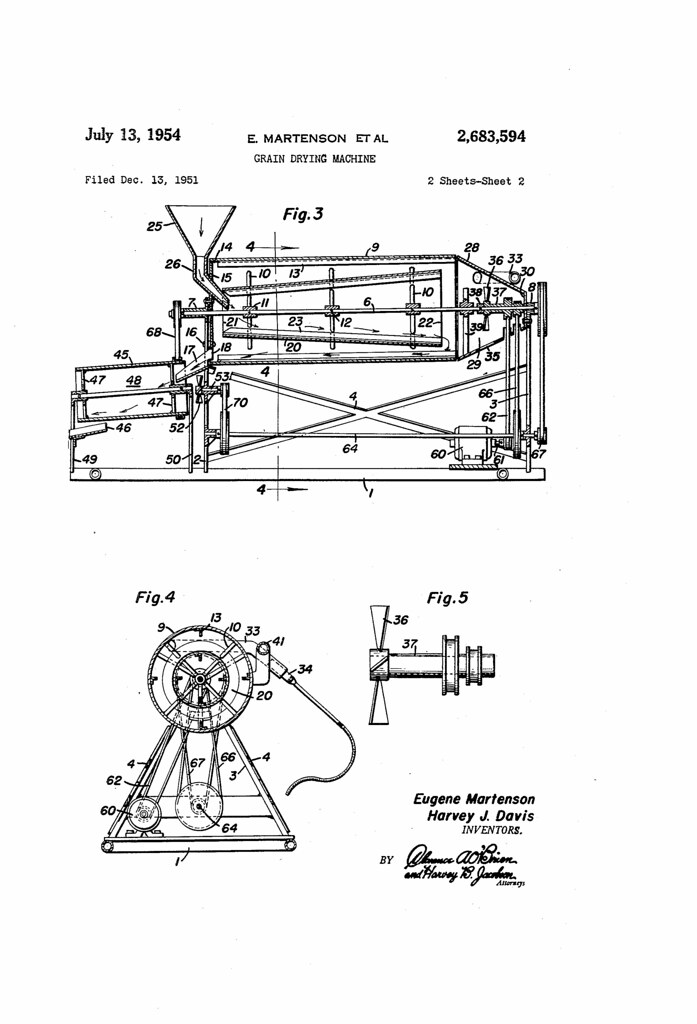
Today in 1954, US Patent 2683594 A was issued, an invention of Harvey J. Davis and Eugene Martenson, for their “Grain Drying Machine.” There’s no Abstract, although in the description it includes these claims:

Our invention relates to improvements in grain drying machines for small grain, especially oats, wheat, rye, barley and corn.

The primary object of our invention is to provide an efficient portable machine for removing, under the action of heat a sufficient amount of moisture from such grain to prevent molding, but, without damaging the grain as regards germination, color, odor, or taste.

Another object is to accomplish the above while agitating the grain so that it will be uniformly but slowly dried under the action of heat at a low temperature.

Still another object is to provide a machine for the above purposes which is economical to manufacture, use and service, and easily cleaned.

US2683594-0
US2683594-1

Filed Under: Beers, Just For Fun, Politics & Law, Related Pleasures Tagged With: Brewing Equipment, History, Law, Malt, Patent

Patent No. 2086832A: Dispensing And Storage Cabinet For Effervescent Beverages

July 13, 2016 By Jay Brooks

patent-logo
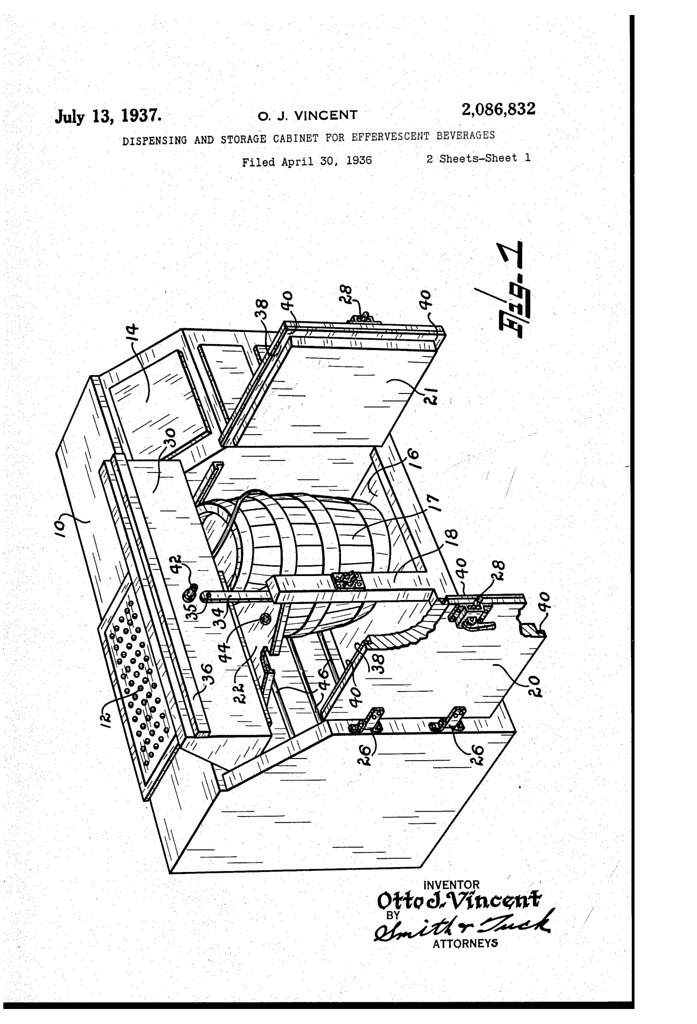
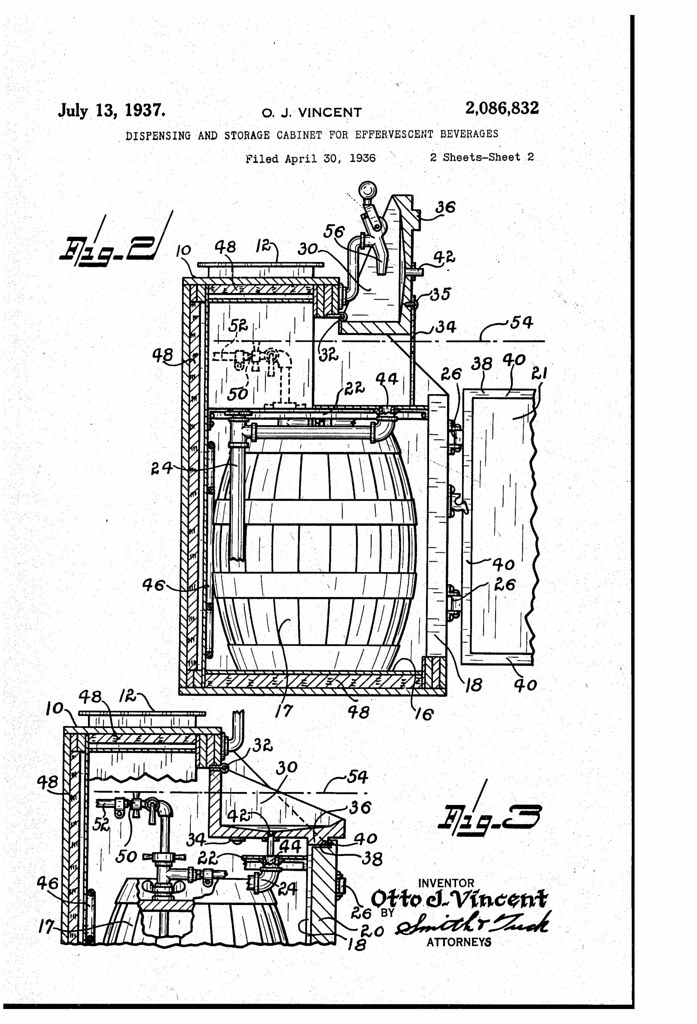
Today in 1937, US Patent 2086832 A was issued, an invention of Charles Candee Green, for his “Dispensing and Storage Cabinet for Effervescent Beverages.” There’s no Abstract, although in the description it includes these claims:

I claim:

1. The combination in a beverage dispensing cabinet having an open front, a center-post at the front of the cabinet, and anelevated horizontal support rigid with the post and cabinet,

with a pair of oppositely opening hinged doors, of a tray extending substantially the combined width of the two doors and hinged to the cabinet above the doors, a prop pivoted on the cabinet adapted to rest on the support for holding the tray in open position, a stop-rib mounted on the under face of the tray, and rabbets on the upper edges of said doors for frictional engagement with the stop-rib when the tray and doors are closed.

2. The combination with an open-front cabinet having a center-post, and a pair of oppositely-opening hinged-doors, of a tray extending substantially the combined Width of the two doors and hinged to the cabinet above the doors, a stop-rib mounted on the under face of the tray to form a front edge-groove, and rabbets forming a complementary groove at the upper edges of the doors, whereby frictional engagement of the rabbets against the stop-rib holds the tray against opening movement when the tray and ‘doors are in closed position.

US2086832-0
US2086832-1

Filed Under: Beers, Just For Fun, Politics & Law, Related Pleasures Tagged With: History, Kegs, Law, Patent

Patent No. 478592A: Hop Picking Machine

July 12, 2016 By Jay Brooks

patent-logo
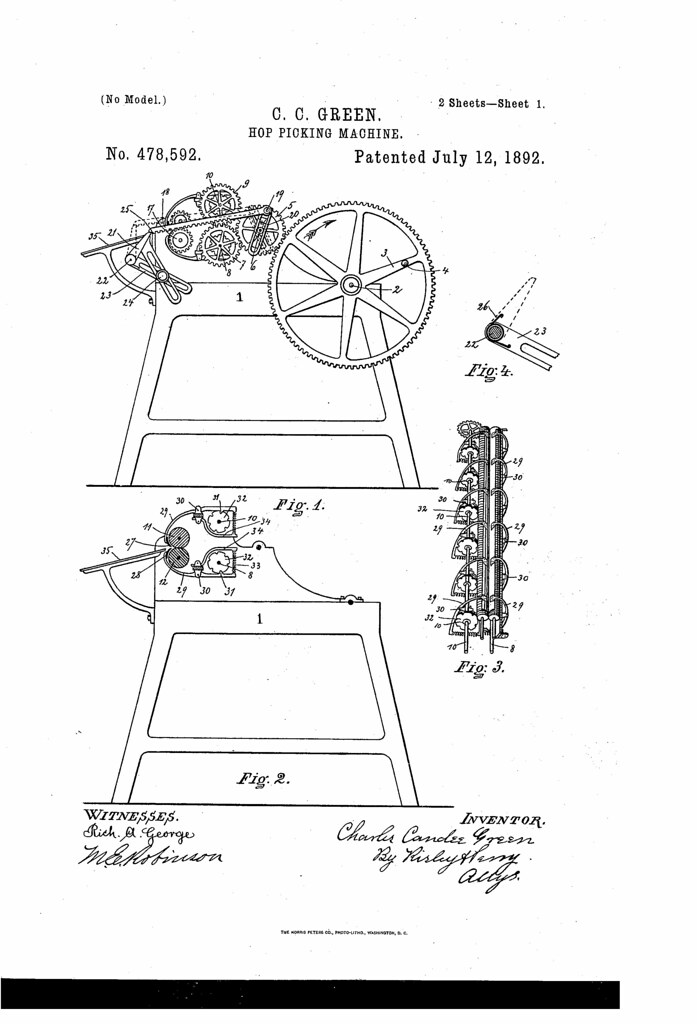
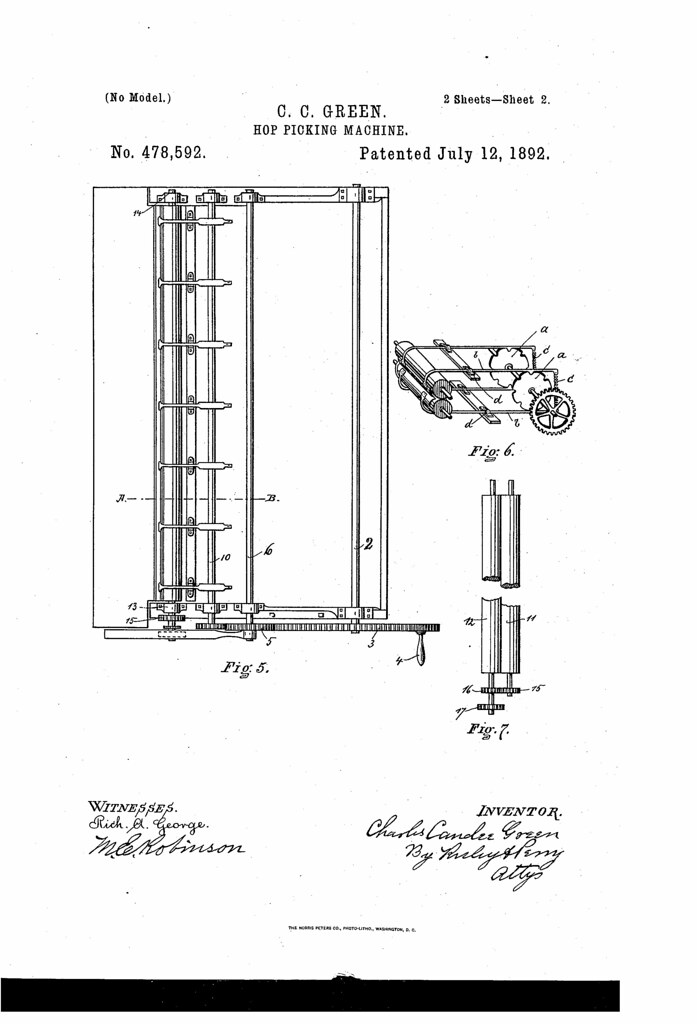
Today in 1892, US Patent 478592 A was issued, an invention of Charles Candee Green, for his “Hop Picking Machine.” There’s no Abstract, although in the description it includes this summary:

My invention relates to an improvement in machines for picking hops from the vine.

US478592-0
US478592-1

Filed Under: Beers, Just For Fun, Politics & Law, Related Pleasures Tagged With: Brewing Equipment, History, Hops, Law, Patent

Patent No. 3260395A: Bottle Cap

July 12, 2016 By Jay Brooks

patent-logo
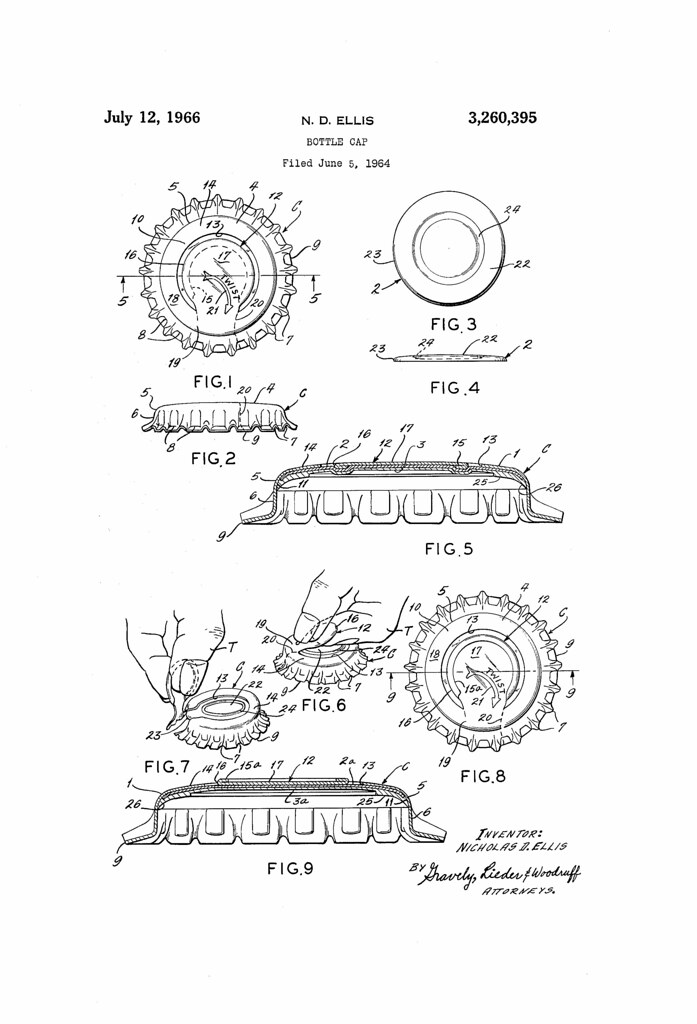
Today in 1966, US Patent 3260395 A was issued, an invention of Nicholas D. Ellis, assigned to Anheuser Busch, for his “Bottle Cap.” There’s no Abstract, although in the description it includes this summary:

This invention relates to an improved bottle cap which can be removed from a bottle by hand without the aid of a bottle opener. This bottle cap may be applied to bottles, such as beer or soda bottles, in the conventional manner with existing high speed automatic capping equipment. Further, this bottle cap may be removed if desired by conventional bottle openers which are in use today.

Bottle caps which require no separate opener, or so called self-opening bottle caps, are generally old and are of different design. Some of these bottle caps have a tongue which extends downwardly from the depending skirt and others have constructions which make them difficult to handle in a hopper and to use on the high speed automatic bottling equipment which exists in many bottling shops or plants today. Others of these self-opening bottle caps have a tongue struck from the metal cap itself which is pulled completely free of the cap when opening, with the result that the remaining portions of the bottle cap are propelled like a rocket and cause property damage or cause personal injury. This frequently happens when the bottle cap is removed rapidly so that the tongue portion remains in the lingers of the person opening the bottle, but the remainder of the bottle cap is free to y upwardly or away from the bottle. Still others cannot be opened in the conventional manner with bottle openers if desired. And others result in the cutting of the fingers with sharp metal edges When opening.

The principal object of the present invention is to provide a self-opening bottle cap which can be used in existing bottle cap handling apparatus and bottle cap machines for application to bottles, said bottle cap comprising an outer shell, an inner disc, and a seal adapted to seal the bottle cap to the bottle and to prevent the outer shell and inner disc from separating either before or after the bottle cap is removed. Another object is to provide a self-opening bottle cap, a tongue having a rounded edge which protects the lingers against cutting and which is not pulled off in its entirety, so that the removed bottle cap remains in the hands of the person opening the bottle. This prevents the pressure in the bottle from propelling the cap or parts thereof at great speed. Another object is to provide fewer scores in the depending skirt of the bottle cap hereinbefore described, thereby reducing the possibility of splitting the score during the crowning operation so as to create a leaker. Another object is to provide these advantages in a bottle cap which can be removed by a conventional bottle opener if desired.

US3260395-0

Filed Under: Beers, Just For Fun, Politics & Law, Related Pleasures Tagged With: Bottles, Crowns, History, Law, Packaging, Patent

Patent No. 2514773A: Fluid Pressure Dispenser With Gas Pressure Supplying Reservoir Within The Supply Container

July 11, 2016 By Jay Brooks

patent-logo
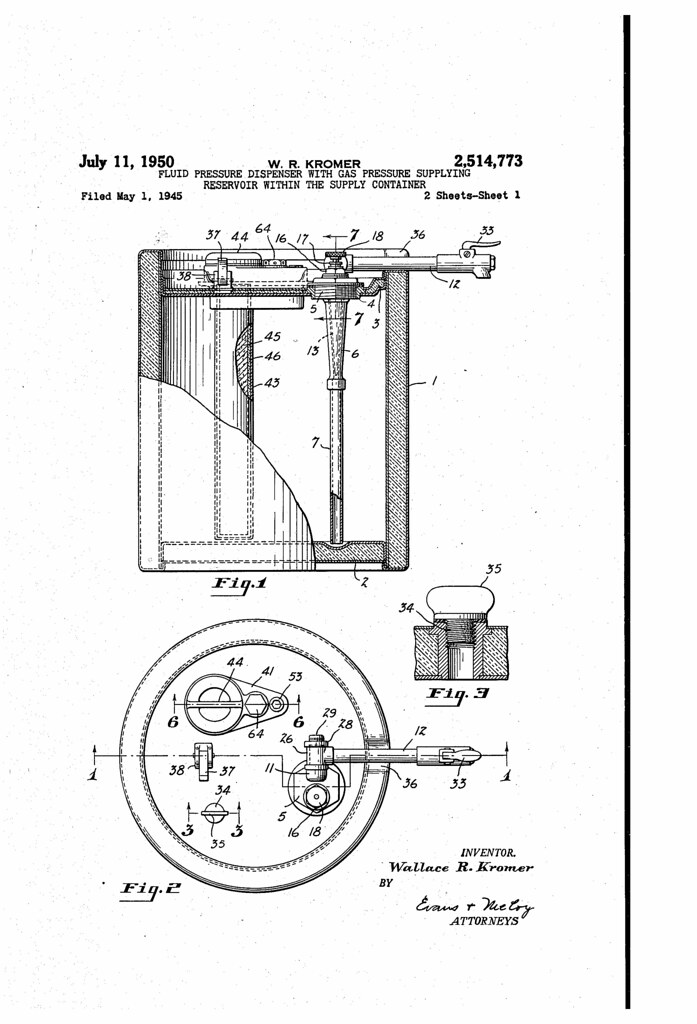
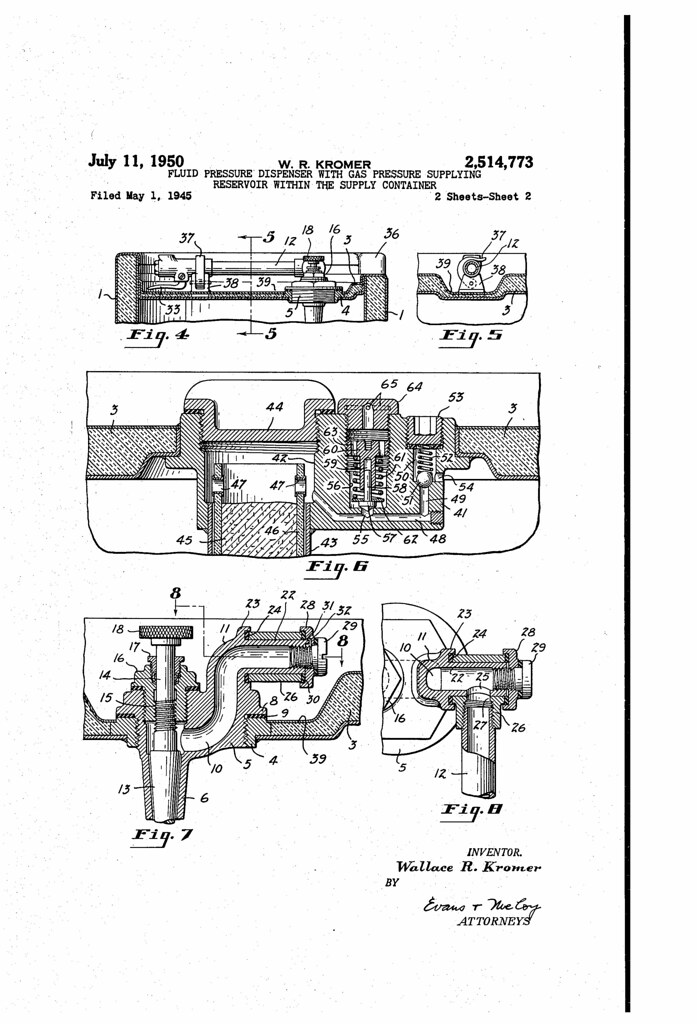
Today in 1950, US Patent 2514773 A was issued, an invention of Wallace R. Kromer, assigned to the Superflow Mfg. Corp., for his “Fluid Pressure Dispenser with Gas Pressure Supplying Reservoir Within the Supply Container.” There’s no Abstract, although in the description it includes this summary:

This invention relates to a dispensing device for beer or carbonated beverages and has for its object to provide a dispensing container that is provided with cooling and pressure generating means that are so designed that they occupy but Small space within the container and reduce but little the liquid capacity of the container.

A further object is to provide a dispensing container of simple. compact construction having convenient cooling, pressure generating and dispensing devices attached to its top wall and adapted to be disposed wholly Within and below the top edge of the chime at the top of, the container so that containers embodying the invention may, be stored and shipped without damage to the attachments; v

An additional object of the invention is to provide a simple” and convenient means for utilizing solid carbon dioxide generally known ‘as DryIce, to cool the beverage and to create and maintain a pressure within the receptacle that will prevent escape of carbon dioxide from the beverage and that U will force the beverage through the tap when the faucet valve is opened.

“A further object of the invention is to provide a faucet that can be moved from an inoperative position overlying the top of the. container, to an operative position projecting laterally from the container and that is detachably fastened in its inoperative position so that it may be used as a handle for carrying the container.

US2514773-0
US2514773-1

Filed Under: Beers, Just For Fun, Politics & Law, Related Pleasures Tagged With: History, Kegs, Law, Patent

« Previous Page
Next Page »

Find Something

Northern California Breweries

Please consider purchasing my latest book, California Breweries North, available from Amazon, or ask for it at your local bookstore.

Recent Comments

  • Ernie Dewing on Historic Beer Birthday: Charles William Bergner 
  • Steve 'Pudgy' De Rose on Historic Beer Birthday: Jacob Schmidt
  • Jay Brooks on Beer Birthday: Bill Owens
  • Steve 'Pudgy' De Rose on Beer Birthday: Charles Finkel
  • Steve 'Pudgy' De Rose on Beer Birthday: Bill Owens

Recent Posts

  • Historic Beer Birthday: John Goetz January 28, 2026
  • Beer Birthday: Jean-Marie Rock January 28, 2026
  • Beer In Ads #5184: The “B”s Are Here, Bruton Bock Beer January 27, 2026
  • Beer Birthday: Logan Plant January 27, 2026
  • Historic Beer Birthday: William Tunis Ryerson January 27, 2026

BBB Archives

Feedback

Head Quarter
This site is hosted and maintained by H25Q.dev. Any questions or comments for the webmaster can be directed here.