Brookston Beer Bulletin

Jay R. Brooks on Beer

  • Home
  • About
  • Editorial
  • Birthdays
  • Art & Beer

Socialize

  • Dribbble
  • Email
  • Facebook
  • Flickr
  • GitHub
  • Instagram
  • LinkedIn
  • Pinterest
  • RSS
  • Twitter
  • YouTube

Powered by Genesis

Moderate Drinking Lowers Diabetes Risk

May 6, 2010 By Jay Brooks

health
A recent study from several universities in the Netherlands shows as much as a 40% decrease in the risk of type 2 diabetes for people who drink alcohol in moderation as compared to people who abstain altogether. Reuters is reporting today about the study, which went online last week at the website for the American Journal of Clinical Nutrition.

The study itself, entitled the “Combined Effect of Alcohol Consumption and Lifestyle Behaviors on Risk of Type 2 Diabetes,” concluded that even a healthier overall lifestyle could not explain the lower risk brought upon by moderate alcohol consumption, as had been previously thought.

From the Abstract:

Objective: We studied whether moderate alcohol consumption is associated with a lower risk of type 2 diabetes in adults with combined low-risk lifestyle behaviors.

Design: We prospectively examined 35,625 adults of the Dutch European Prospective Investigation into Cancer and Nutrition (EPIC-NL) cohort aged 20–70 y, who were free of diabetes, cardiovascular disease, and cancer at baseline (1993–1997). In addition to moderate alcohol consumption (women: 5.0–14.9 g/d; men: 5.0–29.9 g/d), we defined low-risk categories of 4 lifestyle behaviors: optimal weight [body mass index (in kg/m2) <25], physically active (≥30 min of physical activity/d), current nonsmoker, and a healthy diet [upper 2 quintiles of the Dietary Approaches to Stop Hypertension (DASH) diet].Results: During a median of 10.3 y, we identified 796 incident cases of type 2 diabetes. Compared with teetotalers, hazard ratios of moderate alcohol consumers for risk of type 2 diabetes in low-risk lifestyle strata after multivariable adjustments were 0.35 (95% CI: 0.17, 0.72) when of a normal weight, 0.65 (95% CI: 0.46, 0.91) when physically active, 0.54 (95% CI: 0.41, 0.71) when nonsmoking, and 0.57 (95% CI: 0.39, 0.84) when consuming a healthy diet. When ≥3 low-risk lifestyle behaviors were combined, the hazard ratio for incidence of type 2 diabetes in moderate alcohol consumers after multivariable adjustments was 0.56 (95% CI: 0.32, 1.00).

Conclusion: In subjects already at lower risk of type 2 diabetes on the basis of multiple low-risk lifestyle behaviors, moderate alcohol consumption was associated with an approximately 40% lower risk compared with abstention.

All good news, right? Well, one feature that’s ubiquitous every time another study has great news about drinking beer drives me absolutely crazy. The Reuters’ report concludes with this unnecessary disclaimer, as they all seem to.

That said, [the lead research scientist] also noted that experts do not recommend that non-drinkers take up moderate drinking simply because it is related to lower risks of certain diseases. Alcohol always carries the potential for abuse, and the known risks of problem drinking have to be balanced against the possible health benefits of moderate drinking.

It’s as if they’re afraid that if they don’t say something like this, that people will go on a drinking binge, thinking it’s good for them all of a sudden. Can they really think so little of their audience? Or is simply being worried about liability? Either way, it drive me to drink.

Filed Under: Beers, News Tagged With: Health & Beer, Science

Dem Bones & Beer Again

February 10, 2010 By Jay Brooks

skeleton-2
Earlier this week, both the UK Guardian and Reuters had stories about a study which confirmed that beer is a very rich source of silicon. It was done by Charlie Bamforth, among others, at the Department of Food Science & Technology at U.C. Davis, and the study, Silicon in Beer and Brewing, “found beer is a rich source of silicon and may help prevent osteoporosis, as dietary silicon is a key ingredient for increasing bone mineral density.”

From the Reuters article:

“We have examined a wide range of beer styles for their silicon content and have also studied the impact of raw materials and the brewing process on the quantities of silicon that enter wort and beer,” researcher Charles Bamforth said in a statement.

The study, [to be] published in the Journal of the Science of Food and Agriculture, found the beers’ silicon content ranged from 6.4 milligrams per liter to 56.5 mg per liter. The average person’s silicon intake each day is between 20 and 50 mgs.

They found pale ales showed the highest silicon content while non-alcoholic beers, light lagers and wheat beers had the least silicon.

“Beers containing high levels of malted barley and hops are richest in silicon,” said Bamforth.

Add silicon to the long list of ways in which the moderate consumption of beer is good for you.

Filed Under: Beers, News Tagged With: Health & Beer, Science

Loud Music Increases Drinking

January 26, 2010 By Jay Brooks

volume-green
I found this interesting bit of research at the PsyBlog, run by Jeremy Dean, a Psychology researcher at the University College London. The post is entitled Why Loud Music in Bars Increases Alcohol Consumption, and concerns some recent research conducted into the relationship between volume and drinking patterns. Specifically, Dean cites two studies, one in Glasgow, Scotland and the other in France. In some ways the findings are obvious, but it does tend to confirm what you probably already guessed. The PsyBlog starts with the premise that the average bar traditionally keeps the lights dim and the music loud.

But turning the music up so loud that people are forced to shout at each other doesn’t have quite the same beneficial effect on social interactions. Because everyone is shouting, the bar becomes even noisier and soon people start to give up trying to communicate and focus on their drinking, meaning more trips to the bar, and more regrets in the morning.

Of course this is exactly what bar owners are hoping for. People sitting around quietly nursing their drinks for hours are no good for profits. Talkers aren’t the best drinkers. At least that is the received wisdom in the industry.

The first study, Sound Level of Environmental Music and Drinking Behavior: A Field Experiment With Beer Drinkers, was published in the journal Alcoholism: Clinical and Experimental Research. Their results indicated “that high level volume led to increase alcohol consumption and reduced the average amount of time spent by the patrons to drink their glass.”

The second study was published in the journal Popular Music & Society, and was titled Alco-pop? The Use of Popular Music in Glasgow Pubs.

volume-to-11
Here’s a bit more as to how the research was conducted.

The level of the music was randomly manipulated to create the conditions of a true experiment. It was either at its usual volume of 72dB or turned up to 88dB. For comparison: 72db is like the sound of traffic on a busy street while 88db is like standing next to a lawnmower.

Sure enough when the music went up the beers went down, faster. On average bar-goers took 14.5 minutes to finish a 250ml (8 oz) glass of draught beer when the music was at its normal level. But this came down to just 11.5 minutes when the music was turned up. As a result, on average, during their time in the bar each participant ordered one more drink in the loud music condition than in the normal music condition.

The observers even measured the number of gulps taken to finish each drink — the level of the music was found to have no effect on this. So the faster drinking was as a result of more gulps rather than bigger gulps.

The conclusions from both studies seem to validate one another, suggesting a universal application. The results do seem to favor a causal connection between louder music and increased drinking, but what they don’t answer is why this is the case. As Dean puts it. “Some think that people drink instead of talking while others have argued that they drink more because the music creates greater levels of arousal, which then leads to more drinking.”

Personally, I prefer a bar where I can hear myself think, where pleasant conversation is encouraged, but then I prefer to sip, not gulp, my beer in almost any environment. So clearly, I’m not the target demographic, nor I suspect are most hardcore beer geeks, but it still is a fascinating peek into what makes us tick — and drink.

UPDATE: The BC Brews Blog also came across this study independently and posted about it in Loud Music = Heavier, Faster Drinking.

Filed Under: Beers, Editorial, Just For Fun Tagged With: Pubs, Science, Statistics

A Fermentation Question

January 6, 2010 By Jay Brooks

fermentation
I preordered Michal Pollan’s new book, Food Rules, so it arrived on the day it was published. At 112 sparse pages, it’s really more of a pamphlet but I’ve been enjoying reading it off and on for the last few days. When I reached Rule #33 (of 64) it stopped me in my tracks, and it started me thinking. Here’s the rule:

Rule 33

Eat some foods that have been predigested by bacteria or fungi.

Many traditional cultures swear by the health benefits of fermented foods — foods that have been transformed by live microorganisms, such as yogurt, sauerkraut, soy sauce, kimchi, and sourdough bread.

Pollan goes on to list essential nutrients, vitamins, etc. found in these foods. He ends by mentioning that probiotics are contained in many fermented foods, which studies “suggest improve the function of the digestive and immune systems,” and may combat allergies, too.

So here’s my question. If, as Pollan seems to suggest, that it’s fairly settled that fermented foods have health benefits, doesn’t it then follow that fermented beverages would, too?

In Rule 43 he suggests drinking wine with dinner, while not mentioning beer at all. And the man’s from Berkeley, for chrissakes. He appears to be following the old reservatrol canard in choosing wine over other alcohol, though he admits alcohol of any kind can be beneficial in moderation, something that’s becoming increasingly apparent in study after study.

That slight aside, isn’t fermentation fermentation? It’s an anaerobic process (meaning it takes place without oxygen) in which chemical reactions split complex organic compounds into more simple substances. And if it’s good in food, it should be similarly beneficial in beer, wine and spirits, too.

Beer has been called liquid bread since ancient times. It’s nourished men and women since civilization began, and increasingly is believed to have been the very reason for civilization’s beginnings. Some scientists now believe that our ancestor’s tolerance for alcohol in quantity was an important factor in their survival. So much so, that quite literally you and I owe our very existence to the fact that we have an unbroken chain of ancestors stretching back to the dawn of civilization whose ability to process alcohol insured they lived long enough to reproduce. If that had not been the case, I wouldn’t be here to write these words and you wouldn’t be here, reading them now.

Anyway, just some … ahem … food for thought. Any brewers, chemists or scientists out there know if there would be any substantial difference between fermented food and a fermented beverage? I certainly can’t think of any. If not, I would suggest that Food Rule #33 be amended to “Eat some foods or drink some beverages that have been predigested by bacteria or fungi.”

food-rules

Filed Under: Beers, Editorial, Food & Beer Tagged With: Science, Science of Brewing

When All Else Fails, Blame Society

December 30, 2009 By Jay Brooks

crime-dog
Here’s another troubling development in the drive to erase alcohol from society. A study to be published next March in Alcoholism: Clinical and Experimental Research was featured in Science Daily last week based on an early view of the study online. (Thanks to Bulletin reader Pete M. for sending this to me.) That account was titled Alcohol Outlets Lead to Specific Problems Among Youth and Young Adults suggesting the issue is settled but the study’s title is a more vague: Ecological Associations of Alcohol Outlets With Underage and Young Adult Injuries. The Science Daily account is based on the study, but being unwilling to shell out the necessary doubloons for a subscription so I can read the whole thing means only the abstract is available to me, and it’s one of the least useful ones I’ve ever read, having almost no real information about the study at all. Here it is in its entirety.

Objective: This paper argues that associations between rates of 3 specific problems related to alcohol (i.e., accidents, traffic crashes, and assaults) should be differentially related to densities of alcohol outlets among underage youth and young adults based upon age-related patterns of alcohol outlet use.

Methods: Zip code-level population models assessed local and distal effects of alcohol outlets upon rates of hospital discharges for these outcomes.

Results: Densities of off-premise alcohol outlets were significantly related to injuries from accidents, assaults, and traffic crashes for both underage youth and young adults. Densities of bars were associated with more assaults and densities of restaurants were associated with more traffic crash injuries for young adults.

Conclusions: The distribution of alcohol-related injuries relative to alcohol outlets reflect patterns of alcohol outlet use.

From Science Daily’s account:

“Over the past four decades, public health researchers have come to recognize that although most drinkers safely purchase and enjoy alcohol from alcohol outlets, these places are also associated with serious alcohol-related problems among young people and adults,” said Paul J. Gruenewald, senior research scientist at the Prevention Research Center and corresponding author for the study.

“In the early studies, researchers believed associations were due to increased alcohol consumption related to higher alcohol outlet densities,” added Richard Scribner, D’Angelo Professor of Alcohol Research at the LSU School of Public Health. “However, as the research area has matured, the relations appear to be far more complex. It seems that alcohol outlets represent an important social institution within a neighborhood. As a result, their effects are not limited to merely the consequences of the sale of alcohol.”

So while admitting the problem is very complex, they nonetheless go on to leap to some pretty simple conclusions, that don’t seem at all supported by the evidence. At a minimum, their conclusions are only one of many possible reasons for the results their data seems to show, but which in no way leads to one inescapable conclusion, as they seem to think.

As my Bulletin reader Pete succinctly puts it:

It strikes me as another example of a giant leap of logic between an observed correlation and implied causation. There’s a link between, on the one hand, the residential ZIP Codes of patients of certain ages discharged from hospital for certain injuries, and on the other, the number of bars, restaurants, and liquor stores in those same ZIP Codes. Interesting, perhaps, but the real question is why?

Exactly. Why indeed?

But the truly scary bit is in their half-baked conclusions.

The key message, said both Gruenewald and Scribner, is that a neighborhood’s alcohol environment plays a role in regulating the risks that youth and young adults will be exposed to as they mature.

“From a prevention perspective, this represents an important refocusing of priorities, away from targeting the individual to targeting the community,” said Scribner. “This is hopeful because a community-based approach that addresses the over concentration of alcohol outlets in a neighborhood where youth injuries are a problem is relatively easy compared with interventions targeting each youth individually.”

So liquor stores are already subject to strict zoning in many places, will this be used to further isolate them next to the adult bookstores at the edge of towns? Won’t that just increase drunk driving?

Again, I turn to Pete’s assessment.

With no other supporting evidence, the study’s authors appear to suggest that more of these “alcohol outlets” in your neighborhood lead to more assaults, accidents, etc. They make this assertion despite the fact that the hospital data they used doesn’t say whether or not alcohol was even involved in those cases. Moreover, the ZIP Code of one’s residence is often not the ZIP Code where one purchases and consumes their alcohol; where we live and where we drink are not the same, particularly at the spatial resolution of ZIP Codes.

If they really want to explain the empirical patterns they found, I suggest the researchers look at other factors that might correlate with the geography of alcohol outlets. Check zoning ordinances, for example, and the neighborhoods in which such outlets are allowed. My guess is you’d find nearby residences populated disproportionately by less affluent households, ones who are either: (a) at more risk of being involved in an accident or assault regardless of any connection to alcohol, and/or (b) are less likely to have health insurance and thus more likely to end up in a hospital emergency room following minor altercations and accidents that would be treated on an outpatient basis in a more affluent part of town.

There are no doubt plenty of possible explanations; the quickness with which researches will jump to the conclusion that it’s the alcohol’s fault never ceases to amaze me.

Indeed, that is the mystery and the trouble, especially as this is the sort of thing that neo-prohibitionist groups, spearheaded by the Robert Wood Johnson Foundation, have been spending millions of dollars on, and not surprisingly getting the results that they want to further their agenda. There are research groups funded by the brewing industry that come to opposite conclusions, of course, but those are usually discounted or discredited for that affiliation, yet the media rarely does the same to studies like this one, not even bothering to ask about the funding or the agenda of the group. That such studies can then be published in “legitimate” science journals makes them even less likely to be questioned, even though that’s exactly what the media should be doing.

Don’t worry, it’s the not the individual person who abuses alcohol and good sense that’s at fault here, it’s the community where he lives. As a Monty Python skit once suggested, with a Bobby investigating a murder: “society’s to blame? Let’s lock them up instead.”

Filed Under: Editorial, Politics & Law Tagged With: Prohibitionists, Science

Fact: Geologists Love Beer

December 19, 2009 By Jay Brooks

geology
Beginning with the bold pronouncement, “Fact — Geologists Love Beer,” Wired magazine explains Why Geologists Love Beer.

This week in San Francisco, the American Geophysical Union is having their annual convention at Moscone Convention Center. According to Wired:

“Every other convention assumes that if you have a beer, your brain goes soft,” said Kathy Sullivan, who has been serving beer at the AGU meeting for 26 years. ”But not the geophysicists. They think if you have a beer, you can still learn things. So they do.”

At the Thirsty Bear, the closest brewpub to the Moscone Convention Center where the annual meeting is held every December, the waitstaff claims this is the busiest week of the year for them. I heard from the Borehole Research Group at the Lamont Doherty Earth Observatory that one server at the Thirsty Bear said the staff can’t take vacation days during the AGU meeting ”because the geologists are coming.”

earth-beyond
Betsy Mason, the author of the article — and a geologist and beer lover herself — polled the 16,00 convention attendees to try to figure why a love of rocks translates to a love of beer. Her results make entertaining reading. And, this insight is personally good news, because it explains yet another one of my own peculiar obsessions. I, too, love rocks. From childhood, I’ve been fascinated by them and to this day always pick up interesting rocks during vacations to bring back home as souvenirs. Throughout my house, I have jars and plates displaying the rocks I’ve found all over the world. Before now, I just thought it was another one of my odd obsessions, but I’m happy to learn it’s just part and parcel of my love of beer, the two apparently go hand in hand.

Watch the video below, bartender Kathy Sullivan is my new favorite person. Listen to what she has to say about the geologists drinking beer at their convention.

“It’s the only convention that thinks adults know whether they can drink and pay attention or not. Every other convention assumes that if you have a beer your brain goes soft, but not the geophysicists, they think if you have a beer you can still learn things … It’s treating people like adults as opposed to children.”

Filed Under: Beers, Just For Fun Tagged With: San Francisco, Science

Fun With Science: Beer Can Robug

November 15, 2009 By Jay Brooks

science
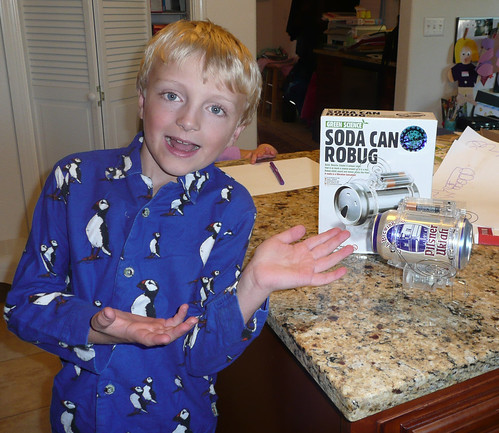
This morning, my son Porter and I finally got around to building the Kids Lab science project that he got for his birthday back in September. It was a Soda Can Robug, but since we’re a soda-free household, we used a beer can instead.
beer-robug
Porter showing off his Beer Can Robug, made with Ukiah Pilsner.

Filed Under: Just For Fun, Related Pleasures Tagged With: Cans, Science

Tipping The Sacred Cows Of Addiction

May 29, 2009 By Jay Brooks

aa
I have nothing against Alcoholic Anonymous per se. I know that it’s been helpful for thousands, perhaps millions of people since 1935. There are currently estimated to be just under 2 million members in a little more than 114,000 groups around the world, with the majority being in the U.S. and Canada.

I grew up with an alcoholic stepfather who was also psychotic and prone to violence, and many, if not most, of his circle of friends were similarly afflicted. When I was in my early 20s, I even went to a couple of meetings for “Adult Children of Alcoholics,” though I don’t recall if they were affiliated with Al-Anon or Adult Children of Alcoholics (a.k.a. Adult Children Anonymous). Not to disparage those groups, but it wasn’t for me. I was an unfocused, troubled youth, trying to find my way in the world alone. But it didn’t take me long to figure out that I wasn’t that untypical or that it had as much to do with losing my mother to breast cancer at 21 than anything else, not to mention my own personality quirks.

But I’ve never been comfortable with their tacit suggestion that it’s the only way. For A.A. to work, one has to admit being “powerless” when in fact many people are powerful enough to overcome their addiction. I remember seeing a documentary several years ago that contrasted AA with a philosophy common in Japan for working with people with addictive behaviors. To the Japanese way of thinking, a person wasn’t “cured” until they could enjoy the occasional drink without lapsing back into their over-indulging ways. That always seemed more correct to me. The AA way of simply avoiding alcohol never seemed like a cure but a way of circumventing the problem without actually addressing it or the underlying causes.

On their website, under the heading “is AA for you?,” it states. “We who are in A.A. came because we finally gave up trying to control our drinking. We still hated to admit that we could never drink safely” and the general pamphlet about A.A. goes on to say that members “cannot control alcohol. [They] have learned that [they] must live without it if [they] are to avoid disaster for [them]selves and those close to [them].” Their stated purpose “is to stay sober and help other alcoholics to achieve sobriety.” But, of course,” staying sober for many is a lifelong struggle. For many they believe it’s the only way they can function. But what if it wasn’t the only way, as so many A.A. members insist? Wouldn’t that be something they would embrace? Well, no, apparently not. It appears that the only way being powerless works is to believe it, then the rest can fall into place. So it’s my experience that challenges to the A.A. ethos are fierce and vigorous, because they believe it will undo the base upon which its foundation stands. If they’re not powerless, then it becomes a house of cards.

So with that in mind, the Toronto Star published an article last week entitled Addiction: Could It Be a Big Lie? The article is examining a new book by Harvard professor Gene M. Heyman, a psychologist. His new book carries the incendiary title Addiction: A Disorder of Choice and “argues that addiction isn’t really an illness, infuriating the medical establishment.”

According to the article, it’s not the first to do so, but is one of several published in the first decade of the 21st century to challenge the conventional wisdom, which the article calls an “overwhelming scientific consensus that addiction is an involuntary disease.” The Star goes on to give voice to people who disagree, who use the opportunity to insult both the author and Harvard itself for even allowing a dissenting opinion into the world.

Heyman’s goal is nothing short of persuading “us that we have been persistently deceived by so-called addiction experts who do not understand addiction.” The book is complex and the publisher describes it like this:

In a book sure to inspire controversy, Gene Heyman argues that conventional wisdom about addiction—that it is a disease, a compulsion beyond conscious control—is wrong.

Drawing on psychiatric epidemiology, addicts’ autobiographies, treatment studies, and advances in behavioral economics, Heyman makes a powerful case that addiction is voluntary. He shows that drug use, like all choices, is influenced by preferences and goals. But just as there are successful dieters, there are successful ex-addicts. In fact, addiction is the psychiatric disorder with the highest rate of recovery. But what ends an addiction?

At the heart of Heyman’s analysis is a startling view of choice and motivation that applies to all choices, not just the choice to use drugs. The conditions that promote quitting a drug addiction include new information, cultural values, and, of course, the costs and benefits of further drug use. Most of us avoid becoming drug dependent, not because we are especially rational, but because we loathe the idea of being an addict.

Heyman’s analysis of well-established but frequently ignored research leads to unexpected insights into how we make choices—from obesity to McMansionization—all rooted in our deep-seated tendency to consume too much of whatever we like best. As wealth increases and technology advances, the dilemma posed by addictive drugs spreads to new products. However, this remarkable and radical book points to a solution. If drug addicts typically beat addiction, then non-addicts can learn to control their natural tendency to take too much.

But as the Toronto Star points out, it’s “fundamentally based, however, on that last, simple point: Addicts quit. Clinical experts believe addiction cannot be permanently conquered, Heyman writes, because they tend to study only addicts who have entered treatment programs. People who never enter treatment – more than three-quarters of all addicts, according to most estimates – relapse far less frequently than those who do, since people in treatment more frequently have additional medical and psychiatric problems.”

Star reporter Daniel Dale continues:

People who have stronger incentives to remain clean, such as a good job, are more likely to make better lifestyle choices, Heyman writes. This is not contentious. But he also argues that the inability to resist potentially harmful situations is a product of others’ opinions, fear of punishment, and “values”; it is a product of a cost-benefit analysis.

He does not dispute that drug use alters the brain. He does not dispute that some people have genes that make them more susceptible to addiction. He disputes that the person who is predisposed to addiction and the person whose brain has been altered are not able to ponder the consequences of their actions. In other words, he disputes that biological factors make addicts’ decisions compulsive.

I find such discussions fascinating because of my own experiences along with what I’ve seen and read about addiction. In my stepfather’s case, his family enabled him by pretending his aberrant behavior didn’t exist and dismissed or excused his violence as something my mother and I either deserved or exaggerated. My mother was also a party to the dysfunction and was clearly co-dependent, but that’s a story for another day. The point is, you’d be hard-pressed to find a more dysfunctional individual who seemingly could not control himself. And yet every summer we’d take a one-week car vacation and over the course of my childhood we drove (from Pennsylvania) as far north as Canada, as far south as the Florida Keys, and as far West as Indiana. A few weeks before we’d load up the car, my stepfather would inexplicably just stop drinking and work harder than I’d ever seen him (for most of the time, he was a mechanic, and owned his own repair shop) to save up money for our vacation. There was no fanfare, no detox time, he’d simply be drunk one day and decide the next it was time to earn the vacation money. It was usually two weeks and sometimes longer if my folks had planned a more extensive trip. So every year, for between two and four weeks, my stepfather seemingly just flipped a switch inside himself and became sober. There were no side-effects I ever saw, no temptations I ever witnessed, it just seemed as natural as the sun coming up each morning. This odd, almost contradictory behavior, I realized (unfortunately, not until I was older), seemed to seriously fly in the face of what conventional wisdom had to say about alcoholism, that my stepfather had no control over himself or his actions. And his example wasn’t the only one I saw, just the one I knew best.

But when Join Together posted this story, most of the comments were predictably dismissive and downright abusive or insulting. Some took a “how dare he” position as if a contrary opinion constituted a personal attack. They seem to think his opinion was just shot from the hip or has no foundation whatsoever and therefore he had no right to state it, even when none had actually read it. I haven’t read it either, of course, but I’m willing to give it a chance whereas the addiction crowd doesn’t seem capable of that, and I suspect it’s that house of cards idea that it could all come crashing down. But that’s what happens when you build with straw or sticks, an idea comes along and huffs and puffs.

The history of science is filled with examples of individuals who theorized beyond the scope of the conventional wisdom of the day and were insulted, disgraced, ruined or worse before later being vindicated. Obviously, I can’t say with any certainty that Heyman’s ideas will stand up to further scrutiny and testing, but history suggests we should at least listen to him and explore his ideas further, and not so quickly dismiss them out of hand, as appears to be what’s happening. The only news organizations to even cover the book’s publication are from Canada. A Google News search came up with not one American article, which in and of itself I think is telling.

The other Canadian piece is an interview in Maclean’s, essentially Canada’s weekly Time magazine and Newsweek rolled into one. It’s a very interesting and enlightening read. Heyman, I’m not surprised to learn, comes across as very even-handed and practical, even saying kind things about A.A.’s effectiveness, despite the addiction crowd’s apparent attack on him.

To the question about how on earth “the idea that addiction is a disease governed by uncontrollable compulsion [took] root?” Heyman replies.

The first people to call addiction a disease were members of the 17th-century clergy. They were looking at alcoholism and they didn’t describe it as sin or as crime. I have a theory as to why they thought this—and why we think it even today. It’s this problem we have with the idea that individuals can voluntarily do themselves harm. It just doesn’t make sense to us. Why wouldn’t you stop? In the medical world, in economics, in psychology and in the clergy, they really have no category for this, no way of explaining behaviour that is self-destructive and also voluntary. The two categories available to them are “sick” or “bad.”

And that does seem to conform to how I see addiction and alcoholism portrayed, yet I have witnessed so many people who have been able to simply quit of their own volition that on reflection it seems almost obvious that it can’t be a disease. It would be like deciding to cure your cancer and then just doing so by simply making such a decision. It would be like saying “that cancer was ruining my life so I just decided to quit having it.” If one person did that, it would be a miracle. But if thousands, perhaps millions of people can effectively just quit doing something considered to be a disease, wouldn’t you have to reevaluate or reconsider that very notion?

And on the other side of the coin, I see lots of people who get drunk and use being drunk as an excuse to do things and get away with doing things that wouldn’t be tolerated from a sober person. To me, that’s the really bad side of viewing alcoholism as a disease. It allows people to not be responsible for their actions when they can persuade others that it was the alcohol that “made them act that way.” Sure it was. I’ve known — and still know — plenty of bad drunks who still play that game. Many people let them get away with it, and I contend it’s because they accept the idea that they can’t help themselves when they’re drunk, that they’re somehow not responsible for their actions. Bullshit, I say. People should be held accountable for their actions, whether sober, falling down drunk or somewhere in between. So I imagine a lot of people who’ve been getting away with acting badly and blaming alcohol will be quite unhappy with Heyman’s assertions, after all it undermines their ability to be jerks and get away with it. But I also believe such people are ruining it for the rest of us, who don’t turn into assholes when we drink too much. I get more talkative and eventually more sleepy. I get friendlier and am probably better company as I’m less reserved in person than usual. But that’s about it, I retain my ability to judge right from wrong, to know what’s acceptable behavior and what’s not. I don’t harass people or get in their face. I’m usually acutely aware of my own level of intoxication. Most importantly, I don’t think I’m unique in that. The majority of people I drink with regularly are similarly self-aware and don’t become a drunken Mr. Hyde to their sober Dr. Jekyll.

So who’s right? Obviously, it’s a complicated question and one not easily decided. But like most things, it’s worth at least discussing the possibility that alcoholism is not a disease, even if it makes some people uncomfortable and may undermine conventional wisdom. We can only evolve in our intellectual understanding of the world if we remain open to new ideas. Some of us can discuss such ideas over a beer, others not so much, at least as long as we cling to the idea they just can’t help themselves.

Filed Under: Editorial, Politics & Law Tagged With: Anti-Alcohol, Science

« Previous Page

Find Something

Northern California Breweries

Please consider purchasing my latest book, California Breweries North, available from Amazon, or ask for it at your local bookstore.

Recent Comments

  • Ernie Dewing on Historic Beer Birthday: Charles William Bergner 
  • Steve 'Pudgy' De Rose on Historic Beer Birthday: Jacob Schmidt
  • Jay Brooks on Beer Birthday: Bill Owens
  • Steve 'Pudgy' De Rose on Beer Birthday: Charles Finkel
  • Steve 'Pudgy' De Rose on Beer Birthday: Bill Owens

Recent Posts

  • Historic Beer Birthday: Gottlieb Sigismund Kirchhof February 19, 2026
  • Beer Birthday: Spike Buckowski February 19, 2026
  • Beer In Ads #5210: Drink A Toast To Spring With Butte Bock February 19, 2026
  • Historic Beer Birthday: Henry Allsopp February 19, 2026
  • Beer Birthday: Chris Black February 19, 2026

BBB Archives

Feedback

Head Quarter
This site is hosted and maintained by H25Q.dev. Any questions or comments for the webmaster can be directed here.