The folks at Easy Lift Equipment just sent me this fun infographic they created, with the help of Frugal Dad, entitled the Case for Beer. Enjoy.


The folks at Easy Lift Equipment just sent me this fun infographic they created, with the help of Frugal Dad, entitled the Case for Beer. Enjoy.

Okay, these things are pretty easy to pick apart because no one will ever agree on where the “best” or “top” destinations are for anything, beer or otherwise. I understand that top x lists are very popular. Hell, I enjoy making them myself. They can be fun. But take a look at what the Travel Channel, written by NYC-based travel writer Jimmy Im, has chosen as the Top 7 Beer Destinations.
So while I’m sure none of the places he’s listed are bad beer destinations, and certainly a few of them deserve to be on this list, I have a hard time accepting these as the very top destinations. The list strikes me as being from someone who’s not really connected to the beer community in any meaningful way. If they had only resisted calling them the top beer destinations and called them instead something like “seven beer destinations worth visiting” that might have worked, but they didn’t. Im specifically states that “these destinations that are fast becoming beer scene kings that offer some of the best suds in town.”
So while I have no problem with Asheville being here, ignoring Philly, Portland (both Oregon and Maine), San Francisco, San Diego, Seattle, Denver, Boston, Chicago and several others makes this list more infamous for what it’s left out than what was chosen. Certainly L.A. is an up and coming beer city, and has made great strides over the last few years, but I’m not sure I’d put it as the second-best beer destination, especially over so many others left out. And he singles out the Strand Brewing Co. and El Segundo Brewing Company as “two of the more popular breweries.” No disrespect to those two breweries — I haven’t been to either of them but I’m sure they’re fine places — but those are not the L.A breweries that are making a splash lately.
Third is the entire state of Virginia, and Im seems to have chosen the Old Dominion State because it’s “so obsessed with its beer culture, it is officially naming the month of August ‘Virginia Craft Brew Month'” and now has 40 breweries. Well July is Oregon Beer Month and February is California Beer Month. Oregon has over 160 breweries and California around 325. So while Virginia is a terrific state and undoubtedly has some fine breweries, if obsession, state beer months and the number of breweries is his criteria, then I’m just not sure Virginia is the right one to choose.
The remaning four, Toronto, the New York Finger Lakes, Atlanta and Traverse City, Michigan, again I’m sure are all fine beer places, but do they deserve to be among the “top 7?” By choosing Toronto, he’s also opened the door to other international beer destinations, of which there are numerous examples, many of which most people would choose over some of the destinations on the Travel Channel’s list. With the last one, Traverse City, Im seems even to have forgotten his own mandate, when he refers to the Michigan town as an “emerging beer town.” It may well be, but shouldn’t we wait until it’s emerged before putting it on the list of the top spots?
So while these things are, as I alluded to, very subjective and depend greatly on how you define the criteria used to rank them, these choices wouldn’t pass muster for even a casual beer lover. It could have been a fun list if they’d only resisted the temptation to declare them the “Top 7 Beer Destinations.” They’re just not.

I saw this tweet earlier today from my neighbors at the Marin Institute — now Alcohol Justice:
#Alcohol is the third-leading #preventable cause of death in the U.S. Fact sheets – #free to download… http://bit.ly/r8KoO5
First of all, somebody at Alcohol Justice (AJ) doesn’t quite understand the hashtag, using it on alcohol, preventable and free!
But Twitter etiquette aside, that statement is false, and they probably know that, making it a lie, to my way of thinking. But saying it that way makes it sound scarier, and AJ is all about propaganda these days as IMHO they’ve become more and more neo-prohibitionist since becoming the self-appointed sheriff, and changing their name.
That statement about alcohol being the “third-leading preventable cause of death in the U.S.” comes from the CDC. It’s from a 2001 study entitled “Alcohol-Attributable Deaths and Years of Potential Life Lost — United States, 2001,” and published in 2004. The very first words of the summary give you the spin, as it begins “Excessive alcohol consumption is the third leading preventable cause of death in the United States.” That’s right, it’s not alcohol, but excessive alcohol. Those of you drinking in moderation and responsibly — that is, the vast majority of adult drinkers — can breathe a sigh a relief. They weren’t talking about you. But they did materially change the “facts” to suit their needs and agenda. Put less charitably, they lied, at least in my opinion. Here’s the first few sentences:
Excessive alcohol consumption is the third leading preventable cause of death in the United States and is associated with multiple adverse health consequences, including liver cirrhosis, various cancers, unintentional injuries, and violence. To analyze alcohol-related health impacts, CDC estimated the number of alcohol-attributable deaths (AADs) and years of potential life lost (YPLLs) in the United States during 2001.
There’s a table at the bottom that reiterates that they’re taking about “the harmful effects of excessive alcohol use.” That table then lists all sorts of diseases, many of which may be related to alcohol, but many or most of which are only marginally associated. These sorts of reports have been discredited before, because they include a disease that excessive alcohol use may make worse, but which won’t cause the disease all on its own. Other factors are always involved. More generally, these are estimates that take a lot of liberties in their calculations. They are not hard numbers by any stretch.
The second report that AJ attributes to this statement is another study, this one also from 2004 in JAMA, the Journal of the American Medical Association. In that article, Actual Causes of Death in the United States, 2000, they found that heart disease, tumors and strokes were the three leading causes of death for Americans. You can see from the numbers that those statistics were relatively precise.

But now look at the next chart, where alcohol consumption is listed as the third highest among what they term “actual causes of death.” Those are obvious estimates, and based on how round the numbers are, probably more like guesses. They come from several studies conducted by interview, some by phone, in both the U.S. and Australia that were aggregated together. So at least a half-dozen studies using different methodologies, questions and sample sizes were lumped together to create their findings. And if you review the study’s limitations near the bottom at the “Comments” section you’ll see that there were many factors, such as genetics and cholesterol levels, that were simply not considered, further clouding the results.
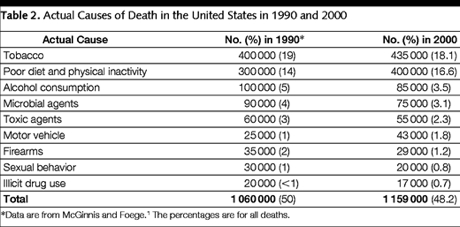
But something else is apparent, too. Even if we accept those guesses (and you shouldn’t) tobacco and overeating/not exercising account for nearly 10 times the deaths that are attributed to alcohol. Those first two account for 34.7%, over a third, while alcohol is 3.5%. And from 1990 to 2000, alcohol actually went down 1.5%, from 100,000 estimated deaths to 85,000.
And while any death is regrettable and a tragedy, especially to their loved ones, roughly 2,437,163 die every year in America. Every one of us will one day become a part of that statistic. The current CDC estimates are that the most likely reasons for our demise will be heart disease, cancer, chronic lower respiratory disease, stroke, accidents (unintentional injuries), Alzheimer’s disease, diabetes, influenza and pneumonia, nephritis (kidney trouble), nephrotic syndrome, and nephrosis (different kidney diseases) and suicide. Some of those diseases may be exacerbated by excessive alcohol consumption, but these, and many other diseases, will be held at bay by moderate alcohol drinking and will also most likely result in our living longer than both teetotalers or excessive drinkers.
Responsible alcohol consumption will also enhance our lives in ways that reduce stress and make our lives more enjoyable. Such positive associations and outcomes are never included in these types of studies, however. Any harm to individuals, often of their own making, is never balanced by the enhancement to our life experience that responsible drinking brings to a majority of Americans. When you go looking for harm, that’s all you will find. But when you set about to twist even these questionable studies to make them seem far worse than even they represent, that’s shameful propaganda and does little to actually address the real problems that some individuals do have with drinking.

The ABMRF is reporting the results of a new study conducted at Oregon State University published in Menopause, the Journal of the North American Menopause Society. The study, Moderate alcohol intake lowers biochemical markers of bone turnover in postmenopausal women, appears to conclude that “Drinking alcohol in moderation with a healthy lifestyle may benefit women’s bone health, lowering their risk of developing osteoporosis.”
From the abstract:
Objective: Epidemiological studies indicate that higher bone mass is associated with moderate alcohol consumption in postmenopausal women. However, the underlying cellular mechanisms responsible for the putative beneficial effects of alcohol on bone are unknown. Excessive bone turnover, combined with an imbalance whereby bone resorption exceeds bone formation, is the principal cause of postmenopausal bone loss. This study investigated the hypothesis that moderate alcohol intake attenuates bone turnover after menopause.
Methods: Bone mineral density was determined by dual-energy x-ray absorptiometry in 40 healthy postmenopausal women (mean +/- SE age, 56.3 +/- 0.5 y) who consumed alcohol at 19 +/- 1 g/day. Serum levels of the bone formation marker osteocalcin and the resorption marker C-terminal telopeptide (CTx) were measured by immunoassay at baseline (day 0) and after alcohol withdrawal for 14 days. Participants then consumed alcohol and were assayed on the following morning.
Results: Bone mineral density at the trochanter and total hip were positively correlated to the level of alcohol consumption. Serum osteocalcin and CTx increased after abstinence (4.1 +/- 1.6%, P = 0.01 and 5.8 +/- 2.6%, P = 0.02 compared with baseline, respectively). Osteocalcin and CTx decreased after alcohol readministration, compared with the previous day (-3.4 +/- 1.4%, P = 0.01 and -3.5 +/- 2.1%, P = 0.05, respectively), to values that did not differ from baseline (P > 0.05).
Conclusions: Abstinence from alcohol results in increased markers of bone turnover, whereas resumption of alcohol reduces bone turnover markers. These results suggest a cellular mechanism for the increased bone density observed in postmenopausal moderate alcohol consumers. Specifically, the inhibitory effect of alcohol on bone turnover attenuates the detrimental skeletal consequences of excessive bone turnover associated with menopause.
The ABMRF report on the study:
Bones are in a constant state of remodeling with old bone being removed and replaced. In people with osteoporosis, more bone is lost than reformed resulting in porous, weak bones. About 80% of all people with osteoporosis are women, and postmenopausal women face an even greater risk because estrogen, a hormone that helps keep bone remodeling in balance, decreases after menopause.
A study by Oregon State University researchers assessed the effects of alcohol withdrawal on bone turnover in postmenopausal women who drank one or two drinks per day several times a week. A significant increase in blood markers of bone turnover was measured in women after they stopped drinking for just two weeks. Alcohol appears to behave similarly to estrogen in that it reduces bone turnover, the researchers said.
Investigators studied 40 early postmenopausal women who regularly had one or two drinks a day, were not on any hormone replacement therapies, and had no history of osteoporosis-related fractures.
Results suggest evidence for increased bone turnover, a risk factor for osteoporotic fractures, during the two week period when the participants stopped drinking. Less than a day after the women resumed their normal drinking, their bone turnover rates returned to previous levels.
“Drinking moderately as part of a healthy lifestyle that includes a good diet and exercise may be beneficial for bone health, especially in postmenopausal women,” said researchers. “After less than 24 hours to see such a measurable effect was really unexpected.”

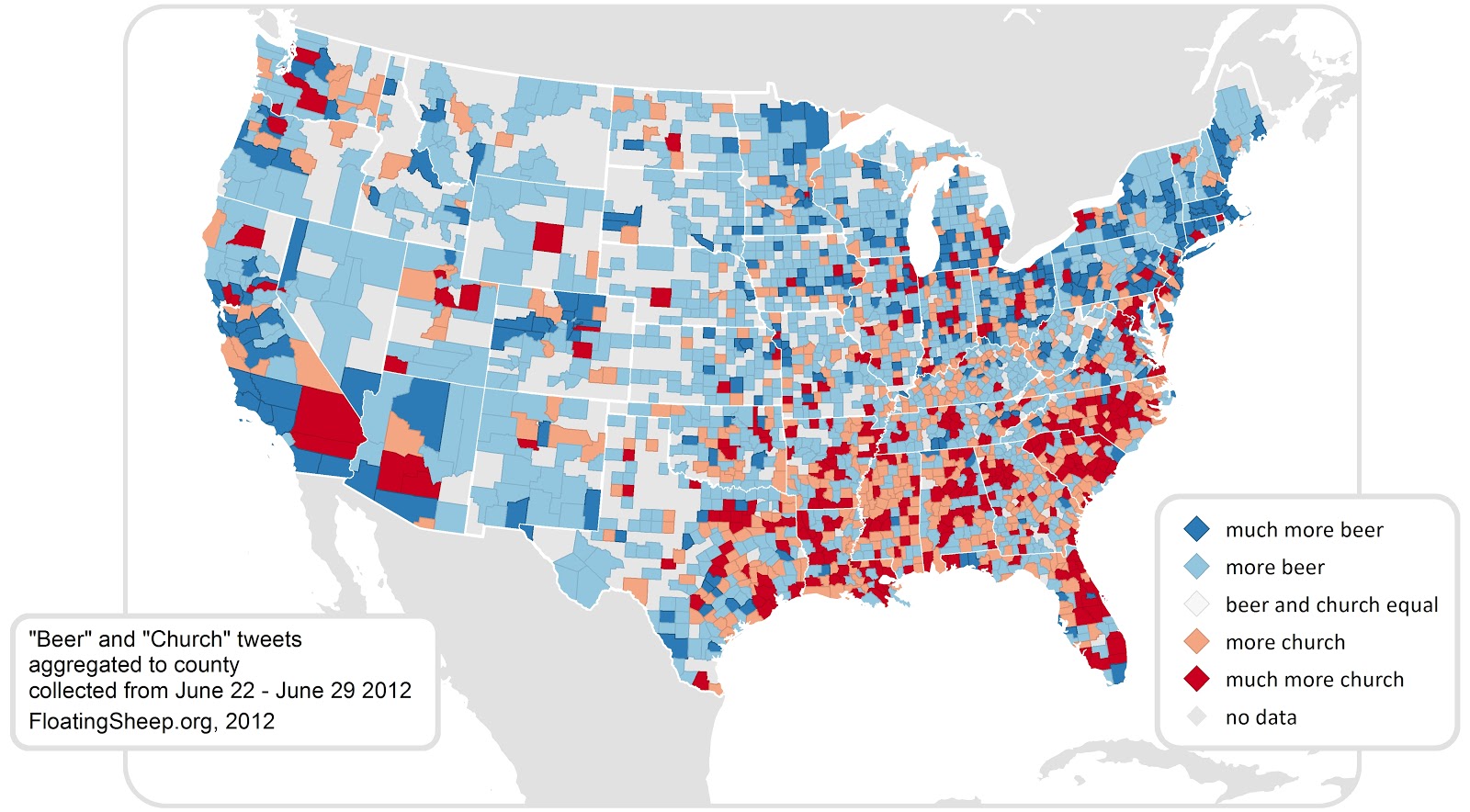
Here’s an interesting bit of statistics about beer and religion from Floating Sheep. Entitled Church or Beer? Americans on Twitter, to put together a set if data they “selected all geotagged tweets sent within the continental US between June 22 and June 28 (about 10 million in total) and extracted all tweets containing the word “church” (17,686 tweets of which half originated on Sunday) or “beer” (14,405 tweets which are much more evenly distributed throughout the week)” and then created an infographic map of the United States based on where the tweets were originating, by county. I’m pleased to see the county where I live came in at “much more beer” though curiously, right next door, Napa was tweeting about “much more church.” They should have checked wine, I guess.
Click here to see the map full size.
Some additional insights from Floating Sheep:
San Francisco has the largest margin in favor of “beer” tweets (191 compared to 46 for “church”) with Boston (Suffolk county) running a close second. Los Angeles has the distinction of containing the most tweets overall (busy, busy thumbs in Southern California). In contrast, Dallas, Texas wins the FloatingSheep award for most geotagged tweets about “church” with 178 compared to only 83 about “beer.”
And finally, this:
We also note that this map strongly aligns with the famous ‘red state’/’blue state’ map from the 2000, 2004, and 2008 elections with a strong “religious right” component in the Southeastern United States and a more liberal, or at least beer-tweeting, Northeast and upper Midwest.

NPR’s Planet Money blog had an interesting report today entitled What America Spends On Booze, breaking it down with some recent data from the U.S. Bureau of Labor Statistics and some great infographics by Lam Thuy Vo of NPR.
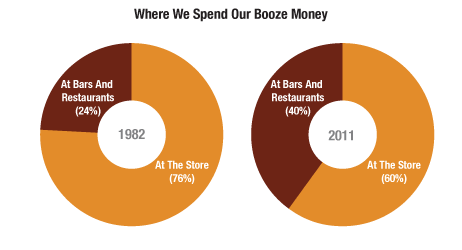
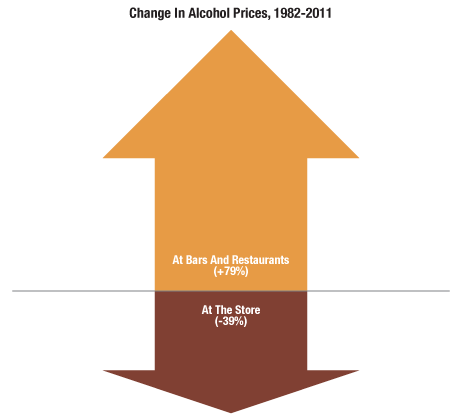
As you can see, we drink outside our homes almost twice as much as we did three decades ago, though as Lam Thuy Vo notes, that’s a little deceptive at least partly because the price of alcohol in bars and restaurants has skyrocketed while real prices have fallen, when adjusted for inflation.
Also, what we spend our alcohol dollars on has likewise shifted over the last thirty years. While beer is still on top, it has slipped a little. Wine is way up, while spirits have significantly dropped.
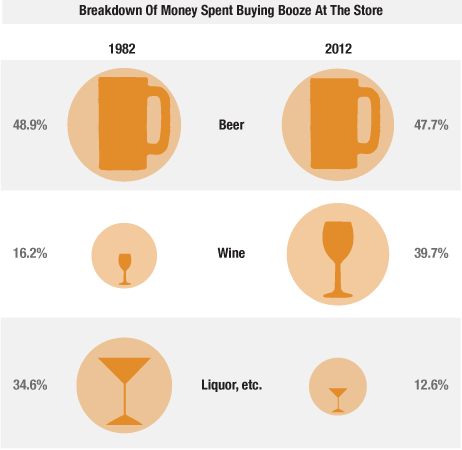
The one thing I’m a bit surprised about is the drop in beer. Since the price of craft beer is generally higher than mainstream adjunct lagers, I would think that the higher dollar rings would cause the figures for beer to rise as the percentage of craft beer has increased. Perhaps the price wars among the big players that have kept the price of beer artificially low for so long have contributed, or at least partially account, for the extended dip.

Hospitality Management Schools sent me this interesting, and helpful, interactive guide to tipping. I confess that while I’m pretty comfortable tipping at restaurants and bars, I’ve never been quite sure how much to tip my barber or the pizza delivery guy.
The embed code for the tip guide doesn’t seem to be working (I keep getting an error code about hot having authorized access despite the graphic having a button giving you he embed code) so here’s a link directly to the guide: Tipping, How To Respond To Hospitality.
Under the notes for tipping waiters, they suggest that even bad service deserves at least a 10% tip. I’m not sure about that one. I understand that sometimes poor service may be out of the hands of the waitstaff, but I can’t abide rewarding certain behaviors. If a waiter is open and tells me there’s a problem with the kitchen, or someone’s out sick and he or she has more territory to cover, I’m happy to take that into account and be understanding. If they’re pleasant in the face of problems and act like decent human beings (the golden rule) then I’ll agree with HMS’s advice. But if they’re simply inattentive, rude, surly or obnoxious, then I don’t see how giving them 10% is fair to anybody.
The last time I was at GBBF, the pub where I was staying was in the old meat packing area of London — Smithfield Market — and Stephen Beaumont (who I was traveling with) and I were excited to get a table at Fergus Henderson’s restaurant (author of “The Whole Beast”). It was very expensive but we thought it was worth checking out. And the food was incredible, but the experience was all but ruined by one of the worst service experiences I’ve ever had. Our waiter could not have been more condescending. He practically dripped sarcasm when Stephen starting exploring beer pairings with him, as if he didn’t even want to deign discussing beer with meat. How gauche. And so I can’t agree that such a person deserves even a modest tip when their actions not only don’t enhance a meal, but actively effect it negatively, such that the experience is made worse directly by their job performance. Service that bad is, mercifully, somewhat rare, but it has happened to me more than a few times. Under most circumstances, I’d agree that service that’s just mediocre or passable does deserve at least 10%. After all, I understand they’re just trying to make a living, and also everybody has a bad day. But truly bad service does not, at least in my opinion. What do you think?
Anyway, enough of my ranting, here’s their introduction to this guide from the school’s blog:
A huge part of the hospitality and service industry is gratuity. Gratuity and how much to tip service workers has always been a highly debated topic as it should be. Many service workers make the majority of their income on tips alone. Becoming a manager at a hotel or a spa, it will be very important to understand how workers get paid and how to structure tipping at your institution to keep your employees happy as well as keeping the company running smoothly.
And with tipping varying so widely from country to country and state to state even, it is hard to have a consistent system of tipping. With all the debate that surrounds gratuity, it seems that most people still don’t know what the correct amount to tip is. Is it 15% or is it 20%? $1 or $2? From airport to take out, this interactive guide will help people determine how much to give to in the service industry and hospitality field.
And interesting, they had this little tidbit under the History of Tipping:
When the custom of tipping made its way to the United States, many people weren’t too happy about it. In the late 1890s, a movement began against tipping as Americans believed tipping allowed service workers to be dependent on the higher class. An anti-tipping bill ultimately failed due to protests from both employers and service workers.

The Foundation for Alcohol Research (ABMRF) recently highlighted a study that appears to show that elderly persons who drink moderately are at a lower or reduced risk of “cognitive decline or dementia and provide cardiovascular benefits.” The study, Alcohol and Cognition in the Elderly: A Review, was published in Psychiatry Investigation. Here’s ABMRF’s report of the study:
Alzheimer’s disease and other types of dementia are most common in the very elderly, and are associated with huge health costs. With a rapidly aging global population, factors influencing the risk of cognitive decline and dementia are important.
A review of the association between alcohol consumption and cognition in the elderly suggests alcohol may have both a neurotoxic and neuroprotective effect, depending on the dose and drinking pattern. Longitudinal and brain imaging studies in the elderly show that excessive alcohol consumption may increase the risk of cognitive dysfunction and dementia, but regular low to moderate alcohol intake may protect against cognitive decline and dementia and provide cardiovascular benefits.
Investigators reviewed studies published from 1971 to 2011 related to alcohol and cognition in the elderly. At present, there are no proven agents to prevent cognitive decline or dementia, although a number of prospective epidemiological studies have shown a lower risk of such conditions among light to moderate drinkers in comparison with non-drinkers.
Other studies suggest that beneficial effects are seen only among certain sub-groups of subjects. A recent meta-analysis by Peters et al of subjects over the age of 65 in longitudinal studies concluded that light-to-moderate alcohol consumption, in comparison with abstinence, was associated with approximately 35-45% lower risk of cognitive decline or dementia.
They also found that heavy drinking has the opposite effect, so that too much alcohol may increase such risks, so it appears that moderation is the key.
And here’s the abstract from the published paper:
Consumption of large amounts of alcohol is known to have negative effects, but consumption in smaller amounts may be protective. The effect of alcohol may be greater in the elderly than in younger adults, particularly with regard to cognition. However, the drinking pattern that will provide optimal protection against dementia and cognitive decline in the elderly has not been systematically investigated. The present paper is a critical review of research on the effect of alcohol on cognitive function and dementia in the elderly. Studies published from 1971 to 2011 related to alcohol and cognition in the elderly were reviewed using a PubMed search. Alcohol may have both a neurotoxic and neuroprotective effect. Longitudinal and brain imaging studies in the elderly show that excessive alcohol consumption may increase the risk of cognitive dysfunction and dementia, but low to moderate alcohol intake may protect against cognitive decline and dementia and provide cardiovascular benefits. Evidence suggesting that low to moderate alcohol consumption in the elderly protects against cognitive decline and dementia exists; however, because of varying methodology and a lack of standardized definitions, these findings should be interpreted with caution. It is important to conduct more, well-designed studies to identify the alcohol drinking pattern that will optimally protect the elderly against cognitive decline and dementia.
And here’s their conclusion, from the full text of the article:
Evidence suggesting that LMD in the elderly protects against cognitive decline and dementia exists. The present review of evidence-based research may help determine the optimal alcohol drinking pattern to prevent cognitive decline and dementia in the elderly and provide an alternative to existing therapeutic interventions, which have limited effectiveness. However, the varying results of several evidence-based studies of the benefits and risks of alcohol on cognition should be interpreted with caution. Furthermore, the cognitive benefit of LMD may vary from person to person; thus, it is difficult to make a clinical recommendation for abstainers to drink alcohol. Nevertheless, it is important to conduct well-designed studies to determine the optimal alcohol drinking pattern for the elderly as the alternative against cognitive decline and dementia.
It sounds like the key is finding the right dosage for each person, the alcohol sweet spot or goldilocks amount. I’m certainly open to experimentation. Because that’s some seriously tasty medicine I can get behind, especially as I age ever closer to my dotage. I think when I have grandkids, I’m going to teach them to call the refrigerator in the garage, stocked with beer, “grandpa’s medicine cabinet.”

This is my sixth annual annotated list of the Top 50 so you can see who moved up and down, who was new to the list and who dropped off. So here is this year’s list again annotated with how they changed compared to last year.
Some new companies made the list, one from a merger — Gordon Biersch and Rock Bottom — now CraftWorks Breweries & Restaurants, along with Bear Republic, Blue Point, Lost Coast (which had been on the list two years ago), Narragansett and Ninkasi.
Off the list was Straub, Independent Brewers United (IBU), which was swallowed up by North American Breweries, Kona Brewing, which was folded into the Craft Brewers Alliance, and individually Gordon Biersch and Rock Bottom were combined into CraftWorks Breweries & Restaurants.
If you want to see the previous annotated lists for comparison, here is 2010, 2009, 2008, 2007 and 2006.
The Brewers Association has also just announced the top 50 breweries in the U.S. based on sales, by volume, for 2011. This includes all breweries, regardless of size or other parameters. Here is the new list:
Here is this year’s press release.