

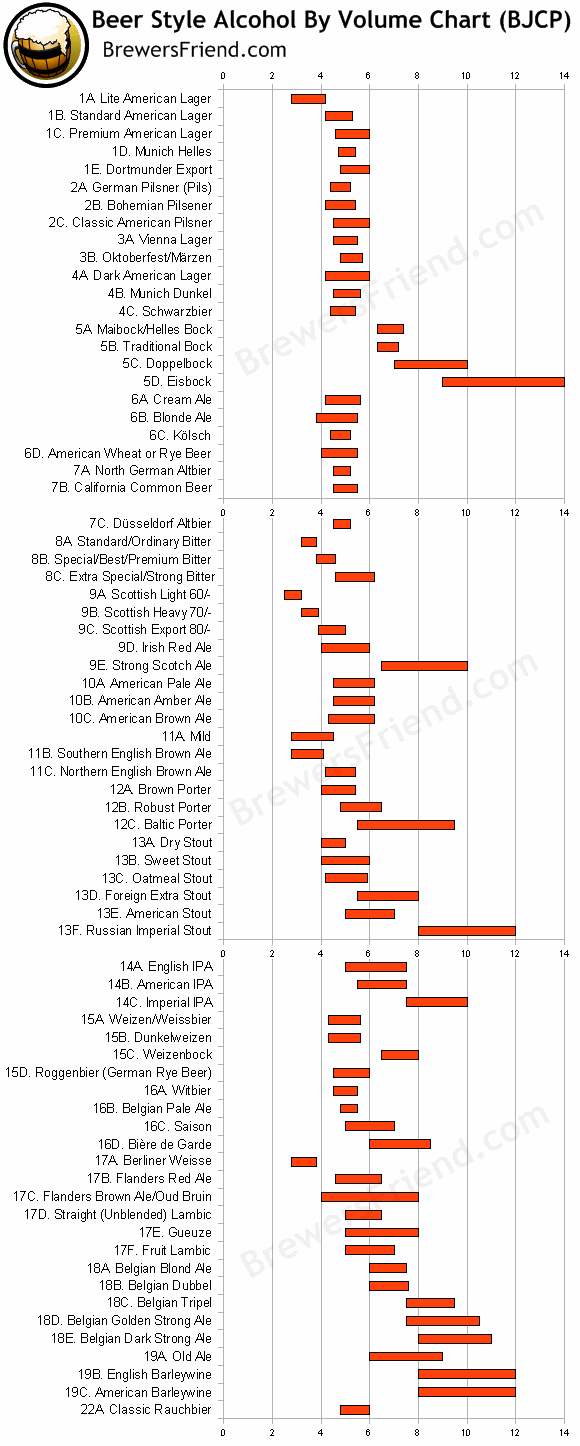
Today’s infographic is another one from Brewer’s Friend, this one is all about Beer Style Alcohol By Volume, showing the BJCP styles with the range of a.b.v. for each.
Beer Family Tree

Today’s infographic comes from the Syracuse Pos-Sentinel, as a part of their Syracuse Beer Week coverage. It’s a Beer Family Tree and shows ales, lagers and hybrids at the top of the tree, and moves down from there, though the tree doesn’t have too many branches. Still, it’s a good starting point for a newspaper.
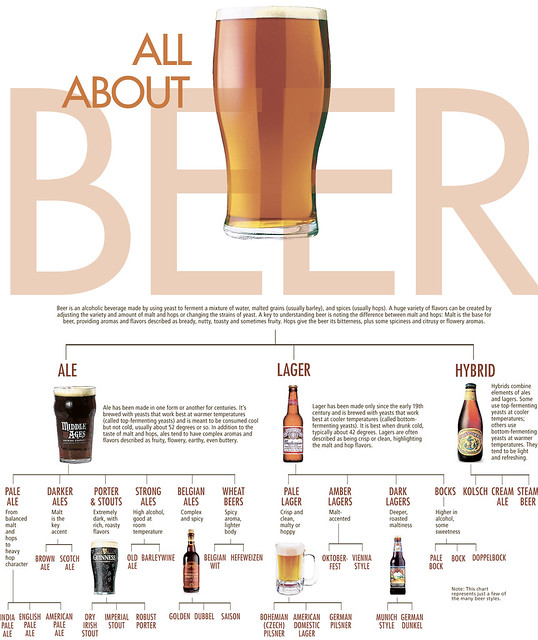
Click here to see the family tree full size.
Generic Beer Infographic

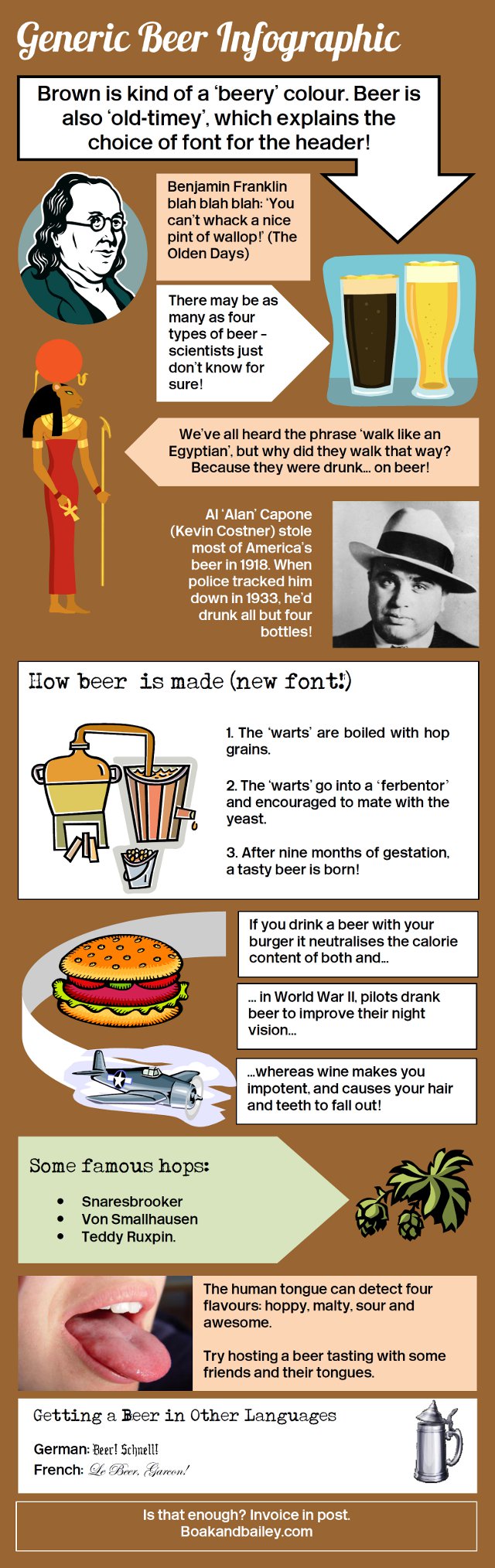
Today’s infographic is perfect for Friday Frivolity, though I wish I’d known about it for April Fool’s Day. It was created by the UK beer bloggers Boak & Bailey, and suggests that not everyone is a fan of the infographic, and possibly not in favor of my project this year trying to round up as many of them as possible each day. Their Generic Beer Infographic is a hilarious take on many of the general infographics that have been created recently, and often get the information wrong.


Beer Brewed With Elephant Dung

I’ve had my share of beers made with odd ingredients, from pizza beer to Wynkoop’s bull testicle beer, with all manner of flowers, nuts, fruits, vegetables and tree parts in between. But this one has to take the cake. The Japanese brewery Sankt Gallen created a beer with elephant dung, which reportedly immediately sold out.

According to Drinks Business:
The beer, which is called Un, Kono Kuro, is made using coffee beans that have passed through an elephant.
The Sankt Gallen brewery called the beer a “chocolate stout,” despite it not containing any chocolate. The coffee beans used in the beer come from elephants at Thailand’s Golden Triangle Elephant Foundation, which cost over $100 per 35 grams. The beans are so expensive as 33 kgs of beans in the mouth yields 1 kg of useable coffee beans.
According to another source, International Science Times, the beer “utilizes the flavor of Black Ivory Coffee, a variety of your morning brew that retails for about $500 per pound because the beans are harvested from elephant poop. And by “harvested” we mean picked out of a big pile of dung and rinsed off. The elephant poop beer uses the coffee beans to enhance the flavor in its coffee stout.” They continue.
Un, Kono Kuro is a pun on “unko” which is the Japanese word for “crap,” a fitting name indeed for elephant poop coffee. Although the elephant poop beer was a sales success, don’t expect it hit shelves anytime soon. The brewer, Sankt Gallen, isn’t adding it to their regular line-up. It’s not cheap beer, either; the retail value of a keg of Un, Kono Kuro is around $1100.
So apparently it’s pretty popular. At least one reviewer said it wasn’t bad, saying “there was an initial bitterness that got washed over by a wave of sweetness. Following that, a mellow body rolled in and spread out through my mouth.” Still, this may be going too far. What do you think?

Colombia Beer History

Today’s infographic shows Five Centuries of Beer in Colombia, created by Pulpo. I suspect that if I knew Spanish it would even be cooler.
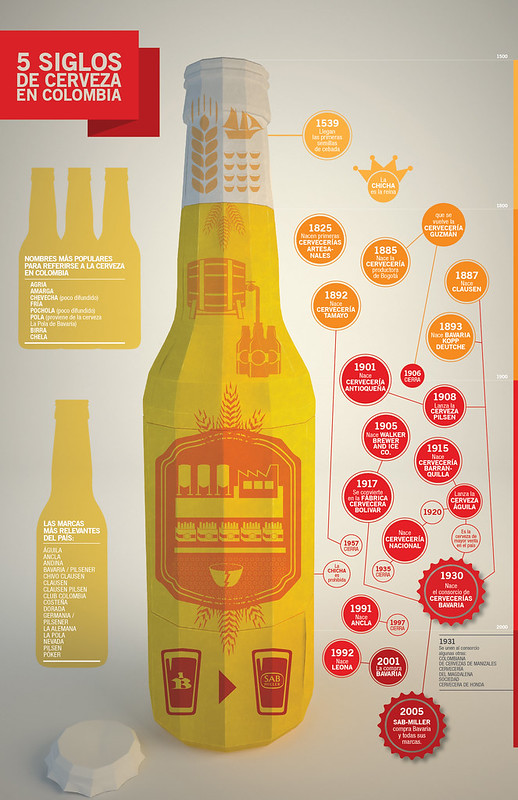
Click here to see the infographic full size.
Beer Style Chart: Beer Styles Compared

Today’s infographic is an amazing chart of beer styles, but not a static one. The view below is simply the starting point of the Beer Style Chart, from there you can manipulate it and compare styles in a myriad of different ways. This great resource was created by the folks from Strange Brew, a Canadian software company that makes a homebrewing program. There’s also a generated chart that shows difference in the styles.

Click here to go to the interactive page.
Olympia Beer Offers Million Dollar Prize For Finding Bigfoot

In what has to be one of the most unusual marketing efforts by a large brewer, Olympia Beer has offered to pay $1 million dollars — in increments of $25,000 a year for the next four decades — to anyone who can find conclusive evidence of a live Bigfoot. The contest is the brainchild of Evan and Daren Metropoulos, who recently bought Pabst Brewing Co., which also owns the Olympia brand.

Full details and rules can be found at OlympiaBigfoot.com, but here’s their “Mission Statement” for finding Bigfoot:
Olympia Beer and Bigfoot have been leaving footprints together in the Pacific Northwest since 1896.
We have been sharing the same backyard for over a century and we believe it’s time to do what has never been done, and that is to offer a one million dollar reward to anyone who can ensure the safe capture of Bigfoot. When we say safe capture that means Bigfoot has to be alive and breathing folks, with no wounds. That’s right you can’t use any act of violence, no guns/knives/boxing gloves/nets/etc, only sugar or sweets to lure him in.
You must register to participate in the search. To report your discovery of irrefutable evidence of the existence of Bigfoot, click on the “Submit Capture Report” link on the left and follow the instructions to report your evidence. You participation in the search is subject to the complete Official Rules.
To aid us in this adventure, Olympia Beer is partnering with The Falcon Project
The Falcon Project has been identified as “the most penetrative search for Bigfoot ever conducted in the United States.” They will conduct an aerial search for Sasquatch employing an unmanned airship with high definition thermal imaging camera equipment.
Sure, it’s a publicity stunt, but it’s a funny one. And what if someone actually does it? Apparently 14% of all Americans believe Sasquatch to be real, while another 14% say they’re not sure.

Winners must provide “irrefutable evidence” of Bigfoot’s existence and, according to the rules, may include “DNA Evidence.” From the rules:
“Bigfoot” refers to a previously undiscovered species of upright, bipedal hominid, native to North America existing contemporaneously with the Contest Period or the twenty-five (25) year period immediately prior to the Contest Period. There is no set type or amount of evidence required to establish proof for purposes of this Contest other than that all evidence presented must satisfy the Judging Panel. Evidence may include, but is not limited to DNA Evidence. DNA Evidence may include hair, blood, tissue or saliva that proves the DNA sequence of the donor shows that said donor resides in the primate evolutionary family tree, among other apes or hominids, but does not have the same genetic markers and DNA sequence as any known species. Evidence may also include “Visual Proof” of a live physical body. Physical remains may be considered as evidence provided that it can be conclusively demonstrated that the date of death pre-dated the Contest Period. Visual Proof shall not include footprints, bone fragments, inconclusive skeletal remains, or any other non-definitive evidence of the existence of Bigfoot. Any photo or video taken with photographic or video equipment is not sufficient to qualify as evidence in and of itself for consideration in the Contest, but may be considered as supporting evidence.
NO HARM SHOULD BE DONE TO BIGFOOT OR ANY LIVING CREATURE AS A RESULT OF PARTICIPATION IN THIS CONTEST. ANY EVIDENCE OF SUCH ACTIVITY SHALL LEAD TO DISQUALIFICATION FROM THE CONTEST AND NOTIFICATION TO THE PROPER LEGAL AUTHORITIES.
Why Success Is Killing the Craft Brew Industry

This ran in The Street a couple of weeks ago, and I meant to post it before but it kept getting pushed down in the queue. Portland writer Jason Notte does an interesting job dissecting the industry and the recent kerfuffles over taxes in Why Success Is Killing the Craft Brew Industry. If you follow the business side of the beer industry, it’s worth a read.

The Beer Color Spectrum

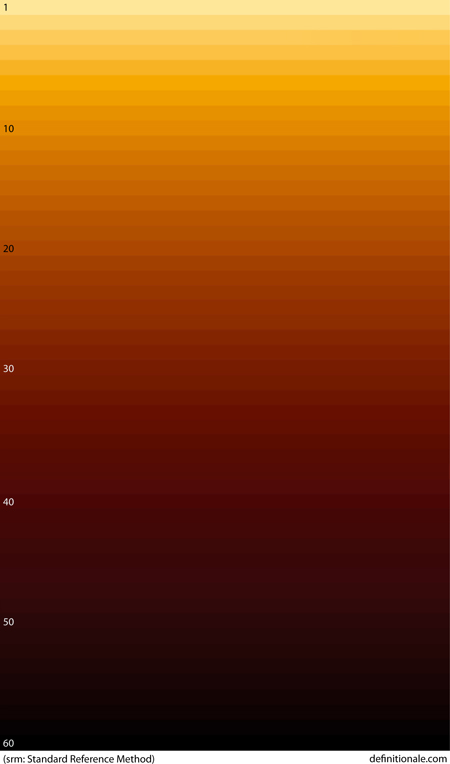
Today’s infographic is a simple rendering of The Beer Color Spectrum, created by Definition Ale, A Canadian beer blog written by Stephen Rich. It uses SRM.
Pete’s Beer Style Spectrum

Today’s infographic is the third of three similar charts that Pete Slosberg created for Pete’s Wicked Ales. It shows popular beer styles (remember this was the late 80s) and where they fell on an x/y axis spectrum. It was one of the first great educational tools for explaining the variation in different beers, something that most people didn’t know anything about back then. This one I recall being on a pad, so you could just tear off copies of it.
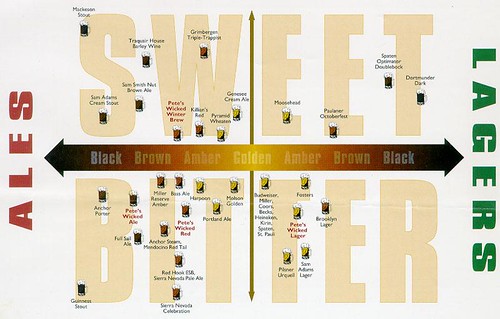
Click here to see the chart full size.