Brookston Beer Bulletin

Jay R. Brooks on Beer

  • Home
  • About
  • Editorial
  • Birthdays
  • Art & Beer

Socialize

  • Dribbble
  • Email
  • Facebook
  • Flickr
  • GitHub
  • Instagram
  • LinkedIn
  • Pinterest
  • RSS
  • Twitter
  • YouTube

Powered by Genesis

Beer In Ads #4969: It Deserves First Prize

May 14, 2025 By Jay Brooks

Last year I decided to concentrate on Bock ads. Bock, of course, may have originated in Germany, in the town of Einbeck. Because many 19th century American breweries were founded by German immigrants, they offered a bock at certain times of the year, be it Spring, Easter, Lent, Christmas, or what have you. In a sense they were some of the first seasonal beers. “The style was later adopted in Bavaria by Munich brewers in the 17th century. Due to their Bavarian accent, citizens of Munich pronounced ‘Einbeck’ as ‘ein Bock’ (a billy goat), and thus the beer became known as ‘Bock.’ A goat often appears on bottle labels.” And presumably because they were special releases, many breweries went all out promoting them with beautiful artwork on posters and other advertising.

Wednesday’s ad is for Hornung’s White Bock Beer, which was published on May 14, 1936. This one was for the Jacob Hornung Brewing Co. of Philadelphia, Pennsylvania, which was originally founded in 1885. This ad ran in The Ephrata Review, of Ephrata, Pennsylvania.

Filed Under: Art & Beer, Beers, Breweries, Just For Fun Tagged With: Advertising, Bock, History, Pennsylvania, Philadelphia

Beer In Ads #4968: Bock Beer At The Owl

May 13, 2025 By Jay Brooks

Last year I decided to concentrate on Bock ads. Bock, of course, may have originated in Germany, in the town of Einbeck. Because many 19th century American breweries were founded by German immigrants, they offered a bock at certain times of the year, be it Spring, Easter, Lent, Christmas, or what have you. In a sense they were some of the first seasonal beers. “The style was later adopted in Bavaria by Munich brewers in the 17th century. Due to their Bavarian accent, citizens of Munich pronounced ‘Einbeck’ as ‘ein Bock’ (a billy goat), and thus the beer became known as ‘Bock.’ A goat often appears on bottle labels.” And presumably because they were special releases, many breweries went all out promoting them with beautiful artwork on posters and other advertising.

Tuesday’s ad is for 5-¢ Bock Beer in “a glass drawn straight from the wood” and was published on May 13, 1933. This one was not for a specific brewery, but the Owl Cabaret and the A.B.W. Club, which was located in Mexicali, Mexico. This ad ran in The Imperial Valley Press, of El Centro, Canada.

Filed Under: Art & Beer, Beers, Breweries, Just For Fun Tagged With: Advertising, Bock, California, History

Historic Beer Birthday: True W. Jones

May 13, 2025 By Jay Brooks

Today is the birthday of True William Jones (May 13, 1814- October 2, 1899). He as born in New Hampshire, and was the brother of Frank Jones, who also had a prominent New Hampshire brewery. True Jones either founded the New Hampshire Brewing Co. of Manchester, New Hampshire in 1879 and then changed its name to the True W. Jones Brewery in 1891, or bought it at that time. In either case, it closed in 1917 due to Prohibition and did not reopen afterwards, which makes sense since he died in 1899.

Here is his obituary from the Manchester Herald on October 3, 1899:

And this obit ran in the Boston Globe:

And interestingly, shortly before Prohibition ended, but 11 years after the brewery closed, they auctioned off the brewery equipment and land.

Filed Under: Art & Beer, Beers, Breweries, Just For Fun Tagged With: History, New Hampshire

Beer In Ads #4967: Prescribed For Spring Fever

May 12, 2025 By Jay Brooks

Last year I decided to concentrate on Bock ads. Bock, of course, may have originated in Germany, in the town of Einbeck. Because many 19th century American breweries were founded by German immigrants, they offered a bock at certain times of the year, be it Spring, Easter, Lent, Christmas, or what have you. In a sense they were some of the first seasonal beers. “The style was later adopted in Bavaria by Munich brewers in the 17th century. Due to their Bavarian accent, citizens of Munich pronounced ‘Einbeck’ as ‘ein Bock’ (a billy goat), and thus the beer became known as ‘Bock.’ A goat often appears on bottle labels.” And presumably because they were special releases, many breweries went all out promoting them with beautiful artwork on posters and other advertising.

Monday’s ad is for Formosa Spring Bock Beer and was published on May 12, 1972. The brewery was the Formosa Spring Brewery of Formosa, Ontario, Canada, which was originally founded in 1870. This ad ran in The Toronto Star, of Toronto, Canada.

Filed Under: Art & Beer, Beers, Breweries, Just For Fun Tagged With: Advertising, Bock, Canada, History, Ontario

Historic Beer Birthday: Louis Hennepin

May 12, 2025 By Jay Brooks

hennepin-silhouette

Today is the birthday of Louis Hennepin (May 12, 1626-c. 1705). Hennepin “was a Roman Catholic priest and missionary of the Franciscan Recollet order (French: Récollets) and an explorer of the interior of North America.” His name was used for a Farmhouse Saison brewed by Brewery Ommegang known as Ommegang Hennepin.

hennepin-explorer-portrait

Here’s his biography from Wikipedia:

Antoine Hennepin was born in Ath in the Spanish Netherlands (present-day Hainaut, Belgium). In 1659, Béthune, the town where he lived, was captured by the army of Louis XIV of France. Henri Joulet, who accompanied Hennepin and wrote his own journal of their travels, called Hennepin a Fleming (i.e. a native of Flanders).

At the request of Louis XIV the Récollets sent four missionaries to New France in May 1675, including Hennepin, accompanied by René Robert Cavelier, Sieur de la Salle. In 1678, Hennepin was ordered by his provincial superior to accompany La Salle on an expedition to explore the western part of New France. Hennepin was 39 when he departed in 1679 with La Salle from Quebec City to construct the 45-ton barque Le Griffon, sail through the Great Lakes, and explore the unknown West.

Hennepin was with La Salle at the construction of Fort Crevecouer (near present-day Peoria, Illinois) in January 1680. In February, La Salle sent Hennepin and two others as an advance party to search for the Mississippi River. The party followed the Illinois River to its junction with the Mississippi. Shortly thereafter, Hennepin was captured by a Sioux war party and carried off for a time into what is now the state of Minnesota.

In September 1680, thanks to Daniel Greysolon, Sieur Du Lhut, Hennepin and the others were given canoes and allowed to leave, eventually returning to Quebec. Hennepin returned to France and was never allowed by his order to return to North America. Local historians credit the Franciscan Récollect friar as the first European to step ashore at the site of present-day Hannibal, Missouri.

Two great waterfalls were brought to the world’s attention by Hennepin: Niagara Falls, with the most voluminous flow of any in North America, and the Saint Anthony Falls in what is now Minneapolis, the only waterfall on the Mississippi River. In 1683, he published a book about Niagara Falls called A New Discovery. The Regionalist painter Thomas Hart Benton created a mural, “Father Hennepin at Niagara Falls” for the New York Power Authority at Lewiston, New York.

thomas-hart-benton-hennepin
The Thomas Hart Benton mural “Father Hennepin at Niagara Falls”

Because of explorations with La Salle throughout the Great Lakes region, there are geographic places named for Hennepin in Illinois, Michigan, New York, Ontario Canada, but especially Minnesota, where he’s considered the unofficial godfather of the state. For example, here’s a more thorough entry on Hennepin from the Minnesota Encyclopedia:

Father Louis Hennepin, a Recollect friar, is best known as an early explorer of Minnesota. He gained fame in the seventeenth century with the publication of his dramatic stories of the exploration of the Mississippi River. Father Hennepin spent only a few months in Minnesota, but his influence is undeniable. While his widely read travel accounts were more fiction than fact, they allowed Hennepin to leave a lasting mark on the state.

Louis Hennepin was likely born in 1640, although some sources suggest it was as early as 1626. The son of a wealthy banker, he was baptized in the small town of Ath in what is now Belgium on April 7, 1640. Hennepin joined the Recollect Friars at a monastery in Béthune, France, and was ordained a priest in 1666. A few years later, Hennepin asked his superiors for permission to join the Recollect missionaries in North America. In 1675, he sailed to Quebec.

The Recollects were a French branch of the Franciscan order. They were active throughout France’s territory in North America. Hennepin spent his first three years as a missionary in the area of the eastern St. Lawrence River, ministering to voyageurs, colonists, and American Indian communities. In 1678, Hennepin was chosen to accompany René-Robert Cavelier Sieur de la Salle on his exploration of the Mississippi. In 1680, while on La Salle’s expedition, Hennepin and two other members of the party, Michel Accault and Antoine Auguelle (Picard du Gay), were sent to explore the section of the Mississippi north of the Illinois River.

The three men set out early in March 1680, progressing north while avoiding ice that remained on the river. They had just reached Lake Pepin on April 11 or 12 when they encountered a Dakota war party. The Dakota took the three men captive and transported them to a village near Lake Mille Lacs. Hennepin, Accault, and Auguelle lived in the Dakota village until late June or early July of 1680.

At midsummer, Hennepin and Auguelle received permission from the Dakota to canoe down the Mississippi to the mouth of the Wisconsin River. There they planned to collect supplies that the La Salle expedition had left for them. During this trip Hennepin and Auguelle first encountered the waterfall on the Mississippi that Hennepin named in honor of his patron saint, St. Anthony of Padua.

During his own expedition, Daniel Greysolon, Sieur du Lhut, heard rumors that the three men were being held captive. On July 25, 1680, Greysolon arrived at the Dakota village to negotiate the release of Hennepin, Accault, and Auguelle. By August, the three captives had begun their journey back to French forts in the east. Hennepin left Canada in the fall of 1681 and returned to France.

Once in France, Hennepin embarked upon the literary career that would bring him both fame and criticism. His first book, A Description of Louisiana, newly discovered to the South-West of New France, was published in Paris in 1683. It detailed his travels, his experiences living with the Dakota, and his discovery of St. Anthony Falls. From the start, Hennepin’s work was a blend of myth and fact. In his travel accounts he made waterfalls much higher and wildlife far more dangerous. He depicted the American Indian populations of North America as barbarous savages. An egotistical and vain man, Hennepin portrayed himself as La Salle’s favorite and most trusted confidant.

In his following two books, published in 1697 and 1698, Hennepin exaggerated further. He claimed that he had traveled from Illinois down the Mississippi to the Gulf of Mexico and back before being captured by the Dakota. The details of his improbable canoe trip, covering some three thousand miles in only a month, were taken directly from accounts of La Salle’s own trip down the Mississippi two years after Hennepin’s time in Minnesota. While his books continued to circulate widely, his reputation was significantly damaged.

Little is known about the end of Hennepin’s life. Around 1700 he traveled to Rome to seek funding from Franciscan authorities. Some say that Hennepin died in Rome around 1701, while other sources suggest he returned to Utrecht and died in 1705. Hennepin’s memory lives on in the many parks, landmarks, schools, and streets, including one in his home city in Belgium, named in his honor.

fr-hennepin-douglas-volk
Painting of Father Louis Hennepin at St. Anthony Falls by Douglas Volk, c. 1905.

Perhaps most amazing, Hennepin is believed to be the first European to see the splendor of Niagara Falls, and at a minimum his journal account of seeing them in 1678 is the earliest known written reference to the famous falls.

louis-hennepin-granger
Father Hennepin at Niagara Falls in 1678. Drawing by C.W. Jefferys.

Filed Under: Beers, Birthdays, Just For Fun Tagged With: Belgium, History

Beer In Ads #4966: If It’s Okeh With You, I’ll Take Menominee Bock Beer

May 11, 2025 By Jay Brooks

Last year I decided to concentrate on Bock ads. Bock, of course, may have originated in Germany, in the town of Einbeck. Because many 19th century American breweries were founded by German immigrants, they offered a bock at certain times of the year, be it Spring, Easter, Lent, Christmas, or what have you. In a sense they were some of the first seasonal beers. “The style was later adopted in Bavaria by Munich brewers in the 17th century. Due to their Bavarian accent, citizens of Munich pronounced ‘Einbeck’ as ‘ein Bock’ (a billy goat), and thus the beer became known as ‘Bock.’ A goat often appears on bottle labels.” And presumably because they were special releases, many breweries went all out promoting them with beautiful artwork on posters and other advertising.

Sunday’s ad is for Menominee Bock Beer and was published on May 11, 1937. The brewery was the Menominee-Marinette Brewing Co. of Menominee, Michigan, which was originally founded in 1870, though it wasn’t known as Menominee-Marinette until after Prohibition. This ad ran in The Escanaba Daily Press, of Escanaba, Michigan. I love the tagline at the bottom: “Beer — The Temperance Drink of the Nation.”

Filed Under: Art & Beer, Beers, Breweries, Just For Fun Tagged With: Advertising, Bock, History, Michigan

Beer In Ads #4965: Wiessner’s Bock Beer

May 10, 2025 By Jay Brooks

Last year I decided to concentrate on Bock ads. Bock, of course, may have originated in Germany, in the town of Einbeck. Because many 19th century American breweries were founded by German immigrants, they offered a bock at certain times of the year, be it Spring, Easter, Lent, Christmas, or what have you. In a sense they were some of the first seasonal beers. “The style was later adopted in Bavaria by Munich brewers in the 17th century. Due to their Bavarian accent, citizens of Munich pronounced ‘Einbeck’ as ‘ein Bock’ (a billy goat), and thus the beer became known as ‘Bock.’ A goat often appears on bottle labels.” And presumably because they were special releases, many breweries went all out promoting them with beautiful artwork on posters and other advertising.

Saturday’s ad is for Wiessner’s Bock Beer and was published in 1909. The brewery was the J.F. Wiessner & Sons Brewing Co. of Baltimore, Maryland, which was originally founded in 1863. This ad ran in The Baltimore Sun, also of Baltimore, Maryland. It’s funny to see Gambrinus (“The Inventor of Beer” — who knew?) riding a goat with the tagline “From Gambrinus to Wiessner., From Primitive Methods to the Climax of Perfection.”

Filed Under: Art & Beer, Beers, Breweries, Just For Fun Tagged With: Advertising, Bock, History

Historic Beer Birthday: George Fix

May 10, 2025 By Jay Brooks

Today is the birthday of George Fix (May 10, 1939-March 10, 2002). Fix was primarily a mathematician “who collaborated on several seminal papers and books in the field of finite element method. For my purposes, he’s much more well know in the beer community as “a beer and homebrewing enthusiast and educator, as well as the author of several books about brewing. He died of cancer in 2002.”

Here’s the beer part of his Wikipedia entry:

Fix also applied his talents to amateur beer brewing. He won hundreds of awards across the United States for his beers, and was named Homebrewer of the Year in 1981 by the American Homebrewers Association (AHA). He was a consultant to numerous microbreweries and brewpubs, and served as an expert witness in brewing-related litigation. He served on the Board of Advisors of the AHA, the editorial board of Brewing Techniques magazine, the steering committee of the Masters Championship of Amateur Brewing, and was a member of Beer Judge Certification Program, the American Association of Brewing Chemists, and the Master Brewers Association of America. In 1999, he wrote Principles of Brewing Science, considered a standard reference for home- and craft-brewers. He also co-authored two books about homebrewing with his wife Laurie, including An Analysis of Brewing Techniques in 1998.

For his achievements and role as an educator in the field of home brewing, Fix was honoured with the AHA Recognition Award in 1991, the Distinguished Service Recognition Award by the Association of Brewers in 1991, and the Ninkasi Award by the AHA in 1997.

He wrote three books that I know of on beer, An Analysis of Brewing Techniques (1998), Principles of Brewing Science: A Study of Serious Brewing Issues (1999), and Vienna, Märzen, Oktoberfest, number 4 in the Classic Beer Style Series (1998).

Here’s his biography from the Brewers Publications.

The late George Fix will be remembered as a pioneer in finite element methods, phase field methods and for numerous other contributions to numerical analysis and applied mathematics. He also distinguished himself as the chairman of three mathematics departments.

George had a second concurrent and distinguished career as a practitioner and scientist in the brewing of beer. He was named Homebrewer of the Year in 1981 by the American Homebrewers Association. He wrote two books with his wife, Laurie, An Analysis of Brewing Techniques and Vienna, Märzen, and Oktoberfest.

In addition, he authored a scientific treatise titled Principles of Brewing Science, which has gone through two editions. He was awarded the Distinguished Service Recognition Award by the Association of Brewers in 1991 and the Ninkasi award by the AHA in 1997, the highest honors bestowed by these organizations at the time.

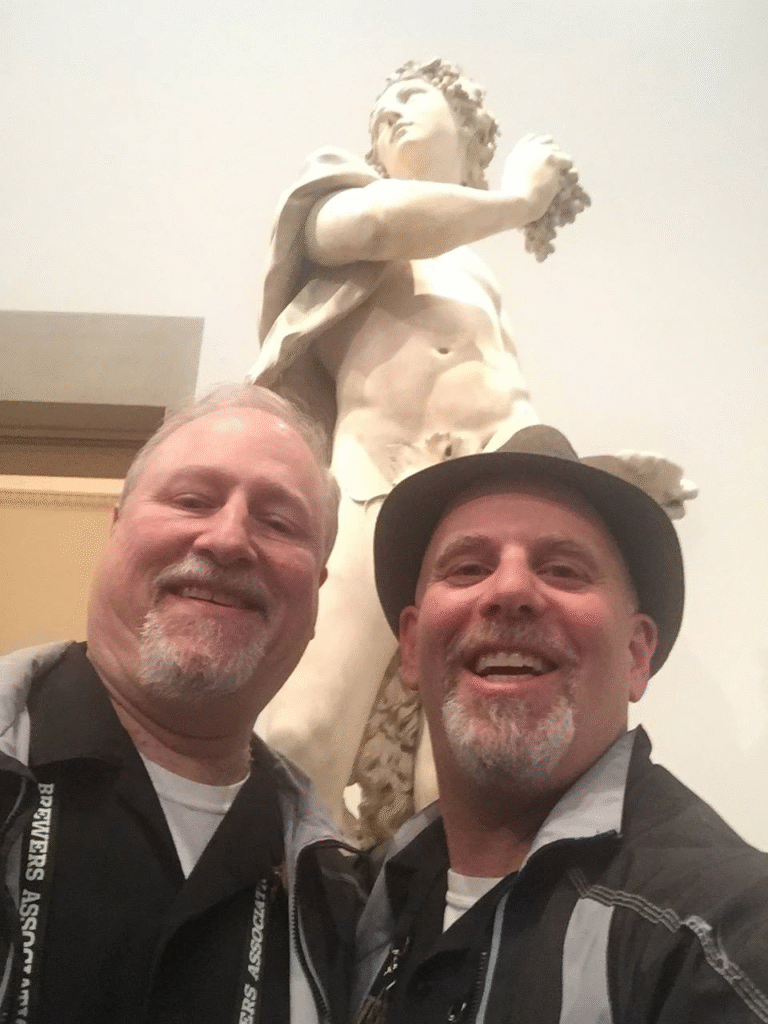
Fix at an event at Anchor Brewery.

Filed Under: Beers

Beer In Ads #4964: Coors Bock Beer

May 9, 2025 By Jay Brooks

Last year I decided to concentrate on Bock ads. Bock, of course, may have originated in Germany, in the town of Einbeck. Because many 19th century American breweries were founded by German immigrants, they offered a bock at certain times of the year, be it Spring, Easter, Lent, Christmas, or what have you. In a sense they were some of the first seasonal beers. “The style was later adopted in Bavaria by Munich brewers in the 17th century. Due to their Bavarian accent, citizens of Munich pronounced ‘Einbeck’ as ‘ein Bock’ (a billy goat), and thus the beer became known as ‘Bock.’ A goat often appears on bottle labels.” And presumably because they were special releases, many breweries went all out promoting them with beautiful artwork on posters and other advertising.

Friday’s ad is for Coors Bock Beer and was published May 9, 1935. The brewery was the Coors Brewing Co. of Golden, Colorado, which was originally founded in 1873. This ad ran in The San Angelo Evening Standard, of San Angelo, Texas.

Filed Under: Art & Beer, Beers, Breweries, Just For Fun Tagged With: Advertising, Bock, Colorado, Coors, History, Texas

Beer In Ads #4963: The Old Reliable Knoxville Brewery’s Bock Beer

May 8, 2025 By Jay Brooks

Last year I decided to concentrate on Bock ads. Bock, of course, may have originated in Germany, in the town of Einbeck. Because many 19th century American breweries were founded by German immigrants, they offered a bock at certain times of the year, be it Spring, Easter, Lent, Christmas, or what have you. In a sense they were some of the first seasonal beers. “The style was later adopted in Bavaria by Munich brewers in the 17th century. Due to their Bavarian accent, citizens of Munich pronounced ‘Einbeck’ as ‘ein Bock’ (a billy goat), and thus the beer became known as ‘Bock.’ A goat often appears on bottle labels.” And presumably because they were special releases, many breweries went all out promoting them with beautiful artwork on posters and other advertising.

Thursday’s ad is for Knoxville Bock Beer and was published May 8, 1892. The brewery was the Knoxville Brewing Co. of Knoxville, Tennessee, which was originally founded in 1878. This ad ran in The Journal and Tribune, also of Knoxville, Tennessee.

Filed Under: Art & Beer, Beers, Breweries, Just For Fun Tagged With: Advertising, Bock, History, Tennessee

« Previous Page
Next Page »

Find Something

Northern California Breweries

Please consider purchasing my latest book, California Breweries North, available from Amazon, or ask for it at your local bookstore.

Recent Comments

  • Ernie Dewing on Historic Beer Birthday: Charles William Bergner 
  • Steve 'Pudgy' De Rose on Historic Beer Birthday: Jacob Schmidt
  • Jay Brooks on Beer Birthday: Bill Owens
  • Steve 'Pudgy' De Rose on Beer Birthday: Charles Finkel
  • Steve 'Pudgy' De Rose on Beer Birthday: Bill Owens

Recent Posts

  • Beer In Ads #5212: Once Again … It Is The Professor’s Please To Present Bartel’s Bock Beer February 20, 2026
  • Drake’s Brewing To Form West Coast Craft Joint Venture With Figueroa Mountain February 20, 2026
  • Historic Beer Birthday: Kasper George Schmidt February 20, 2026
  • Beer In Ads #5211: It’s Here Again … Bock Beer At Its Best! February 19, 2026
  • Beer Birthday: Grant Johnston February 19, 2026

BBB Archives

Feedback

Head Quarter
This site is hosted and maintained by H25Q.dev. Any questions or comments for the webmaster can be directed here.