Brookston Beer Bulletin

Jay R. Brooks on Beer

  • Home
  • About
  • Editorial
  • Birthdays
  • Art & Beer

Socialize

  • Dribbble
  • Email
  • Facebook
  • Flickr
  • GitHub
  • Instagram
  • LinkedIn
  • Pinterest
  • RSS
  • Twitter
  • YouTube

Powered by Genesis

The Session: Beer Blogging Friday Coming

March 1, 2007 By Jay Brooks

Happy March! Stan Hieronymus over at Appellation Beer had a wacky idea a couple of weeks back, and invited the beer bloging community to join him in his gentle madness. The idea is simple enough. Once a month, in our case, on the first Friday of each month any beer bloggers who want to participate will all blog on that day on the same subject or theme. For the first time around, we’ll all be writing about stouts, and the theme is “Not Your Father’s Stout.” One blog will play host and the hosts will rotate from month to month. Stan will host the first one tomorrow and Alan McLeod of A Good Beer Blog will host the April gathering, announcing the theme shortly after March 2, and I’ll be tackling May.

I also created a logo for the event in an effort to tie the event together visually. If you’re planning on participating, I’d encourage you to grab the logo from the logo page I set up. The logo is there in different sizes and with slightly different text. I also included the original photoshop file if you want to download it and muck about with it to personalize it for your blog. I’d suggest that we all leave “The Session” text alone and personalize only the rest of the image, either the text on the mat or some other modification. I say that because we want the logo to act as a marker to inform readers of who is participating in the online event. I think we need to maintain some consistency of appearance for it to be easily recognizable and to help this idea be successful.
Filed Under: News, The Session

Kiwi Beer Drinker of the Year

February 28, 2007 By Jay Brooks

New Zealand has picked up the challenge and today will be hosting their own Beer Drinker of the Year contest which will take place at the Cock & Bull in Te Rapa, Hamilton. Only announced less than three weeks ago by Bruce Holloway, beer and sports writer for the Waikato Times, the contest plans to widen the field for next year’s contest.

Filed Under: Just For Fun, News Tagged With: Australia

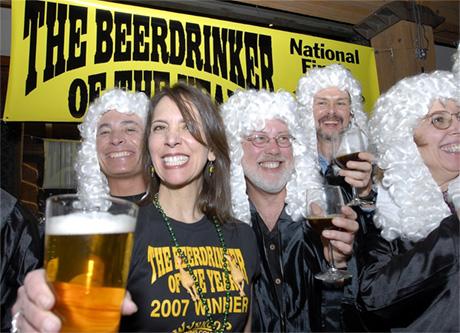
Diane Catanzaro Named Beer Drinker of the Year

February 26, 2007 By Jay Brooks

On Saturday, Diane Catanzaro became the 11th recipient of the coveted title “Beer Drinker of the Year,” and only the second woman to win the award. Catanzaro is a college professor in Norfolk, Virginia, a homebrewer and a BJCP-certified beer judge.

Diane Catanzaro moments after winning. Behind her are judges Tom Ciccateri (2005 winner), Tom Dalldorf (Celebrator Beer News), Gary Steinel (2003 winner) and Carolyn Smagalski (aka The Beer Fox, Bellaonline.com). (Photo by Duane Howell)

From the Press Release:

A professor of industrial/organizational psychology at Christopher Newport University (in Newport News, VA), Catanzaro is the second woman to win the competition. (Cornelia Corey of Clemmons, NC won the title in 2001.) Her home beer bar is The Biergarden in Portsmouth, Virginia.

“This is a dream come true for me,” Catanzaro said after winning the title. “I can use the title to carry the flag for Beer Nation and spread the news about craft beer. And it gives me an opportunity to promote a better understanding of beer to women in America.”

“Beer is not just some fizzy yellow drink,” she said. “It has a rich history, an incredible array of styles and flavors, and it’s part of a healthy life style. And it’s not just for the boys.”

Catanzaro, a finalist in last year’s Beerdrinker contest, beat out finalists Logan Perkins (of Denver, Colorado) and Phil Farrell (Cumming, GA). Her impressive beer drinking experiences, humor and beer ambassadorship helped her land the crown.

“I’ve never seen three more deserving finalists,” said Tom Dalldorf, editor and publisher of Celebrator Beer News and one of the seven judges for the finals. ”But Diane was very engaging, and her personality and very beery background helped her win the title. She speaks well for the beer community.”

The finalists weathered two hours of difficult questions from the judges. The queries stretched from questions about beer chemistry, styles and history, to the finalists’ abilities to sing old beer-advertising jingles and recall esoteric beer trivia.

During the competition’s Beer Whispering segment, Catanzaro impressed judges with a cross-continental conversation with a blend of the Duchess de Bourgogne and Oskar Blues Brewery’s Old Chub Scottish-Style Ale.

For her closing statement, she sang a reworked version of the bygone blues song “Beer Drinking Woman” that referenced Tommee Arthur, Flying Dog Brewery’s Horn Dog barley wine, and female craft brewing legend Carol Stoudt.

Catanzaro’s 2006 beer experiences included tasting beer at numerous breweries, bars and festivals in the US and Belgium, and leading 16 college students on a tour of Belgian breweries and bars.

On the heels of her Beerdrinker victory, she leaves this week for Belgium with another group of students. The group will explore the art and history of Belgium, and its beer culture. While in Belgium, Catanzaro will attend the Zythos Beer Festival and the famed “open brew day” at Cantillon Brewery in Brussels.

On her beer resume, she outlined her philosophy about beer drinking: “People who say they don’t like beer just haven’t met the right beer! I’ll be happy to arrange an introduction… I can be a positive role model for more women to discover the joy of beer and break stereotypes.”

Beer Drinker of the Year Diane Catanzaro with her beer-drinking Barbie, a model Mattel will probably not be offering for sale anytime soon. Pity, really.. (Photo by Tom Dalldorf)

Diane Catanzaro’s Barbie posing fellow finalist Phil Farrell’s infamous rubber chicken. (Photo by Tom Dalldorf)

Filed Under: Just For Fun, News Tagged With: Awards, Colorado, National

Linda Starck Loses Her Battle With Cancer

February 23, 2007 By Jay Brooks

Sad news, indeed, today as I got the word that earlier this morning Linda Starck passed away in her home. She will be deeply missed. Thanks to all the brewers, homebrewers and other caring people who gave so generously to help Linda with her battle. I know that she and her family greatly appreciated the outpouring of support. In the last correspondence I received from Linda, she wrote “I’m overwhelmed by all that you are doing to help support my treatments. It really means a lot to me and my family.”


Linda Starck lost her valiant fight against lung cancer Friday, February 23 at 8:25 a.m. in her home. She was surrounded by family. Since being diagnosed a year ago, on February 28, 2006, she showed unbounded courage and grace in her battle. Linda was well loved in the brewing industry. She was a Brewers Association staff member for over 20 years. She was loved by those who knew her and will be missed by many.

A memorial service is anticipated — A Celebration of Life is being planned — hopefully Friday or Saturday, March 2 or 3. Additional information will be posted as it is determined by Linda’s family. A special memorial web page has been set up by the Brewers Association so people can write thoughts in celebration of Linda’s life. This page is now up and it will be the place to get updates and share your thoughts

The family is collecting photos immediately for use at the memorial service. If you would like to submit any photos, please include your name and return information if you would like photos returned.

Email digital photos to:

Bill Wolfkiel, AWTLLP@aol.com

Send photos to:

Bill Wolfkiel
6525 Gunpark Drive, Suite 370-501
Boulder, CO 80301

The family asks that no flowers be sent, but rather, contributions be made to the American Lung Association:

American Lung Association
61 Broadway, 6th floor
New York, NY 10006.

Thanks to so many who generously supported Linda throughout this last year. Join us in remembering Linda and share your thoughts and stories here. Check the memorial page for updated information.

Filed Under: News Tagged With: Announcements, Colorado, Other Event, Websites

Style Trends for Early 2007

February 23, 2007 By Jay Brooks

Here is a chart of the latest style trends broken out by the top 10 selling styles, based on year to date sales as of January 28, 2007, courtesy of DBBB, the Domestic Brewers Bottled Brands. They publish the book, “The Essential Reference of Domestic Brewers and Their Bottled Brands” and have a website, which offers monthly online updates of the book.

The chart is based on IRI Data showing sales of beer from the beginning of the year through January 28th of this year by beer style. IRI is short for Information Resources, Inc., a company that surveys sales of beer (and everything else) from over 15,000 retailers (mostly groceries) in the U.S. As a result, their data is invariably skewed toward the national and regional brands since it doesn’t take into account direct sales and sales from small mom & pop stores. I used to get IRI data from almost every medium to large brewer who called on me when I was a beer buyer for BevMo. And while it’s not accurate for craft beer in specific, it does give you a general idea of certain trends, especially when you follow it over a period of time.


Filed Under: News Tagged With: Business, National

Choosing Responsibility

February 22, 2007 By Jay Brooks

Join Together is a neo-prohibitionist group that is run by the Boston University School of Public Health. I say that, because they are funded primarily by the Robert Wood Johnson Foundation, and in my opinion Johnson was an extremist nut job, especially with regards to alcohol. But Join Together does a great job of collecting news reports about their cause and so I get their newsletter so I, too, can keep track. Most of the missives I get are about new studies, horrific accounts of binge drinking, essentially anything that supports the neo-prohibitionist agenda. But today’s was a little different and may represent something of a shot over the bow to reversing the trend toward another Prohibition.

John M. McCardell, Jr., the former president of Middlebury College in Vermont has founded a non-profit organization called Choose Responsibility, with the goal of educating the public about binge drinking and furthering the debate for lowering the drinking age in the U.S. from 21 to 18. McCardell, of course, saw his share of drinking on his college campus and brings a unique respectability to the debate which I think will make it harder for anti-drinking groups to dismiss out of hand, which is their usual tactic for anyone who disagrees with them.

From the Join Together news summary:

McCardell said that college officials who think that they have campus drinking under control are “delusional,” adding that most officials are politically restrained from being honest about student drinking. He said his research shows that the age-21 law has had little positive impact on student drinking, adding that trends such as declining DWI rates could just as easily be attributed to other factors. “This is by definition a very emotional issue, but what we need is an informed and dispassionate debate,” McCardell said.

McCardell said the current law makes it hard for parents and schools to teach about responsible drinking. “You either become an arm of the law, which you are not about, or a haven from the law, which poses a fundamental ethical dilemma,” he said.

“I think the 21-year-old drinking age is a disastrous failure,” he said. “Many colleges are worried that if they talk about alcohol with their freshmen, they will be charged with condoning underage drinking.”

“This is not about giving more beer to young people,” said McCardell. “This is about opening our eyes to the social reality around us.”

That’s the chilling effect the decades of proselytizing against drinking by MADD and other neo-prohibitionist organizations has caused. I find it profoundly sad that this is a topic that people are afraid to talk about honestly. What good does it do our society when politicians, school officials charged with the care of our nation’s youth, trade organizations and companies that make alcoholic beverages are effectively muzzled from debating the neo-prohibitionist agenda? Because to these extremists you’re either with them or against them, there is no middle ground. But no topic should be off-limits for discussion, especially when the debate leads directly to public policy decisions. Imagine what would happen if any beer company came out in favor of lowering the drinking age, which clearly would be in their business interests. They’d be excoriated: charged with encouraging underage drinking, picketed and boycotted, and probably accused of clubbing baby seals. What chance at re-election would any politician have who had the temerity to even suggest looking into this issue? I’d put them at slim to none.

And that’s what I really hate about extremism, they take a position that anyone who disagrees with them is an enemy. It seems as if we’ve lost the very ability to have reasonable disagreements with others and still respect them, their opinions or even their right to hold them. We live in an almost completely polarized society, and that’s doing none of us any good.

However unpopular McCadell’s organization is bound to make him with neo-prohibitionists, he’s starting to make some waves. The Associated Press profiled the new group in a syndicated article last week. In the AP story, Choose Responsibility suggests the following.

[McCardell] said federal and state laws that raised the drinking age to 21 did little to keep young people between the ages of 18 and 21 from consuming alcohol. Instead, the laws drove drinking underground and — over the last 20 years — have helped fuel a surge in binge drinking, he said.

“We need to, I think, take our heads out of the sand and open our eyes to the reality and say to ourselves ‘Aren’t we better off trying to educate young people about alcohol and trusting them to exercise adult responsibility in the same way that we trust them when they are appointed to juries or sent to Iraq,” he said Thursday.

Unsurprisingly, MADD disagreed, pointing to the same contradictory statistics they always cling to. But like most advocacy groups, they use — and sometimes distort — only those studies that support their agenda and ignore or marginalize those that support the opposition.

Also last week, Inside Higher Ed, a blog focused on post-high school education, profiled Choose Responsibility in a piece entitled “An Honest Conversation About Alcohol.”

Choosing Responsibility has also set up a blog, Rethinking Drinking, in which they will track this issue in the media and across the web. They’re just getting started, but already there’s a lot of good information there. For example, Grace Kronenberg, Assistant to the Director at Choose Responsibility, posted the following, which gives a great foundation to the reasons and background about what they’re doing.

Ever wonder why we have a 21 year-old drinking age?

The primary reasons cited by supporters of the law:
 

  • It saves lives by preventing alcohol-related traffic fatalities among 18-20 year-olds and the rest of the population.
  • Since the developing adolescent brain is affected differently by alcohol than the adult brain, the 21 year-old drinking age protects adolescents and young adults from its potentially negative consequences.
  • It prevents adolescents from gaining access to alcohol. Some research has found that the earlier one starts to drink, the more likely he or she will experience alcohol dependence and related problems later in life.


Seem bold? We thought so too! Our research has shown that the arguments above are overstated:
 

  • There is no demonstrable cause and effect relationship between the 21 year-old drinking age and the decline in alcohol-related fatalities. While its proponents may claim that the 21 year-old drinking age is solely responsible, we found that many factors–increased seat belt use, development of airbag and anti-lock brake technologies, advent of the “designated driver,” and stigmatization of drunk driving to name just a few–had the effect of making our roads and vehicles safer over the past two and a half decades.
  • The claims of neurological research on alcohol and the adolescent brain have, in many cases, been overstated. Statements like MADD’s “teenagers who drink too much may lose as much as 10 percent of their brainpower” often exaggerate the findings of research findings based on data gathered from rat populations, leading to an oversimplified and alarmist approach to very complicated neurological research. Stay tuned here for more information on alcohol and the brain…
  • The context in which one first consumes alcohol is as, if not more, important as the age of initiation. Age is just a number. Scientific and anthropological data from around the world have shown that the context in which alcohol is first consumed cultural attitudes toward drinking are much more important in determining whether or not an individual will have alcohol-related problems later in life.


[used with permission]

And on the course they’ve set for themselves.

Why 18?

Besides the fact that much evidence cited in favor of the 21 year-old drinking age is exaggerated or misinterpreted (see above), there are several arguments against it:
 

  • The 21 year-old drinking age is an abridgment of the age of majority. By 18, Americans are legally adults and are entitled to all the rights and responsibilities that come with that role but one: the freedom to choose whether or not to consume alcohol.
  • The 21 year-old drinking age marginalizes the role of parents in the process of teaching and encouraging responsible decisions about alcohol use. There is near-consensus cross culturally that parents play an indispensable role in introducing their children to responsible alcohol use. The 21 year-old drinking age effectively eliminates this important parental role, forcing parents to either break the law by serving their under 21 year-old sons and daughters alcohol at home or to risk having their children’s first exposure to alcohol be at an unsupervised college or high-school keg party.
  • Under the 21 year-old drinking age, fewer young people are drinking, but those who choose to are drinking more. This alarming rise in the rates of binge drinking on campuses and in communities around the nation has caused a major, national public health problem. Almost daily, we are bombarded with horrific stories of heavy drinking teens and young adults. Between 1993 and 2001, 18-20 year olds showed a 56% increase in episodes of heavy drinking, the largest increase among American adults. The recent media barrage could not be more clear: the 21 year-old drinking age does not keep young people under 21 from drinking, and drinking dangerously.
  • The 21 year-old drinking age breeds disrespect for law and ethical compromises. The vast majority of people who drink in the United States began drinking before age 21, testament both to the inefficacy of the current law and of the rampant disrespect for its provisions. Because the law is inconsistently enforced and easily circumvented by underage drinkers and those who provide them with alcohol, it has created a climate that makes it all too easy for young adults to obtain and consume alcohol without realizing the legal and ethical consequences of their actions.


[used with permission]

Perhaps my deepest disagreement with 21 being the drinking age stems from when I was eighteen and a member of the U.S. military. We were permitted to drink alcohol on the base but the second we stepped off of it, we were treated like children once more, and were unable to even drink a beer. It was infuriating to be able to vote and die for my country but still not be able to legally drink a beer. At eighteen, we were told we were adults but not treated as such and did not realize the full benefits of adulthood for another three years.

By contrast, most other first world countries either permit their citizens to drink at a younger age or leave it to tradition, parents and local custom. Without the great taboo that exists here, most kids abroad seem to have a much healthier approach to drinking and binging is far less of a problem. When alcohol is part of the culture and not stigmatized, there is less abuse. When families learn to drink together, alcohol cannot tear them apart because those rituals are a part of them. Here, we separate drinking from family activities with, predictably, the opposite effect.

If nothing else, America is a nation of laws, which is both a good and bad thing. But we tend to create laws for everything and over time have gone completely overboard in the sheer number of laws under which we’re all expected to live. For every problem, a new law is passed. Does it actually fix the problem? Not usually, in my experience, and just as often makes it worse with some unintended consequences.

There’s an idea in Taoism which speaks to this problem. In his Tao Te Ching, Lao-Tzu says the following at chapter 57.

Conquer with Inaction

Do not control the people with laws,
Nor violence nor espionage,
But conquer them with inaction.

For:

The more morals and taboos there are,
The more cruelty afflicts people;
The more guns and knives there are,
The more factions divide people;
The more arts and skills there are,
The more change obsoletes people;
The more laws and taxes there are,
The more theft corrupts people.

Yet take no action, and the people nurture each other;
Make no laws, and the people deal fairly with each other;
Own no interest, and the people cooperate with each other;
Express no desire, and the people harmonize with each other.

Said another way, in Brian Bruya’s brilliant translation.

Therefore the Sage says:

“I take no unnecessary action, and the people change of their own accord. I am tranquil and the people are orderly of their own accord. I don’t trouble them, and the people are prosperous of their own accord. I am not greedy, and the people become simple of their own accord.”

Politicians seem to think they play some kind of special role in society, making up all kinds of rules and regulations according to their own ideas and then imposing them on everyone else. If people in power can rule through non-action, tranquility and no-desires, then there might be hope for peace in the world.

What does that mean for the debate on the drinking age? I think that by setting such an arbitrary point at which one day you’re not mature enough to handle alcohol but one day later you are is actually causing more underage drinking than it’s preventing. I drank as a minor. Almost every single person I grew up with drank as a minor, a condition which I suspect continues to this day. What damage did it do in the big picture? Generation after generation, children will continue to try whatever they are told is most forbidden. That’s just human nature. But by criminalizing it, going to such fantastic lengths to keep it from happening and making it impossible for families to choose how to teach their children about responsible drinking in the home we have created a society with a very unhealthy relationship with alcohol. And it shows, especially when you contrast us with other cultures.

Alcohol has played a vital role in humanity’s growth from hunter gatherers to gleaming skyscrapers, and quite possibly may have been the inspiration for civilization itself. But by the misguided efforts of a few who want to remake the world according to their own views, the rest of us have been saddled with the cumbersome, unwieldy system we have today that tries to regulate, restrict and, if possible, obliterate that heritage. At a very minimum, we should be able to talk about it. I’m glad that one more organization, Choose Responsibility, is entering the debate.

Filed Under: Editorial, News Tagged With: Law, Prohibitionists, Websites

Bud TV Under Fire

February 21, 2007 By Jay Brooks

The first time I logged into Bud.tv, I had a heck of a time gaining access and proving that I was over 21 despite the fact that I’m more than twice as old as the age of consent. Presumably, that was because I’ve recently moved and I had to use my old information to get in. Frankly, it felt a little creepy thinking they had all of my personal information. I suspect that most people think that’s a small price to pay for keeping minors out of the website. I don’t agree, of course, and have grown weary of having to prove I’m an adult over and over and over again.

But as difficult as I — and many others it seems — found it was to register for Bud.tv, apparently it’s still not difficult enough for the attorneys general of almost half the states in the country. Here are the states who think it’s too easy for kids to get into Bud TV:

  1. Alaska
  2. Arizona
  3. Connecticut
  4. Delaware
  5. Illinois
  6. Iowa
  7. Kansas
  8. Louisiana
  9. Maine
  10. Maryland
  11. Nevada
  12. New Mexico
  13. New York
  14. North Carolina
  15. Ohio
  16. Oregon
  17. South Carolina
  18. Tennessee
  19. Vermont
  20. West Virginia
  21. Wyoming

Plus two U.S. territories:

  • District of Columbia
  • Puerto Rico
  • .

The twenty-three attorneys general have written to Anheuser-Busch requesting “better tools to make sure underaged viewers aren’t accessing its new Bud.TV site.” Apparently name, zip code and birthdate aren’t invasive enough because a clever kid could know that information about their parents or another adult. It seems they won’t be satisfied until at least people have to enter “their name and full address, or a driver’s license number, exactly as it appears on a government-issued ID.” But that’s still not enough, as they’d also like to have a postcard sent to the person’s address or have someone phone the house to insure the registrant is “legal-aged adult, and not a child below the drinking age.” The states believe that because A-B is creating the content for some reason they “have a higher responsibility to ensure that youth are not exposed to the marketing on [their] site.” Using that logic, why haven’t these states sent similar letters to every network and cable channel that creates original programming? Why not hold every media that creates its own content to the same principle? Or are only businesses that advertise as well as “creating the programming” held to a higher standard?

That seems absolutely preposterous, especially when you consider that all this effort is being proposed not to keep alcohol from falling into a minor’s hands, but merely to keep them from watching TV on the internet. To go to such great lengths to keep kids from watching the same commercials they can see by turning on the television seems ridiculous, but all too typical. Of course, there is more than just commercials on Bud.tv. There are also several inane tv-like episodic shows. From what I’ve seen so far they seem more tame than the average HBO show, and with no apparent nudity or swearing. From the descriptions of the shows, it’s possible some have mature themes but it doesn’t appear any worse than the average evening cable show.

But here’s a kicker:

Maine attorney general G. Steven Rowe, who helped to spearhead the effort along with Louisiana’s Attorney General Charles Foti, said he didn’t have any evidence that underage children are accessing the Web site, but said it’s clear that more could be done to safeguard children.

So all this strutting and puffing doesn’t even have any basis in reality. It’s just a headline-grabbing stunt to “protect the children” from a threat that doesn’t even exist.

Here’s how Media Post Publications’ “Just An Online Minute” (free subscription required) for today questioned their logic:

But, while it’s probably true that people under 21 can access Bud.tv’s content, it’s unclear why this poses such a problem for the authorities. After all, minors have been exposed to the company’s marketing for years.

Consider, in addition to advertising on programs like the Super Bowl — certainly viewed by people under 21 — Anheuser-Busch has served as official sponsor of dozens upon dozens of professional sports teams, ranging from the Chicago Bulls to the Carolina Panthers to the St. Louis Cardinals (who play their home games in Busch stadium).

It’s hard to imagine that watching a clip on Bud.tv will somehow prove more powerful with minors than the company’s myriad ads and other marketing efforts in the offline world.

There’s nothing I find particularly compelling on Bud.tv, and I’m usually no great fan of A-B’s business practices, but this political stunt by these states is yet another contemptible, shameless and public deceit pretending “it’s for the children.” Curiously, only three of the top twenty beer-producing states (as of 2005 statistics) are among the signatories, but twelve of the bottom twenty are. Coincidence? Most likely not, as following the money will rarely steer you wrong. Notice Missouri is absent from the list of complaining states, as is Wisconsin and Colorado, where the number two and three biggest breweries are located.

So no matter how you slice it, I can’t see where the problem is that all these states were so quick to complain about. First, the attorneys general admit there’s no evidence whatsoever that kids are watching Bud.tv. Second, it’s already more difficult to gain access to the website than any other free site I’ve ever visited. Third, once you make it to Bud.tv, there’s no pornographic, violent or overtly adult content that children need to be protected from. At worst, it’s the sort of stuff you’d see on cable television. If anything, these states’ stunt will probably backfire and generate more buzz and traffic to the Bud.tv website than if they’d just kept their pens in their pockets.

So I find myself in unfamiliar territory, siding with A-B when they say the following:

‘Despite these extraordinary efforts, some have urged us to make the age verification process more difficult and even more invasive of people’s privacy,’ said a company spokeswoman, Francine Katz, in a statement.

I felt the current age verification was already pretty “invasive of people’s privacy,” certainly more than I felt was appropriate or necessary. Think about it this way. The internet, in terms of parenting, is really not much different than television. It is and should be up to parents to decide what their children see and at what age or time in their lives. Trying to protect children from perceived harm is no business of the state or federal government. It’s a lazy parent that wants to turn over control of what their child can watch to the powers that be. I think these attorneys general might want to spend more time with their own kids instead of telling me how to raise mine. Perhaps then they’ll see fit to spend their time and resources more wisely, going after true criminals and others who would do the people of their states real harm, instead of some vague potential for children possibly seeing something intended for adults. Seriously, who would you rather see the top lawyer in your state prosecute; the killers, robbers and rapists or the website that your kids might hack into and watch innocuous short films on a tiny two by three inch screen?

Filed Under: Editorial, News, Politics & Law Tagged With: Business, Law, Prohibitionists, Websites

It’s Official! Double-Digit Craft Beer Growth Again!

February 20, 2007 By Jay Brooks

The results are in and again craft beer has hit one out of the park. For the fourth straight year, growth in the sale of craft beer has shown signifcant improvement.

From the BA press release:

The continuing growth of craft beer entered double digit territory in 2006, with sales by craft brewers up 11.7% by volume for the year. This comes on top of strong growth in each of the prior three years and illustrates the ongoing surge of consumer interest in craft beers.

“American tastes are clearly changing thus the demand for more flavorful and diverse beers is exploding,” said Paul Gatza, Director of the Brewers Association, which tabulates industry growth data.

The Brewers Association estimates 2006 sales by craft brewers at over 6,600,000 barrels (one barrel equals 31 U.S. gallons) up from an adjusted total of just under 6,000,000 barrels in 2005. The increase totals over 690,000 barrels or 9.5 million case-equivalents. For 2006 craft beer posted a retail sales figure of $4.2 billion.

A strong area of distribution for craft beer is grocery, convenience, drug and liquors stores. According to Information Resources Inc. (IRI), “The beer category reaped growth from import (+10.9%) and micro-brew (+16.9%) products, while suffering losses across domestic and non-alcoholic varieties.”

“Craft beer has become a great American success story and today U.S. craft brewers are being watched, emulated and celebrated globally.” stated Julia Herz, Director of Craft Beer Marketing for the Brewers Association. “Demand has become contagious. Craft beer is satisfying the thirst and beer enthusiasm of a continuously growing number of beer drinkers who are seeking flavor, diversity and value.”

A more extensive release of the 2006 production numbers will be available from the Brewers Association on April 19 at the Craft Brewers Conference in Austin, TX and unveiled in the May/June issue of The New Brewer magazine. The craft beer segment includes 1377 breweries.

The definition of craft beer as stated by the Brewers Association: An American craft brewer is small, independent and traditional. Craft beer comes only from a craft brewer. Small = annual production of beer less than 2 million barrels. Beer production is attributed to a brewer according to the rules of alternating proprietorships. Flavored malt beverages are not considered beer for purposes of this definition. Independent = Less than 25% of the craft brewery is owned or controlled (or equivalent economic interest) by an alcoholic beverage industry member who is not themselves a craft brewer. Traditional = A brewer who has either an all malt flagship (the beer which represents the greatest volume among that brewers brands)

Filed Under: News Tagged With: Business, National, Press Release

Toronado Barley Wine Festival Results 2007

February 17, 2007 By Jay Brooks

Here are the results from the 2007 Toronado Barley Wine Festival in San Francisco:


  • 1st Place: Big Nugget, Alaskan Brewing
  • 2nd Place: Angel’s Share, Lost Abbey
  • 3rd Place (tie): Doggie Claws, Hair of the Dog
  • 3rd Place (tie): XI, Uinta Brewing


Congratulations to all the winners.
 

Filed Under: Events, News Tagged With: Awards, California, Festivals, San Francisco

This Here’s the Wattle …

February 16, 2007 By Jay Brooks

I confess I never really knew what exactly a wattle was, apart from some sort of Australian plant. But every time I hear the word — which admittedly doesn’t happen often — I think of the following declaration by the philosphy professors from the University of Woolamaloo in Australia. “This here’s the wattle — the emblem of our land. You can stick it in a bottle or you can hold it in yer hand.” All of their names are Bruce, of course, because the reference is from an episode of the brilliant British television show Monty Python’s Flying Circus.

But I saw recently that an Australian brewer, Barons Brewing, is using black wattle in their beer. So I figured it was time to figure out what the heck a wattle is, after all.

It turns out that a wattle is essentially the Australian word for an Acacia. Here’s what Wikipedia has to say about acacias:

Acacia is a genus of shrubs and trees of Gondwanian origin belonging to the Subfamily Mimosoideae of the family Fabaceae, first described from Africa by Linnaeus in 1773. Acacias are also known as thorntrees or wattles, including the yellow-fever acacia and umbrella acacias. There are roughly 1300 species of Acacia worldwide, about 950 of them native to Australia, with the remainder spread around the dry tropical to warm-temperate regions of both hemispheres, including Africa, southern Asia, and the Americas. The genus Acacia however is apparently not monophyletic. This discovery has led to the breaking up of Acacia into five new genera as discussed in list of Acacia species.

Black wattle, or Acacia mearnsii, is the variety being used by Barons Brewing.

Black wattle is a fast-growing leguminous nitrogen fixing tree. Native to Australia, A. mearnsii is often used as a commercial source of tannin or a source of fire wood for local communities. It threatens native habitats by competing with indigenous vegetation, replacing grass communities, reducing native biodiversity and increasing water loss from riparian zones. They are similar to Acacia dealbata. The species is named after E. A. Mearns who collected the type from a cultivated specimen in East Africa.

I’ve always been a fan of gruits and other beers made with herbs and spices. The complexity and range of flavors available by adding just a hint of one or more ingredients is astounding. And shrubs and trees, too, can work a similar magic on brewing. Beer made with spruce, for example, was quite common in colonial America where hops was in short supply. So I’m dying to try some of Baron’s new Black Wattle Superior, a Wattle Seed Ale.

Here’s what their website has to say about it:

In creating the Black Wattle range, we have used a combination of select malt and hops, brewed to traditional methods and standards. Black Wattle however, offers something special. All beers in the Black Wattle range feature a unique touch of Australia, incorporating native herbs and spices during the brewing process. The resulting beer delivers a wealth of flavours that have not been experienced in beer until today.

The first beer released is the Wattle Seed Ale, which starts with a blend of Australian and European malts, creating a rich flavour base of caramel with a hint of chocolate. The smooth malt flavours are lightly hopped and then infused with roasted Wattle Seed, bringing a unique and authentic Australian flavour to this fine red ale. The result is an outstanding ale that boasts a smooth taste profile balancing its robust character, an ultimately rewarding yet distinctive beer.

At 5.8% ABV and offering a long and lasting flavour, the Wattle Seed Ale is best enjoyed with or after a meal, complimenting a juicy steak, rack of lamb, or a prosciutto and rockmelon starter. Alternatively, this select ale will be enjoyed at almost any occasion by those who enjoy something special in a beer.

But I can’t bring up the Bruces from the Philosophy Department of the University of Woolamaloo without mentioning their “Philosophy Song.” I saw it performed live at the City Center in New York when my parents let me take my first unchaperoned trip to the Big Apple in 1976, when I was 17. It’s still one of my favorite Monty Python bits and I remain a huge fan of the show and much of the individual members’ later work, as well. The lyrics are reprinted below.

Bruces’ Philosophers Song

Immanuel Kant was a real pissant
Who was very rarely stable.

Heidegger, Heidegger was a boozy beggar
Who could think you under the table.

David Hume could out-consume
Wilhelm Friedrich Hegel, [later versions have ‘Schopenhauer and Hegel’]

And Wittgenstein was a beery swine
Who was just as schloshed as Schlegel.

There’s nothing Nietzsche couldn’t teach ya ’bout the raising of the wrist.
Socrates, himself, was permanently pissed.

John Stuart Mill, of his own free will,
On half a pint of shandy was particularly ill.

Plato, they say, could stick it away—
Half a crate of whisky every day.

Aristotle, Aristotle was a bugger for the bottle.
Hobbes was fond of his dram,

And René Descartes was a drunken fart.
‘I drink, therefore I am.’

Yes, Socrates, himself, is particularly missed,
A lovely little thinker, but a bugger when he’s pissed.

Filed Under: Beers, Just For Fun, News Tagged With: Australia, Humor

« Previous Page
Next Page »

Find Something

Northern California Breweries

Please consider purchasing my latest book, California Breweries North, available from Amazon, or ask for it at your local bookstore.

Recent Comments

  • Bob Paolino on Beer Birthday: Grant Johnston
  • Gambrinus on Historic Beer Birthday: A.J. Houghton
  • Ernie Dewing on Historic Beer Birthday: Charles William Bergner 
  • Steve 'Pudgy' De Rose on Historic Beer Birthday: Jacob Schmidt
  • Jay Brooks on Beer Birthday: Bill Owens

Recent Posts

  • Beer In Ads #5137: Bock Is Back… Look For It March 1st February 28, 2026
  • Historic Beer Birthday: John Holme Ballantine February 28, 2026
  • American Craft Beer Hall of Fame: 2nd Year Inductees February 28, 2026
  • Beer Birthday: Jeff Bell February 28, 2026
  • Beer In Ads #5136: American Bock Beer Is Being Served Today! February 28, 2026

BBB Archives

Feedback

Head Quarter
This site is hosted and maintained by H25Q.dev. Any questions or comments for the webmaster can be directed here.