Brookston Beer Bulletin

Jay R. Brooks on Beer

  • Home
  • About
  • Editorial
  • Birthdays
  • Art & Beer

Socialize

  • Dribbble
  • Email
  • Facebook
  • Flickr
  • GitHub
  • Instagram
  • LinkedIn
  • Pinterest
  • RSS
  • Twitter
  • YouTube

Powered by Genesis

Budweiser Negotiating to Buy Budweiser

September 14, 2007 By Jay Brooks

No, you read that right. In April it was announced that the Czech Republic, who owns and operates Budejovicky Budvar — from the Bohemian town of Budweis — was considering selling it to the highest bidder to help with the country’s budget woes. Naturally they used the gentler word privatize, but the result is the same. Forbes is reporting that Anheuser-Busch has been in negotiations for some time now.

A-B and Budvar have been bickering over the Budweiser trademark for over a century, though recently A-B agreed to distribute Czechvar (Budvar’s trade name in the U.S.) in the American market. Buying the Czech brewery would make good sense from a business point of view, because the still numerous pending trademark disputes would simply vanish, saving untold millions in legal fees. Plus A-B would be able to market its own Budweiser uniformly throughout the world. Currently there are a number of nations where Budvar has prevailed in litigation and the American Budweiser must be sold in those countries under a different name. Buying the brewery then seems like it would be worth its weight in gold. Of course, the Czech government is apparently not one to let an opportunity pass it by and is exploiting the situation. They’re asking $1.5 billion, even though that’s twelve times its annual sales of just over $125 million. Most valuations use a formula of around 2.5 times annual sales, making a pricetag of $300 million or so a bit more reasonable, at least to prospective buyers.

A-B began selling beer under the name Budweiser (admittedly taking the name from the Bohemian town of Budweis) in 1876 (registering the trademark in 1878), whereas the present brewer, Budejovicky Budvar, didn’t begin brewing until 1895. But as the Czechs are quick to point out, beer was being brewed in the town of Budweis since the 13th century, since 1265 to be exact. And in that time before trademarks and brand names per se, beer brewed in the town was called Budweiser to distinguish it from beer made in other towns, it just wasn’t made by the same company. To a number of people, however, the dispute is about more than just who used the brand name first. To the Czechs it’s understandably a matter of national pride. How do you tell someone they can’t use the name of their own town on their own labels with a company name that also includes the name of the town?


Well if you’re Anheuser-Busch, you rely on the fact that you’ve spent millions and millions of dollars building a brand name and some upstart company shouldn’t be able to just waltz in and trade on all that hard work. And while I do understand A-B’s position, I’d be more sympathetic to it if this dispute just started recently after they really have created a worldwide brand name over many, many years spending untold dollars to do so. But that’s not exactly what happened. This dispute began early in the 20th century, only ten years or so after the modern Budvar was formed and only 30-odd years after Anheuser began using the Budweiser name. At that time they were certainly a successful company, but nowhere near the international behemoth they are today. Looked at today, it’s much easier to accept A-B’s arguments, but not when the dispute began. The vast majority of the effort and resources that A-B has spent building up the value of the brand name took place after Budvar began complaining that A-B was using their town’s name. I’m not sure that matters from a legal standpoint (though perhaps it should) but it just feels wrong. I know that’s idealistic and isn’t how the world really works, but I’m not convinced that most people want to live in a world where the bully with the most money usually wins. A-B may have even figured out a way to market Budweiser in the Czech Republic, by buying another local brewery, Jihocesky Pivovary, which is currently located in southern Bohemia. But in 1997 they found documents indicating they were the first brewery in Budweis, having been founded in 1795.

But buying Budejovicky Budvar would finally and forever put this dispute to bed. I just don’t know if that’s really the right result. It certainly doesn’t feel like it would end the controversy or really answer the question of who really should be entitled to use the name “Budweiser.”

 

Filed Under: Editorial, News Tagged With: Business, Europe, History, International, Law, National

Today Alcopops, Tomorrow Beer

August 27, 2007 By Jay Brooks

Join Together, another one of those pesky neo-prohibitionist groups, is still crowing about the California Board of Equalization‘s wrong-headed decision last week to tax FMB’s (flavored malt beverages, a.k.a alcopops) using the same schedule as spirits. This will mean, beginning in mid-2008, makers of FMBS will be required to pay about 25% more in taxes. Neo-Prohibitionists groups who pushed this issue believe that making alcopops more expensive will somehow reduce underage consumption.

As I’ve said before, it’s quite easy to see why the BOE would vote in favor of higher taxes, especially during a statewide budget crunch, but even at that it was a narrow 3-2 decision. Insiders present at the meeting tell me that the BOE hinted at al present that in ruling they way they did, they were giving all concerned parties a chance to take the issue to the legislature where the BOE made clear they believe it should be decided. I’ve heard an unconfirmed story already that the anti-alcohol Marin Institute has talked to the state speaker, fully expecting his support, only to be shut down in no uncertain terms. It’s no surprise we’ve haven’t heard that side of the story from them.

Knowing that makes it much harder to swallow Join Together characterizing the ruling as “groundbreaking.” Their headline, Alcopops are Liquor, Not Beer, Calif. Tax Board Rules, is misleading at best and an out and out lie at worst. The BOE did no such thing. They only ruled that alcopops should be “taxed” as spirits, not that they “are” spirits. A small point, perhaps, but I think illustrative of how willing these groups are to torture the truth and bend it to their will.

Speaking of lying, here another pernicious one:

Michael Scippa, advocacy director for the Marin Institute, told Join Together that up to 90 percent of the alcohol contained in alcopops is derived from distilled spirits, and that California law states that a beverage with any amount of detectable alcohol from such sources is considered a distilled product, not a beer product.

“Up until now, alcopop manufacturers have gotten away with a cynical manipulation of California’s alcoholic beverage laws, mischaracterizing their products – which derive most of their alcoholic content from distilled spirits – as though they were beer to permit them to be sold cheaply and broadly throughout the state,” said Scott Dickey, an attorney with the San Francisco-based Public Law Group, which provided free legal services to the campaign to change the alcopops classification. “The BOE’s decision is a big step forward in holding alcopop manufacturers accountable for this deception.”

That’s not true, they are malt beverages with flavoring added. Distilled spirits are not added and it is not where their “alcoholic content” is derived from. They are most closely related to beer, which is precisely why they they are called flavored malt beverages and why they have been taxed like beer. Their alcohol content is likewise about the same as the average beer. They are fermented like beer and then chemical flavoring compounds are added, which give FMBs their distinctive sweet, fruity essence. Unlike attorney Scott Dickey’s assertions, which in fact are mischaracterizations, FMBs are exactly what their name suggests, no one has deceived anyone.

When Diageo first presented Smirnoff Ice to me in my capacity as the beer buyer for Beverages & more, they were quite candid about their reasons for launching the new product. Since they were prohibited from advertising their brand in certain media and likewise not permitted to sell their brand in certain stores, at least in California, such as convenience stores, gas stations, etc. By making an alcoholic product that was not spirit-based, they could now do so and it would further allow them to promote, market and advertise the core brand of Smirnoff to a wider audience. I think the fantastic success of Smirnoff Ice, and their countless imitators, surprised Diageo as much as it delighted them. But it was created precisely NOT to be a spirit, and if they had used distilled spirits in its manufacture, that would have defeated its original purpose.

Unlike the assertion of Marin Institute executive director Bruce Lee Livingston, whose grasp on reality seems to be slipping, that “[f]or generations, Big Alcohol has evaded proper taxation on these products,” they have been taxed at the exact rate they should have been for what the product actually is. And as I pointed out previously, Smirnoff Ice was introduced in 2001 and a generation is about thirty years. Clearly math is not his strong suit.

Now I’m no fan of FMBs. I don’t like them. I don’t like the way they often subvert young people’s conversion to craft beer. From a purely business point of view, I understand why the parent companies have used them to build their brand awareness while creating new profits at the same time. But I have been hearing a disturbing number of people inside the brewing industry willing to throw them under the bus, short-shortsightedly failing to recognize that the attack on FMBs is not an end unto itself, but merely the first battle in a much longer war. Don’t believe me? Just wait, do nothing, and see what happens.

I have it on good authority that the next salvo from the Marin Institute will be to ask the legislature/BOE to reclassify all malt beverages over 6% abv as distilled spirits! That means any strong beer like Belgian tripels, dubbels, bocks and doppelbocks, barleywines and even some IPAs will all be considered distilled spirits for taxation. I’m sure they’ll be spinning it as an attack on malt liquor, but some of our most cherished styles of beers will fall under such a definition, making them either more expensive or economically unfeasible for the breweries to continue making them.

Distillation, of course, is a specific process for separating, in the case of liquids, different components with different boiling points. There are a few kinds of distilling, such as freeze distilling, pot distilling and reflux distilling, and each of them does roughly the same thing or yields similar results. Liquids distilled are separate and distinct from either beer or wine, of course, as the process deviates wildly at one point and the resulting spirits are generally much, much stronger than either. Types of distilled products include absinthe, bourbon, brandy, calvados, cognac, gin, ouzo, rum, schnapps, scotch, tequila, vodka, whisky (and whiskey) to name just a few of the more common examples. Other non-alcoholic or lethal products which are distilled are gasoline, kerosene and paraffin.

So trying to call strong beers distilled spirits is not really in keeping with reality. Spirits — and wine for that matter — is generally much more alcoholic than beer, so trying to paint even a 10% strong beer with the same broad brush as whisky is akin to trying to fit a square peg in a round hole. It just doesn’t work. But it really has nothing to do with reality — or concepts of fairness — but instead is the drawing of the next battle line in a war whose goal is another national prohibition. We have to be vigilant of these groups and what they’re trying to accomplish. It’s our very complacency and disorganized apathy that they’re counting on to succeed. You can color me as reactionary as you like, but no harm can come from committing ourselves now to defeating the well-organized campaign for another prohibition. If we succeed, life continues as before. But if we lose, we’ll have no beer to cry into. Don’t let that happen.


Filed Under: Editorial, News Tagged With: Business, California, Law, Prohibitionists

Still More Beer Health Claims

August 26, 2007 By Jay Brooks

While reading over the text of the latest study showing a decreased risk of kidney cancer for moderate beer drinkers, I noticed in the References a couple of older studies that showed that beer and/or alcohol had both specific and general health benefits. Most of the 37 academic papers listed as references were about renal cell cancer (a.k.a. kidney cancer), but these two, both from 2000, were about other health benefits of beer consumption.

The first, Beer increases plasma antioxidant capacity in humans, was published in the February 2000 issue of the Journal of Nutritional Biochemistry. Here is the PubMed abstract:

The positive association of a moderate intake of alcoholic beverages with a low risk for cardiovascular disease, in addition to ethanol itself, may be linked to their polyphenol content. This article describes the effect of acute ingestion of beer, dealcoholized beer, and ethanol (4.5% v/v) on the total plasma antioxidant status of subjects, and the change in the high performance liquid chromatography profile of some selected phenolic acids (caffeic, sinapic, syringic, and vanillic acids) in 14 healthy humans. Plasma was collected at various times: before (T0), 1 hour after (T1), and 2 hours after (T2) drinking. The study is part of a larger research planned to identify both the impact of brewing on minor components potentially present in beer and their metabolic fate in humans. Beer was able to induce a significant (P < 0.05) increase in plasma antioxidant capacity at T1 (mean +/- SD: T0 1,353 +/- 320 microM; T1 1,578 +/- 282 microM), returning close to basal values at T2. All phenolic acids measured in plasma tended to increase after beer intake (20% at T1, 40% at T2). Syringic and sinapic acid reached statistical significance (P < 0.05 by one-way analysis of variance-Fisher’s test) at T1 and T2, respectively. Plasma metabolic parameters (glucose, total cholesterol, triglycerides, and uric acid) and plasma antioxidants (alpha-tocopherol and glutathione) remained unchanged. Ethanol removal impaired the absorption of phenolic acids, which did not change over the time of the experiment, accounting for the low (and not statistically significant) increase in plasma antioxidant capacity after dealcoholized beer drinking. Ethanol alone did not affect plasma antioxidant capacity or any of the antioxidant and metabolic parameters measured.

The second one, Nutritional and Health Benefits of Beer, was published in the November 2000 issue of The American Journal of the Medical Sciences. Here is the PubMed abstract:

Physicians should be aware of the growing evidence supporting the nutritional and health benefits of moderate consumption of alcohol as part of a healthy lifestyle. The recently approved voluntary label on wine (“the proud people who made this wine encourage you to consult your family doctor about the health effects of wine consumption”) implies that physicians should promote wine as the preferred source of dietary alcohol. However, studies evaluating the relative benefits of wine versus beer versus spirits suggest that moderate consumption of any alcoholic beverage is associated with lower rates of cardiovascular disease. From a nutritional standpoint, beer contains more protein and B vitamins than wine. The antioxidant content of beer is equivalent to that of wine, but the specific antioxidants are different because the barley and hops used in the production of beer contain flavonoids different from those in the grapes used in the production of wine. The benefits of moderate alcohol consumption have not been generally endorsed by physicians for fear that heavy consumers may consider any message as a permissive license to drink in excess. Discussions with patients regarding alcohol consumption should be made in the context of a general medical examination. There is no evidence to support endorsement of one type of alcoholic beverage over another. The physician should define moderate drinking (1 drink per day for women and 2 drinks per day for men) for the patient and should review consumption patterns associated with high risk.

Interesting stuff and not terribly surprising given that recent years have seen a growing body of such findings. What’s perhaps more curious is how silent the neo-prohibitionist groups are about all of the health benefits of moderate consumption. It’s getting harder and harder for them to maintain their shrill evils of alcohol position in light of these generally unbiased scientific findings. What’s perhaps more troubling is that their very inflexibility, especially their refusal to entertain lowering the drinking age or allow reasonable alcohol education, are actually causing the problems associated with immoderate drinking to increase. By forcing kids to drink underground, without benefit of parental or adult supervision or example, today’s generation seems far less equipped to learn moderation.

Take for example, the neo-prohibitionist position undertaken by government studies that defines binge drinking as five drinks in one session. If physicians in many other studies suggest that two drinks per days is considered to be the definition of moderate drinking, then the distance between healthy drinker to problem drinker seems fantastically small. That makes one or both standards all but meaningless. But since it would be hard to argue that the standard of two drinks per day is too high then it seems to me a prima facie conclusion that it’s the binge drinking standard that is out of whack.

But these groups with government collusion continue to demonize alcohol and refuse, where possible, to allow parents to teach their children about how to drink, with the predictable result that newly freed college students binge at the first opportunity. As former Middlebury College president John M. McCardell Jr. — and the founder of Choose Responsibility — asks, has making the drinking age 21 stopped kids from drinking? The answer is quite obviously “no,” which suggests that this approach does not work as intended. And with the growing body of health benefits associated with moderate drinking, aren’t these prohibitions simply doing more harm than good? I think an argument can be made that by not allowing alcohol education and making alcohol a forbidden taboo, neo-prohibitionist groups are actually causing more binge drinking and keeping young people from realizing the health benefits of moderation.
 

Filed Under: Editorial Tagged With: Health & Beer, National

Putting On Airs

August 19, 2007 By Jay Brooks

A friend sent me this link (thanks Steve) to a Wall Street Journal article entitled When Beer Takes On Vintners’ Airs, about craft brewers making beer with more complex flavors. There’s a lot of good in the article, but I can’t help but feel like it’s dripping with a certain condescension. I don’t know if it’s intentional or simple ignorance. Of the last 43 articles by author Conor Dougherty, only two were about beer, with the vast majority of his writing being about economics. And in one of the two he likens cask ale to flat beer, a fundamental mistake and in that article his writing barely conceals a disdain similar to the current piece. In the article published on Friday, he starts out with a particularly fallacious statement.

Small brewers have long boasted that their beer can stand up to the finest wine. Their new strategy: Make beer that tastes like wine.

No brewer I know sets out to make his beer taste like wine. That’s never been the goal, nor is it the result. The brewers mentioned in the article merely are trying to stretch the boundaries of beer and make unique and original works of liquid art for their customers. Just because they may have some flavors that wine also has doesn’t mean the brewers who made them set out to make a wine. Taste any of them side by side with a wine. If you can’t tell the difference, stick to water. They’ll never be mistaken for wine.

Though many winos may be loathe to admit it, brewing is a far more complicated and involved process, requiring far more equipment, ingredients and education or experience than does making wine. Winemakers — at least all the ones I know — will freely admit this. A winemaker from Mondavi that I sat with at a dinner there told me she thought winemaking was easy compared to brewing, that all she did was get the grapes ready and let nature do its thing. Brewers, on the other hand, have figurative knobs and buttons to fiddle with in endless combinations. In the same way a mere twelve notes account for all the world’s music, four main ingredients account for a diversity in beer that is truly staggering. While a sad majority believe, as Dougherty puts it, that beer is “plain and even watery,” they couldn’t be more mistaken. The major beer companies have been passing off an industrial product as beer for so long now — and with so much marketing muscle behind it — that a majority of Americans today believe that’s what beer is. Simply put, they’re wrong. Or more kindly, that it’s not all that beer is or can be.

People might refer to Wonder Bread as bread but does anybody think it’s the only kind of bread? Who doesn’t know there are many kinds of bread or that there are lots of better breads? I’m sure Wonder Bread and all of the other nutritionally challenged white breads far outsell gourmet artisanal bread but it seems to me most people at least recognize that there is a difference. Yet time and time again, people seem to think that all beer is the same and often seem quite surprised to discover that there are literally dozens of distinctive styles of beer. That’s a triumph of marketing that’s perpetuated by a media that insists on remaining as ignorant as the public at large. Even when some do appear to at least realize there is beer beyond the industrial lagers, they are often dismissive and condescending which only serves to maintain the status quo opinion.

But back to the Journal. Just because brewers use grapes as an adjunct or age the beer in oak wine barrels doesn’t make it wine or even a wine beer. Winemakers don’t own grapes. Not everything made with grapes is wine. Are cork dorks up in arms over grapes in jams and jellies trying to make winey jam? And like jams, brewers also use many other fruits in beer, too, there’s nothing sinister about a few using grapes.

But Dougherty concludes that “the concept with all of these” beers it to add “extra layers of complexity” and refers to them all with a broad brush, branding them all “winey beers,” which I find more than a little derogatory. Every time he finds any similarity between one of these boutique beers and his beloved wine — such as serving temperature, bottle size, or the fact that it uses a cork — he takes it as a sign of beer trying to copy wine or be like wine. It’s as if he believes that these features are somehow the exclusive domain of wine, and none dare do the same lest they be accused of envy or stealing. It’s a very weird position to take. Beer has used corks for over a century, it’s nothing new. Many Belgian beers have been using corks since the 19th century right up to the present. 750 ml bottles likewise are nothing new for beer outside our shores. And as for being consumed at warmer temperatures, that’s also been the case for centuries. It only seems strange to Americans since the major companies so vigorously promote the notion of ice cold beer. The colder the beer, the less of the flavors that will come through. It’s not magic. If you make a beer that actually has good rich, complex flavors you’ll want to taste those, won’t you? And so you drink them at a slightly warmer temperature. So what?

The article also calls these so-called “winey beers” hybrids just because they “have a stronger aroma, fruitier tastes — and alcohol levels that, at 10% to 15%, are two to three times that of a typical beer.” Huh? IPAs have strong aromas, plenty of mild beers have fruity esters and barleywines, bocks and Belgian tripels are plenty strong. That makes them hybrids … why? Dougherty also calls them a detour, because for craft brewers they’re a relatively recent phenomenon. As the craft beer segment matures, why wouldn’t you expect brewers to make increasingly sophisticated products? Why is that a detour, and not simply the vanguard brewers leading the way?

Apparently cheese and food pairings and the ability of some beers to be aged is also infringing on wine’s cache, because Dougherty seems surprised that pairing might even be suggested. Cheese and beer have long been a far better pairing than wine. It’s only that the wine industry has done a great job of inextricably linking the two that most people don’t realize it. But the monks at Chimay, to give one example, have been making cheese as long as they’ve been making their fine beer. Together, as you might expect, they’re a heavenly delight. Beer dinners, of course, are becoming more common every day and there’s nothing noteworthy about strong beers ability to be aged.

The article finishes up with a tasting, naturally not by experts, but by journalists who are fans of either beer or wine. It’s the rare wine tasting that includes amateurs, but that seems de rigueur for media beer tastings. Just bring in a few shlubs off the street and see what they think. It’s just beer, after all. Who needs people who know what they’re tasting? That seems especially egregious given this whole piece is talking about beers who by definition are not the usual “plain and even watery” beers. So perhaps that’s why they chose journalists instead of just the man on the street. Either way, it’s infuriating. What did they learn? Nothing, apparently. Here’s the write-up:

On a recent afternoon, we gathered a panel of reporters and editors made up of both beer and wine fans to sample winey beers from around the country. Our first discovery: These beers aren’t for everyone. Comments ranged from “interesting” to “terrible.” A number of our testers said most of the brews tasted like neither beer nor wine but made them pine for one or the other. “Is it possible that there is beer and wine and the two should never meet?” asked one befuddled sampler.

Wow, they “discovered” that something you taste isn’t universally beloved? Tell me, please, what is “for everyone?” Wine? Nope. Whisky? Nope. Coffee? Nope. Water? Probably, but that’s got to be the only liquid I can think of that truly is for everyone. Saying some people found them “interesting” and some “terrible” without any context like who they are,what their predispositions are, or their backgrounds makes these cryptic one-word comments completely meaningless. Of course they didn’t taste like wine, they’re not wines no matter how many times you insist on calling them “winey beers.” That some people didn’t think they tasted like beers merely displays how little the tasters know about beer and its diversity. Beer doesn’t have just one taste or flavor. It doesn’t all taste the same. And more importantly, each bottle they tasted (although to be fair I don’t even know what beers they tasted because that isn’t revealed) is a unique beer and isn’t meant to taste like anything else. Why did the tasters expect that it would taste like either beer or wine?

But my favorite line is that last sentence of the paragraph, “‘[i]s it possible that there is beer and wine and the two should never meet?’ asked one befuddled sampler.” Befuddled is the word for it, alright. Dictionary.com’s second definition for “befuddled” is “to make stupidly drunk.” The first involves confusion, which is what this particular taster and perhaps the entire article seems to be. Beer and wine have not “met” in any of these beers. They are strictly beers. They are complex beers with full, rich flavors which some people cannot help comparing to wines just because they happen to also have some of the same flavors. Dark beers often have coffee notes from the roasted malt, too, but nobody complains about brewers making beer that tastes like coffee. No matter how “winey” the beers are, or how much whining the author insists upon, they are not beers that taste like wine, nor are they meant to be. Please, for the love of everything holy, stop calling them “winey beers.”

Over a lifetime of tasting beer, I’ve used terms also used by wine tasters in describing beers like the ones mentioned in the article, as well as many others, without once thinking they were beers trying to emulate wine. To my way of thinking, any phrase that someone reading a description would understand and recognize is useful in communicating the elusive and largely personal sensation of taste. It’s hard enough to train one’s palate to discern minute flavor compounds, aromas and defects, let alone be able to write them down so that others can readily understand what you’re talking about and get a sense of what the beer they’re reading about might taste like. So any descriptor that conveys something recognizable is worth using if it furthers that goal, even if it’s commonly used to describe a wine. I know there any many people who believe that beer should never be described using anything but very basic language, usually because such advocates believe beer itself too basic to be discussed in loftier terms. That’s a mistake and merely serves to perpetuate the myth that all beer tastes the same and will not yield subtle nuances of flavor. I also think there’s a backwards prejudice that thinks discussing beer as the complex beverage that it is will necessarily make it take on the snobbish airs that many ascribe to wine aficionados. But the beers mentioned in this Wall Street Journal article are already as complex as wine, and so to not describe them in similarly complex terms is to not do them justice. That’s a very different thing from presuming because they’re complex they must be trying to be like wine. How insulting it is to presume complexity equals wine and as ales and lagers they couldn’t possibly stand on their own as fine beers. But my point is that we should be able to describe any of these beers using allusions to wine and winelike flavors without the presumption that they either are wines or beer trying to be like wines. They’re beers simply trying to be as flavorful and unique as they possibly can. If the wine community can’t understand what to me seems so self-evident, perhaps they’re not as sophisticated as their reputation suggests. It can’t be bottle envy, can it?

From time to time, I am accused — even by colleagues — of going too far and overreacting to articles like this one, usually because they claim some attention paid to beer is better than no attention, or it’s not all bad or because they sense no malicious intent. All of those arguments may be true, but I still think at least part of the reason beer is so often lambasted by the media is that no one calls them on their mistakes or their unflatteringly offensive portrayals. Appeasement is almost always a bad way to go. Nobody’s going to change people’s attitudes if everyone remains passive and quiet.

So yes, maybe this latest Wall Street Journal article helps spread the word about craft beers that are every bit as good as fine wine. But I don’t think it’s asking too much that they do so without insulting beer in the process. Maybe hiring someone to write about beer who actually likes the stuff, has an open mind or knows something about it would be a good start.

In the end, I find it strange that the author’s title suggests that wine has airs that brewers are attempting to copy or emulate. To put on airs is “to assume an affected or haughty manner.” I am certainly willing to agree that there are segments of the wine industry that reflect such pretentiousness, but don’t understand why the wine community would be so willing to paint themselves so unflatteringly and then suggest that beer, by making complex, flavorful beers that rival wine, they, too, are putting on similar airs. Why can’t we just talk about the new, complex beers and leave wine out of it altogether.


Filed Under: Editorial Tagged With: Mainstream Coverage

MADD Hopping Mad Over Movement to Lower Drinking Age

August 16, 2007 By Jay Brooks

On the heels of a growing debate and movement to lower the drinking age from 21 to 18, MADD has issued an “Action Alert” to its members and affiliate neo-prohibitionist groups asking them to let their friends, family and legislators know the “facts.” Though in reality what they’re hoping to do is reinvigorate the moral zealots and remind legislators that common sense and following the will of the people are anathema to staying in office. Politicians don’t like to be portrayed as being for underage drinking, but that’s exactly what would happen to anyone with the temerity to express an opinion other than their own.

They must be feeling the heat from people speaking out against the current drinking age, because their rhetoric seems more vicious than usual. And their press releases use the word “fact” an awful lot despite not really offering anything new or anything that is actually a fact. To my way of thinking, if you can reasonably debate something claimed to be a fact, then it’s not really a fact in the first place. Here are the three points on which they hang their latest argument:

  1. Almost 50 high-quality studies have found conclusively that the 21 minimum drinking age decreases alcohol-related fatalities by 16 percent
  2. The brain continues to grow into the early/mid-20s and that drinking before this can damage the brain irreversibly
  3. In most countries with lower drinking ages, intoxication is much more common among young people than in the United States

So let’s look at these so-called “facts.”

1. There’s nothing conclusive about these studies and many experts believe that alcohol-related fatalities were already in decline before the drinking-age was effectively raised in 1984. Then there’s how you define “alcohol-related fatalities,” which in many cases includes passengers who’d been drinking or even victims. So that means that if a sober person accidentally ran over someone who’d been drinking, it was counted as an alcohol-related fatality. That hardly sounds like a high-quality study to me. Most, if not all, of these studies suffer from the same sorts of problems. They’re hardly ironclad facts that everyone agrees upon.

2. This is a beautiful one. Fear is always a great tool of propagandists. Apparently all of the people of the rest of the world have damaged brains, as does everyone of my generation who drank before reaching the age of 21. Except that virtually every other country’s kids beat the pants off of us at math, science and other academic measurements. Imagine how smart the rest of the world would be if only they didn’t allow their kids to drink. I guess they’d all be super-geniuses. If this was really the danger they make it out to be, no country on Earth would allow drinking before the brain fully formed. I’m going to assume this is only a problem if someone drinks to great excess and that would more properly be curbed by making it legal earlier and teaching responsibility and moderation both through parental modeling and learning in the home.

3. This claim is mostly based on a European study that appeared to show higher “intoxication rates” but the study itself, in it’s conclusion, said only that “the pattern of alcohol consumption reveals that frequent drinking is most prevalent among students in the western parts of Europe, such as the British Isles, the Netherlands, Belgium but also in Austria, the Czech Republic and Malta. Very few students in the northern parts of Europe drink that often (my emphasis).” “Frequent drinking” and “intoxication” are two very different things. The definitions are not necessarily comparable and, as such, these are hardly facts.

One interesting side note is that the only example given by MADD (on their new propaganda website Why 21) — which they also call the best example — is to “look at what happened in New Zealand.” They continue:

“In 1999, New Zealand lowered its purchase age from 20 to 18. Not only did drunk driving crashes increase, but youth started to drink earlier, binge drinking escalated, and in the 12 months following the decrease in legal drinking age, there was a 50 percent increase in intoxicated 18- and 19-year-old patients at the Auckland Hospital emergency room. Clearly, Europe has serious issues with youth alcohol use.”

Hmm, how to put this delicately? Apparently being a teetotaler makes you unable to know anything about geography. Last time I checked, New Zealand wasn’t anywhere near Europe, not even in the same hemisphere. Talk about keeping your facts straight, they don’t even know what countries are in Europe. Is it possible many neo-prohibitionists are also flat-earthers and don’t believe in maps? That would certainly fit my perspective of many of them.

Another howler in the Myths & Facts at Why 21 is in their explanation about why being able to vote or die in the military are not sufficient reasons to also be allowed to drink. They note that different “rights have different ages of initiation,” such as the minimum age to get a hunting license, drivers license or even get married. They then state that “these minimum ages are set for a reason” and list the reason for the drinking age as the following:

In the case of alcohol, 21 is the minimum age because a person’s brain does not stop developing until his or her early to mid-20s. Drinking alcohol while the brain is still developing can lead to long-lasting deficits in cognitive abilities, including learning and memory.

Anybody ever heard that as the reason why the drinking age is 21? Me neither. That certainly wasn’t how they sold it in 1984. Back then it was supposedly to reduce drinking and driving. But the WMD story didn’t fly I guess so now it’s regime change in the guise of developing brain scares. Again, if this was anything other than smoke and mirrors, the rest of the world would have sat up and done something about it, too. Can you really believe that only Americans love their children enough to protect them? Who is naive enough to believe Europeans or the rest of the world wouldn’t rush to protect their own kids’ developing brains if a true threat actually existed?

Another thing that doesn’t fly is the ages for hunting licenses, driving, buying tobacco and legal consent for sex and marriage. All of those occur before one becomes a legal adult, which happens at age eighteen. So those rights are regulated to people who are not yet considered adults. It’s done by adults to protect people who it is believed need such protection. The over 18 examples they give are the ages one can be elected to Congress and minimum age requirements imposed to rent a car or hotel room. The minimums for Congress (25), the Senate (30) and President (35) were set down at a time when living to 35 made you an elder statesman. I can see no reasonable sense in which this is comparable to the drinking age. Trying to insure more experienced men and women would represent us in government bears no relationship to at what age you can drink a beer. And the minimums to rent a car or stay in a hotel are industry standards and are about liability and risk management. They have nothing whatsoever to do with rights or the law. It’s not illegal to rent a car if you’re under 25, it’s just that no major car company will take your business. It’s a decision fueled by commercial interests, not a mandatory law imposed by our government.

So as far as I can tell, all of the under-18 regulated behaviors and the over-18 ones MADD uses in their rationalization, be they constitutional or business-oriented, are in no way related to the idea of what it means to be an adult. And that, I think, is the crux of the argument. I don’t think anyone would dispute that to vote or to fight and possibly die defending our nation makes you an adult. If participating in our democracy or fighting for it doesn’t make you an adult, then I don’t know what else possibly would or, indeed, could. At 18 you can also enter into contracts, gamble, hunt, buy cigarettes, drop out of school, have sex and/or get married without your parents consent. Really, the only legal good I can think of that’s denied eighteen-year olds is alcohol. And as the rest of the world does not deny its adults in this way, one can only conclude that fanaticism and moral zealots have gotten their way. That a few souls have decided it’s time to show the MADD Emperor’s nakedness, I can only say “what took you so long.”


Filed Under: Editorial Tagged With: Law, National, Press Release, Prohibitionists

California Redefines Distilled Spirits

August 14, 2007 By Jay Brooks

California’s Board of Equalization took the surprising move today (by a one vote margin) of redefining distilled spirits using some very odd language. The new definition, which takes effect in July 2008, was re-written in an effort by neo-prohibitionist groups to tax FMB’s (flavored malt beverages, a.k.a. alcopops or malternatives) at a higher rate under the pretense of keeping them out of the hands of children. The idea that by making them more expensive they’ll be less attractive to younger and underage drinkers is, of course, prima facie ridiculous. I can understand the state’s angle because it will produce more revenue for them, but that it will help cure underage drinking is pure fantasy. California State Controller John Chiang went so far as to say “taxing flavored malt beverages as liquor will also help reduce their popularity with young people by simply pricing the product out of their reach.” Tell that to the sixteen-year old punks driving around Marin County in new BMW’s that they won’t be able to afford Smirnoff Ice anymore. What utter hogwash.

Even if I accept such tortured logic, why should everybody — older adults included — be punished with higher prices and why should those companies arbitrarily now have to pay significantly higher taxes? I think McDonald’s happy meals are destructive to the health of our nation’s youth. Should we charge McDonald’s a health tax on every happy meal so they’re so expensive no one will buy them anymore, for the good of our children? I think Coke is rotting the teeth and insides of millions of kids. Should a bottle of Coca-cola cost $5.00 to compensate for the health risks and keep children from buying them? Would it then be fair that the rest of us have to spend $5, too, to buy a coke and a smile? Why should every product we don’t want kids to have be more expensive for the rest of us just so they may not be able to afford it? It just doesn’t make sense. But that’s effectively the logic at work here. Is that really how we want to orient our society?

Here is the new language:

Regulation 2558. Distilled Spirits. Define distilled spirits to include any alcoholic beverage, except wine, which contains 0.5 percent or more alcohol by volume from flavors or ingredients containing alcohol obtained from the distillation of fermented agricultural products. (emphasis added.)

What’s troubling about this decision is that this new definition could — which means probably will — be interpreted to include some beer aged in oak barrels as well as certain other craft beers as distilled spirits. If subject to the much higher spirits tax, it will make them either prohibitively expensive or, more likely, effectively force brewers to stop making them altogether. And that would effectively quash some of the most innovative beers being produced today.

According to people who attended the hearing, it appears likely that this issue may be challenged in the courts and/or be dealt with through the legislature. Neo-prohibitionist groups, of course, are already claiming victory and sending out celebratory press releases, such as the one I received from the Marin Institute, who referred to the votes as “historic” and applauded the “strong leadership” of California’s state controller John Chiang. Apparently they regard a strong leader as someone who does their bidding.

Here’s some more back-patting from the press release:

“This is an enlightened step forward in controlling underage consumption of alcohol,” said Bruce Lee Livingston, MPP, Executive Director of Marin Institute. “For generations, Big Alcohol has evaded proper taxation on these products. Now, the state will benefit and the health and well-being of our youth will be improved.”

I find it curious that they even use the word “enlightened,” since that brings to mind the Enlightenment, a time that couldn’t be more removed from the sort of tactics neo-prohibitionists are using now. To enlighten, means to “to give intellectual or spiritual light to” something, or in older parlance to simply “shed light upon.” Trying to remove alcohol from society in order to impose ones own morals on everyone else is the very opposite of enlightened.

Then there’s his “[f]or generations, Big Alcohol has evaded proper taxation on these products.” (my emphasis.) A generation is generally considered to be about thirty years. FMBs first appeared a little over ten years ago, fifteen at most. And they really didn’t become all that popular until the introduction of Smirnoff Ice, which was in 2001. That was only six years ago, not quite the at least sixty years that Chiang’s “generations” implies.

“Public policy trumped corporate-influenced politics today,” said Michele Simon, Director of Research and Policy at Marin Institute. That’s one way of looking at it, I suppose. Another is ‘fear mongering moral crusaders hijacked democracy in an effort to advance their own narrow agenda by pretending to care about the welfare of children and trumped common sense and reason today.’ It’s all how you choose to spin it.

Now personally I’m no fan of FMBs, either, and I also think they subvert young people from discovering the joys of craft beer, but I don’t believe making them more expensive is in any way useful. If the true goal of the neo-prohibitionists really is to keep them out of the hands of children (as they claim), a more effective strategy might be to keep kids from drinking sweet soda and developing a fondness for sweeter drinks in the first place. Then alcopops would not have the same appeal for them as they get older. Plus it would have the added benefit of keeping kids healthier by reducing their intake of sugar, high fructose syrup and other harmful chemicals in today’s soda-pop. But I don’t think this brouhaha really is about the children, but rather is anti-alcohol merely using children as a justification that’s easier to sell than another prohibition.

And that’s why I’m particularly troubled by the vague language of the new definition. Because I believe this is just another first step in a larger and more sinister effort not just to control children’s access to FMBs, but to restrict access to all alcohol. Today it’s FMBs, tomorrow … who knows what. So the enemy of my enemy is my friend in this case. If it was just about the taxes I wouldn’t like it, but at least I’d understand it. The way the neo-prohibitionist groups have been pushing against FMBs makes it obvious that it’s about more than just money. That they’ve persuaded the state of California to take this step and play into their hands is quite disturbing, to say the least.


Filed Under: Editorial, News Tagged With: Business, California, Ingredients, Law, Prohibitionists

Penny Wise and Pint Foolish

August 8, 2007 By Jay Brooks

Seth Kugel, a travel writer for the New York Times who writes a regular column entitled “Weekend in New York,” tackles such Big Apple topics as where to take your dog, ice cream and where to picnic in Central Park. His most recent column (sent to me by my friend Maureen. Thanks Maureen.) is called “For Beer Tastes, on Beer Budgets” and aims to steer tourists and locals alike to the cheapest possible beer that can be had in the city that never sleeps. To which I can only ask … why? What is our national obsession with buying the cheapest possible anything and everything?

I’m sure I’ll be in the minority — again — but I think beer is already too inexpensive and should actually cost more. As it is, few small brewers make buckets of cash for their considerable efforts. Many are fine hand-crafted artisanal products that are akin to other gourmet food products people are willing to spend more for, such as cheese, bread or chocolate. Even the big brewers make their money on volume, not individual margins. Their markup is really quite low when compared with many other types of goods. Even as the cost of ingredients, transportation and marketing continue to rise, the big guys engage in price wars with one another making the cost of a beer artificially low. Most people think this is a good thing because we’ve been conditioned to believe cheaper is somehow better. That whatever is least expensive is inherently most desirable. Wal-Mart has become the biggest retailer in the world by pandering to this cheapskate ethos. People may say they want quality, good customer service and selection but they’re generally full of shit. When they open their wallets, they want to pay as little as possible.

Some of that is understandable, of course. Few of us are as rich as Croesus with virtually unlimited amounts of money to spend, so making choices about what and how much of your money to spend is inevitably necessary. But that doesn’t mean finding the cheapest price should be our mantra. Being cheap shouldn’t be a philosophy or way of life the way it seems to have become. Naturally, the propagandists have been selling conspicuous consumption for close to a century now and most of us have internalized the drive for buying more and more stuff. Couple that with real wages dropping for decades and the only way to keep up with the Joneses is to spend less and less for the same useless crap. We live in a society dominated by business, whose interests have been sold to our politicians. It’s so bad that when terrorists attack us our leaders tell us to “go shopping.”

Kugel likens finding a “cheap beer” to big game hunting, “like trying to find a cheetah on the African savanna.” He adds, “[s]ure, $7 pints dot the landscape like plump antelope, but the rare sub-$3 brew lurks in the underbrush like the fleetest footed of the big cats, hard to bring down without the help of a skilled guide savvy in sniffing out tell-tale footprints or happy-hour specials.” He finds 50-cent Budweiser on the Upper West Side in a bar where “bras hang from above the bar and snapshots of women who had apparently until recently been wearing those bras are posted on the wall.” Then there’s $7 pitchers of beer at the aptly named “Cheap Shots.” Kugel tells us of finding $2 cans of PBR, $5.75 quarts of light beer, and $2 Yuengling drafts. One place in Brooklyn features “’Crap-o-copia,’ a bucket of ice jammed with six cans of whatever the beer-loving cat dragged in for $12. On a recent visit, that included American classics like Stroh’s, Schmidt’s, Genesee Cream Ale and Miller High Life.”

But what he fails to mention or justify throughout his article is just what is the point of the hunt? Why must we find the Cheetah? If Cheetah tastes like Bud, PBR or Coors — the tastes-like-chicken sameness of the beer jungle — then who cares how cheap it is. I wouldn’t drink it if it were free. I want my beer to taste of something, to actually have flavor and I’m willing to pay for Antelope, though I’m confident he could have found discount Antelope — say a $5 pint of something worthwhile. But Kugel seems to take the position that it’s more important for it to be cheap, that it simply doesn’t matter which big game you find because they’re all the same. It’s hard for me to believe that a travel writer has never noticed that all beer is not the same. After all, travel writers are paid to experience new people, places, and things. How is it possible one could remain completely ignorant of the world’s most popular alcoholic beverage to the point where price is the only way to differentiate between them?

The two-buck Chuck phenomenon aside, can you imagine stories in the New York Times about finding the cheapest wine or whisky when you’re out on the town? I can’t, and it seems to me this is just another of the countless insults beer endures. Why is beer the Rodney Dangerfield of alcoholic beverages? Why is it so acceptable for the media to take cheap shots (yes, pun intended) at beer without even realizing how insulting they’re being? It’s a bit like telling Polish jokes at a Pulaski Club or fat jokes at an Overeaters Anonymous meeting without even realizing your poor taste. It’s that bone-chilling ignorance that really gets me going. When I lived in North Carolina several decades ago, you’d still hear older white people address black men casually as “boy” without the slightest inkling that they were doing anything wrong, insensitive or insulting. That may be an extreme example, but that’s what these constant attacks on beer feel like to me. I don’t think Seth Kugel, or indeed most of the rest of the beer-ignorant press, sets out maliciously to insult beer. They simply don’t know any better. And that may be the saddest fact of all. It might be downright funny if it weren’t for the fact that people read the Times as America’s “paper of record” and believe what is written in its pages. So while I believe the entire media has a duty to try to be accurate, the Times has an even higher standard to uphold. Yet in the one subject I know at least a little about, they very often fail miserably to show even a passing familiarity with beer (with Eric Asimov being a notable exception).

Beer has been struggling mightily for over 25 years to gain some respect. Given the strides made by the craft beer industry in that time it certainly deserves its place among the other fine gourmet beverages of the world. Once the laughingstock of the world, American beer today is known throughout the world to be of the finest quality. There are now more different beer styles brewed in the U.S. than anywhere else in the world. That’s an unbelievable swing in a little over two short decades. It’s a shame that something like 95% of all Americans didn’t get the news. Here, thanks in part to our mainstream media, the perception of beer as interchangeable cheap swill for the hoi polloi remains how most people think about beer, including our intrepid Times author. So instead of searching for the cheapest beer, how about trying to find out what the difference is between a $7 antelope and $3 cheetah. It should be obvious, I agree, but so long as the mainstream media remains so beer-blind such ignorant advice like where to find the cheapest beer will continue to pass for real journalism.


Filed Under: Editorial Tagged With: Business, Eastern States, Mainstream Coverage

Researchers Target Beer As Binge Drink of Choice

August 7, 2007 By Jay Brooks

There’s more nonsense coming from the CDC, the Center for Disease Control (the same government yahoos who refuse to acknowledge mercury’s role in my son Porter’s autism, as well as millions of other children) who is publishing a study in next month’s American Journal of Preventive Medicine suggesting people are more likely to binge on beer than other types of alcoholic drinks. The CDC apparently surveyed 14,000 binge drinkers in 18 states who told them that they like beer best. Of those surveyed, 67% preferred beer, 22% liked spirits and 11% were winos with a taste for the grape or premixed drinks (don’t ask me why they lumped those two types of drinks together) with 74% of “binge drinkers” having beer either exclusively or in combination.

Of course, it all comes down to your definition of binge drinking, which they define as “five or more drinks in a row.” Now let’s just think this through for a moment. Beer has an average alcohol content of maybe 4.5% abv. Wine has around 14% and spirits, while harder to pin down, has as alcohol percentage far above wine or beer. So of those three types of drinks, which one is it most possible for the greatest number of people to drink five or more of in a single sitting? Anyone, anyone? Bueller, Bueller? Even if you don’t compare equal amounts of liquid consumed but just typical servings it’s considerably easier to down a six-pack of beer than six glasses of wine, six shots of whisky or even six mixed drinks. So it shouldn’t take a genius or even a doctorate to predict that the lowest alcoholic drink would be consumed more often by people on a binge. After all, it’s not really much of a binge if you pass out in under an hour. Not to mention beer outsells wine 4 to 1 and spirits by a considerable margin, too, so why wouldn’t you expect that to remain consistent among “binge drinkers,” too?

Why blame the drink? What is the point of this ridiculous exercise? Should beer be treated differently because more people abuse it, but keep wine and spirits untouched, since their drinkers are among the sophisticated upper class? With beer being more popular why wouldn’t it be proportionally involved in instances of abuse. You would expect that to be the case. I can’t help but thinking “yeah … and … so what.” Once alcohol enters your bloodstream your body doesn’t discriminate between what form it originally came in — inside you alcohol is just alcohol — a chemical compound: C2H5OH. It’s merely societal features that determine which drink people choose.

So what possible policy changes might flow from this study? It just doesn’t make any sense. This seems like a case where the statistics don’t really mean anything useful. All the study appears to do is confirm what you’d expect would be the case if you think about it for a few seconds. Good thing our tax dollars were channeled into something anyone with a high school diploma should have been able to figure out. Is the CDC setting up conditions for neo-prohibitionists to promote making beer harder to access than wine and spirits, the way the state of Tennessee recently did? Heaven forbid we suggest ways to reduce “binge drinking” that involves lowering the drinking age in line with the rest of the civilized world or allow parents to educate their children on how to drink responsibly by introducing it in the home. Those kinds of ideas — which should be taken for granted — are rarely, if ever, even discussed by policymakers and politicians.

An article in Forbes, via HealthDay News, stated that the “study also found that beer was the primary choice of binge drinkers who were most likely to cause alcohol-related harm, such as drinking and driving.” Of course, that could just as easily be that someone with five beers in them is in much better shape to drive (not that I’m saying that they should drive) than someone with five glasses of wine or five glasses of vodka. It’s as if they’re targeting beer precisely because it’s not impairing people enough.

The Forbes piece continues:

“This study isn’t looking at alcohol consumed by people drinking responsibly, or moderately; this is alcohol consumed by people drinking five or more drinks in a sitting, so almost all of them are going to be impaired — if not overtly intoxicated,” Naimi said in a prepared statement. “This is exactly the kind of drinking behavior that leads to so many deaths and secondhand problems that inflict real pain and costs on society, not just the drinker.”

What that statement ignores is what it means to “drink responsibly, or moderately.” That idea has changed over the years. People’s attitudes towards drinking — and driving — used to be much more tolerant. Have lives been saved by changes to the law and to its more statutory enforcement? Possibly, but I remain somewhat skeptical of what statistics have been offered and continue to believe that even if that is indeed the case, that the price that our society has paid as a whole is too high. Education and altered attitudes quite possibly could have done the same thing, without the draconian measures MADD undertook creating a world where people are literally afraid to have a good time.

When I was first old enough to drive (and then drink) five beers over a few hours would not have made me impaired by the then standard of 0.10% blood alcohol level (BAC). By my weight, I could consume seven drinks in one hour and still be under that BAC level. Even under our present standard of 0.08% BAC I can theoretically still have six drinks in one hour and be legally able to drive. That means even if I decided to become a “binge drinker” I could legally do so, and possibly even drive. But most binges involve greater periods of time and thus could conceivably involve even more drinks. I would much rather have my five drinks over several hours of conversation, food or games than quaff it down as fast as possible. But that’s what education and being a responsible adult can do for you. I find it highly insulting that if I have five pints of beer over the course of an evening’s enjoyment that I am branded a “binge drinker,” with all the derogatory associations that entails. I hold down two jobs (one paid, the other a labor of love), pay my taxes, am involved in my community and my children’s schools. I vote, I support local businesses and frequent my local library. But for some I’ll always be an unrepentant deviant because on occasion I drink a half dozen pints in one day? Bullshit.

In the modern, post-MADD, world, the bar for drinking responsibly is growing lower and lower and it is quite clear the neo-prohibitionists will not be satisfied until all alcohol is again removed from society. In a recent story (sent in by Seth. Thanks Seth.) from the San Francisco Chronicle, MADD doesn’t even want people drinking on Amtrak trains, even though there’s no driving involved. Is this study more fuel for the neo-probs? If so it’s more than a little unsettling that my government is helping the cause of another prohibition with my tax dollars. After all, it’s my country, too. Love it or drown your sorrows.
 

NOTE: Davis on Draft also has a nice rant on a different version of this story, his was from MSNBC.


Filed Under: Editorial Tagged With: Health & Beer, Mainstream Coverage, Prohibitionists, Statistics

Session #6: Fruit Beer

August 3, 2007 By Jay Brooks

fruit
This has been a brutal month for me, in the last few weeks I’ve been to Denver, Portland and am writing this from Mammoth Lakes, California, where I’m attending a CSBA meeting and beer festival. So the Bulletin has suffered, but I didn’t want to miss this month’s Session because it’s an idea that I strongly believe in. I’ll try to be brief for this one (at least brief for me) since I have a speaking engagement in a few hours. Our host for the month, Greg Clow, chose fruit beers for this month’s topic and it’s another worthy one.

session_logo_all_text_200

The use of fruit in beer, of course, is not a new phenomenon by any stretch of the imagination. The Belgians, for example, have been using fruit in lambics for centuries. I always chuckle to myself when people make allusions to fruit beer not being for men, without having the foggiest notion what their talking about. I’d love to see their face when they try their first sour cherry lambic and can no longer sustain that argument. Fruit beers are, according to taste, for everybody. It’s probably a good idea to like the fruit used in a particular beer, and to have it be not too sweet or not too sour, depending on your own tolerance and preferences. But there’s such a wide range and variety of fruit beers that there’s undoubtedly one to suit any person’s tastes.

Off the top of my head, here’s just a few different fruits that are or have been used in beer:

  • Apple: Jack Russell Harvest Apple, New Glarus Apple Ale, Unibroue Ephemere
  • Apricot: Alpine Apricot Nectar, Cantillon Fou’ Foune, Pyramid Apricot Ale, Valley Apricot Ale
  • Banana: De Troch Chapeau Banana Lambic, Wells Banana Bread Beer
  • Blackberry: Coast Range Blackberry Wheat, Jack Russell Blackberry Abbey Ale, Oregon Trail Blackberry Porter (Jim Koch’s Oregon Brewing also made a blackberry porter)
  • Black Currant: Lindemans Cassis Lambic, Unibroue Ephemere
  • Blueberry: BluCreek Blueberry Ale, Jack Russell Blueberry Beer, Marin Blueberry, SLO Blueberry Ale
  • Cherry: Bell’s Cherry Stout, Cantillon Kriek, Melbourn Bros. Spontaneous Fermentation Cherry, New Glarus Belgian Red, Samuel Adams Cherry Wheat
  • Cranberry: Samuel Adams Cranberry Lambic
  • Elderberry: Ebulum Elderberry Black Ale (I also once had an Elderberry Barleywine at a CAMRA festival in Peterborough that knocked me for a loop)
  • Gooseberry: Grozet Gooseberry and Wheat Ale
  • Grape: Cantillon St. Lamvinus, Cantillon Vigneronne, Concord Grape Ale
  • Grapefruit: Groslch 2.5 Pink Grapefruit, St. Peter’s Fruit Beer
  • Honeysuckle: Barrel House Honeysuckle Blond
  • Kiwi: Bube’s Kiwi-Strawberry Wheat
  • Lemon: Magic Hat Hocus Pocus, Saxer Lemon Lager, Stiegl Lemon Beer
  • Lime: Lakeport Brava Lime, Viking Lime Twist
  • Orange: Buffalo Bill’s Mandarin Hefeweizen, Caldera Dry Hop Orange, Craftsman Orange Grove Ale, Dogfish Head Blood Orange Hefeweizen, Triple Rock Orange
  • Peach: Four Peaks Arizona Peach, Lindemans Peche Lambic, Unibroue Ephemere
  • Pear: Hopper’s Pear Lambic
  • Pineapple: Maumee Bay Pineapple Wheat
  • Plum: J.W. Lee’s Plum Pudding, Watch City Jack Horner’s Plum Wit
  • Pomegranate: He’Brew Genesis Ale (original recipe), Moylan’s Pomegranate Wheat
  • Prickly Pear: Real Ale Brewing Prickly Wit, Sleeping Giant Prickly Pear Pale Ale
  • Raspberry: Undoubtedly the most popular fruit in beer, probably because it works so well. Great Divide Wild Raspberry, Lindemans Framboise, Marin Raspberry Trail Ale, New Glarus Raspberry Tart, Purple Haze Raspberry Wheat Brew
  • Strawberry: Melbourn Bros. Spontaneous Fermentation Strawberry, Pete’s Wicked Strawberry Blonde
  • Tomato: Pizza Beer, Uehara Shuzou Tomato Bibere
  • Watermelon: 21st Amendment Watermelon Wheat

This list is merely to show the amazing diversity of different fruits used in beers. No two are alike, and so saying you don’t like fruit beer is like saying you don’t like people. There’s just too many variables to make such a blanket statement. I think it comes down to perception again of some weird prejudice in the U.S. where fruit in beer is seen as unmanly, as ridiculous a notion as I can imagine. There’s just too many good flavors here to ignore them over masculinity. But I guess that’s more for the rest of us.

When fruit beers became trendy fifteen years ago, there were certainly some that were better than others and a few used too much extract, in my opinion. But at some point there seemed to be something of a backlash for reasons unknown, and a lot of breweries quietly dropped their beers made with fruit. Today, breweries that still make fruit beers are generally the ones where their popularity never waned and they just continued making them without worrying too much about how they were perceived. Customers were buying them, and that was really all that mattered. Happily, new breweries are also venturing into fruit beer and seems pretty clear to me that they’ll always be around, at least as long as people care about flavor and how things taste.

The Plumcots Are Coming, The Plumcots Are Coming!

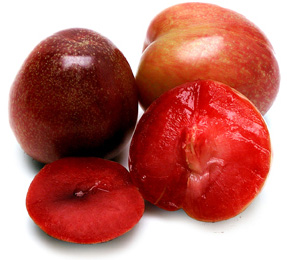
Russian River Brewing recently added another fruit to the list of fruit beers, the plumcot, which is a hybrid cross between a plum and apricot. It was crossbred by none other than Luther Burbank right in Santa Rosa, just a few blocks from the brewery. That’s why brewer Vinnie Cilurzo chose it, because he could use a local ingredient created right in his own backyard.

Plumcots are also called Pluots, but the two are not interchangeable. Pluots are a variation on Burbank’s Plumcot created by Floyd Zaiger. Pluots are three-quarters plum and one-quarter apricot whereas plumcots are closer to 50-50. Pluots are also a registered trademark owned by Zaiger, a practice that I understand but loathe on many levels.

plumcots

The beer is Compunction, a blonde ale brewed with plumcots. It had an original gravity of 1048 and is 5.8% abv. It’s slightly cloudy with golden color and a thin white head. Brett is the first aroma that hits you with fruity esters coming closely behind. The sweetness is puckering and works nicely as a contrast for the Brettanomyces. It’s surprisingly refreshing and light, given its strength. The beer is also aged in wooden barrels, but the beer’s strong flavors don’t allow much barrel characteristics to come through, really only a touch. Another interesting beer from Russian River Brewing.

Filed Under: Editorial, The Session Tagged With: History, Ingredients, Tasting

Marston’s Gobbles Up Old Thumper

July 12, 2007 By Jay Brooks

Marston’s, who brews Banks, Mansfield and Jennings as well as the eponymous beers, is buying out the regional Hampshire brewery, Ringwood, whose most well-known beer is undoubtedly “Old Thumper.” The pricetag is £19.2 million pounds (or just shy of $39 million dollars) and also includes Ringwood’s pubs in and around Hampshire. Six months ago, Marston’s also bought Eldridge Pope for £155m ($314.5 million U.S.).

According to a BBC article, “[t]he acquisition will boost Marston’s presence in the South of England and enhance its range of regional breweries which include Midlands-based Banks’s.” Alistair Darby, Marston’s managing director is quoted as saying. “We plan to develop its excellent brands as part of our strategy to meet consumer demand for premium ales with local provenance and heritage.” And here I thought they just wanted to make more money.

Ringwood Brewery has an interesting history. It’s situated in the relatively small town of Ringwood in Hampshire, which is in southern England, about 20 miles from the coast and 85 miles from London. The town is part of the rural district of Hampshire and is essentially a market town located along the River Avon and adjacent to “New Forest,” the largest remaining unenclosed pasture land, heathland and old-growth forest in England. By 1811, Ringwood was a bustling community and at one time boasted four breweries, but the last one — Carter’s — closed around 1923. Fifty-five years later, in 1978, Ringwood Brewery was opened by Peter Austin, who today is considered to be the “father of British micro-brewing.” Not only was he one of the first small breweries to open in modern times, but he also helped save cask beer from extinction.

The yeast Austin brought with him from the now-defunct Hull Brewery in northern England is today known as “Ringwood yeast” and is a popular ale strain used by countless small American craft breweries. Alan Pugsley, who learned brewing from Peter Austin, is the co-owner and master brewer of Shipyard Brewing in Portland, Maine. That’s also the reason that Ringwood’s “Old Thumper” beer is made under license by Shipyard for sales in North America. To learn more about how Ringwood Brewery greatly influenced the craft beer movement here in the United States, through Alan Pusgley, there are two illuminating interviews with him online by Lew Bryson and Andy Crouch.

Despite Marston’s claims that they’re only in it to “meet consumer demand for premium ales with local provenance and heritage,” I can’t help but be suspicious of yet another big brewery chain swallowing up a smaller one. These things rarely go well for the one being bought. There’s a lot of heritage in the Ringwood Brewery and it would be a crying shame if it was lost to another economic decision by a large company that only cared about its bottom line. And apparently I’m not the only one. CAMRA has also made its concerns known about the acquisition in a Publican article by Adam Withrington. CAMRA believes this buyout by Marston’s may have a “domino effect” for increasing the consolidations of pubs and breweries, a trend I personally thought was fairly well-established in England as already taking place.

From the Publican:

CAMRA chief executive Mike Benner said: “The practice among larger breweries of acquiring smaller competitors is a race where the only loser is the consumer who is often denied a locally brewed beer.

“As one of the larger breweries buys a brewery and expands their estate their competitors start hunting for their next purchase to keep up. CAMRA’s fear is that an increasing number of smaller breweries will be lost if this race continues and consumer choice will suffer as a result.”

CAMRA’s fears arise from a significant number of small local breweries being bought and closed down by bigger regionals over the last three years. Greene King has purchased both Ridley’s in Essex, Scottish brewer Belhaven and Nottinghamshire brewer Hardys & Hansons and closed all three breweries. In 2005 Fuller’s bought Hampshire regional brewer Gales and closed its brewery in Horndean.

The Ringwood Brewery in Hampshire, England.
 

Filed Under: Editorial, News Tagged With: Business, Europe, Great Britain

« Previous Page
Next Page »

Find Something

Northern California Breweries

Please consider purchasing my latest book, California Breweries North, available from Amazon, or ask for it at your local bookstore.

Recent Comments

  • Bob Paolino on Beer Birthday: Grant Johnston
  • Gambrinus on Historic Beer Birthday: A.J. Houghton
  • Ernie Dewing on Historic Beer Birthday: Charles William Bergner 
  • Steve 'Pudgy' De Rose on Historic Beer Birthday: Jacob Schmidt
  • Jay Brooks on Beer Birthday: Bill Owens

Recent Posts

  • Beer Birthday: Dave Alexander May 8, 2026
  • Historic Beer Birthday: Emil Christian Hansen May 8, 2026
  • Beer In Ads #5244: Southern Brewing Bock Beer May 7, 2026
  • Historic Beer Birthday: Anton Dreher May 7, 2026
  • Beer In Ads #5243: Union Brewery Bock Beer! May 6, 2026

BBB Archives

Feedback

Head Quarter
This site is hosted and maintained by H25Q.dev. Any questions or comments for the webmaster can be directed here.