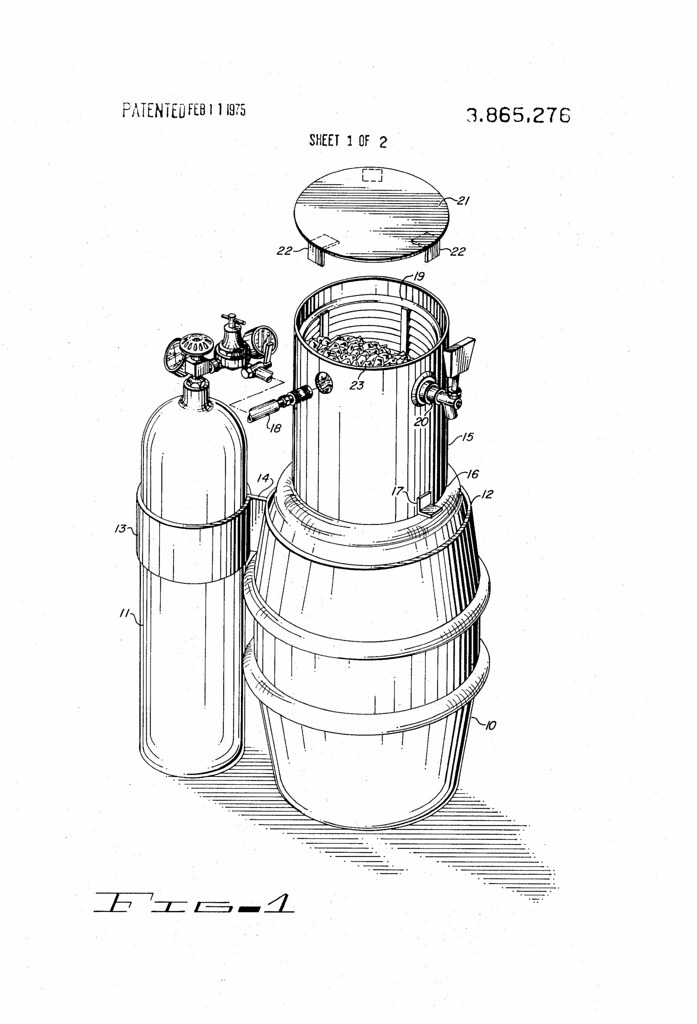
Today in 1881, US Patent 237884 A was issued, an invention of William Mainzer and John Singer, for their “Cask for Beer and Other Liquids.” There’s no Abstract, but the application states that “the object of this invention is to furnish casks for holding beer and other liquids, so constructed that they can be safely handled and transported without detaching the faucets, and can thus be furnished to the consumer with faucets applied ready for use, and can be returned to be refilled without detaching the faucets.”
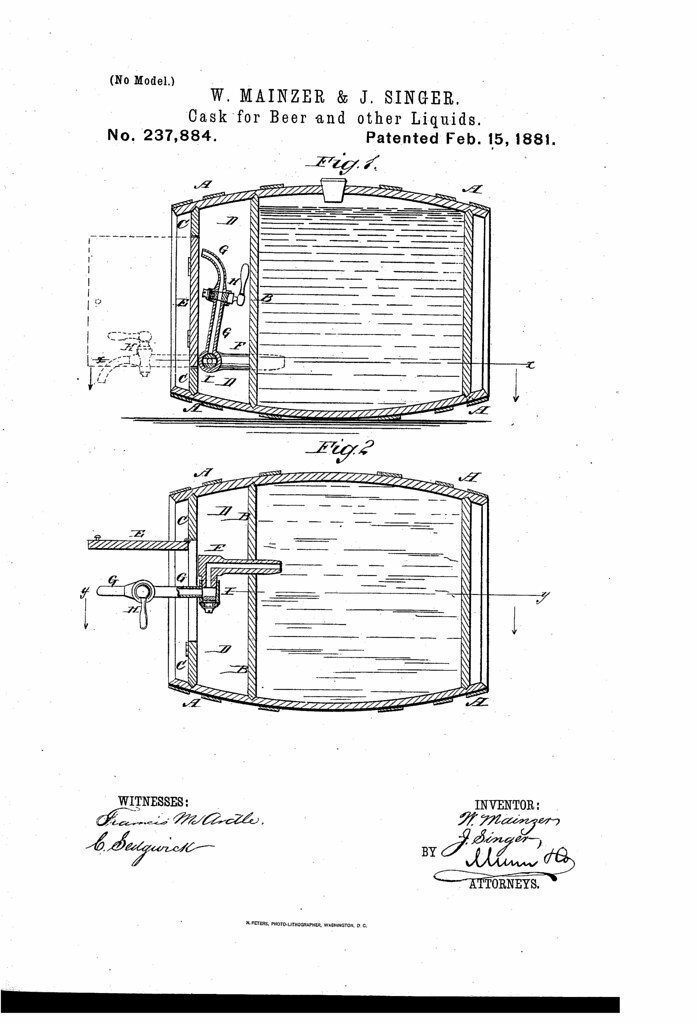
Patent No. 253683A: Apparatus For Raising Beer
Today in 1882, US Patent 253683 A was issued, an invention of Peter J. Catterall and Edward Birch, from Manchester, England, for their “Apparatus for Raising Beer.” There’s no Abstract, but the application states their “invention relates to apparatus for raising valves, through one of which the liquid is admitted to the chamber, and through the other the liquid is forced to the bar or delivery-tap” and there “is a section of the three-way tap that admits and discharges the water used to raise the beer or other liquid.”
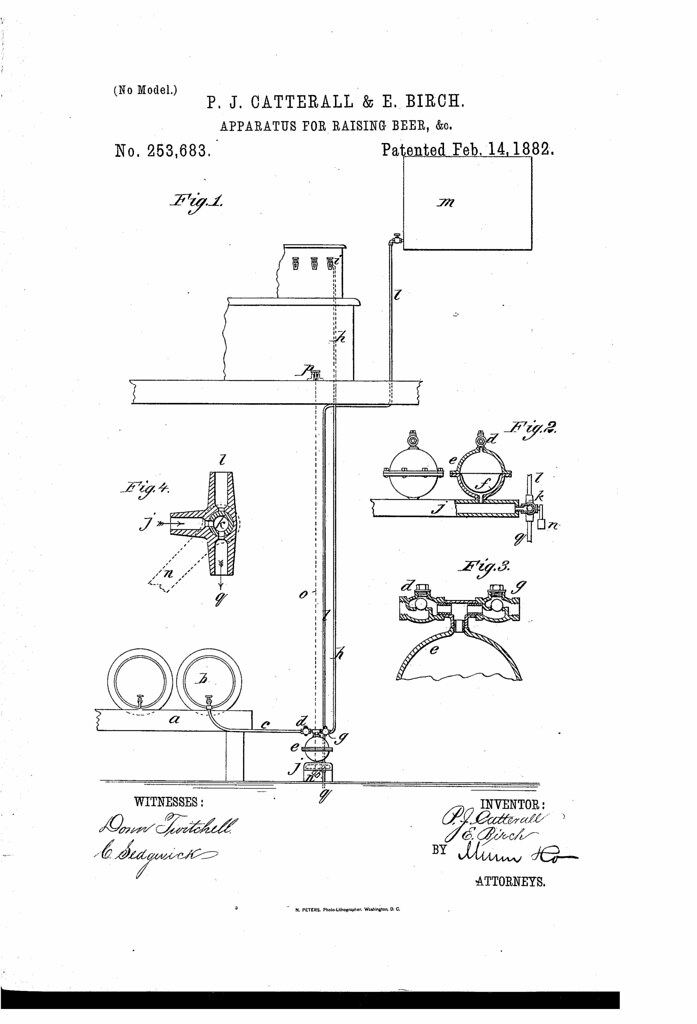
Patent No. 491939A: Process Of Producing Pure Cultivated Pressed Yeast
Today in 1893, US Patent 491939 A was issued, an invention of Charles A. Hansson, for his “Process of Producing Pure Cultivated Pressed Yeast.” There’s no Abstract, but the application begins by stating that he’s “invented certain new and useful Improvements in Processes of Producing Pure Cultivated, Pressed Yeast, of which the following is a specification.”
For the production of a pure cultivated pressed yeast it is necessary to have the fluid out of which the yeast is to receive its nourishment free as far as possible from foreign ferments and bacteria, that is sterilized.
According to methods heretofore used in the manufacture of yeast the sterilizing of this fluid could not have been effected to any advantage because, as the theories now existing indicate, the pepsin and not the lactic acid (the latter serving merely as a mediator) acts as a converter of the albumin into peptones, and as the pepsin contained in the grain is insufficient to transform all albuminoids in the mash into peptones, a comparatively small part of it was so transformed, and the greater part would, consequently, during the process of sterilizing, coagulate and thus be rendered insoluble, that is useless as nourishment for the yeast plant. To overcome this difliculty I make use of an additional increment of pepsin, by adding to the mash, a reinforcing quantity of pepsin and by leaving the mash under the influence thereof, together with some inorganic acid, (when necessary) and at a temperature most favorable for the pepsin, whereby much more of the albumin contained in the raw material is transformed into peptones, and I acquire a fluid which may be submitted to heating sufficiently for sterilizing with but little or no detrimental coagulation of albumin. Through the heating process I am enabled to procure a fluid sufficiently sterilized and thereby practically prepared for a pure cultivated yeast.
Having the fermenting tub covered and introducing into the fluid by mechanical means, sterilized air favorable for the development of the yeast, I avoid its infection which would take place should the fermentation be carried out in the usual way.
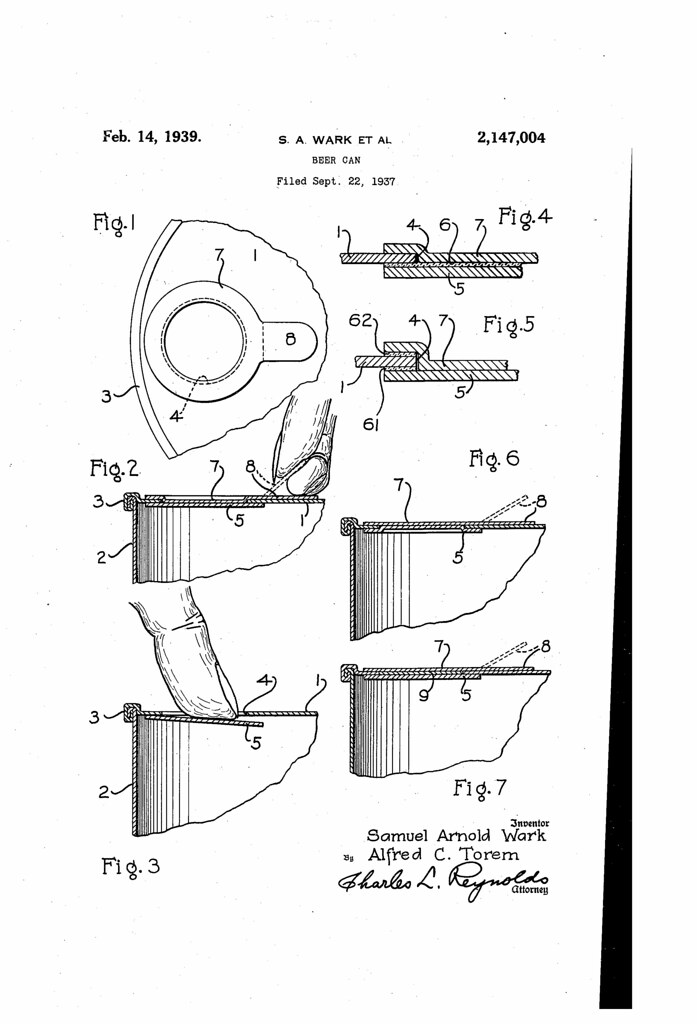
Patent No. 2147004A: Beer Can
Today in 1939, US Patent 2147004 A was issued, an invention of Samuel Arnold Wark and Alfred C. Torem, for their “Beer Can.” There’s no Abstract, but this is just four years after the introduction of beer cans, and this is one of the more inscrutable applications I’ve read with statements like the “drawing is intended as informative rather than restrictive.” It also says simply that their “invention relates fluids under pressure are to be held, designed as a can for beer.” The rest doesn’t seem to be as informative, or well-written or even flow like many others. But it looks more like modern cans that the cans from the late 1930s.
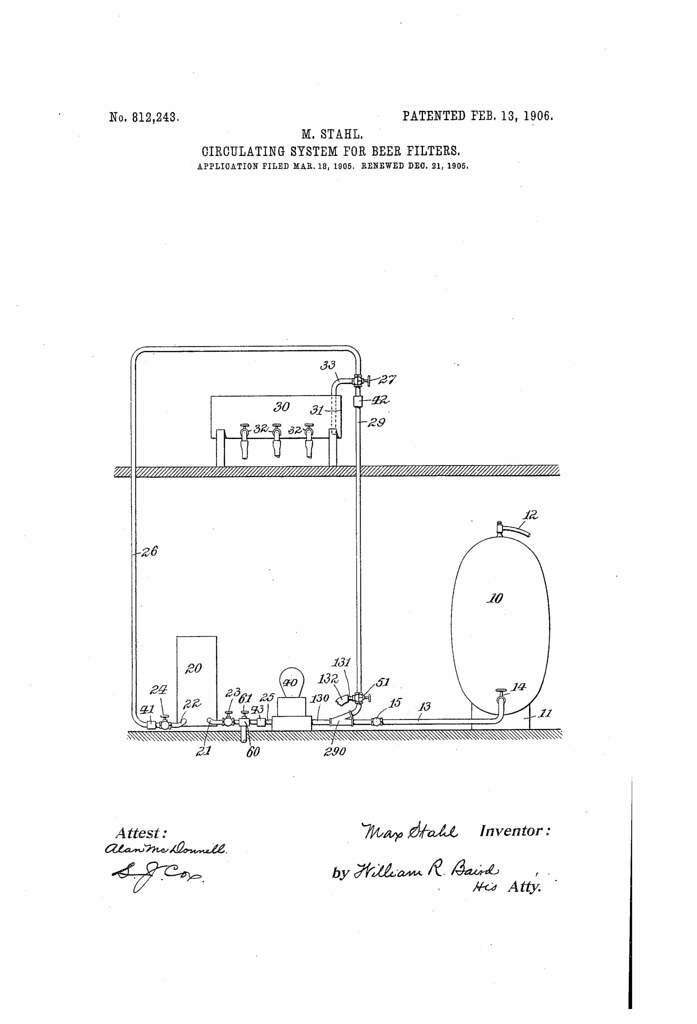
Patent No. 812243A: Circulating System For Beer-Filters
Today in 1906, US Patent 812243 A was issued, an invention of Max Stahl, for his “Circulating System for Beer-Filters.” There’s no Abstract, but Stahl describes his invention as an improvement over then-current systems, saying his “invention aims to and does overcome the losses and disadvantages [mentioned earlier in the description], and in brief it consists of providing means whereby the column of beer can be switched off the racking-bench and continuously returned to the filter until stable relations are secured and the beer no longer runs cloudy or contains fibers of filter mass.”
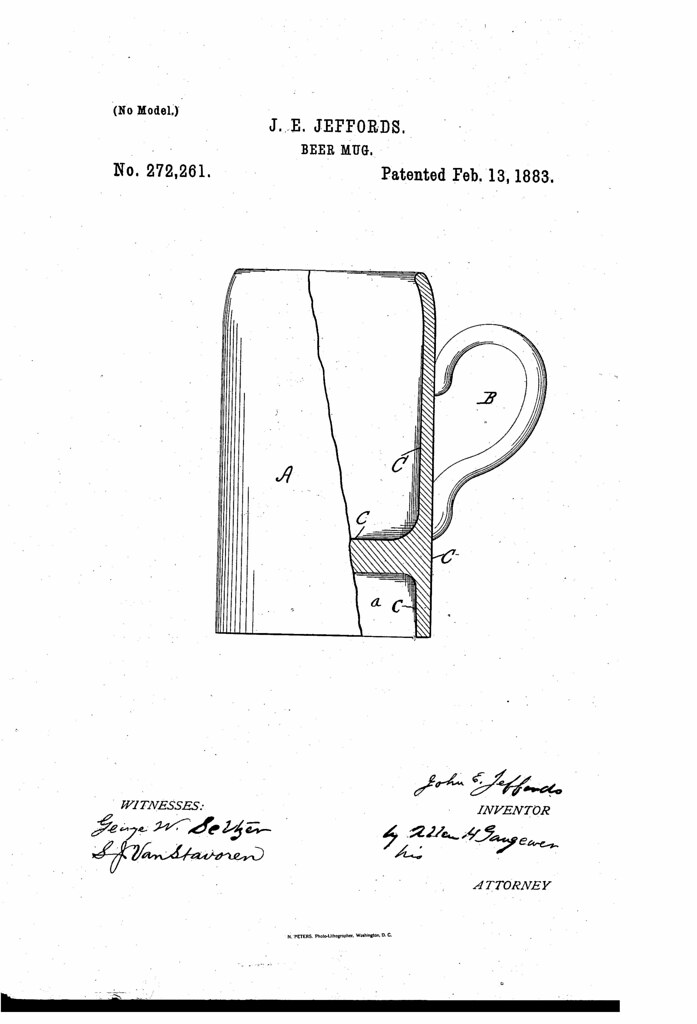
Patent No. 272261A: Beer-Mug
Today in 1883, US Patent 272261 A was issued, an invention of John E. Jeffords, for his “Beer-Mug.” There’s no Abstract, but Jeffords describes his invention as and its purpose “to provide a neat and a cheap form of mug, which is readily cleansed and not easily broken,” adding that it “consists of a beer-mug made of suitable porous material, glazed.”
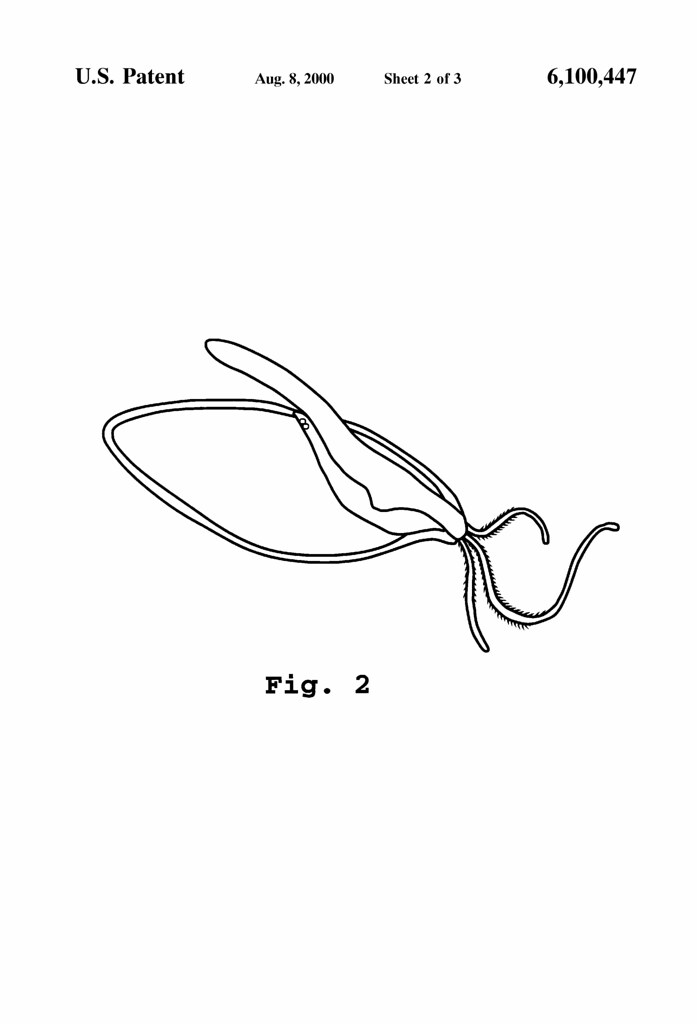
Patent No. 6100447A: Method Of Barley Transformation
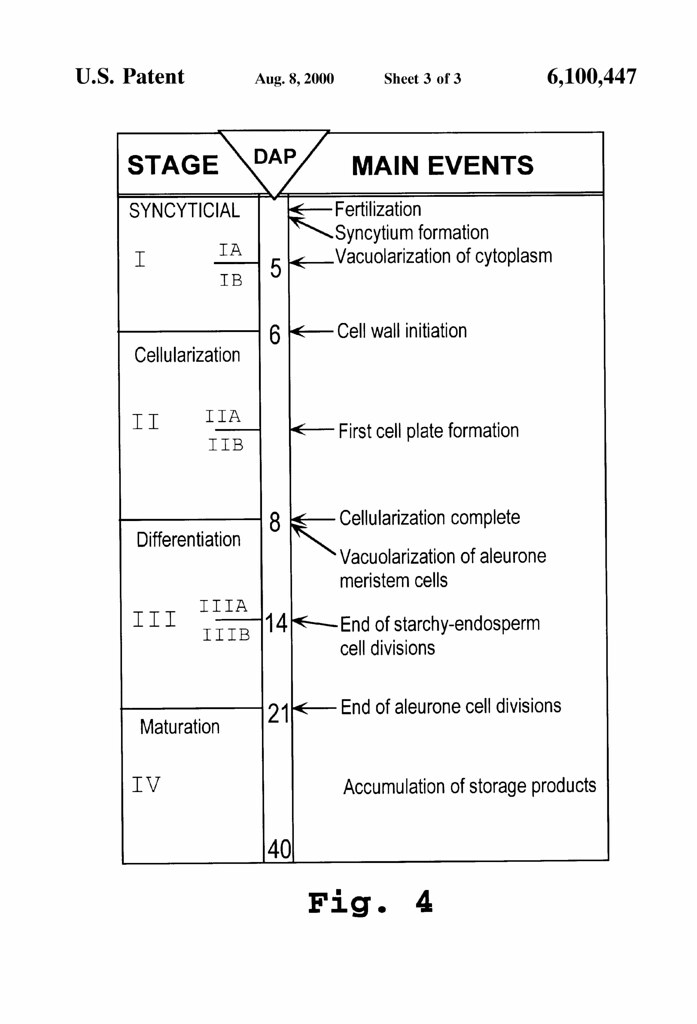
Today in 2000, US Patent 6100447 A was issued, an invention of Liying Wu and Raymond L. Rodriguez, for their “Method of Barley Transformation.” Here’s the Abstract:
A method for stably transforming barley from mature barley seeds as starting material is disclosed. The method involves germinating mature barley seeds until early shoot development occurs, exposing scutellar or embryo tissue cells on the embryo side of germinated seeds, and introducing foreign DNA into the cells. The cells are initially grown under conditions that allow expression of a selectable marker introduced with the foreign DNA, then on a callus-growth medium effective to suppress callus formation in the absence of the selectable marker. Successfully transformed calli can be cultured in suspension to obtain a desired foreign protein, or regenerated into plants, to obtain the foreign protein from the transformed plants, e.g., germinated seeds.

Patent No. 3077202A: Beer Keg Tap
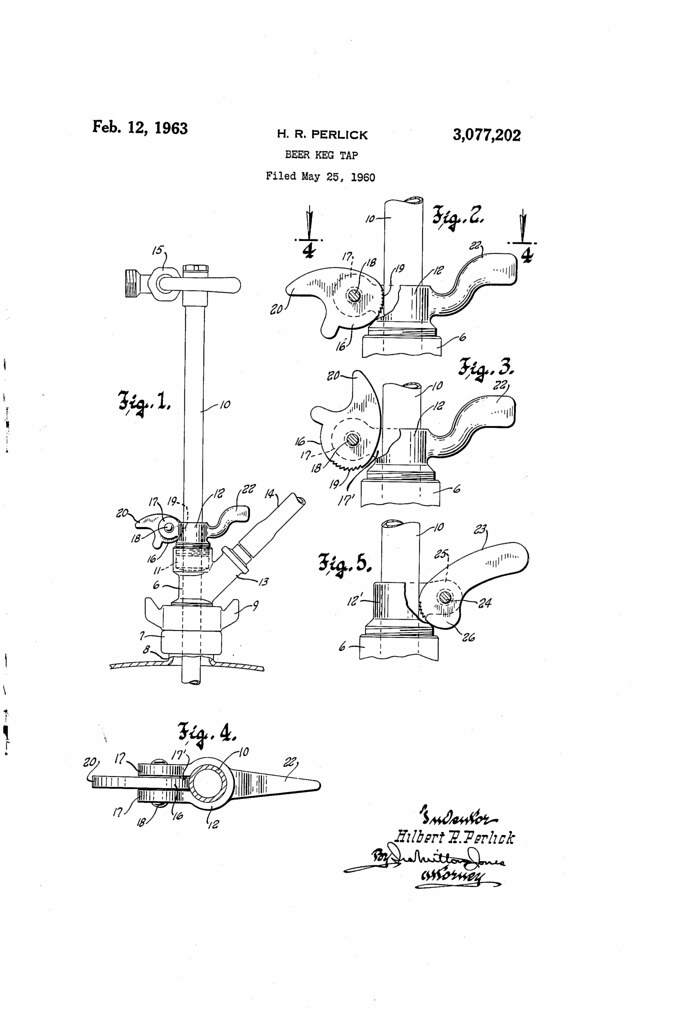
Today in 1963, US Patent 3077202 A was issued, an invention of Hilbert R. Perlick, for his “Beer Keg Tap.” There’s no Abstract, but the description makes plain the aims of this patent, and what improvement it’s bring to the tapping of beer kegs:
With a view toward overcoming the danger inherent in beer keg taps heretofore available, this invention has as its purpose to provide simple means to positively assure against accidental ejection of the tap rod from the keg, by equipping the beer keg tap with a self-energizing unidirecional clutch means carried by the body thereof and operable to automatically grip the tap rod and secure it against outward movement.
Another object of this invention is to provide a beer keg tap having a self-energizing unidirectional clutch means to grip the tap rod and hold it against outward movement in which this safety feature is so designed and constructed that the attainment of the desired objective is accomplished with a minimum structural change to the existing tap and in which only one of its elements, namely the packing gland or top nut requires any modification whatsoever.
Patent No. 8646660B2: Reusable Beer Keg
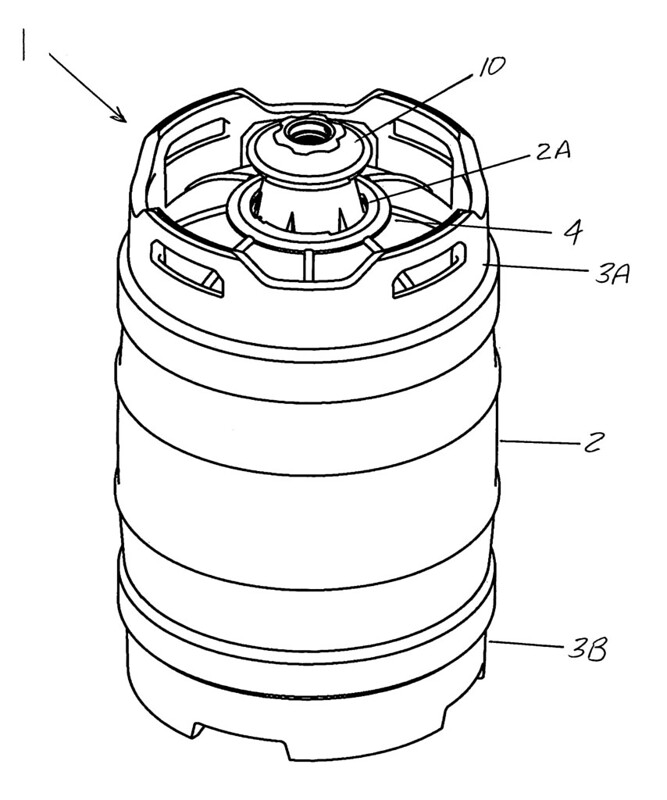
Today in 2014, just one year ago, US Patent 8646660 B2 was issued, an invention of Thomas W. Bates, Dan Morgan, and Leslie W. Ross, for their “Reusable Beer Keg.” Here’s the Abstract:
A reusable beer keg is disclosed including a hollow beer keg body with a dispenser tube assembly having a dispenser valve, dispenser tube, and a disposable bladder. The dispenser valve is releasably attached to a top portion of the keg body and the dispenser tube and bladder extend into the interior of the keg body. When beer flows through the open dispenser valve and into the bladder, the beer causes the bladder to expand until it contacts the inside surface of the keg body. When the beer keg has been emptied it can be returned to the brewery for reuse by cleaning the dispenser valve, dispenser tube and disposing of the used bladder. The beer keg parts can then be reassembled, using a new bladder in place of the used bladder.


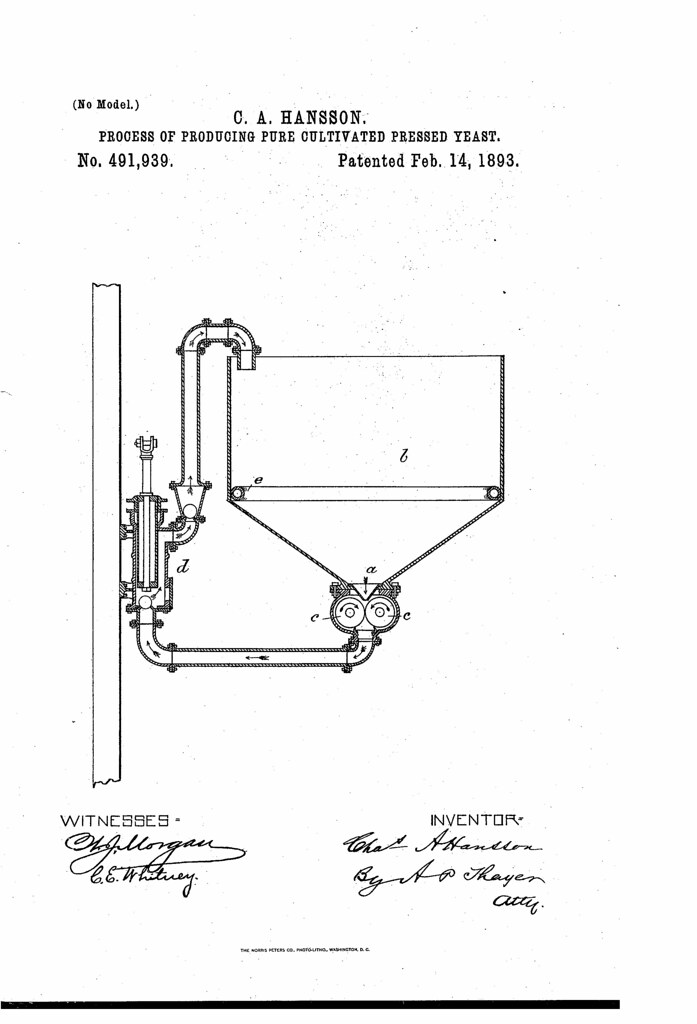
Patent No. 3865276A: Portable Keg Tapper
Today in 1975, US Patent 3865276 A was issued, an invention of Hank A. Thompson, for his “Portable Keg Tapper.” Here’s the Abstract:
Portable apparatus is provided for tapping a beverage container such as a beer keg. A portable ice container adapted to be supported by the top of the keg has an opening in the bottom communicating with the tapping aperture of the keg. A dispensing faucet is carried by the ice chamber. A beverage delivery conduit is formed into a cooling coil inside the ice chamber. The inlet of the conduit terminates in a releasable coupling adapted to be attached to a conventional tapping pipe. The outlet of the conduit communicates with the dispensing faucet.