Brookston Beer Bulletin

Jay R. Brooks on Beer

  • Home
  • About
  • Editorial
  • Birthdays
  • Art & Beer

Socialize

  • Dribbble
  • Email
  • Facebook
  • Flickr
  • GitHub
  • Instagram
  • LinkedIn
  • Pinterest
  • RSS
  • Twitter
  • YouTube

Powered by Genesis

Session #51 Round-Up & Announcing Session #51.5

May 7, 2011 By Jay Brooks

session-the
Well that was great fun, I was certainly glad to see so many people step up and participate, despite my best efforts to make things as difficult as possible. And everybody seemed to have a very good time, too. Cheese and beers just brings out the best in all of us, I guess. Anyway, I’m doing the round-up a little bit differently this Session, because this is not just the end of the Session, but also the beginning of the second phase, or Session #51.5. Below you’ll find a list of all of the beers paired with each of the three cheeses, or their substitute parenthetically, along with a link to each Session post submission. In most cases, I listed just the best pairing from each blogger for each cheese, unless otherwise noted. Also, I’ll continue to update this list as late submissions continue to roll in, as they inevitably do. Following that, you’ll find instructions on how to participate in round two, Session #51.5 on Friday, May 20.

The Beer & Cheese Pairings

1. Widmer 1-Year Aged Cheddar
cheese-widmer

Here are the best pairings everybody chose for the Widmer 1-Year Aged Cheddar, or a suitable substitute. I’ve noted what substitute cheese was used, where applicable.

  • Adnams Innovation IPA (Lincolnshire Poacher):
    Reluctant Scooper
  • Alaskan Smoked Porter (Apple-smoked cheddar):
    The Brew Lounge
  • Brasserie Dupont vec Les Bons Voeux (English Cheddar, age unknown):
    Hoppy-Hour
  • DC Brau The Public Pale Ale (Isle of Mull Cheddar):
    Yours For Good Fermentables
  • Dogfish Head 90 Minute IPA (Three Year Old Aged Wisconsin Cheddar):
    Ramblings of a Beer Runner
  • Drake’s 1500 Pale Ale:
    Brewed For Thought
  • Firestone Walker Union Jack IPA (Dubarton Cheddar):
    Beer Search Party
  • Fort George Vortex IPA (Tillamook Extra Sharp Vintage White Cheddar, aged two years):
    The Brew Site
  • Green Flash Hop Head Red Ale (Black Creek Extra Sharp Cheddar, aged 3 years):
    Bottle Chasers
  • Green Flash West Coast IPA (Carr Valley 10-year WI Cheddar):
    The Pour Curator
  • Greene King IPA (Balderson 1 year old aged cheddar):
    BeerTaster
  • North Coast Old Stock (Black Creek 9-Month Sharp White Cheddar):
    99 Pours
  • Paulaner Hefeweizen (Spanish Adarga de Oro, aged):
    Thirsty Pilgrim
  • Samuel Smith Imperial Stout (Widmer 10 Year Cheddar):
    What We’re Drinking
  • Sierra Nevada Ovila Dubbel (English Cheddar, aged 15 months):
    Growler Fills
  • Speakeasy Payback Porter:
    Brookston Beer Bulletin
  • Uinta Organic Sum’r (Black Creek 9-Month Sharp White Cheddar):
    99 Pours
  • Unibroue La Fin du Monde (Balderson 3 year old cheddar):
    A Good Beer Blog
  • Williams Brothers Joker IPA (Wexford Cheddar):
    The Beer Nut

2. Cypress Grove Humboldt Fog
cheese-cypress-grove

Here are the best pairings everybody chose for the Humboldt Fog, or a suitable substitute. I’ve noted what substitute cheese was used, where applicable.

  • 21st Amendment Fireside Chat:
    Bottle Chasers
  • 21st Amendment Monk’s Blood:
    Ramblings of a Beer Runner
  • Allagash Dubbel:
    Beer Search Party
  • Brasserie Cazeau Saison Cazeau (Fivemiletown Cooneen):
    Reluctant Scooper
  • Butternuts Moo Thunder Stout (Monte Enebro blue goat cheese):
    Yours For Good Fermentables
  • Dogfish Head/Birra Del Borgo collaboration My Antonia (French, surface ripened goat milk cheese):
    Hoppy-Hour
  • Duchesse de Bourgogne (Brouwerij Verhaeghe):
    Wine and Beer of Washington State
  • Firestone Walker (for Trader Joe’s) Mission Street Pale Ale:
    Bottle Chasers
  • Fremont Brewery Abominable Winter Ale:
    Wine and Beer of Washington State
  • Gagleer:
    Brewed For Thought
  • Gordon Biersch Blonde Bock:
    Growler Fills
  • Harviestoun Old Engine Oil (Snøfrisk):
    99 Pours
  • Jolly Pumpkin Bam Biere:
    What We’re Drinking
  • Left Hand Fade to Black Vol. 2 Smoked Baltic Porter:
    The Pour Curator
  • Mill Street Belgian Wit (Woolwich Dairy Chevrai):
    BeerTaster
  • Paulaner Hefeweizen (Roquefort):
    Thirsty Pilgrim
  • Saison Dupont:
    The Brew Lounge
  • Schneider-Weisse Aventinus Weizenbock:
    Brookston Beer Bulletin
  • Sierra Nevada Ovila Dubbel:
    Growler Fills
  • Unibroue Blanche de Chambly (Woolwich Dairy Chevrai):
    BeerTaster
  • Widmer Cherry Oak Doppelbock (Trader Joe’s Goat’s Milk Cheddar):
    The Brew Site

3. Maytag Blue
cheese-maytag-blue

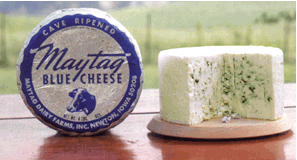
Here are the best pairings everybody chose for the Maytag Blue, or a suitable substitute. I’ve noted what substitute cheese was used, where applicable.

  • Brewdog Tactical Nuclear Penguin / Sink the Bismark (Long Clawson Stilton):
    Reluctant Scooper
  • Kasteel Rouge:
    The Pour Curator
  • Lagunitas Gnarleywine:
    Ramblings of a Beer Runner
  • Neustadt Springs Neustadt 10W30 (Tuxford & Tebbutt Stilton):
    BeerTaster
  • Pelican Pub & Brewery Stormwatcher’s Winterfest 2010 (Rogue Creamery Oregon Blue Cheese):
    The Brew Site
  • Pike Brewing Old Bawdy Barley Wine (2009):
    Wine and Beer of Washington State
  • Russian River Pliny the Elder:
    Brewed For Thought
  • Russian River Temptation:
    Brookston Beer Bulletin
  • Sierra Nevada 30th Anniversary Barleywine:
    The Brew Lounge
  • Sierra Nevada Bigfoot Barleywine Style Ale:
    Appellation Blog
  • St. Ambroise Vintage 2010 (Tuxford & Tebbutt Stilton):
    BeerTaster
  • Stone Old Guardian Belgo Barleywine (Stilton):
    Beer Search Party
  • Stone Sublimely Self Righteous (Salemville Amish Blue Cheese Crumbles):
    99 Pours
  • Williams Brothers Gold (Bellingham Blue):
    The Beer Nut

I was also glad to see so many people not stress too much about the specific cheeses I recommended. I knew that not everybody would be able to find them going in, but it seemed like the more who could find the same cheeses, the better the experiment would work, because it could more easily be duplicated regardless of location. But I also realized that with beer bloggers so spread out around the world, that in the end it was an impossible task and felt it was better to participate with a substitute cheese then not at all, and as long as the cheeses were somewhat similar, I figured it would still be valid. A number of people also added additional cheeses or could not find substitutions that were similar, so the list below is all of the other and extra cheeses that peoples paired together.

4. Other or Extra Cheeses Paired

  • Boulevard Smokestack Tank 7 (Gruyere & Manchego):
    Appellation Blog
  • Brooklyn Black Chocolate Stout (Mature Ardrahan, a semi-soft cheese):
    The Beer Nut
  • Brooklyn Lager (KH DeJong Gouda):
    The Pour Curator
  • Cigar City Maduro (Triple Cream Brie):
    The Pour Curator
  • Dogfish Head Indian Brown Ale (Snow White Goat Cheddar):
    The Brew Lounge
  • Duchesse de Bourgogne [Brouwerij Verhaeghe] (French Comte):
    Wine and Beer of Washington State
  • Foggy Noggin Anniversary Ale and the Quadrupel Belgian (French Comte):
    Wine and Beer of Washington State
  • Trappiste Rochefort 10 (Parmesan):
    Yours For Good Fermentables
  • Victory Headwaters pale (KH DeJong Edam):
    The Pour Curator
  • Williams Brothers Gold (Mature Ardrahan, a semi-soft cheese):
    The Beer Nut
  • Part 2: The Extra Special Second Follow-Up Mid-May Session

    Okay, I know not everyone will want to go for this, but if you’re with me so far and you’ve already participated in Session #51, here’s the idea for part two. Use the list of beers chosen by everybody for each of the three cheeses that are listed above to try a few more beers with the same cheese. Over the next two weeks, simply pick up some of the other beers that were suggested, and try them with the same three cheeses and do a follow up blog post on Friday, May 20 — which I’m calling Session #51.5 — to explore more fully pairing cheese and beer.

    You can write about how your choices compared, or what you learned from the other suggestions, or which out of all the ones you tried worked best. What recommended pairing most surprised you? Which didn’t seem to work at all, for you? It’s my way of taking the Session concept and making it more interactive and collaborative, essentially an “online cheese-off.” First, we made our best recommendations for pairing a beer with these three cheeses, and now we have an opportunity to try as many of the suggestions as we can, and discover which worked best. I’ll then do a second round-up and report the findings of the group as a whole to the beers and the three cheeses together.

    Spread the cheese .. er, the word. If you’ve already done Part One, don’t stop now, keep going. Read what your fellow bloggers liked, and pick a few to try yourself. To participate, just post a comment here with a link to your blog post for Session #51.5.

    Filed Under: Beers, Events, Food & Beer, Just For Fun, The Session Tagged With: Announcements, Blogging, Cheese, Websites

    Session #51: The Great Online Beer & Cheese-Off

    May 5, 2011 By Jay Brooks

    beer-and-cheese
    It’s my great pleasure to host our 51st Session, my second time playing host over the four years we’ve been doing them. I chose a frightfully complicated topic which I’ve taken to calling by an overly grand name: The Great Online Beer & Cheese-Off. You can go back and read the long, original version of what’s going on, or here it is in a nutshell.

    1. Pick up three cheeses:
      1. Maytag Blue, or another blue cheese.
      2. Widmer Cellars 1-yr old aged cheddar, or another aged cheddar.
      3. Humboldt Fog, or another goat cheese.
    2. Pick a few beers you think will pair well with each cheese.
    3. Drink them with the cheese.
    4. Write up your results and post them on or before Friday, May 6.
    5. Leave a comment here, the announcement, or send me an e-mail so I can find your Session post.

    session_logo_all_text_200

    So in addition to the Session Announcement , I also wrote about cheese and beer pairing in my last newspaper column, similarly challenging readers to try some beer with the same three cheeses and send in their best pairings, too.

    Wednesday evening, a few friends joined me to try several beers with each of the cheeses. Sean Paxton, the Homebrew Chef, and Pete and Amy Slosberg, who started Pete’s Wicked Ales in the 1980s, each brought a beer for each cheese, I picked a couple for each, and then I included some of the most promising sounding pairings that readers of my newspaper column sent in. Here’s what we discovered.

    The Beer & Cheese Pairings

    1. Widmer 1-Year Aged Cheddar

    cheese-widmer

    We started with the cheddar. The Widmer is a simple cheddar, but with solid, strong flavors. I love the nuttiness and the way it melts in your mouth. The beers we had for the cheddar were the Belgian sweet gale beer, Gagleer, Bear Republic’s Racer 5 , Russian River’s Pliny the Elder, Anderson Valley’s Brother David’s Double, Speakeasy’s Payback Porter, HUB’s Secession Cascadian Dark Ale and Firestone Walker’s Pale 31.

    A few of our choices didn’t really work at all, which was immediately apparent. The Gagleer was too sweet, Pale 31 was too mild to stand up to the cheese and the roasted malt in HUB’s Cascadian Dark Ale was accentuated by the cheese, making the pairing too harsh to work well. The vegetal, oniony cattiness of Pliny — delightful on its own — brought out an equal amount of bitterness in the cheese and led to a hash astringency in the combination. While talking through the cheeses, Pete asked if I had another dopplebock we might try, so I opened an older Salvator I had in my beer cellar (a.k.a. “the garage”). Even slightly oxidized, it was our third best pairing with the cheddar. It had only a slight malt sweetness, which complimented the nutty flavors in the cheese nicely. Racer 5, Bear Republic’s IPA, was our second favorite. It seemed to have the right level of bitterness to work with the Widmer Cellars cheddar, the two were a little bit more than the some of their parts. I think it could have been fun to try the cheese with just a variety of IPAs, because it really seemed like the IBUs and the choice of hop varieties make a big difference in whether or not the beer and cheese pairing is a hit or a miss.

    Our top choice, a unanimous decision, was Speakeasy’s Payback Porter. The cheese brought out an underlying smokey quality in the beer, accentuating it perfectly, and made the two something more than either could achieve alone. And that, we concluded, was what made a pairing great; when the two elements — the beer and the cheese — combined to become a third thing that was unique in and of itself.

    2. Cypress Grove Humboldt Fog

    cheese-cypress-grove

    We tasted the Humboldt Fog, a goat cheese from Cypress Grove Chevre, second. It’s a fantastic cheese; with unmistakably strong flavors. It’s creamy, with a zippy tang and sharp bite.

    The beers we had for the Humboldt Fog were Aventinus Weizenbock, the Bruery’s Orchard White, Ommegang’s Hennepin, Hoegaarden, Russian River Temptation and Saison Dupont.

    The Orchard White was an utter failure, the spices and floral notes really clashed with the cheese, making it too perfumy. We also tried the Pliny from the last flight and found its bitterness stomped on the cheese. Both the Payback Porter and HUB’s Black IPA did likewise, with the beer bringing out too much bitterness in the pairings that overwhelmed the cheese. In “The Brewmaster’s Table,” Garret Oliver singled out Hennepin as a beer to pair with goat cheese, but it didn’t actually work too well with the Humboldt Fog. It wasn’t terrible, but it brought out a bitterness in the beer when combined with the cheese that was less than ideal.

    But most actually worked fairly well with this versatile cheese. The Velvet Merkin/Merlin (which we went back and tried; see below) worked better than I expected; the oats in the stout smoothed and rounded out the flavor combinations. And the orange peel and coriander in the Hoegaarden, a last minute impromptu addition, brought all sorts of complexity to the pairing that made it hard to choose the best choice with the goat cheese.

    In addition to the new ones we added for each cheese, we also left all of the beers on the table from the previous cheese (and yes, the table filled up quickly) so we could try an even greater variety of combinations. As a result, we might never have discovered how well the Racer 5 went with the Humboldt Fog. It might not have occurred to be pair such a hoppy beer with the goat cheese, but the contrast was delicious, and we gave it an “honorable mention.”

    For our third best, we picked Temptation. The two were just heavenly together, as was our second choice: Saison Dupont. Both beers are zesty, spicy and complex and served to bring out a lot of flavor components from the cheese in the process, hitting that sweet spot of being more than the sum of their parts. But the beer that did all that, but better and with far more intangibles, was the Aventinus Weizenbock from Schneider-Weisse. The beer itself has an awful lot going on, and brought out so much more in the cheese that we thought we’d died and gone to heaven. I’d swear we heard choirs of angels faintly ringing in the air.

    3. Maytag Blue

    cheese-maytag-blue

    Lastly, we tried the Maytag Blue, a classic blue cheese that crumbles easily and is very spicy and tangy. The runnier it gets, the more I like it.

    In addition to the beers we’d opened before it, we also tried it with Firestone Walker’s Velvet Merkin (or Merlin for the feint of heart), Lagunitas Imperial Stout and North Coast’s Old Rasputin.

    Most of the lighter styles from the previous flights weren’t up to the challenge of keeping their own against such as strong cheese as Maytag Blue, though the Racer 5 was an exception, and showed itself to be a very versatile beer to pair with a variety of cheese. Both the Velvet Merlin and the Lagunitas stout were strong enough and worked well enough for us to declare a two-way toe for third place. Personally, I thought the Lagunitas had a slight edge because it was stronger and stood up better than the softer oatmeal stout. But I was alone in that, and unable to break the deadlock.

    Of the stouts, the already wonderful Old Rasputin became even better with the blue cheese, earning itself second place in our informal contest. Strength against strength, complexity upon complexity, the two were a beautiful match. There’s just something about a big, lip-smackingly good complex imperial stout, with all its roasty goodness, malty sweetness and alcoholic punch, that seeps into the veins of the tangy power of a blue cheese and can match it round after round in the boxing ring inside your mouth. But remember that was our second choice. The best was yet to come.

    Hands down, and unanimously so, we liked the Russian River Temptation from the second flight as the best beer to pair with the Maytag Blue. It was simply “otherworldly.” It’s even hard to describe. We all took a sip, looked at each other furtively and knew. It was that good. Everything just worked. The combination of the two was so much more than the either individually, it was if they were made to go together.

    beer-and-cheese

    And that, in essence, was the takeaway, what the exercise taught us. Like “white wine with fish,” any kind of guidelines about what beer styles goes with what cheese is only slightly better than guesswork. There is a very specific component to each beer and each cheese that alone determines if the pairing works or not, and that seems especially true for stronger beers (in both strength and flavors) and stronger cheeses, too. It may well be that milder cheese and beer do more easily fit a framework of guidelines. But in our little experiment, it became clear that guidelines are just a starting point. You have to really get under the hood and try various beers and cheeses together. And what you find is that while one IPA may work with one cheddar, it may not work at all with another. That makes it much harder to predict what will work together, but at least trying endless combinations is not exactly a grueling, miserable task. I’ll gladly try fifty beers with one one cheese to find that perfect pairing. Because when its good, holy moley, is it ever good.

    The other thing we noticed is that beers with pronounced flavors, such as very strong bittering or very sweet malt tended to accentuate those when combined with the cheese. As a gross generality, beers that were more balanced tended to work much better with whichever cheese we paired with them. That was interesting, and might require some more research.

    Well, that was great fun. Now it’s time to open another bottle of Temptation and cut up some Maytag Blue. Yum. I can’t wait to hear what everybody else tried and what combinations worked best. So that’s my round one. Look for the details on round two, Session #51.5 — which will take place in two weeks on Friday, May 20 — in the round-up, which I’ll likely be posting tomorrow morning.

    Filed Under: Beers, Food & Beer, Just For Fun, Reviews, The Session Tagged With: Blogging, Cheese, Websites

    Cheese & Beer Pairing Session Next Friday

    May 1, 2011 By Jay Brooks

    session-the
    A gentle reminder that the first Friday in May is less than a week away, and that means it will be time for the next Session, a.k.a. Beer Blogging Friday. I’ll be your host for the 51st Session, and I’m making it as difficult as possible, though not on purpose, I assure you. I thought it would be fun to take things a step farther and really do something different and challenging. So check out the original announcement for the full details, but in a nutshell here’s the dealio:

    1. Pick up three cheeses*:
      1. Maytag Blue, or another blue cheese.
      2. Widmer Cellars 1-yr old aged cheddar, or another aged cheddar.
      3. Humboldt Fog, or another goat cheese.
    2. Pick a few beers you think will pair well with each cheese.
    3. Drink them with the cheese.
    4. Write up your results and post them on or before Friday, May 6.
    5. Leave a comment here, the announcement, or my Session post, or send me an e-mail so I can find your Session post.

    bluecheese-cashel

    Rinse. Lather. Repeat.

    That’s the easy part. Now here’s where I make things a little trickier. As soon as I can, probably Saturday morning May 7, I’ll post the round-up with a list of all the beers that every participant thought worked best with each cheese. Two weeks later, I’ll be hosting Session #51.5. Here’s how to then take part in round two:

    1. Pick a few beers from the round-up list, as few or as many as you wish.
    2. Have another session where you drink those new beers with the same cheeses.
    3. Write up your results and post them on or before Friday, May 20.
    4. Leave a comment on the round-up post, or my new 51.5 Session post, or send me an e-mail so I can find your new Session post.
    5. That’s it, you did it. Now wasn’t that easy?

    cheese-edam
    Even with making it a tad more complicated, I think it should be great fun to really dig in and experiment and learn about how best to pair cheese and beer together. What works and what doesn’t through trial and error will always trump abstract philosophies of how to pair the two.

    So spread the cheese .. er, the word. Get some cheese and some beer, and start eating and drinking the two. I hope to hear how it went next Friday, May 6, for the Great Online Beer & Cheese-Off.

    * NOTE: I’ve heard that many people have had some trouble finding some or all of the recommended cheeses. Sorry about that. I really thought they’d be easier to find. But don’t stress about it, using a substitute will be just fine. Please don’t let that keep you from participating. Hopefully, all of you can find a blue cheese, an aged cheddar cheese and a goat cheese to pair with some beer for this Session. I’m looking forward to hearing about how everybody’s tastings went.

    Filed Under: Beers, Food & Beer, Just For Fun, News, The Session Tagged With: Announcements, Cheese, Pairing

    Cheese Buying Time

    April 15, 2011 By Jay Brooks

    cheese
    A gentle reminder that there are exactly three weeks until the next Session a.k.a. The Great Online Beer & Cheese-Off. Now would be a perfect time to pick up three cheeses for the tasting, try them, and start thinking about what beers might work best with them. Here are the cheeses to be on the lookout for:

    1. Maytag Blue

    cheese-maytag-blue

    Maytag Blue or another blue cheese.

    2. Widmer 1-Year Aged Cheddar

    cheese-widmer

    Widmer Cellars one-year old aged cheddar or another one-year aged cheddar cheese.

    3. Cypress Grove Humboldt Fog

    cheese-cypress-grove

    Humboldt Fog from Cypress Grove Chevre or another goat cheese.

    It’s easier to participate then my long-winded explanation. Just eat cheese, drink beer and write about it. On Friday, May 6.

    Filed Under: Beers, Events, Just For Fun, The Session Tagged With: Announcements, Cheese

    Announcing Session #51: The Great Online Beer & Cheese-Off

    April 8, 2011 By Jay Brooks

    session-the
    Our 51st Session is the third of our run at nostalgia, albeit a mere four years worth of it. Stan Hieronymus first proposed the Session four years ago, and was the first host, too, followed by Alan (from A Good Beer Blog) and then I hosted the third outing.

    bluecheese-cashel
    So here I am venturing into Area 51, and while I tried to keep things simple, I just couldn’t help myself and have made the topic one that will require a little work, but I think the challenge will be worth it and great fun in the end. It involves two of my favorite things: beer and cheese. Before I spring the particulars on you, first a little background about where the idea came from.

    cheese
    I’ve been to many cheese and beer tastings, whether part of a structured dinner or a separate dedicated cheese event. In almost every case, whoever put on the tasting chose the beer and the cheese. If you’ve done likewise, I’m assuming you’ve had the same experience. Some pairings work, others don’t. Whichever way it goes, you usually only get one shot at it, that is just one cheese paired with one beer.
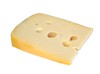
    cheese-edam
    But finding that divine pairing always made the effort worthwhile because when it works, boy does it ever. A perfect pairing of cheese and beer is practically spiritual. At least to me, but as I say; I love cheese.
    cheese-saintpaulin
    So I was thrilled when someone figured out another way to sample cheese and beer. During the first SF Beer Week three years ago, Vic Kralj — who owns The Bistro in Hayward — hosted a different kind of cheese and beer event: the “cheese-off.” What Vic did was pick five cheeses and then invited five breweries to play along. Each brewery took the five cheeses and paired each with one of their beers.
    cheese-dutchleerdammer
    So then on the night of the event, attendees got a plate of each cheese, in turn, along with the five beers (one chosen by each of the five breweries). You then tried each beer with the cheese and then picked the pairing you thought worked best. That continued through each of the five cheeses. Then they tallied up the votes — just for fun — to see which beer was the most popular with each cheese. The Bistro hosted a cheese-off two years, and you can read the write-up for the 2009 Cheese-Off and the 2010 Cheese-Off to get a better idea of how it worked.

    Part 1: The Regular May Session

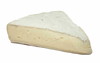
    cheese-brie
    That brings us back to Session #51, and the topic of cheese and beer. Below are three cheeses. I chose ones that I believe are available throughout the U.S. and quite possibly beyond our shores. And they all sell via mail order, too. So pick up some of each, or if you can’t find those specific cheeses, choose similar ones. Pick a beer to pair with each one and post your results on the first Friday in May.
    cheese-softcheese-maroilles
    There are at least a few approaches you could take:

    1. Guess what beer to pair, and then report the results.
    2. Try a few beers with each cheese, then report the results on which worked best, and why.
    3. Invite some friends over, and have each bring a beer to pair, then report the results on which worked best, and why.
    4. Obviously, if you can only pair one cheese, or two, don’t let that deter you.
    5. Whatever else catches your fancy.

    The Three Cheeses

    1. Maytag Blue

    cheese-maytag-blue

    This is one my favorite blues, and not just because it’s owned by the Maytag family, who until recently owned Anchor Brewery. The Maytag Dairy Farm was founded in Iowa by Fritz Maytag’s father in 1941, making it one of the first artisanal cheese companies in America. One of my favorite ways to use Maytag Blue is to crumble some on top of a bowl of chili, something I tried at an Anchor event where both were being served. It’s a terrific combination.

    To get you started, Stephen Beaumont and Brian Morin, in their “beerbistro cookbook,” suggest barley wine or even imperial stout for blue cheese. In the “Brewmaster’s Table,” author Garret Oliver doesn’t mention blue cheese, but does suggest Barley Wines with Stilton, which is a specific type of blue cheese.

    2. Widmer 1-Year Aged Cheddar

    cheese-widmer

    I wanted to make sure I included at least one Wisconsin cheese — I am a cheesehead, after all — and Widmer’s Cheese Cellars makes some great golden orange cheddars. Even the one-year old aged cheddar is very full-flavored. Widmer’s website described it as having “rich, nutty flavor [that] becomes increasingly sharp with age. Smooth, firm texture becomes more granular and crumbly with age.”

    For milder cheddars, Beaumont and Morin suggest brown ales or pale ales, and for older, sharper cheddars, IPAs or strong abbey ales. Likewise, in the “Brewmaster’s Table,” Oliver suggests India Pale Ales with cheddar cheese.

    3. Cypress Grove Humboldt Fog

    cheese-cypress-grove

    Humboldt Fog is a goat cheese from Cypress Grove Chevre in California. It’s described on their website as a “soft, surface ripened cheese. The texture is creamy and luscious with a subtle tangy flavor. Each handcrafted wheel features a ribbon of edible vegetable ash along its center and a coating of ash under its exterior to give it a distinctive, cake-like appearance.”

    In the Brewmaster’s Table, Oliver suggests “a spicy Belgian beer with residual sweetness,” and specifically Ommegang’s Hennepin. Beaumont and Morin recommend Belgian-style wheat beer or doppelbocks for goat cheese generally.

    bluecheese-cashel
    You can also find some general information about cheese at Artisanal Cheese, the American Cheese Society and the California Artisan Cheese Guild. And there’s some more pairing tips available from Lucy Saunders, the beer cook, Taste of Home and Artisanal Cheese
    cheese-edam
    So that’s the three cheeses. To participate in the May Session, pick them (or similar ones) up and pair them with whatever beer you feel will best enhance the two, using whatever method you want. Then on May 6th, post your results. Let everybody know what you think are the best beers to pair with these three cheeses.

    So that’s the regular Session. But wait … there’s more.

    Part 2: The Extra Special Second Follow-Up Mid-May Session

    Okay, I know not everyone will want to go for this, but if you’re with me so far here’s the idea for part two. As soon as I can after the May 6th Session, I’ll post the round-up with a list of all the beers that everyone suggested to pair with each of the cheeses. Then over the subsequent two weeks, whoever wants to participate, pick up some of the other beers that were suggested, and try them with the same three cheeses and do a follow up blog post on Friday, May 20 — let’s call it Session #51.5 — to explore more fully pairing cheese and beer.

    You can write about how your choices compared, or what you learned from the other suggestions, or which out of all the ones you tried worked best. What recommended pairing most surprised you? Which didn’t seem to work at all, for you? It’s my way of taking the Session concept and making it more interactive and collaborative, essentially an “online cheese-off.” First, we each make our best recommendations for pairing a beer with these three cheeses, and then we try as many of the suggestions as we can, and discover which is the best one. I’ll then do a second round-up and try to report the findings of the group as a whole to the beers and the three cheeses together.

    Spread the cheese .. er, the word. Even with making this next Session as difficult as possible, I’m hoping the fun factor of trying these cheeses with a lot of beer will make for a lively and interesting Session, with a lot of participation. If you agree, let’s get the word out and get people on board to do some beer and cheese pairing.
    cheese-dutchleerdammer
    To participate, post a comment here with a link to your blog post for Session #51. To keep going with Session #51.5, post your link on or after May 20 to the round-up which should be up on May 7.

    Filed Under: Beers, Food & Beer, Just For Fun, The Session Tagged With: Announcements, Blogging, Cheese, Food

    Session #50: How Do They Make Me Buy The Beer?

    April 1, 2011 By Jay Brooks

    buy-please
    Our 50th Session is hosted by Alan McLeod from A Good Beer Blog, and is the second of our third hosting by the three original Session hosts on our fourth anniversary of Beer Blogging Friday. The topic he’s chosen is How Do They Make Me Buy Their Beer?, by which Alan means:

    What makes you buy someone’s beer? Elemental. Multi-faceted. Maybe even interesting.

    • Buying beer. I mean takeaway. From the shelf to you glass. What rules are dumb? Who gives the best service? What does good service mean to you? Please avoid “my favorite bar references” however wonderful. I am not talking about taverns as the third space. Unless you really really need to and contextualize it into the moment of transaction at the bar. If you can crystallize that moment of “yes” when the bartender is, in fact, tender go for it.
    • What doesn’t work? What fad or ad turned you off what had previously been turned on about some beer’s appeal? When does a beer jump the shark? When does a beer store fail or soar? When does a brewery lose your pennies or earn your dimes?
    • Go micro rather than macro. You may want to explore when you got tired of “extreme” or “lite” or “Belgian-style” but think about it in terms of your relationship with one brewery rather than some sort of internet wave of slag … like that ever happens.
    • What is the most you paid for a great beer? More importantly – because this is not about being negative – what is the least? I don’t mean a gift. What compels you you to say this is the quality price ratio (“QPR”) that works best for you? When does a beer scream “you would have paid 27% more for me but you didn’t need to!”?

    session_logo_all_text_200

    As an old curmudgeon who’s been alive and drinking before there was a craft beer industry — at least in practice, if not entirely legally — my earliest memories of the beer available where I lived were the more or less local regional brands. I grew up in medium-sized east coast industrial town — Reading, Pennsylvania — and our local brewery closed my junior year of high school — 1976. Before that, I vividly recall accompanying my stepfather to the beer distributor to pick up beer and soda. He didn’t always choose Reading Premium, but he did gravitate toward the more local and regional brands (in this case, mostly from Philadelphia, eastern Pennsylvania and New York).

    The funny thing about that is nobody talked about “buying local” as a concept and the word “locavore” was decades from being coined. But that’s what people did. They patronized local businesses. We bought almost all of our produce from the local farmer’s market, along with some of our meat and other food. It was open every Friday in an indoor setting where each person rented a stall that was the same from week to week, and they were more or less permanent with cash registers, refrigerated cases, etc. But they were the local farmers, butchers, food purveyors, etc. We knew them all by name. They were a part of the community. About every six months or so, my parents bought a side of beef from a butcher, had it cut into numerous packages — ground beef, steak, etc. — and stored it in a deep freezer in our basement. All the meat came from the same cow, it wasn’t from an assembly line meat-packing plant. For bread, we went to the local baker. Milk was delivered to our doorstep twice a week. Charles Chips even made potato chip deliveries, though I preferred Good’s Chips in the Blue Can, which we bought every week at the farmer’s market. Good’s were made by a Mennonite family on their farm in nearby Reinholds. I visited the chip farm once. It was a simple operation, but it worked. The chips themselves were even simpler. The label read: potatoes, fried in lard, salt added. They were the best chips … ever.

    And beer was just the same. I remember when I was little, my Mom liked Sunshine beer, another label from the Reading Brewing Co. Then there were the Philly brands: Schmidt’s, Ortlieb’s, etc. Everyone drank Ballantine when visiting my aunt and uncle in New Jersey. There were other regional Pennsylvania and New York brands: Yuengling, Genesee Cream Ale, Schaefer and Fyfe & Drum Extra Lyte Beer (their slogan: less filling … more refreshing). I seem to recall a lot of Carling Black Label in our house, too. I think it was on sale a lot, though I don’t remember where it was brewed back then. The point is I don’t even remember seeing a national brand until I was well into my teens. I first started being aware of Budweiser in junior high, Lite Beer from Miller when they started advertising nationally in the mid-1970s or so, and Coors once I started driving in high school. It became “cool” to get a Coors iron-on t-shirt down the shore at Ocean City or Wildwood, our preferred weekend getaway towns.

    header_title

    But the greed and consumerism that seemed to mark the 80s also sounded the death knell for local, and even healthy, food in general. High-fructose corn syrup began it meteoric rise around 1975 but really hit its stride in the 1980s. Giant grocery store chains dominated and the locally owned ones disappeared, paving the way for the big national food processors to likewise dominate stores shelves (they were the only ones who could afford the slotting fees that should be illegal, but curiously are not when it comes to food).

    Pennsylvania grocery stores couldn’t sell beer (and still can’t) so I don’t have firsthand knowledge of what happened to grocery sets during that time, but I can only assume what happened with food, also happened with beer. At that time, I started moving around for work — Virginia, New York, back to Pennsylvania, North Carolina and then, finally, California in 1985. By the time I arrived in California — thirsty for good beer, sparked by my time in NYC — there was the chain of Liquor Barns that carried a wide selection of both imported beer and the new micros, but grocery stores were still almost exclusively national and international brands, with just a few exceptions. Bars, too, carried a very small number of beers, and very few, if any micros. It slowly got better, but even in 1991, when I visited over 550 bars in four months to write The Bars of Silicon Valley: A Beer Drinker’s Guide to Silicon Valley, very few carried anything beyond the Big 3 and a few imports (usually Heineken, Corona, or if the bar was Irish or British-themed: Guinness).

    So what does all this nostalgia have to do with Alan’s topic? How does any of that make me buy a particular beer, or choose one over another? As the Peter Allen song claims, “Everything Old Is New Again,” and so it is with buying locally. What once was taken for granted as not so much buying locally, but simply “buying,” people are again purchasing locally made or grown goods, the only difference is this time it’s on purpose. It’s a decision, based on a growing understanding that doing so is beneficial on several fronts. It’s good for the planet because the closer the food is to the consumer, the shorter distance is as to travel, meaning it uses less fossil fuels, and as a bonus it’s usually fresher, too. It’s also good for the local economy because it creates local jobs, but more importantly the money stays in circulation locally, too. It isn’t shipped back to a corporate headquarters somewhere else, which is just one of the reasons Wal-Mart is so bad for local economies.

    The dirty little secret in brewing is that many of the ingredients for making beer come from far afield, and there isn’t much that can be done about that. Barley and hops don’t grow everywhere, and certain types that are necessary for certain kinds of beers can’t be obtained from local sources in many, many places. More and more breweries, both large and small, are trying to make “estate” beers or beers made using only relatively local ingredients. Sierra Nevada is making an estate beer using their own locally grown barley and hops, and the San Francisco brewpub, Thirsty Bear, recently made a beer using all organic ingredients from northern California farmers. But that’s hard to do, especially in certain locations where the agriculture just isn’t available. I applaud such efforts, but it simply isn’t feasible for everybody. Hops is starting to be grown in more locations than the Pacific Northwest, but most efforts will not be able to replace the Willamette or the Yakima Valleys, only supplement the supply, not to mention hop varieties from abroad — England, Germany, the Czech Republic, New Zealand, etc.

    So the brewing industry, for the most part, will have to continue to hang its hat on local production, not that that’s necessarily a bad thing, just the reality of how beer is made. But with over 1700 breweries in the U.S. — and 618 in planning — finding locally brewed beer is getting easier and easier. In a sense, we’re returning to a time when it was local and regional breweries that held sway. In the late 19th century, America peaked at just over 4,000 breweries. It was a time when beer didn’t travel or age very well and so every locale needed a brewery. Even many small and mid-sized towns had multiple breweries. Then it was out of necessity, but today an increasing number of people are choosing smaller, local beers over the national brands. It’s happening very slowly — too slowly for my personal tastes — but it is moving in the right direction. The big brands, both foreign and domestic, are flat or down in some cases, while the smaller breweries are for the most part up, and up a lot in many cases. And that’s played out over ten plus years, a sufficiently long enough period of time that I think we can safely call it a trend.

    I continue to believe that distribution will be the single most important aspect of continuing that growth and finding, finally, a tipping point, where better local beer becomes the norm. And that’s one worrying counter-trend. The number of distributors continues to shrink, and that will be bad, I think, if a work around can’t be found, especially in states where self-distribution is not legal, where franchise laws are particularly strong, and where it’s difficult for alternative new distribution models to emerge.

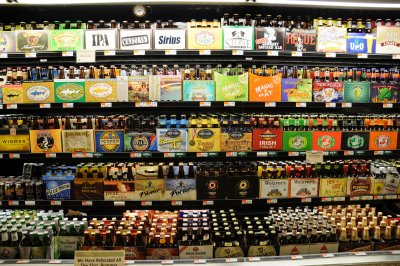
    beer-shelf-3

    So what causes me to make a particular purchase decision? How Do They Make Me Buy The Beer? Well, firstly, I’m not a typical consumer. If you write a beer blog, chances are you’re not either, even if you believe otherwise. Because you and I will will try almost any new beer. That’s just who we are. Typical consumers, I’d argue, don’t. The only evidence I need for that is the fact most breweries have a flagship beer that accounts for 60%, 70% or even 80% of their total production. Somebody is buying all that beer, if it’s not you and me. Although, the fact that seasonal beer is the fastest growing category in grocery stores does suggest that many people are buying something different along with the flagship beer, too.

    But secondly, if I’m not buying beer to sample for work, if I’m just picking up beer to watch a game with friends, or for a party or just to have a good time, I’ll buy something brewed locally. Usually, I know all the beers on a typical grocery or liquor store’s shelves — occupational hazard — so once I get past the novelty of something new, factoring in the weather and/or what I’m eating, the decision comes down to location, location, location.

    beer-shelf-5

    Filed Under: Beers, Breweries, Editorial, The Session Tagged With: Business, Marketing

    Session Five-0 Ponders The Philosophy Of “How Do They Make Me Buy Their Beer?”

    March 16, 2011 By Jay Brooks

    session-the
    Our 50th Session — The Big Five-0 — is a monumental one and our host, Alan from A Good Beer Blog, is tackling it with appropriate seriousness, especially considering it’s on April Fool’s Day. He’s chosen as his topic How Do They Make Me Buy Their Beer? Alan elaborates:

    What makes you buy someone’s beer? Elemental. Multi-faceted. Maybe even interesting.

    • Buying beer. I mean takeaway. From the shelf to you glass. What rules are dumb? Who gives the best service? What does good service mean to you? Please avoid “my favorite bar references” however wonderful. I am not talking about taverns as the third space. Unless you really really need to and contextualize it into the moment of transaction at the bar. If you can crystallize that moment of “yes” when the bartender is, in fact, tender go for it.
    • What doesn’t work? What fad or ad turned you off what had previously been turned on about some beer’s appeal? When does a beer jump the shark? When does a beer store fail or soar? When does a brewery lose your pennies or earn your dimes?
    • Go micro rather than macro. You may want to explore when you got tired of “extreme” or “lite” or “Belgian-style” but think about it in terms of your relationship with one brewery rather than some sort of internet wave of slag … like that ever happens.
    • What is the most you paid for a great beer? More importantly – because this is not about being negative – what is the least? I don’t mean a gift. What compels you you to say this is the quality price ratio (“QPR”) that works best for you? When does a beer scream “you would have paid 27% more for me but you didn’t need to!”?

    So pull out your wallet. Stare at it. What beer makes you open it up and throw down your hard-earned cash? Then tell the world what it is for the next Session on Friday, April 1. No fooling.

    Filed Under: Beers, Just For Fun, News, The Session Tagged With: Announcements, Blogging, Business

    Help Alan Decide On The Next Session Topic

    March 10, 2011 By Jay Brooks

    a-good-beer-blog
    Alan up at A Good Beer Blog will be hosting our 50th Session, which will be held — no joke — on April Fool’s Day.

    But Alan is struggling to find just the right topic for “such a monumental moment in beer blogging history” and doesn’t “want to make it a case of Five-Uh-Oh.” He needs your help. He’s got a few ideas of his own but could undoubtedly use a few more. Got a great idea for a Session topic? One you’ve been hoping someone would tackle? Send it Alan’s way.

    Personally, I’d hate to see the Session pass without having something to do with April Fool’s Day, but then I’m a devout Holideist.

    Filed Under: Just For Fun, The Session Tagged With: Announcements, Blogging

    Session #49: A Regular Beer

    March 4, 2011 By Jay Brooks

    food-placesetting-blue
    Our 49th Session is hosted by Stan Hieronymus from Appellation Beer, bringing things full circle back to the very beginning of the Sessions, when Stan first proposed them four years ago. Stan was also the very first host and as we begin the fifth year on monthly Sessions, he again assumes the mantle, taking on the topic A “Regular” Beer. What is a “regular” beer, you may be wondering? Take it away, Stan:

    In March of 2007 I couldn’t have guessed the topic March 4, 2011 might be “regular beer.” How vague is that? But when in December I was motivated to post my defense of “regular beer” the course was set.

    Please write about a regular beer (time to lose the quotation marks). You get to define what that means, but a few possibilities:

    • It might be your “go to” beer, brewed commercially or at home. The one you drink regularly.
    • I could be a beer your enjoy on a regular special occasion. When in San Francisco I always like to start with draft Anchor Liberty Ale. But it might be your poker night beer.
    • It doesn’t have to be a “session beer,” but it can be.
    • It probably shouldn’t have an SPE of more than $25 (that’s a very soft number; prices may vary by region and on premise further confuses the matter). Ask yourself, is it what somebody in a Miller High Life TV commercial in the 1970s could afford? Because affordability matters. I’m all for paying a fair price (which can mean higher than we’d like) to assure quality and even more for special beers, but I’m not ready to part with the notion that beer should be an everyman’s drink.
    • Brewery size, ownership, nationality do not matter. Brew length doesn’t matter. Ingredients don’t matter. It feels a little strange typing that last sentence, since the Mission Statement here says ingredients matter. But I hope you get the point. I prefer beer that costs a little more because its ingredients cost more, because there’s more labor involved. You don’t have to. Beer should be inclusive.

    session_logo_all_text_200

    To me, the idea, concept, notion, whatever of “a regular beer” is most closely aligned with the European idea of “table wines” and the mostly Belgian “table beer,” or at least that’s what I’d like to see here. The closest thing in the States to table beer is, sadly, probably macro lagers, who’ve essentially hijacked the low-calorie beer for everyday drinking. And it’s the absurd low-calorie light beers that are the most popular of those. It’s not that they’re not well made — they are — but they have so little flavor and what flavors they do have I find personally unpleasant for the most part. But they’re the beers that a grand majority of the populace drinks for everyday occasions, whether on the table or other ordinary circumstances. And their popularity I have to think is partly the reason why we don’t think of more full-flavored, but light-bodied, beers as “table beers.”

    The closest analogue in craft beer is probably the “flagship” beer, the best-selling beer that each microbrewery sells. Flagship beers tend to outsell every other beer that the brewery makes exponentially. For most, the flagship accounts for week over half of total sales. In a sense that makes them regular beers. And while that’s no doubt desirable for any business, for craft breweries it can also be a problem because it can make the brewery appear stale since so much of craft beer sales is centered on the “new.” But without those flagship sales, most couldn’t afford to make the specialties, seasonals and one-offs that make their reputations. Both are equally important, and in fact striking that balance is perhaps the most important strategy a brewery needs to work out to maintain success.

    A few years ago I was walking the hall at the Great American Beer Festival, trying to get somewhere in a hurry, when I got caught behind a group of young men and couldn’t get around them. So as I patiently waited for an opening, I started listening to their conversation. We were passing the Sierra Nevada booth when one of the young men elbowed his friend, and pointing to the Sierra Nevada stand, said “my Dad really likes that beer.” “Oh, that’s going to be a problem,” I though to myself and indeed it was. I’ve since had conversations with people from the brewery who’ve acknowledged that the perception of Sierra Nevada Pale Ale as “your Dad’s beer” was a problem. That’s at least part of the reason that Sierra Nevada has launched so many new projects, collaborations, new series, the anniversary beers, beer camp, etc. And it’s worked. They’ve struck a nice balance between the near ubiquitous pale ale and some pretty exciting new stuff.

    beercantable

    But back to the table. Throughout many countries in Europe, wine is not the snobfest it often is over here. Ordinary table wine sits in every home for every meal. But it’s not the low quality box wines we think of, but very flavorful, though slightly lower in strength, wine. It tastes great, but is also ideal for drinking every day, no special occasion necessary. Table beer used to be very common in Belgium, too, until recently when it’s been replaced on the table by bottled water or — ugh — soda pop. In fact, until the 1970s, table beer was served in school to children, but now has also been replaced by soda. Although there is a movement to get rid of soda and replace it once more with low-alcohol table beer, with advocates arguing that beer is more healthy than soda, something I’ve said for years. I’d like to see that tried here, but oh the hue and cry would be swift and noisy to be sure.

    But the reality is table beer would be more healthy for kids than all the chemical-laden soda pop, and those are still sold in many schools, despite their role in juvenile obesity and other health problems for kids. The fact that in this country, alcohol is the bogeyman but soda companies are not only allowed but celebrated strikes me as hypocrisy run amuck. Serving table beer at home wold also educate children about alcohol and quite possibly would lead to less abuse and binge drinking as young adults and/or in college.

    Here’s how Table Beer was described in the World Beer Cup guidelines for 2010.

    50. Other Belgian-Style Ale
    A. Subcategory: Belgian-Style Table Beer
    These ales and lagers are very low in alcohol and traditionally enjoyed with meals by both adults and children. Pale to very dark brown in color. Additions of caramel coloring are sometimes employed to adjust color. They are light bodied with relatively low carbonation with limited aftertaste. The mouth feel is light to moderate, though higher than one might anticipate, usually because of unfermented sugars/malt sugars. Malted barley, wheat and rye may be used as well as unmalted wheat, rye, oats and corn. A mild malt character could be evident. Aroma/flavor hops are most commonly used to employ a flavor balance that is only low in bitterness. Traditional versions do not use artificial sweeteners nor are they excessively sweet. More modern versions of this beer incorporate sweeteners such as sugar and saccharine added post fermentation to sweeten the palate and add to a perception of smoothness. Spices (such as orange and lemon peel, as well as coriander) may be added in barely perceptible amounts, but this is not common. Diacetyl should not be perceived.Original Gravity (ºPlato): 1.008-1.038 (2-9.5 ºPlato) ● Apparent Extract/Final Gravity (ºPlato): 1.004-1.034 (1-8.5 ºPlato) ● Alcohol by Weight (Volume): 0.4-2.8% (0.5-3.5%) ● Bitterness (IBU): 5-15 ● Color SRM (EBC): 5-50 (10-100 EBC)

    The abv actually puts table beer below where most people define even session beers, making it closer to small beer. And in that sense, it barely even exists in America. There’s non-alcoholic beer — an abomination in my mind — at 0.05% or less and then there’s a very few beers that are between 3.5% and 5% but virtually nothing in between. That’s a niche waiting to be filled, as far as I’m concerned. C’mon people, let’s get this party started. Bring back “Table Beer.”

    Filed Under: Beers, Editorial, Just For Fun, The Session Tagged With: Session Beers

    Next Session Defines A “Regular” Beer

    February 15, 2011 By Jay Brooks

    session-the
    Our 49th Session brings things full circle from the very beginning of the Session, first proposed by Stan Hieronymus four years ago. Our fifth year of monthly Sessions will start with the original first three hosts, Stan, Alan (from A Good Beer Blog) and myself. The first of these blasts from the past has Stan, from Appellation Beer, taking on the topic A “Regular” Beer. What is a “regular” beer, you may be wondering? Take it away, Stan:

    In March of 2007 I couldn’t have guessed the topic March 4, 2011 might be “regular beer.” How vague is that? But when in December I was motivated to post my defense of “regular beer” the course was set.

    Please write about a regular beer (time to lose the quotation marks). You get to define what that means, but a few possibilities:

    • It might be your “go to” beer, brewed commercially or at home. The one you drink regularly.
    • I could be a beer your enjoy on a regular special occasion. When in San Francisco I always like to start with draft Anchor Liberty Ale. But it might be your poker night beer.
    • It doesn’t have to be a “session beer,” but it can be.
    • It probably shouldn’t have an SPE of more than $25 (that’s a very soft number; prices may vary by region and on premise further confuses the matter). Ask yourself, is it what somebody in a Miller High Life TV commercial in the 1970s could afford? Because affordability matters. I’m all for paying a fair price (which can mean higher than we’d like) to assure quality and even more for special beers, but I’m not ready to part with the notion that beer should be an everyman’s drink.
    • Brewery size, ownership, nationality do not matter. Brew length doesn’t matter. Ingredients don’t matter. It feels a little strange typing that last sentence, since the Mission Statement here says ingredients matter. But I hope you get the point. I prefer beer that costs a little more because its ingredients cost more, because there’s more labor involved. You don’t have to. Beer should be inclusive.

    Still not clear? Consider this a sample post. It mostly illustrates you can write anything you damn please.

    So put on your thinking cap — or should that be drinking cap? — and let everybody know what you think a regular beer might be for the next Session on Friday, March 4.

    Filed Under: Beers, News, The Session Tagged With: Announcements, Blogging

    « Previous Page
    Next Page »

    Find Something

    Northern California Breweries

    Please consider purchasing my latest book, California Breweries North, available from Amazon, or ask for it at your local bookstore.

    Recent Comments

    • Bob Paolino on Beer Birthday: Grant Johnston
    • Gambrinus on Historic Beer Birthday: A.J. Houghton
    • Ernie Dewing on Historic Beer Birthday: Charles William Bergner 
    • Steve 'Pudgy' De Rose on Historic Beer Birthday: Jacob Schmidt
    • Jay Brooks on Beer Birthday: Bill Owens

    Recent Posts

    • Beer In Ads #5148: Ach Himmel Mr. Goat March 6, 2026
    • Historic Beer Birthday: Conrad Windisch March 6, 2026
    • Historic Beer Birthday: Samuel Wainwright March 6, 2026
    • Beer In Ads #5147: Frankenmuth Is Michigan’s Largest Selling Bock March 6, 2026
    • Historic Beer Birthday: John Bird Fuller March 6, 2026

    BBB Archives

    Feedback

    Head Quarter
    This site is hosted and maintained by H25Q.dev. Any questions or comments for the webmaster can be directed here.