Brookston Beer Bulletin

Jay R. Brooks on Beer

  • Home
  • About
  • Editorial
  • Birthdays
  • Art & Beer

Socialize

  • Dribbble
  • Email
  • Facebook
  • Flickr
  • GitHub
  • Instagram
  • LinkedIn
  • Pinterest
  • RSS
  • Twitter
  • YouTube

Powered by Genesis

Target: Alcohol

October 23, 2007 By Jay Brooks

target-alcohol
I happened upon this item from across the pond at Zythophile, who appears to be a soul mate when it comes to disliking neo-prohibitionists and their attendant propaganda. The UK’s Times Online made a rather startling, if not altogether surprising, revelation that the Department of Health in Great Britain, in defining what it means to be a “hazardous drinker” in 1987 did so by essentially just making it up and pulling the numbers out of thin air. I’ll let that sink in. As the Times’ article puts it, the “guidelines have no basis in science. Rather, in the words of a member of the committee that drew them up, they were simply ‘plucked out of the air’.” The twenty year-old standards by the Royal College of Physicians set “safe limits” at 21 units of alcohol a week for a man and 14 for a woman, apparently without regard to weight so far as I can tell. Britain defines one unit of alcohol as “8 grams of pure ethanol.”

In the article, a doctor involved in creating the standard, reminisces:

Richard Smith, the former editor of the British Medical Journal and a member of the college’s working party on alcohol, told The Times yesterday that the figures were not based on any clear evidence. He remembers “rather vividly” what happened when the discussion came round to whether the group should recommend safe limits for men and women.

“David Barker was the epidemiologist on the committee and his line was that ‘We don’t really have any decent data whatsoever. It’s impossible to say what’s safe and what isn’t’.

“And other people said, ‘Well, that’s not much use. If somebody comes to see you and says ‘What can I safely drink?’, you can’t say ‘Well, we’ve no evidence. Come back in 20 years and we’ll let you know’. So the feeling was that we ought to come up with something. So those limits were really plucked out of the air. They weren’t really based on any firm evidence at all. It was a sort of intelligent guess by a committee.”

Well how scientific. And I’d think all well and good if it were just a guideline, some advice to tell a patient. But, of course, that’s not how the government used these numbers. They instead not only endorsed the numbers — and indeed why shouldn’t they having come from a supposedly reputable health organization — they essentially set them in stone, terrorizing citizens with them the same way America’s health bureaucracy does likewise by defining binge drinking at a ridiculous “five or more drinks in a row.”

Not only that, but they continued to cling to the numbers as gospel, despite numerous subsequent studies that contradicted those numbers. For example, here are the results of a 2000 study by the World Health Organization:

The WHO’s International Guide for Monitoring Alcohol Consumption and Related Harm set out drinking ranges that qualified people as being at low, medium or high-risk of chronic alcohol-related harm. For men, less than 35 weekly units was low-risk, 36-52.5 was medium-risk and above 53 was high-risk. Women were low-risk below 17.5 units, medium between 18 and 35 and high above 36.

Government bureaucracy has a habit of becoming entrenched even in the face of contrary evidence. At least one blogger I respect sees this as no big deal, that everyone simply knew the numbers were made up. Perhaps I wouldn’t be so bothered by that if I didn’t strongly believe my own government, in collusion with Big Pharma and much of the guilt-ridden medical community, has been lying — and continues to lie — to my face about my own son Porter’s autism. I think it’s a mistake to take lying so cavalierly, especially when it comes from an area of society that we’re conditioned to place great trust in: the medical community. The Hippocratic Oath was undoubtedly a good start, but the more I learn about the way doctors, their protectionist professional groups, along with medical insurers, pharmaceutical companies, hospital administrators and the like manipulate patients and society at large for their own purposes, the more that oath seems hypocritical and largely an anachronism in our modern world that medical science seems quick to ignore whenever it doesn’t suit them.

I think it’s precisely because people tend to trust doctors and so-called medical science that they often can’t conceive of it being used as propaganda or to support an extreme agenda. And that’s why I find this sort of lying so dangerous. We may take for granted that our government will lie to us or that people trying to persuade us of something might do likewise, but I don’t see how that makes it acceptable or something we shouldn’t get worked up about. Have we really all been lied to so much that we no longer recognize it? That it becomes acceptable if it’s for our own good? I can see how telling a fib to a child to keep him or her safe as a temporary solution has some merit, but if we don’t fess up when they get older, that’s an entirely different matter. Though personally, I think nowadays we overprotect children and go too far in trying to keep them from experiencing any adversity. As a result, they are incapable of dealing with even the smallest slight as young adults. This also makes it easier for our own government to continue becoming more and more paternalistic as each successive generation becomes increasingly comfortable with being told what to think and within what narrow range is acceptable. We’re all adults and yet more and more governments treat their citizens like children to be taken care of instead of allowing everyone to have a real say in decisions made on our behalf. That’s a classic example of a slippery slope. If you accept one lie because you believe it’s for your own good, then it becomes easier for you to accept the next one, and the next one after that, etcetera. I find this whole subject fascinating, and if you want to read more about it, I recommend Lying: Moral Choice in Public and Private Life, by Sissela Bok, and The Liar’s Tale, A History of Falsehood, by Jeremy Campbell.

As usual, I’ve veered off on a tangent, so let’s hear from another British doctor who also conveniently believes that the specific limits are superfluous.

Christopher Record, a liver-disease specialist at Newcastle University, suggested that “it doesn’t really matter what the limits are”. “What we do know is, the more you drink, the greater the risk. The trouble is that we all have different genes. Some people can drink considerably more than [the limits] and they won’t get into any trouble.”

Well that doesn’t mean it doesn’t matter. That means using a standard that doesn’t work is useless and counter-productive for predicting how a person will react to a given amount of alcohol. And if government continually uses false statistics to manage its population, it does them great harm, both psychologically and possibly physically. It would be one thing if for the last twenty years health officials told people that drinking too much had dire consequences and advocated that people take care in that regard. That would be quite sensible and without question in the public interest. But that’s not what the health agencies did. Instead, they made up a number and told people not to drink more than this amount or there would be dire health consequences, knowing full well that the the levels they set had no basis in science whatsoever.

I’m confident that our own definition of binge drinking had a similarly unscientific genesis and I know how that definition has been used to skew statistics toward a specific agenda by neo-prohibitionists. I would be shocked to learn that our British cousins never did likewise. When you officially and purposely set what it means to be a heavy drinker at a level you know to be too low, you can claim with a straight face that there are many more alcoholics plaguing society than there really are. Armed with these false statistics, committed anti-alcohol organizations can do a lot of harm to society.

I’m not entirely sure why governments tend to embrace neo-prohibitionist agendas, but Zythophile’s hypothesis bears examining.

My personal guess is that too many politicians — and members of public health committees — are in the game because they want to control others, and they associate drinking with loss of control, and therefore want to stop it: except they know, after the failure of prohibition in the United States, that stopping people drinking is impossible, and so they try to make us feel as guilty as possible about one of life’s best pleasures.

But whether they meant well or were being maliciously manipulative, this sort of lying by those entrusted with the public health is pretty hard to swallow.

Filed Under: Editorial, News Tagged With: Europe, Great Britain, Health & Beer, International, Statistics

Garrett’s Thoughts (And My Own) on MillerCoors

October 22, 2007 By Jay Brooks

garrett-oliver
On Friday, the New York Times ran an editorial by Garrett Oliver entitled Don’t Fear Big Beer. Oliver is the brewmaster at Brooklyn Brewery as well as the author of the seminal book on beer and food, The Brewmaster’s Table. I have a lot of respect for Garrett’s opinions, generally, and he makes some good points here, too. I certainly agree with him when he announces that “today the United States has by far the most exciting beer culture in the world.”

And I love his suggestion that the craft brewing segment has shed its “fad” status after nearly thirty years of ups and downs to emerge as a mature, stable part of the beer industry, or in Oliver’s words — “a welcome return to normality.” Historically, that makes sense. For most of the years since Europeans washed up on America’s shores, the small and regional brewery held sway. It’s only been since the rise of our big, national corporate society that things have gotten so out of whack. The consolidation of countless industries has been bad for everybody, except of course the big corporations and their shareholders, over the last fifty plus years. When I graduated from high school — ahem, thirty years ago — there were only 40 or so breweries left in the entire nation and it looked like the industry was doomed to make insipid caricatures of European lagers in perpetuity.

Then a few things happened. Airfare got cheaper and more people started traveling, discovering diverse beers all over the map. Based on this new demand, a number of the larger import brands started selling their beer in larger U.S. cities. This was the setting where I personally discovered better beer, haunting small jazz clubs throughout New York City that were serving Bass Ale, Guinness and Pilsner Urquell. Then there was homebrewing, which came up and out from the underground, when Jimmy Carter signed a federal law decriminalizing it in 1978. Those three changes to 1970s society, along with others I’m sure I’m forgetting, conspired to create a backlash among a small but thirsty minority who wanted beer that tasted of something more than the watery concoctions the big brewers were — and still are — passing off as beer. Thanks to those cranky few who wouldn’t settle for the beer landscape as it was, the microbrewery revolution forever changed what was possible and as a result, today the diversity of great beer available here in the states is better than anywhere else on Earth. The fact that this was accomplished in the face of an advertising and marketing blitzkrieg sending the opposite message about what beer is makes it all the more remarkable. Their success seems to have prefigured similar returns to quality local and regional renaissances in all manner of goods, such as coffee, bread, cheese, chocolates and organic food generally.

Is “[t]he age of American industrial brewing,” as Garret teases, “over”? Not today, certainly. Even Garrett knows that “it’s not going away tomorrow” but I absolutely love his notion that “there is no future in it.” On a level playing field, I think things would indeed run their course fairly quickly, in perhaps a generation, with flavorful beers gaining the upper hand among anyone taking the time to think about their choices and learn something about what they’re drinking. Unfortunately, real life is nothing like that. Large corporations have almost all the resources, not to mention the ear of a political system that knows that helping the status quo keeps them in office. They’re not going gentle into that good night without a fight. And, sadly, I think they have enough of an advantage that they could hang on a good long time absent a social and economic revolution. Government tends to bail out big corporations and lets small ones die every single day. Which is not to imply Garrett doesn’t know that, but he’s decided to accentuate the positive, certainly a laudable approach.

Oliver ends his editorial with some truly inspiring words:

If we truly want to restore the vibrant beer culture that flourished in this country before Prohibition, craft brewers need to retain the values and goals — creating beers that are flavorful, interesting to drink and made from proper beer ingredients — that put us on the map in the first place. Let’s not undo American beer again.

I wish I could be that sunny and optimistic. I think what he says, while correct, is not really the problem faced by small breweries. Oliver seems to imply that craft brewers hold the keys to their own success and that all they need do is stay true to themselves, that simply making a great product is enough to guarantee continued growth. Maybe I’m mis-reading that, but it seems far more complicated to me, and it ignores the fact that the big brewers will not give up their own hard won market share easily.

That’s why I think Garrett is overlooking something when he says “America’s 1,500 craft brewers are undaunted by the prospect of a juggernaut that would have 30 percent of the domestic market” and that “MillerCoors is not a threat to craft brewers.” He ties that last statement to over expansion, and while that has been a problem for many small brewers trying to grow too quickly, it’s not really the reason Miller or Coors are combining their efforts to challenge Anheuser-Busch’s market dominance. I think craft brewers should feel a bit more daunt about that task. There is a problem that 95% of the market believes the beer they drink is good enough and are either too busy or too ignorant to know the difference. That’s a real problem.

But the more proper question is whether Miller and Coors separately or MillerCoors together makes that problem any different. I’ve been giving this a lot of thought since I first heard the news the morning I arrived in Denver for GABF last week, trying to figure out what it will mean for the marketplace, and especially for the smaller players. I can’t help but think this will change the nature of distribution, especially in smaller markets. All over the place in the last decade, we started seeing markets with three distributors (with each having one of the three big brewers in their portfolio) consolidate down to two, with one Bud house and the other carrying both Coors and Miller. And while I suspect neither Coors nor Miller was particularly thrilled to have to share the spotlight, for distributors it was a boon. But two distributors usually means less places for small brewers to find someone to carry their beer and sell it to retailers, bars and restaurants. If that spreads to larger cities, it would certainly reduce the choices available to a small brewer. In Bud houses that are owned by A-B (where that’s legal) or ones that tow the 100% share of mind that leaves a small brewer with a choice of exactly one, not really a choice at all. San Francisco is like that, to some extent. Cal Bev went out of business five or so years ago, leaving Golden Brands — now called DBI Beverage Distributors (with Miller and Coors) and Matagrano (with Bud). In the City by the Bay, at least two independent distributors, that is ones without a big flagship brand, also bring smaller brands to market, but that’s not the case in many other places.

Will that continue to happen with the consolidation of the two major brands? No one can say for sure, of course, but it certainly seems logical that we’ll begin to see more two-distributor territories in the near future. And that I think could be very bad for some small brewers, especially the ones without the resources to hire a field representative to work with the distributors in markets outside their home. The regional breweries, which are already fueling most of the craft beer segment’s growth, should have no problem keeping a distributor, but it could be problematic for the smaller, more local breweries. It may also make it more difficult for cusp breweries just on the verge of growing larger. With only two distributors to choose from (and effectively one in some places), instead of three, it seems likely some breweries will have a hard time finding a home to sell their wares and that this could effectively keep some breweries from expanding their business.

Also, it seems to me the prices wars among the big three will not go away in a reconfigured landscape of the big two. Those price wars have kept beer prices artificially low for quite some time, and that has also made it difficult for craft brewers to charge a more premium price for their beer, even though it’s warranted. The recent scarcity of barley and hops and the attendant price hikes that will now finally have to be taken will only increase the gap between the big brands and the craft brands, especially if the big two go head to head (which seems likely, doesn’t it?). It’s my feeling that makes it harder to persuade people to trade up to better beer. So while it may be too early to tell if any of this will indeed have an effect on the beer industry generally, it seems foolish to carry on and just assume it won’t.

Perhaps Oliver is correct with his advice not to be afraid, but we can’t ignore them either. Just as they respond to gains by the craft segment and view us a threat to their market share, we have to protect our more modest gains just as vigorously. To me, that’s how we lay to rest the age of American industrial brewing. It’s not merely enough to make a more flavorful product that people want, we also have to work together as a united front. That’s the real lesson of the MillerCoors merger. The two small giants finally realized that fighting each other for number two was a fool’s game and did nothing but help number one. The craft segment, for all its collegial atmosphere, does include ugly examples of infighting for a larger share of our tiny slice of the pie. The only way we win this fight, is if we all win this fight. Not even the largest craft brewer can come close to being anything but a speck of a David to the Goliaths of our industry. It’s only together as an idea and as a movement that we register at all. That’s our strength, that we’re everywhere all at once, a many tentacled benevolent beast. Cut off one, and there are still 1,499 more left to fight the fight. But we must work together to have any effect at all. Can I get an Amen, brewer?

NOTE: Stan sent me two links to posts where my friend and colleague Maureen Ogle has also addressed this issue, the first, Pondering the Fear of Beer, and the second, Pondering Beer’s Future, both address questions raided by Garrett Oliver’s NY Times op-ed piece. Thanks Stan.

Filed Under: Editorial Tagged With: Business, National

Marin Munchies

October 18, 2007 By Jay Brooks

Thursday night in Marin was delicious, with Brendan Moylan’s newest venture, Noonan’s Bar & Grill, which like Marin Brewing is also located at Larkspur Landing in Larkspur, hosting a beer dinner conceived by head brewer Arne Johnson. Arne put the menu and the pairing together, working with Noonan’s chef Jose Flores.

Arne Johnson sporting his four gold medals won the previous week at the Great American Beer Festival with Brendan Moylan, owner of Marin Brewing.

All of Arne’s pairings were good, but none worked quite as well as his dry, chocolately Pt. Reyes Porter with the pork mole empañadas with fresh cotija cheese.

Brendan Moylan with chef Jose Flores, explaining how he prepared some of the dishes.

The main course; Petaluma duck breast with pale ale braised beet greens, sage & queso fresco polenta and ancho chili orange sauce paired with Arne’s Imperial IPA, White Knuckle. The big hop beer did a great job of stripping the heat from the dish, which is great because I’m a hot spice wuss.

Rodger Davis, formerly of Drake’s, Beer Chef Bruce Paton and Arne Johnson.

After the dinner, Arne opened some special bottles from his personal stash.


Filed Under: Events, Food & Beer Tagged With: Bay Area, California, Photo Gallery

GABF 2007: Day 4, Saturday

October 13, 2007 By Jay Brooks

Saturday began, as it always does, with a media brunch sponsored by Samuel Adams, followed by the GABF awards ceremony, which is essentially the craft beer industry’s Oscars. Afterwards, there were many side events on the last day, along with the crowded Saturday Night Session and the inevitable trip to Falling Rock to end the evening.

From the awards ceremony. Arne Johnson and Shane Aldrich, from Marin Brewing in Larkspur, California, winning one of their four gold medals, this one for Triple Dipsea Belgian-Style Ale in Category: 61 Belgian Style Abbey Ale. Marin Brewing also won three more gold medals, for Tiburon Blonde in Category: 59 Belgian and French-Style Ale, Pt. Reyes Porter in Category: 64 Robust Porter, and Star Brew Triple Wheat in Category: 74 American-Style Wheat Wine Ale.

Geno Acevedo, from El Toro Brewing in Gilroy, California, at the beginning of Saturday’s evening session.


For many more photos from Saturday at GABF, visit the galleries for the Saturday Awards Ceremony and the Rest of Saturday’s events.
 

Filed Under: Events Tagged With: Awards, Colorado, Festivals, Photo Gallery

GABF 2007: Day 3, Friday

October 12, 2007 By Jay Brooks

Friday we finished judging at Noon and I rushed over to a media lunch with Lucy Saunders, Sam Calagione and Marnie Old. Then there was the Alpha King Challenge at Falling Rock along with some other events Chris Black had planned for us, including kegs of Sierra Nevada’s new Harvest Ale. After that, the Friday Night Session resumed at 5:30 and was as crowded as expected.

Past Alpha King winner Brendan Moylan, who owns both Marin Brewing and Moylan’s, downstairs waiting for the results of this year’s contest.

Chris Black also had as his guests the father and son brewers from Bosteels in Belgium.

Back at the Denver Convention Center, John Mallet, from Bell’s Brewing, shows he’s ready to strut his stuff at the disco (at right) with (from left) Bob Pease and Ray Daniels, both with the Brewers Association, along with British publican extraordinaire, Mark Dorber, who do not look quite ready for the dance floor. Though to be fair, Ray looks like he’s leaning into the idea.


For many more photos from Friday at GABF, visit the galleries for the Friday Daytime Events and the Friday Night Session.
 

Filed Under: Events Tagged With: Colorado, National, Other Events, Photo Gallery

GABF 2007: Day 2, Thursday

October 11, 2007 By Jay Brooks

Thursday morning began, not counting judging, with a quick trip to Great Divide Brewing‘s Hospitality Reception for brewers and the media. I’ve been going to their soirée for as long as I can remember. Then the first session began at the Denver Convention Center. The first session is not usually as crowded as later ones, but all four session sold out in advance, which is the first time that’s happened. As a result, Thursday night was every bit as packed as Friday and Saturday. New Glarus ran out of beer in less than three hours.

At the Great Divide Brewery on Arapahoe in Denver, the only couple to have both won Beer Drinker of the Year, Cornelia Corey and Ray McCoy.

At the Denver Convention Center, this year’s festival fittingly included tributes to Michael Jackson throughout, including this large banner that hung in the center of the hall.

The panelists from one of the “In the Brewing Studio” discussions, this one on women in brewing. From left: Carol Stoudt (from Stoudts Brewing), Jennifer Talley (from Squatter’s Pub Brewery), Natalie Cilurzo (from Russian River) and Teri Fahrendorf (formerly with Steelhead Brewing)


For many more photos from Thursday at GABF, visit the galleries for the Great Divide Reception and the Thursday Night Session.
 

Filed Under: Events Tagged With: Colorado, Festivals, National, Other Events, Photo Gallery

GABF 2007: Day 1, Wednesday

October 10, 2007 By Jay Brooks

Each year, the night before GABF, the Brewers Association holds a reception at Wynkoop for the brewers and then afterwards the party continues just around the corner at The Falling Rock. Below are links to galleries from both parties. Look for additional photo galleries from the festival throughout the day.

At the Brewers Reception, Chris and Cheryl Black, owners of the Falling Rock, Mark Dorber, formerly the publican of the White Horse in London (and now owner of the Anchor, his new venture) and Glenn Payne, of Meantime Brewing.

Over at the Falling Rock, Greg Koch, from Stone Brewing, gets down, gets funky.


For more photos from the night before GABF, visit the galleries for the Brewers Reception and the Falling Rock
 

Filed Under: Events Tagged With: Colorado, Other Events, Photo Gallery

Coors & Miller To Collaborate?

October 9, 2007 By Jay Brooks

+

Holy Cow! You get on a plane for a few hours and all hell breaks loose. While I was flying to the Great American Beer Festival in Denver, SAB Miller and Molson Coors announced that they will “combine their U.S. operations to create a business that will have annual sales of $6.6 billion and be the second-biggest market player behind Anheuser-Busch.” The new venture will be known as MillerCoors. Wow, that’s big news. I’m sure we’ll hear a lot from business analysts and beer people over the next few days about what this will mean for the beer industry, but for right now I need to digest it all and just drink it in. Wow.


Filed Under: News Tagged With: Business, National

Greenpeace Asserts GE Rice Used in Bud

October 8, 2007 By Jay Brooks

budweiser
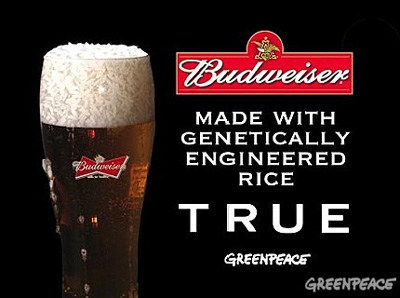
Greenpeace today released the results of an independent analysis of rice at an Arkansas mill which supplies rice to Anheuser-Busch for use in their beer. The lab found genetically engineered rice in 75% of the samples. From the press release:

An independent laboratory, commissioned by Greenpeace, detected the presence of GE rice (Bayer LL601) in three out of four samples taken at the mill. The experimental GE rice is one of three rice varieties that were first found in 2006 to have contaminated rice stocks in the US. Since then, GE contamination has been found in approximately 30 per cent of US rice stocks. This has had a massive negative impact on the US rice industry as foreign markets, where GE rice has not been approved, have been closed to US rice.

“Anheuser-Busch must make a clear statement about the level of GE contamination of the rice used to brew Budweiser in the US and spell out what measures are in place to ensure this beer does not reach the company’s export markets,” said Doreen Stabinsky, Greenpeace International GE Campaigner.

“US beer drinkers need Anheuser-Busch to explain why it is not preventing use of this genetically-engineered rice in the US. If, as the company has informed Greenpeace, all of the Budweiser exported from the US or manufactured outside of the US is guaranteed GE free then Anheuser-Busch needs to state this publicly, and explain the double standard,” said Stabinsky.

Greenpeace informed Anheuser-Busch of the test results prior to their release and sought clear information from the company on the extent of contamination and its global policy on the use of GE ingredients. Anheuser-Busch responded that the rice is approved in the US and is not used in brewing Budweiser destined for export. The full extent of the contamination remains unclear, however.

LL601 GE rice was retroactively granted approval by the US Dept of Agriculture in an effort to reduce public concern and company liability despite 15,000 public objections. The European Food Safety Authority stated that there was insufficient data to make a finding of safety. Greenpeace says that US consumers have a right to know if this GE rice is used to make Budweiser. This GE rice is not approved outside the US so the Budweiser brewed with it could not be sold abroad.

Anheuser-Busch is the largest single rice buyer in the US, buying 6-10 per cent of the annual US rice crop. Budweiser is one of only a few beers having rice as an ingredient. The brand is found in around 60 countries through a mix of exports and local brewing arrangements.

I recently did an article on green breweries and interviewed the Senior Group Director of Environmental, Health and Safety for A-B. I was pleasantly surprised at just how many things they were doing to be “green” so it seems surprising that they’d overlook genetically engineered rice being used in the beer itself. One thing you can say about Anheuser-Busch is that they do care about their public perception, so it will be interesting to see their reaction to this revelation.

bud-gerice

Doug Muhleman, Anheuser-Busch’s Group Vice President of Brewing, Operations and Technology, released a statement yesterday which I think suggests that Greenpeace is not the virtuous one in this story. On closer examination, this may be more about international politics than beer. Here’s Muhleman’s statement:

Greenpeace’s statements regarding our beer brands are false and defamatory. All of our products are made according to the highest quality standards and in complete compliance with the laws in each country where we sell our beers.

We stand in support of U.S. farmers, who are partners with us in the quality of our products. Greenpeace recently asked us to join their advocacy campaign on genetically modified crops. We refused their calls to boycott U.S. farmers, and they are now retaliating.

The use of genetically modified crops in the United States is not new. The vast majority of the commercial corn and soybean supply in the United States contains genetically modified versions that are certified to be safe for human consumption by the U.S. Government.

We use U.S. rice for brewing our products for U.S. consumption. U.S.-grown long-grained rice that may have micro levels of Liberty Link proteins present is fully approved by the U.S. Government, having determined that it is perfectly safe for human consumption. Moreover, the Liberty Link protein, like all proteins, is substantially removed or destroyed by the brewing process. Liberty Link has not been found in any of our tests of our beers brewed in the United States.

We fully comply with all international regulatory standards on the use or presence of genetically modified ingredients wherever our beers are sold internationally, as well. Neither Anheuser-Busch, nor our international licensed brewing partners use genetically modified ingredients, including genetically modified rice, in brewing products sold in any country with legal restrictions.

We talked with Greenpeace, hoping to help them understand the facts. We are disappointed that they instead chose to pursue pressure tactics.

Now I’m no fan of GMO’s, but they have been used here for many years and, like it or not, they’re a part of our massive food system. Short of pulling out every crop in the country and starting over, I’m not exactly sure what would satisfy Greenpeace. Certainly the way Greenpeace is seeking to sensationalize this seems more bullying than anything. I confess I was alarmed when I first read the story but having looked at it more closely in the interim I’m not sure their tactics are entirely warranted.

ab-muhleman
Me with Doug Muhleman at an A-B reception at GABF last year.

Filed Under: News, Politics & Law Tagged With: Business, Health & Beer, Ingredients, International, National, Press Release

Northern California Homebrewers Festival

October 8, 2007 By Jay Brooks

I spent a fun weekend with the family attending the 10th annual Northern California Homebrewers Festival. Friday night we had a great beer dinner by Sean Paxton, the Homebrew Chef, and Saturday all day we enjoyed some excellent homebrewed beer. The theme for the festival was sour beers and beers made with wild yeast.

Homebrew club booths at the 10th annual Northern California Homebrewers Festival.

For more photos from this year’s Northern California Homebrewers Festival, visit the photo gallery.
 

Filed Under: Events Tagged With: California, Festivals, Homebrewing, Northern California, Photo Gallery

« Previous Page
Next Page »

Find Something

Northern California Breweries

Please consider purchasing my latest book, California Breweries North, available from Amazon, or ask for it at your local bookstore.

Recent Comments

  • Bob Paolino on Beer Birthday: Grant Johnston
  • Gambrinus on Historic Beer Birthday: A.J. Houghton
  • Ernie Dewing on Historic Beer Birthday: Charles William Bergner 
  • Steve 'Pudgy' De Rose on Historic Beer Birthday: Jacob Schmidt
  • Jay Brooks on Beer Birthday: Bill Owens

Recent Posts

  • Beer In Ads #5228: We Are Coming On The Run … April 22, 2026
  • Beer In Ads #5228: All Together For Newark April 21, 2026
  • Beer Birthday: Steve Parkes April 21, 2026
  • Beer In Ads #5227: It’s Here! Bock Beer By Bosch April 20, 2026
  • Beer Birthday: Drew Beechum April 20, 2026

BBB Archives

Feedback

Head Quarter
This site is hosted and maintained by H25Q.dev. Any questions or comments for the webmaster can be directed here.