Sunday’s ad is for Schlitz, from 1939. In this ad, all about aerial photography, in addition to American landmarks shot from the air, there’s also a photo of the Schlitz brewery in Milwaukee.
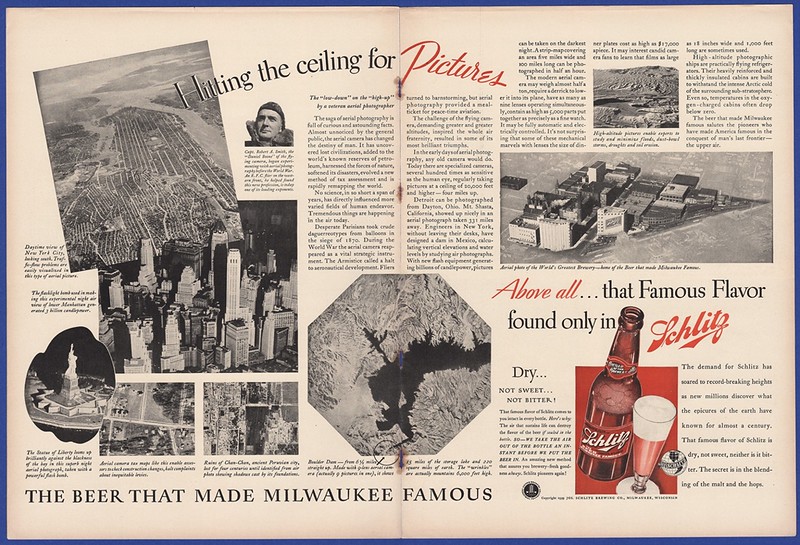

Sunday’s ad is for Schlitz, from 1939. In this ad, all about aerial photography, in addition to American landmarks shot from the air, there’s also a photo of the Schlitz brewery in Milwaukee.

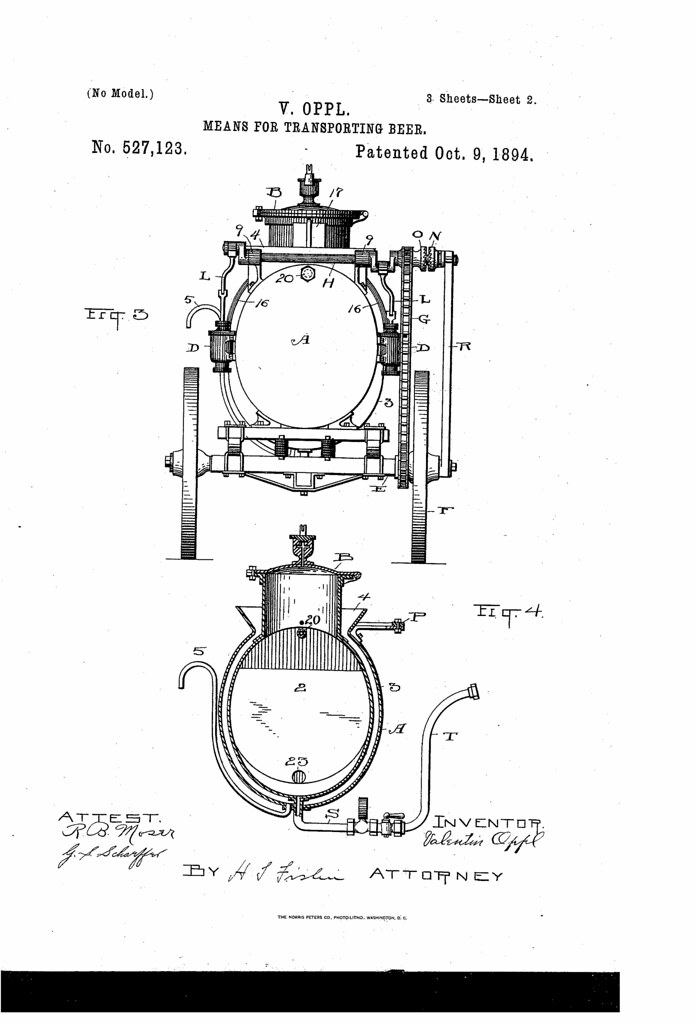
Today in 1894, US Patent 527123 A was issued, an invention of Valentin Oppl, for his “Means For Transporting Beer.” There’s no Abstract, although in the description it includes these claims:
My invention relates to means for transporting beer, and the invention consists in a four-wheeled vehicle having a tank permanently thereon, pumps connected with the tank and power mechanism to operate the pumps.


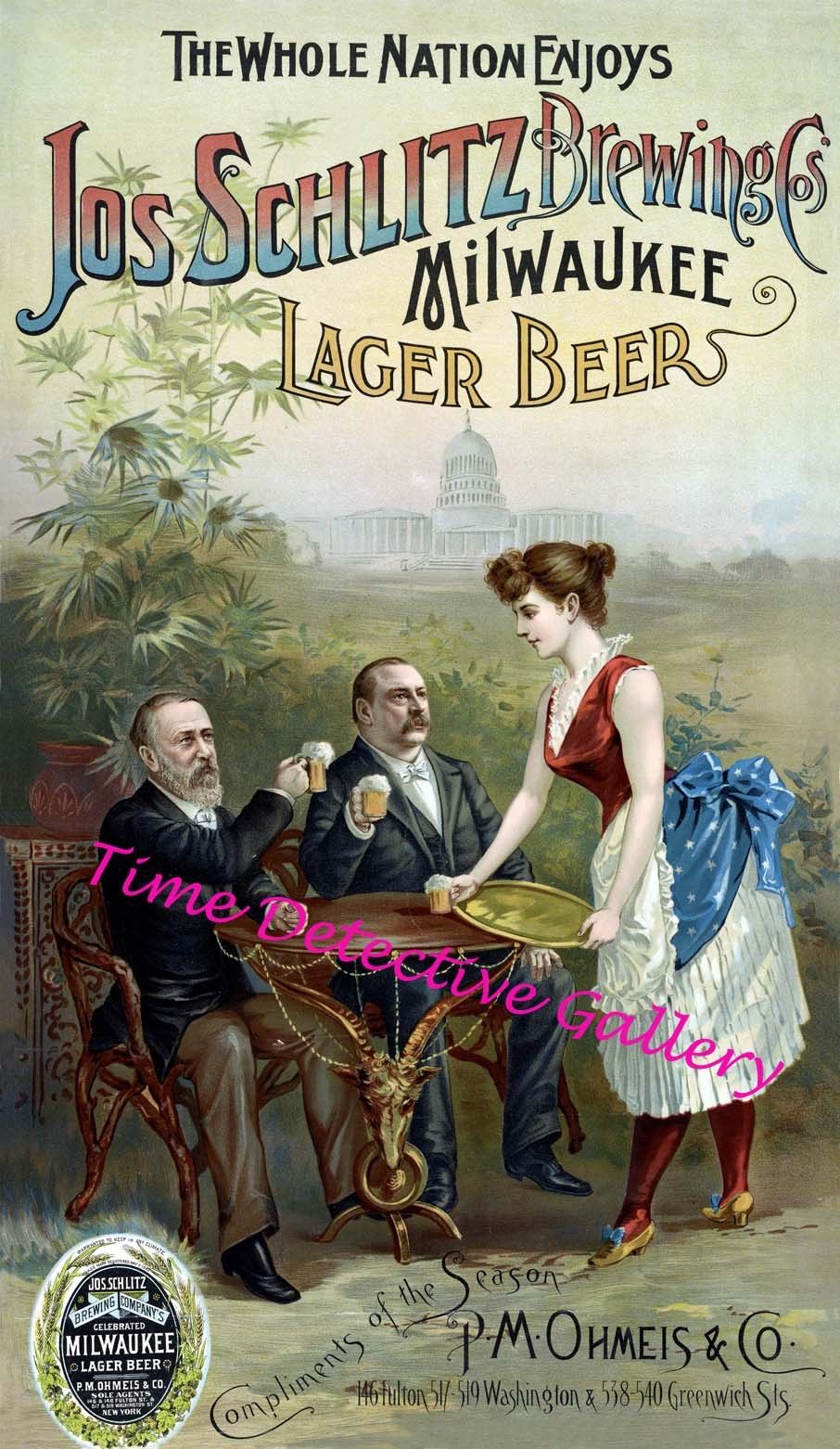
Friday’s ad is for Schlitz, from 1888. In this ad, a very patriotic server, in the shadow of the U.S. Capitol, is setting down a third glass of beer, as her two customers try to clink their glasses together while staring off into space. And are those the smallest beer glasses you’ve ever seen? And lastly, what about that goat table leg?
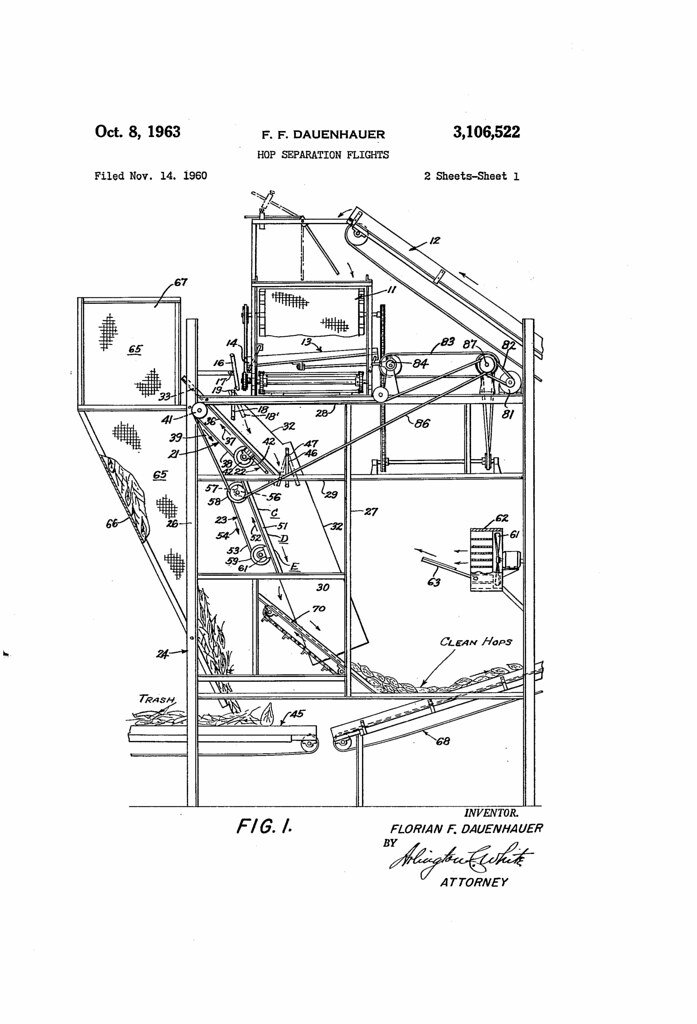
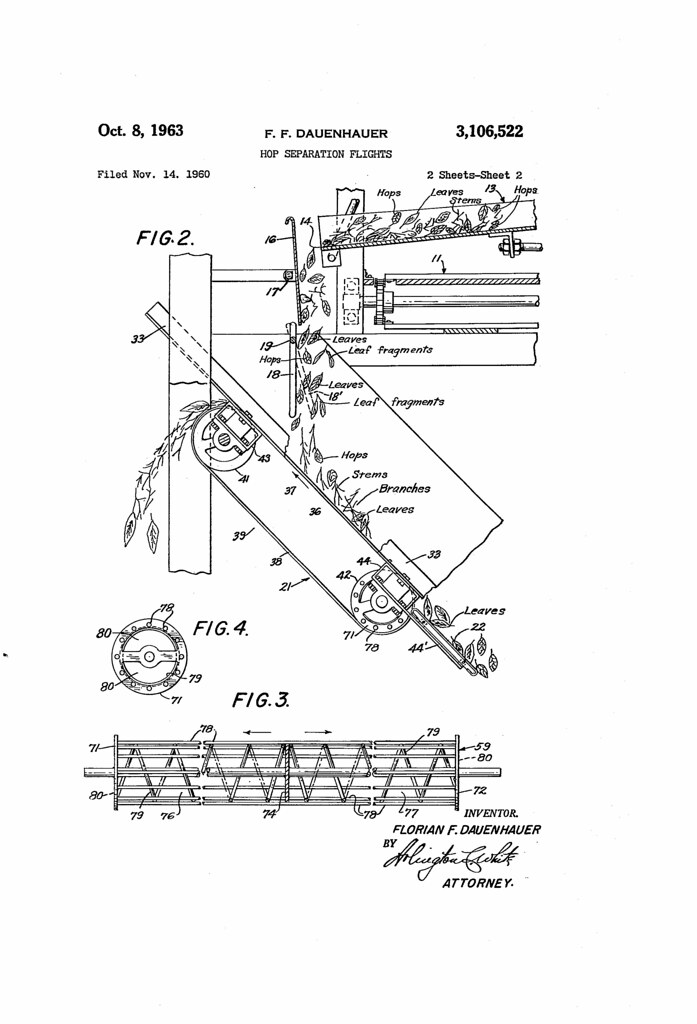
Today in 1963, US Patent 3106522 A was issued, an invention of Florian F. Dauenhauer, for his “Hop Separation Flights.” There’s no Abstract, although in the description it includes these claims:
The stripping of hops from hop vines by mechanical means results in the by-product of mixtures of considerable foreign material and stripped hops; such foreign material including vine fragments, branches, leaves and leaf fragments as Well as long and short stems all comrningled with individual hops. And, it has continuously been a problem in the art to reduce such foreign material to a minimum in order to avoid deleterious factors in beverages utilizing hop. The present invention is directed to the provision of means for effecting the separation of an appreciably increased quantity of leaves and leaf fragments at a hop-cleaning stage prior to the final cleaning stage so that the end result is appreciably cleaner hops having much less than 1% of foreign material intermingled or commingled therewith.
A primary object of the present invention is to provide hop separation flights capable of effecting the removal of substantial quantities of leaves and leaf fragments from moving mixtures of hops intermingled and commingled with foreign material, including leaves and leaf fragments.
Another important object of the invention is to provide improved hop separating flights of the indicated nature which are additionally characterized by their ability to relieve the load on the final cleaner or clean-up separating equipment and make the latter more effective in reducing the quantity of foreign material in mixtures of hops and foreign material.
A still further object of the present improvement is to provide hop separation flights of the aforementioned character which can readily be installed at a minimum of expense for utilization with hop separating machines of any type.
Friday’s ad is for Schlitz, from 1914. In this ad, which ran in the Detoit Press on July 17, 1914, the warning inside the beer-drinking man’s head reads. “Nature has many ways of warning man of danger. The sense of taste and smell both serve for protection.” That’s followed by them stating that those skunk aromas and flavors come from “beer from light bottles.” They suggest; “Why take the risk?” Brown bottles are better, so buy Schlitz.

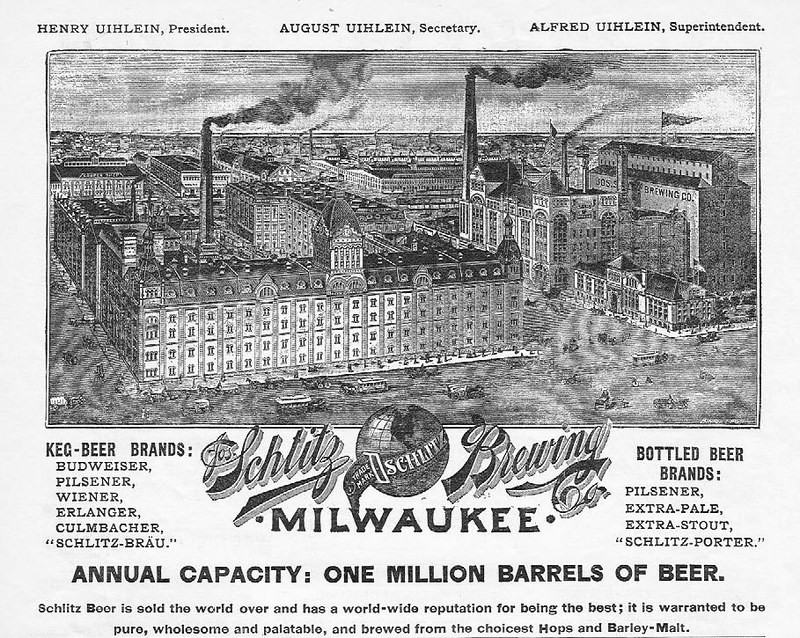
Thursday’s ad is for Schlitz, from 1900. In this ad, after Schlitz had passed away and original founder August Krug’s nephews, August and Henry Uihlein, inherited the brewery, they continued building the business and by 1900 were brewing one million barrels of beer per year. I love these old brewery illustrations that make them seem just massive. And notice the keg-beer brands offered. One listed is “Budweiser.” That seems curious. And some of the bottled beers include “Extra-Pale,” “Extra-Stout,” and Schlitz-Porter.”
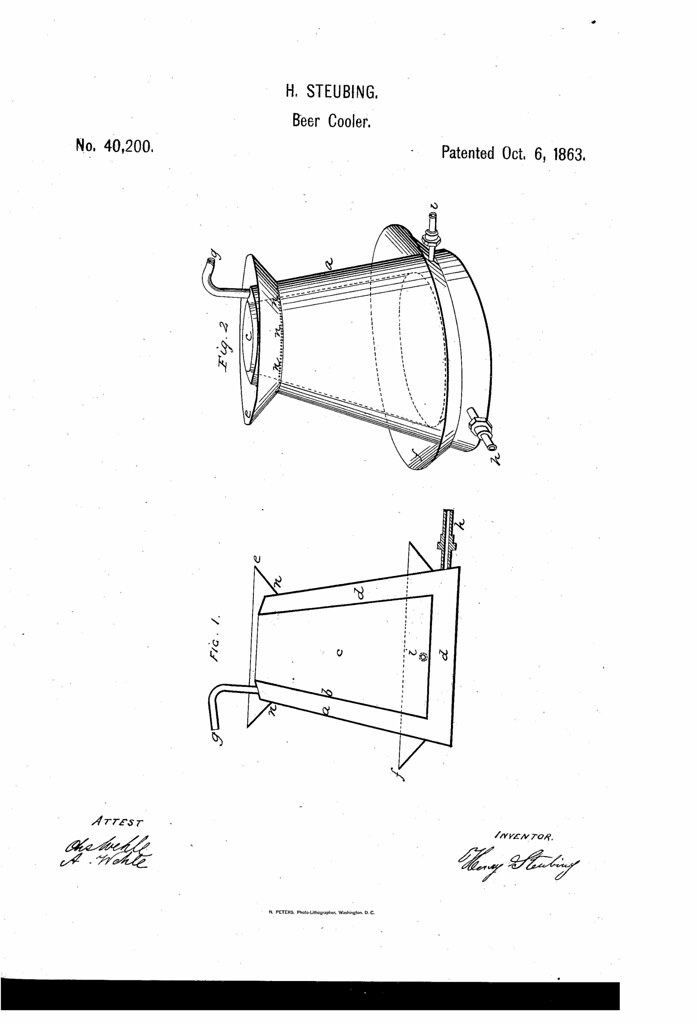
Today in 1863, US Patent 40200 A was issued, an invention of Henry Steubing, for his “Improved Apparatus For Cooling Beer or Other Liquids.” There’s no Abstract, although in the description it includes these claims:
The said apparatus is used in the following manner: Cold water or iced water is introduced into the space d from a reservoir, until the space d is filled with it and during the whole time of cooling. Then the ale, beer, or other liquid to be cooled is admitted into the hollow cylinder c steadily and continuously, when the same Will overflow into the space formed by the flange e, and will 110W down through the holes n n’ n on the outer mantel, a, into the space formed by the lower flange, j’, after which it flows out of the apparatus through the pipe i. Thus it will be seen that a certain quantity of iced water or cold water cools the ale, beer, or other liquid, rst by its contact on the inside b of the cooler, and then by its contact on the outside c of said cooler, thereby effecting `a great saving of the cooling material.
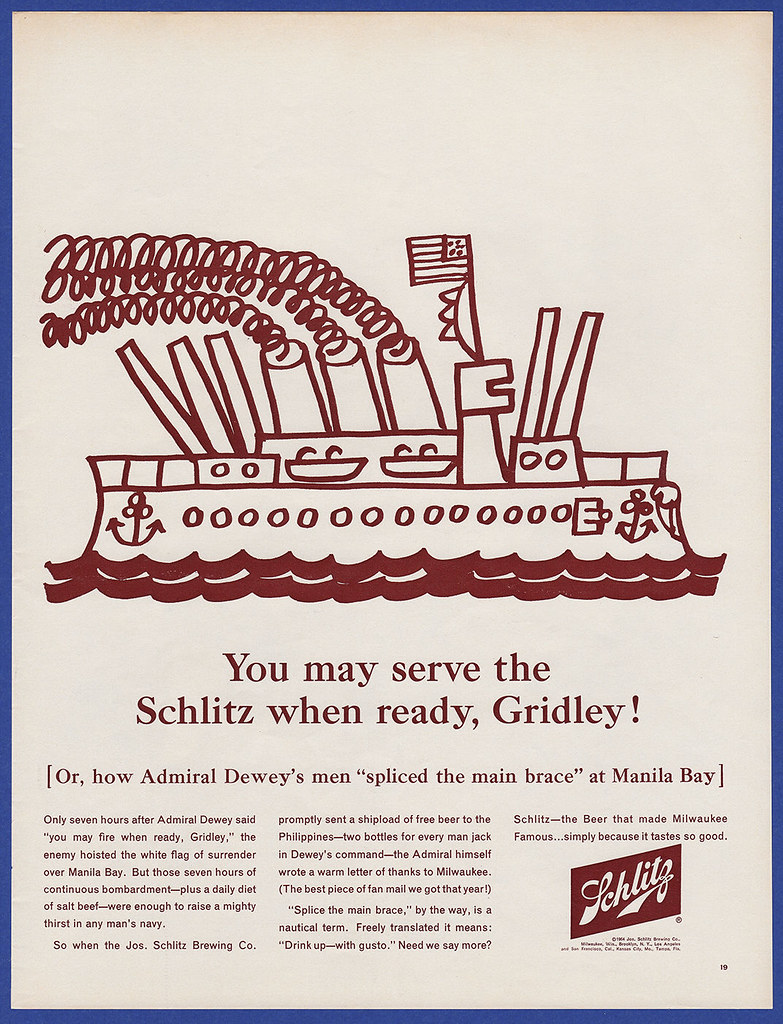
Wednesday’s ad is for Schlitz, from 1964. In this ad, nearly thirty years later, they’re still talking about the story of Admiral George Dewey, who destroyed the Spanish fleet in Manila Bay in the Philippines in the spring of 1898, without a single American casualty. This was during the Spanish-American War. Besides the art being far more minimalist, in this version of the story after their victory, the Schlitz office in Manila the next day delivered to Dewey and his crew “two bottles for every man jack in Dewey’s command,” whereas the earlier ad claims it was 3600 bottles of Schlitz, one for every sailor who took part in the battle.
Also, the phrase in ad, “splice the main brace” is in fact a nautical term defined as meaning “an order given aboard naval vessels to issue the crew with an alcoholic drink” by Wikipedia, and Origins of Naval Terminology claims. “It was the custom, after the main brace was properly spliced, to serve grog to the entire crew. Thus, today, after a hard day (or, not so hard day), the phrase has become an invitation to have a drink.” So that’s a real thing. I’ll have to figure out a way to work that into a conversation.
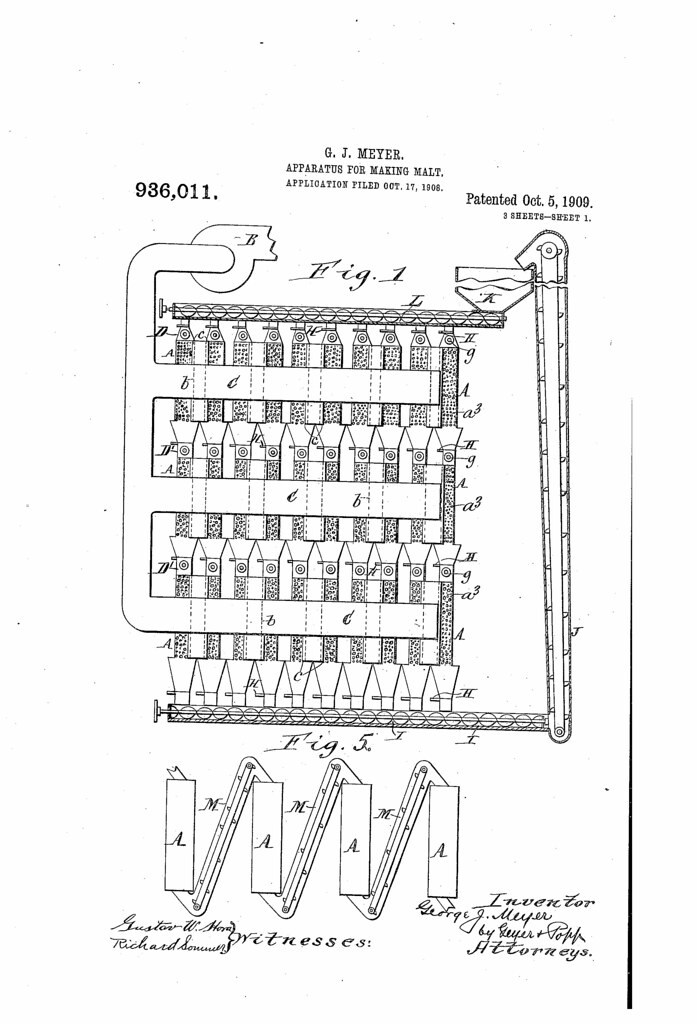
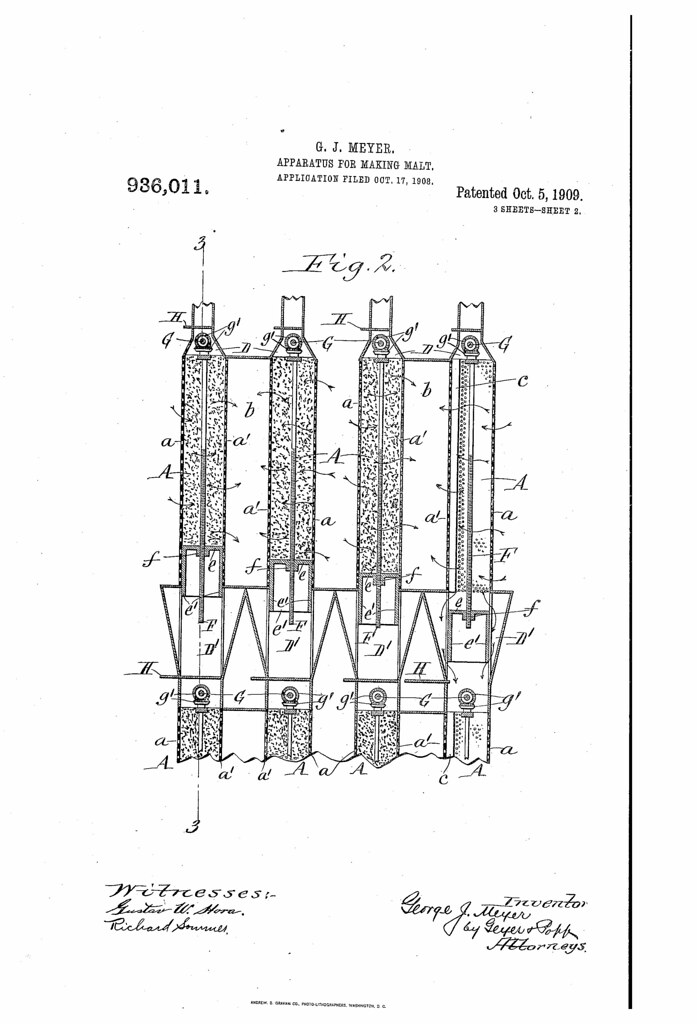
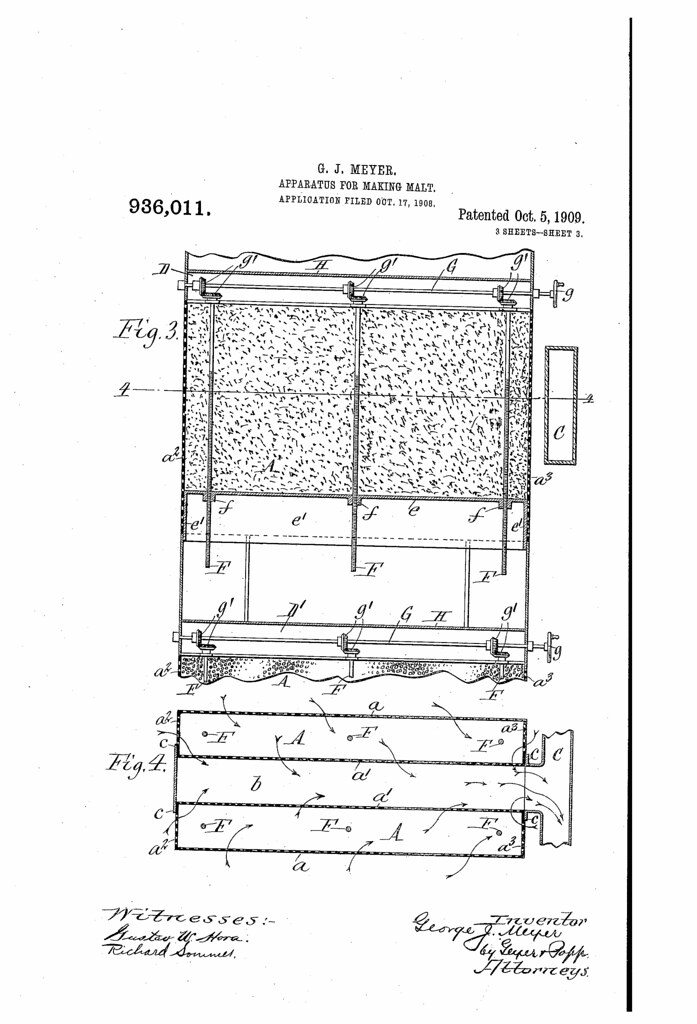
Today in 1909, US Patent 936011 A was issued, an invention of George J. Meyer, for his “Apparatus For Making Malt.” There’s no Abstract, although in the description it includes these claims:
Heretofore malting has usually been effected by tumbling barley or other grain around in rotatable drums or turning the same over periodically by hand or mechanical shovels while the same is supported in thin horizontal layers on a floor or in shallow boxes. None of these systems utilize the overhead space in the rooms of malt houses and therefore are not economical in this respect,
One of the objects of this invention is to utilize this overhead space to the fullest extent and thereby increase the malting capacity of a building of certain dimensions.
My invention has the further object to simplify the means whereby malting is effected so as to reduce the cost thereof and also insure a more thorough mixing of the barley from time to time during the malting operation so as to insure a more uniform product.
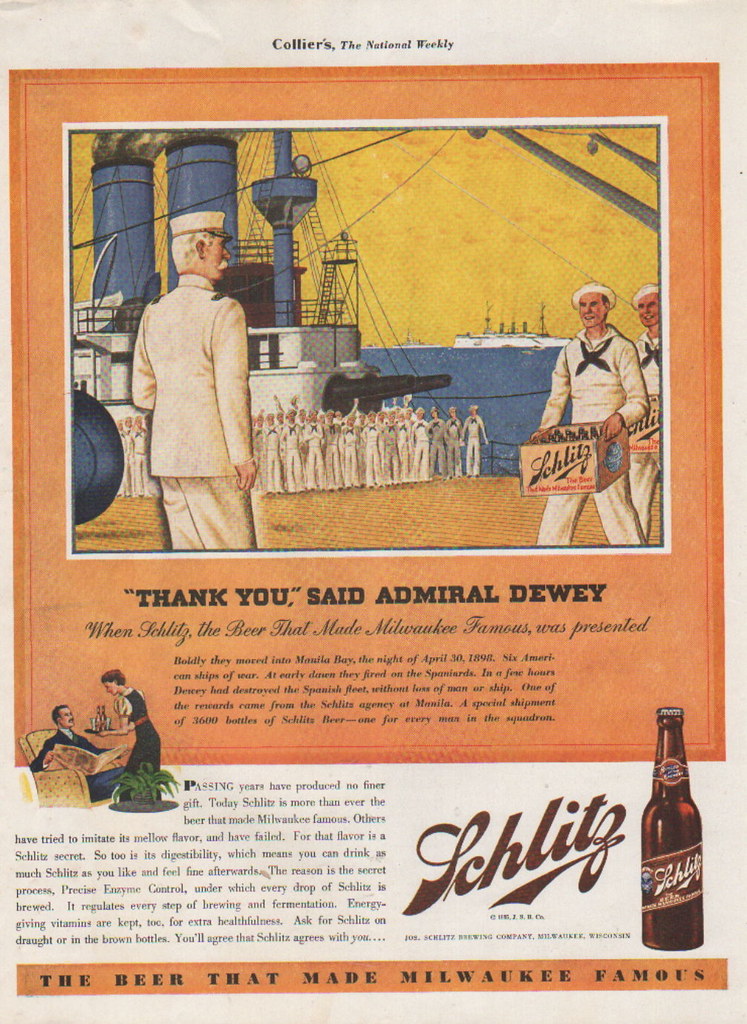
Tuesday’s ad is for Schlitz, from 1935. In this ad, they tell the story of Admiral George Dewey, who destroyed the Spanish fleet in Manila Bay in the Philippines in the spring of 1898, without a single American casualty. This was during the Spanish-American War. Apparently one of his rewards for this heroic feat was that the Schlitz office in Manila the next day delivered to Dewey and his crew 3600 bottles of Schlitz, one for every sailor who took part in the battle.