Brookston Beer Bulletin

Jay R. Brooks on Beer

  • Home
  • About
  • Editorial
  • Birthdays
  • Art & Beer

Socialize

  • Dribbble
  • Email
  • Facebook
  • Flickr
  • GitHub
  • Instagram
  • LinkedIn
  • Pinterest
  • RSS
  • Twitter
  • YouTube

Powered by Genesis

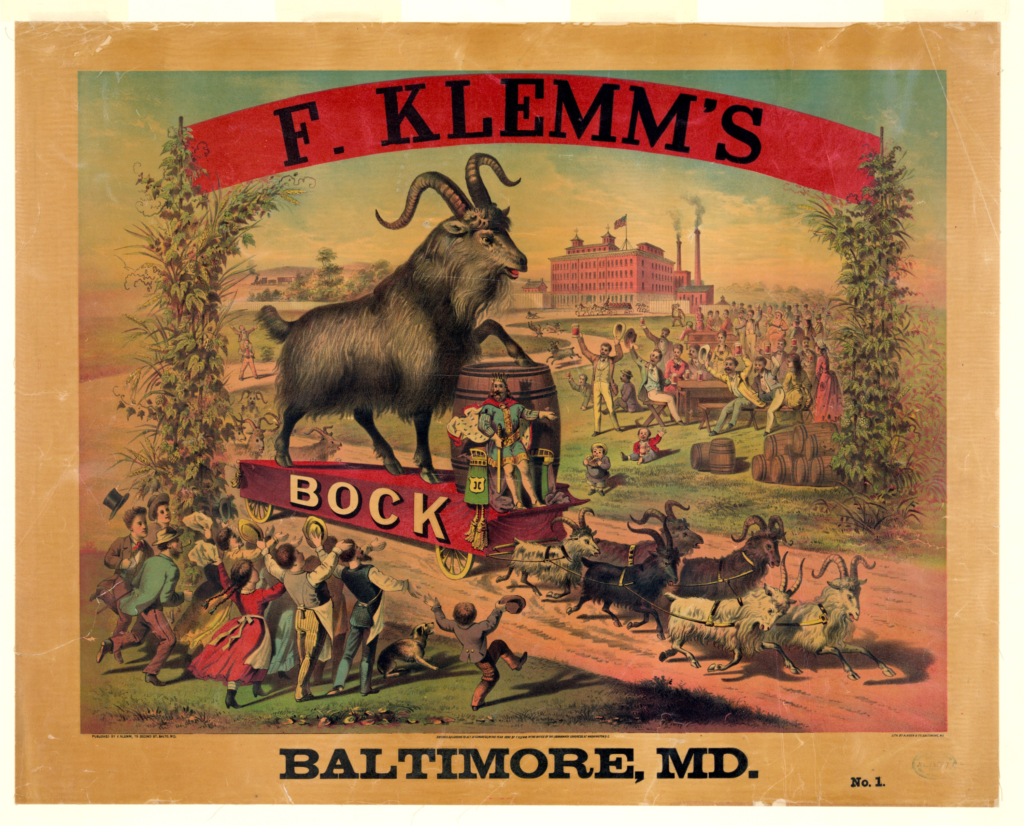
Beer In Ads #4855: F. Klemm’s Bock No. 1

January 18, 2025 By Jay Brooks

Last year I decided to concentrate on Bock ads. Bock, of course, originated in Germany, in the town of Einbeck. Because many 19th century American breweries were founded by German immigrants, they offered a bock at certain times of the year, be it Spring, Easter, Lent, Christmas, or what have you. In a sense they were some of the first seasonal beers. “The style was later adopted in Bavaria by Munich brewers in the 17th century. Due to their Bavarian accent, citizens of Munich pronounced ‘Einbeck’ as ‘ein Bock’ (a billy goat), and thus the beer became known as ‘Bock.’ A goat often appears on bottle labels.” And presumably because they were special releases, many breweries went all out promoting them with beautiful artwork on posters and other advertising.

Saturday’s ad for “Bock” was created for the F. Klemm Brewery of Baltimore, Maryland. In tiny letters on the bottom right of the poster, it reads: “No. 1.” You can see No. 2 from yesterday here. The lithograph was created in 1880. The lithographer was A. Hoen & Co., of 75 Second St., in Baltimore, Maryland. “A. Hoen & Co. was a Baltimore, Maryland-based lithography firm founded by Edward Weber in the 1840s as E. Weber & Company. When August Hoen took it over following Weber’s death, he changed the name and built the company into one of the most prominent in the industry at the time.”
Filed Under: Art & Beer, Beers, Breweries, Just For Fun Tagged With: Advertising, Bock, History, Maryland

Beer In Ads #4854: F. Klemm’s Bock No. 2

January 17, 2025 By Jay Brooks

Last year I decided to concentrate on Bock ads. Bock, of course, originated in Germany, in the town of Einbeck. Because many 19th century American breweries were founded by German immigrants, they offered a bock at certain times of the year, be it Spring, Easter, Lent, Christmas, or what have you. In a sense they were some of the first seasonal beers. “The style was later adopted in Bavaria by Munich brewers in the 17th century. Due to their Bavarian accent, citizens of Munich pronounced ‘Einbeck’ as ‘ein Bock’ (a billy goat), and thus the beer became known as ‘Bock.’ A goat often appears on bottle labels.” And presumably because they were special releases, many breweries went all out promoting them with beautiful artwork on posters and other advertising.

Friday’s ad for “Bock” was created for the F. Klemm Brewery of 75 Second St., in Baltimore, Maryland. In tiny letters on the left side of the poster, in red, it reads: “No. 2,” suggesting there is a number one somewhere. Stay tuned, I’ll see if I can find that one. The lithograph was created in 1880. The lithographer was A. Hoen & Co., also of Baltimore, Maryland. “A. Hoen & Co. was a Baltimore, Maryland-based lithography firm founded by Edward Weber in the 1840s as E. Weber & Company. When August Hoen took it over following Weber’s death, he changed the name and built the company into one of the most prominent in the industry at the time.”

Filed Under: Art & Beer, Beers, Breweries, Just For Fun Tagged With: Advertising, Bock, History, Maryland

Beer In Ads #4853: Triumph Bock

January 16, 2025 By Jay Brooks

Last year I decided to concentrate on Bock ads. Bock, of course, originated in Germany, in the town of Einbeck. Because many 19th century American breweries were founded by German immigrants, they offered a bock at certain times of the year, be it Spring, Easter, Lent, Christmas, or what have you. In a sense they were some of the first seasonal beers. “The style was later adopted in Bavaria by Munich brewers in the 17th century. Due to their Bavarian accent, citizens of Munich pronounced ‘Einbeck’ as ‘ein Bock’ (a billy goat), and thus the beer became known as ‘Bock.’ A goat often appears on bottle labels.” And presumably because they were special releases, many breweries went all out promoting them with beautiful artwork on posters and other advertising.

Thursday’s ad for “Bock” depicts King Gambrinus leading a chariot being pulled by two goats, while holding an overflowing chalice of beer. There’s also a monkey holding a whip, as if he’s driving the chariot. The title of the poster is “Triumph Bock,” though I’m not sure wht that’s the case. The lithograph was created in 1889. The lithographer was H. Schile & Co. of 295 Bowery in New York City. Henry Jerome Schile was born in Germany, and emigrated to the U.S. in 1851, settling in Manhattan, which is where he opened his own print company. 

Filed Under: Art & Beer, Beers, Just For Fun Tagged With: Advertising, Bock, History, New York

Beer In Ads #4852: Bavarian Bock

January 15, 2025 By Jay Brooks

Last year I decided to concentrate on Bock ads. Bock, of course, originated in Germany, in the town of Einbeck. Because many 19th century American breweries were founded by German immigrants, they offered a bock at certain times of the year, be it Spring, Easter, Lent, Christmas, or what have you. In a sense they were some of the first seasonal beers. “The style was later adopted in Bavaria by Munich brewers in the 17th century. Due to their Bavarian accent, citizens of Munich pronounced ‘Einbeck’ as ‘ein Bock’ (a billy goat), and thus the beer became known as ‘Bock.’ A goat often appears on bottle labels.” And presumably because they were special releases, many breweries went all out promoting them with beautiful artwork on posters and other advertising.

Wednesday’s ad for “Bock” depicts an outdoor setting with a couple in the foreground next to what appears to be some hop plants. There’s also a goat with them. Behind them, scenes play out such as a beer wagon coming through a tunnel and and a wpoman defending herself agaiunst a goat with her umbrella. Rgw title of the poster is “Bavarian Bock,” so perhaps that’s where the scene is meant to be taking place. The chromolithograph was created iin 1887. The lithographer was H. Schile & Co. of 295 Bowery in New York City. Henry Jerome Schile was born in Germany, and emigrated to the U.S. in 1851, settling in Manhattan, which is where he opened his own print company. 

Filed Under: Art & Beer, Beers, Just For Fun Tagged With: Advertising, Bock, History, New York

Beer In Ads #4850: Coronation Bock

January 13, 2025 By Jay Brooks

Last year I decided to concentrate on Bock ads. Bock, of course, originated in Germany, in the town of Einbeck. Because many 19th century American breweries were founded by German immigrants, they offered a bock at certain times of the year, be it Spring, Easter, Lent, Christmas, or what have you. In a sense they were some of the first seasonal beers. “The style was later adopted in Bavaria by Munich brewers in the 17th century. Due to their Bavarian accent, citizens of Munich pronounced ‘Einbeck’ as ‘ein Bock’ (a billy goat), and thus the beer became known as ‘Bock.’ A goat often appears on bottle labels.” And presumably because they were special releases, many breweries went all out promoting them with beautiful artwork on posters and other advertising.

Monday’s ad for “Bock” depicts a king — possibly King Gambrinus? — on his throne next to a keg. A goat is standing up, leaning against the barrel, and the king is placing another crown on the goat’s head. The lithograph was created in 1877. In small print at the bottom of the poster it reads “Coronation Bock,” or more precisely it’s misspelled “Corronation.” The lithographer was H. Schile & Co. of 295 Bowery in New York City. Henry Jerome Schile was born in Germany, and emigrated to the U.S. in 1851, settling in Manhattan, which is where he opened his own print company. 

Filed Under: Art & Beer, Beers, Just For Fun Tagged With: Advertising, Bock, History, New York

Beer In Ads #4849: Roessle Bock

January 12, 2025 By Jay Brooks

Last year I decided to concentrate on Bock ads. Bock, of course, originated in Germany, in the town of Einbeck. Because many 19th century American breweries were founded by German immigrants, they offered a bock at certain times of the year, be it Spring, Easter, Lent, Christmas, or what have you. In a sense they were some of the first seasonal beers. “The style was later adopted in Bavaria by Munich brewers in the 17th century. Due to their Bavarian accent, citizens of Munich pronounced ‘Einbeck’ as ‘ein Bock’ (a billy goat), and thus the beer became known as ‘Bock.’ A goat often appears on bottle labels.” And presumably because they were special releases, many breweries went all out promoting them with beautiful artwork on posters and other advertising.

Sunday’s ad for “Bock” is for the Roessle Brewery of Boston, Massachusetts. The chromolithograph was created in 1894. The lithographer was H. Schile & Co. of 295 Bowery in New York City. Henry Jerome Schile was born in Germany, and emigrated to the U.S. in 1851, settling in Manhattan, which is where he opened his own print company. 

Filed Under: Art & Beer, Beers, Just For Fun Tagged With: Advertising, Bock, Boston, History, Massachusetts, New York

Beer In Ads #4848: The Three Bocks

January 11, 2025 By Jay Brooks

Last year I decided to concentrate on Bock ads. Bock, of course, originated in Germany, in the town of Einbeck. Because many 19th century American breweries were founded by German immigrants, they offered a bock at certain times of the year, be it Spring, Easter, Lent, Christmas, or what have you. In a sense they were some of the first seasonal beers. “The style was later adopted in Bavaria by Munich brewers in the 17th century. Due to their Bavarian accent, citizens of Munich pronounced ‘Einbeck’ as ‘ein Bock’ (a billy goat), and thus the beer became known as ‘Bock.’ A goat often appears on bottle labels.” And presumably because they were special releases, many breweries went all out promoting them with beautiful artwork on posters and other advertising.

Saturday’s ad for “Bock” shows a goat attacking a cask of beer and a man defending it by opening the tap and spraying the goat with it. At least that’s what I think is gping on, but who really knows? The poster is inexplicably named “The Three Bocks.” The lithograph was created in 1895. The lithographer was H. Schile & Co. of 295 Bowery in New York City. Henry Jerome Schile was born in Germany, and emigrated to the U.S. in 1851, settling in Manhattan, which is where he opened his own print company. 

Filed Under: Art & Beer, Beers, Just For Fun Tagged With: Advertising, Bock, History

Beer In Ads #4847: Beer Cellar Bock

January 10, 2025 By Jay Brooks

Last year I decided to concentrate on Bock ads. Bock, of course, originated in Germany, in the town of Einbeck. Because many 19th century American breweries were founded by German immigrants, they offered a bock at certain times of the year, be it Spring, Easter, Lent, Christmas, or what have you. In a sense they were some of the first seasonal beers. “The style was later adopted in Bavaria by Munich brewers in the 17th century. Due to their Bavarian accent, citizens of Munich pronounced ‘Einbeck’ as ‘ein Bock’ (a billy goat), and thus the beer became known as ‘Bock.’ A goat often appears on bottle labels.” And presumably because they were special releases, many breweries went all out promoting them with beautiful artwork on posters and other advertising.

Friday’s ad for “Bock” shows several colorfully dressed men in a beer cellar, harrasing their server, and singing, playing cards, and drinking beer. The poster is referred to as “new cellar bock 135.” The lithograph was created in 1890. The lithographer was H. Schile & Co. of 295 Bowery in New York City. Henry Jerome Schile was born in Germany, and emigrated to the U.S. in 1851, settling in Manhattan, which is where he opened his own print company. 

Filed Under: Art & Beer, Beers, Just For Fun Tagged With: Advertising, Bock, History, New York

Beer In Ads #4846: Columbia Bock

January 9, 2025 By Jay Brooks

Last year I decided to concentrate on Bock ads. Bock, of course, originated in Germany, in the town of Einbeck. Because many 19th century American breweries were founded by German immigrants, they offered a bock at certain times of the year, be it Spring, Easter, Lent, Christmas, or what have you. In a sense they were some of the first seasonal beers. “The style was later adopted in Bavaria by Munich brewers in the 17th century. Due to their Bavarian accent, citizens of Munich pronounced ‘Einbeck’ as ‘ein Bock’ (a billy goat), and thus the beer became known as ‘Bock.’ A goat often appears on bottle labels.” And presumably because they were special releases, many breweries went all out promoting them with beautiful artwork on posters and other advertising.

Thursday’s ad for “Bock” shows the personification of Columbia in the clouds with Cupid(?) and a goat down on the ground below. The lithograph was created in 1893. The lithographer was H. Schile & Co. of 295 Bowery in New York City. Henry Jerome Schile was born in Germany, and emigrated to the U.S. in 1851, settling in Manhattan, which is where he opened his own print company. 

Filed Under: Art & Beer, Beers, Just For Fun Tagged With: Advertising, Bock, History, New York

Beer In Ads #4845: Wooden Door Bock

January 8, 2025 By Jay Brooks

Last year I decided to concentrate on Bock ads. Bock, of course, originated in Germany, in the town of Einbeck. Because many 19th century American breweries were founded by German immigrants, they offered a bock at certain times of the year, be it Spring, Easter, Lent, Christmas, or what have you. In a sense they were some of the first seasonal beers. “The style was later adopted in Bavaria by Munich brewers in the 17th century. Due to their Bavarian accent, citizens of Munich pronounced ‘Einbeck’ as ‘ein Bock’ (a billy goat), and thus the beer became known as ‘Bock.’ A goat often appears on bottle labels.” And presumably because they were special releases, many breweries went all out promoting them with beautiful artwork on posters and other advertising.

Wednesday’s ad for “Bock” shows a goat drinking a mug of beer through a wooden door, possibly a barn door, or maybe the door to a bar. The lithograph was created in 1880. The lithographer was A. Hoen & Co. of 75 Second St., in Baltimore, Maryland. “A. Hoen & Co. was a Baltimore, Maryland-based lithography firm founded by Edward Weber in the 1840s as E. Weber & Company. When August Hoen took it over following Weber’s death, he changed the name and built the company into one of the most prominent in the industry at the time.”

Filed Under: Art & Beer, Beers, Just For Fun Tagged With: Advertising, Baltimore, Bock, History, Maryland

« Previous Page
Next Page »

Find Something

Northern California Breweries

Please consider purchasing my latest book, California Breweries North, available from Amazon, or ask for it at your local bookstore.

Recent Comments

  • Bob Paolino on Beer Birthday: Grant Johnston
  • Gambrinus on Historic Beer Birthday: A.J. Houghton
  • Ernie Dewing on Historic Beer Birthday: Charles William Bergner 
  • Steve 'Pudgy' De Rose on Historic Beer Birthday: Jacob Schmidt
  • Jay Brooks on Beer Birthday: Bill Owens

Recent Posts

  • American Craft Beer Hall of Fame: 2nd Year Inductees February 28, 2026
  • Beer Birthday: Jeff Bell February 28, 2026
  • Beer In Ads #5136: American Bock Beer Is Being Served Today! February 28, 2026
  • Historic Beer Birthday: James Younger February 28, 2026
  • Historic Beer Birthday: Joseph Metcalfe February 28, 2026

BBB Archives

Feedback

Head Quarter
This site is hosted and maintained by H25Q.dev. Any questions or comments for the webmaster can be directed here.