
Our 31st Guinness poster by John Gilroy goes back to the pint, smiling, as usual. The tagline is “Guinness Is Good For You.” At least it makes you smile.


Our 31st Guinness poster by John Gilroy goes back to the pint, smiling, as usual. The tagline is “Guinness Is Good For You.” At least it makes you smile.

Friday’s ad is from an earlier period, just before the golden age of poster, nearer the turn of the century, around 1905. It’s by artist Francisco Tamagno and is advertising Biere De Ville Sur Illon.
Here’s a short biography of the artist.
Francisco Tamagno was among the original movement of France’s fanciful graphic advertisement art tradition so popular around the Turn of the 20th Century, as it is now as vintage art. His signature style is influenced by his Portuguese heritage, infusing his French-themed art with bright, lively colors in highly pictorial settings. Born in Sintra, Portugal in 1851, in his early career, he was a portrait painter. He moved to Paris in the 1880’s to work as the house artist of the printer Camis; preparing theatrical playbills, and later graduating to posters for railroads, bicycle manufacturers and distillers. He died in Paris in 1923.

Thursday’s ad continues the impromptu series from the golden age of posters, the 1920s. This one is again from France around 1927. It’s for Brasserie Lengrand and is by the artist G. Piana.

Wednesday’s ad is another from the golden age of posters, the 1920s. It’s an Italian poster by artist Leonetto Cappiello, and features a trio of lovely ladies dancing around a pilsner glass like it was a Maypole.

Tuesday’s ad is by one of my favorite poster artists, Alphonse Mucha. The title of it is Bieres de la Meuse and it was done in France around 1897.

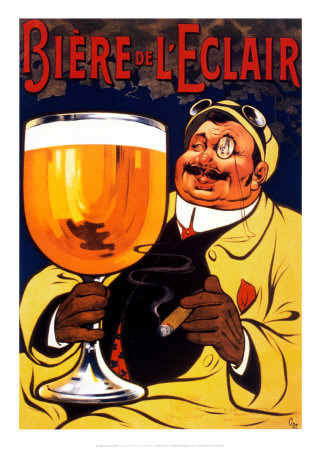
With Monday’s ad we continue our journey back to the French beer ads of the 1920s, this one for Biere de L’Eclair. A big man with big cigar, and an even bigger mug of beer. Who’s thirsty now?
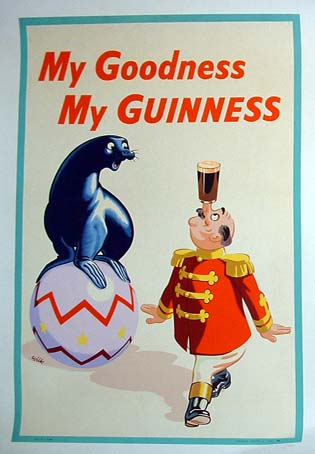
Our 30th Guinness poster by John Gilroy features a circus ringmaster showing a seal just how it’s done, balancing a bottle of Guinness on his own bulbous nose. The tagline is “My Goodness, My Guinness.”
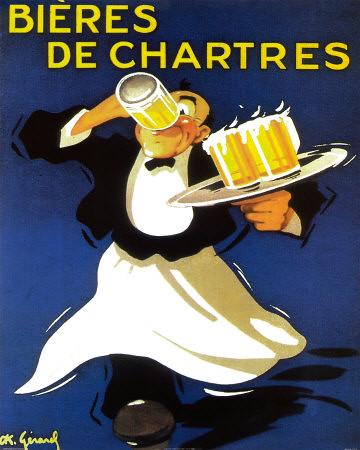
Friday’s ad is yet another French beer, this one for Bieres de Chartres. While I don’t know very much about it, or who the artist is, it’s from the same period of time — the 1920s — and is cut from the same cloth. It may even be a tad funnier, what with the waiter drinking the beer even as he delivers it.
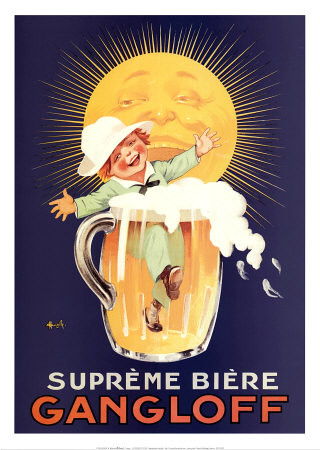
Thursday’s ad is another French beer, and like Tuesday’s ad, features an anthropomorphic sun. It was done by French illustrator Marcellin Auzolle and is specifically for Supreme Biere Gangloff. A lot of great artists worked for Gangloff in the 1920s, I hope their beer was as good as their taste in artists. It’s also great to see kids in beer ads, especially given our peculiar paranoia about mixing the two.
Wednesday’s ad is for one of the most well-known Italian beers, Birra Moretti. It’s the iconic Moretti man used on the beer label since just after World War II, which has a fascinating story in its own right, which is reprinted below from Moretti’s website.
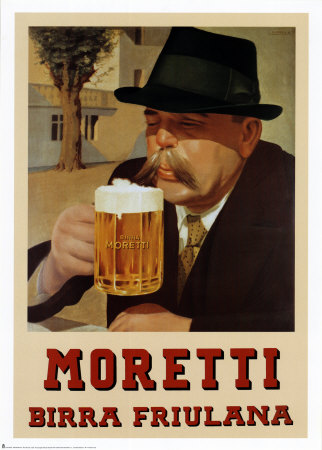
The quality of Birra Moretti beer is guaranteed by the Man on the Label, the moustached drinker who is the symbol of the Birra Moretti brand. This moustached gentleman has an unusual history… In 1942, Birra Moretti had already been a popular drink all over Friuli for over 80 years. One day, Commander Lao Menazzi Moretti saw a pleasant-looking old man with a moustache sitting at a little table in the Boschetti di Tricesimo inn (Udine).
He was just the kind of character Moretti had been looking for to represent the qualities and character of his beer: wholesome, traditional and authentic. Commander Moretti didn’t let him get away. He went up to him and asked the man if he could photograph him and also asked him what he would like in return. “Cal mi dedi di bevi, mi baste” — answered the man in Friuli dialect, which means “Get me a drink, that’ll do.”
The photographs were taken and were used after the turbulent times caused by the war were over, when they were handed over to Professor Segala, a famous poster artist of the time. Segala, following Commander Moretti’s descriptions of the original colours (the photographs were, of course, in black and white), created an advertising billboard which was used for years, wherever Birra Moretti was sold. This billboard gave rise to the now-famous Birra Moretti label.