Brookston Beer Bulletin

Jay R. Brooks on Beer

  • Home
  • About
  • Editorial
  • Birthdays
  • Art & Beer

Socialize

  • Dribbble
  • Email
  • Facebook
  • Flickr
  • GitHub
  • Instagram
  • LinkedIn
  • Pinterest
  • RSS
  • Twitter
  • YouTube

Powered by Genesis

Look Away From the Beer

December 19, 2007 By Jay Brooks

This interesting tidbit comes by way of the Fermenting Barrel via Tomme Arthur (thanks, Tomme), who knew my little crusading heart would appreciate the inanity of it all. It seems a new ordinance in the southern Utah town of Springville “requires beer displays be erected no closer than 15 feet from a store’s public entrance.” The Utah County Health Department’s Division of Substance Abuse also wanted retailers to keep all “beer 10 feet back from a store’s front windows,” too, but the City Council decided instead to just keep it away from the front doors. According to a story in the Salt Lake Tribune, “Richard Nance, substance-abuse division director, said the goal is to try to ensure that children do not get mixed messages about where the community stands on alcohol use.” What exactly is that mixed message he’s so worried about? Seriously, what is it? Anybody know? I mean, despite a huge religious influence in Utah, beer is still legal there, right? So what message is being sent by its proximity to the front door, for chrissakes?

Retailers, however, don’t appear too concerned about the new law — not that there’s much they could probably do anyway. Apparently most stores already keep their beer stock in the back of the store, which is also where most keep the milk, isn’t it? One added benefit, I suppose, is that less beer may be exposed to the light streaming through the front door, which may reduce skunking (hey, I’m looking for the silver lining here).

The Fermenting Barrel‘s take:

Tell me this, are the kids absorbing the alcohol by being in the mere vicinity of a case of beer? Can’t the kids still walk to the back of the store and *gasp* be exposed to beer? Or are the children confined to the front of the store?

In my opinion there’s way worse things kids can be exposed to right at the counter, say…pornography, cigarettes, or even junk food, candy, and soda. Last I checked diabetes was one of the worst epidemics in the US. How does it usually develop? Through obesity caused from a poor diet and a sedentary lifestyle. How about going even a little further, what about all the easy access kids have to the crap on TV, the Internet, and movies.

OK, I’m done ranting. You get my point. There’s bigger fish to fry than fretting over kids walking past a case of beer when they walk in a store. Just leave it to Utah to come up with even more insane alcohol laws. As if their laws weren’t already weird enough.

Amen, brother.


Filed Under: Editorial, News Tagged With: Business, Law, Prohibitionists, Strange But True, Western States

Harriet’s Beer For Girls

December 17, 2007 By Jay Brooks

Harriet Easton, age 19, appears to be one ambitious and entrepreneurially-minded young lass. She’s determined to fill the void created by a continuing drop in UK pub beer sales. “Figures released last month showed beer sales in pubs at their lowest level for 70 years. Seven million fewer pints per day are now being sold, with sales down 49 per cent since they peaked in 1979.” One obvious market being neglected is the female segment. So Easton, a politics student at Newcastle University, spent a year and a half — and £35,000 — on R&D to create a beer especially for women. It’s a “light ale with extract of orange and a modest 4.2 per cent alcohol.” Easton teamed up with a local brewery, Hanby Ales of Wem in Shropshire, to create the curiously named Harry’s Beer, which will be marketed to women beginning Monday at the Salopian Bar in Shrewsbury. On hand will be, Paula Waters, chairman of CAMRA. “Waters said: ‘I applaud the inventive way Harriet has brought this product to market. She’s a sassy and savvy young woman who has recognised there are others just like her who want to drink real ale and retain their femininity.'”

But as far as I can tell, this is not her first attempt. In August of this year there was at least one story about Harriet Easton in the Shropshire Star called These Girls Are For Real. At that time, they reported Easton debuting another beer, this one called Rushing Dolls beer for girls. In that article, Rushing Dolls was described as having “a zest of lime—it’s very light and hoppy.” There Easton was quoted as having created her beer because others were — I just love this expression — too blokey. Hop Talk even did a post about it in September. The lime version was “thought to be the first ever beer for girls” and now the new orange version is being similarly touted, this time by the Publican, who say it’s the “first real ale aimed specifically at women.” This time around, Easton says:

“Real ale has typically and consistently been marketed towards men with names full of cheesy puns and innuendo, and images of buxom wenches serving up frothy jugs,” said the politics student at Newcastle university. “They can keep all that — there’s no need to move on, lads — just move over”.

Still, I can’t help but think of Virginia Slims or pink trains for girls. It seems to me either a woman will develop a taste for beer or she won’t. I know plenty of women who already love craft beer, including my wife, and it didn’t take a specially designed beer for them to like beer. Trying to make one specifically for the ladies seems like a gimmick at best. But if it brings more women into the fold, I suppose that can’t be all bad.
 

Filed Under: Beers, Editorial, News Tagged With: Business, Europe, Great Britain, Strange But True

SABMiller Gets A Blue Tongue

December 6, 2007 By Jay Brooks

SABMiller announced yesterday that they are purchasing Australia’s Bluetongue Brewery in a joint venture with Coca-Cola Amatil Limited to be known as Pacific Beverages Pty Limited. The purchase price was not revealed though it is estimated to be around $20 million USD. It has also been reported that they are considering building a greenfield brewery to brew additional brands for distribution by Pacific Beverages in region including Peroni Nastro Azzurro, Pilsner Urquell, Miller Genuine Draft and other Miller brands.

Bluetongue was founded in 2003 in Newcastle, New South Wales. They have an annual capacity of over 50,000 hectolitres and make five different beers: Bluetongue Premium Lager, Bluetongue Premium Light, Bluetongue Traditional Pilsner, Bluetongue Alcoholic Ginger Beer and Bondi Blonde (a low-carb beer). In their four-year history, Bluetongue has shown remarkable growth including 70% over the past year. Earlier this year they even hired Paris Hilton as a spokesperson for Bondi Beer. And Bluetongue is Whale Safe Beer.


According to the press release, here’s the story of the brewery’s name:

Bluetongue’s name originates from the blue-tongued lizard, one of Australia’s favourite native creatures. They are about 30cm long, have a large fierce looking head and are easily recognised by their bright blue tongue which they stick out to warn off predators. Blue-tongues are often found basking in the sun in the Australian bush and in backyards across suburban Australia.


Filed Under: Uncategorized Tagged With: Australia, Business, International, Press Release

How To Win Friends and Influence People

December 2, 2007 By Jay Brooks

I got a comment the other day to one of my old posts about Rolling Rock when the brouhaha was going down in Latrobe, Pennsylvania earlier this year. E-Rokk, the person who posted the comment, apparently had a run-in with an Anheuser-Busch distributor’s rep. He also has a blog with four friends called Hey Stupid, which according to their byline “is a collection of writers that are pissed off at society, culture, the world and most importantly…you.” E-Rokk is a former Pennsylvania resident who moved to the Rapid City, South Dakota area and took with him a fondness for Rolling Rock beer. He claims to be a beer connoisseur, but his list of favorite beers is not exactly bursting with esoterica. In fact, more than half of his list includes generic industrial light lagers, most of whom are made by the big three but marketed under their original regional brand names. His favorite three are Yuengling, Iron City Light and Rolling Rock, which pretty much tells you everything you need to know.

Anyway, he tried the new A-B-made version of his beloved Rolling Rock and found that it no longer tasted the way he remembered it, and so he wrote a rant on his blog that spared no one’s feelings and told A-B in no uncertain terms to go fornicate without a companion, though, of course, not in those words. A little while later, he received a response from his local A-B distributor, Eagle Sales of the Black Hills, Inc. The letter was apparently written by the distributor’s “Contemporary Marketing Coordinator,” Cassie Kimball. I can only imagine what that job description entails. Anyway, to satisfy myself that her response was legitimate, I checked out the distributor’s website and sure enough she is the last person listed at the bottom of the web page “Our People.” He reprinted her response in it’s entirety and it’s a terrific example of how not to interact with your customers, especially when E-Rokk still listed several beers as his favorites that Eagle Sales distributes.

Because technically her letter is copywrited material, I won’t publish it here, but please go read it at E-Rokk’s Hey Stupid blog, you won’t be disappointed. She basically swears back at him and further tells him his band will never receive any promotional support from A-B (which is odd since I didn’t even know he was in a band). It’s riddled with typos and grammatical nonsense, which is pretty scary especially since I would think communication skills would be fairly important for someone in marketing. I know people can make mistakes — hell, I make them all the time — but her letter seems to show only a rudimentary familiarity with the English language and how to communicate coherently. But perhaps I’m being too hard on her.

My favorite thing she says, though, is about her beer knowledge. She claims that mainstream beers are called “American premiums” — I just love this aside — “as real beer connoisseurs like to say.” That has me doubling over. American premium is essentially a made-up term used as a category by Nieslen, IRI and other businesses when discussing a particular group of goods, to distinguish them from sub-premium and other categories. It has no meaning in the real world but only as business jargon. And I don’t know many beer connoisseurs, real or otherwise, who refer to this type of beer as American Premium, not with a straight face anyway. It is a subcategory at GABF under category 26, American-Style Lager, but that’s more to allow the big companies a place to enter their products. Likewise, it’s a subcategory under BJCP guidelines for category 1, Light Lager. But you won’t find it coming up in any serious discussion of beer styles. But then again, maybe I’m not as “with it” as she is. After all, she’s the “contemporary” marketing coordinator, whereas I’m just an old curmudgeon.

I also love her revisionist history when she claims A-B bought the Rolling Rock brand “to help it stay alive.” Their own flagship brands’ sales woes had nothing to do with wanting to pick up another brand for their distributors. That’s hilarious. I feel kinda sorry for her, in a way. She just keeps putting her foot in her mouth. At least she does it with confidence, I guess. She really seems to believe what she’s saying and yet appears to have no idea about what’s really going on in the industry she’s a part of. Ah, to be young and ignorant.

The way she just attacked and swore back at her critic has to have come up in PR 101 as how not to communicate with a customer, no matter what they’ve said. It’s frankly pretty astonishing. E-Rokk responded by writing back to her, to what end I can’t fathom. It was just as bad as his original rant but it will be interesting to see if his baiting works and she writes back again to escalate things even farther.


Filed Under: Editorial Tagged With: Business, Midwest, Strange But True, Websites

Craft Brewers Merge, Too

November 14, 2007 By Jay Brooks

The last time I took a trip, that one to Denver for GABF, Miller and Coors merged their domestic operations. Now I’m in Munich, Germany on my last day of a long beer trip and Widmer Brothers and Redhook announce, they too, will be merging. I have got to stop leaving the house otherwise who knows what might happen next.

Maybe it’s because the news reports I read were from Seattle newspapers, but I was surprised that Redhook is the buyer because Widmer has been the much stronger performer ever since Anheuser-Busch purchased minority stakes in both breweries in the late 1990s. Shortly thereafter, Redhook was called “Budhook” derisively by many craft beer aficionados and their reputation, as well as their business, did appear to suffer. Certainly Redhook was not as active in the community as they had been before. Widmer Brothers, on the other hand, seemed to maintain their reputation and sales continued to grow. But perhaps more importantly, the Widmers continued to be active in the brewing community and were out in the public, effectively managing to keep the perception intact that they are a quality-minded small craft brewery.

Redhook reportedly will buy stock in Widmer valued at about $50 million. The new company’s name, with no touch of irony, will be called the “Craft Brewers Alliance.” Both Widmer and Redhook will continue to brew beer as before at their respective breweries.

Their combined output will be approximately 600,000 barrels, enough to catapult them into the top ten, probably around eighth or ninth. The pair separately was number 11 and 12 last year. Kurt Widmer will become the chairman of the Craft Brewers Alliance, which also has a stake in Chicago’s Goose Island Brewing and a distribution agreement with Hawaii’s Kona Brewing. Paul Shipman, who helped found Redhook, will be given the title chairman emeritus, but effectively will be retiring from the day to day operations of the business.


Filed Under: Editorial Tagged With: Business, National, Oregon, Washington

Sam to Sam: “Sorry About That”

October 26, 2007 By Jay Brooks

sam-adams-new
Okay, it’s not exactly a full-blown apology, but the words “for that we apologize” do appear in a statement released today by the Boston Beer Co. regarding what they characterize as “clarification” of “what really happened in Portland, Oregon.”

The statement begins:

The Boston Beer Company, brewer of Samuel Adams Boston Lager, wishes Portland City Commissioner Sam Adams the best of luck in his pursuit of higher office. And guess what – Samuel Adams Beer has in no way ever suggested that Sam Adams the candidate cannot use his own name. But, according to recent stories in the media, it sure hasn’t looked that way.

Which I guess is their way of saying Intellectual Property Manager Helen Bornemann never said “she’s willing to discuss Adams’ use of his name on his Web sites “probably for the length of the time the election is being held,” as was reported by the Associated Press. It sure looks like a direct quote. It would nice to have a more definitive answer about that statement, because frankly that’s the one that stuck in my craw. She either said it or she didn’t. Which is it?

Boston Beer continues:

A little history: last week The Boston Beer Company learned that an individual named Dave Anderson of Portland, Oregon had registered two domain names that featured the name Sam Adams. Not knowing his intent, we sent him a letter asking him not to use these sites. Next thing we knew, we had a call from the legal department at broadcasting conglomerate, Clear Channel, at which point we learned that Dave Anderson is a DJ at Clear Channel’s KEX radio and that a man named Sam Adams was indeed running for Mayor of Portland. We wish we had learned a little more about Portland’s race for mayor before sending out that initial letter, and for that we apologize.

Notice how in the statement they use the passive phrase “asking him not to use these sites.” Reread the original letter again and see if that sounds like they’re just “asking?”

The only thing they really admit to in the letter is that they “wish [they] had learned a little more about Portland’s race for mayor before sending out that initial letter.” Amen, that is the problem in a nutshell. And that’s the only thing they’re apologizing for, that they wish they’d “learned a little more.” I hate to keep beating a dead horse, especially over a company I generally like a great deal, but that sure seems like a pretty half-hearted apology. Notice that they’re not actually apologizing for sending the letter, making threats or not using a more measured approach or even for Bornemann’s statement that “she’s willing to discuss Adams’ use of his name on his Web sites ‘probably for the length of the time the election is being held.'”

They go on to say that they reacted so swiftly because they’ve had bad experiences in the past and characterize themselves as “a small company.” Technically that’s correct because the federal standard for a brewery business to qualify as a small business it must have less than 500 employees. According to Google Finance, Boston Beer has approximately 433. Certainly they’re smaller than Anheuser-Busch, Miller, Coors and even Pabst, but with total revenues last year exceeding $285 million they are the biggest microbrewery in the country, and by a pretty wide margin. The next closest brewery is Yuengling, and while they’re privately held so I don’t know their revenue, I do know they have only 185 employees and are not distributed nationwide. With numbers so much larger than a majority of their peers, calling them small seems a little hard to swallow. I doubt they talk about themselves that way to investors. But if you’re trying to garner a little sympathy, the underdog card is always a good one to play.

They go on to explain their actions:

Why did we ask Clear Channel and Dave Anderson not to use those domain names? In the past we have experienced times when individuals and organizations have tried to use our brand name for commercial purposes or to disparage our good name. We have learned that, as a small company, we need to protect our identity. At the least we wanted to prevent a situation where people looking for our Web site end up linked to a radio station promotional site.

On the other hand, there have been occasions over the years when individuals actually named “Sam Adams” have registered domain names that included the words Sam Adams, and we have had no quarrel with that.

Those are, of course, all legitimate reasons and any company should protect its intellectual property. But as they say, a spoonful of sugar helps the medicine go down. When you use a bludgeon, you should expect things might go awry. Would it have mattered if Bornemann had waited another day or even a few hours to send the letter, giving her ample time to figure out the true nature of the situation she was facing? Would such a modest delay have weakened her case? Could she not have called her company’s local field representatives and/or the distributors of Samuel Adams beer working in the Portland area soliciting what they knew? Could she not have looked up the website of the radio station or the name “Sam Adams” along with the modifier “mayor?” I think any of these actions might have been quite revealing and saved her company much grief.

But there’s one more thing I think would make all of this go away, and that’s perhaps the hardest thing for any modern company or person, for that matter, to do: and that would be giving an unqualified apology or just saying a blanket “I’m sorry.” I’m not sure why that’s so difficult for people these days, but it does seem spin always gets in the way. You almost never hear people just simply say they’re sorry. Instead they “regret,” or “wish it had been different” or some other similar device so it sounds like they’re apologizing without actually doing so. There’s a great phrase used in a song by one of my favorite songwriter/singers, John Wesley Harding, and the line is “naked as a true apology.” And I think that nicely captures people’s feelings today about apologizing, that it somehow makes them vulnerable or open to attack. But sometimes it really is the best thing to do, right or wrong. I’ll even start the ball rolling. To all of the people I’ve met over the years and who are my friends at the Boston Beer Co., I’m sorry for having been so hard on the company over the last couple of days.


Filed Under: Editorial, News Tagged With: Business, National, Press Release

Sam Adams: Patriot, Brewer, Bully

October 25, 2007 By Jay Brooks

I want to be clear from the start. There are people who have been bashing the Boston Beer Co. for a long time for a variety of reasons. I’m not one of those people. I like Jim Koch and think he’s done more good than harm to promote better beer to an ever-widening audience of consumers. I think Samuel Adams Boston Lager is a fine-tasting, if somewhat unremarkable, beer. When choices are thin, I’ll happily drink one, which is something I won’t do with several other high-profile popular beer brands. And the specialty beers Jim has made include some really terrific beers that have truly stretched the imagination and the very definition of what beer is.

That being said, I think Jim Koch is getting some awfully bad advice. First there was the ill-conceived radio talk show stunt that Boston Beer was involved with which challenged a couple to have sex in a church. Many were not amused — though personally I could have cared less — and there was some public relations fallout from the incident. Now there’s a new flap that’s not doing Jim Koch any favors and I think the blame rests squarely with his advisors and their poor handling of it.

The story concerns Portland, Oregon’s new candidate for mayor: Sam Adams. No, not the long-dead patriot and signer of the Declaration of Independence. And not the historical brewer personage that the Boston Beer Co. appropriated for their own use in 1984. No, this Sam Adams has been around since 1963, or at least 21 years before the beer brand was trademarked. This Sam Adams is running for the mayor of beertown, Portland, Oregon. When current mayor, Tom Potter, who’s led the Oregon Brewers Festival Parade two years in a row, announced he would not be running again, popular City Commissioner Adams stepped up and announced his candidacy to be the city’s next mayor.

Two DJs from KEX News Radio 1190 in Portland, Dave Anderson and Mark Mason, registered the domain names www.samadamsformayor.com and www.mayorsamadams.com on behalf of the candidate and promised to give them to Adams provided he went on their show to discuss politics, which he subsequently did.

In the meantime, Boston Beer’s Intellectual Property Manager, Helen Bornemann, got wind of the web addresses and fired off a boilerplate cease and desist letter without, apparently, doing any research whatsoever or even picking up a phone to ask anyone about the domain names. I’m no lawyer, though I did work in a law office for eight years and I’m also married to one, but that strikes me as a pretty sloppy way to react. I know IP is something companies take very seriously and often vigorously protect, but a little fact-checking might have gone a long way toward keeping them from placing their foot so deeply in their mouth. The letter is up on the radio station’s website for all the world to see.

In the letter, she announced that they’ve been using the trademarks since 1984, to which the bemused mayoral candidate quipped. “I’ve been using it since 1963.” But Sam Adams the candidate is also concerned and his staff is talking with attorneys, too. Adams is already using the campaign slogan “Sam Adams for Portland Mayor” on his own website and it will likely appear on signs and bumper stickers. too.

According to an AP story, “Boston Beer’s Helen Bornemann said she didn’t know there was a real Sam Adams running for mayor when she sent the letter.” But she sent it anyway without bothering to find out. To me that’s a bully’s arrogance. It’s saying I must be right and you have to prove me wrong … or else. She further tries to excuse her behavior by claiming that “she feared someone was copying the advertisements” that Boston Beer Co. ran years ago, a marketing campaign called “Sam Adams for President.” Feared, but again didn’t try to find out any facts to support those fears.

So okay, she made a mistake. I could almost excuse her behavior up to this point as being over zealous in trying to protect her client’s or her company’s interests (it’s not clear if she’s a lawyer but if not she’s clearly consulted with one and cites specific law in her letter to the radio DJs). But then she pours gasoline on the fire with this statement, again from the AP story. “Bornemann said she’s willing to discuss Adams’ use of his name on his Web sites ‘probably for the length of the time the election is being held.'”

Oh, really. She’s “willing,” is she, to talk about whether Sam Adams should be allowed to use his own freaking name in his own campaign website as he runs for mayor of a prominent American city? How magnanimous. How insulting. Oh, and after the election she may not allow him to be able to continue using his own name? This is an excellent example of how to get yourself some very negative PR. I don’t think it’s even about a strict interpretation of law, it comes down to how the public — your potential customers — view your actions. And the city of Portland is not amused.

If you didn’t know, the state of Oregon has already had a somewhat tenuous relationship with the Boston Beer Co., ever since they had another contract brand that they marketed under the name Oregon Beer Co. in the mid-1990s To be fair, I really liked the Blackberry Porter they made, but Oregonians were not particularly thrilled with having their own beer prestige co-opted by a beer that — and somebody correct me if I’m not remembering this correctly — wasn’t even brewed in Oregon. Boston Beer had, of course, a legal right to use the name but it struck many people at the time as somewhat dishonest.

There’s already a backlash and calls to boycott Samuel Adams beer over this latest gaffe. In addition to the AP story that’s been picked up all over the place, such as in the Washington Post, there’s also been local coverage in the Oregonian and Willamette Week. Naturally, it’s Portland bloggers who are setting the tone and calling for boycotts, such as Rusty’s Blog, who’s following it day by day. Today, for example, his post is called Sam Adams Post, Day 3. Others include Beervana, Blue Oregon, The Champagne of Blogs, Jack Bog’s Blog, Metroblogging Portland, Witigonen and the ZehnKatzen Times. But my favorite take on all this is from Isaac Laquedem’s blog, who advances the novel theory that Boston Beer Co. may be in violation of local election laws (as set forth in ORS 260.695). The way the election laws are written it’s possible to interpret them so that if they continue to sell the Samuel Adams brand people could confuse the bottles as a political endorsement for the candidate. Hilarious.

I think when all the dust settles, this will be remembered and perhaps even taught in business schools as a stellar example of how and why not to react to a potential IP threat in a kneejerk fashion. Yes, Bornemann will cling to the excuse that she was just doing her job and perhaps she even has a leg to stand on, legal-wise (though I sort of doubt it), but had she exercised even a modicum of common sense and tried to learn something about the true nature of what she perceived as a threat to her company’s trademark, she could have avoided creating a PR nightmare that will doubtless continue to haunt her company for years to come, especially in Portland, Oregon and the Pacific Northwest. How much ill will has been created and how much business will Boston Beer ultimately lose over that simple failure to investigate and the bullying tactics of their IP Manager? Obviously, that’s hard to say, but I wouldn’t want to be in her shoes come performance review time.

 
UPDATE: Yesterday the Wall Street Journal Law Blog dubbed this issue the Trademark Dispute Of the Day: Sam Adams v. Sam Adams. Apparently they’ve received a call from a spokeswoman for Boston Beer claiming “they never had an issue with the mayoral candidate using his name but they do have an issue with the radio station using Sam Adams for its own business purposes.” Hmm. That’s new. Sounds like revisionist backpedaling to me. Let’s not forget that Boston Beer’s IP Manager, Helen “Bornemann said she’s willing to discuss Adams’ use of his name on his Web sites ‘probably for the length of the time the election is being held.'” That certainly goes beyond the scope of merely having an “issue with the radio station using Sam Adams for its own business purposes.” And while we’re at it, what exactly would be the “business purposes” that Boston Beer is so worried about? Given that the word “mayor” is in both domain names and there really is a person named “Sam Adams” who’s running for and quite possibly will be elected mayor (and I’ve got to believe all this publicity will give Adams a big assist in getting votes) it’s hard for me to understand their concerns. Wouldn’t a reasonable person conclude that the first domain name would be used by the mayoral candidate and the second by mayor Adams (assuming he’s elected) and not for any nefarious “business purposes.”


Filed Under: Editorial, News Tagged With: Business, Law, Oregon, Portland, Websites

Garrett’s Thoughts (And My Own) on MillerCoors

October 22, 2007 By Jay Brooks

garrett-oliver
On Friday, the New York Times ran an editorial by Garrett Oliver entitled Don’t Fear Big Beer. Oliver is the brewmaster at Brooklyn Brewery as well as the author of the seminal book on beer and food, The Brewmaster’s Table. I have a lot of respect for Garrett’s opinions, generally, and he makes some good points here, too. I certainly agree with him when he announces that “today the United States has by far the most exciting beer culture in the world.”

And I love his suggestion that the craft brewing segment has shed its “fad” status after nearly thirty years of ups and downs to emerge as a mature, stable part of the beer industry, or in Oliver’s words — “a welcome return to normality.” Historically, that makes sense. For most of the years since Europeans washed up on America’s shores, the small and regional brewery held sway. It’s only been since the rise of our big, national corporate society that things have gotten so out of whack. The consolidation of countless industries has been bad for everybody, except of course the big corporations and their shareholders, over the last fifty plus years. When I graduated from high school — ahem, thirty years ago — there were only 40 or so breweries left in the entire nation and it looked like the industry was doomed to make insipid caricatures of European lagers in perpetuity.

Then a few things happened. Airfare got cheaper and more people started traveling, discovering diverse beers all over the map. Based on this new demand, a number of the larger import brands started selling their beer in larger U.S. cities. This was the setting where I personally discovered better beer, haunting small jazz clubs throughout New York City that were serving Bass Ale, Guinness and Pilsner Urquell. Then there was homebrewing, which came up and out from the underground, when Jimmy Carter signed a federal law decriminalizing it in 1978. Those three changes to 1970s society, along with others I’m sure I’m forgetting, conspired to create a backlash among a small but thirsty minority who wanted beer that tasted of something more than the watery concoctions the big brewers were — and still are — passing off as beer. Thanks to those cranky few who wouldn’t settle for the beer landscape as it was, the microbrewery revolution forever changed what was possible and as a result, today the diversity of great beer available here in the states is better than anywhere else on Earth. The fact that this was accomplished in the face of an advertising and marketing blitzkrieg sending the opposite message about what beer is makes it all the more remarkable. Their success seems to have prefigured similar returns to quality local and regional renaissances in all manner of goods, such as coffee, bread, cheese, chocolates and organic food generally.

Is “[t]he age of American industrial brewing,” as Garret teases, “over”? Not today, certainly. Even Garrett knows that “it’s not going away tomorrow” but I absolutely love his notion that “there is no future in it.” On a level playing field, I think things would indeed run their course fairly quickly, in perhaps a generation, with flavorful beers gaining the upper hand among anyone taking the time to think about their choices and learn something about what they’re drinking. Unfortunately, real life is nothing like that. Large corporations have almost all the resources, not to mention the ear of a political system that knows that helping the status quo keeps them in office. They’re not going gentle into that good night without a fight. And, sadly, I think they have enough of an advantage that they could hang on a good long time absent a social and economic revolution. Government tends to bail out big corporations and lets small ones die every single day. Which is not to imply Garrett doesn’t know that, but he’s decided to accentuate the positive, certainly a laudable approach.

Oliver ends his editorial with some truly inspiring words:

If we truly want to restore the vibrant beer culture that flourished in this country before Prohibition, craft brewers need to retain the values and goals — creating beers that are flavorful, interesting to drink and made from proper beer ingredients — that put us on the map in the first place. Let’s not undo American beer again.

I wish I could be that sunny and optimistic. I think what he says, while correct, is not really the problem faced by small breweries. Oliver seems to imply that craft brewers hold the keys to their own success and that all they need do is stay true to themselves, that simply making a great product is enough to guarantee continued growth. Maybe I’m mis-reading that, but it seems far more complicated to me, and it ignores the fact that the big brewers will not give up their own hard won market share easily.

That’s why I think Garrett is overlooking something when he says “America’s 1,500 craft brewers are undaunted by the prospect of a juggernaut that would have 30 percent of the domestic market” and that “MillerCoors is not a threat to craft brewers.” He ties that last statement to over expansion, and while that has been a problem for many small brewers trying to grow too quickly, it’s not really the reason Miller or Coors are combining their efforts to challenge Anheuser-Busch’s market dominance. I think craft brewers should feel a bit more daunt about that task. There is a problem that 95% of the market believes the beer they drink is good enough and are either too busy or too ignorant to know the difference. That’s a real problem.

But the more proper question is whether Miller and Coors separately or MillerCoors together makes that problem any different. I’ve been giving this a lot of thought since I first heard the news the morning I arrived in Denver for GABF last week, trying to figure out what it will mean for the marketplace, and especially for the smaller players. I can’t help but think this will change the nature of distribution, especially in smaller markets. All over the place in the last decade, we started seeing markets with three distributors (with each having one of the three big brewers in their portfolio) consolidate down to two, with one Bud house and the other carrying both Coors and Miller. And while I suspect neither Coors nor Miller was particularly thrilled to have to share the spotlight, for distributors it was a boon. But two distributors usually means less places for small brewers to find someone to carry their beer and sell it to retailers, bars and restaurants. If that spreads to larger cities, it would certainly reduce the choices available to a small brewer. In Bud houses that are owned by A-B (where that’s legal) or ones that tow the 100% share of mind that leaves a small brewer with a choice of exactly one, not really a choice at all. San Francisco is like that, to some extent. Cal Bev went out of business five or so years ago, leaving Golden Brands — now called DBI Beverage Distributors (with Miller and Coors) and Matagrano (with Bud). In the City by the Bay, at least two independent distributors, that is ones without a big flagship brand, also bring smaller brands to market, but that’s not the case in many other places.

Will that continue to happen with the consolidation of the two major brands? No one can say for sure, of course, but it certainly seems logical that we’ll begin to see more two-distributor territories in the near future. And that I think could be very bad for some small brewers, especially the ones without the resources to hire a field representative to work with the distributors in markets outside their home. The regional breweries, which are already fueling most of the craft beer segment’s growth, should have no problem keeping a distributor, but it could be problematic for the smaller, more local breweries. It may also make it more difficult for cusp breweries just on the verge of growing larger. With only two distributors to choose from (and effectively one in some places), instead of three, it seems likely some breweries will have a hard time finding a home to sell their wares and that this could effectively keep some breweries from expanding their business.

Also, it seems to me the prices wars among the big three will not go away in a reconfigured landscape of the big two. Those price wars have kept beer prices artificially low for quite some time, and that has also made it difficult for craft brewers to charge a more premium price for their beer, even though it’s warranted. The recent scarcity of barley and hops and the attendant price hikes that will now finally have to be taken will only increase the gap between the big brands and the craft brands, especially if the big two go head to head (which seems likely, doesn’t it?). It’s my feeling that makes it harder to persuade people to trade up to better beer. So while it may be too early to tell if any of this will indeed have an effect on the beer industry generally, it seems foolish to carry on and just assume it won’t.

Perhaps Oliver is correct with his advice not to be afraid, but we can’t ignore them either. Just as they respond to gains by the craft segment and view us a threat to their market share, we have to protect our more modest gains just as vigorously. To me, that’s how we lay to rest the age of American industrial brewing. It’s not merely enough to make a more flavorful product that people want, we also have to work together as a united front. That’s the real lesson of the MillerCoors merger. The two small giants finally realized that fighting each other for number two was a fool’s game and did nothing but help number one. The craft segment, for all its collegial atmosphere, does include ugly examples of infighting for a larger share of our tiny slice of the pie. The only way we win this fight, is if we all win this fight. Not even the largest craft brewer can come close to being anything but a speck of a David to the Goliaths of our industry. It’s only together as an idea and as a movement that we register at all. That’s our strength, that we’re everywhere all at once, a many tentacled benevolent beast. Cut off one, and there are still 1,499 more left to fight the fight. But we must work together to have any effect at all. Can I get an Amen, brewer?

NOTE: Stan sent me two links to posts where my friend and colleague Maureen Ogle has also addressed this issue, the first, Pondering the Fear of Beer, and the second, Pondering Beer’s Future, both address questions raided by Garrett Oliver’s NY Times op-ed piece. Thanks Stan.

Filed Under: Editorial Tagged With: Business, National

Coors & Miller To Collaborate?

October 9, 2007 By Jay Brooks

+

Holy Cow! You get on a plane for a few hours and all hell breaks loose. While I was flying to the Great American Beer Festival in Denver, SAB Miller and Molson Coors announced that they will “combine their U.S. operations to create a business that will have annual sales of $6.6 billion and be the second-biggest market player behind Anheuser-Busch.” The new venture will be known as MillerCoors. Wow, that’s big news. I’m sure we’ll hear a lot from business analysts and beer people over the next few days about what this will mean for the beer industry, but for right now I need to digest it all and just drink it in. Wow.


Filed Under: News Tagged With: Business, National

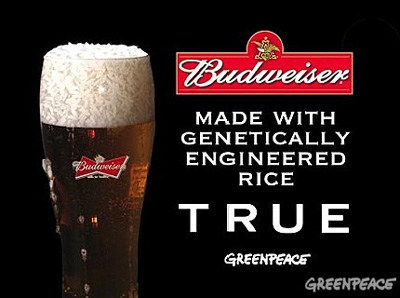
Greenpeace Asserts GE Rice Used in Bud

October 8, 2007 By Jay Brooks

budweiser
Greenpeace today released the results of an independent analysis of rice at an Arkansas mill which supplies rice to Anheuser-Busch for use in their beer. The lab found genetically engineered rice in 75% of the samples. From the press release:

An independent laboratory, commissioned by Greenpeace, detected the presence of GE rice (Bayer LL601) in three out of four samples taken at the mill. The experimental GE rice is one of three rice varieties that were first found in 2006 to have contaminated rice stocks in the US. Since then, GE contamination has been found in approximately 30 per cent of US rice stocks. This has had a massive negative impact on the US rice industry as foreign markets, where GE rice has not been approved, have been closed to US rice.

“Anheuser-Busch must make a clear statement about the level of GE contamination of the rice used to brew Budweiser in the US and spell out what measures are in place to ensure this beer does not reach the company’s export markets,” said Doreen Stabinsky, Greenpeace International GE Campaigner.

“US beer drinkers need Anheuser-Busch to explain why it is not preventing use of this genetically-engineered rice in the US. If, as the company has informed Greenpeace, all of the Budweiser exported from the US or manufactured outside of the US is guaranteed GE free then Anheuser-Busch needs to state this publicly, and explain the double standard,” said Stabinsky.

Greenpeace informed Anheuser-Busch of the test results prior to their release and sought clear information from the company on the extent of contamination and its global policy on the use of GE ingredients. Anheuser-Busch responded that the rice is approved in the US and is not used in brewing Budweiser destined for export. The full extent of the contamination remains unclear, however.

LL601 GE rice was retroactively granted approval by the US Dept of Agriculture in an effort to reduce public concern and company liability despite 15,000 public objections. The European Food Safety Authority stated that there was insufficient data to make a finding of safety. Greenpeace says that US consumers have a right to know if this GE rice is used to make Budweiser. This GE rice is not approved outside the US so the Budweiser brewed with it could not be sold abroad.

Anheuser-Busch is the largest single rice buyer in the US, buying 6-10 per cent of the annual US rice crop. Budweiser is one of only a few beers having rice as an ingredient. The brand is found in around 60 countries through a mix of exports and local brewing arrangements.

I recently did an article on green breweries and interviewed the Senior Group Director of Environmental, Health and Safety for A-B. I was pleasantly surprised at just how many things they were doing to be “green” so it seems surprising that they’d overlook genetically engineered rice being used in the beer itself. One thing you can say about Anheuser-Busch is that they do care about their public perception, so it will be interesting to see their reaction to this revelation.

bud-gerice

Doug Muhleman, Anheuser-Busch’s Group Vice President of Brewing, Operations and Technology, released a statement yesterday which I think suggests that Greenpeace is not the virtuous one in this story. On closer examination, this may be more about international politics than beer. Here’s Muhleman’s statement:

Greenpeace’s statements regarding our beer brands are false and defamatory. All of our products are made according to the highest quality standards and in complete compliance with the laws in each country where we sell our beers.

We stand in support of U.S. farmers, who are partners with us in the quality of our products. Greenpeace recently asked us to join their advocacy campaign on genetically modified crops. We refused their calls to boycott U.S. farmers, and they are now retaliating.

The use of genetically modified crops in the United States is not new. The vast majority of the commercial corn and soybean supply in the United States contains genetically modified versions that are certified to be safe for human consumption by the U.S. Government.

We use U.S. rice for brewing our products for U.S. consumption. U.S.-grown long-grained rice that may have micro levels of Liberty Link proteins present is fully approved by the U.S. Government, having determined that it is perfectly safe for human consumption. Moreover, the Liberty Link protein, like all proteins, is substantially removed or destroyed by the brewing process. Liberty Link has not been found in any of our tests of our beers brewed in the United States.

We fully comply with all international regulatory standards on the use or presence of genetically modified ingredients wherever our beers are sold internationally, as well. Neither Anheuser-Busch, nor our international licensed brewing partners use genetically modified ingredients, including genetically modified rice, in brewing products sold in any country with legal restrictions.

We talked with Greenpeace, hoping to help them understand the facts. We are disappointed that they instead chose to pursue pressure tactics.

Now I’m no fan of GMO’s, but they have been used here for many years and, like it or not, they’re a part of our massive food system. Short of pulling out every crop in the country and starting over, I’m not exactly sure what would satisfy Greenpeace. Certainly the way Greenpeace is seeking to sensationalize this seems more bullying than anything. I confess I was alarmed when I first read the story but having looked at it more closely in the interim I’m not sure their tactics are entirely warranted.

ab-muhleman
Me with Doug Muhleman at an A-B reception at GABF last year.

Filed Under: News, Politics & Law Tagged With: Business, Health & Beer, Ingredients, International, National, Press Release

« Previous Page
Next Page »

Find Something

Northern California Breweries

Please consider purchasing my latest book, California Breweries North, available from Amazon, or ask for it at your local bookstore.

Recent Comments

  • Bob Paolino on Beer Birthday: Grant Johnston
  • Gambrinus on Historic Beer Birthday: A.J. Houghton
  • Ernie Dewing on Historic Beer Birthday: Charles William Bergner 
  • Steve 'Pudgy' De Rose on Historic Beer Birthday: Jacob Schmidt
  • Jay Brooks on Beer Birthday: Bill Owens

Recent Posts

  • Beer In Ads #5152: A Message From Over The Sea About Genuine Bock Beer March 8, 2026
  • Beer In Ads #5151: March Is Bock Beer Time March 8, 2026
  • Beer In Ads #5150: The Best Of Bocks Comes To Town! March 7, 2026
  • Historic Beer Birthday: John J. Saltzmann March 7, 2026
  • Beer In Ads #5149: Winter Brewed For Summer Flavor! March 7, 2026

BBB Archives

Feedback

Head Quarter
This site is hosted and maintained by H25Q.dev. Any questions or comments for the webmaster can be directed here.