Brookston Beer Bulletin

Jay R. Brooks on Beer

  • Home
  • About
  • Editorial
  • Birthdays
  • Art & Beer

Socialize

  • Dribbble
  • Email
  • Facebook
  • Flickr
  • GitHub
  • Instagram
  • LinkedIn
  • Pinterest
  • RSS
  • Twitter
  • YouTube

Powered by Genesis

Today Alcopops, Tomorrow Beer

August 27, 2007 By Jay Brooks

Join Together, another one of those pesky neo-prohibitionist groups, is still crowing about the California Board of Equalization‘s wrong-headed decision last week to tax FMB’s (flavored malt beverages, a.k.a alcopops) using the same schedule as spirits. This will mean, beginning in mid-2008, makers of FMBS will be required to pay about 25% more in taxes. Neo-Prohibitionists groups who pushed this issue believe that making alcopops more expensive will somehow reduce underage consumption.

As I’ve said before, it’s quite easy to see why the BOE would vote in favor of higher taxes, especially during a statewide budget crunch, but even at that it was a narrow 3-2 decision. Insiders present at the meeting tell me that the BOE hinted at al present that in ruling they way they did, they were giving all concerned parties a chance to take the issue to the legislature where the BOE made clear they believe it should be decided. I’ve heard an unconfirmed story already that the anti-alcohol Marin Institute has talked to the state speaker, fully expecting his support, only to be shut down in no uncertain terms. It’s no surprise we’ve haven’t heard that side of the story from them.

Knowing that makes it much harder to swallow Join Together characterizing the ruling as “groundbreaking.” Their headline, Alcopops are Liquor, Not Beer, Calif. Tax Board Rules, is misleading at best and an out and out lie at worst. The BOE did no such thing. They only ruled that alcopops should be “taxed” as spirits, not that they “are” spirits. A small point, perhaps, but I think illustrative of how willing these groups are to torture the truth and bend it to their will.

Speaking of lying, here another pernicious one:

Michael Scippa, advocacy director for the Marin Institute, told Join Together that up to 90 percent of the alcohol contained in alcopops is derived from distilled spirits, and that California law states that a beverage with any amount of detectable alcohol from such sources is considered a distilled product, not a beer product.

“Up until now, alcopop manufacturers have gotten away with a cynical manipulation of California’s alcoholic beverage laws, mischaracterizing their products – which derive most of their alcoholic content from distilled spirits – as though they were beer to permit them to be sold cheaply and broadly throughout the state,” said Scott Dickey, an attorney with the San Francisco-based Public Law Group, which provided free legal services to the campaign to change the alcopops classification. “The BOE’s decision is a big step forward in holding alcopop manufacturers accountable for this deception.”

That’s not true, they are malt beverages with flavoring added. Distilled spirits are not added and it is not where their “alcoholic content” is derived from. They are most closely related to beer, which is precisely why they they are called flavored malt beverages and why they have been taxed like beer. Their alcohol content is likewise about the same as the average beer. They are fermented like beer and then chemical flavoring compounds are added, which give FMBs their distinctive sweet, fruity essence. Unlike attorney Scott Dickey’s assertions, which in fact are mischaracterizations, FMBs are exactly what their name suggests, no one has deceived anyone.

When Diageo first presented Smirnoff Ice to me in my capacity as the beer buyer for Beverages & more, they were quite candid about their reasons for launching the new product. Since they were prohibited from advertising their brand in certain media and likewise not permitted to sell their brand in certain stores, at least in California, such as convenience stores, gas stations, etc. By making an alcoholic product that was not spirit-based, they could now do so and it would further allow them to promote, market and advertise the core brand of Smirnoff to a wider audience. I think the fantastic success of Smirnoff Ice, and their countless imitators, surprised Diageo as much as it delighted them. But it was created precisely NOT to be a spirit, and if they had used distilled spirits in its manufacture, that would have defeated its original purpose.

Unlike the assertion of Marin Institute executive director Bruce Lee Livingston, whose grasp on reality seems to be slipping, that “[f]or generations, Big Alcohol has evaded proper taxation on these products,” they have been taxed at the exact rate they should have been for what the product actually is. And as I pointed out previously, Smirnoff Ice was introduced in 2001 and a generation is about thirty years. Clearly math is not his strong suit.

Now I’m no fan of FMBs. I don’t like them. I don’t like the way they often subvert young people’s conversion to craft beer. From a purely business point of view, I understand why the parent companies have used them to build their brand awareness while creating new profits at the same time. But I have been hearing a disturbing number of people inside the brewing industry willing to throw them under the bus, short-shortsightedly failing to recognize that the attack on FMBs is not an end unto itself, but merely the first battle in a much longer war. Don’t believe me? Just wait, do nothing, and see what happens.

I have it on good authority that the next salvo from the Marin Institute will be to ask the legislature/BOE to reclassify all malt beverages over 6% abv as distilled spirits! That means any strong beer like Belgian tripels, dubbels, bocks and doppelbocks, barleywines and even some IPAs will all be considered distilled spirits for taxation. I’m sure they’ll be spinning it as an attack on malt liquor, but some of our most cherished styles of beers will fall under such a definition, making them either more expensive or economically unfeasible for the breweries to continue making them.

Distillation, of course, is a specific process for separating, in the case of liquids, different components with different boiling points. There are a few kinds of distilling, such as freeze distilling, pot distilling and reflux distilling, and each of them does roughly the same thing or yields similar results. Liquids distilled are separate and distinct from either beer or wine, of course, as the process deviates wildly at one point and the resulting spirits are generally much, much stronger than either. Types of distilled products include absinthe, bourbon, brandy, calvados, cognac, gin, ouzo, rum, schnapps, scotch, tequila, vodka, whisky (and whiskey) to name just a few of the more common examples. Other non-alcoholic or lethal products which are distilled are gasoline, kerosene and paraffin.

So trying to call strong beers distilled spirits is not really in keeping with reality. Spirits — and wine for that matter — is generally much more alcoholic than beer, so trying to paint even a 10% strong beer with the same broad brush as whisky is akin to trying to fit a square peg in a round hole. It just doesn’t work. But it really has nothing to do with reality — or concepts of fairness — but instead is the drawing of the next battle line in a war whose goal is another national prohibition. We have to be vigilant of these groups and what they’re trying to accomplish. It’s our very complacency and disorganized apathy that they’re counting on to succeed. You can color me as reactionary as you like, but no harm can come from committing ourselves now to defeating the well-organized campaign for another prohibition. If we succeed, life continues as before. But if we lose, we’ll have no beer to cry into. Don’t let that happen.

 

Filed Under: Editorial, News Tagged With: Business, California, Law, Prohibitionists

Craft Beer Growth Continues Double-Digit Growth in First Half of 2007

August 15, 2007 By Jay Brooks

The Brewers Association just released the sales numbers for craft beer covering the first half of 2007. It’s all good news and craft beer is again showing double-digit growth at approximately 11%, which is the same percentage growth rate it sustained in 2006.

From the press release:

The Brewers Association, the trade association that tabulates industry data for craft brewers, reports craft beer sales and growth continue to break records. The volume of craft beer sold in the first half of 2007 rose 11% compared to this same period in 2006 and dollar growth increased 14%. For the first time ever craft beer has exceeded more than a 5% dollar share of total beer sales.

Overall, the U.S. beer industry sold one million more barrels in the first half of 2007 compared to 2006, with 400,000 of these new barrels produced by craft breweries. This equates to 3.768 million barrels of craft beer sold in the first two quarters of 2007 compared to 3.368 million barrels sold in the first half of 2006.

Scan data from Information Resources, Inc. provide additional data points that confirm strength for the segment. Craft beer sales in the supermarket channel through July 15th, 2007 showed a 17.4% increase in dollar sales compared to the same period in 2006. This growth in sales was higher than any other alcohol beverage category.

“The 1,400 small, independent and traditional craft brewers in the U.S. have hit their stride,” said Paul Gatza, Director of the Brewers Association.“United States craft brewers are making many of the world’s best beers, and the marketplace is responding.”

Coupled with the growth statistics has been a tidal wave of media coverage in the first half of 2007 including NBC’s Today Show on July 3 stating, “Beer is the new wine and can go with just about any food.” Additionally, Gallup, in its latest poll on alcohol beverages, announced for the second straight year that “Beer Again Edges Out Wine as Americans’ Drink of Choice.”

Julia Herz, Director of Craft Beer Marketing for the Brewers Association concluded, “Craft beer market share is steadily and consistently growing. A grassroots movement is responsible for this success as appreciators continue to trade up.”

The definition of craft beer as stated by the Brewers Association: An American craft brewer is small, independent and traditional. Small = annual production of beer less than 2 million barrels. Beer production is attributed to a brewer according to the rules of alternating proprietorships. Flavored malt beverages are not considered beer for purposes of this definition. Independent = Less than 25% of the craft brewery is owned or controlled (or equivalent economic interest) by an alcoholic beverage industry member who is not themselves a craft brewer. Traditional = A brewer who has either an all malt flagship (the beer which represents the greatest volume among that brewers brands) or has at least 50% of its volume in either all malt beers or in beers which use adjuncts to enhance rather than lighten flavor.

In addition, the Brewers Association released the following charts:


Filed Under: News Tagged With: Business, National, Press Release

California Redefines Distilled Spirits

August 14, 2007 By Jay Brooks

California’s Board of Equalization took the surprising move today (by a one vote margin) of redefining distilled spirits using some very odd language. The new definition, which takes effect in July 2008, was re-written in an effort by neo-prohibitionist groups to tax FMB’s (flavored malt beverages, a.k.a. alcopops or malternatives) at a higher rate under the pretense of keeping them out of the hands of children. The idea that by making them more expensive they’ll be less attractive to younger and underage drinkers is, of course, prima facie ridiculous. I can understand the state’s angle because it will produce more revenue for them, but that it will help cure underage drinking is pure fantasy. California State Controller John Chiang went so far as to say “taxing flavored malt beverages as liquor will also help reduce their popularity with young people by simply pricing the product out of their reach.” Tell that to the sixteen-year old punks driving around Marin County in new BMW’s that they won’t be able to afford Smirnoff Ice anymore. What utter hogwash.

Even if I accept such tortured logic, why should everybody — older adults included — be punished with higher prices and why should those companies arbitrarily now have to pay significantly higher taxes? I think McDonald’s happy meals are destructive to the health of our nation’s youth. Should we charge McDonald’s a health tax on every happy meal so they’re so expensive no one will buy them anymore, for the good of our children? I think Coke is rotting the teeth and insides of millions of kids. Should a bottle of Coca-cola cost $5.00 to compensate for the health risks and keep children from buying them? Would it then be fair that the rest of us have to spend $5, too, to buy a coke and a smile? Why should every product we don’t want kids to have be more expensive for the rest of us just so they may not be able to afford it? It just doesn’t make sense. But that’s effectively the logic at work here. Is that really how we want to orient our society?

Here is the new language:

Regulation 2558. Distilled Spirits. Define distilled spirits to include any alcoholic beverage, except wine, which contains 0.5 percent or more alcohol by volume from flavors or ingredients containing alcohol obtained from the distillation of fermented agricultural products. (emphasis added.)

What’s troubling about this decision is that this new definition could — which means probably will — be interpreted to include some beer aged in oak barrels as well as certain other craft beers as distilled spirits. If subject to the much higher spirits tax, it will make them either prohibitively expensive or, more likely, effectively force brewers to stop making them altogether. And that would effectively quash some of the most innovative beers being produced today.

According to people who attended the hearing, it appears likely that this issue may be challenged in the courts and/or be dealt with through the legislature. Neo-prohibitionist groups, of course, are already claiming victory and sending out celebratory press releases, such as the one I received from the Marin Institute, who referred to the votes as “historic” and applauded the “strong leadership” of California’s state controller John Chiang. Apparently they regard a strong leader as someone who does their bidding.

Here’s some more back-patting from the press release:

“This is an enlightened step forward in controlling underage consumption of alcohol,” said Bruce Lee Livingston, MPP, Executive Director of Marin Institute. “For generations, Big Alcohol has evaded proper taxation on these products. Now, the state will benefit and the health and well-being of our youth will be improved.”

I find it curious that they even use the word “enlightened,” since that brings to mind the Enlightenment, a time that couldn’t be more removed from the sort of tactics neo-prohibitionists are using now. To enlighten, means to “to give intellectual or spiritual light to” something, or in older parlance to simply “shed light upon.” Trying to remove alcohol from society in order to impose ones own morals on everyone else is the very opposite of enlightened.

Then there’s his “[f]or generations, Big Alcohol has evaded proper taxation on these products.” (my emphasis.) A generation is generally considered to be about thirty years. FMBs first appeared a little over ten years ago, fifteen at most. And they really didn’t become all that popular until the introduction of Smirnoff Ice, which was in 2001. That was only six years ago, not quite the at least sixty years that Chiang’s “generations” implies.

“Public policy trumped corporate-influenced politics today,” said Michele Simon, Director of Research and Policy at Marin Institute. That’s one way of looking at it, I suppose. Another is ‘fear mongering moral crusaders hijacked democracy in an effort to advance their own narrow agenda by pretending to care about the welfare of children and trumped common sense and reason today.’ It’s all how you choose to spin it.

Now personally I’m no fan of FMBs, either, and I also think they subvert young people from discovering the joys of craft beer, but I don’t believe making them more expensive is in any way useful. If the true goal of the neo-prohibitionists really is to keep them out of the hands of children (as they claim), a more effective strategy might be to keep kids from drinking sweet soda and developing a fondness for sweeter drinks in the first place. Then alcopops would not have the same appeal for them as they get older. Plus it would have the added benefit of keeping kids healthier by reducing their intake of sugar, high fructose syrup and other harmful chemicals in today’s soda-pop. But I don’t think this brouhaha really is about the children, but rather is anti-alcohol merely using children as a justification that’s easier to sell than another prohibition.

And that’s why I’m particularly troubled by the vague language of the new definition. Because I believe this is just another first step in a larger and more sinister effort not just to control children’s access to FMBs, but to restrict access to all alcohol. Today it’s FMBs, tomorrow … who knows what. So the enemy of my enemy is my friend in this case. If it was just about the taxes I wouldn’t like it, but at least I’d understand it. The way the neo-prohibitionist groups have been pushing against FMBs makes it obvious that it’s about more than just money. That they’ve persuaded the state of California to take this step and play into their hands is quite disturbing, to say the least.


Filed Under: Editorial, News Tagged With: Business, California, Ingredients, Law, Prohibitionists

Penny Wise and Pint Foolish

August 8, 2007 By Jay Brooks

Seth Kugel, a travel writer for the New York Times who writes a regular column entitled “Weekend in New York,” tackles such Big Apple topics as where to take your dog, ice cream and where to picnic in Central Park. His most recent column (sent to me by my friend Maureen. Thanks Maureen.) is called “For Beer Tastes, on Beer Budgets” and aims to steer tourists and locals alike to the cheapest possible beer that can be had in the city that never sleeps. To which I can only ask … why? What is our national obsession with buying the cheapest possible anything and everything?

I’m sure I’ll be in the minority — again — but I think beer is already too inexpensive and should actually cost more. As it is, few small brewers make buckets of cash for their considerable efforts. Many are fine hand-crafted artisanal products that are akin to other gourmet food products people are willing to spend more for, such as cheese, bread or chocolate. Even the big brewers make their money on volume, not individual margins. Their markup is really quite low when compared with many other types of goods. Even as the cost of ingredients, transportation and marketing continue to rise, the big guys engage in price wars with one another making the cost of a beer artificially low. Most people think this is a good thing because we’ve been conditioned to believe cheaper is somehow better. That whatever is least expensive is inherently most desirable. Wal-Mart has become the biggest retailer in the world by pandering to this cheapskate ethos. People may say they want quality, good customer service and selection but they’re generally full of shit. When they open their wallets, they want to pay as little as possible.

Some of that is understandable, of course. Few of us are as rich as Croesus with virtually unlimited amounts of money to spend, so making choices about what and how much of your money to spend is inevitably necessary. But that doesn’t mean finding the cheapest price should be our mantra. Being cheap shouldn’t be a philosophy or way of life the way it seems to have become. Naturally, the propagandists have been selling conspicuous consumption for close to a century now and most of us have internalized the drive for buying more and more stuff. Couple that with real wages dropping for decades and the only way to keep up with the Joneses is to spend less and less for the same useless crap. We live in a society dominated by business, whose interests have been sold to our politicians. It’s so bad that when terrorists attack us our leaders tell us to “go shopping.”

Kugel likens finding a “cheap beer” to big game hunting, “like trying to find a cheetah on the African savanna.” He adds, “[s]ure, $7 pints dot the landscape like plump antelope, but the rare sub-$3 brew lurks in the underbrush like the fleetest footed of the big cats, hard to bring down without the help of a skilled guide savvy in sniffing out tell-tale footprints or happy-hour specials.” He finds 50-cent Budweiser on the Upper West Side in a bar where “bras hang from above the bar and snapshots of women who had apparently until recently been wearing those bras are posted on the wall.” Then there’s $7 pitchers of beer at the aptly named “Cheap Shots.” Kugel tells us of finding $2 cans of PBR, $5.75 quarts of light beer, and $2 Yuengling drafts. One place in Brooklyn features “’Crap-o-copia,’ a bucket of ice jammed with six cans of whatever the beer-loving cat dragged in for $12. On a recent visit, that included American classics like Stroh’s, Schmidt’s, Genesee Cream Ale and Miller High Life.”

But what he fails to mention or justify throughout his article is just what is the point of the hunt? Why must we find the Cheetah? If Cheetah tastes like Bud, PBR or Coors — the tastes-like-chicken sameness of the beer jungle — then who cares how cheap it is. I wouldn’t drink it if it were free. I want my beer to taste of something, to actually have flavor and I’m willing to pay for Antelope, though I’m confident he could have found discount Antelope — say a $5 pint of something worthwhile. But Kugel seems to take the position that it’s more important for it to be cheap, that it simply doesn’t matter which big game you find because they’re all the same. It’s hard for me to believe that a travel writer has never noticed that all beer is not the same. After all, travel writers are paid to experience new people, places, and things. How is it possible one could remain completely ignorant of the world’s most popular alcoholic beverage to the point where price is the only way to differentiate between them?

The two-buck Chuck phenomenon aside, can you imagine stories in the New York Times about finding the cheapest wine or whisky when you’re out on the town? I can’t, and it seems to me this is just another of the countless insults beer endures. Why is beer the Rodney Dangerfield of alcoholic beverages? Why is it so acceptable for the media to take cheap shots (yes, pun intended) at beer without even realizing how insulting they’re being? It’s a bit like telling Polish jokes at a Pulaski Club or fat jokes at an Overeaters Anonymous meeting without even realizing your poor taste. It’s that bone-chilling ignorance that really gets me going. When I lived in North Carolina several decades ago, you’d still hear older white people address black men casually as “boy” without the slightest inkling that they were doing anything wrong, insensitive or insulting. That may be an extreme example, but that’s what these constant attacks on beer feel like to me. I don’t think Seth Kugel, or indeed most of the rest of the beer-ignorant press, sets out maliciously to insult beer. They simply don’t know any better. And that may be the saddest fact of all. It might be downright funny if it weren’t for the fact that people read the Times as America’s “paper of record” and believe what is written in its pages. So while I believe the entire media has a duty to try to be accurate, the Times has an even higher standard to uphold. Yet in the one subject I know at least a little about, they very often fail miserably to show even a passing familiarity with beer (with Eric Asimov being a notable exception).

Beer has been struggling mightily for over 25 years to gain some respect. Given the strides made by the craft beer industry in that time it certainly deserves its place among the other fine gourmet beverages of the world. Once the laughingstock of the world, American beer today is known throughout the world to be of the finest quality. There are now more different beer styles brewed in the U.S. than anywhere else in the world. That’s an unbelievable swing in a little over two short decades. It’s a shame that something like 95% of all Americans didn’t get the news. Here, thanks in part to our mainstream media, the perception of beer as interchangeable cheap swill for the hoi polloi remains how most people think about beer, including our intrepid Times author. So instead of searching for the cheapest beer, how about trying to find out what the difference is between a $7 antelope and $3 cheetah. It should be obvious, I agree, but so long as the mainstream media remains so beer-blind such ignorant advice like where to find the cheapest beer will continue to pass for real journalism.


Filed Under: Editorial Tagged With: Business, Eastern States, Mainstream Coverage

Marston’s Gobbles Up Old Thumper

July 12, 2007 By Jay Brooks

Marston’s, who brews Banks, Mansfield and Jennings as well as the eponymous beers, is buying out the regional Hampshire brewery, Ringwood, whose most well-known beer is undoubtedly “Old Thumper.” The pricetag is £19.2 million pounds (or just shy of $39 million dollars) and also includes Ringwood’s pubs in and around Hampshire. Six months ago, Marston’s also bought Eldridge Pope for £155m ($314.5 million U.S.).

According to a BBC article, “[t]he acquisition will boost Marston’s presence in the South of England and enhance its range of regional breweries which include Midlands-based Banks’s.” Alistair Darby, Marston’s managing director is quoted as saying. “We plan to develop its excellent brands as part of our strategy to meet consumer demand for premium ales with local provenance and heritage.” And here I thought they just wanted to make more money.

Ringwood Brewery has an interesting history. It’s situated in the relatively small town of Ringwood in Hampshire, which is in southern England, about 20 miles from the coast and 85 miles from London. The town is part of the rural district of Hampshire and is essentially a market town located along the River Avon and adjacent to “New Forest,” the largest remaining unenclosed pasture land, heathland and old-growth forest in England. By 1811, Ringwood was a bustling community and at one time boasted four breweries, but the last one — Carter’s — closed around 1923. Fifty-five years later, in 1978, Ringwood Brewery was opened by Peter Austin, who today is considered to be the “father of British micro-brewing.” Not only was he one of the first small breweries to open in modern times, but he also helped save cask beer from extinction.

The yeast Austin brought with him from the now-defunct Hull Brewery in northern England is today known as “Ringwood yeast” and is a popular ale strain used by countless small American craft breweries. Alan Pugsley, who learned brewing from Peter Austin, is the co-owner and master brewer of Shipyard Brewing in Portland, Maine. That’s also the reason that Ringwood’s “Old Thumper” beer is made under license by Shipyard for sales in North America. To learn more about how Ringwood Brewery greatly influenced the craft beer movement here in the United States, through Alan Pusgley, there are two illuminating interviews with him online by Lew Bryson and Andy Crouch.

Despite Marston’s claims that they’re only in it to “meet consumer demand for premium ales with local provenance and heritage,” I can’t help but be suspicious of yet another big brewery chain swallowing up a smaller one. These things rarely go well for the one being bought. There’s a lot of heritage in the Ringwood Brewery and it would be a crying shame if it was lost to another economic decision by a large company that only cared about its bottom line. And apparently I’m not the only one. CAMRA has also made its concerns known about the acquisition in a Publican article by Adam Withrington. CAMRA believes this buyout by Marston’s may have a “domino effect” for increasing the consolidations of pubs and breweries, a trend I personally thought was fairly well-established in England as already taking place.

From the Publican:

CAMRA chief executive Mike Benner said: “The practice among larger breweries of acquiring smaller competitors is a race where the only loser is the consumer who is often denied a locally brewed beer.

“As one of the larger breweries buys a brewery and expands their estate their competitors start hunting for their next purchase to keep up. CAMRA’s fear is that an increasing number of smaller breweries will be lost if this race continues and consumer choice will suffer as a result.”

CAMRA’s fears arise from a significant number of small local breweries being bought and closed down by bigger regionals over the last three years. Greene King has purchased both Ridley’s in Essex, Scottish brewer Belhaven and Nottinghamshire brewer Hardys & Hansons and closed all three breweries. In 2005 Fuller’s bought Hampshire regional brewer Gales and closed its brewery in Horndean.

The Ringwood Brewery in Hampshire, England.
 

Filed Under: Editorial, News Tagged With: Business, Europe, Great Britain

The Milwaukee Beer Party

July 10, 2007 By Jay Brooks

In a modern day version of the Boston Tea Party — but without the Indian costumes or a ship — Wisconsin beermakers staged a protest today by dumping out kegs of beer into the Milwaukee River. The Milwaukee Beer Party, which is what I’ll be calling it, was held to bring attention to Wisconsin SB 224, a state Senate bill that would make things more difficult for small local brewers.

From the AP article:

Basically, it divides small brewers into two licensed classes — those who want to serve food as brewpubs, and those who seek to bottle and distribute their product on a larger scale. The latter would face new restrictions on food service.

The brewers, who acknowledge they’re not savvy about the legislative process, say it’s not fair for new beer makers to have to decide their fate that early.

“Every business takes on a life of its own,” said Jim McCabe, proprietor of the Milwaukee Ale House. “For the guy that wants to start a brewery tomorrow, he’s got to make decisions early in his business life that aren’t possible.”

After countdowns in English and German, the kegs were opened with mallets that spewed suds across the deck and into the Milwaukee River.

The whole issue started when the Great Dane Pub opened a third location in the Madison area, but couldn’t sell its own brews because the law only allows two such operations per chain.

The brewers are also upset that the law was introduced on July 3 and is already scheduled for a vote Wednesday in the Senate’s Transportation, Tourism and Insurance Committee.

“This is just a run-of-the-night operation that’s being ram-roaded down our throats,” said Russ Klisch, owner of Lakefront Brewery Inc. in Milwaukee and president of the Wisconsin Brewers Guild. “There are so many questions out there that have been unanswered.”

It appears that lawmakers were unaware if the consequences of the actions and amendments are in the works, according to Terry Tuschen, a spokeperson for the bill’s sponsor, Senator Fred Risser (D-Madison). “Everybody’s working hard to fix what needs to be fixed,” Tuschen said. Still, if you live in Wisconsin, it probably can’t hurt to contact your local state senator’s office and ask them not to support the bill unless those provisions are amended or removed.


The Milwaukee Beer Party
From Channel 3 Wisconsin
 

Filed Under: News, Politics & Law Tagged With: Business, Law

The Official Beer of Planet Earth

July 10, 2007 By Jay Brooks

Now that’s a slogan: “The Official Beer of Planet Earth.” Butte Creek Brewing Co., the other little brewery in Chico, California, announced today that they will be revamping their entire packaging and introducing two new slogans, “Organic Pioneers” and “The Official Beer of Planet Earth.”

From the press release:

Golden West Brewing Announces Redesign of Butte Creek Organic Ales and Lagers

CHICO, Calif. — Golden West Brewing Company, Inc. announced today that it has completed the redesign of its core product line of Butte Creek Organic Ales and Lagers. The new labels, six-pack carriers, and case boxes released today in select markets eventually will be in all 25 states where Butte Creek is sold.

As part of the redesign of the brand, Butte Creek is using two new marks – “Organic Pioneers” and “The Official Beer of Planet Earth” – as cornerstones of its marketing campaign for the organic ales and lagers.

“We are very excited about the re-branding of Butte Creek Organic Ales and Lagers and believe our updated design is necessary to compete with recent entrants, such as Anheuser-Busch, into the organic beer category,” said John Power, President of Golden West Brewing.

Golden West Brewing has filed applications with the United States Trademark and Patent Office (“USPTO”) for both marks and hope the marks will be successfully registered with the USPTO. However, there is no guarantee the USPTO will publish the marks for opposition.

As part of the redesigning and marketing campaign, Golden West has secured new vendors for the glass and six-pack carriers that should reduce overall cost of these key raw materials.

“A limited price increase that went into effect July 1, combined with more effective purchasing of glass and cardboard, should improve our gross margins in the current third quarter of 2007,” Power said.

Golden West also announced the completion of a private placement of 282,000 shares at $0.33 per share to provide additional working capital. Details of the placement are contained in the Company’s Current Report on Form 8-K covering the financing.

About Golden West Brewing Company, Inc.

Golden West Brewing Company, Inc. was formed in 2003 and completed a small self-underwritten public offering in 2006. Golden West through its wholly owned subsidiary, Golden West Brewing Company, acquired the assets and certain liabilities of Butte Creek Brewing Company of Chico, California in August 2005. Founded in 1996, Butte Creek Brewing Company is one of the pioneer certified organic microbreweries in the United States


Filed Under: Uncategorized Tagged With: Business, California, Northern California, Packaging, Press Release

Oregon Leads Small Brewers Caucus

June 23, 2007 By Jay Brooks

maps-or
Last month, 34 members of the House of Representatives formed the Small Brewers Caucus to monitor and effect issues of interest to craft brewers. The week after the Craft Brewers Conference, on May 15, the caucus held its first meeting just prior to a reception on Capitol Hill celebrating “American Craft Beer Week” hosted by the Brewers Association.

From the original press release:

hse-sm-brew-caucus

The House Small Brewers Caucus, co-chaired by U.S. Representatives Peter DeFazio (D-Oregon) and Greg Walden (R-Oregon), is currently composed of 34 Members of Congress who share an interest in the issues of importance to America’s small brewers. Brewers Association Board of Directors who were in Washington that day to participate in the American Craft Beer Week celebration, listened as Congressman Walden stated that the primary mission of the Caucus is to provide an interactive opportunity to learn about the dynamics of running a small business as a brewery, the brewing process itself and the quality and value of the beer and brewing activities. Several other Congressmen also in attendance spoke briefly to the group, among them Congressman DeFazio who is himself a homebrewer and a primary sponsor and leader in the successful effort to pass House Resolution 753 of 2006 commending American craft brewers and recognizing the first American Craft Beer Week.

“The fact that Members of Congress recognize the unique place small brewers and craft beer have in our society, is extremely gratifying and important,” said Brewers Association President Charlie Papazian also in attendance at the meeting. “There is a very real danger that the voice of the small members of the brewing community may not be heard over that of its larger brethren, so a group of legislators bound by a common interest in the history, tradition and excitement that are hallmarks of today’s small brewers, should help ensure our issues get fair consideration.”

The story is starting to get some attention in places where craft beer is closely tied to the local economy. For example, in Portland, Oregon, the Oregonian recently ran a story about the new caucus, focusing on the fact that both co-chairs are Representatives from Oregon. (Thanks Jim, for sending me the link.) Frankly, that makes sense given Oregon’s beer scene. With three other Oregonian members of the caucus from the Beaver State, that’s a total of five of the 34 members (or almost 15%). Most of the other members also appear to be from states with vibrant craft beer cultures. For example, California is the only other state with five members, including — I’m proud to be able to say — the Representative from my own District, Lynn Woolsey. She represents both Sonoma and Marin counties. New York and Pennsylvania have four members each, and there are three from Colorado, and two from Michigan. The eleven remaining members are each from a single state. Curiously, there’s no one from either Washington or Wisconsin. That seems surprising, since both states have quite a few breweries. It also appears to be a largely bipartisan group, with 20 Democrats and 14 Republicans.

It’s certainly nice to see our elected officials paying to least some attention to craft beer and the concerns of those who brew it.

The 34 members of the Small Brewers Caucus:

Rep. Peter DeFazio, co-chair (D-Ore.)
Rep. Greg Walden, co-chair (R-Ore.)

Rep. Harry E. Mitchell (D-Ariz.)
Rep. Vic Snyder (D-Ark.)
Rep. Brian Bilbray (R-Calif.)
Rep. Wally Herger (R-Calif.)
Rep. Darrell Issa (R-Calif.)
Rep. Mike Thompson (D-Calif.)
Rep. Lynn Woolsey (D-Calif.)
Rep. Marilyn Musgrave (R-Colo.)
Rep. Ed Perlmutter (D-Colo.)
Rep. Mark Udall (D-Colo.)
Rep. Dave Loebsack (D-Iowa)
Rep. Dennis Moore (D-Kan.)
Rep. Tom Allen (D-Maine)
Rep. Stephen F. Lynch (D-Mass.)
Rep. Thaddeus McCotter (R-Mich.)
Rep. Fred Upton (R-Mich.)
Rep. Russ Carnahan (D-Mo.)
Rep. Denny Rehberg (R-Mont.)
Rep. Mike Arcuri (D-N.Y.)
Rep. Kirsten Gillibrand (D-N.Y.)
Rep. Randy Kuhl (R-N.Y.)
Rep. Nydia Velazquez (D-N.Y.)
Rep. Tom Cole (R-Okla.)
Rep. Earl Blumenauer (D-Ore.)
Rep. Darlene Hooley (D-Ore.)
Rep. David Wu (D-Ore.)
Rep. Charles Dent (R-Penn.)
Rep. Phil English (R-Penn.)
Rep. Jim Gerlach (R-Penn.)
Rep. Patrick Murphy (D-Penn.)
Rep. Lloyd Doggett (D-Texas)
Rep. Virgil Goode (R-Va.)
 

If your representative isn’t on this list, consider writing him a letter and asking him or her to join the caucus and support small businesses such as craft breweries in their district.

sm-brew-caucus-fish
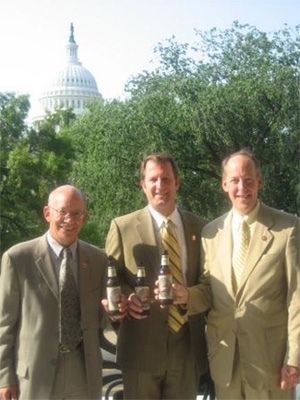
Representative Peter DeFazio, Gary Fish, owner of Deschutes Brewery, and Representative Greg Walden — all from Oregon — enjoying craft beer at the Capitol Hill reception May 15.

Filed Under: News, Politics & Law Tagged With: Business, National, Oregon

Do Labels Matter?

June 20, 2007 By Jay Brooks

Alan from A Good Beer Blog sent me a link to this interesting article from today’s Globe and Mail entitled “Why you drink what you do (apart from the obvious reason).” The story details a research effort at Brock University in Ontario, Canada, to look into the real reasons people pick up particular wines instead of other ones.

The effort is described in the article as:

Part psychology lab, part focus-group boardroom and part stage set, the facility, which was launched last week with a $69,000 federal grant, will enable researchers to create a variety of ambiences, including a barrel-cellar tasting room, candle-lit restaurant and liquor store.

The plan is to scientifically look at a variety of factors that may influence a purchase decision and to what extent they do influence. In addition to the label itself, they’re also planning on looking at lighting, background music, other people, and the influence of so-called expert or snob opinions.

I know from my time in retail that people really do shop the ratings. I’ve watched people walk wine aisles with a Wine Spectator in hand looking for specific wines that received a rating high enough for them to buy. I’ve even heard such people insult live human beings trying to suggest trying a different wine that they liked, but which perhaps wasn’t rated in that issue or didn’t get a rating high enough. I certainly don’t think ratings are unimportant or irrelevant, but I do think that they can be relied upon much too heavily.

If you find a critic whose tastes appear to align with your own, then it’s probably a safe bet that what that person recommends will also find favor with your own palate. But even then not always. It’s a pretty rare thing generally speaking, because no two people taste things in exactly the same way. We all have slightly different combinations of sensitivities and tolerances for certain smells and tastes. If you work at it, you can learn your own and adjust for them. For example, I’m particularly sensitive to a type of oxidation that manifests itself as cattiness or simply catty. To me it stands out like cat piss — which is what I call it — and it often overwhelms a beer for me, making it hard for me to concentrate on the beer’s more positive attributes. Normally it can be detected only in levels of 55 parts per trillion, but I suspect that my own sensitivity runs higher. People I taste with regularly can even predict what I’ll say about such beers, so I constantly have to remember to play that down, if possible, because I know I’m more sensitive to that particular aroma than others often are.

But more often you’re simply drawn to certain tastes without really even knowing why. So unless and until you can identify your own peculiar preferences, it’s best to try as many different things as you can in effort to discover what you really like for yourself. The ratings can be a helpful start, but by no means should you ignore first hand suggestions or your own intuition. And to lock yourself in to only buying wine that receives a certain rating is to miss a lot of very exciting and tasty discoveries.

The article’s author, Beppi Crosariol, goes even farther when she suggests that in her experience, “people who talk loudest and dominate conversations are also far more likely to be collectors of overpriced wine.” When she wonders aloud whether or not “we really need PhDs in lab coats to remind us the wine world is teeming with arrogant, self-appointed dictators and irrational buying behaviour,” she ultimately concludes that we do. “If you can show me another consumer product more irrationally priced than wine, I will eat my hat and wash it down with a magnum of lukewarm Hochtaler,” she continues. “Quality and price are so often in such blatant conflict in the wine world, you would do better to choose a bottle with a blindfold on than willfully empty your wallet on something you’d never tasted.” Well said. So she believes that perhaps if scientific study can reveal such prejudices as meaningless, it might “help consumers feel more comfortable about dismissing the pretentious blather of experts,” and “it would be one giant leap forward for fun, pleasure and fairer pricing.” Hard to disagree with that, I’d say.

Unfortunately, the professor conducting these experiments, Hildegarde Heymann, has her own prejudices to overcome, and she doesn’t even appear to even notice them when she says.

“[T]he subject of wine, more than that of any other consumer product, is loaded with emotional and psychological baggage. The average woman may pay scant attention to the skirt and blouse she pulls on in the morning, she says, yet ‘people will agonize over a $10 bottle of wine. They tend to take it extraordinarily personally. There is such a need by the consumer to make the right wine choice.’

Now I don’t want to speak for all women here, but most of the ones I know will in fact agonize over what “skirt and blouse she pulls on in the morning” far more than their choice of wine. I hope I’m not revealing too much when I say that my own wife often tries on several outfits before being satisfied with what’s she wearing for the day. So has almost every woman I’ve ever dated or known well-enough to know their wardrobe choices. Now that could just be me, but I tend to doubt that I’m unique in my experience that women tend to take their appearance and what they wear “extraordinarily personally.” For that matter, so do many men. So I’m already beginning to question her firm grasp on reality, and therefore my hopes for her study, when she drops the bomb.

And, Prof. Heymann adds, that is regrettable. ‘People pick up a beer without thinking about it. They should be able to pick up wine the same way.’

Okay…. Where to begin? First, that she believes that wine is the only consumer product “loaded with emotional and psychological baggage” or is loaded with the most seems almost delusional. Has she not been watching the evolution of advertising over the past century? Every single consumer good is tied to an emotional need, that’s what advertising does. Does she think people buy expensive, inefficient cars unemotionally with cool detachment? What does she think brand loyalty is, for chrissakes, if not an emotional response? An entire industry exists for the sole purpose of selling us emotions.

But, of course, that’s small potatoes compared to that second-last sentence. Let’s look at that one more time. “People pick up a beer without thinking about it.” Well, I guess Anheuser-Busch can dismantle their gargantuan advertising and marketing budgets and concentrate on making a better tasting beer. Is the good professor smoking crack? People pick up their beer of choice because of years of relentless marketing and advertising designed to get them to do just that. Hellooooo! That she honestly doesn’t appear to think people consciously — or even unconsciously — choose what beer they buy is positively baffling.

And that takes me to the title of this screed, do labels matter? Of course they do, but not just for wine. You don’t need a PhD to know that virtually every product takes the label they put on it very, very seriously. Having designed from the bottom up, several private label beers — at least one of which is still around — gave me a window into this process. We came up with names, graphics and stories and went through more versions than I care to recall. Suffice it to say it was a long and tortuous process. So I view labels much differently now than I once did. For example, almost all labels change, even the ones you don’t think do. Most large companies are constantly tweaking and updating their labels and packaging in order to stay competitive and stand out on the shelf. If you don’t do that, people will lose interest and no longer have a reason to pick up their products. If you look at a major label — Budweiser or Heineken is good for this — from year to year, you’ll see that minor changes occur all the time. Because they’re well-established brands, they don’t overhaul them in one go, but if you look at them in ten year increments, you’ll see that they have actually changed quite a bit over time. For less well-established brands, it’s usually a good idea to redo your packaging from top to bottom every two to three years so — okay, I hate this buzzword, too — that it remains “fresh.” It is well-known that there are many people who buy both beer and wine based on the label. It’s hardly a secret, it’s why companies put so much effort into their design. So finding out what it is about labels that makes one more palatable than another is certainly of interest, but it’s the other, less well-known factors that I think most people in the business will be interested to learn.

But in the end, I’m still not sure what to make of her last statement, that people “should be able to pick up wine the same way.” By “same way,” she means, of course, “without thinking about it.” Now why on Earth is that how people should buy anything, much less wine? I don’t know about you, or the rest of Canada, but I actually want to think about which beer, wine or whatever that I buy. I find I don’t usually make good choices if they’re mindless. I find that thinking about what I want often leads to my getting exactly that — what I want. Why shouldn’t the choices I make about what to drink, what to eat or even what to wear be personal? If not personal, what would they then be? Wouldn’t impersonal choices lead to drinking, eating and wearing exactly the same thing? That’s certainly not the world I want to live in.

I certainly like the idea of looking into the reasons people choose what they do. It’s a fascinating topic, to me. But I’m befuddled by the concluding idea that the goal of the research is to remove the thinking from choosing. Having personal choices and emotional ones at that, is one of the things that makes us human. If they were all the same, we’d all be the same. Think Globally, Drink Locally, but whatever you do, keep thinking. Vive la Différences.


Filed Under: Editorial Tagged With: Business

Georgia Action Alert

June 17, 2007 By Jay Brooks

I almost missed posting this before it’s too late. According to the new grassroots organization, Support Your Local Brewery, there’s legislation in Georgia that will be bad for small brewers and their ability to offer samples of their beer at their brewery during tours. The vote is on Tuesday, June 19 so if you’re in Georgia contact your Congressperson as soon as possible, and no later than the end of the business day on Monday.

Here’s the press release from SYLB:

Georgia’s beer consumers and brewers are facing a threat that could adversely impact the business operations of in-state breweries and consequently your access to Georgia’s craft-brewed beer.

The Georgia Department of Revenue is proposing to adopt a new rule that would severely restrict beer tasting for attendees of brewery tours (please refer to the Synopsis for the actual rule language). The Department will consider adoption of this rule on Tuesday, June 19 – now is the time to make your voice heard in opposition to this rule.

Please read the following information which includes a message from Terrapin Beer Co.’s John Cochran who has been working with Georgia’s small production breweries to oppose this measure. You will find all the information you need for contacting the Commissioner of the Department of Revenue.

John has also included a suggested message to send, and Support Your Local Brewery suggests you visit the Beer Serves America web site for detailed information on the economic contribution of Georgia’s beer community to state coffers. Please consider including some of this information in your message to underscore the valuable economic contribution being made, which in no way should be jeopardized.

Thanks for your support in protecting Georgia’s brewers and beer consumers.

If you want to read the a synopsis of the bill itself, you can view it at the SYLB website.

From John Cochran of Terrapin Beer Co.:

All Georgia breweries need your help. We recently received notice that the Georgia Department of Revenue has decided to change the rules that apply to tours at breweries in Georgia. The new proposal calls for a limit of a 2oz pour of each beer style on the tour with a maximum limit of only 16oz. The 16oz pour is only possible if we have eight different styles of beer to offer on the tour. If a brewery only has four beers available to taste, then only 8oz can be poured at the tour.

It is the belief of the Georgia breweries, and our wholesalers, that the proposed rule change would effectively kill the tours. Since the breweries have spent significant sums of money on tasting rooms for the purposes of conducting tours this investment would be lost. In addition it would cause the layoff of employees who now operate as tour guides and could cause serious harm to the bottom line of all breweries. The tours are our main marketing tool and by losing the ability to continue tours as they are currently structured, we would lose customers, lose sales, and find it much more difficult to continue in business.

If you have enjoyed tours at Sweetwater and Atlanta Brewing in the past and you would like to continue to enjoy tours at those locations and at Terrapin Beer Company (tours starting this fall if these proposed changes do not take effect) then please take the time to help fight for our rights.

Atlanta Brewing, Sweetwater and Terrapin have worked together to craft a response to the proposed rule changes. If you agree with us that the proposed rule change is egregious and will harm the brewery tours and thereby harm our businesses, please take the time to send the attached response to the Department of Revenue, as indicated below.

E-mail your comments to regcomments@dor.ga.gov and be sure to include a reference to “NOTICE NUMBER AT-2007-1” on any correspondence you send.

The SYLB also helpfully has a template of a short letter you can use to send, which I reprinted below:

To: Commissioner Graham

Re: Notice Number AT-2007-1
560-2-2-.61

The Georgia Department of Revenue has proposed a significant change in the states’ long standing policy on service limitations for brewery tours. The proposed new rule will adversely affect my decision as a customer of the breweries, to attend the tours. By doing so it will also put at risk the brewer’s investment in facilities designed to attract and accommodate tour attendees such as myself and will severely limit the marketing and sales of the brewery’s products. I oppose adoption of the proposed rule change and respectfully urge the department to withdraw proposed rule 3a.

Sincerely,
YOUR NAME AND ADDRESS HERE

If you can help out, please send in your comments as soon as possible. The craft beer community thanks you for your help.
 

Filed Under: Uncategorized Tagged With: Business, Law, Press Release, Southern States, Tasting

« Previous Page
Next Page »

Find Something

Northern California Breweries

Please consider purchasing my latest book, California Breweries North, available from Amazon, or ask for it at your local bookstore.

Recent Comments

  • Bob Paolino on Beer Birthday: Grant Johnston
  • Gambrinus on Historic Beer Birthday: A.J. Houghton
  • Ernie Dewing on Historic Beer Birthday: Charles William Bergner 
  • Steve 'Pudgy' De Rose on Historic Beer Birthday: Jacob Schmidt
  • Jay Brooks on Beer Birthday: Bill Owens

Recent Posts

  • Beer In Ads #5152: A Message From Over The Sea About Genuine Bock Beer March 8, 2026
  • Beer In Ads #5151: March Is Bock Beer Time March 8, 2026
  • Beer In Ads #5150: The Best Of Bocks Comes To Town! March 7, 2026
  • Historic Beer Birthday: John J. Saltzmann March 7, 2026
  • Beer In Ads #5149: Winter Brewed For Summer Flavor! March 7, 2026

BBB Archives

Feedback

Head Quarter
This site is hosted and maintained by H25Q.dev. Any questions or comments for the webmaster can be directed here.